2016 International Conference on Computer, Mechatronics and Electronic Engineering (CMEE 2016) ISBN: 978-1-60595-406-6
Information Diffusion Model and Hadoop Implementation
Research on Online Social Network
Hong-song CHEN
1,2,*and Yue HU
3,41Department of Computer Science, University of Science and Technology Beijing, Beijing, 100083,
China
2
Beijing Key Laboratory of Knowledge Engineering for Materials Science, Beijing, 100083
3
Institute of information engineering, Chinese Academy of Sciences, Beijing 100093, China
4
University of Chinese Academy of Sciences, Beijing 100049, China *Corresponding author
Keywords: Social network, Information diffusion model, Hadoop, Network topology.
Abstract. Social networks are currently gotten increasing focus with the growth of online social network services, such as Facebook, Sina Weibo. One major challenge for social network research is how to build information diffusion model to describe the complex information diffusion model. For this purpose, information diffusion models are researched. To show the importance of network topology, how to identify the most important spreaders in the network is a key scientific problem. Different kinds of network centrality measure methods are analyzed. The role of a potential edge in social network is analyzed. The relationship between network topology structure and information diffusion dynamics model is analyzed. Pagerank algorithm for SinaWeibo users are implemented in Hadoop cloud computing platform. Experiment result shows that Pagerank algorithm can be implemented in Hadoop cloud platform to recognize the important spreaders in social network. Big data in social network can be analyzed in the platform.
Introduction
A social network is a theoretical concept which is used to study relationships between individuals, groups and organizations in social sciences. Over the past decade, there has been an increasing interest in social network research with the development of Internet and Online social media. To social scientists, physical scientists, statistician and computer scientists, social networks has been a new interdisciplinary. A social network is a set of actors (individuals or social groups) and relationships of different kinds (friendship, kinship, status, sexual, business or political) among them [1]. The quantitative analysis of social interactions goes back to the early 1920s [2]. The study of the school child’s choice of companions was reported by Wellman in 1926[3], Mayo studied the social interactions between factory workers in the 1930s [1]. The cross-interaction of researchers form diverse disciplines as sociology, applied anthropology, social psychology and statistics, which breaks the knowledge borders of multi discipline [3], and specialized journals as Social Networks published by Elsevier.
By the 1980s, social network analysis had been a research field within social sciences. In the 1990s, social network analysis extended to physics and biology. Of all the related fields, national and social security is perhaps the area which need be supported by social network theory greatly. Because the organized crime and terrorist groups are widely using social networks to organize their disrupt activities. Social network theory views social relationships in terms of nodes and ties. Nodes are the individual actors within the networks, and ties are the relationships between the actors. Comparing to other networks, there are some characters in social network. Social networks own some special attributes in degree distribution, diameter, network clustering coefficient and graph centralization.
Duncan J. Watts and Steven H. Strogatz explore simple models of networks that can be tuned between regular network and random network.[5]. They find that these systems can be highly clustered, like regular lattices, yet have small characteristic path lengths, like random graphs. They call them ‘small-world’ networks. Scale-free features of networks could reflect the networks’ evolutionary history[6], dominated by growth and aggregation of different constituents. Similar mechanisms could explain the origin of the social and economic disparities governing competitive systems, due to the local decisions made by the individual vertices. The rule of 150 declares that the size of a general social network is about 150 members. 150 people perhaps are the number of people that can be controlled without an organizational hierarchy. 150 people perhaps are the number of people that can be directly influenced by an authorized person. M. E. J. Newman and Juyong Park show distinctly different patterns of correlation between the degrees of adjacent vertices[7], with degrees being positively correlated (assortative mixing) in most social networks and negatively correlated (disassortative mixing) in most nonsocial networks. Social networks are divided into communities and nonsocial networks are not. They have studied a simple model of community structure in social networks in which individuals belong to groups and are acquainted with others with whom they share those groups. Social networks show high levels of clustering, whereas clustering in many nonsocial networks is not higher than one would expect on the basis of pure chance.
Computational social science is emerging that leverages the capacity to collect and analyze data with an unprecedented breadth and depth and scale[8]. The emergence of a computational social science need develop a paradigm for training new scholars. Because a single dramatic incident involving a breach of privacy could produce rules and statutes that stifle the nascent field of computational social science, a self-regulatory regime of procedures, technologies, and rules is needed that reduces this risk but preserves research potential.
Relationship between Network Topology and Information Spreading
Network topology plays an important role in information spreading process. Information spreading model is related to some crucial structural properties of social networks. The degree distributions in social networks follow a power-law, and the power-law coefficients for both in-degree and out-degree are similar[9]. Nodes with high in-degree also tend to have high out-degree. Social networks appear to be composed of a large number of highly connected clusters consisting of relatively low-degree nodes. Identifying the most efficient ‘spreaders’ in a network is an important step towards optimizing the use of available resources and ensuring the more efficient spread of information. The most efficient spreaders are those located within the core of the network as identified by the k-shell decomposition analysis. When multiple spreaders are considered simultaneously, the distance between them becomes the crucial parameter that determines the extent of the spreading.
directly related actors depends on the intervening actors. The most prominent representative of this concept is betweenness centrality (BC), where the determination of an actor’s centrality is based on the quotient of the number of all shortest paths between actors in the network that include the regarded actor and the number of all shortest paths in the network. The common characteristic of all networking concepts presented so far is that only little or no attention is paid to indirect contacts, meaning they are not or only indirectly included in the quantification of an actor’s centrality. This is where the so-called influence measures come into play. These CM consider actors to be centrally involved in the network if their directly connected network members stand in relation with many other well-connected actors. Some of the best known of these recursively defined CM are the eigenvector centrality (EC), the CM by Bonacich, and the CM by Katz. Besides these representatives of the four basic concepts of centrality, a plethora of other CM has been defined over the years which enable the integration of edge weights or of directional connections or are suitable for specific applications and network types.
In graph theory and social network analysis, alpha centrality is a measure of centrality of nodes within a graph[11]. It is an adaptation of eigenvector centrality with the addition that nodes are imbued with importance from external sources. Alpha-centrality approach can be used for asymmetric networks. Every individual has some status that does not depend on his or her connection to others. The parameter Alpha reflects the relative importance of endogenous versus exogenous factors in the determination of centrality. PageRank vector is the right eigenvector with unit eigenvalue of the Google matrix constructed from the adjacency matrix of a given directed network[12]. PageRank vector is used by the Google search engine for an efficient ranking of web pages. PageRank opinion formation (PROF) model takes into account the situation in which an opinion of an influential friend from high ranks of the society counts more than an opinion of a friend from a lower society level. For a homogeneous distribution of two opinions, there exists a bistability range of opinions which depends on a conformist parameter characterizing the opinion formation. They find that the LiveJournal and Twitter networks have a stronger tendency to a totalitarian opinion formation than the university networks.
Game theory has been widely used to model society, economic systems, or biological evolution. As for the models of opinion dynamics, a natural question that arose recently was what kind of new behaviors the interplay between complex topologies and game models would eventually produce. When multi information spread in social network, they will compete influential nodes and network topology to fulfill maximum information diffusion, so game theory can be used to model multi-information spread and diffusion in social network. Models where topological and dynamical complexity coexist in an epidemic spreading scenario have not been studied in details so far. This is due in part to the inherent complex patterns of interconnections between individuals, but also to the intrinsic nonlinearity of the problem. Understanding how specific types of network structure interact with diffusion dynamics remains a challenging research question.
Pagerank Algorithm Implementation in Hadoop Cloud Computing Platform
Figure 1. The completed Map-Reduce job running Pagerank algorithm.
Seen from figure1 , Map type job and Reduce type job are all completed correctly. The results sorted by Pagerank algorithm are stored in the HDFS file system.
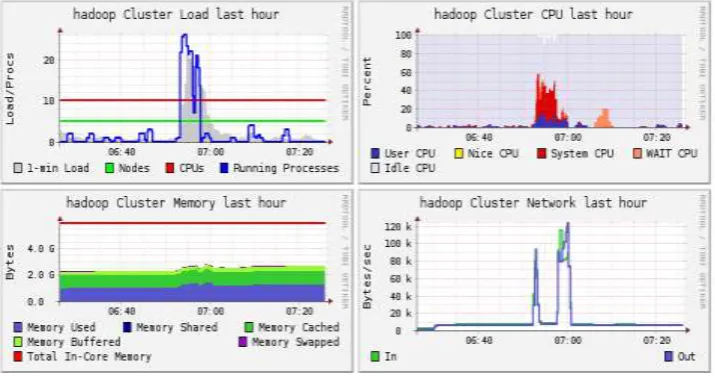
The Hadoop Cluster resource usage status monitored by Ganglia Software System is shown in the figure 2.
Figure 2. Hadoop Cluster resource usage status monitored by Ganglia.
Seen from the figure 2, when the distributed Pagerank algorithm runs on Hadoop, the number of running processes increases quickly, CPU usage percent and occupied network bandwidth increase at the same time, but Memory usage increases a little. So Pagerank algorithm is a compute-intensive job in Hadoop cluster. With the increase of social network scale, more nodes should be added to meet the computing requirement. The nodes with high Pagerank value have important position in the social network topology, they have greater influence on the information diffusion than that with low Pagerank value. The amount of nodes in social network is huge, so cloud-based Pagerank computing method and performance analysis are important research work.
New Problem and Challenge
[image:4.595.119.477.271.459.2]Dealing with information leaks depends on what users are willing to disclose, and it has to do with government laws and market regulation within a given jurisdiction. Attack techniques include direct attack techniques and malicious applications. Protection from direct attacks relies on experts, but protection from malicious applications depends mostly on users’ watchfulness .Information security and privacy protection problem should be emphasized. Some rumor can be spread by online social networks in a short time, how to judge if information is a rumor or a truth is a challenge to current computing technique. At the same time, personal privacy information should be protected in social network. How to protect personal privacy information in social network by technique and law method is a great problem and challenge in current society and world.
Conclusion
With the rapid development of Internet and smart mobile terminal, information can be diffused and spread by online social network quickly. There are some special characters in social network, such as small world, scale free, high levels of clustering. SIR-based Information diffusion models are proposed and improved by multi-discipline researchers. Network topology structure plays an important role in information diffusion and spreading process. Different centrality measure algorithms are summarized in this paper. High centrality degree nodes generally are high influential nodes in social networks. While the relationship between network topology and information diffusion dynamics should be researched in detail. Pagerank value computing for SinaWeibo users is done by Hadoop cloud technique to meet the requirement of high scale social network computing. Some new problem and challenge are proposed in the paper, such as information diffusion model, big data and mining algorithm in social network, information security and privacy protection problem. We think that information diffusion involves multi-discipline interaction, many problems and challenges exist in the research aspect. Researchers from different aspects can contribute to the research aspect.
Acknowledgment
This research work is supported by Beijing Nature Science Foundation Project (No.4142034). Fundamental Research Funds for the Central Universities (No.FRF-BR-15-056A). Chinese 973 foundation research plan (No.2013CB329605, No.2013CB329606).
References
[1] J. Scott. Social Network Analysis: A Handbook, 2nd ed., Sage Publications, London, 2000.
[2] L.C. Freeman, Connections 19 (1996) 39.
[3] B. Wellman, J. Educ. Res. 14 (1926) 126.
[4] S. Milgram. Psychology Today. pp. 2-60. 1967.
[5] Watts D J, Strogatz S H. Collective dynamics of “small-world” networks. Nature, 1998, 393(6684): 440-442.
[6] Albert-László Barabási and Réka Albert. Emergence of Scaling in Random Networks. Science, 1999, 286( 5439) :509-512.
[7] M. E. J. Newman and Juyong Park. Why social networks are different from other types of networks. Physical Review E 68, 036122 2003
[9] Alan Mislove, Massimiliano Marcon, Krishna P. Gummadi. Measurement and Analysis of Online Social Networks.IMC '2007 Proceedings of the 7th ACM SIGCOMM conference on Internet measurement: 29-42.
[10] Sinan Aral, Dylan Walker. Identifying Influential and Susceptible Members of Social Networks. Science 337, 337 (2012).
[11] Bonacich, P. and Paulette, L. (2001). Eigenvector-like measures of centrality for asymmetric relations. Social Networks, 23, 191-201.