The London School of Economics and Political Science
Working Together to Protect Children;
A Case Study of Policy Implementation in Greece.
Helen Athanasiou
A thesis submitted to the Department of Social Policy at the
London School of Economics for the degree of Doctor of
Declaration
I certify that the thesis I have presented for examination for the MPhil/PhD degree of the London School of Economics and Political Science is solely my own work other than where I have clearly indicated that it is the work of others (in which case the extent of any work carried out jointly by me and any other person is clearly identified in it).
The copyright of this thesis rests with the author. Quotation from it is permitted, provided that full acknowledgement is made. This thesis may not be reproduced without the prior written consent of the author.
Abstract
This is an exploratory case study aiming to describe the current state of the child protection system in Greece by examining both policy interventions and service responses targeted at all the stages of the phenomenon, ranging from detection and investigation to the provision of support or out of home care.
This thesis is embedded in EU and international mandates for protecting children, embracing the Convention for the Rights of the Child as the starting point and value base of any developed, contemporary system designed to deal with this complex phenomenon. The main objective is to paint a picture of policy implementation in conjunction with front line interagency and multidisciplinary working. Data is collected and analysed in regards to all three levels; the macro, or policy level; the meso, or organisational/structural level and the micro, or frontline, professional, case specific, grassroots level.
The researcher uses first-hand knowledge of the systems of both England and Greece in order to position Greece within the EU continuum of approaches based on the long-standing dilemma of support versus protection. As a result, the study concludes by offering suggestions on how to overcome barriers and improve the current situation in Greece so as to ensure that vulnerable children and their families receive appropriate and adequately designed services that would potentially enhance their life chances and enable better outcomes. This is achieved by distilling lessons to be learned from other more developed systems and adopting them to the Greek reality. This is an opportune moment for such a study as there is significant
Acknowledgements
“Sometimes a scream is better than a thesis” states Ralph Waldo Emerson as the LSE has been reminding us, but sometimes a thesis is a scream in disguise, wearing many layers of academic illustration but aiming just the same to disturb those who have fallen asleep on their watch and voice injustices or societal troubles and capture the world’s attention and direct it to a specific aspect of a particular phenomenon, shedding light and, if an optimist, even provoking change.
A thesis is made of screams one could argue and a researcher screams or feels like
screaming very often whilst engaging with a thesis; a roller coaster ride ( as a colleague of mine called it) with many bumps that translate into screams, both out of pleasure and pain, interest and fatigue or even exhaustion.
Thank you all who stood by me along the way, first of all my vigorously guiding and supportive, supervisors; Professor Eileen Munro and Dr Gill Bridge, who at times appeared to have more faith in me than I had in myself with the wish that they will continue to encourage the many who will follow this path, parents; the late Mr Alexander Athanasiou who left me with a vision and Mrs Denomache Athanasiou who stayed behind and patiently helped keep it alive and saw it through. A special teacher and guide, Mrs Aggeliki Klotzari who was there during all major life transitions and made me understand the glory of teaching, as colours of her shining qualities seem to have rubbed off and brought me where I am today. Also teachers, colleagues, friends and co-travellers whose advice, kind words and encouragement compelled me to carry on, at times helped generate ideas, but most importantly made this journey a more positive one. Furthermore, I would like to voice my great appreciation to IKY, the provider of Greek State scholarships and the LSE for their financial support, without which there could not have been a thesis. And last, but by no means least, thank you to the people who helped this project materialise, the participants of all phases of this study, people who gave their time and insight and as such are the voices behind this study.
May this scream reach far and wide and evoke the winds of change for the children in need of protection in Greece.
Table of Contents
Chapter 1: Introduction 13
1.1 Defining child abuse and neglect 16
1.2 Societal Responses to Child Abuse 20
1.3 Ecological Approach 22
1.4 A ‘Policy Network’ Approach and ‘Inter-Organisational Analysis’ 25
1.5 The structure of the thesis 30
1.6 Conclusion 32
Chapter 2: Multidisciplinary and Interagency; Review of the Literature 34
2.1 Definitions; an elusive attempt to put the house in order. 35
2.2 Policy/Macro-level; is it political wisdom or political jargon? 42
2.3 Inter-organisational issues/Meso level; are they partners or competitors? 43
2.4 Professionals/Micro level; an attempt to herd cats? 44
2.5 Impact or what is to be gained by working together and for whom 46
2.6 Facilitators; what enables synergy 48
2.7 Obstacles/Challenges or forces working against this uniting vision 49
2.8 Learning or work in progress 51
2.9 Conclusions 53
Chapter 3: Setting the Context; Findings from the Country in Focus; or As Greek As It Gets
55
3.1 The Greek Welfare State 55
3.11 Reforms 66
3.21 Ethnic Diversity 72
3.3 Awareness and Detection of Child Abuse and Neglect 75
3.31 Relevant Research Findings 76
3.32 Out of home care 82
3.33 Other services and related information 85
3.4 The legal framework 93
3.5 Nongovernmental Organisations (NGOs) 97
3.51 Main Greek NGO involved in Child Protection 98
3.51.1 Help Line 101
3.51.2 Children in Danger 103
3.51.3 Intervention in the field 108
3.51.4 Children’s Homes 110
3.51.5 Networking 113
3.6 Interview findings 114
3.7 Conclusion 114
Chapter 4: Methodology and Research Design 117
4.1Methods 117
4.11 First Phase 119
4.12 Second Phase 123
4.2 Research Questions 130
4.21 First Phase 130
4.22 Second phase 132
4.23 Third phase 133
4.3 Analysis 136
4.4 Ethics 140
4.51 A topic guide for the first interviews 142
4.52 A topic guide for the second phase of interviews 142
4.53 Ethics list 144
4.54 Ethics protocol 145
4.6 Conclusion 147
Chapter 5: Findings and Discussion; The Tale of the Two Greek Networks 148
5.1 Network A 151
5.2 Network B 154
5.3 Cases 157
5.4 Arising Themes 160
5.41 Micro Level 162
5.41.1 Feelings on network participation 162
5.41.2 Positives and negatives for the professionals arising from network participation
167
5.41.3 Practical issues that impact communication and collaboration 170
5.41.4 Is it necessary for parental responsibility to be recognised prior to any interventions?
171
5.41.5 Role clarity 172
5.41.6 Role importance 172
5.41.7 Down to business; professionals’ commenting on what it is like to work with members of the various professions
173
5.42 Meso Level 177
5.42.1 Variation in the experience of collaboration between member organisations in comparison to non-member ones
177
5.42.2 Positives and negatives for the services involved arising from network participation
178
participation
5.43 Macro Level 183
5.43.1 Ways to improve the initiative 183
5.43.2 Issues hindering communication and collaboration 185
5.43.3 All other significant issues or comments 188
5.5 Conclusion 192
Chapter 6: Findings and Discussion; The Three, Three-Staged Vignettes 194
6.1 Phase One 195
6.2 Phase Two 196
6.3 Phase Three 197
6.31 Descriptive Statistics 199
6.4 Network Activation 205
6.41 Descriptive Statistics 206
6.5 Agreement or Disagreement within the Network 208
6.51 Descriptive Statistics 209
6.52 Reasons Provided for Disagreements amongst Professionals 212
6.53 Existing group processes for dealing with disagreements 214
6.6 Conclusions 216
Chapter 7: Conclusions 217
7.1 Research questions revisited 218
7.2 Results and criticisms of the situation in Greece 222
7.21 Macro 222
7.22 Meso 224
7.23 Micro or practitioner level 227
7.4 The ways forward 232
7.41 Policy Level 235
7.5 Conclusion and contribution 242
Bibliography 245
Appendices
Table of Figures
-Chapter 1
Figure 1 A complete child protection system 22
-Chapter 3
Figure 2 Every Child Matters, the 'onion model' 39
Figure 3 Number of Social Workers employed by the three generic welfare offices in the Prefecture of Athens (2001)
63
Figure 4 A map of services likely to deal with child protection cases in Greece
91
Figure 5 Main reasons for calling the phone line in 2005 101
Figure 6 Main reasons for calling the phone line in 2006 101
Figure 7 Main reasons for calling the phone line in 2007 102
-Chapter 4
Figure 8 Socio-demographic data of the first sample 120
Figure 9 Socio-demographic data of the second sample 128
Figure 10 The main stages of research design 139
-Chapter 5
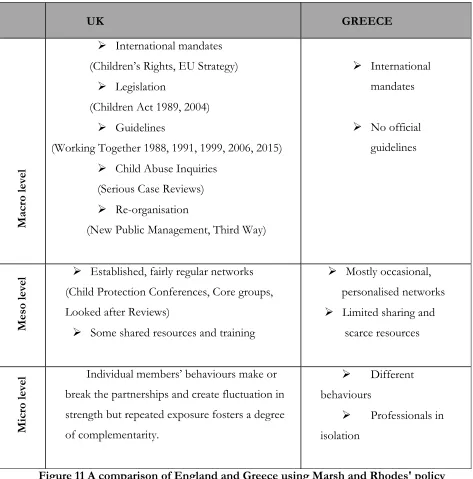
Figure 11 A comparison of England and Greece using Marsh and Rhodes' policy network
149
Figure 13 Comparing and grouping quotes 166
Figure 14 Presenting the respondents views on working with various professionals
175
-Chapter 6
Figure 15 Cross tabulation gender/case outcome 199
Figure 16 Cross tabulation profession/ case outcome 200
Figure 17 Cross tabulation vignette/ case outcome 200
Figure 18 Cross tabulation network/ case outcome 201
Figure 19 Box plot years of experience 202
Figure 20 Report on years of experience/ case outcome 204
Figure 21 Box plot years of network participation 204
Figure 22 Report on years of network participation/ case outcome 205
Figure 23 Cross tabulation vignette/ initial activation 207
Figure 24 Cross tabulation network/ initial activation 207
Figure 25 Cross tabulation gender/ agreement 209
Figure 26 Cross tabulation profession/ agreement 210
Figure 28 Cross tabulation network/ agreement 211
Figure 29 Report on years of experience/ agreement 212
Figure 30 Report on years of participation/ agreement 212
-Chapter 7
Chapter 1
Introduction
In Homer’s Iliad (circa 8th century BC), Hephaestus, one of the twelve ancient Greek gods, reveals how he was thrown twice from the top of Mount Olympus, Greece’s highest mountain, believed to be the home of the gods. In the first instance, his mother, Hera, who at birth was embarrassed by his weak appearance, dropped him. He landed at sea where the goddess Thetis rescued him. She and Eurynome, mother of the Graces, hid Hephaestus from the wrath of his own mother after his fall. He worked secretly with the two goddesses for nine years perfecting his craft before reclaiming his rightful place among the gods. (Book xviii, verses 394-490) Later on, after having reconciled with Hera, Hephaestus took his mother’s side in defiance of Zeus. He dared to attempt to rescue her after Zeus had hanged her by her wrists from heaven because she had disobeyed him. The Olympian, in his rage, caught Hephaestus by the foot and threw him from the top of Mount Olympus to the earth far below. After falling for a whole day, at sunset Hephaestus landed on Lemnos, broken and nearly lifeless. This time around the islanders came to his rescue. However, after this second incident he could only walk with a cane. (Ibid, Book I, verse 586-594).
This was one of the first incidents, though clearly not the only one, of physical abuse to be recorded in Greek mythology, where gods had human characteristics and frequently displayed anger, hatred, envy, etc. Not only was Hephaestus cast from Olympus due to his weak appearance, which was considered shameful by his own mother, but he was also disabled as a result of Zeus’s inability to control his anger whilst trying to intervene in what would nowadays be called an incident of domestic violence. Hephaestus was the victim, or a survivor, as is the currently preferred term, of both parents on separate occasions. This myth clearly reveals the presence and, at least during the poet’s time, the likely societal tolerance of physical
of changes through time and place of what are considered acceptable and unacceptable terms and practices. Finally, the myth highlights the role of the community in dealing with violence in the family by identifying the inhabitants of Lemnos as the ones who came to Hephaestus’ rescue the second time round.
Has there been a shift in the way Greeks recognise and deal with the maltreatment of children in the past approximately 3,000 years? Or are Olympian traits still to be found? This is one of the pertinent questions that this thesis will explore focused on the here and now rather than approaching it from a historical perspective. The ultimate aim of this case study will be to attempt to describe the phenomenon of child abuse and neglect in Greece, explore community responses by presenting service provision, policy and implementation, whilst looking at current trends and international influences. The researcher will use her experience working within the English and the Greek child protection systems, as well as her familiarity with Greek culture, to analyse the situation in Greece.
already hinted above, not an aim in itself but a vehicle for guaranteeing the protection of children through timely, holistic and evidence-based interventions.
Although Greece has officially pledged a commitment to dealing with child maltreatment as a member of the United Nations (UN), the EU and other relevant international bodies and ratifying conventions, such as the Convention for the Rights of the Child (CRC) (1989), there is little information available on how all this is being translated and implemented, or what the reality is for children and families in need of support and/or protection. What differences, if any, have the twenty-five years, 1989-2014, of the CRC made to abused and/or neglected children and their families in Greece? Has viewing children as bearers of rights rather than as being ‘owned’ and fully represented by their parents who always know best caused shifts in policy, law, service provision and professional practice? The study of Greece will therefore be anchored to relevant multinational perspectives and initiatives, exploring lessons to be learnt and how the current situation can be improved using advances in other countries as sources of wisdom. In order to achieve this, the essential ingredients of a developed child protection policy will be established, based on international guidelines and relevant literature.
A brief examination of the Greek child protection services immediately revealed to the researcher a rudimentary level of formal structures and procedures available, which in turn lead to the intentional inclusion of an investigation of non-governmental initiatives and accessible, informal models of service collaboration in the thesis, so as to paint a more detailed and balanced picture of the situation. When faced with an incompetent official system, not-for-profit organisations that may have the necessary flexibility as well as sensitive, experienced professionals, more often than not partly trained abroad and thus exposed to more
sophisticated systems, seem to take leading roles in moving things forward or finding new and/or innovative ways of making the most out of, or working around, the existing system. In a system that appears somewhat inadequate, initiatives of this kind must be considered when painting the whole picture, the reality for children and families, whilst simultaneously evidencing the need for change and indicating ways forward already accepted by the professional
community.
“Two years after the crisis broke out its impact on the daily lives of millions of families, children and young people is clearly perceptible. Although the impact of the crisis is by no means uniform across the EU, evidence suggests that children and families are being disproportionally affected.”
In conjunction with internal trends, other external pressures were and still are present, like the children’s rights movement, for example, which further accentuated the need for
improvement in service provision for vulnerable children and their families. In addition, evident trends to compare and contrast systems within the EU in order to promote and combine best practices may be assisted through the unique accumulation of pertinent
information within this thesis that recognises both the strengths and weaknesses of the existing situation in Greece.
This introductory chapter will begin to set the scene by presenting internationally
acceptable definitions of the complex phenomena of child abuse and neglect. Subsequently, it will explore understandings of and responses to maltreatment, thus highlighting the complexity of the phenomenon under study. Finally, it will conclude by introducing the contents of the remaining chapters of this thesis.
1.1 Defining Child Abuse and Neglect
Attempting to define child abuse and/or neglect is a far more complicated task than one would initially imagine. A variety of definitions exist that more often than not mainly rely on value-laden terminology that is open to interpretation and can thus significantly fluctuate in
accordance with different people’s perceptions and frames of reference.
concept was originally introduced by Winnicott (1965) to imply that no parent can meet the children’s needs in the best possible way at all times, as his or her own needs and external factors may affect the equation. Evidence exists that practitioners working within the child protection field over time tend to lower their standards in relation to what they consider acceptable parenting in comparison with other citizens. A study by Rose and Meezan (1996) comparing standards held by practitioners to those held by mothers in relation to neglect revealed that mothers judged incidents as more serious than the workers. Time and exposure to various forms of poor parenting, it would seem, shift the understanding and tolerance of various behaviours and alter the borderline between what is considered acceptable and what unacceptable behaviour. Thus, behaviours such as those described at the beginning of this chapter, found in Greek mythology, even if still observable, are nowadays no longer acceptable. In addition, place, interpreted here as geography and culture, plays a leading role in shaping attitudes and approved or tolerated practices towards children. Even the length and notion of childhood itself is ever changing and rights and responsibilities are acknowledged and attributed differently around the world. As a result, in parts of our modern world one can find child labour that can on occasions scarily resemble child slavery, child exploitation, child weddings, and child soldiers, to name but a few of the extreme examples of the discrepancy that exists and is attributed to culturally acceptable or culturally encouraged customs and traditions. This volatility of tolerable terms and conditions would explain the term “socially constructed”, which is often used when talking about abuse and neglect and similarly applies to an array of terms in the realm of the social sciences. It is mainly in this light that the term “social construct” appears in the related literature. (Munro, 2002) Thus, each and every community may be seen as either a risk or a protective factor. Especially so given the fact that, according to WHO (2002), maltreatment can also be viewed as part of a greater typology of violence that includes ‘self-directed violence’, ‘interpersonal violence’ and ‘collective violence’. Consequently, one would anticipate that preventing child abuse and/or neglect within a society that exhibits a high incidence of all other forms of violence would prove a much greater challenge.
varies, thus impacting, among other things, the international picture of the incidence of the phenomenon.
This study will use the terms child abuse and/or neglect interchangeably with the term child maltreatment. The operational definition that will be adopted is the one provided by the Convention on the Rights of the Child, chosen due to its international nature and the fact that Greece, like all other countries apart from the USA and Somalia, has ratified the Convention. This is interpreted as an acceptance of and agreement with its principles, which translates into its inclusion in Greece’s respective national legislations and consequently its use as a guide to social policy planning and implementation. Within the Convention, Article 19 refers to child maltreatment as follows:
“State parties shall take all appropriate legislative, administrative, social and educational measures to protect the child from all forms of physical or mental violence, injury or abuse, neglect or negligent treatment, maltreatment or exploitation, including sexual abuse, while in the care of parent(s), legal guardian(s) or any other persons who have care of the child.
Such protective measures should, as appropriate, include effective procedures for the establishment of social programmes to provide necessary support for the child and for those who have the care of the child, as well as for other forms of prevention and for identification, reporting, referral, investigation, treatment and follow-up of instances of child maltreatment described heretofore, and, as appropriate, for judicial involvement.” (UN, 1989:318)
It is exactly these measures that the researcher went in search of during the fieldwork of this research. Another definition of the phenomenon that is accepted internationally and offers a more detailed definition of the sub-groups of types of maltreatment stems from the World Health Organisation (WHO), an undisputed authority on public health matters, and is meant to be applicable to all countries throughout the world:
“Child abuse or maltreatment constitutes all forms of physical and/or emotional ill-treatment, sexual abuse, neglect or negligent treatment or commercial or other exploration, resulting in actual or potential harm to the child’s health, survival, development or dignity in the context of a relationship of responsibility, trust or power.”
“Physical abuse of a child is that which results in actual or potential physical harm from an interaction or lack of an interaction, which is reasonably within the control of a parent or person in a position of responsibility, power or trust. There may be single or repeated incidents.
Emotional abuse includes the failure to provide a developmentally appropriate, supportive environment, including the availability of a primary attachment figure, so that the child can develop a stable and full range of emotional and social competencies commensurate with her or his personal potentials and in the context of the society in which the child dwells. There may also be acts towards the child that cause or have high probability of causing harm to the child’s health or physical, mental, spiritual, moral or social development. These acts must be
reasonably within the control of the parent or person in a relationship of responsibility, trust or power. Acts include restriction of movement, patterns of belittling, denigrating, scapegoating, threatening, scaring, discrimination, ridiculing or other non-physical forms of hostile or rejecting treatment.
Neglect or negligent treatment is the failure to provide for the development of the child in all spheres: health, education, emotional development, nutrition, shelter, and safe living
conditions in the context of the resources reasonably available to the family or caretakers and causes or has a high probability of causing harm to the child’s health or physical, mental, spiritual, moral or social development. This includes the failure to properly supervise and protect children from harm as much as is feasible.
Sexual abuse is the involvement of a child in sexual activity that he or she does not fully comprehend, is unable to give informed consent to, or for which the child is developmentally unprepared and cannot give consent, or that violate the laws or social taboos of society. Child sexual abuse is evidenced by this activity between a child and an adult or another child who by age or development is in a relationship of responsibility, trust or power, the activity being intended to gratify or satisfy the needs of the other person. This may include but not limited to:
-the inducement or coercion of a child to engage in any unlawful sexual activity, -the exploitative use of a child in prostitution or other unlawful sexual practices, -the exploitative use of children in pornographic performances or material.
Exploitation is the commercial or other exploitation of a child refers to use of the child to work or other activities for the benefit of others. This includes, but is not limited to, child labour and child prostitution. These activities are to the detriment of the child’s physical or mental health, education, or spiritual, moral or social-emotional development.”
From a Greek perspective, Agathonos-Georgopoulou (1997), a Greek social worker, established scholar and researcher who has written extensively on child abuse and/or neglect, suggests the use of a definition of abuse by Garbarino and Gilliam (1980), “Any acts of commission or omission by a parent or guardian that are judged by a mixture of community values and professional expertise to be inappropriate and damaging”. The use of terms such as “community values” or, as in the previous page, “social taboos of society” proves yet again the subjectivity of the definitions and strengthens the argument regarding the complexity of agreeing on what constitutes abusive behaviour in a variety of settings.
Unfortunately, definitions are not the only ambivalent area within child protection; they are more the initial confusion as they become closely attached to theories surrounding the causation of the phenomenon. These theories yet again appear to similarly alter over the course of time and in turn affect the policies, services and interventions designed and implemented in
developed countries.
1.2 Societal Responses to Child Abuse
This section discusses the way societies conceptualise the problem of maltreatment and respond to it and how responses change over time. As a result, it highlights how complex it is as a concept to study and how the way maltreatment is looked at greatly affects the chosen ways to respond.
Parton, discussing the history of child maltreatment in England, argues that child abuse was initially viewed as a medico-social problem when it emerged as a major social problem in the 1960s, but later became seen as socio-legal. Important decisions about the future of vulnerable children and their families were at times taken in a doctor’s office or a welfare office rather than the courts. He presents three approaches according to their respective foci: the legal or penal, the medical or deterministic, and the social or humanistic, which he in turn divides into
thus exonerating society as a whole and identifying mainly therapeutic interventions. The abuser is sick. Finally, the social or humanistic way of thinking promotes a more holistic and humane approach to the phenomenon, exploring the characteristics of the child, the parent, the family, the community and society as a whole and focusing on how all these interact. The abuser is analysed as a social construct, in that it is the interface between the individual and humankind, or the person and his/her environment that somehow interrelate, and therefore intervention needs to take this intricate mechanism into account.
A consensus has formed around the view that it is a multi-factorial phenomenon, where the needs and characteristics of the child and the parents as well as wider environmental, societal and cultural issues are intertwined (Gil, 1970; Freeman, 1983; Parton, 1985; Jones et al, 1987, WHO and ISPCAN, 2006; etc.). Causation can thus be understood as a very complex issue, warranting a multi-faceted approach or intervention that requires a case-specific combination of expertise that cannot be found in one profession.
“No single factor on its own can explain why some individuals behave violently towards children or why child maltreatment appears to be more prevalent in certain communities than in others. As with other forms of violence, child maltreatment is best understood by analysing the complex interaction of a number of factors at different levels – an understanding that is vital for dealing effectively with the problem of child maltreatment.” (WHO and ISPCAN, 2006:13)
solutions that in turn necessitate that various professions dealing with abused and/or neglected children and their families work in unison. “A multi-disciplinary approach should ensure not only an integrated strategy to respond to violence effectively, but as importantly, a consistent and evidence-based strategy to prevent it” (WHO and ISPCAN, 2006: VI).
1.3 Ecological Approach
As discussed in the previous section, theories of the causes of child maltreatment have moved from a psychopathological to a psychosocial understanding, with an ecological framework now being dominant.
“The ecological model builds on the assumption that the causes of violence are complex and involve the interaction of factors at many levels of the social system, ranging from the individual through to national and international forces. The model discerns four causal levels, each of which is embedded in the next: 1) Individual; 2) Family; 3) Community; 4) Structural.” “Each level of the ecological model represents a level of risk and a key point of intervention, and experience has shown that interventions, which target several levels at the same time, are more effective than single level interventions.” (The WHO, 2001: 6)
This approach stems from the work of Bronfenbrenner (1977; 1979; 1995; 2001; 2005), who approached child development by identifying five systems or layers that impact his/ her growth.
These systems were the microsystem, the mesosystem, the exosystem, the macro system, and the chronosystem. The systems describe significant influences in a child’s life that start from the parents and the immediate family (micro), move on to include the school, the church, the neighbourhood (meso). They also incorporate the community, parents’ employment and available resources (exo) and finally the global situation, legal frameworks, culture, etc. (macro). The chronosystem joins the child’s developmental stage with the timing of various external events and changes.
In an attempt to relate the ecological perspective to a child protection system the
researcher was aided by a significant development for this study. UNICEF’s Child Protection Strategy -adopted in 2008- describing Child Protection Systems as
“a set of laws, policies, regulations and services, capacities, monitoring, and oversight needed across all social sectors -especially social welfare, education, health, security, and justice- to prevent and respond to protection-related risks.”
This framework will be used in studying how child maltreatment is dealt with in Greece.
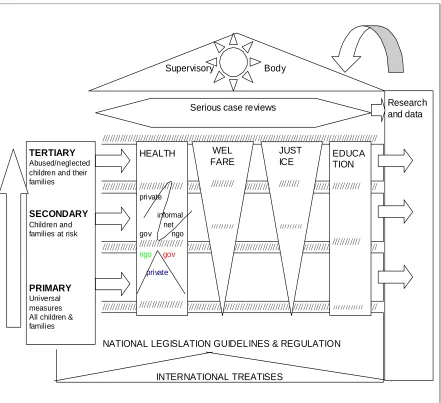
One task is to clarify the main components of a child protection system. As a result of the description of the key ingredients, the researcher has integrated these components into Figure 1. In clarifying the system depicted above, the foundations are national legislation and
guidelines and regulations clearly influenced, and even at times directed, by international
TERTIARY
Abused/neglected children and their families
SECONDARY
Children and families at risk
PRIMARY
Universal measures All children & families
////////////////////////////////////////////////////////////////////////////////////////////////////////////
////////////////////////////////////////////////////////////////////////////////////////////////////////////
////////////////////////////////////////////////////////////////////////////////////////////////////////////
////////////////////////////////////////////////////////////////////////////////////////////////////////////
NATIONAL LEGISLATION GUIDELINES & REGULATION
[image:23.612.98.539.302.705.2]INTERNATIONAL TREATISES
Figure A Child protection system
Supervisory Body
Serious case reviews
WEL FARE ///////// ///////// /// JUST ICE //////// ///////// //// HEALTH ///////////////// private informal net gov ngo /////////////////
ngo gov
agreements and commands. The main pillars of the system are health, welfare –or social services-, the judicial system, and education, presented in no particular order. As all three levels of prevention appear within the system, universal (information, awareness, support, and/ or reinforcement) as well as specialist services (to detect, register, monitor, and respond to child abuse and neglect) are included across all four service groups. The variation in shape attributed to the welfare services and the courts- the inverted triangles -were chosen to illustrate the greater involvement of these two agencies as cases progress from universal to specialised, whilst the involvement of the remaining two, i.e. education and health, were seen as largely unaltered. Having established this, it could also be argued that greater demand would also be placed on the resources of the health system as remedial action, emergency and therapeutic services would likely be needed at the point when specialist assessments and interventions are required. Within the dimension of health services, an attempt was made to demonstrate the potential mix in service provision, i.e. to depict the fact that different parts may be provided in the public, private or voluntary sectors. This mapping is, in the researcher’s opinion, useful when
the child protection system should be visible. This hyper system would include the welfare state as a whole, government and governance, policy and politics, the economy, etc.
It is of extreme importance not to forget culture, a strong component that affects each and every part of the system and as such colours any attempts to understand a system or adapt it. Culture can provide extremely useful information when exploring the possibility of
convergence and good practice sharing between countries. This can take the form of identifying any adjustments required to fine-tune a policy, service or practice transfer from one country to another in order to ensure increased chances of a well-targeted and well-received intervention. Such detail is of extreme significance and may even be the key to eventually guarantee
successful cross-country reforms.
This model also brings to mind “network policy”, as levels of cooperation that influence each other and as such require holistic consideration.
1.4 A ‘Policy Network’ Approach and ‘Inter-Organisational Analysis’
This section explains the theoretical concepts deployed to investigate partnership working within this thesis.
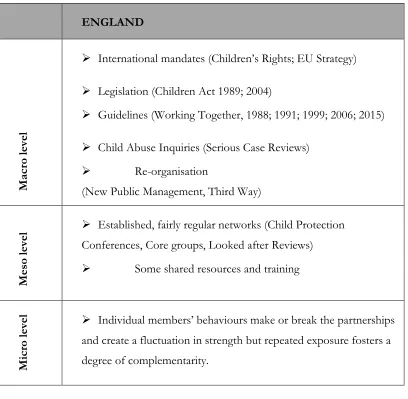
In the first instance, a “policy network” approach is examined as presented mainly by Marsh and Rhodes (Marsh and Rhodes, 1992; Rhodes, 1997; Marsh, 1998). Policy networks are defined as “… (more or less) stable patterns of social relations between interdependent actors, which take shape around policy problems and/or policy programmes” (Kikert et al, 1997:6). Marsh describes networks as “structures of resource dependency” and recognises the “dialectical nature” of the relationship between network structure and individual behaviour. (1998:11 & 70 respectively) These networks are seen to be located at the “meso level” but are susceptible to external processes (macro level) as well as members’ behaviour (micro)
(1998:195).
functions and factors related to the participant’s own organisational objectives. Within the first concept, balance can be achieved across four categories:
1. Domain consensus (agreement regarding the role and scope of each agency)
2. Ideological consensus (agreement in relation to the nature of tasks and the best way to approach them)
3. Positive evaluation (views of the workers of one agency about the work of another) 4. Work coordination (alignment of working patterns and culture)
The second concept includes the following: the main service delivery objectives, ensuring or enhancing pubic legitimacy and support for the service agenda, ensuring adequate funding, and the organisational/professional paradigm (i.e. the technological-ideological commitment to certain ways of working). Whilst network analysis focuses on policy formation, Benson’s
approach may be more useful to understanding policy delivery or implementation networks and the relationship between the two (p24).
In addition, Benson describes three possible states of imbalance or disequilibrium. He initially names forced coordination (high on work cooperation but low on domain or ideological consensus and positive evaluation). The second state is what he refers to as
consensual inefficiency (low levels of work coordination but strong on domain and ideological consensus and positive evaluation). Evaluative imbalance is the third and final state (high on work cooperation and strong on domain and ideological consensus, but low on mutual positive evaluation).
To the aforementioned typology the author suggests adding “the theoretical possibility of other states”, namely, high positive evaluation but low ideological and domain consensus and weak coordination (evaluative inefficiency); high levels of ideological and domain consensus but poor work coordination, negative evaluation (forced consensus); domain inefficiency (strong domain consensus but weak ideological) or vice versa and lastly ideological inefficiency. This typology may prove useful in assisting the analysis of not only the networks as a whole but also the relationships between different agencies within the network as the imbalances
Hallett (1995) presented evidence of a network operating in four layers, namely the main or core layer, a second more generic layer, a case-specific layer, and finally a peripheral layer. In a similar manner Sanders et al (1997) undertook research on Area Child Protection
Committees’ membership and described three tiers, starting from full membership, through significant involvement, to peripheral involvement. Similarly, in 1999 Webb spoke of a
continuum of intensity of involvement with two ends: from “routinised” to “radical”. The first level is described as being characterised by close and regular contact assisting in the
development of a mutual appreciation and understanding, and the latter with infrequent contact that may impair communication and foster misunderstandings and poor evaluation. These distinctions may prove valuable to bear in mind when observing the Greek networks in terms of classifying the level of involvement of each agency and the frequency of contact with the network.
It would also be relevant to critically observe the power balance as “…the relative power of medical professionals may be seen to have colonised many areas of health and social care provision and constrained the role of other professionals…” (p18). Both Greek networks appear to have been initiated by medical professionals who have on one occasion informally assumed a supervisory role. This arrangement may be the trigger for further conflict since, according to Birchall and Hallett in 1995, profession was the most significant issue impacting professionals’ opinions about how different cases should be dealt with.
A systems-theory approach is therefore advocated and supported in so far as the
dimensions contributing to the quality of networking are interrelated and if something changes in one direction it is highly likely that it will affect the bigger picture. It is also viewed by Benson as a system within a system, or a mini “political economy”, with both internal and external dynamics.
ENGLAND
M
acro
lev
el
International mandates (Children’s Rights; EU Strategy)
Legislation (Children Act 1989; 2004)
Guidelines (Working Together, 1988; 1991; 1999; 2006; 2015)
Child Abuse Inquiries (Serious Case Reviews)
Re-organisation
(New Public Management, Third Way)
M
es
o leve
l Established, fairly regular networks (Child Protection
Conferences, Core groups, Looked after Reviews)
Some shared resources and training
M
icr
o leve
l Individual members’ behaviours make or break the partnerships
[image:28.612.106.514.69.468.2]and create a fluctuation in strength but repeated exposure fosters a degree of complementarity.
Figure 2 A Policy Network Approach to analyse England
Reder and Duncan (2003) present the factors that have been highlighted in previous research to influence interagency relationships as: territorialism, role identifications, status and power, competition for resources, professional and organisational priorities, stereotypes, value systems, mutual unfulfilled expectations, and last but not least, disrespect for the other’s expertise (Stevenson, 1989; Blyth and Milner, 1990; Morrison, 1998). These factors would appear to fall within the broader categories presented above from Benson’s
requiring “nurturing” and can only be accomplished locally on a basis of trust and respect (1997:4). In addition, they present a framework to serve as an organising tool to assist in
understanding several reoccurring themes. The first theme identified is an organisational shift in contrast to what they term individual entrepreneurialism, thus highlighting the danger of relying on individuals rather than agreements, which seems to be the case in one of the Greek
networks examined in this study. Secondly, the authors raise the excellence versus equity theme, which is concerned with organising scarce resources across a locality at the expense of the rest of the country. Thirdly, issues related to costs in comparison to perceived benefits (are ventures cost effective and what about the alternatives?), which had been also flagged as an important issue to be taken into consideration when evaluating such ventures. The fourth theme is related to the focus of the adopted model, whether its emphasis can be seen to be medical or social, and the fifth, to explore any compromises between flexibility and formality of agreements. Following this, the type of management is examined, for example project management versus mainstream management. Issues of co-location or non-co-location are also considered pertinent. In addition, one must explore and take into account where members’ loyalties lie, whether with the team or the organisation. The distinction between social work and care management requires consideration, too, and finally, the broader picture within which
cooperation is taking place and whether this could be characterised as a hierarchy, a market or a network (1997:27-29). All of these issues must be tackled in order to understand, evaluate and reinforce a partnership, as they appear to be significant enough to make or break an initiative for collaboration. Again these concepts pair well with inter-organisational analysis and the systems approach selected by the author and as such they will be taken into consideration in chapter six, where the Greek networks are analysed. 1
In addition, in 1992 Hardy and colleagues presented what they perceived as being barriers to achieving collaboration. They divided these into: structural (complexity, non-coterminosity and fragmentation), procedural (differences in planning and budgeting), financial (differences in funding and resources), and professional barriers (differences in ideologies and values, threats to job security, conflicting views about user interests and roles), as well as barriers related to status and legitimacy (organisational self-interest, potential threats to autonomy and domain,
and differences between elected and appointed agencies). 2 These notions fit in well with
Benson’s typology and will also feature in chapter six.
In 1998 Glisson and Hemelgarn undertook research in the US that concluded that best results were accomplished within a positive organisational climate where staff were supported and highly committed and that, surprisingly enough, uncoordinated services achieved better results for children than coordinated ones. Could this suggest that bad or messy coordination is worse than no coordination at all? Coordination is definitely not a way to mask other shortages and calamities. In addition, it is important to take into account that causal relationships between interventions and outcomes are always problematic (Sullivan and Skelcher, 2002:19), and that partnerships were introduced whilst other approaches continued to exist (e.g. hierarchies and markets). The same is obviously true for Greece, as the networks there exist mainly within large hierarchical bureaucracies.
Having explored some pertinent themes in relation to collaboration that fit with the chosen framework, it will now be linked back to the idea of the need to deal with child maltreatment holistically, as established earlier on, based on the complexity and high interdependence of the forces at work.
1.5 The Structure of the Thesis
This subsection will briefly explain the content of the remaining chapters of this thesis and will serve as an outline of what is to follow.
To begin with, the second chapter focuses on literature related to multi-disciplinary and interagency working. The aim is to define the vast array of terms and collaborative
arrangements that exist in order to facilitate an understanding of the impact such ways of working have on services, professionals and service users, as well as pertinent issues enhancing or hindering synergy. Later, the Greek networks are located and analysed within this literature.
The subsequent chapter, chapter three, presents the findings of the initial phase of the study based on bibliographical searches combined with the first set of unstructured interviews and the researcher’s observations. The Greek child protection system is introduced and the occurrence of child maltreatment in the country established and explored on the basis of
available statistics and published research. This is included among information about the greater picture including the welfare state and other existing formal arrangements such as out-of-home care, as well as non-governmental organisations (NGOs), demographical trends, ethnic diversity and the relevant legislation that are seen as directly linked to child protection. The topics covered within this chapter mirror those identified within international reports as significant ingredients of any developed child protection system.
In Chapter four the researcher deals with methodology and aims to clarify how this study was undertaken and what the central research questions at the heart of it are. It examines the favoured choice of case study methodology together with the selected ways to assure quality of results. Sampling and interviewing at all three phases is included. Furthermore, it investigates ethical issues and presents the topic guides devised for the interviews together with some socio-demographic data regarding the respondents of the first and the second phases of this study. Chapter four concludes by highlighting the analytical process, or, in other words, the course of action followed to arrive from the available data to the end results.
Having clarified the methods, Chapter five fully presents the two Greek professional networks studied during phase two and phase three of this project using interview quotes. Findings from the semi structured interviews and non-participant observations conducted by the researcher are examined through the lens of the relevant literature highlighted in the previous chapter and the findings from a study compiled in the UK that bears some important similarities in terms of its design. This chapter portrays the interaction between the
practitioners that brings the system to life.
The next chapter, chapter six, is a second findings chapter. It presents in detail the three, three-staged vignettes used during the interviews. It discusses findings arising and explains how these were analysed. This adds to the previous chapter by completing the picture of issues discussed with the practitioners and network members.
available information on child protection in Greece, and having established the essential ingredients of a developed system as well as good practice pointers through reports, guidelines and literature, identifying gaps and duplications through constructive critical analysis will be fairly uncomplicated. Finally, what is or is not there with what should arguably be there – is combined to generate well-targeted recommendations for policymakers, managers and
practitioners to guide Greece to an efficient and effective system for protecting children from parental maltreatment in any form.
1.6 Conclusion
Bringing the first chapter to an end, it is important to summarise and regroup all pertinent issues that serve as an introduction to this thesis. When it comes to child abuse and/or neglect, Greece is no exception as such instances are even visible in its mythology. Having recognised the phenomenon, Greece eventually joined most other countries in accepting the responsibility to protect its children by taking all suitable measures. This thesis will attempt to explore all the laws, policies, and services currently in place in Greece with the aim of protecting children from abuse and/or neglect. To this end, observations and interviews will enhance the picture and offer a realistic portrait of how the system works. Finally, by recognising with the aid of international guidelines and movements what is significant, it will go on to suggest what is missing in the Greek system and how existing approaches can be ameliorated in order to ensure the greatest degree of protection possible across the country.
As already considered earlier in this chapter, the remit of child abuse and/or neglect, like many other phenomena within the realm of the social sciences, shifts continuously through time and space and as such is extremely difficult to define unquestionably. Consequently, though maltreating children is generally considered wrong, the spectrum of what is thought of as abusive behaviour varies and so do theories trying to account for the causes of the
phenomenon. Such variations are of significance for this study as they heighten or amplify the complexity of the situation and can considerably impact the choice of approaches when
designing interventions.
constructed and coloured by international movements as well as the English experience. Overall, the focus of this study is interagency and multidisciplinary collaboration as the preferred approach for the prevention of child abuse and/ or neglect.
Chapter 2
Multidisciplinary and Interagency Working; Review of the Literature
This chapter introduces the literature reviewed regarding partnership working and interagency and multidisciplinary collaboration, which will be of significant importance when presenting and analysing the main set of this study’s findings. Data gathered during the second phase consists of the interviews of sixteen professionals based in two different localities in Greece and
involved in child protection who are members of the two networks observed. Initially, an attempt will be made to untangle the definitions of these terms in order to aid clarity, and then the rest of the chapter will follow the macro, meso and micro level of organisation in order to present the pertinent issues described in the literature that are of relevance to this particular study as they tie networking into the greater picture of the Greek welfare state and child protection system to be presented in chapter three. The presence of this chapter is
methodologically justified when considering the cyclical and flexible nature of its design, as is described in the fourth chapter, which was chosen to respond to any findings generated during the explorative process, which is the very nature of case study research.
This will be followed by an exploration of the impact of collaboration as reported by various research projects in order to be able to compare views of the participating professionals recorded by this project with other previous research findings and to establish links or contrasts. Finally, ways of enhancing collaboration will be presented coupled with factors that are
considered obstacles to working together. This information will serve the researcher and the readers when in subsequent chapters, chapters five and six, findings from the second round of observations and interviews will be presented.
This review is mainly based on four previous reviews, namely, “Coordination and Child Protection; A Review of Literature” compiled by Christine Hallett and Elizabeth Birchall in 1992, “Learning in and for interagency working. Interagency Collaboration: a review of the literature” in 2004 by Paul Warmington and partners, “Multi-agency working and its
produced on the topic before, during and immediately after the fieldwork. It is of great interest to investigate whether terms and approaches have shifted over time, and if so, how the
discourse has evolved and if any of the original issues have been resolved and or replaced by new ones. Other significant more recent works will be quoted throughout this chapter to enhance the picture of collaboration3 and how it is conceived in so far as it is a significant
feature of any developed child protection system. As Lupton and partners argue, “...effective child protection is a collective responsibility, involving the participation, to a greater or lesser extent, of a wide range of different agencies and professional groups”. (2001:1) In this light, the two networks discovered in Greece during this project are viewed as exactly that, individual grassroots initiatives aiming to make the Greek “unsystematic” system more effective and as such a better place not only for the children and families involved but also for the professionals called to work within it.
2.1 Definitions; an Elusive Attempt to Put the House in Order.
The related terms coordination, collaboration, cooperation, and integration often appear to be used interchangeably, as if synonymous, thus creating great ambiguity. The unruly employment of prefixes co-, multi-, trans-, inter-, and intra- adds to the perplexity. This apparent confusion in the use of terminology obviously impacts research in general but particularly attempts to compare different studies or to generalise findings. At the same time, it can also be seen as a testament to the natural complexity of working together, which could in turn help explain the difficulties inherent in translating policy into practice. The majority of attempts to counteract this issue have led to various albeit tentative descriptions of a continuum evident in the relevant literature. The range described covers everything from isolation or loose coordination to full integration and partnership working or even merger, usually linking the different terminology to breadth or depth of joint working as well as to the structures set up to support it.
Percy-Smith, in 2005, provided the following definitions whilst exploring models of partnerships for children, which may clarify the plethora of relevant terms. These are
presented as cited in Atkinson and partners (2004), but additional references are also included when similarities emerged during the researcher’s examination of supplementary sources. As a result,
Joined-up working: involves deliberate and coordinated planning and working, takes account of different policies and varying agency practice and values. Reference can be found to joined-up thinking, practice or policy development (Lloyd et al, 2001).
Joint working: professionals from more than one agency working directly together on a project (Kennedy et al, 2001).
Multi-agency/cross-agency working: more than one agency working together. A service is provided by agencies acting in concert and drawing on pooled resources or pooled budgets (Lloyd, 2001 and Atkinson et al, 2002).
Multi-professional/multi-disciplinary working: staff of different professions, backgrounds and training working together (Gregson, 1992 cited in Leathard, 2003).
Interagency working: more than one agency working together in a planned and formal way (Lloyd et al, 2001 and Warmington et al, 2004).
Cross-boundary working: agencies working together in areas, which extend beyond the scope of any one agency.
Cross-cutting: Cross-cutting issues are those that are not the ‘property’ of a single organisation or agency. Examples include social inclusion, improving health and urban regeneration, or child protection.
Integration: agencies working together within a single, often new, organisational structure (Leathard, 2003 and Fox and Butler 2004).
Networks: informal contact and communication between individuals or agencies. A concept originally derived from mathematics that has been used extensively throughout the years in sociology, policy and management (Whittington, 1983 and Payne, 2000).
Collaborative working/collaboration: agencies working together in a wide variety of ways to pursue a common goal while also pursuing their own organisational goals (Armitage, 1983 and Williams, 1986). Additionally, collaboration is described as “a structure or process of concerted decision-making wherein the decisions or actions of two or more organisations are made simultaneously in part or in whole with some deliberate adjustment to each other” (Warren et al, 1974:16). 4
Cooperation: informal relationships between organisations designed to ensure that organisations can pursue their own goals more effectively (Westrin, 1987; Harker et al, 2004; and Fox and Butler, 2004).
Coordination: more formal mechanisms to guarantee that organisations take account of each other’s strategies and activities in their own planning.
In addition, a definition from a different source, (Hall et al, 1977; Mulford and Rogers, 1982; and Fox and Butler, 2004)
Partnership: when ‘two or more people or organisations (are) working together towards a common aim’ (Leeds Health Action Zone 2002, cited in Townsley et al2004) also (Dickson et al, 2004) and (Fox and Butler, 2004). In a similar manner partnership is defined as “involving two or more organisations, groups, or agencies that together identify, acknowledge and act to secure one or more common objective, interest or area of interdependence; but where the autonomy and separate accountability arrangements of the partner organisations are in principle retained” (Glendinning, 2002). Finally, another interesting concept in the related literature, defined by Engestrom and partners in 1999, appears to be that of
Knotworking: ‘a rapidly changing, distributed and partially improvised orchestration of collaborative performance that takes place between otherwise loosely connected actors and their work systems to support clients. In knotworking various forms of tying and untying of
otherwise separate threads of activity take place’ (cited in Warmington et al 2004). They also introduce the term co-configuration, as an alternative to professionals working in closely linked teams, where practitioners work with each other loosely in ever-changing combinations or coalitions in spite of differences in backgrounds, or values (cited in Atkinson et al, in 2007). These ideas seem valuable when exploring ad hoc instances of cooperation and will prove useful when thinking of the Greek networks examined in this study.
Payne in 2000 also attempted to shed light on the different uses of the various prefixes. His approach explores their connotation by identifying “multi” as professionals working with each other without crossing any boundaries, thus retaining their respective roles, knowledge and agency responsibilities. The prefix “inter”, on the other hand, is seen as entailing some
adjustment of roles, knowledge and responsibilities in order to fine-tune these in relation to each other. Finally, “trans” is presented as transference of roles, knowledge, and
facets of one professional’s role may at times be undertaken by another within the group. Furthermore, Payne argues that “professional” is more centred on various tasks undertaken by specific professional groups, whilst “disciplinary” is more focused on skills and knowledge, and “agency” is fixed on responsibilities within various organisations and the wider area of service provision as a whole (Payne, 2008:9).
A degree of equality between partners (the “Third Way”) is evident in all definitions mentioned above rather than the uneven relationships involved in commissioning or contracting that characterised markets and quasi-markets (New Public Management), or the clear lines and powers in hierarchies (bureaucracies). However, they do not incorporate the range of joint activities, the structures necessary, or the rationale behind them, which are all useful notions for an evaluation as they point to types of evidence that need to be included (p. 370).
In all the aforementioned definitions the notion of a gradual strengthening of ties between professionals and the agencies they represent is evident, which could be visualised as a ladder that signifies greater interaction, connection and even co-funding and co-production each and every step along the way. It appears that treating the neighbouring terms as a continuum is a longstanding approach. As there appears to be no consensus on the definition, in 1999 Hall presented a continuum conceptualised by Sutton in 1997 that consists of communication, consultation, collaboration, joint planning and joint commissioning. Hall’s continuum is characterised as more applicable to service planning and development rather than to day-to-day interactions amongst different agencies (p. 216). He then goes on to introduce another
continuum developed by Hudson and colleagues in 1997 that begins with isolation and passes through communication and collaboration to end with integration. Each step along the way, starting with communication, is seen to be leading to the next. For example, professionals communicate with each other on individual cases with the aim of working together, i.e.
collaboration, indicating that time is needed to gradually build integration and that the roots of such integration lie in communication between the professionals involved. Huxham (2000) also notes that a variety of terms are used: alliance, collaboration, cooperation, networking, joint working, etc. These terms refer to an array of activities along a continuum, from plain
work of Davidson in 1976, Bond et al in 1985 (based on Armitage, 1983) to Westrin in 1987, the continuum is from isolation through to collaboration throughout an organisation, or from “working separately” to “being part of a true team” (Gough et al, 1987:101), or Gaster and partners’ succession from “information exchange” to “full partnership” in 1999. (cited in Percy-Smith, 2005:28-29) More recently, Himmelman in 1992, Shinners in 2001 and Fox and Butler similarly argue for definitions based on levels of engagement from cooperation through coordination to integration. (Fox and Butler, 2004:39)5 In the same vein, Townsley and
partners presented a three-tier model in 2004.
Nonetheless, a certain degree of overlap between definitions is observable that impacts on the overall clarity of the terms used, as some of the lines drawn to distinguish the various levels of co-working are arbitrary, on the one hand possibly aiding mental compartmentalisations, but on the other creating many grey areas that have the potential to cause a certain degree of confusion. Weiss argued: “…the definitional ambiguity which makes co-ordination a handy political device has led to chasm between rhetoric and operationalization. Co-ordination is discussed in the political arena as though everyone knows precisely what it means, when in fact it means many inconsistent things and occasionally means nothing at all.” (1981:41).6 Lack of
definition is seen by some as positive because they translate the lack of clarity into greater “flexibility, responsiveness and adaptability” to local circumstances and modern societal needs (Clarke and Glendinning, 2000:117). However, even though the absence of definition could be seen as a way to foster flexible and responsive relationships, it is nonetheless important for evaluations and it remains to be seen whether vagueness equals locality and needs-specific adjustments.
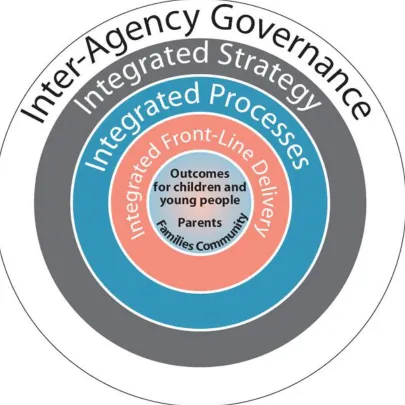
Some of the models of integration put forward in the literature are one-dimensional, focusing on information sharing, or co-planning, for example, some depict the extent of collaboration and others how co-working is organised. Yet others approach the topic from multiple aspects, thus exploring integration at different levels and/or distinguishing processes and structures. A recent example of this is the Every Child Matters’ “onion” model, which depicts integration across all layers or levels, from the macro through the meso to the micro, thus arguing for the need to merge activities on every level in order to achieve the highly
desirable optimal synthesis. A valid criticism of this model raised by Robinson and partners in 2008 is that even though it appears to place service users at the heart of the model
[image:40.612.121.526.177.582.2]diagrammatically, it only raises outcomes for children and families rather than highlighting them as co-workers or co-participants within the integration process. (See diagram below from www.everychildmatters.gov.uk)
Figure 2 Every Child Matters, the 'onion model'
Puonti, 2004). However, few authors make use of organisational theory (Birchall and Hallett, 1995 and Farmakopoulou, 2002). This signifies a mosaic of approaches that adds an extra layer of complexity to the matter and/or another dimension where diversity appears.
Themes such as collective responsibility, interdependency, sustainability, communication, cooperative planning and integration of processes lend themselves as dimensions for evaluating amalgamation (Robinson et al, 2008). The latest trend evident in the wider narrative in health and welfare is a strong focus on involving service users (participation) and sustaining partnering ventures (Miller and McNicholl, 2003 and DCSF, 2007). Therefore, the language is shifting from discussing outcomes for users to viewing them as co-participants, which is in line with an overall international recognition of the need to involve users and carers as experts in their own right and to encourage and enable their full participation across the board.
Consequently, this thesis will not adopt a pre-set or “a priori” definition in so far as it is exploratory in nature and thus open to investigating what the Greek system is like according to the respondents and the available literature, rather than setting out to look for something tightly predetermined. As a result, ambiguities and ambivalences regarding conflicting or overlapping definitions can be avoided.
2.2 Policy/Macro-Level, Is it Political Wisdom or Political Jargon?
“...it is hard to find a policy or guidance document that does not promote coordination of services and collaboration of workers” (Payne, 2008:27).
Even as a policy objective aiming to improve the somewhat fragmented picture, offer a more holistic response to complex social problems, and increase efficiency, collaboration remains elusive and harder to achieve in practice than was initially anticipated.
“Coordination is widely perceived both as an important objective and an important problem. It has been a central plank of government policy and an important part of professional rhetoric in this field for years, since before the cataclysmic impact on the social work world of the Maria Colwell inquiry which reported in 1974” (Birchall and Hallett, 1995: 2).
Even though the importance of collaboration was recognised more than 30 years ago and it is seen as mandatory for good child protection outcomes, repeated failures to achieve such practice have been highlighted as contributing factors in the majority of inquiries into child deaths. The theme has been reoccurring from the inquiry into Maria Colwell’s death in 1974 to the death of Victoria Climbie in 2000, which could indicate that multi-disciplinary working is in practice harder to perfect than was originally anticipated. “A wide range of issues from
organisational and occupational sociology are pertinent, as well as a variety of legal,
administrative, financial and technical opportunities and constraints.” (Birchall and Hallett, 1995: 3) Therefore, achieving interagency cooperation, which appears straightforward at a policy level, seems extremely complicated at the grassroots level.
However, Anning and partners in 2006 raised the significance of taking into consideration the macro level when examining an initiative. The macro level can be understood as regional or even national. In child protection in England, there is a strong top-down impetus