2017 International Conference on Mathematics, Modelling and Simulation Technologies and Applications (MMSTA 2017) ISBN: 978-1-60595-530-8
Configuration Design and Modeling Simulation of Welding Double-layer
Synchronous Crumple Collision Energy-absorbing Structure
San-chuan ZHANG, Jun-zhi CHENG and Xia LI
College of Mechanical Engineering, Zhengzhou University, Zhengzhou 450001, China
Keywords: Automobile design, Collision energy-absorbing structure, Welding double-layer thin-wall rectangular tube, Energy-absorbing efficiency.
Abstract. In order to solve the problem of miniaturized fuel vehicle or pure electric vehicle with small space, so thatit is not possible to install the traditional collision-absorbing structure, a kind of thin-wall rectangular tubular energy-absorbing structure configuration, which is by welding Q420 and aluminum alloy, is designed. The geometric model that be modeled by SolidWorks is imported into LS-DYNA software for orthogonal marshalling simulation test and analysis of significant structural parameters. And then, the theory equations of the energy-absorbing efficiency and
structural parameters is deduced by the least square method. The results show that the energy absorption efficiency can be 85%, when the structure length is only about half of the traditional single layer structure. The wall thickness of inner or outer layers and length are two significant factors that influence the absorption efficiency. In a certain range, the absolute error of theoretical calculation and simulation results is less than 5%, The equation has obvious effectiveness.
Introduction
In recent years, the research on the energy-absorbing structural characteristics of thin-walled tubes mainly focuses on the crack effect[1], multi-cell structure[2] and double-layer structure[3], and the periphery of thin-walled tube wrapped glass fiber or kenaf fiber[4,5] or interlayer filled with carbon fiber honeycomb core [6]. It is beneficial to improve the efficiency of energy absorption and enhance the crashworthiness of the vehicle.
The energy absorption structure of cross section shape, wall thickness, length have a significant impact on the collapse mode [7]. But as the passenger vehicle to the intelligent and miniaturization direction. It is urgent to research and develop a new type of energy absorbing structure with short crushing deformation displacement.
Energy Dissipation Principle of Vehicle Collision
Taking the frontal collision of the vehicle as an example. When the stress acting on the metal tube material exceeds the yield stress, the energy absorbing structure form folds, horizontal development and gradual compaction. The energy dissipated by the energy-absorbing structure during deformation is the sum of the bending energy and the tensile energy of the axial plastic hinge [8]. The relationship between the load and the amount of collapse deformation is shown in Fig.1.
Figure1. The general collapse deformation process of energy absorption structure.
∙ ∙ . (1) where, is the axial loading, is structure length of the axial collapse.
It can be seen from Eq.1 that the longer the axial crush deformation length, the more favorable it is for improving the collision safety of the vehicle. Therefore, the energy-absorbing structure should be designed as long as possible to ensure that the Euler instability does not occur.
Configuration and Simulation of Welding Double-layer Energy-absorbing Structure Cross Section Shape
[image:2.612.92.519.281.340.2]The circumference and length of the three thin-walled tubes. Its energy absorption characteristics as shown in Table 1 (already a separate text, not repeat them here). Circular and bellows are relatively easy to instability. And the instantaneous peak force of collision is much higher than the rectangular cross-section. Therefore, the design uses a rectangular cross-section pattern and is configured as a nested rectangular cross-section pattern for the inner and outer layers.
Table 1. Energy absorption characteristics of three cross-section energy-absorbing structures.
Cross-section Indicators
Energy-absorbing Efficiency, % Whether the deformation is stable or not Peak Force, kN
Circular 80.45 not 880
Bellows 83.45 not 800
Rectangular 85.71 yes 420
Double Layer Structure of Non-stiffened Plate Connection
A double layer is made to reduce the original length of the energy absorption structure. In the collision process, the inner and outer layers have collapse deformation to energy absorption. The energy absorption efficiency and peak stress are improved to a certain extent by the step-by-step deformation of stiffened plate connection double-layer energy structure by literature [3]. However, the stiffeners will interfere with the collapse deformation of the inner and outer layers during the collision process, and the energy-absorbing unable achieve better results. Therefore, the design uses a double-layer independent deformation absorbing structure with a non-stiffened plate connection.
Configuration and Modeling of Welding Double-layer Energy-absorbing Structure
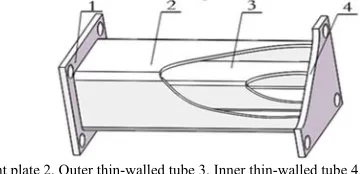
In order to reduce the protection of the spacing between the inside and outside the tube and the accuracy of the installation of the coaxiality, a double-layer structure with end plate welded design is proposed. Its geometry structure is shown in Fig.2.
1. Front plate 2. Outer thin-walled tube 3. Inner thin-walled tube 4. Rear end plate
Figure 2. Welding double-layer thin-walled rectangular tube energy-absorbing structure.
According to the target model needs. Using SolidWorks software to make vehicle collision modeling, including rigid walls, bumpers, energy-absorbing structure and vehicle weight, etc., as shown in Fig.3, then imported into HyperMesh for grid division and loading processing.
The overall model uses shell units, with a total of 14834 grids and 15467 nodes. The average value of the grid size is 4mm. The initial velocity of 50 / is loaded axially and the gravity acceleration g is loaded vertically. Simulation time is 0.08s. The internal and external materials are
[image:2.612.203.383.517.604.2]Figure 3. Grid model. Table 2. Material properties.
Material Name 10Density,-6 /
Elastic Modulus, Yield Strength, Tensile Strength,
Poisson's Ratio
Aluminum 2.81 71 455 780 0.33
Q420 7.85 210 420 634 0.3
Simulation Test
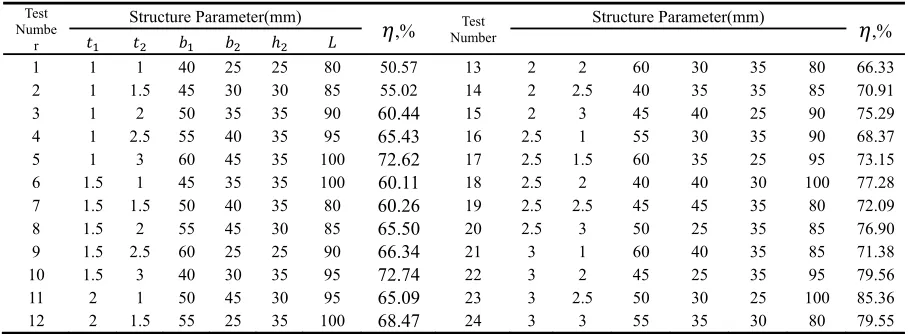
There are seven structural parameters in the double energy absorption structure. It is suitable to adopt the orthogonal experimental method. Limiting the length 100mm, the long side of the outer tube is taken as 40mm. A combination of 25 groups of structural parameters and simulation results, as shown in Table 3, is designed for 6 factors and 5 level orthogonal test. where, is the length, is the long side of the tube cross section, is the short side of the tube cross section, is the thickness, i 1 indicates the outer layer and i 2 indicates the inner layer, is the energy-absorbing efficiency. It can be seen from Table 3 that the energy absorption efficiency of No. 23 was the highest, up to 85.36%. And its axial length is 100mm reduce by half compared with tradition, and the outer section size is moderate, which meets the design requirement.
Table 3. Orthogonal experimental structure parameter combination and simulation results table.
Test Numbe
r
Structure Parameter(mm)
,% Number Test Structure Parameter(mm) ,%
1 1 1 40 25 25 80 50.57 13 2 2 60 30 35 80 66.33 2 1 1.5 45 30 30 85 55.02 14 2 2.5 40 35 35 85 70.91
3 1 2 50 35 35 90 60.44 15 2 3 45 40 25 90 75.29
4 1 2.5 55 40 35 95 65.43 16 2.5 1 55 30 35 90 68.37
5 1 3 60 45 35 100 72.62 17 2.5 1.5 60 35 25 95 73.15
6 1.5 1 45 35 35 100 60.11 18 2.5 2 40 40 30 100 77.28
7 1.5 1.5 50 40 35 80 60.26 19 2.5 2.5 45 45 35 80 72.09
8 1.5 2 55 45 30 85 65.50 20 2.5 3 50 25 35 85 76.90
9 1.5 2.5 60 25 25 90 66.34 21 3 1 60 40 35 85 71.38
10 1.5 3 40 30 35 95 72.74 22 3 2 45 25 35 95 79.56
11 2 1 50 45 30 95 65.09 23 3 2.5 50 30 25 100 85.36
12 2 1.5 55 25 35 100 68.47 24 3 3 55 35 30 80 79.55
Simulation Test Results Analysis and Design Theory
Obviously, the overall energy-absorbing efficiency of the double-layer energy-absorbing structure depends on the synergy of the two layers of internal and external structures in the process of collapse. In order to establish the design theory and method, the influence rule of the inner and outer layer structure parameters and their combination methods on the overall energy-absorbing efficiency of the structure must be further discussed.
Influence of Structural Parameters on Significance
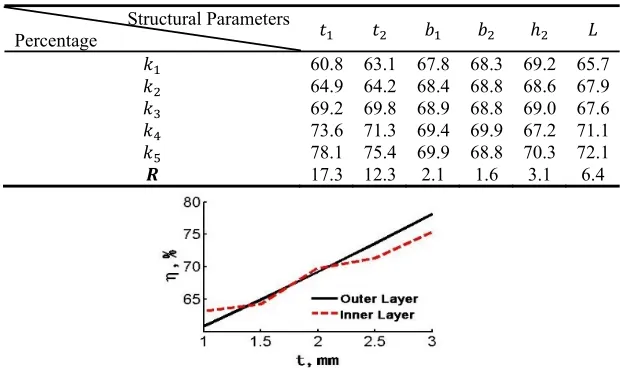
[image:3.612.79.533.428.595.2]Table 4. Influence Weight of Structural Parameters on Energy-absorbing Efficiency Unit: %.
Structural Parameters Percentage
60.8 63.1 67.8 68.3 69.2 65.7 64.9 64.2 68.4 68.8 68.6 67.9 69.2 69.8 68.9 68.8 69.0 67.6 73.6 71.3 69.4 69.9 67.2 71.1 78.1 75.4 69.9 68.8 70.3 72.1
17.3 12.3 2.1 1.6 3.1 6.4
Figure 4. Relation figure of wall thickness and energy-absorbing efficiency.
The comparison of data from Table 4 shows that: the main factors affecting the energy- absorbing efficiency are as follows: , , . The effect of thin-walled thickness on energy absorption efficiency is shown in Fig.4. As the outer wall thickness increases, the energy absorption efficiency increases linearly. However, the energy absorption efficiency of the inner tube increases with the jump of the stage. Therefore, the change of the wall thickness of the inner tube has a great influence on the energy-absorbing efficiency of the whole structure.
Structural Design Theory
Using the average stress model of a single-layer square tube [9], the average stress of a welded double-walled thin-walled rectangular tube :
∑ 13.06 . (2) where, is the correction parameter of outer tube or inner tube, is the characteristic stress of outer tube or inner tube material, which can be expressed as [10]:
. (3) where, is the yield stress of the material, is the ultimate stress of the material, and is the strain rate index of the material. In this article, 0.101.
From Eq. 1 and Eq. 2, can be obtained by the total absorption energy of thin-walled tube:
∑ 13.06 . (4) where, is the effective collapse length.
Using the least-squares method to rewrite Eq. 4 as:
⋯ . (5) where, 、 、… is a multivariate function about x, and the structure is known.
, … is the coefficient to be sought. Combined with the measured data. Find out:
=4.1755, 4.5776
. . .
. (6)
where, is the quality of the automobile. is the initial speed of the car. and are the power exponents of the thickness and half of the circumference of the cross section, respectively. is the material strain rate indices of the outer and inner tubes, respectively.
Energy absorption structure of the general shape of the cross-sectional size of 50mm × 40mm, so the E.q10 can be changed to:
. . .
. (7) Fig.5 is the inner and outer two layers spacing d and energy-absorbing efficiency relationship curve about the third group of Table 3. When it reaches a certain value, the energy -absorbing efficiency is basically maintained at around 80%. Obviously, the structure of the energy-absorbing structure of the inner tube size parameters should satisfied:
[image:5.612.93.375.272.353.2]35 45 ,25mm 35 . (8)
Figure 5. Relation of influence of inner and outer space on energy-absorbing efficiency.
Example Verification
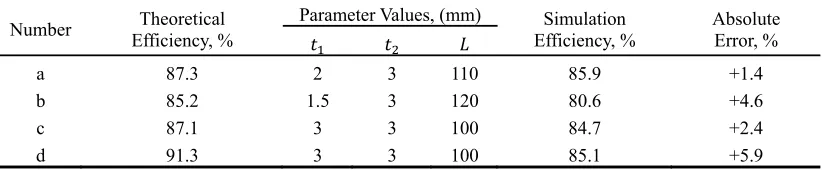
Assuming that is 85%, the relevant structural parameters are obtained from Eq.7 and Eq.8 and take the integer values. Substituting the value of the integer into Eq.10 to calculate the actual theoretical energy-absorbing efficiency. And compared it with the verified energy absorption efficiency obtained by the direct simulation with the structural parameter model to find the absolute error value. The results are shown in Table 5.
It can be seen from Table 5. The absolute error between the theoretical calculation efficiency of directly calculated to determine the double collapse energy structure parameters and the simulation verification efficiency that according to the set energy efficiency of 85% is up to 5.9%. However, the absolute error between the theoretical calculation efficiency of the wall thickness of 1 *thickness 2* structure length are 2 * 3 * 110, 3 * 3 * 100 respectively and the verification efficiency is smaller. Show that Eq. 8 has the design reference meaning.
Table 5. Comparison between the evaluation of formula and the actual simulation.
Number Efficiency, %Theoretical Parameter Values, (mm) Efficiency, % Simulation Absolute Error, %
a 87.3 2 3 110 85.9 +1.4
b 85.2 1.5 3 120 80.6 +4.6
c 87.1 3 3 100 84.7 +2.4
d 91.3 3 3 100 85.1 +5.9
Main Conclusions
1) Using Q420 and aluminum alloy as inner and outer layers materials of double-layer collapse energy-absorbing structure. The differential yield strength synergy can significantly reduce the peak collision load while meeting the demand of overall energy absorption efficiency.
0 5 10 15
50 60 70 80 90
d,mm
[image:5.612.101.512.566.651.2]2) Double-layer thin-walled rectangular tubular energy-absorbing structure with welded non-stiffened plates can be shortened by nearly half of length and the energy-absorbing efficiency can still reach 85%. The configuration structure use small installation space and simple structure.
3) The results of orthogonal test simulation results were significantly analyzed. The parameter formula of the energy absorption efficiency is derived. Within a certain range, the theoretical calculation is in good agreement with the comprehensive anti-fidelity result, which is of reference value to the development of energy absorption structure of short collapse stroke.
Reference
[1] Nia A. Alavi, H. Badnava, K.H. Fallah Nejad. An experimental investigation on crack effect on the mechanical behavior and energy absorption of thin-walled tubes [J]..Materials and Design, 2011, Vol. 32 (No.6): 3594-3607.
[2] Zhang Xiong, Cheng Geng Dong.A comparative study of energy absorption characteristics of foam-filled and multi-cell square columns[J].International Journal of Impact Engineering, 2007, Vol. 34(N-O. 11): 1739-1752.
[3] Dong Xiwen, Kang Guozheng, Zhu Zhiwu. Optimization of Double-layer Hierarchical Energy Absorbing Structure [J]. Journal of Xihua University, 2014, (06): 37-41. (in Chinese)
[4] K.H. Kim, K.C. Shin, etal. Axial Crush and Energy Absorption Characteristics of Aluminum /GFRP Hybrid Square Tube [J]. Key Engineering Materials, 2000, Vol. 183-187 Part 2: 1147-1152. [5] K.C. Shin, J.J. Lee, et al. Axial crush and bending collapse of an aluminum/GFRP hybrid square tube and its energy absorption capability [J]. Composite Structures, 2002, Vol. 57(NO.1-4): 279-287.
[6] J.S. Kim, H.J. Yoon, et al. Experimental Investigation of Composite Sandwich Square Tubes under Quasi-Static and Dynamic Axial Crushing [J]. Advanced Composite Materials, 2011, Vol. 20(No.4): 385-404.
[7] W. Abramowicz, N. Jones. Dynamic axial crushing of square tubes [J]. International Journal of Impact Engineering, 1984, Vol. 2 (No.2): 179-208.
[8] J.M. Alexander. An approximate analysis of the collapse of thin cylindrical shells under axial load [J]. Quart Journal of Mechanics Applied Math, 1960, 13(1): 10-15.
[9] W. Abramowicz, N. Jones. Dynamic progressive buckling of circular and square tubes. Int J Impact Eng 1986; 4(4): 243–70.