© 2016, IRJET ISO 9001:2008 Certified Journal Page 1551
EXPERIMENTAL STUDY ON PARTIAL REPLACEMENT OF CEMENT
WITH MINERAL ADMIXTURES AND SAND WITH QUARRY DUST
Veeresh Hiremath
1, Prof .Venu R .Patil
21
Dept of Civil Engineering, JCE Belagavi, Karnataka, India
2
Professor, Dept of Civil Engineering, JCE Belagavi, Karnataka, India
---***---Abstract -
Concrete is most important in construction field.The replacement of some materials such as cement, sand and coarse aggregates etc. may change the compressive strength of concrete by various parameters. In recent years many research work has been carried out in order to get good strength and durability of concrete. For M30 grade of concrete,
the replacement of cement is done by adding fly ash and micro silica with different proportions varying from 0% to 15%. Also the fine aggregate is replaced with different proportions of quarry dust varying from 0% to 15%. In this present study, experimental work has been carried out for four mixes of different proportion of concrete with fly ash, micro silica and quarry dust. These specimens are prepared and tested after different ages of curing i.e. 3,7,14 and 28 days and the effect of these materials on concrete is studied.
Key Words: Fly ash, Micro silica, Quarry dust, Partial replacement, compressive strength etc.
1. INTRODUCTION
The concrete having strength more than 40Mpa is termed as high strength concrete. In India the high strength concrete is used for pre stressed concrete bridges the first bridge in India was built in 1949 for the Assam rail link at Siliguri. The water cement ratio of high strength concrete should be in the range of 0.35 to 0.40 or even lower. To achieve maximum water reduction in high strength concrete use high range water reducers. The manufacturer of high strength concrete should ensure that the good bond strength between cement paste and aggregate, strength of aggregates, surface characteristics and size of aggregate. These properties of aggregates varies the ultimate required compressive strength. Good ensuring of these properties leads the manufacturer in achieving the concrete of high strength.
1.2 Fly ash:
Fly ash or pulverized-fuel ash, which is the ash precipitated electrostatically or mechanically from the exhaust gases of coal-fired power stations, is another pozzolana which is
beneficial in this aspect even though it has been mentioned that it is not as effective as the silica fume. In the production of cement the fly ash is used. It is also used as a filling material in dams, as a sub base and base material in highway constructions, in retaining walls and also as light weight construction material. The pozzolanic properties and filler property of fly ash enhance the characteristics of the both mortars and concrete similar to other pozzolana material. The incorporation of class F fly ash into concrete helps in the removal of calcium hydroxide, as a result it enhance the sulphate resistance characteristics of the concrete. Similarly, fly ash concrete has high resistance to sulphate attack. Besides that, the reduced permeability of mature concrete prepared with fly ash results in a reduced chloride ingress. The concrete prepared using fly ash have good workability because of reduction in temperature of hydration, enhanced flow ability, and increase in setting time. The filler property, reduction of water and energy consumption, and reduction of gases that cause green house effect are the major positive environmental factors that can be achieved by using fly ash. To produce one ton of cement approximately one ton of carbon dioxide is emitted which can be controlled by using fly ash as replacement to cement.
1.3 Micro silica:
© 2016, IRJET ISO 9001:2008 Certified Journal Page 1552
1.4 Quarry dust:
In stone quarries while in the process of crushing the stones in crusher units, waste material or dust is abundantly deposited known as quarry dust which can be effectively used as an replacement to conventional fine aggregate in concrete production. Earlier investigation indicates that stone crusher dust has a good potential as fine aggregate in concrete construction. The quarry dust which generally referred as waste product helps in reducing the cost of building and also reduced impact on environment. Crusher dust has potential as fine aggregate in concrete structure with a reduction in cost of concrete by about 20 percent compared to conventional concrete.
1.5 Objective:
The primary aim of this project is to study the behavior of high strength concrete by partial replacement of ordinary cement with mineral admixtures (fly ash and micro silica) and fine aggregate (natural river sand) with quarry dust. Finally the Compressive strength, Split/Indirect tensile strength and Water absorption of concrete mix is calculated and the results are studied. Also the aim is to determine the optimum dosage of micro silica, fly ash and quarry dust as replacement material to attain the highest compressive strength of concrete. And durability of concrete is also studied by Alkalinity test of concrete by using Phenolphthalein indicator solution.
2. MATERIALS AND ITS TESTING:
Table 2.1 Tests on materials
Name of the
material Tests obtained Results
Cement
Specific Gravity 3.12
Fineness test 6.33%
Fly ash
Specific Gravity 2.13
Fineness test 8%
Micro Silica Specific Gravity 2.16
Fine
Aggregate Fineness modulus of Specific Gravity 2.73
fine aggregate Zone II
Quarry Dust Specific Gravity 2.16
Fineness modulus of
quarry dust Zone II
Coarse
aggregate Aggregate crushing Specific Gravity 2.74
value 21.93%
Aggregate impact
value 36.23%
3. METHODOLOGY:
3.1 Introduction
Here partial replacement of cement by micro silica and fly ash with0% to 15% and fine aggregate by quarry dust with 0% to 15% is done respectively. The M30 grade of concrete is adopted for the present study. The properties of M30grade concrete are enhanced by adding mineral admixtures. The concrete test specimens were prepared, cured and finally the mechanically properties are test as compressive strength, Indirect/split tensile strength and water absorption for each proportion is tested and the results are studied. Alkalinity of all these four different mixes is analyzed by using Phenolphthalein indicator solution. In this work a total of four different mixes proportions of concrete are prepared using cement, fine aggregates, coarse aggregates, micro silica, fly ash and quarry dust (0% to 15%) on which the experimental study is carried out.
The following mixes are prepared for current study: Table 3.1 Mix Details
Mix Designation Percentage Replacement for cement and sand
Mix 1 M1 100% OPC + 100% S
Mix 2 M2 (90% OPC + 5% FA + 5% MS) + (95% S + 5%QD)
Mix 3 M3 (80% OPC + 10% FA + 10% MS) + (90% S + 10%QD)
Mix 4 M4 (70% OPC + 15% FA + 15% MS) + (85% S + 15%QD)
s
Table 3.2 Mix proportions for trial number
1 Cement 350 kg/m3
2 Fine aggregate 848.48 kg/m3
3 Coarse aggregate 1176.008 kg/m3
4 Water 140 kg/m3
5 Superplasticizer 7 kg/m3
© 2016, IRJET ISO 9001:2008 Certified Journal Page 1553 Table 3.3 Mix proportion
Cement Fine
Aggregate Aggregate Coarse Water 350 kg/m3 848.48 kg/m3 1176 kg/m3 140 kg/m3
1 2.424 3.360 0.4
3.2 Preparation of test specimens:
The test specimens were casted in cast-iron steel moulds. And oil is applied for the interior portion of the mould for easy demoulding. The ingredients were weighed on a digital balance and placed in pan mixer machine for mixing in dry condition. It was ensured that a uniform color of the mix was obtained before adding water. Water is added for correct quantity using measuring jar. Proportioning of a concrete mix means determining the relative amounts of materials (cement, aggregate, water) required for batches of concrete for required strength. The investigation was carried out with standard mix M30 with water/cement ratio 0.40.
3.3 Tests on fresh concrete:
Slump cone test
3.4 Tests on Hardened concrete:
Compressive strength test
Split tensile test
Water absorption test
Alkalinity test
Density calculation
4. RESULTS AND DISCUSSION
4.1 Slump cone test:
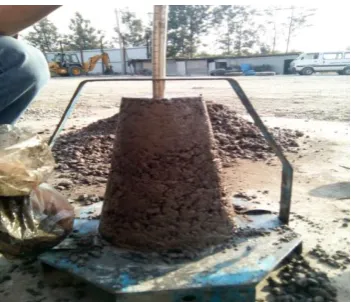
[image:3.595.320.542.268.425.2]Fig 4.1 Slump cone test
Concrete Mixes Slump in mm
Mix 1 35 mm
Mix 2 10 mm
Mix 3 10 mm
Mix 4 10 mm
The slump value of Mix 1 is 35mm whereas for Mix 2, Mix 3 and Mix 4 it is 10mm. The slump value is decreased by addition of mineral admixtures to the concrete. It indicates that the concrete has low workability.
4.2 Compressive strength test:
Fig 4.2 Compressive strength test Concrete
Mixes N/mm3 Days 2
7 Days N/mm2
14 Days N/mm2
28 Days N/mm2
Mix 1 17.10 21.77 23.83 33.84
Mix 2 21.47 23.10 28.04 38.07
Mix 3 16.42 19.18 25.99 30.52
Mix 4 15.98 18.36 23.68 28.77
[image:3.595.68.244.586.737.2]© 2016, IRJET ISO 9001:2008 Certified Journal Page 1554
4.3 Split tensile test:
[image:4.595.317.555.231.460.2]Fig 4.3 Split tensile test Concrete
Mixes N/mm3 Days 2
7 Days N/mm2
14 Days N/mm2
28 Days N/mm2
Mix 1 1.508 1.532 1.697 2.145
Mix 2 1.626 1.697 2.546 3.06
Mix 3 1.532 1.579 2.239 2.828
Mix 4 1.579 1.603 1.885 1.956
It can be observed from the results that the split tensile strength of reference concrete i.e. mix 1 is 1.508 N/mm2, 1.532 N/mm2, 1.697 N/mm2 and 2.145 N/mm2 for 3,7,14 and 28 days respectively. Where as for mix 2 is 1.626 N/mm2, 1.697 N/mm2, 2.546 N/mm2 and 3.06 N/mm2 for 3,7,14 and 28 days respectively. The percentage increment for mix 2 is 7.82%, 10.77%, 50% and 42.65% for 3,7,14 and 28 days compared to reference mix 1. For further increment in the percentage of mineral admixture and quarry dust, there is decrease in split tensile strength for 3,7,14 and 28 days. The strength is increased because of the high Pozzolanic nature of micro silica.
4.4 Water absorption test:
Concrete
Mixes 3 Days 7 Days 14 Days 28 Days
Mix 1 1.386 % 1.644 % 1.500 % 1.540 %
Mix 2 1.829 % 1.577 % 1.279 % 1.439 %
Mix 3 1.817 % 1.608 % 1.919 % 1.207 %
Mix 4 2.246 % 1.813 % 1.936 % 1.795 %
It can be observed from the results that the percentage of water absorption increases slightly as the percentage of fly ash, micro silica and quarry dust increases. In mix 2 and mix 3 there is decrease in water absorption considerably. The highest water absorbed cube is 2.246% which is mix 4 at 3 days and lowest water absorbed cube is mix 3 at 28 days i.e.1.207%.
4.5 Alkalinity test:
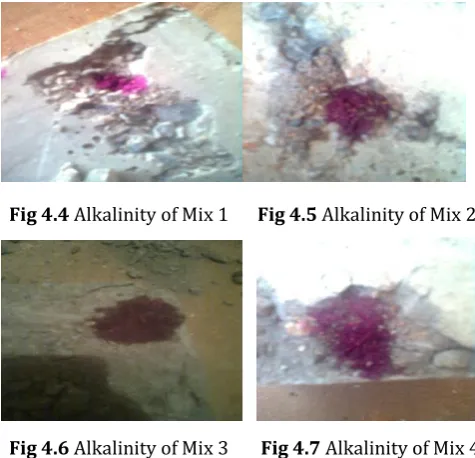
Alkalinity test is carried out by using phenolphthalein indicator. First the concrete cubes or cylinders are tested in a compression testing machine and taken out from the machine. Then 2 to 3 drops of Phenolphthalein indicator are sprayed on the portion of concrete surface where it fails. The change in colour in that portion of concrete indicates the amount of alkalinity.
Fig 4.4 Alkalinity of Mix 1 Fig 4.5 Alkalinity of Mix 2
Fig 4.6 Alkalinity of Mix 3 Fig 4.7 Alkalinity of Mix 4
Concrete
Mixes Range of Alkalinity Remarks
Mix 1 Colour less to purple Moderate alkaline
Mix 2 Colour less to purple Moderate alkaline
Mix 3 Colour less to violet red Severe alkaline Mix 4 Colour less to light
purple Mild alkaline
It can be observed that the concrete mixes has alkalinity by observing the color change i.e. colorless to light purple indicates mild, colorless to purple is indicates moderate and colorless to violet red is indicates severe alkalinity. The alkalinity of concrete should be more than 8 for good concrete. If the pH Value of concrete is above 12 this leads to low corrosion in concrete.
4.6 Density of cubes:
Concrete
Mixes 3 Days kg/m3 7 Days kg/m3 14 Days kg/m3 Days 28
kg/m3
Mix 1 2561.97 2522.46 2559.99 2562
© 2016, IRJET ISO 9001:2008 Certified Journal Page 1555
Mix 3 2394.06 2417.77 2423.69 2567.89
Mix 4 2372.34 2376.29 2423.7 2423.69
It can be observed from the results that the reference concrete mix 1 has more density than other mixes at all ages the densities of mix 1 concrete are 2561.97 kg/m3, 2522.46 kg/m3, 2559.99 kg/m3 and 2561.97 kg/m3 for 3, 7, 14, and 28 Days. The densities of mix 2, mix 3 and mix 4 are decreased compared to that of reference mix 1. This is due to the presence of micro silica, quarry dust and fly ash. The highest density of cube is mix 3 at 28 Days i.e. 2567.89 kg/m3. The density of Mix 2, Mix 3 and Mix 4 concrete is decreased due to light weight of micro silica and fly ash. The decrease in a density indicates that decrease in the dead load of the structure.
4.7 Density of cylinder:
Concrete
Mixes 3 Days kg/m3
7 Days kg/m3
14 Days kg/m3
28 Days kg/m3
Mix 1 2332.82 2349.11 2324.39 2366.59
Mix 2 2326.78 2314.21 2341.06 2327.29
Mix 3 2306.60 2301.76 2360.68 2174.74
Mix 4 2284.53 2277.87 2290.82 2351.81
It can be observed from the results for cylinder also reference concrete mix 1 has a more density than other mixes the densities of mix 1 are 2332.82 kg/m3, 2349.11 kg/m3, 2324.39 kg/m3 and 2366.59 kg/m3 for 3, 7, 14 and 28 Days. The highest density of cylinder is mix 1 at 28 Days i.e. 2366.59 kg/m3.
5. COST ANALYSIS:
Concrete mixes Total cost per m3
Mix 1 4738.72
Mix 2 4902.75
Mix 3 5066.77
Mix 4 5230.81
6. CONCLUSION:
1. Mix 2 that is the replacement up to 5% micro silica, 5% fly ash and 5% quarry dust in place of cement and fine aggregate increases the compressive strength and split tensile strength when compared to mix 1 for M30 grade of concrete.
2. The percentage increase of compressive strength for mix 2 i.e. 5% micro silica, 5% fly ash and 5% quarry dust in place of cement and fine aggregate is 25.55%, 6.10%, 17.66% and 12.5%. Whereas for
split tensile strength is 7.82%, 10.77%, 50% and 42.65%. at 3,7,14 and 28 days.
3. For mix 3 and mix 4 there is decrease in compressive strength and split tensile strength at 3,7,14 and 28 days respectively as the percentage of mineral admixture and quarry dust is increased. 4. The compressive strength of mix 2 i.e. 5% micro
silica, 5% fly ash and 5% quarry dust in place of cement and fine aggregate at 28 days is 38.07 N/mm2 which is nearest to the target strength i.e. 38.25 N/mm2.
5. It can be observed that the modulus of rupture of concrete is increased compared to that of compressive strengths.
6. The alkalinity in concrete is increased after addition of mineral admixtures which will help in prevention of corrosion by providing a passivity around the reinforcement.
7. The density of concrete is decreased by addition of micro silica, quarry dust and fly ash to the concrete. This results in the production of light weight concrete.
8. Adding of mineral admixtures (micro silica and fly ash) to the concrete decreases slump value which leads low workability.
9. M30 grade concrete is normal strength concrete. Hence by adding mineral admixtures to the M30 grade concrete, it can be enhanced to high strength concrete.
7. SCOPE FOR FURTHER STUDIES:
1. Experimental work by using different grades of concrete with flexural strength test can be carried out.
2. Behavior of High strength concrete when subjected to freezing and thawing can be studied.
3. Experimental work using different mineral admixtures along with micro silica can be investigated.
4. Experimental work by keeping the percentage of fly ash as constant and vary the percentages of micro silica and quarry dust to check the strength of concrete.
REFERENCE:
1. Nilli M, Ehsani A, and Shabaani K, Influence of Nano-Sio2 and Microsilica on Concrete Performance,
January 2010.
© 2016, IRJET ISO 9001:2008 Certified Journal Page 1556 3. Dehwaah H.A.F, Mechanical properties of
self-compacting concrete incorporating quarry dust powder, silica fume or fly ash, Construction and Building Materials 26 (2012) 547–551, 2011. 4. Joseph O. Ukapata, Mauarice E. Ephraaim and
Godwin A. Akekee, compressive strength of concrete using lateritic sand and quarry dust as fine aggregate, Vol. 7, No. 1, January 2012.
5. Sudhira S.K and Satone S.R, junie. 2013, effect of quarry dust as partial Replacement of sand in concrete, Indian Streams Research Journal, ISSN:-2230-7850, Volume 3, Issue. 5, June. 2013. 6. Mudasira Hussain Pandita and Mrs. D. Renuka
Parameswari, High Density Concrete using fly ash, micro silica and recycled aggregate – an experimental study, (IJETT) – Volume 10 Number 1 - Apr 2014.
7. Xiao-Yong Wanga, Ki-Bonga Park, Analysis of compressive strength development of concrete containing high volume fly ash, Construction and Building Materials 98 (2015) 810–819, 2015. 8. Mehmete Gesogalu, ErhanaGüneyisi, Dilere Sabah
Asad, GulerFakhraddinMuhyaddin, Properties of low binder ultra-high performance cementitious composites: Comparison of nanosilica and microsilica, Construction and Building Materials 102 (2016) 706–713, 2015.
9. Ramana S. N, Zaine M. F. M, MahmudaM, H. B. and TaneK. S, Influence of Quarry Dust and Fly Ash on the Concrete Compressive Strength Development, 07 March 2016.
10. Ahmeda S. F. U., Properties of Concrete Containing Construction and Demolition Wastes and Fly Ash, © 2013 American Society of Civil Engineers.
BIOGRAPHIES:
Mr. Veeresh Hiremath, B.E, M. Tech
(Construction Technology). He received his Bachelor of Engineering degree in
Civil Engineering from Rural Engineering college Hulkoti in 2014. He is rite now pursuing his Master of
Technology in Construction Technology from Jain College of Engineering
Belagavi.
Prof. Venu R. Patil, B.E, M. Tech
(Structural Engineering). She received her Bachelor of Engineering Degree in Civil Engineering from KLECET Belagavi in 2011. In 2013 She received Her Master of Technology Degree in Structural Engineering from GIT Belagavi. She joined Jain College of Engineering Belagavi as a faculty. She worked as professor in Jain College of Engineering Belagavi for 2.5 years.