© 2015, IRJET ISO 9001:2008 Certified Journal Page 88
A Survey on Authentication System Using 2d Color Barcode
Roshan Varma
1, Sweta Pawar
2, Jaydeep Girase
3, Namrata Gaidhani
4Prof. Ashvini Y. Bhamare
51 UG Student, Dept. of Comp. Engg., BVCOE & RI, Maharashtra, India
2 UG Student, Dept. of Comp. Engg., BVCOE & RI, Maharashtra, India
3 UG Student, Dept. of Comp. Engg., BVCOE & RI, Maharashtra, India
4 UG Student, Dept. of Comp. Engg., BVCOE & RI, Maharashtra, India
5 UG AP, Dept. of Comp. Engg., BVCOE & RI, Maharashtra, India
---***---Abstract -
The propose designing mechanism of 2DColor Barcode for mobile applications. Color
components are used more for its aesthetic value than as a means to encode more data. Also by exploiting the spectral diversity afforded by the cyan (C), magenta (M), and yellow (Y) print colorant channels commonly used for color printing and the complementary red (R), green (G), and blue (B) channels, respectively, used for capturing color images. Specifically, to exploit this spectral diversity to realize a three-fold increase in the data rate by encoding independent data in the C, M, and Y print colorant channels and decoding the data from the complementary R, G, and B channels captured via a mobile phone camera. Here used interference cancellation algorithm based on a physically-motivated mathematical model for the print and capture processes. To estimate the model parameters required for cross-channel interference cancellation, two alternative methodologies: a pilot block approach that
uses suitable selections of colors for the
synchronization blocks and an expectation
maximization approach that estimates the parameters from regions encoding the data itself. Experimental results show that the proposed framework successfully overcomes the impact of the color interference, providing a low bit error rate and a high decoding rate for each of the colorant channels when used with a
corresponding error correction scheme. This
mechanism applied for 2DCBLogin (2D Color Barcode Login), one of the leading two factor authentication programs, which successfully balances security with convenience. It combines the traditional username and password with a time-sensitive, one time passcode. In contrast to this advanced security, users may conveniently login by scanning a code with their smartphone. Although the scanning feature of the 2DCBLogin system is limited to smart phone owners,
users may also login through the traditional ID and password method. The 2DCBLoginsystem illustrates the modern development of two factor authentication, which substantially increases the security of online transactions. Encourage further research cyber-security to foster consumer confidence and growth in online markets.
Key Words: 2D Color Barcode, OTP, Interference
Cancellation, Approval request, Authentication.
1. INTRODUCTION
A barcode is an optical device (machine)-readable illustration of information about the item to that it's connected. It’s used for tagging objects with identification and trailing data for automating sales and inventory trailing tasks. Originally barcodes described data by varied the widths and spacing of parallel lines, noted as linear or one-dimensional (1D). After they changed into rectangles, dots, hexagons and different geometric patterns in two-dimensions (2D). Common samples of 2-D barcodes include QR (Quick Response) code, Aztec code, data matrix, HCCB (High capability Color Barcodes) etc. These are used for the aim of facilitating access to on-line information concerning products and services publicized in print media. The URLs (Universal Resource Locator) for the online data can even be embedded inside the print and upon decoding, permit the users to access the information.
1.1 Style & Develop 2D Color Barcode
© 2015, IRJET ISO 9001:2008 Certified Journal Page 89 need a way longer code to secret writing larger quantity of
data tips like the worth, product name, manufacturer, practically, and expiration date of a product. Thus the 2D barcodes were designed to hold considerably a lot of knowledge than its 1D barcode. A scanner, like a charge coupled device (CCD) scanner, is mostly utilized in industries to scan a 2nd code. The analysis of camera phones might modification the present standing. Resolutions limit, distortion, out of focus blurring, and noise with illumination selection iatrogenic by the phone camera square measure the killers of direct use of most existing 2D code for mobile phones.
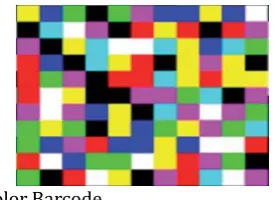
Fig -1: 2D Color Barcode
To resolve this downside by planning and through an experiment evaluating algorithms for retrieving digital knowledge from color cells by exploitation interference cancellation framework so on minimize their error rates. To perform associate experimental study of the sensible performance of many color classifiers and cluster. This permits to spot the foremost effective algorithms for secret writing color barcodes in terms of their error rate and their total running times.
Color Barcode for Mobile Applications, 2nd barcodes have gained quality mutually of the key pervasive technologies for mobile applications on good Phones. They will be used as shortcuts to computer address links, a way to store contact data for simple transfer admission tickets or boarding passes and tokens for retrieving digital data, like public transportation timetables or recent turn out production data, either directly from the barcode itself or through a networked info server. Most mobile applications use black-and-white 2nd barcodes that carry solely a restricted quantity of encoded knowledge. With exploitation a lot of colors here are able to store most quantity of knowledge within.
1.2 Interference Cancellation Framework
A color barcode framework for portable applications by exploiting the spectral diversity afforded by the cyan (C), magenta (M), and yellow (Y) print colorant channels ordinarily used for color printing and therefore the complementary red (R),green (G), and blue (B) channels, severally, used for capturing color pictures. Specifically, here have a tendency to exploit this spectral diversity to comprehend a three-fold increase within the rate by
coding freelance information within the C, M, and Y print colorant channels and decryption the information from the complementary R, G, and B channels captured via a portable camera. To mitigate the impact of cross-channel interference among the print colorant and capture color channels, here have to used interference cancellation algorithm for the print and capture processes. To estimate the model parameters needed for cross-channel interference cancellation, here have a tendency to propose two different a pilot block approach that uses appropriate alternatives of colors for the synchronization blocks associate degree an expectation maximization approach that estimates the parameters from regions coding the information. This Interference cancellation permits optimizing the information storage, addressing the necessity for top density barcodes.
Different from different color barcodes, the framework projected during this paper encodes information as freelance barcodes in C, M, and Y printing channels and doesn't write information within the color values of individual blocks. Here not only permits a physical model-based interference approach for up the decryption, however conjointly permits re-use of variety of
optimizations and enhancements developed for
monochrome barcodes. Thus, for instance, accommodative thresholding ways that handle variations within the illumination level and error correction committal to writing schemes developed for correcting typical errors encountered in barcode applications are directly applicable to individual colorant channels inside our projected framework. in addition, the projected framework’s approach of coding severally within the colorant layers conjointly provides higher strength to inter-colorant miss-registration in printing compared with typical approaches of coding in color, which can be terribly sensitive to miss-registration. Experimental results demonstrate that the projected framework is effective similarly as sturdy to decryption errors as a result of cross channel interference and therefore the barcodes supply glorious performance.
1.3 Application: 2DCBLogin
[image:2.595.90.228.249.349.2]© 2015, IRJET ISO 9001:2008 Certified Journal Page 90 additionally login through the standard ID and parole
methodology. The 2DCBLogin system illustrates the trendy development of two issue authentication that considerably will increase the protection of on-line transactions. To encourage additional analysis cyber-security to foster shopper confidence and growth in online markets.
As information technologies develop, users store additional personal info on-line, raising the importance of cyber-security. To encourage our analysis into authentication, here tend to 1st explore differing Types of security risks. Once characteristic the threats, here tend to analyze developments among the two issue authentication system. Specifically, here tend to have an interest within the use of good Phones to come up with a 1 Time parole
(OTP). Recent technological advances in
telecommunications have impressed the replacement of tokens with good phones, increasing the benefit of use and accessibility of OTP systems. To through empirical observation analyze these developments thorough, here tend to perform a case study of the 2DCBLogin, one in all the leading types of good phone OTP systems. Among our case study here tend to determine similarities and variations between the 2DCBLogin systems and ancient TP systems. for instance, rather than coming into a half-dozen to eight digit code generated by a novel token, the 2DCBLogin system permits users demonstrate themselves by scanning a 2D Color Barcode on the website/Mobile Device with their good phone. These new developments among telecommunications and two issue identification systems are considerably increasing the applying of security systems to guard personal information. Here expect innovative systems that connect good phones and private security like the 2DCBLogin system to play a significant role in developing safer user accounts and net transactions.
2. LITERATURE SURVEY
Douglas Chai, over the past few years, 2D barcodes have gained popularity as one of the key pervasive technologies for mobile applications on smartphones. they will be used as shortcuts to uniform resource locator links; a way to store contact information for simple transfer; admission tickets or boarding passes; and tokens for retrieving digital data, like public transportation timetables or recent produce production information, either directly from the barcode itself or through a networked database server.1 Most mobile applications use black-and-white 2D barcodes (such as QR codes or Data Matrix) that carry only a restricted amount of encoded data. Using 2D Color barcode, the color part is employed additional for its visual value than as a way to encode additional data. Two approaches will increase a 2D barcode’s data capacity: increasing data cell density by using additional cells
among a given symbol size or increasing the offered data symbol space by using additional colors [6].
Akash Bhalerao, online banking is one of the foremost vital tasks performed by web user. On-line banking is most crucial system within which the net user uses daily life. The user list of the online banking system has been increased in half-moon of 2009, the largely user who used the service per day was 26,410,000.The amount of dealings went on the far side 20 trillion 950 million. It has been observing increase within the number of users on a steep percentage .The most banks provide online banking procedures with 100% security. Most of the standard banks are providing new offer in online banking system with peace of mind‘[1].
Akash Bhalerao, the one-time password (OTP) is a password that is valid for only one time. OTP avoids short comings that are related to traditional or fixed password, the foremost necessary shortcoming being addressed by one time password (OTP). The softness of one time password system is to generate new password for each transaction and relies on two necessary factors: (1) a PIN to unlock the OTP generator, (2) the OTP smart card itself. within the server side, an ISSN: 2278 – 1323 All Rights Reserved © 2015 IJARCET 1063 authentication server can check the validity of password by sharing a similar algorithm and keys. There are several software system or devices is used to generate the OTP, as an example mobile phones. The authentication procedure starts by the users entering his user name. The OTP is send to user by SMS. Then receiving SMS by user and type OTP in browser. The AS cross check whether OTP is accurate or not and redirects the browser back to server supplier and user log in [1].
© 2015, IRJET ISO 9001:2008 Certified Journal Page 91 provide strong and reliable barcode reading. The database
2D barcode were at the start made-up to boost data capability for industrial applications. However, when integrated into mobile phones with inbuilt cameras that can scan and decode data, these 2D barcodes can operate as moveable databases, letting users access information anytime, anywhere, no matter network property. Currently allow us to move to important and popular 2D barcodes [3].
Jonathan M. McCune, here now discusses related work in using camera-equipped mobile phones to recognize barcodes. Many projects exist that request to permit camera-equipped mobile phones to move with physical objects through the utilization of 2D barcodes. Rohs and Gfeller developed their own 2D code explicitly to be used with mobile phones, action their ability to be scan from electronic screens and printed paper. Woodside developed semacodes that is associate implementation of the Data Matrix barcode standard for mobile phones. Woodside considers the first application of semacodes as containers for a URL that contains information concerning the physical location where the barcode was installed. It used SpotCodes to enhance (HCI) human-computer interaction by using a camera-phone as a pointing and choice device. Researchers functioning on the CoolTown project at H.P. Labs proposed tagging electronics around the house with barcodes to be scan by camera phones or PDAs so further data concerning the tagged device could be simply retrieved [4].
Hiroko Kato, camera phones have permeated into our everyday lives, the 2D barcode has attracted researchers and developers as a cost-effective present computing tool. A variety of 2D barcodes and their applications are developed. Nevertheless, they need not been wide used. A possible limitation is their irresponsibility in terms of usability and robustness. Increasing data capability is one of the solutions that address both issues since it helps give a wider type of applications and improve the robustness using further data capability for error detection and correction. A way of achieving this is to use color symbols for encoding data. However, using a larger multitude of colors introduces issues that can negatively have an effect on the robustness of barcode reading. This can be very true when developing a 2D barcode for mobile devices [5]. Douglas Chai, as for using a lot of colors, it’s well documented that correct color identification is a difficult task, particularly for mobile applications that haven't any control over the operational environment. Different lighting conditions, as well as different barcode reading devices, result in totally different colors identified within the same barcode. Moreover, different resolution cameras across different smartphones, as well as the phones’ image compression techniques, smudge the colors on the borders of adjacent data cells. This additional complicates the task of correctly identifying barcode colors, which is why so few color 2D barcodes so far use more than four
colors. Though some of the challenges in developing a color 2D barcode for mobile applications are common to the development of different types of barcodes, others are specific to the use of colors and even additional so in mobile applications [6].
3. SYSTEM OVERVIEW
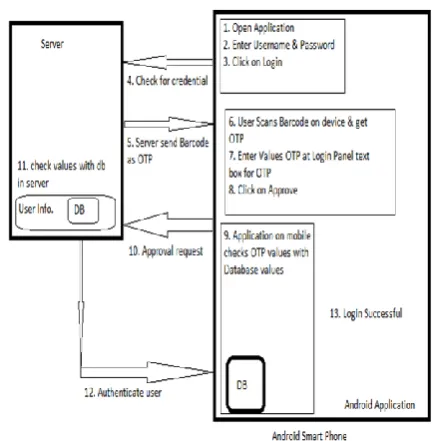
Fig -2: OTP Login Process with Mobile Phone
Following steps are working of system:-
1. Open Application: At a starting stage open the application for registration and further processing. 2. Enter the Username and password : After opening the
application here enter the username and password for logging purpose
3. Click on Login: after filling information here click on login.
4. Check for credential: check the process are in correct form or not
5. Server send Barcode: after that server generate automatic barcode with data send via mail id to user using OTP method
6. Users scan barcode on device &get OTP: User scan barcode using our system for authentication process. 7. Enter the values at login panel text box on Approve:
After a scanning a particular barcode here get secure code for authentication purpose these values are insert in identification box for authentication.
8. Click on approval: for users are correct or not here check this process by approval.
[image:4.595.322.539.197.418.2]© 2015, IRJET ISO 9001:2008 Certified Journal Page 92 sending via mail these secure code are matched with
our server generated code.
10. Approval request: after a scanning particular barcode user send approval request to server for verifying process.
11. Check values with db server: if scan code are matched with our server generated code then our authentication process are done means here authenticate our user. Means approval user or client. 12. Authenticate user: When server generated code are
matched with user sending code and send an approval request to server then here authenticate our user. 13. Login successful: After completing our all process here
authenticate our user then user login process are successfully done.
4. MATHMATICAL MODEL
4.1 Pilot Block Approach
Where, is the captured image value corresponding
to the substrate in the channel and .
An estimate isthen calculated from these observed values.
4.2 EM Type Approach
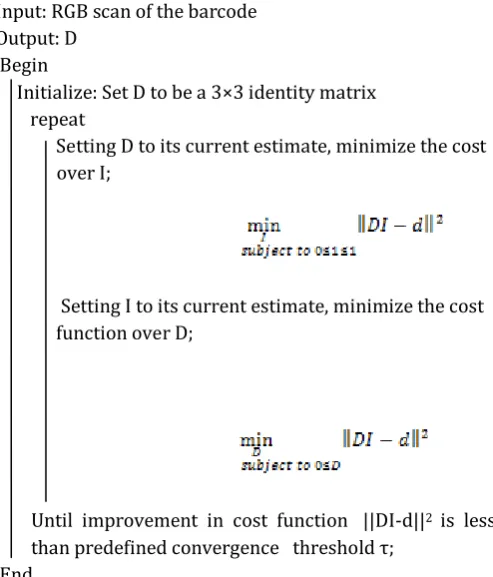
Algorithm EM-Type Algorithm [6]
Input: RGB scan of the barcode Output: D
Begin
Initialize: Set D to be a 3×3 identity matrix repeat
Setting D to its current estimate, minimize the cost over I;
Setting I to its current estimate, minimize the cost function over D;
Until improvement in cost function ||DI-d||2 is less than predefined convergence threshold τ;
End
Where D is the matrix whose ith column is
at a given location (x, y) are obtained
from the recorded density at that
location by I = D -1d
5. ALGORITHMIC STRATEGY
5.1 Algorithm for Developing 2D Color Barcode
Fig -3: 2D Color Barcode
[image:5.595.311.558.127.416.2]© 2015, IRJET ISO 9001:2008 Certified Journal Page 93 2. Convert this string to Binary Stream
3. Generate Block of 3 Bits
4. Assign color with respect to block bits
5. Arrange Block in Tabular form shown in Image attached.
5.2 Decoding Algorithm
Once here tend to find all the finder pattern’s components and perform the desired corrections, successive step is to decrypt the 2D barcode. To maximize information capability within a given house, the info space of our color 2D barcode doesn’t embody format info like the amount of data cells. Thus, before the 2D barcode reading, here tend to should reckon the number of information cells. This decoding process takes the subsequent steps.
5.2.1 Calculating the amount of knowledge cell
The size of the checker borders’ or temporal arrangement pattern’s black-and-white cells correspond to the dimensions of knowledge cells, so here can calculate cell size by measurement black-and-white cells of each the vertical and horizontal checker borders. Note that the color reference cells area unit read as “white” as a result of here’re victimization the binarized image for these computations. Here additionally use the temporal arrangement patterns to calculate the center of every cell and modify it once the formula detects image distortion or changes in cell pitch.
5.2.2 Retrieving color values
For this step, the algorithm applies a color-value sampling operation to the color image, starting by retrieving every color’s price from the corresponding color reference cell.
5.2.3 Reading the values
Supported the values of the color reference cells obtained in the previous step, the rule will detect information cell color. Then, it decodes the two dimensional (2D) barcode and retrieves the encoded data, just by remapping every cell’s color to its individual information. Figure shows Associate in nursing algorithmic flow diagram between our barcode recognition and detection algorithms.
5.3 Finder Pattern Recognition
Because here have to design our example 2D barcode to be used with smartphones, here developed the popularity recognition algorithmic program for the kinds of pictures such phones can capture. Once the phone captures an image, the algorithmic program locates the finder pattern via the subsequent steps.
5.3.1 Thresholding & binarizing the captured image Thresholding converts the reconstructed coloured image to a binarized image (that is, a black-and-white one), that facilitates the symbol’s detection and correction. This method removes the impact of color, as well as the colors within the reference cells, effort simply the black-and-white check boarders. Previous work conducted thresholding in 2 completely different ways: employing a changed adaptive thresholding method 2, 3 and using Associate in nursing empirical thresholding worth obtained from experiments.
5.3.2 Finding the L-shaped guide bar
The ratio of the longest bar to the second longest of the L-shaped guide bar is fastened at 2:1, and also the size of the tiniest bar of the L-shaped guide bar is equivalent to two information cells. Once the rule finds a most continuous region of binarized “black” cells, it calculates the co-ordinates of the four corners and uses them to live the bar sizes. Each bar’s relative size and also the four corners coordinates change the calculation of the L-shaped guide bar’s orientation.
5.3.3 Correcting the image orientation
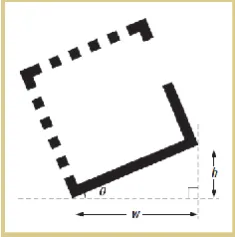
An angle’s tangent is that the quantitative relation of the alternative side’s length to the adjacent side’s length. The algorithmic rule will get the lengths of the alternative facet h and therefore the adjacent facet w via the coordinates of each ends of the longest bar (see Figure). Therefore here will calculate the orientation angle Q between the image’s x-axis and therefore the base of the longest bar as Q= arctan (h/w). Correcting for Q can correct the captured image’s orientation error.
Fig -4: Image Orientation
5.3.4 Searching for the 2 guide blocks
[image:6.595.374.492.510.629.2]© 2015, IRJET ISO 9001:2008 Certified Journal Page 94 equivalent to the dimensions of 3 knowledge cells. Failure
to find any regions that satisfy the criterion among the search space indicates that the candidate L-shaped guide bar was a false positive. Consequently, the reading computer code searches for the second largest continuous region of binarized “black” cells as another candidate for the guide bar. The method repeats till the popularity rule finds all the finder pattern’s components; otherwise, it’ll terminate with a slip stating that no barcode image was found.
5.3.5 Correcting image distortion
Projective mapping (also referred to as perspective
transformation4) may be a quadrilaterals
to-quadrilaterals mapping that may be performed once the rule locates the four corresponding points.
6. CONCLUSION
The framework proposed in this paper provides an effective method for extending monochrome barcodes to color. Our color code buildings offer three times the data rates of their monochrome counterparts, exploiting the spectral diversity delivered by color printing and capture systems in combination with model-based interference cancellation that mitigates inter-channel coupling presented by the physical characteristics of the devices. Although, bit error rates and therefore information capabilities vary across the three resulting channels, the error rates are in ranges that are readily handled by the error correction coding choices available for monochrome barcodes.
As information technologies such as smart mobiles phones develop, the threat of hacking grows in conjunction. More specifically, online account verification is a growing hot issue because of several well publicized hacking incidents of large Korean firms. Here discussed account
authentication methods and the related
hardware/software. Out-dated and unsecure methods of authentication include the static one factor ID and password. In contrast, modern methods involve dynamic components such OTP (One Time Password) systems, which are commonly used in the market. Although dynamic OTP systems provide much more security than one factor authentication, the complexity renders it a hassle to use. For example, a user needs to install the application and type the OTP key for every verification. Today people want an authentication method with both security and as ease of use. To address this demand, here suggest the 2DCBLogin system. The unique aspect of the 2DCLogin system is that it allows automatic login through the scanning of a 2D Color code by a smart phone. Within the Color Barcode developed by the secure website is an OTP key. By scanning the code, the smart phone stores the 2D color code and transmits the mobile phone number, IP address and the OTP Key to the server system. Upon
verification of this information, the server automatically logs the user in. Thus, the 2DCBLogin system provides easy of use as well as strong security. Even though the 2DCBLogin method requires a smart phone, the market applications. Encourage further research into the development of user verification technologies within internet security systems, especially since online security systems play a significant role in the growth of online markets.
ACKNOWLEDGEMENT
This work was supported by Pune University and BVCOE&RI, Nashik. We are very much thankful that he gave opportunity to complete this work in time to us. We would also like to thanks our Prof. C. K. Patil. Principal BVCOE&RI. Prof. H. D. Sonawane. H.O.D, Computer Department, for providing their valuable supported time throughout engineering.
REFERENCES
[1] Akash M.Bhalerao, Abhijeet P.Pandhare, Akash H.Bhogade, Amit C.Mane,” Secure Banking System Using Android application”.
[2] Soma. V.Vijaya Lakshmi. P,” Per-Colorant-Channel High Capacity Color Barcodes: An Interference Cancellation Framework”.
[3] Aryachandran S, Jyothi R L, “Secure Color QR Codes”. [4] Jonathan M. McCune, Adrian Perrig, Michael
K.Reiter,” Seeing-Is-Believing: Using Camera Phones For Human-Verifiable Authentication”.
[5] H. Kato, Keng T. Tan, and D. Chai, “Novel colour selection scheme for 2D barcode”.
[6] Keng T. Tan Douglas Chai, Hiroko Kato, and Siong Khai Ong, ”Designing a Color Barcode for Mobile Applications”.
[7] Soonduck Yoo, Seung-jung Shin and Dae-hyun Ryu, “An Innovative Two Factor Authentication Method: The QRLogin System”.
[8] O Bulan, H. Blasinski, and G. Sharma, “Color QR codes: Increased capacity via per- channel data encoding and interference cancellation”.
[9] O. Bulan and G. Sharma, “High capacity color barcodes: Per channel data encoding via orientation modulation in elliptical dot arrays”.
[10]S. J. Simske, J. S. Aronoff, and M. Sturgill, “Revenge of the physical mobile color barcode solutions to security challenges”.
[11]B. Oztan and G. Sharma, “Per-separation clustered-dot color halftone watermarks: Separation estimation based on spatial frequency content”. [12]G. Sharma and H. J. Trussell, “Digital color imaging”. [13]H. Bagherinia and R. Manduchi, “A theory of color
barcodes”.