© 2015, IRJET ISO 9001:2008 Certified Journal
Page 863
Tuning controller parameters and load frequency control of multi-area
multi-source power system by Particle Swarm Optimization Technique
V.Jyothi
1, P. Bharat Kumar
21
PG Scholar, Department of EEE, JNTU Anantapur, Andhra Pradesh, India
2Lecturer, Department of EEE, JNTU Anantapur, Andhra Pradesh, India
---
Abstract-
This article presents the setting of the controller parameters using particle swarm optimization (PSO) and its application to the load frequency control (LFC) of a power system from several sources that have different production sources as hydropower, thermal and gas power plants. A controller (PID) proportional integral derivative is used for tuning and analysis of the proposed model. The optimization of particle swarm algorithm (PSO) has been developed for the appropriate control settings for optimal performance. The superiority of the proposed approach was demonstrated by comparing the results with the optimum output feedback controller algorithm used for the same power systems. The comparison is made through various performance measures such as excess, time and standard error criteria of power frequency and tie-line after a disturbance step (SLP) load pertubation. Note that the dynamic performance of the proposed controller is improved by using PSO. Further-more, it also notes that the proposed system is robust and unaffected by the change of the charge state, the parameters of the system and the size of SLP.
1. INTRODUCTION:
The problem of controlling the actual output power generating units in response to changes in the frequency of the exchange system and tie-line power within specified
limits is known as load frequency control (LFC).In general,
it is considered as a part of automatic generation control (AGC) and is very important in the operation and control
of power systems.Energy systems on a large scale usually
consist of control zones or regions that represent coherent
groups of generators. The control area may have a
combination of thermal, hydro, gas, nuclear and renewable
sources of energy. Researchers around the world are
trying to propose several strategies for LFC power systems in order to maintain the system frequency and tie line flow in their programmed values during normal operation and
during small perturbations.Paper is literature that most of
the works of LFC were carried out in two hydrothermal
systems or thermal-thermal areas. It is noted that
considerable research will propose best AGC systems based on modern control theory, neural networks, fuzzy systems theory, reinforcement learning [8] and ANFIS
approach.But these advanced approaches are complicated
and require familiarity of users to these techniques, thus
reducing its applicability. Alternatively, classic controllers
Proportional Integral Derivative (PID) remain the preferred choice of an engineer because of its structural simplicity, reliability and favorable relationship between
performance and cost.It also offers the simplified dynamic
modeling, requiring less user skills, and minimal development effort, which are the main problems of
engineering practice. The growth in the size and
complexity of power systems with increased energy demand has necessitated the use of intelligent systems that combine knowledge, techniques and methodologies from various sources for real-time control of energy
systems.
The burden of a power system is constant and never given to ensure the quality of energy supply, a frequency controller load is needed to maintain the system frequency
to the desired nominal value. In an energy system
deregulated, each control area contains different types of uncertainties and various disturbances due to more complex modeling errors of the system and change the structure of power system Therefore, a control strategy need not only maintains the constancy of the flow rate and tie-desired power but also achieves zero steady-state error
and inadvertent exchange.
The controller proportional integral derivative (PID) is the most popular feedback controller used in the process
industries.It is a robust controller, easy to understand that
it can provide excellent control performance despite the
various dynamic characteristics of the process plant. As
the name suggests, the PID algorithm has three basic modes, proportional mode, integral and derivative modes. A proportional controller has the effect of reducing the rise
time but never eliminates steady state error. An integral
© 2015, IRJET ISO 9001:2008 Certified Journal
Page 864
but it can make the transient response worse. Derivative
control has the effect of increasing the system stability by reducing excess, and improved transient response. Proportional integral controllers (PI) are now more often
used in the industry type.A control without the derivative
mode (D) is used when: not a fast system response is required, the great disturbance and noise are present during operation of the process and there are long delays
in the transport system.Derivative mode improves system
stability and allows increased gain and integral gain decreased which in turn increases the speed of response
proportional controller.PID controller is often used when
quick response and stability are required. In view of the
foregoing, I, PI and PID controllers are considered
structured herein.
In the design of a modern technique based on heuristic optimization controller, the objective function is first defined on the basis of specifications and undesired
limitations.The design of the objective function to tune the
controller is usually based on a performance index that
considers the entire closed-loop response. Typical output
specifications in the time domain are overshooting peak,
rise time, settling time, and steady-state error.
2. Design control system under study
Two area system covering hydraulic, thermal units, gas turbines warming and is considered in the first instance
for the controller design for the system. The linearized
models of governors, reheat turbines, hydraulic turbines, gas turbines are used for simulation and study LFC power
system as shown in Fig. 1. Each unit has its parameter
adjustment factor to decide the participation and
contribution to the rated load.The sum of the participation
factor of each control must be equal to 1. In Fig.1 R1, R2,
R3 are the parameters of regulation, hydraulic and gas thermal units respectively, UT, UH and UG are the outputs of control, thermal hydraulic units and gas respectively, KT, KH and KG are participation factors of thermal, hydro
and gas generating units, respectively, is the constant
speed governor thermal unit time in seconds, steam
turbine time constant in seconds, Kr is the constant reheat steam turbine, is Tr reheat time constant of the steam
turbine sec, is time nominal starting penstock water in
seconds, is the regulator of the hydraulic turbine speed
reset the time in seconds, is hydro turbine regulator
Time constant speed transient fall in s, is hydro
turbine main regulator time constant servo speed in seconds, is the time constant standby gas turbine, speed regulator in seconds, and c is the time constant delay of the gas turbine, the speed controller in seconds, is the valve positioner of the gas turbine, is the constant of the gas turbine valve positioner, TF is the gas turbine constant
time fuel sec, is the gas turbine time delay combustion
reaction sec is the gas turbine compressor discharge at
constant volume time in sec gain of power system in
Hz / puMW, is the system time constant power in sec
F is the incremental change in the exchange rate and
incremental load PD.The nominal system parameters are
given in reference
As the change of power between control areas will be minimized quickly, ITAE is a better objective function in
studies of AGC and therefore used in this document. The
objective function is expressed as:
J=ITAE=
where F is the frequency deviation system and is the
simulation time interval. The problem constraints are the
limits of the driver parameters. Therefore, the design
problem can be formulated as the following optimization
problem.Subject to minimize J
where J is the objective function and and are
the maximum control parameters and minimum. As
reported in the literature, the minimum and maximum values of the controller parameters are chosen as _1 and 1
© 2015, IRJET ISO 9001:2008 Certified Journal
Page 865
Fig.1. Transfer function model of multiple sources of multiple area with HVDC link
3. CONVENTIONAL METHODS FOR CONTROLLER TUNING:
The proportional integral derivative controller (PID) is the most popular feedback controller used in the process industries. It is robust, easy to understand controls that can provide excellent control performance despite various dynamic characteristics of the treatment plant. As its name suggests, the PID algorithm consists of three basic modes: proportional mode, integral and derivative modes. A proportional controller has the effect of reducing the rise time, but never eliminates the steady-state error. Integral control has the effect of eliminating the steady-state error,
butit may make the transient response worse. Derivative
control has the effect of increasing the stability of
the system, thereby reducing the overshoot, and improving the transient response. Proportional Integral controllers are the type most often used in industry today. A control method without the derivative (D) is used when a fast system response is not required, significant disruption and noises are present during operation of the process and there are significant delays in the transport system. Derivative mode enhances system stability and allows the gain to decrease and increase integral gain which in turn increases the speed of the response of the
proportional controller.PID control is often used when the
stability and quick response is required. From the above discussion, PID,PI,I controllers are considered for load
© 2015, IRJET ISO 9001:2008 Certified Journal
Page 866
The tuning is defined as the setting of control parameters to the optimum values for the desired control response. Stability is a basic requirement. However, different systems have different behavior, different applications have different requirements and requirements may conflict with one another.PID tuning is a difficult problem, although there are only three parameters and principle is simple to describe, because it must answer complex criteria within the PID control. So there are different loop tuning methods, some of them:
Manual setting method
Ziegler-Nichols tuning method
PID tuning methods software
4. DIFFERENTIAL EVOLUTION
Differential Evolution (DE) is a population based stochastic optimization algorithm capable of handling not differentiable, non-linear and multi-modal objective functions, with some readily selected control parameters. The problem of the design of the proposed controller is formulated as an optimization problem and DE is used to search optimal control parameters. DE works with two people; old generation and the new generation of the same population. The population size is adjusted by the parameter NP. The population is composed of actual dimension values D vectors that equals the number of design parameters / variables control. The population is initialized randomly within initial parameter. The optimization process is affected by three main operations: a mutation, crossover and selection. In every generation, the individuals of the current population become targets vectors. Vector for each target, the mutation operation produces a mutant vector, by adding the weighted difference between two vectors selected randomly a third vector. The cut operation generates a new vector, called test vector by mixing the entries of the vector mutant with those of the target vector. If the test vector gets a fitness value better than the target vector, then the test vector replaces the target vector in the next generation. Evolutionary operators are described below.
4.1. Initialization
For each parameter j with the lower and upper bound the values of the initial parameters are usually uniformly at
random in the interval [XLj;XUj].
4.2. Mutation
For given parameter vector , three vectors (
, ) are randomly selected so that the indices i, r1 , r2
and r3 are distinct. A donor vector is produced by
adding the weighted difference between two vectors for third vector as
= +F . ( - )
where F is a constant from (0, 2)
4.3. Crossover
Three parents are selected for crossover and the child is a
perturbation of one of them. The trial vector Ui,G+1 was
developed from elements of the target vector (Xi,G) and elements of donor vector (Xi,G). Donor vector elements enter the vector trial with probability CR:
Uj,i,G+1=
With U(0, 1), is a random integer from (1, 2, .
. ., D) where D is the solution’s dimension i.e. number of
control variables. ensures that
4.4. Selection
The target vector is compared with the test vector
and the one with the best fitness value is admitted to the next generation. The selection operation in DE can be represented by the following equation:
=
Where I [ 1, ]
5. PSO CONTROLLER FOR INTERCONNECTED POWER SYSTEM
PSO is a robust stochastic optimization technique based on
movement and swarm intelligence. It was developed in
1995 by James Kennedy (social psychologist) and Russell
Eberhart (electrical engineer). A number of agents
(particles) that constitute a swarm move in the search
space in search of the best solution is used.Each particle is
treated as a point in an n-dimensional space, which adjusts its "fly" according to his own experience of flight and flight
experience of other particles. Each particle keeps track of
its coordinates in space of the solution that are associated with the best solution (fitness) it has achieved so far by the
particle.This value is called personal best, pbest. Another
best value that was followed by the PSO is the best value obtained so far by any particle in the neighborhood of that
particle.This value is called gbest.All PSO particles remain
© 2015, IRJET ISO 9001:2008 Certified Journal
Page 867
survival of the fittest.No crossover operation in PSO.In EP
balance between local and global search you can be set through the strategy parameter, while PSO equilibrium is
reached through the inertial weight factor (w)
.
PSO optimized PID controller is designed for LFC and
tie-power control.The objectives are to control the frequency
and tie-between area with good power oscillation damping, also get good performance in this study, the optimal values of the PK parameters KI and Kd for PID
controller easily and accurately calculated using a PSO.In a
typical run of the PSO, an initial population is generated
randomly. This is known as initial population generation
0th.Each individual of the initial population has an index
value associated performance. The use of performance
index information, the PSO then produces a new
population.In order to obtain the performance index value
for each of the individuals in the current population, the
system must be simulated.The PSO then produce the next
generation of people who use crossover operators and
mutation breeding.These processes are repeated until the
population is converged and the optimal value of
parameters found. The document aims to use the PSO
algorithm in order to obtain optimal values of the PID
controller to a system of two frequency load area. Each
adjustment controller may represent a particle in the search space that changes its parameters proportionality constant Kp, an integral constant Ki, and Kd derivative constant to minimize the error function function. The error function used here is the integral time absolute error
(ITAE).
PSO steps: Steps PSO as implemented for the
optimization:
Step 1: Initialize an array of particles with random
positions and velocities associated to satisfy the inequality
constraints.
Step 2: Check satisfying the equality constraints and
modify the solution if necessary.
Step 3:Assess the fitness function of each particle.
Step 4:Compare the current value of the fitness function
better with particles above value (pbest). If the current
fitness value is lower, then assign the current value of fitness for pbest and assigned the coordinates (positions)
to pbestx.
Step 5: Determine the current global minimum value of
fitness between the current positions.
Step 6: Compare the current global minimum above the
minimum overall (gbest).If the current global minimum is
better than gbest, then assign the global minimum current for gbest and assigned the coordinates (positions) to
gbestx.
Step 7: Changespeeds.
Step 8:Each particle moves to the new position and return
to step 2.
Step 9: Repeat step 2-8 until a stopping criterion is
satisfied or reached the maximum number of iterations
Fig.2. Flowchart for PSO
NO
END Start
Initialize particles with random position and velocity vectors
For each particle position (p) evaluate the fitnes s
If fitness (p) is better than fitness (pbest) then P best=p
Set best of pbest as g best
Update particle velocity and position
If gbest is the Optimal Solution
© 2015, IRJET ISO 9001:2008 Certified Journal
Page 868
6. RESULTS AND COMPARISON:
During the simulation study, Error signals f1, f2 and tie line power required for the controller software is
transferred to the PSO.All positions of the particles in each
dimension are held within the limits specified by the user,
and Velocities subject to the [Vmin, Vmax] range. A
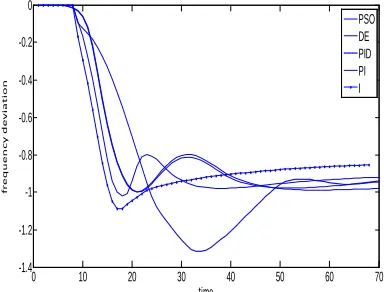
gradual increase in demand of 0.01 pu is applied to zone 1 The frequency deviation of the first area frequency and f1 and second f2 deviation of the area and the area between
clamping signal power closed loop system shown in Fig. 3,
4 and 5. Similarly a step increase in demand of 0.01 applies
to Area2.frequency deviation of the first area and the f1
and f2 frequency of the second area and the area between
clamping signal powercircuitry of theclosed loop system
[image:6.612.322.539.129.431.2]are shown in Fig.6,7,8.
Table 1: Parameters of the controller to the system using
different controllers
Kp Ki Kd
PSO 1.34 3.48 1.2
DE 2.28 0.1514 0.8464
PID 0.933 0.7185 0.4198
PI 1.01 1.6974 -
I - 1.46 -
Simulation results show improved performance in the time domain specifications for a load of 0.01 pu step Using the PSO approach, global and local solutions could be found simultaneously for a better adjustment of the controller
parameters .The PID value that was obtained by the PSO
algorithm is compared with the PID controller derived from differential evolution algorithm, PID controller, PI controller and the I in different perspectives namely,
robustness and stability. All simulations were carried out
using MATLAB A comparison of time domain specifications overshoot and settling time for a load of 0.01 pu step in area 1 are tabulated as given in the table (2) and it is very clearly that the PSO based controller dramatically reduces
overshoot by a large value.Settling time improved.
Table 2: Analysis of the system performance by using
different methods of setting the controller
Settling Time Max.Overshoot
PSO 8.4 0.0098
DE 9.06 0.0103
PID 13.76 0.078
PI 8 0.07
I 9.94 0.09
0 10 20 30 40 50 60 70
-1.4 -1.2 -1 -0.8 -0.6 -0.4 -0.2 0
Time
Fr
eq
u
en
c
y
D
ev
ia
ti
o
n
PSO DE PID PI I
Fig.3.Change in frequency of the Zone-1 for 1% change in
the area-1
0 10 20 30 40 50 60 70
-1.4 -1.2 -1 -0.8 -0.6 -0.4 -0.2 0
time
f
r
eq
u
en
c
y
d
ev
ia
ti
o
n
PSO DE PID PI I
Fig.4.Change in frequency of the Zone-2 for 1% change in
[image:6.612.36.253.340.471.2] [image:6.612.327.519.476.622.2]© 2015, IRJET ISO 9001:2008 Certified Journal
Page 869
0 10 20 30 40 50 60 70
-0.4 -0.3 -0.2 -0.1 0 0.1 0.2 0.3 time ti el in e p o w er d ev ia ti o n PSO DE PID PI I
Fig.5.Change in linking power lines to the 1% change in
the area-1
0 10 20 30 40 50 60 70
-1.4 -1.2 -1 -0.8 -0.6 -0.4 -0.2 0 time fr eq u en c y d ev ia io n PSO DE PID PI I
Fig.6. Change Frequency Zone-1 for the 1% change in the
area-2
0 10 20 30 40 50 60 70
-1.4 -1.2 -1 -0.8 -0.6 -0.4 -0.2 0 time fr eq u en c y d ev ia ti o n PSO DE PID PI I
Fig.7.Change in frequency of the Zone-2 for 1% change in
the area-2
0 10 20 30 40 50 60 70
-0.4 -0.3 -0.2 -0.1 0 0.1 0.2 0.3 time T iel in e p o w er d ev ia ti o n PSO DE PID PI I
Fig.8.Change in linking power lines to the 1% change in
the area-2
7. Conclusion
Load Frequency Control (LFC) system power supply multiple units with different sources of electricity generation and thermal, hydro and gas power plants is presented in this paper. The controller parameters are optimized using Swarm Optimization technique particles (PSO). Initially, Multi System Multi Area Power source is considered and the control parameters PSO technique is tuned by performing multiple runs of the algorithm for each variation of control parameters. The parameters Proportional Integral Derivative (PID) are optimized using PSO optimization technique. The superiority of the proposed approach has been demonstrated by comparing the results with integral controller (I), proportional integral controller (PI), Proportional Integral Derivative (PID) controller and the PID controller used for the same energy systems using various performance measures such as settling time and criteria of standard frequency error sedimentation and tie-line power deviation after a load disturbance step (SLP). It is noted that the dynamic performance of the proposed controller is improved. Furthermore, it is also noted that the proposed system is robust and not affected by the change in the load condition, the system parameters and the size of SLPs.
Appendix B: System Settings
© 2015, IRJET ISO 9001:2008 Certified Journal
Page 870
REFERENCES
[1] Banaja Mohanty, Sidhartha panda, PK Hota., Controller tuning parameters of differential evolution algorithm and its application to load frequency control system of multi-source energy, electric power and energy systems 54 (
2014) 77-85
[2] Kennedy, J., Eberhart, RC, Particle Swarm
Optimization,Proc.IEEE International
Conference on Neural Networks, Perth
Australia, IEEE Service Center, Piscataway, NJ,
IV: 1942-1948, 1995.
[3] gaing, ZL., A Particle Swarm Optimization
Approach for the optimal design of PID
In AVR system controller, IEEE Transactions
Energy conversion, Vol.19, No.2, June
2004.
[4] Kim Dong Hwa and Park Jin Ill Intelligent PID Controller Setting the AVR system using GA and PSO
Springer-Verlag Berlin Heidelberg :. ICIC 2005, Part II,
LNCS 3645, pp 366-375 (2005).
[5] stability and system control Kundur P. Power. New
York: Mc-Grall Hill;1994.
[6] Elgerd OI.Electricity systems theory introduces energy.
New Delhi: Tata
McGraw-Hill;1983.
[7] frequency control Hassan B. robust feed system. New
York: Springer;2.009.
[8] Ibraheem, Kumar P, DP Kothari. Recent philosophies
automatic generation
control strategies energy systems. IEEE Trans Power Syst
2005;20: 346-57.
[9] Parmar KPS, Majhi S, DP Kothari. Load frequency
control of real power
generation system with multi-source energy. Int J Syst
Energy Power Elect
2012;42: 426-33.
[10] DK Chaturvedi, Satsangi PS, PK Kalra. Control load
frequency: A general neural network approach.Electronic
Power Energy Syst 1999;21: 405-15.
[11] Ghosal SP.The optimization of the PID gains particle
swarm optimization fuzzy automatic generation control
based.Electr Power Syst Res 2004;72: 203-12.
[12] Ahamed TPI, PSN Rao, PS Sastry. A reinforcement
learning approach ofautomatic generation control. Electr
Power Syst Res 2002;63: 09/26.
[13] Khuntia SR, Panda S. simulation study for the automatic control of generating a
multi-power system ANFIS focus area. Soft Comput Appl 2012; 12: 333-41.
[14] Saikia LC, J Nanda, S. Mishra Performance comparison of several classical
AGC controllers for multiple interconnected areas thermal system. Int J Elect
Energy Power Syst 2011; 33: 394-401.
[15] Nanda J, Mishra S, Saikia LC. Maiden application based bacterial foraging
optimization technique in controlling automatic
generation multiarea. IEEE Trans Power Syst 2009; 24: 602-9.
BIOGRAPHIES
V.Jyothi currently pursuing M.Tech in Control Systems at JNTUA College of Engineering and Technology Anantapur, Andhra Pradesh. Her area of interest is Control Systems.