© 2016, IRJET | Impact Factor value: 4.45 | ISO 9001:2008 Certified Journal | Page 2747
COMPARATIVE STUDY OF SCHEDULED AND UNSCHEDULED MAC
PROTOCOLS IN WSN
*1
Mrs. Praveena P, *
2Ms. Lavanya S.,
*1
M.Phil Research Scholar, Department of Computer Science Auxilium College (Autonomous),
Vellore, TamilNadu, India.
*2
Assisant Professor, Department of Computer Science Auxilium College (Autonomous),
Vellore, TamilNadu, India.
---***---Abstract
- Medium-Access control (MAC) protocoldesigned for wireless sensor networks. Wireless Sensor Networks used for battery-operated computing and sensing devices. A network of these devices collaborate for a common application such as environmental monitoring. Wireless networks have received much attention in past decades from researchers and commercial development. Unfortunately, these advances do not directly apply to sensor networks because the goals and constraints differ from sensor networks. The largest difference comes from the limited energy resources available within sensor networks, which does not commonly limit traditional wireless network devices. Traditional wireless MAC protocols provide high throughput, low latency, fairness and mobility management, but often have little or no consideration for energy conservation. Sensor network MAC protocols, however, must provide the best performance at the smallest amount of energy consumption due to limited energy resources available to each sensor node. Sensor network MAC protocols often trade performance characteristics, such as throughput and latency, for a decrease in energy consumption to length a sensor node's life time. In this paper discussed about advantages and disadvantages of scheduled and unscheduled MAC protocols based on the constraints, also discussed about energy attribute for each scheduled and unscheduled MAC protocols.
Key Words:
Medium-Access control (MAC), Wireless Sensor Networks used for battery-operated computing and sensing devices.I. INTRODUCTION
Wireless networking is comprised of number of numerous sensors and they are interlinked or connected with each other for performing the same function collectively or cooperatively for the sake of checking and
balancing the environmental factors. This type of networking is called as Wireless Sensor Networking.
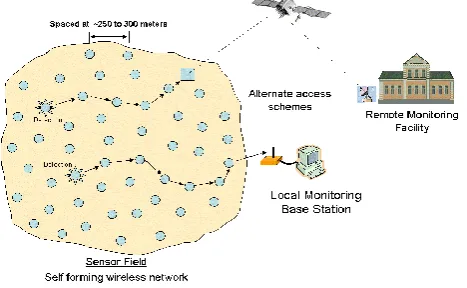
Wireless Sensor Network is a group of sensor nodes work collaboratively to perform the task. It consists a number of distributed autonomous sensors to monitor the physical or environmental conditions then pass the data through the network to the base station. A sensor node is a tiny device that includes three basic components: a sensing subsystem for data acquisition from the physical surrounding environment, a processing subsystem for local data processing and storage, and a wireless communication subsystem for data transmission. In addition, a power source supplies the energy needed by the device to perform the programmed task. There are different Sensors such as pressure, accelerometer, camera, thermal, microphone, etc.
[image:1.595.321.555.588.732.2]Wireless Sensor Networking is an emerging technology that has a wide range of potential applications including environment monitoring, smart spaces, medical systems and robotic exploration such a network normally consists of a large number of distributed nodes that organize themselves into a multi-hop wireless network. Each node has one or more sensors embedded processors and low-power radios, and is normally battery operated. Typically, these nodes coordinate to perform a common task.
© 2016, IRJET | Impact Factor value: 4.45 | ISO 9001:2008 Certified Journal | Page 2748
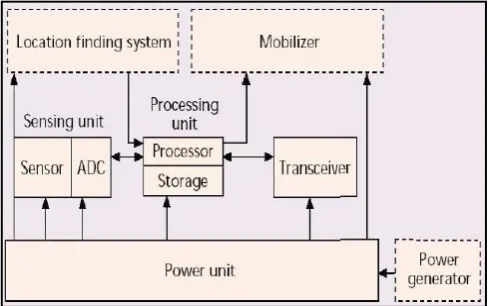
1.1 Sensor Node Architecture [image:2.595.308.557.98.292.2]A sensor node typically consists of five main parts: one or more sensors gather data from the environment. The central unit in the form of a microprocessor manages the tasks. A transceiver communicates with the environment and a memory is used to store temporary data or data generated during processing. The battery supplies all parts with energy. To assure a sufficiently long network lifetime, energy efficiency in all parts of the network is crucial. Due to this need, data processing tasks are often spread over the network, i.e. nodes co-operate in transmitting data to the sinks.
Fig 1.2 : Sensor Node Architecture
1.2 Features of Sensor Node
There are certain features which have to be considered when it chooses a sensor. They are as given below:
Accuracy
Environmental condition - usually has limits for temperature/ humidity
Range - Measurement limit of sensor
Calibration - Essential for most of the measuring devices as the readings changes with time
Resolution - Smallest increment detected by the sensor
Cost
Repeatability - The reading that varies is repeatedly measured under the Same environment.
Characteristics of WSN
The main characteristics of a WSN include:
Deeply distributed architecture
Autonomous operation
Energy conservation
Scalability
[image:2.595.36.281.268.421.2] Data centric network
Fig 1.3 Modern Sensor Nodes
II. RELATED WORK
1. Medium Access Control with Coordinated Adaptive Sleeping for Wireless Sensor Network
This paper proposes S-MAC, a Medium Access Control (MAC) protocol designed for wireless sensor networks. Wireless sensor networks use battery-operated computing and sensing devices.
A network of these devices will collaborate for a common application such as environmental monitoring.
These characteristics of sensor networks and applications motivate a MAC that is different from traditional wireless MACs such as IEEE 802.11 in several ways:
Energy conservation and self-configuration are primary goals,
While per-node fairness and latency are less important.
S-MAC uses a few novel techniques to reduce energy consumption and support self-configuration.
It enables low-duty-cycle operation in a multi hop network. Nodes form virtual clusters based on common sleep schedules to reduce control overhead and enable traffic-adaptive wake-up. S-MAC uses in-channel signaling to avoid overhearing unnecessary traffic
The paper presents measurement results of S-MAC performance on a sample sensor node, the UC Berkeley Mote, and reveals fundamental tradeoffs on energy, latency and throughput. Results show that S-MAC obtains significant energy savings compared with an 802.11-like MAC without sleeping
Advantages
© 2016, IRJET | Impact Factor value: 4.45 | ISO 9001:2008 Certified Journal | Page 2749
Disadvantages Transmitting a long message as a single packet costs high.
If the long message is fragmented into many independent small packets, then user have to pay the penalty of large control overhead and longer delay.
2. Coordinated Energy Conservation in Ad Hoc Networks
This paper presents a new power conservation scheme for multi-hop ad hoc networks.
A virtual backbone consisting of special nodes (coordinators) is used for the power saving algorithm and routing.
This paper presents a new distributed algorithm for constructing a connected dominating set (CDS) that is used to construct and maintain the virtual backbone of the network.
This scheme includes a message history based variable sleeping time for the non-coordinators.
Simulations indicate that scheme results in better power conservation than other practical schemes discussed in the literature if the network has a sparse message density.
First, it presents a new algorithm for maintaining and constructing the backbone. Secondly, it propose a power saving protocol, which allows the nodes to sleep for varying amounts of time depending on the message history of that node.
This simulations show that the proposed scheme results up to 50% power saving compared to existing schemes.
3. MAC Protocols for Wireless Sensor Networks: a Survey
Wireless Sensor Networks are appealing to researchers due to their wide range of application potential in areas such as target detection and tracking, environmental monitoring, industrial process monitoring, and tactical systems.
Various MAC protocols with different objectives were proposed for Wireless Sensor Networks. In this paper, first outline for the sensor network properties that are crucial for the design of MAC layer protocols.
Then, it describes several MAC protocols proposed for sensor networks emphasizing their strengths and weaknesses.
Advantages
The energy waste caused by idle listening is reduced by sleep schedules. In addition to its implementation simplicity, time synchronization overhead may be prevented with sleep schedule announcements.
Broadcast data packets do not use RTS/CTS which increases collision probability. Adaptive listening
incurs overhearing or idle listening if the packet is not destined to the listening node. Sleep and listen periods are predefined and constant, which decreases the efficiency of the algorithm under variable traffic load.
III. NEW PROPOSED MODEL
3.1 Introduction to MAC ProtocolMAC stands for Medium Access Control. A MAC layer protocol is the protocol used to control the access of physical transmission medium on LAN. It tries to ensure that two nodes are not interfering with each other at the time of transmissions. It ensures that the channel can be accessed by multiple users. The task of MAC sub layer is to provide fair access to channels by avoiding possible collisions. The main goal of MAC protocol in WSN is energy efficiency and thereby prolongs the lifetime of sensor nodes. It consists of set of rules that determine which node should access the transmission medium.
Objective
The Medium Access Control protocols for the Wireless Sensor Networks have to achieve two objectives:
The first objective is the creating a infrastructure for the sensor network and the MAC scheme used to establish the communication link between the sensor nodes.
The second objective is to share the communication medium fairly and efficiently.
To design a good MAC protocol the following attributes are needed:
Energy Efficiency
Scalability and adaptability
Latency, throughput, fairness and bandwidth utilization.
MAC layer, the IEEE802 LAN and MAN Reference Model defined MAC as a sub layer of data link layer presented in OSI model. The MAC layer main functions are delimiting the frame and recognition, addressing, transferring of data from upper layers, error protection (generally using frame check sequences), and arbitration of access to one channel shared by all nodes. MAC layer protocols for WSNs are more energy efficient and it also maximizes the lifetime.
3.2 Reasons for Energy Wastage
The reasons for the unnecessary energy waste in wireless communication are:
Packet Collision
Over Hearing
Idle Listening
Over Emitting
3.3 Functional Model of MAC Protocol
© 2016, IRJET | Impact Factor value: 4.45 | ISO 9001:2008 Certified Journal | Page 2750
layer defines a medium independent facility provided bythe physical layer, and under the access-layer-independent LAN LLC sub layer. It is mostly applicable to local area broadcast media suitable for use with the media access discipline known as CSMA/CD.
3.4 Performance Metrics for MAC protocol
The following metrics are used to evaluate the energy consumption MAC protocol:
Energy Consumption per minute
Average Delivery Ratio
Average Packet throughput Energy Consumption per Minute
The energy efficiency of the sensor nodes can be defined as the total energy consumed / total bits transmitted. The unit of energy efficiency is joules/bit. The lesser the number, the better is the efficiency of a protocol in transmitting the information in the network. This performance matrix gets affected by IDLE LISTENING.
Average Delivery Ratio
It refers to the average number of packets that are send and received from over all the nodes.
Average Packet Throughput
Throughput is typically defined as the rate at which messages are serviced by a communication system. It is usually measured either in messages per second or bits per second. Energy efficiency is one of the most important issues in the design of MAC protocol for wireless sensor nodes.
IV Sensor Network MAC Protocols
Two general classifications for sensor network MAC protocols exist: scheduled protocols and unscheduled, or random, protocols. Scheduled MAC protocols attempt to organize nearby sensor nodes so their communications occur in an order way. The most common scheduling method organizes sensor nodes using time division multiple access (TDMA) where a single sensor node utilizes a time slot. Organizing sensor nodes provides the capability to reduce collisions and message retransmissions at the cost of synchronization and state distribution. Unscheduled protocols attempt to conserve energy by allowing sensor nodes to operate independently with a minimum of complexity. While collisions and idle listening may occur and cause energy loss, the unscheduled MAC protocols typically do not share information or maintain state.
Most sensor network MAC protocols have some overlap in their effort to limit energy consumption. The most common and effective way to conserve energy places the transceiver and processor into a low power sleep state when the resources have no work to perform. In this way
the sensor node can consume much less energy—typically several orders of magnitude less—than if the processor entered a busy loop and the transceiver entered an idle state.
Sensor network MAC protocols may sleep periodically for fixed, known durations or may sleep for random lengths of time depending on how a sensor node interacts with other sensor nodes. The duty cycle of a sensor node corresponds to the fraction of time the sensor node remains in an active state. Sensor nodes that maintain a high duty cycle can respond to traffic and network changes more quickly, but consume energy at a higher rate. A lower duty cycle MAC protocol can save energy, but low activity levels place a limit on the protocol’s complexity, the possible network capacity, and the message latency. MAC protocols often have the duty cycle as a protocol parameter.
S-MAC stands for Sensor MAC. This protocol is used to reduce the energy consumption in collision, idle listening, overhearing. In this protocol every node has two states namely Sleep state and Listen state. In this nodes can receive and send the data in a listen period itself. The Sensor MAC protocol is a fixed duty cycle approach. It is simple and effective to reduce the idle listening problem. The S-MAC protocol is widely used in WSNs for energy conversation. There are three major sources of energy consumption are identified. These are:
Collision: Energy wastage due to retransmitting the collided packet.
Overhearing: It occur when it listen to node transmission that are not intended of it.
Idle Listening: It occur when a node listen to receive a packet at the time of no transmission.
Fig 1.4 Overview of S-MAC
CC-MAC itself consists of two components:
1. Event MAC (E-MAC)
2. Network MAC (N-MAC)
© 2016, IRJET | Impact Factor value: 4.45 | ISO 9001:2008 Certified Journal | Page 2751
nodes rotate the role of generating measurements tobalance energy consumption throughout the network. Sensor nodes get elected as the representative of the correlated sensor nodes by winning contention for the wireless medium. E-MAC slightly modifies the standard RTS/CTS/DATA/ACK scheme in the IEEE 802.11 standard by introducing a First Hop (FH) bit into the control packet headers. The sensor node actively reporting measurements sets the FH bit when it transmits messages so that other nodes can decide to generate measurements or not. If a sensor node lies further than the correlation radius from all other sensor nodes generating measurements, then it will begin to also generate measurements.
Network MAC (N-MAC),
In which forwards the filtered measurements to the sensor network sink once the originating sensor node has transmitted the measurement, the FH bit gets cleared and the message becomes a forwarding message for the N-MAC protocol. N-N-MAC forwards messages from sensor nodes generating measurements to the sensor network sink, but since the E-MAC protocol has removed most of the redundancy present in multiple measurements the forwarded traffic becomes more important. To compensate for this, N-MAC protocol transmissions take preference over E-MAC transmissions through the use of smaller back off windows and inter-packet times in same way that the PCF in IEEE 802.11 receives preferential access to the wireless channel over the DCF.
Characteristics of S-MAC
The characteristics of S-MAC are: It forms nodes into a flat, pee to peer topology. Like clustering protocol, S-MAC doesn’t require cluster head. In this, nodes are form by virtual cluster by using common schedules, it communicate directly with peers
Maintaining Synchronization
The before sending packets in S-MAC maintain a synchronization that are: Before each node starts a periodic listen and sleep period, it chooses a schedule table and exchange with neighbors. Each node maintains a schedule table. Initial schedule is established by synchronizer, Follower. They follow some rules to join the table. To maintain the schedule table it uses the clock drift. It can update the table by using SYNC packet.
Collision Avoidance
If the multiple neighbors are wanted to take to a node, at the same time they try to send which node as start to listening. In this case they use medium for contention. In S-MAC follow some procedures, such as virtual and physical carrier sense and RTS/CTS exchange the hidden problem. If a node receives a packet destined to another node, it knows how long to keep silent from this field. The node records this value in a variable called the network allocation vector (NAV) and sets a timer for it. If the NAV value is not zero, then the node determines the medium is busy. This is called virtual carrier sense.
Overhearing Avoidance
In S-MAC the Overhearing Avoidance includes: S-MAC tries to avoid overhearing by letting interfering nodes go to sleep after they hear an RTS or CTS packet. This approach prevent neighboring nodes, because DATA packets are normally longer than the control packets. At which nodes should sleep when there is an active transmission in progress. Duration field in each transmitted packet indicates how long the remaining transmission will be. So if a node receives a packet destined to another node, it knows how long it has to keep silent.
Message Passing
The Message Passing includes: A message is the collection of meaningful, interrelated units of data. The receiver usually needs to obtain all the data units before it can perform in-network data processing or aggregation. Transmitting a long message as a packet is disadvantageous as the re-transmission cost is high. Fragmentation into small packets will lead to high control overhead as each packet should contend using RTS/CTS. Fragment message in to small packets and transmit them as a burst.
© 2016, IRJET | Impact Factor value: 4.45 | ISO 9001:2008 Certified Journal | Page 2752
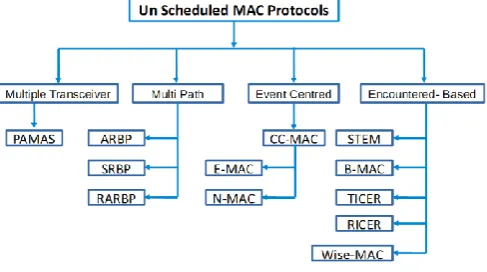
4.1. Classification of MAC Protocols:Fig1.5: classification Of MAC Protocols
4.2. Unscheduled MAC Protocols
[image:6.595.313.551.225.349.2]Unscheduled MAC protocols offer the advantage of simplicity. Without having to maintain and share state, an unscheduled MAC protocol may consume fewer processing resources, have a smaller memory footprint, and decrease the number of messages that a sensor node must transmit. Additionally, sensor nodes that get added to the network, through redeployment or movement, can begin to participate much more quickly because they do not have to obtain the current schedule or join another sensor node group. However, unscheduled MAC protocols experience, in general, a higher rate of collision, idle listening, and overhearing because the sensor nodes do not coordinate transmissions.
Fig 1.6: Unscheduled MAC Protocol
4.3 Scheduled MAC Protocols:
Scheduled MAC protocols attempt to reduce energy consumption by coordinating sensor nodes with a common schedule. Most proposed protocols use some form of TDMA since other forms of multiple access, such as frequency or code division, would increase the cost and power requirements of the sensor nodes. By producing a schedule, the MAC protocol clarifies which sensor nodes should utilize the channel at any time and thus limits or eliminates collisions, idle listening, and overhearing. Nodes not participating in message communication may enter the sleep mode until they have work to perform or need to receive a message.
[image:6.595.39.283.401.537.2]
Additionally, the MAC protocol can share traffic or status information so that the individual sensor nodes can optimize energy consumption over a collection of sensor nodes instead of at just a single sensor node. For example, nodes with important traffic or with a larger backlog of messages may get preferential treatment in the assignment of time slots. Simple traffic engineering also becomes possible by sharing state among sensor nodes, allowing a much higher level of fairness to exist within the sensor network.
Fig 1.7: Scheduled MAC Protocol
V. ADVANTAGES AND DISADVANTAGES OF
SCHEDULED AND UNSCHEDULED MAC PROTOCOLS
5.1 Unscheduled MAC Protocol:
Unscheduled MAC protocols leverage simplicity to minimize resource utilization within a sensor node. However, they generally provide less functionality than a scheduled protocol, so other protocols must implement needed operations. Coordinating neighboring sensor nodes for communication, a problem implicitly solved in scheduled MAC protocols, becomes a primary function of unscheduled MAC protocols. End users that require very simple MAC protocols because of resource constraints or only require limited functionality may find an unscheduled MAC protocol the best option.
© 2016, IRJET | Impact Factor value: 4.45 | ISO 9001:2008 Certified Journal | Page 2753
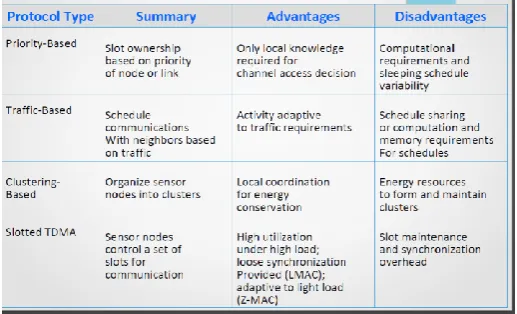
5.2 Scheduled MAC Protocol: [image:7.595.35.294.276.433.2]Several scheduled MAC protocols proposed for sensor networks. Many provide the capability to lower energy consumption by reducing collisions, limiting idle listening, and providing functionality for other protocols, but they require that sensor nodes expend energy to share state and maintain synchronization. Additionally, the extent and frequency to which the sensor network undergoes organization and reorganization can greatly affect its performance. However, scheduled MAC protocols may allow sensor nodes to remain asleep for longer periods of time and forward messages with less effort than those using unscheduled MAC protocols since the sensor node has some indication of its neighbor’s plans.
Table 1.2: Protocol Comparison
CONCLUSION
S-MAC, US-MAC protocols are used to solve the idle listening problem. Based on the thesis, low energy efficiency is needed to transmit the packets from source to destination at the time of solving the ldle listening problem. In future energy models can be used to find out the energy efficiency of MAC protocols. One of the key applications of the sensor networks which is widely adapted due to its huge number of implementations and usages, in the MAC protocols. Although, this application is known for its high demands of energy in order to perform its tasks in the best manner as many as possible. Since the main drawback that faces most in the transmission of packets in sensor networks is the fact that the sensor network suffers from a very limited power supply. Therefore, the need to optimize the energy consumption in idle listening problem is a fact must be faced. Since most the energy savings research was focusing on minimizing the energy consumed by the radio component (RF radio) in the sensor nodes by reducing the number of messages transmitted and received, considering the energy consumed and the sensing components in the sensor
nodes which also attributed to a respectful amount of energy consumption. Therefore the idle listening problem to be solved by using MAC protocols. In this scheme, it uses types of MAC protocols to solve the idle listening problem. S-MAC uses sleep and active period by fixing time synchronization. US-MAC protocols uses, a short beacon frame from receiver to sender to send the packets from sender to receiver. Finally it proven that US-MAC is the best way than that of S-MAC protocol.
REFERENCES:
1. Akyildiz, I.F., Su,W., Sankarasubramaniam, Y., and Cayirci, E. "Wireless sensor networks: a survey". Computer Networks, vol 38(4), pp 393- 422, March 2002.
2. Karl H and Willig A.” Protocols and Architectures for Wireless Sensor Networks”.John Wiley & Sons Ltd, Chichester. 2005.
3. D. Culler, D. Estrin, and M.Srivastava. "Overview of sensor networks". Special Issue in Sensor Networks, IEEE Computer, 37(8):4149, 2004. 4. Michael Buettner, Gary V. Yee, Eric Anderson, and
Richard Han“A Short Preamble MAC Protocol for Duty-Cycled Wireless Sensor Networks”.
5. Yanjun Sun, Omer Gurewitz , David B. Johnson.” RI-MAC: A Receiver- Initiated Asynchronous Duty Cycle MAC Protocol for Dynamic Traffic Loads in
Wireless Sensor Networks”, IEEE Computer,
37(8):41, 2007
6. Ilker Demirkol, Cem Ersoy, and Fatih Alagöz, “MAC Protocols for Wireless Sensor Networks: a Survey” October 2009.
7. Selma Ikiz, Vinit A. Ogale and Vijay K. Garg {ikiz, ogale, garg},”Coordinated Energy Conservation In Ad Hoc Networks”, The University of Texas at Austin Austin TX 78712.
8. Tijs van Dam Koen Langendoen, “An Adaptive Energy Efficient MAC Protocol for Wireless Sensor Networks”, July 2012 IEEE Transactions.
9. Saha, M R Yousuf, and M A Matin, “Energy Efficient Scheduling Algorithm for S-MAC Protocol In Wireless Sensor Network”,North South University, Dhaka, Bangladesh.