© 2016, IRJET | Impact Factor value: 4.45 | ISO 9001:2008 Certified Journal | Page 638
DESIGN OF FLEXIBLE MICRSTRIP PATCH ANTENNA OF 2.4 GHz OPERATION
FREQUENCY USING HFSS
Shivam Mokha
1, Shubham Jangir
2, Shreyas Pimple
3, Sumeet Bandhaokar
41, 2,3,4 Department of Electronics Engineering, Shri Ramdeobaba College of Engineering & Management, Nagpur,
Maharashtra, India.
---***---Abstract — This is a research paper on “Design of
Flexible Patch Antenna”. Flexible patch antenna in recent years has made a great progress in the field of electronics due to various advantages provided by its design i.e. it’s size, shape, conformity, ease of fabrication. This paper describes the design of a rectangular patch antenna in free space as required aided with special software. The software used to create a flexible patch antenna is Ansys HFSS.The calculations and simulations performed on the flexible Microstrip patch antenna are found and noted in this paper. We considered the frequency of 2.4 GHz for wide applications like that of WLAN, Bluetooth, etc. Dimensional
parameter calculations are mentioned in this paper.
Keywords — Patch Antenna, Flexible Patch Antenna, Special type of Substrate (Kapton Polymide).
INTRODUCTION
In the modern world, communication plays a vital role in human lives. Communication system is one of the most relied upon on daily basis, thus, the makes antennae as a vital part of this structure.
Of all the feeding techniques of Microstrip antenna, which includes Co-Axial feed, Inset feed, Aperture & Proximity coupled feed: Inset feed is the best way to fabricate the antenna. For this, the length of the inset feed is to be calculated along with its width.
An antenna (plural antennae or antennas), or aerial, is an electrical device which converts electric power into radio waves, and vice versa. It is usually used with a radio transmitter or radio receiver. In transmission, a radio transmitter supplies an electric current oscillating
at radio frequency (i.e. a high frequency alternating current (AC)) to the antenna's terminals, and the antenna radiates the energy from the current as electromagnetic waves(radio waves). In reception, an antenna intercepts some of the power of an electromagnetic wave in order to produce a tiny voltage at its terminals that is applied to a receiver to be amplified. [1]
II. MOTIVATION
Conventional antennae are found to be quite rigid in its structure & hard to implement in places with low availability of spaces. Moreover, these structures may not be cost effective depending on the process involved to define them.
The complexity of the device could be far more intensive in nature depending on the requirement & nature of its design.
It can be very difficult to implement these antennae devices in the fast growing world, where the size of the devices tends to decrease every year.
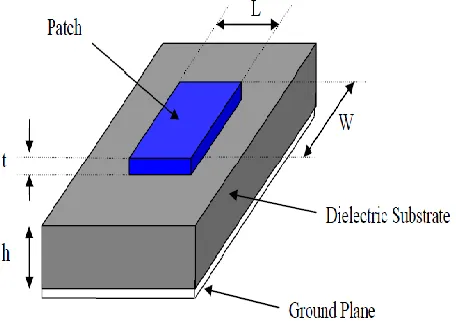
MICROSTRIP PATCH ANTENNA
© 2016, IRJET | Impact Factor value: 4.45 | ISO 9001:2008 Certified Journal | Page 639 Fig. 1: Structure of a Microstrip Patch Antenna
APPLICATIONS
After analyzing the advantages and disadvantages of the microstrip antennas, it can be observed that its advantages significantly overshadow its disadvantages. Due to the fact that most present-day systems demand for small size, lightweight, low cost and low antennas, the employment of microstrip technology arises extensively over the years. Even though conventional antennas possess far superior performance over microstrip antennas, it is still clearly disadvantaged by the other properties of the microstrip antennas. Shown below are some typical system applications which employ microstrip technology [2]:
1. The telemetry and communications antennas on missiles.
2. Radar altimeters use small arrays of microstrip radiators.
3. Aircraft-related applications include antennas for telephone and satellite communications.
4. Satellite imaging systems. 5. Satellite communications 6. WLAN and WIMAX. 7. High speed GPS.
ADVANTAGES AND DISADVANTAGES OF PATCH ANTENNA
Sr.
No Advantages Disadvantages
1 Light weight and low
volume. Narrow bandwidth
2 Low profile planar
configuration which can Low efficiency
Be easily made conformal to host surface.
3 Low fabrication cost, hence
can be Low Gain
Manufactured in large quantities.
4 Supports both, linear as
well as circular Low efficiency
© 2016, IRJET | Impact Factor value: 4.45 | ISO 9001:2008 Certified Journal | Page 640 5 Can be easily integrated
with microwave
Extraneous radiation from
integrated circuits (MICs). feeds and junctions
6 Capable of dual and triple frequency
Poor end fire radiator except
operations. tapered slot antennas
7 Capable of dual and triple
frequency Low power handling
[image:3.612.29.570.42.424.2]operations. capacity.
Table 1: Advantages & Disadvantages of Microstrip Patch Antenna [3]
VI. SUBSTRATE TYPES
The most commonly used flexible substrates are:
Electro-textile Paper based
Kapton Polymide film Flexible bow tie
[image:3.612.35.307.92.426.2]Kapton Polyimide film has a loss tangent of about 0.002, with some adhering qualities like a profile of 50.8 µm, a good dieletric as well as tensile strength and temperature rating. The following chart describes its qualities with a comparision with others.
Table 2: Comparative Study of Different Types of Flexible Antennas.[4]
VII. METHOD OF IMPLEMENTATION
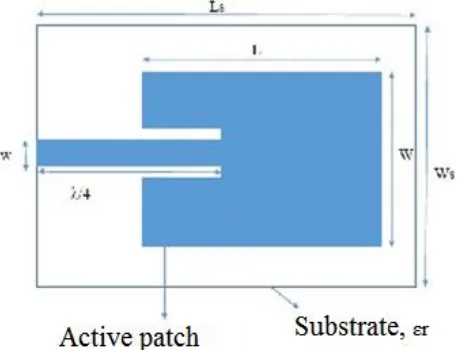
To begin with, the dimensions of the rectangular patch were calculated using formulae as being shown below. The width of the substrate and ground plane is required to calculate the power efficiency & bandwidth which is dependent on the operating frequency and the substrate dielectric constant. [5]
Fig. 2: Structure of The Patch[5]
[image:3.612.350.544.496.628.2]© 2016, IRJET | Impact Factor value: 4.45 | ISO 9001:2008 Certified Journal | Page 641 The antenna is based on a concept of fabricating the antenna
using ink-jet technology.
Use a highly conductive ink like that of Copper or Silver is preferred while preparation.
[image:4.612.37.268.332.507.2]A flexible patch antenna is designed in HFSS. The length of the patch is 32.152 mm, the width of the patch is 42.11 mm and Permittivity of the substrate is 3.4 and the resonance frequency is 2.4 GHz. Kapton Polymide is used as a substrate with a substrate height of 1.00 mm. The rectangular patch was energized using coaxial probe feed. This patch was designed in HFSS. After design, the patch was simulated in HFSS to get the directivity, the gain curves along with the 3D visuals of the far field radiation and the 3D view of the designed antenna patch. Fig. 3.1 shows the design of the single rectangular patch in HFSS.
Fig. 3: The design of the single rectangular patch in HFSS.
The transmission line model equations are as
follows:(1) To find the length of inset (Fi)
Fi = 10−4 [(0.001699 ∗ εr7) + (0.13761 ∗ εr6) – (6.1783 ∗ εr5) +
(93.187 ∗ εr4) – (682.69 ∗ εr3) + (2561.9 * εr2) – (4043 *εr1) + 6697]*(L/2)
(2) To find the width of substrate where the input impedance is usually 50 ohms.
Zc =
(3) Foe effective radation efficiency its value is given by (W)
W=
Where C is the free-space velocity of light i.e. 3×10⁸ m/s and εr is the dielectric constant of material.
(4) The Microstrip separates two dielectrics, i.e. air and substrate. Hence most of the electric field lines reside inside the substrate and some extend to air. This transmission line cannot support pure TEM mode of propagation since the phase velocities would be different in air and the substrate. Hence, effective dielectric constant must be obtained in order to account for fringing fields. [6]
The value of this effective dielectric constant is given by (𝜀reff)
© 2016, IRJET | Impact Factor value: 4.45 | ISO 9001:2008 Certified Journal | Page 642
Here, h is the height of substrate material.
W is the width of substrate material.
(5) To find the actual length L of the antenna, effective length (Leff) is given by,
Leff =
The L is the length extension due to the fringing field and can be calculated using the equation,
(6) To find the actual length (L)
L= Leff - 2△L
(7) The width and length of the Ground plane is calculated as follows:
𝐿𝑔 = 2 ∗ L ; Wg = 2 ∗𝑊
Various parameters are calculated and the table is formulated as follows: Seri al Nu mb er Paramet ers Valu
es Units
1 Frequenc
y, fo 2.4
Gigaher tz (GHz) 2 Dielectric constant, ɛr
3.4 No unit
3 Substrate
height, hs 1
Millime ter (mm) 4 Thickness of conducto r, t .035 Millime ter (mm)
5 Width of
patch, Wp 42.1 1 Millime ter (mm)
6 Length of
patch, Lp 32.1 52 Millime ter (mm) 7 Effective dielectric constant, ɛreff
3.26 No unit
8 ΔL .475
Millime ter (mm)
9 Length of
ground
38.1
© 2016, IRJET | Impact Factor value: 4.45 | ISO 9001:2008 Certified Journal | Page 643
plane, Lg (mm)
10
Width of ground plane, Wg
48.1 1
Millime ter (mm)
11
Width of feedline, Wf
1.8
Millime ter (mm)
12 Length of
Inset, Fi 8.98
Millime ter (mm)
13
Input Impedanc e, Zc
50 Ohms
[image:6.612.49.567.46.695.2](Ω)
Table 2: Calculated values of various parameters
VIII. OUTPUT
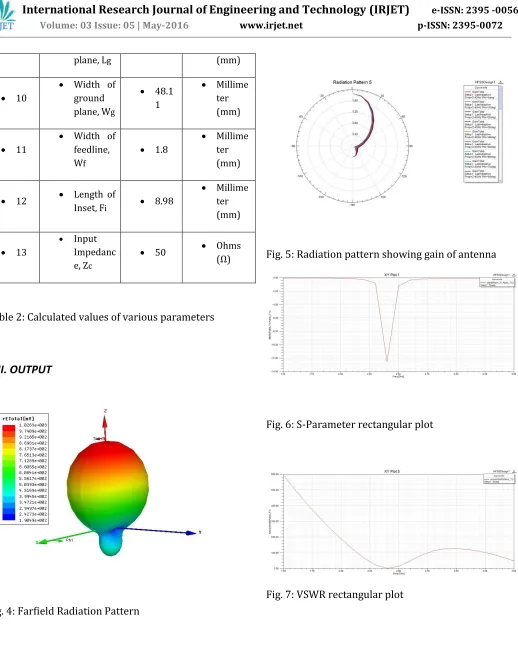
[image:6.612.28.308.90.330.2]Fig. 4: Farfield Radiation Pattern
Fig. 5: Radiation pattern showing gain of antenna
[image:6.612.320.566.317.429.2]Fig. 6: S-Parameter rectangular plot
[image:6.612.320.567.515.622.2]© 2016, IRJET | Impact Factor value: 4.45 | ISO 9001:2008 Certified Journal | Page 644 Fig. 8: Radiation pattern showing directivity of antenna
XI. CONCLUSION
The proposed design achieves an evolution from simple Rectangular Microstrip Patch antenna towards a flexible Microstrip patch antenna. The proposed designs includes the study of Microstrip patch antenna with substantially negligible thickness, on a Kapton Polymide substrate with the conductive ground plane as well as the patch made of Copper.
Thus, the proposed antennas designs represent a Flexible Patch antenna which is operable at robust, thin and has a low profile. These properties make it very useful in applications where space available is less and also where efficiency cannot be compromised.
X. REFRENCES
[1] https://en.wikipedia.org/wiki/Antenna_(radio)
[2] N. J. Kolias, R. C. Compton, J. P. Fitch and D. M. Pozar, Antenna, CRC Press, 2000.
[3] Haider R. Khaleel, Hussain M. Al-Rizzo and Ayman I. Abbosh,” Design, Fabrication, and Testing of Flexible Antenna.
[4] Indrasen Singh, Dr. V.S. Tripathi, “Micro strip Patch Antenna and its Applications: a Survey,” Indrasen Singh et al, Int. J. Comp. Tech. Appl., Vol 2 (5), 1595-1599.
[5] Azlin Lolin, “Design of a Rectangular Microstrip Patch Antenna,” ECM 521 technical report, 2011.
[6] http://www.iosrjournals.org/
BIOGRAPHIES
Shivam Mokha, B.E Final Year student, RCOEM, Nagpur.
Shubham Jangir, B.E Final Year student, RCOEM, Nagpur.
Shreyas Pimple, B.E Final Year student, RCOEM, Nagpur.
![Table 1: Advantages & Disadvantages of Microstrip Patch Antenna [3]](https://thumb-us.123doks.com/thumbv2/123dok_us/8194558.814152/3.612.350.544.496.628/table-advantages-disadvantages-microstrip-patch-antenna.webp)