2019 International Conference on Computer Science, Communications and Big Data (CSCBD 2019) ISBN: 978-1-60595-626-8
Return Good For Good?—Experimental Study
Based on an Emotion Game
Zhi FAN
1,2, Ya ZHOU
1,*and Ke-qiang LI
11
School of Systems Science, Beijing Normal University, 100875, Beijing, China
2
Department of Basic Courses, Beijing Union University, 100101, Beijing, China *Corresponding author
Keywords: Emotion game, Emotion, Environment, Strategy.
Abstract. Payoff, emotion, environment and strategy will affect players’ actions in a game. An emotion game has the features of separating the payoff’s effect from an emotion’s effect on decision-making. In this study, the human subject played repeated emotion games with his computer opponents who were randomly selected according to a fixed probability in different altruistic environments, and the payoff for each human subject was not decided by his own action. We demonstrate the influence of emotion and environment on strategy. We find that altruistic actions will increase with the degree of environmental friendliness, but friendliness without punishment will not only play a positive role, but will also change people’s coping strategies and make people more prone to speculation and vengeance. An opponent’s unfriendly behaviour in a friendlier environment can make people feel more dissatisfied and retaliate more.
Instruction
In decision-making, human beings often pay attention to other people’s incomes or their income relationships and are triggered by different emotions affecting their decision-making. Social preference theory has partly explained the subjects’ boundedly rational behaviors in the ultimatum, dictator, gift exchange and public goods games. Social preferences, such as altruistic preferences, unequal aversion preferences (dissatisfaction or guilt), reciprocal preferences, and competitive preferences, among other types, all relate to the subjects’ emotions.
In the above game experiments, the combined effects of monetary payoffs and emotions on the subject’s decision-making were studied, because the game involved a trade-off between players’ own payoffs and those of others. To eliminate the influences of this trade-off, researchers proposed playing a generous game [1] and an envy game [2]. In those games, a player’s actions only affect his own or another’s earnings, and he can change one’s payoff without paying any monetary cost. The emotion game has the same features as these games and simple choice experiments [3]. Unlike the above games, in the emotion game, two players can make their decisions under the same conditions. The results of interaction between two players may trigger the subject’s emotions that influence his decision-making, making the subject’s choice focus on a particular option and highlighting the role of emotion.
Experiment Design
The payoff matrix of emotion game is as follows:
Column player
1 2
Row player 1 1,1 2,1
2 1,2 2,2
In an emotion game, one player’s payoff is completely determined by the action of the other player, and one player can make his opponent receive more without paying any monetary cost. Choosing option 2 is called altruistic behaviour, in which the player behaves in a friendly way. However, it is impossible for the player to change his (or her) own income by his (or her) action. For the fully rational subject, he (or she) has no optimal strategy; he (or she) could choose option 2 with any probability at the individual level, but at the group level, there is a unique value of 0.5. However, if the emotions are taken into account, the game payoff structure will change, which is similar to Prisoner's dilemma or the Stag Hunt game. The role of some emotion is highlighted.
Although the player’s payoff does not depend on his own action in a static emotion game, the player can change his own payoffs through reciprocity in the repeated game. This study focuses on the influence of emotion on decision-making where it is not possible to change one’s own payoffs by his own actions, so the possibility of reciprocity must be eliminated. To do that, we design human-computer experiments in which the human player’s opponent is a virtual computer player who is randomly selected according to a fixed probability, a framework which is more suitable for studying the evolution of emotion and strategy. Games with the computer opponents have been used in many studies to identify how people respond to a particular strategy in a specific game [6], to study the mismatch between individual human behaviour and a certain learning rules [7], to analyse the behaviour patterns of players [8] and to identify individual social preferences in some strategic environments [9,10,11,12,13,14,15].
In our previous studies, we have demonstrated that strong reminders can minimize a human player’s emotional involvement, whereas weak reminders can lead to more emotional involvement. Although initially knowing his opponent was a computer without emotion, the human player still unconsciously treated his opponent as a human player in repeated games. When interacting with a computer player with emotions on a group level, the human players acted differently in various altruistic environments. In this paper, we will further study the reason for different actions in various altruistic environments. When the computer opponent chose randomly, the human subject’s response to a different combination of the two players’ actions in last round was treated as his strategy. We will compare strategy with and without emotions and investigate the impact of emotion on strategy. We change the degree of friendliness (kindness) of the environment to study the impact of environment on strategy.
Experiment Hypothesis
In the experiments, the computer player has no emotions and it does not react to human behaviour, but the human players have emotions. Altruistic, unequal aversion, and competitive preferences, along with other psychological factors can affect a subject’s decision-making. The subjects with altruistic preferences will always choose option 2, those with competitive preferences will always choose option 1, and those with unequal aversion preferences will adjust their choices according to the combination of the two players’ choices in the last round to express their feelings of dissatisfaction, guilt and calm. This study focuses on the effects of dissatisfaction, guilt, calm and friendliness of environment on each subject’s strategy.
destroyed for the pleasure of destroying when they could simultaneously destroy each other without any destruction cost and did not fear retaliation. Therefore, we make the following assumption:
On the group level,
Hypothesis 1: When the player’s payoff does not depend on his own action, the players with unequal aversion preferences cope strategically to express their emotions.
Hypothesis 2: In different altruistic environment, the coping strategies of the human players with unequal aversion preferences are different.
Because friendly environments can make people feel more comfortable, they are conducive to the generation of positive emotions in a more altruistic environment; the negative emotions of subjects will be weakened and people will behave in a friendlier manner, so subjects’ coping strategies will change.
Experiment Procedure
There are three treatments in the experiments, each consisting of 96 subjects in each treatment playing 100 rounds of emotion games with his computer opponents. All the subjects were recruited from BBS of Beijing Normal University. All 288 subjects were randomly selected to participate in the experiment. In each treatment, different human subjects played with different virtual computer players, but the set of strategy choices for the different virtual computer players was the same. In each round, the computer player chose according to the fixed probability q. A different probability of the computer choosing option 2 decides the altruistic degree of the environment under different treatments. The bigger the probability q is, the friendlier the environment is. The details of the experiments are shown in Table 1. The computerized experiments were programmed in Z-Tree software [16].
Table 1. Summary of the experiment implementation.
Treatment Altruistic Value of q Reminder Number of subjects Male Female Total
WAWR Weak 1/3 Weak 22 74 96
MAWR Median 1/2 Weak 24 72 96
SAWR Strong 2/3 Weak 24 72 96
Table 2. Summary of behavioural types in experiments.
Treatment Competitive Unequal aversion Altruistic Total
WAWR 3 88 5 96
MAWR 5 88 3 96
SAWR 4 87 5 96
Experiment Result
Even in different environments, individuals with altruistic preferences will always choose option 2 and individuals with competitive preferences will always choose option 1. In this study, the individual whose percentage of choosing option 2 in 100 rounds was less than 5% is defined as a subject with competitive preferences, the individual whose percentage of choosing option 2 was more than 95% is treated as a subject with altruistic preferences, and the remaining individual is a subject with unequal aversion preferences. In three treatments, the components of these three kinds of subjects are shown in Table 2. The Kruskal-Wallis nonparametric test shows that there is no difference among the three treatments (p-value= 0.283). In the following analysis of the influence of emotion and environment on strategy, we mainly aim at the subjects with unequal aversion preferences, while the subjects with altruistic preferences and competitive preferences are moved.
Result 1: The Subjects with Unequal Aversion Preference Did Not Select Randomly But Responded Strategically
We found that for the subjects with altruistic preference, as q decreases for the computer player, the probability that the human players choose option 2 also decreases. In SAWR, MAWR and WAWR, human players choose option 2 with probability 51%, 47% and 39%, respectively. Are the different results based on the same coping strategies? If the subjects’ unequal aversion preferences do not affect their actions, they will not change their choices according to the combinations of two players’ choices. Then, faced with all four possible combinations of the previous round of bilateral choices (the human player’s choice and the computer player’s choice)-11,12,21,22, the four probabilities p2|ij (i,j=1,2) should be the same on the group level, 2|ij, which means the human player chooses option 2 in the current round under the condition that the human player has chosen option i and the computer has chosen option j in last round. That is, p2|11= p2|12= p2|21= p2|22=1/2. Otherwise, because the subject with unequal aversion preferences cares about the payoff relationship between him and his opponent, p2|11, p2|12, p2|21, p2|22 will be different. When the outcome is 11 or 22, their payoffs are the same and the human player feels calm, but he will be more pleasant in state 22 and will choose option 2 with a bigger probability. When the outcome is 12, his own payoff is more than his opponent, he may feel guilt and will compensate his opponent, and the probability of choosing option 2 in the next round will be bigger than that in state 11. When the outcome is 21, his own payoff is less than his opponent’s payoff, so he may feel dissatisfaction and will pay his opponent back, and the probability of choosing option 2 in next round will be smaller than that in state 22.
Figure 1. Group coping frequency by round in WAWR, MAWR and SAWR.
In each round, we may count the four frequencies f2|11, f2|12, f2|21, f2|22, which are the estimated values of p2|11, p2|12, p2|21, p2|22. We calculate the 40 rounds moving average value of p2|11, p2|12, p2|21, p2|22 and find that in each treatment these 4 values are not the same. The evolution of each p2|ij by round is shown in Fig. 1.
It shows that although the computer chose randomly, the human players still adjusted their actions according to the results that they faced. However, the four coping probabilities have the same evolutionary characteristics, and the fluctuation is not obvious with the increase of round. It shows that the subjects’ strategies are stable in the face of random situations.
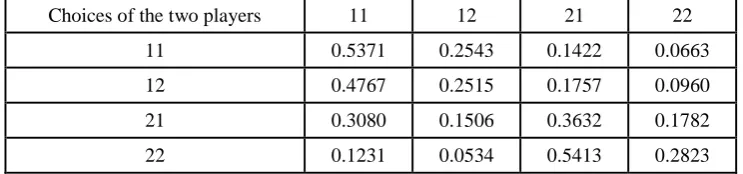
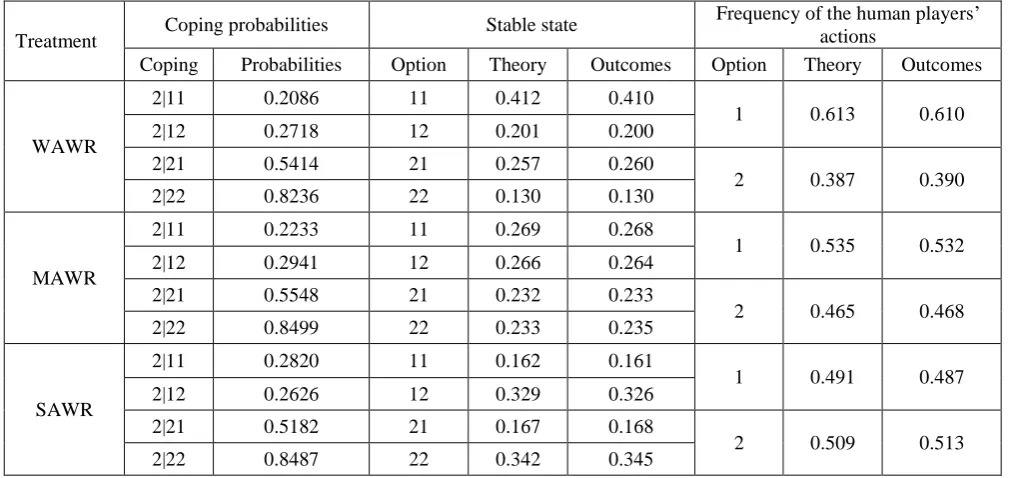
[image:5.595.112.484.528.615.2]The group strategy is stability, so we can analyse the evolution of group actions according to Markov transfer. For example, in WAWR, the first order Markov transfer matrix is shown in Table 3. From Table 3, we can obtain the estimated values of p2|11, p2|12, p2|21, p2|22, as shown in Table 4. The sum of the absolute differences between the statistical results and the theory’s stable state is 0.006, which shows that our hypothesis of the human players’ group strategy can explain most of the human players’ group behaviours.
Table 3. Transition probabilities of one-shot outcomes in WAWR.
Result 2: Environments Change Coping Strategies
In the three treatments, the environment’s altruistic (friendliness) degree is controlled by changing the probability of the computer choosing option 2, and the 40-round moving average value of each coping probability is shown in Fig. 1. The four probabilities in different treatments changed by round, and we find that the influences of environment on strategies vary differently.
(1) The human players’ strategies are more sensitive to environmental friendliness when their opponents are not friendly. Although there are differences in the three environments for both p2|12 and p2|22, Fig. 1 shows that the differences are much smaller than that of both p2|11 and p2|21 clearly. Moreover, the differences occur earlier for p2|11 and p2|21.
(2) Although they are increasing by round, p2|11, p2|12, p2|21 all decrease. However, in the friendlier environment, the human players felt more optimistic, and in SAWR, p2|11 is always bigger than it is in the other two environments. It is worth noting that a friendlier environment can
Choices of the two players 11 12 21 22
11 0.5371 0.2543 0.1422 0.0663
12 0.4767 0.2515 0.1757 0.0960
21 0.3080 0.1506 0.3632 0.1782
breed the subject’s discontent when the human players benefit less than their opponents, so their retaliatory behaviours increase. The reason for this may be that a small number of unfriendly actions in a friendlier environment can make the human players more impressed, because “You could be friendly, but you weren’t friendly”. At the same time, the guilt of facing his own unfriendly behaviour when his opponent was being friendly will be slightly weakened, which results in a slight increase in speculation, and which may be related to the fact that the computer always chooses at random without punishing anyone’s unfriendly behaviour.
(3) In the more hostile environment, the human players may feel more discontent and pessimism. Even in the face of both players acting friendly, both the perceptions of environmental friendliness and pessimistic expectations will reduce the human players’ friendliness, and it is evident that p2|22 of WAWR decreased in the later stage of experiments, however that in both other environments still remain unchanged.
[image:6.595.46.554.354.593.2]The combined effect of emotion and environment makes the human players’ coping strategies similar but different in different various altruistic environments, which makes the human players’ frequency of choosing option 2 different. As shown in Table 4, with the decrease of the degree of altruism in the environment, the human players’ frequency of choosing option 2 also decreases correspondingly on the group level. The experimental results are basically consistent with the theoretical analysis in WAWR, MAWR and SAWR according to the first order Markov transfer.
Table 4. Summary of group coping probabilities, stable state and choosing probabilities of the human players with unequal aversive preferences.
Treatment Coping probabilities Stable state
Frequency of the human players’ actions
Coping Probabilities Option Theory Outcomes Option Theory Outcomes
WAWR
2|11 0.2086 11 0.412 0.410
1 0.613 0.610 2|12 0.2718 12 0.201 0.200
2|21 0.5414 21 0.257 0.260
2 0.387 0.390 2|22 0.8236 22 0.130 0.130
MAWR
2|11 0.2233 11 0.269 0.268
1 0.535 0.532 2|12 0.2941 12 0.266 0.264
2|21 0.5548 21 0.232 0.233
2 0.465 0.468 2|22 0.8499 22 0.233 0.235
SAWR
2|11 0.2820 11 0.162 0.161
1 0.491 0.487 2|12 0.2626 12 0.329 0.326
2|21 0.5182 21 0.167 0.168
2 0.509 0.513 2|22 0.8487 22 0.342 0.345
Conclusion and Discussion
effect on the individual decision-making will be better between emotions and monetary payoffs? All of those will be studied later. It is believed that the game experiment in which the virtual computer will respond to the human player and the game experiment in which both players are human beings with emotions will help us know more.
References
[1] W. Güth, M. V. Levati, An experimental study of the generosity game, Theory Decision. 72.1 (2012) 51–63.
[2] S. Casal, W. Güth, M. Jia, M. Ploner, Would you mind if I get more? an experimental study of the envy game, Journal of Economic Behavior & Organization. 84. 3 (2012) 857–865.
[3] E. Fehr, H. Bernhard, B. Rockenbach, Egalitarianism in young children, Nature. 454.7208 (2008) 1079–1083.
[4] K. Abbink, and A. Sadrieh, The pleasure of being nasty, Economics Letters. 105.3 (2009) 306-308.
[5] E. Winter, S. Zamir, An experiment with ultimatum bargaining in a changing environment, Japanese Economic Review. 56.3 (2005) 363–385.
[6] J.W. Walker, V.L. Smith, J.C. Cox, Bidding behavior in first price sealed bid auctions: use of computerized Nash competitors, Economics Letters. 23 (1987) 239–244.
[7] P. Duersch, A. Kolb, J. Oechssler, B. C. Schipper, Rage against the machines: how subjects play against learning algorithms, Economic Theory. 43.3 (2010) 407–430.
[8] J. Shachat, J. T. Swarthout, L. Wei, A hidden markov model for the detection of pure and mixed strategy play in games, Econometric Theory. 31.4 (2015) 729–752.
[9]D. Houser, R. Kurzban, Revisiting Kindness and Confusion in Public Goods Experiments, American Economic Review. 92.4(2002)1062–1069.
[10] K. Mccabe, D. Houser, L. Ryan, V. Smith, T. Trouard, A functional imaging study of cooperation in two-person reciprocal exchange, Proceedings of the National Academy of Sciences of the United States of America. 98.20 (2001) 11832–11835.
[11] T. Brenner and N. J. Vriend, On the behavior of proposers in ultimatum games. Journal of Economic Behavior & Organization. 61.4 (2006) 617-631.
[12] C. A. Cox, A. Karam, R. J. Murphy, Social preferences and cooperation in simple social dilemma games, Journal of Behavioral and Experimental Economics. 69(2017) 1–3.
[13] T. Yamakawa, Y. Okano, T. Saijo, Detecting motives for cooperation in public goods experiments, Experimental Economics. 19.2 (2016) 500–512.
[14] E. I. Hoppe, P. W. Schmitz, Contracting under incomplete information and social preferences: An experimental study, Review of Economic Studies. 80.4 (2013) 1516–1544.
[15] C. D. Mauro, M. F. Castro, Kindness, confusion, or ambiguity?, Experimental Economics.14. 4 (2011) 611–633.