VIEWPORT-AWARE ADAPTIVE 360°
VIDEO STREAMING USING TILES
FOR VIRTUAL REALITY
Cagri Ozcinar, Ana De Abreu, and Aljosa Smolic
Trinity College Dublin (TCD), Dublin 2, Ireland.
ABSTRACT
360° video is attracting an increasing amount of atten-tion in the context of Virtual Reality (VR). Owing to its very high-resolution requirements, existing professional stream-ing services for 360° video suffer from severe drawbacks. This paper introduces a novel end-to-end streaming system from encoding to displaying, to transmit 8K resolution 360° video and to provide an enhanced VR experience using Head Mounted Displays (HMDs). The main contributions of the proposed system are about tiling, integration of the MPEG-Dynamic Adaptive Streaming over HTTP (DASH) standard, and viewport-aware bitrate level selection. Tiling and adap-tive streaming enable the proposed system to deliver very high-resolution 360° video at good visual quality. Further, the proposed viewport-aware bitrate assignment selects an optimum DASH representation for each tile in a viewport-aware manner. The quality performance of the proposed system is verified in simulations with varying network band-width using realistic view trajectories recorded from user experiments. Our results show that the proposed streaming system compares favorably compared to existing methods in terms of PSNR and SSIM inside the viewport.
Index Terms— 360° video, virtual reality, tiling, DASH, viewport-aware
1. INTRODUCTION
During the last years, significant achievements have been made regarding the rendering capacity and quality of Head Mounted Display (HMD) systems [1]. Modern HMDs can render 360° video at a sufficiently high frame-rate and reso-lution, allowing the viewer to be immersed in the VR envi-ronment.
Although numerous professional VR video services have emerged for streaming the 360° video,e.g.,YouTube 360 [2], they suffer from severe drawbacks. More clearly, each video frame, containing a 360° Field of View (FOV), is encoded and transmitted regardless of the FOV of the HMD. In fact, the existing HMDs have a viewable FOV that ranges from 96° to 110° [3], meaning they use only around one fifth of the transmitted data [4]. The area of the 360° video frame dis-played by the HMD at a given time is known as theviewport. Hence, the perceptual quality of such video mainly depends
on the viewport quality. In existing professional services, re-gions outside the viewport waste a considerable proportion of the bandwidth. This unnecessarily utilized bandwidth re-sults in overall low-quality video streaming to comply with the present Internet and decoding limitations.
Considering its data-intensive representation and the best-effort nature of the Internet, 360° video streaming requires a bitrate adaptive solution to offer an enhanced VR experi-ence. To this end, MPEG-Dynamic Adaptive Streaming over HTTP (DASH) [5], which is an international standard for adaptive streaming, is a key enabler in achieving a smooth VR video playback. The main aim of DASH is to provide a high-quality streaming experience based on the client bandwidth. In DASH, video streams are requested using a manifest file, Media Presentation Description (MPD), which contains a set of bitrate representations.
The significant requirements regarding resolution to en-sure high-quality VR experience [3,6] can be managed with tiling and viewport-aware solutions using DASH. For exam-ple, tiling can generate self-decodable regions,i.e.,tiles, by spatiallydividing the frames. In addition, tiling can consider the importance of regions [7] and can enable parallel down-loading [8] and decoding [9,10] features. As the HMDs use only the viewport out of the captured 360° video, the visual quality of the viewport can be enhanced in a viewport-aware manner.
This paper focuses on adaptive 360° video streaming and provides improved viewport quality compared to existing pro-fessional services. A VR video streaming system, from en-coding to displaying, is designed to transmit 8K 360° video and to offer an enhanced VR experience. The main contri-bution of this work is an end-to-end streaming system im-plementation that contains tiling, a novel extension of the MPD, and DASH bitrate level selection in a viewport-aware manner. Experimental results showed that the proposed sys-tem demonstrates significant quality enhancements compared with the streaming approach that is currently used by profes-sional VR services [2,11] in this area. Our work concentrates on adaptive distribution of bitrate and quality over the 360° video in contrast to existing professional services. The sys-tem uses the tiling concept to divide each video frame into tiles to encode, transmit, and decode them effectively. To fa-cilitate tiled 360° video streaming, we extended the concept
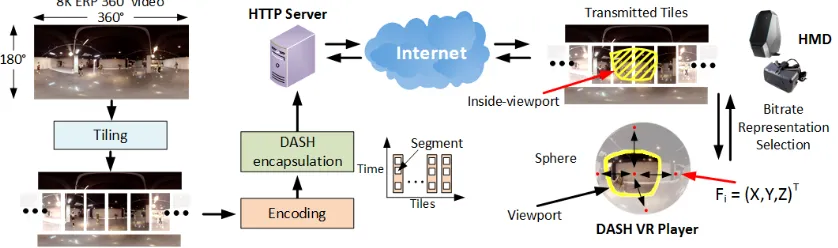
Fig. 1: Schematic diagram of our adaptive 360° video streaming system for VR.
of DASH Spatial Relationship Description (SRD) [12], and introduced a new MPD for DASH streaming. The proposed DASH player also efficiently distributes the available band-width to the tiles and requests the best bitrate representation for each tile in a viewport-aware manner.
The rest of this paper is organized as follows: the related work is presented in Sec.2. In Sec.3, we introduce the pro-posed solution. In Sec.4, we present the experimental results. Finally, Sec.5concludes the paper.
2. RELATED WORK
Several early studies [13–16] used tiling for the aim of viewport-aware 360° video transmission, where an HMD technology was utilized without using a bitrate adaptive streaming. Although these solutions are far from achieving the expected high-quality performance because of the limita-tions of the early technologies, they are pioneering works in this area.
Recent advances in adaptive streaming and modern HMDs have made it feasible to deliver and render high-quality 360° video. There are two types of adaptive stream-ing solutions which are commonly used in this area, namely, non-tiled and tiled. In the context of non-tiled, a recent work in [17] focused on the quality impact of 360° video projec-tions. In addition, in the context of tiling research, a short paper of Skupinet. alin [18] described the bandwidth prob-lem of 360° video, and suggested to use tile-based streaming. Also, in the work in [19], high-resolution video content is transmitted in tiled fashion using fixed rectangular tiles, such as 5×5.
To design a practically applicable streaming system for 360° video and to address studies needed in this area [20], we developed a system for VR that supports tiled and viewport-aware adaptive streaming. We used unequal tile sizes and viewport-aware bitratedistributionusing a noveldistance cri-terion. To verify our method, we recordedrealviewport tra-jectories from subjects in viewing sessions. With using our recorded data, we calculated the viewport quality scores and compared our proposed method with the reference solution, which is based on the existing professional adaptive stream-ing systems [11].
3. PROPOSED STREAMING SYSTEM
Typically 360° video is shot using a collection of cameras that cover a 360° FOV. The captured frames are then stitched together and projected onto a 2D plane using the Equi-Rectangular Projection (ERP) [21]. The overall video has to have a very high resolution such as 8K in order to provide high quality for a given viewport, which is only a portion of the overall view.
To increase the streaming performance of such content, we propose an adaptive streaming system that enhances the visual quality of the video displayed in the viewport. The proposed system divides each ERP video frame into self-decodable tiles, encodes them at various bitrates, and then encapsulates and stores them in the HTTP server. Each bit-stream contains multiple self-decodable time segments for the purpose of adaptive streaming.
The proposed DASH VR player requests the most appro-priate bitrate representations for each tile given the available network bandwidth and the viewport location. To avoid unde-sirable quality degradation during a possible sudden viewport movement, our current system streams the whole tiled ERP frame by gradually reducing the bitrate (or quality) of the outside-viewport tiles and increases the quality of the inside-viewport tiles. To this end, in order to use our approach with the DASH standard, we extended the DASH-SRD representa-tion, and contributed a novel MPD for DASH streaming. Fi-nally, the decoded tiles are rendered in the HMD after project-ing them back into a sphere. A schematic diagram summariz-ing the proposed streamsummariz-ing system is presented in Fig.1.
3.1. Tiling and encoding
viewing adjacency of the equator [22]. First, each ERP video frame is vertically divided into three parts: the equator and two poles. The equator represents the middle segment, and the two poles stand for the top and the bottom sections of the frame. As the poles occupy the largest regions of re-dundant pixels [23], in those areas, larger tile resolution size can be used to compress them using a lower bitrate. Addi-tionally, as the equator is associated with the most dominant viewing adjacency [22], it is further divided horizontally into several tiles to efficiently transmit them using the proposed viewport-aware representation selection, as shown in Fig.1.
Each tiled video frame may then be encoded e.g. with either the H.264/Advanced Video Coding (AVC) [24] or the High Efficient Video Coding (HEVC) standard (H.265/MPEG-HEVC). As the proposed system is a codec agnostic, the player can decode each tile stream with either of the coding standards, along with several possible individual decoders for AVC or a single decoder for HEVC encoded tiles. Im-portantly, tiling offers additionally parallel downloading and decoding opportunities to transmit and decode the high-resolution 360° video effectively.
3.2. MPD extension for 360°video
In order to transmit the tiled video frames to the VR client, the DASH standard is used for adaptive streaming. To this end, Each encoded tile is divided into self-playable time segments, and an MPD is delivered before starting a streaming session. The MPD describes the structure of bitrate representations for each tile.
In order to use our streaming approach with the DASH standard, a novel MPD structure is introduced for 360° video content. For that, the standard MPD structure for SRD is extended to support our viewport-aware approach. The pro-posed MPD includes the tiles’ Identification Numbers (ID), their resolutions, their positions and their center locations in terms of the spherical Cartesian coordinates. This way, each tile can be requested with its ID and then mapped to a sphere with the help of its resolution and its position on the sphere. To facilitate viewport-aware streaming, a center location is added in the MPD for each tile. This way, eachithtile con-tains a center point, which is represented asFi= (X, Y, Z)T, as illustrated in Fig.1.
3.3. Viewport-aware representation selection
Given the current viewport, an optimal bitrate representation is selected for each tile. This work is interested in provid-ing more importance to the tiles in the viewport, meanprovid-ing higher bitrate. Consequently, the total bits to be assigned to the tiles that areoutsideof the viewport are reduced. The per-ceived visual quality is enhanced by increasing the bitrate of the viewport. The bitrate of the tiles outside of the viewport is gradually reduced based on thedistancebetween the spheri-cal center location of the viewport and each outside-viewport tile.
The proposed DASH VR player requests the optimum bi-trate representation for each tile using the designed MPD. To this end, we defineV,SinandSout for the viewport, a set of the tiles inside the viewport, and a set of tiles outside of the viewport, respectively. The bitrate assigned to theithtile in the viewport is the following:
RVi = (γRcur)ωi i∈V, i6∈S
out, (1) where the tile represents asi,i ∈ Zandi ∈ [1, N]. N
de-notes the total number of tiles. γis a client-defined constant term, which isγ ∈ [0,1]. In this work,γ is selected as 0.8 empirically. Rcuris the current available bandwidth, andωi is the weight of theithtile inSin. This weight is calculated for theithtile as:
ωi=
#of pixels in(V ∩Siin)
ρtot
, (2)
whereρtotis the total number of pixels inV.
To gradually distribute the remaining bandwidth among the outside-viewport tiles, the Euclidean distance,δi, is cal-culated between the middle point of theV, and each defined Fipoint for each outside-viewport tile,Sout
i . The bitrate es-timation for theithtile inSoutis calculated as follows:
RSout
i
=κbi((1−γ)Rcur) i∈Sout, i6∈V, (3) whereκbiis calculated asκbi=
κi
Σiκi andκi= maxiδi
δi . Finally, the client requests a bitrate representation for each tile, which can be obtained as follows:
J ⇐min
J |rJ−Ri| i∈(S
in∪Sout), (4)
where R=RSout ∪RSin,Jis the selected DASH represen-tation ID,J ∈ {1, . . . , }givenis the total number of rep-resentations, andrJ is the bitrate of theJthrepresentation.
4. EXPERIMENTS 4.1. Setup
Fig. 2: Quality over time comparison between the proposed and the reference adaptive streaming solutions.
environment. We evaluated the algorithms at a perceptually acceptable quality level for VR video applications [4]. The connection between the server and the client was a local wired connection, with varying bandwidth between 4 and 22Mbps. The proposed method, denoted asproposed, divides each video frame intoNtiles. Two tiles were utilized for the poles, andN −2tiles were used for the equator. In this test, we experimented with several settings of N. Encoded bitrate for each tile is equally distributed by dividing thetarget bi-trateto theN tiles. The DASH VR player was implemented using three APIs, namely, three.js [28], WebVR [29], and dash.js [30]. On the contrary, the reference system, denoted asreference, which works in similar principle in existing pro-fessional streaming services, neither uses viewport-aware nor tiling techniques. Thereferencetransmits each 8K ERP video frame as a single tile using DASH.
PSNR and SSIM measures were employed to evaluate the objective viewport quality. For that, we recorded real view trajectories of 8 users viewing the content on Oculus Rift DK2 [1]. Each participant session started after a 10sec. train-ing video. Average inside-viewport quality scores were cal-culated over time using the participants’ trajectories.
4.2. Performance Evaluation
To evaluate the quality performance of theproposedand the referenceadaptive streaming methods over varying network throughput, average qualities were calculated using the par-ticipants’ changing viewport over the time. N = 12, 10 and 8 were tested to investigate the impact of the number of tiles. Fig. 2shows the comparison between theproposed and the referencestreaming solutions in terms ofaveragePSNR and SSIM with theirvariationsover time. In the figure, the filled area shows the variation, and the left and right axes represent the objective measures and the bitrate representation, respec-tively. The dashed-line denotes the selected bitrate represen-tation by the DASH client.
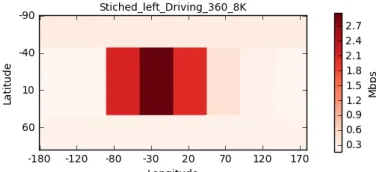
The results show that the proposed with N=10 con-siderably increases the streaming quality compared with the reference at all times. Also, the results show a qual-ity drop after each 1sec. segment playback. The reason is the viewport movement before delivering new segments. Because we used a distance-based bitrate distribution, vi-sual quality was preserved effectively, compared with the reference, for each content. The bitrate distribution of the Stiched left Driving360 8K sequence is illustrated in Fig 3, where the inside-viewport tiles use the highest
[image:4.612.341.529.250.336.2]bi-trates. In addition, as it can be seen in Fig 2, the pro-posedwithN=10 achieves 1.66/0.02 and 5.72/0.04 average PSNR(dB)/SSIM gains with respect to thereferencemethod for theStiched left Driving360 8KandStiched left Dancing 360 8Ksequences, respectively.
Fig. 3: Bitrate distribution of the 4th participant at 4 sec. withN = 10. Selected representation and calculated view-port quality are 9Mbpsand 40.156dB, respectively.
In this work, we demonstrated that theproposed stream-ing performance depends on the viewport movement activity and content type. For example, for theStiched left Driving360
8K sequence, theproposedwithN = 12 and 8 methods pre-serves complex details at low bitrate, and provides higher visual quality. Also, in theproposed withN = {12,10,8} methods, a considerable quality gain was achieved with re-spective to theproposedfor theStiched left Dancing360 8K sequence. In this sequence, theproposedwithN = 10, which uses the optimumNsize in our system, achieved the highest quality performance relative to usingN={12,8}.
5. CONCLUSIONS
6. REFERENCES
[1] Oculus VR, “Oculus rift,” https://www3. oculus.com/en-us/rift/, Accessed: 2017-1-5.
[2] YouTube, “Virtual reality,” https: //www.youtube.com/channel/
UCzuqhhs6NWbgTzMuM09WKDQ, Feb 2017.
[3] “Requirements for high quality for VR,” Tech. Rep. MPEG 116/M39532, JTC1/SC29/WG, ISO/IEC, Chengdu, CN, Oct. 2016.
[4] Huawei Technologies co., LTD.,Whitepaper on the VR-Oriented Bearer Network Requirement, 15 Sept. 2016.
[5] ISO/IEC 23009-1, “Information technology — dy-namic adaptive streaming over HTTP (DASH) — part 1: Media presentation description and segment formats,” Tech. Rep., ISO/IEC JTC1/SC29/WG11, 2014.
[6] J. D. Moss and E. R. Muth, “Characteristics of head-mounted displays and their effects on simulator sick-ness,”Human Factors, vol. 53, no. 3, pp. 308–319, April 2011.
[7] M. Meddeb, M. Cagnazzo, and B. Pesquet-Popescu, “ROI-based rate control using tiles for an HEVC en-coded video stream over a lossy network,” in2015 IEEE International Conference on Image Processing (ICIP), 2015, pp. 1389–1393.
[8] D. Stenberg, “HTTP2 explained,” ACM SIGCOMM Computer Communication Review, vol. 44, no. 3, pp. 120–128, 2014.
[9] K. Misra, A. Segall, M. Horowitz, S. Xu, A. Fuldseth, and M. Zhou, “An Overview of Tiles in HEVC,” IEEE Journal of Selected Topics in Signal Processing, vol. 7, no. 6, pp. 969–977, Dec 2013.
[10] O. A. Niamut, E. Thomas, L. D’Acunto, C. Concolato, F. Denoual, and S. Y. Lim, “MPEG DASH SRD: Spa-tial relationship description,” in7th International Con-ference on Multimedia Systems. 2016, MMSys ’16, pp. 5:1–5:8, ACM.
[11] “360 video and virtual reality (VR) in JW player part 1 : State of the industry,” https://www.jwplayer.com/blog/
360-vr-part1-state-of-the-industry/, Feb 2017.
[12] “Spatial relationship description, generalized URL pa-rameters and other extensions,” Tech. Rep., ISO/IEC 23009-1:2014/Amd 2, 2015.
[13] C. Grunheit, A. Smolic, and T. Wiegand, “Efficient rep-resentation and interactive streaming of high-resolution panoramic views,” in2002 International Conference on Image Processing (ICIP), Sept. 2002, vol. 3, pp. III– 209–III–212 vol.3.
[14] A. Smolic and P. Kauff, “Interactive 3-D video repre-sentation and coding technologies,” Proceedings of the IEEE, vol. 93, no. 1, pp. 98–110, Jan 2005.
[15] P. R. Alface, J. F. Macq, and N. Verzijp, “Evaluation of bandwidth performance for interactive spherical video,” in2011 IEEE International Conference on Multimedia and Expo, July 2011, pp. 1–6.
[16] S. Heymann, A. Smolic, K. Mueller, Y. Guo, J. Rurain-sky, P. Eisert, and T. Wiegand, “Representation, coding and interactive rendering of high-resolution panoramic images and video using MPEG-4,” inPanoramic Pho-togrammetry Workshop, Berlin, Germany, Feb. 2005, pp. 24–25.
[17] X. Corbillon, A. Devlic, G. Simon, and J. Chakareski, “Viewport-adaptive navigable 360-degree video deliv-ery,” arXiv:cs.MM 1609.08042v1, vol. cs.MM, no. 1609, Sep. 2016.
[18] R. Skupin, Y. Sanchez, C. Hellge, and T. Schierl, “Tile based HEVC video for head mounted displays,” in IEEE International Symposium on Multimedia (ISM), San Jose, CA, USA, Dec 2016, Accessed: 2017-1-16.
[19] J. Le Feuvre and C. Concolato, “Tiled-based adap-tive streaming using MPEG-DASH,” in 7th Interna-tional Conference on Multimedia Systems, New York, NY, USA, 2016, MMSys ’16, pp. 41:1–41:3, ACM.
[20] “Descriptions of core experiments on DASH amendment,” Tech. Rep. MPEG2016/ N16224, JTC1/SC29/WG, ISO/IEC, Geneva, Switzerland, June 2016.
[21] J. P. Snyder,Flattening the Earth: Two Thousand Years of Map Projections, University of Chicago Press, 1993.
[22] M. Yu, H. Lakshman, and B. Girod, “A framework to evaluate omnidirectional video coding schemes,” in 2015 IEEE International Symposium on Mixed and Aug-mented Reality, 2015, pp. 31–36.
[23] M. Budagavi, J. Furton, G. Jin, A. Saxena, J. Wilkinson, and A. Dickerson, “360 degrees video coding using re-gion adaptive smoothing,” in2015 IEEE International Conference on Image Processing (ICIP), 2015, pp. 750– 754.
[25] G. Bang, G. Lafruit, and M. Tanimoto, “Description of 360 3D video application exploration experiments on divergent multiview video,” Tech. Rep. MPEG2015/ M16129, ISO/IEC JTC1/SC29/WG11, Chengdu, CN, Feb. 2016.
[26] “VideoLAN,” http://www.videolan.org/ developers/x264.html, Feb 2017.
[27] J. Le Feuvre, C. Concolato, J.-C. Dufourd, R. Bouqueau, and J.-C. Moissinac, “Experiment-ing with multimedia advances us“Experiment-ing GPAC,” in Proceedings of the 19th ACM International Conference on Multimedia, New York, NY, USA, 2011, MM ’11, pp. 715–718, ACM.
[28] “JavaScript 3D library. https://threejs.org/,”https:// github.com/mrdoob/three.js/, Feb 2017.
[29] “WebVR: Bringing virtual reality to the web,”https: //webvr.info/, Feb 2017.