RESEARCH ON BENCHMARKING IN HIGHER EDUCATION: AN
OVERVIEW
Mr. Pulatkhon Lutfullayev, Faculty of Education, University of Malaya,
ABSTRACT
Benchmarking has proved to be an effective method for identifying the best practices and improving the quality and processes in an organization. The technique has been used widely in business and industry for couple of decades, and within a decade the concept has been broadly embraced and applied in higher education. This paper describes the effectiveness of the benchmarking application practices in higher education from the different perspectives to improve quality. The paper also presents a critical review of research works that have been done around the world in the area of benchmarking in higher education. The purpose of this review is to identify the trend, critical issues, topics of focus, research methodologies, findings, and implications of the research done, finally, some pragmatic suggestions are offered to improve the quality of local universities.
1. CONCEPT OF QUALITY IN ORGANIZATIONS
In the past six decades, corporations around the world believed that ‘quality’ was the most critical aspect of gaining competitive advantages the market, and thus maintaining their sustainability. ‘Quality’ as a concept not only focused on products, but also encompassed input, human resources, and management process aspects—hence, there emerged later the concept of ‘total quality management’ (TQM), based on the belief that quality products and services were the natural results of the overall quality of organization.
Numerous evaluation tools have been designed to measure and upgrade the total quality of corporations and organizations, among them the Malcolm Baldrige Award, ISO (International Standards Organization), European Quality Award, Deming Application Prize, and Six Sigma. Apart from that, many new awards have been created for promoting quality of different types of firms and products, and new quality concepts have emerged such as quality assurance (QA), benchmarking, and best practices. The mind set of corporations has become ever more competitive, comparative, and evaluative in nature. The goal is to be the best in class; hence, claiming the status and prestige that come along with the goal (Spendolini 1992; Zairi 1996; Alstete 1995; Bender& Schuh 2002).
In the pursuit of status, prestige, and accreditation, most corporations employ the benchmarking process as the tool for pushing themselves towards the best standard (Zairi 1996; Coding 1993). There are various definitions of benchmarking, but essentially it is the process used in management by which organizations to compare and evaluate various aspects of their processes and performances in relation to the best practices of leading organizations in same class. The goal of benchmarking is to provide key personnel, in charge of processes, with reputable standards for measuring the quality and cost of internal activities, and to help identify where opportunities for improvement may reside (Alstete, 1996).
Benchmarking can be an effective diagnostic instrument and it may give rise to alternative solutions, but that the judgment about how far those solutions can be applied must remain in the hands of management. A central purpose of benchmarking is therefore to provide managers with an external point of reference or standard for evaluating the quality and cost of their organization’s internal activities, practices, and processes (Alstete, 1995). Benchmarking will not be effective if it simply takes a snapshot of a comparative situation. It needs to be an on-going, systematic process for measuring and comparing the work processes of one organization with those of another by bringing an external focus on internal activities.
2. ORIGINATION OF BENCHMARKING
The term “benchmarking” originated in business and manufacturing firms. Sylvia Coding (2000) says that benchmarking was first used in Egypt in the olden times to scale the things by labeling the horizontal flat strip iron of stone at an accurate determined point as a bench. However, in recent decades, almost all authors who wrote about benchmarking linked the early application of it with American Xerox Corp which found itself in deep trouble in 1979. At that time, Xerox was losing a significant share of the lucrative photocopier market to its Japanese counterparts which could sell more cheaper product than Americans. Then Xerox conducted an analysis in its operation and compared it with Japanese firms’ best practices. They examined why they failed, how things are done, and how Japanese did things in their various processes. As a result by 1980, Xerox achieved to survive in market by producing competitive and quality productions and consequently won the prestigious Malcolm Baldrige national quality award in 1991. From the Xerox’s experience, it is thus defined that benchmarking as a continuous, systematic process of evaluating companies recognized as industry leaders, to determine business and work processes that represent ‘best practices’ and establish rational performance goals (Zairi, 1996).
In the decades of 1980-90s benchmarking became one of the popular management tools in organizations to achieve quality and to learn best practices. Later it has been used by several companies like General Motors, Hewlett Packard, Dupont, Motorola, Royal Mail and others. Zairi (1996) described all benchmarking practices that have used by companies and business sectors including service, post office, financial sectors, electronic and IT sectors, telecommunication sectors, chemical industry, aerospace industry, automobile industry, health care and etc.
3. BENEFITS OR ADVANTAGES OF BENCHMARKING
institution’s shortcomings, then convey the findings, with potential solutions, to an audience that will include both proponents and adversaries (Bender, 2001). Conveying the idea and proposals to a wide range of members help to make collaborative planning and decision, rather than making decisions behind the close doors.
As Bender (2001) suggests, institutions must routinely evaluate all their aspects and make changes necessary to address its shortcomings, from the curriculum to the physical plant. Failure it, that means jeopardizing its future. A definite benefit of the benchmarking in higher education is self-analyzing, i.e. institutions are forced to study their own processes, collect information, and raise questions about the efficacy of current processes and systems in place. Spendolini (1992) says benchmarking offers the opportunity for practitioners to think “out of the box” to discover new ideas, because in many instances leaders tend to work in their own “boxes” most of the time where they have been successful and are comfortable. In his book on “Benchmarking”(1992), Spendolini clearly identifies that benchmarking is a continuous process, not a one-time event; benchmarking is not a process that provides simple answers through the numbers reported, or in the process enablers that are the means for achieving the better numbers; but it is a process that provides valuable information that needs to be incorporated, or adapted, into the organization that hopes to improve and can identify industry standards. Alstete (1996) mentions several benefits of benchmarking, which include:
• It is easy to understand and be implemented by all levels of employees in the organization for all kind of processes.
• Many companies such as Xerox, Motorola, IBM and others have been using it for years.
• Benchmarking uses reliable research techniques such as surveys, interviews, and site visits which provide external and objective measurements for goal-setting, and for improvement tracking over time.
Today, more corporations, nonprofit organizations, and institutions of higher education are using benchmarking as the key tool for making both strategic and operational changes, on problem- and process-based approaches, and horizontally or vertically within their structures (Alstete, 1996; Camp, 1995; Rush 1994). Doerfel and Rueben (2002) suggest that the most typical goals of benchmarking are assessment and innovation. Assessment and innovation are the result of comparison one own organizational activities with those of other one. Comparisons with peers, competitors, or leaders provide the basis for interpreting one’s own results in a meaningful manner, and it can provide new insights into ways of thinking and working, and inspire and motivate useful and profound change.
The Consortium for Excellence in Higher Education (2003) states that benchmarking can help an organization: to obtain an objective assessment of process strengths and weaknesses; to seek methods and ideas to stimulate the thinking of internal groups; to overcome internal resistance to appropriate change; to justify methods, operations or resources in place.
4. TYPES OF BENCHMARKING
The major types of benchmarking are internal, external-competitive, external-collaborative and best in class. Alstete (1996) identifies five types: internal, external competitive, external collaborative, external trans-industry (best-in-class), and implicit benchmarking. Jackson and Helen (2000) classified benchmarking types according to referencing processes:
(i) Implicit or explicit benchmarking,
(iii) Internal or external focused benchmarking,
(iv) Vertical or horizontal benchmarking which is focused on the whole process, (v) Quantitative and qualitative approach benchmarking,
(vi) Input-process-output focused benchmarking.
Sarah Cook (2000) identifies four types of benchmarking namely internal, competitive, non-competitive, and best practice/world class. A team of authors from Bucharest, Lazăr Vlăsceanu et al., (2000) identify three types: strategic benchmarking (focusing on what is done, on the strategies organizations use to compete); operational benchmarking (focusing on how things are done, on how well other organizations perform, and on how they achieve performance), or data-based benchmarking (statistical benchmarking that examines the comparison of data-based scores and conventional performance indicators). They mentioned also internal/external and external collaborative/trans-industry/ implicit benchmarking types. They say, within different types, benchmarking may be either vertical (aiming at quantifying the costs, workloads, and learning productivity of a predefined program area) or horizontal (looking at the costs of outcomes of a single process that cuts across more than one program area).
Achtemeier and Simpson (2005) mention process benchmarking, metric benchmarking and goals and milestones. Process benchmarking involves identifying a problem area within one’s own institution, identifying another not necessarily similar institution with exemplary performance in this area, and sending a team of people who work in this area to the exemplar institution to learn how it achieves its outstanding results. The team then adapts these best practices to improve the home institution. Metric benchmarking means the comparison, among several institutions, of data for selected indicators in order to determine an institution’s relative performance (Smith, Armstrong, & Brown, 1999). Goals and milestones represent another way to understand benchmarking. One identifies internal targets to indicate an institution’s process, and these may be chosen without any external reference by which to measure (Zairi, 1996).
Alstete (1996) gives two types of benchmarking approaches, which is strategic benchmarking and operational-level benchmarking. With strategic approach, the organization looks at its overall competitive products and services to understand and develop competitive products and strategies (Camp, 1995). Operational benchmarking is used to understand specific customer requirements and the best practices to achieve customer satisfaction by improving internal organizational processes.
Consortium for Excellence in Higher Education (2003) identifies seven main approaches to benchmarking:
• Strategic benchmarking, which used where organizations seek to improve their overall performance by focusing in on specific strategies or processes;
• Performance or Competitive Benchmarking, a process whereby organizations use performance measures to compare themselves against similar organizations;
• Process Benchmarking, which focuses on specific processes or operations, in higher education examples might be enquiry management, enrolment or timetabling;
• Functional and Generic Benchmarking, which involves partnerships of organizations drawn from different sectors that wish to improve some specific activity or process;
• External Benchmarking, which is enable the comparison of the organizations functions and key processes against good practice organizations;
• Internal Good Practice Benchmarking, which establishes of good practice organization-wide through the comparison of internal activities or operations;
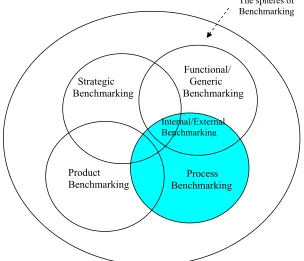
• International Benchmarking, it can be undertaken internationally as well as nationally. The commonsense approach to benchmarking draws appropriately from a mix of all these approaches and organizational learning is best done when it is carried out within a spirit or partnership and collaboration that enable both parties to learn from each other. The relationships between these different types of benchmarking are shown in
[image:5.612.141.445.334.595.2]Figure 1.
Figure 1: Relationships Between the Different Types of Benchmarking. (Source: Benchmarking Methods and Experiences, 2003, p8).
Jackson and Lund (2000) convinced, internal benchmarking is a process used in decentralized organizations where performance in similar processes is compared between operating units. In universities this can mean comparisons between different academic departments or schools or between different administrative or service units (Jackson and Lund 2000). Southard and Parante (2007) described more clearer the significances and processes of internal
Functional/ Strategic Generic Benchmarking Benchmarking
Internal/External Benchmarking
Product
Benchmarking Process Benchmarking
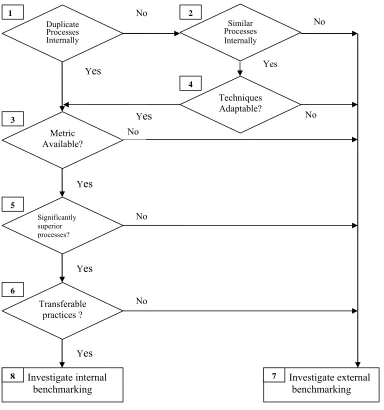
benchmarking. The practical flowchart which they developed in Figure 2, is helpful to determine whether an organization’s proposed case study or implemented finding best practices appropriate for internal or external benchmarking. It leads the user through a set of questions. At the end of the set of questions, contained within the diamond-shaped decision boxes, the choice as to whether one should pursue internal or external benchmarking will be clear. Southard and Parante (2007) convinced the framework for steps in internal benchmarking: (1) Identify and isolate a particular process or point in a process, (2) Assemble a benchmarking team, (3) Determine what tools are most appropriate for analyzing the process, (4) Identify a similar internal process for comparison, (5) Evaluate the two processes, (6) Evaluate the transferability of those aspects, (7) Transfer the aspects and monitor the results.
Figure 2: Benchmarking process flowchart.
(Source:Peter B. Southard and Diane H. Parente (2007), p5.) Duplicate
Processes Internally
Similar Processes Internally
Techniques Adaptable?
Transferable practices ? Significantly superior processes?
Metric Available?
Investigate internal benchmarking
Investigate external benchmarking
1 2
3
4
5
6
7 8
Yes
Yes
Yes
Yes
Yes
Yes
No
No
No
No
5. APPLICATION OF BENCHMARKING IN COLLEGES AND UNIVERSITIES Traditionally, educational organizations are natured for spreading and sharing of knowledge, collaboration in research and, assistance to each other. Several authors advocated that benchmarking is more suitable in higher education than business sector, due to its collegial environment, which encourages easily to collaborate and cooperate (Bender and Schuh, 2000; Alstete, 1995; Schofield, 1998). As Schofield (1998) says despite increasing market pressures, higher education remains an essentially collaborative activity with institutions having a strong tradition of mutual support. Alstete (1995) says, due to its reliance on hard data and research methodology benchmarking is especially suited for institutions of higher education in which these types of studies are very familiar to faculty and administrators. The earliest benchmarking processes and methodologies were applied and adapted to higher education in North America from 1990. Several authors such as Jeffrey W. Alstete, John H. Schuh and Bender E. Barbara made a large contribution to develop the benchmarking knowledge and its uses in higher education. Currently in the USA, Benchmarking practices are widely used by professional associations like NACUBO (National Association of College and University Business Officers), ACHE (The Association for Continuing Higher Education) and other universities such as Chicago, Oregon, Pennsylvania, Utah and etc, and private consulting companies like “The Benchmarking Exchange”(www.benchnet.com), or “Educational Benchmarking”(www.webebi.com).
The benchmarking methodologies followed to transfer in European and Australian higher education recently after 1990. In Europe some centers are currently famous in using and successfully doing the benchmarking programs such as: European Center for Strategic Management of Universities (www.esmu.be) in Belgium, Centre for Higher Education Development (CHE www.che.de) in Germany, UNESCO-CEPES – European Centre for Higher Education (www.cepes.ro), Universidade de Aveiro (www.ua.pt) in Portugal.
In UK, the earlier works are closely linked with the contributions of Norman Jackson and Helen Lund who are the authors of book: “Benchmarking for Higher Education”. They explain the adoption of benchmarking followed with starting the performance assessment period between 1980-92. Rapid rose of student enrollment (450,000 in 1980 and 800,000 in 1992) in UK universities and colleges faced with a progressive reduction in the unit of funding from government sources. They sought to bridge the funding gap in two ways: increasing efforts to keep income from non-government sources; and through achieving cost saving or ‘efficiency gains’ (Jackson, Helen, 2000).
Russian author Knyazev (2001) also confirms that, the adoption of benchmarking in higher education strengthened recently after declining state budget on higher educational institutions. They sought to find alternative ways of finance, and at same time they bothered to persevere the efficiency and quality, and to satisfy the stakeholders.
Through the literature review I noticed that several authors advocated that benchmarking is more suitable in higher education than business sector, due to its collegial environment, which encourages easy collaboration and cooperation. But, Schofield (1998) convinced improving performance by collaboration or comparison with other universities is nothing new in higher education. What is new, however, is the increasing interest in the formalization of such comparisons. As his concern benchmarking is directly relevant to current UNESCO concerns described in its policy paper 'Change and Development in Higher Education' (1995). He confirms that comparative statistics provided in international university ranking (e.g. Times Good University Guide, UK) publications would be not technically regarded as benchmarking, and in increasingly market oriented education systems a poor rating in such tables may provide a much more effective stimulus for immediate comparisons with other institutions. But Australian universities have been using widely the benchmarking practices in university ranking practices. Garlick and Pryor (2004) convinced the practice of benchmarking may have two objectives – first, as a means for assessing the quality and cost performance of an organization’s practices and processes in the context of industry-wide or function-specific ‘best practice’ comparisons, and the second, benchmarking can be used as an ongoing diagnostic management tool focused on learning, collaboration and leadership to achieve continuous improvement in the organization over time.
The early benchmarking exercise in Australian universities undertaken by the Teaching and Learning Development Unit at Queensland University of Technology in 1995 to compare the ways in which university teachers undertaking the Graduate Certificate in Education are prepared for teaching. Since 1995, Australian universities also joined to American NACUBO project but consequently participants have not continued this participation due to being reluctant commitment. Several benchmarking surveys have been conducted such as Student Administration Benchmarking Project in 1996, Boston Consulting Group, Australian Association of Higher Education Facilities Officers (AAPPA) which covers 36 institutions in Australia and New Zealand, Northern Territory University Library, University of Melbourne Counseling Service in 1996. McKinnon, Walker & Davis (2000) in their “Benchmarking Manual for Australian Universities” was designed to identify the most important aspects of contemporary university life in changing times and to find ways of benchmarking them. The manual identifies 67 benchmarks in the following nine areas of university activity: governance, planning and management; external relationships; financial and physical infrastructure; learning and teaching; student support; research; library and information services; internationalization; and staffing. The purpose of their benchmarking model is to place all public universities in Australia to be the high-quality and leading universities in the world. The McKinnon et al. manual was an attempt to address what was seen as the piecemeal nature of benchmarking in the Australian university sector through a more consistent approach. However, Garlick and Pryor (2004) objects that Manual’s attempt at bringing consistency, however, resulted in a tick-a-box template approach based on viewing university benchmarking purely as an assessment exercise from the outside in, rather than an approach based on fundamental improvement from the inside out.
6. GENERIC BENCHMARKING PRACTICES CONDUCTED BY NATIONAL AND INTERNATIONAL AGENCIES.
As Alstete (1996) identifies, ‘generic benchmarking’, also called ‘best in class’ uses the broadest application of data collection from different kinds of organizations. Generic benchmarking compares work processes at one organization to others who have truly into native and exemplary performance. Jackson and Helen (2000) mentions same idea, but they called it as ‘implicit benchmarking’. Schofield (1998) also says, implicit benchmarking, which is a by-product of information-gathering exercises such as a survey undertaken by a national agency. By these ideas, one can notice that generic, best in class, and implicit benchmarking types are same. However, the term ‘generic’ widely used in much of the literatures, I preferred to use the term ‘generic’. In the manual of Consortium for Excellence in Higher Education (2003), mentioned ‘functional’ benchmarking, and confirmed that functional or generic benchmarking involves partnerships of organizations drawn from different sectors that wish to improve some specific activity or process.
Generic benchmarking processes are used by several agents and organizations such as NACUBO (National Association of College and University Business Officers), CHEMS (Commonwealth Higher Education Management Service), ACHE (The Association for Continuing Higher Education), ESMU (European Center for Strategic Management of Universities), HEFCE (Higher Education Funding Council for England), and DETYA (Department of Education training and Youth Affairs), and NCCI (National Consortium for Continuous Improvement in Higher Education) which facilitates comparison and identify directions for change that will lead to improvement.
NACUBO is located in Washington, D.C., serves a membership of more than 2,500 colleges, universities, and higher education service providers across the country. NACUBO represents chief administrative and financial officers through a collaboration of knowledge and professional development, advocacy, and community. It has established in 1962 and now represents more than two thirds of the higher education institutions in the United States. It is predominant agent of benchmarking among the US universities. It has developed a benchmarking project that addresses selected areas within a higher education entity. The goal of the NACUBO project is to encourage participating institutions to work together to discover best practices and provide institutions with the data they need for improvement of operations that may cost too much or provide low quality service (Alstete 1995). The project which is conducted in 1991, covered areas such as general accounting, alumni relations, account payable, admission, account receivable, student registration, development payroll and purchasing. In contrast, Robin H Farquhar (1998) suggests, although this project provides information for benchmarks, it does not necessarily result in benchmarking. It provides participants with a detailed gap analysis, comparing their own performance of a process with the means of all study participants and cohort groups, but what the institution then does with this information is up to it. However, NACUBO endeavors to improve its approach with each yearly iteration and, although there have been many dropouts (including some Canadian institutions), there remain almost 100 subscribers – some regularly and others occasionally - from a potential pool of around 1,500 institutions (Robin H Farquhar 1998).
innovation; to learn from others what works and what does not; to research, and continually improve, ways of comparing with each other (Wragg, 1998). CHEMS is the management consultancy service of the Association of Commonwealth Universities. Garlick and Pryor (2004) says that as distinct from the NACUBO arrangement, the CHEMS club enables participating universities to compare their management practices and processes (e.g. strategy, policy, human resources, student support, external relations, and research management) against a range of comparable institutions.
Another recent benchmarking project conducted by ESMU (European Center for Strategic Management of Universities) in Belgium. ESMU transfers expertise on university management practices, promotes policies for institutional change and provides services to European universities (ESMU, 2005). ESMU establishes networks, develops projects and practical tools to support universities with their strategic development (www.esmu.be). ESMU conducts Benchmarking program named “European Benchmarking Initiative in Higher Education” which offers a unique and cost effective opportunities for participating universities to compare their key management processes with those of other universities. This helps identify areas for change and assists in setting targets for improvement. ESMU’s project based on different topics in every year since 1999. The 2005 topics were in internationalization, strategic partnership, governance and structures, and designing new Masters and Doctorates. By producing handbook on benchmarking approaches, number of case studies, benchmarking standards, and interactive website, ESMU project provides member universities with wide information and opportunities for benchmarking activities. The main target of the project is to accelerate the reformations in line with the Bologna Processes, and encourage European Higher education institutions to become strong players in the European economy.
The similar benchmarking actions conduct by English Universities Benchmarking Club (EUBC). EUBC is aimed for developing good management practices, and dissemination among the eight member universities in UK. What should be benchmarked; what are the critical criteria for providing an efficient, quality service; what are the processes used now by universities to deliver services; how do they compare with other universities; what are the Benchmarks? This is where the EUBC comes in (EUBC, 2005). EUBC has undertaken a pilot Benchmarking exercise looking at the Assessment of Student Applications and the Student Registration processes during the summer of 2001.
EFQM (European Foundation for Quality Management) Excellence Model is being applied in higher education in Europe. The EFQM Excellence Model is a framework for organizational management systems, promoted by the European Foundation for Quality Management (EFQM) and designed for helping organizations in their drive towards being more competitive. Regardless of sector, size, structure or maturity, to be successful, organizations need to establish an appropriate management system. The EFQM Excellence Model is a practical tool to help organizations do this by measuring where they are on the path to excellence; helping them understand the gaps; and then stimulating solutions.
7. BENCHMARKING METHODOLOGY PRACTICES
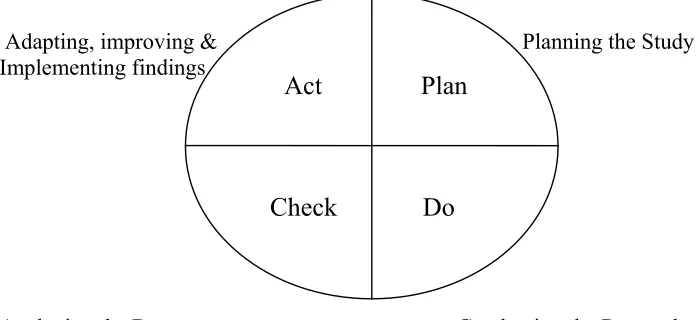
Benchmarking process models and methodologies are various with different number of phases from four steps to 20-30 steps. Camp (1989b) suggested a ten-step generic process for benchmarking. In higher education, Alstete (1995) suggested four-step approach: Plan-Do-Check-Act (PDCA) as shown in below figure 3 (Watson 1993, Alstete 1995).
Adapting, improving & Planning the Study Implementing findings
[image:11.612.94.443.156.316.2]Analyzing the Data Conducting the Research Figure 3: Alstete’s Benchmarking process.
(Source: Benchmarking process compared with the Deming cycle. Alstete (1995), p.34)
The first step is planning, which means selecting administrative or teaching process to be studied. In other words, it involves planning what to benchmark and who to benchmarking. The second step uses primary and or secondary research to gather the data. This can involve researching publicly available information about the target colleges and universities through professional associations, personal contacts, a library, or on-line computer services. The third step in benchmarking consists of analyzing the data gathered to calculate the research findings and develop recommendations. This is the critical point in study where the differences or gaps between the participants performance are identified. Adapting, improving & Implementing findings is the final step.
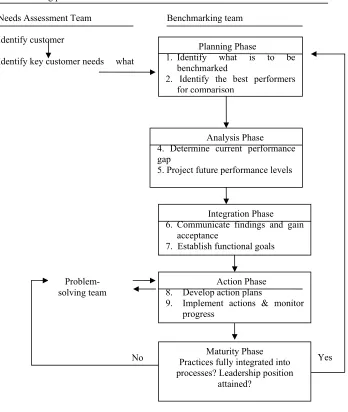
Fong et al (1998) suggested the model (Figure 4) which is modified the models of Vaziri (1992) and Camp (1989d). It indicates that benchmarking is a systematic approach to performance improvement in order to satisfy customers’ needs and requirements. This models involves stages of planning, analysis, integration, action, and maturity. It has a cyclical or repetitive nature, and it involves a goal-setting process.
Act Plan
Benchmarking process model
Needs Assessment Team Benchmarking team
Identify customer
[image:12.612.96.444.77.489.2]Identify key customer needs what
Figure 4: Fong et al’s benchmarking process model
(Source:Benchmarking: a general reading for management practitioners, Fong et al. 1998, p 413.)
Schofield (1998) suggests five types of methodologies that institutions can adapt:(1) Ideal type standard, (2) Activity based benchmarking, (3) Vertical benchmarking, (4) Horizontal benchmarking, (5) Use by institutions of comparative performance indicators.
Clark (1993) states the following steps of benchmarking: (1) identifying what is to be benchmarked, (2) identifying comparative companies, (3) determining data collection methods and collecting the data, (4) determining current performance levels, (5) projecting future performance levels, (6) communicating benchmark findings and gaining acceptance, (7) establishing functional goals, (8) developing action plans, (9) implementing the plans and monitoring progress, and (10) recalibrating measurements. Kempner (1993) argues, as with other quality concepts benchmarking should be integrated into the fundamental operations
Analysis Phase
4. Determine current performance gap
5. Project future performance levels
Integration Phase 6. Communicate findings and gain
acceptance
7. Establish functional goals
Action Phase 8. Develop action plans
9. Implement actions & monitor progress
Problem-solving team
No Yes
Planning Phase
1. Identify what is to be benchmarked
2. Identify the best performers for comparison
Maturity Phase Practices fully integrated into processes? Leadership position
How well are we doing compared to others? How good do we want to be? Who is doing it the best? How do they do it? How can we adapt what they do to our institutions? How can we be better than the best?
[image:13.612.103.402.196.333.2]Many education systems or organizations apply some sort of benchmarking, i.e.: (1) establish performance or quality gaps, (2) find a better way of doing something, (3) understand how it is being done, (4) adopt or adapt it to suit the contemporary environment, (5) continuous improvement efforts (Zairi, 1996). Graphically, Zairi’s benchmarking process model can be portrayed as Figure 5 below:
Figure 5: Zairi’s Model of Benchmarking
8. CONCLUSION
The primary recommendation within this paper is to apply the internal benchmarking against best practices in Malaysian public universities as in the case in Australian universities (McKinnon et al’s Manual). Internal benchmarking seems the suitable one for a university because it is about the internal self-improvement organization development, regardless of other universities in the world. Internal benchmarking has been done in colleges and universities in other countries and Malaysia for decades; only the terms for it might different, such as internal quality control, internal audit, or management review. However, the full process and significance of benchmarking has not been fully realized like it is today, i.e. in the corporatized vogue (Sufean Hussin, personal communication, January 4, 2006). Since the Malaysian Public universities striving to be more competitive and world class, internal benchmarking is to be useful support to get to know the status quo and to monitor the quality. These priorities are more concerned in strategic policies of Malaysian Higher Education Ministry, one which is recently announced The National Higher Education Action Plan (the Star, Sep, 2007). The internal benchmarking practices can also help to identify the apex universities. Four main criteria for benchmarking the local universities according to global standards (Datuk Ong Tee Keat, theSun, August 24, 2007) such as (1) level of intake of internal students and (2) academic staffs, (3) media visibility, and (4) citations, also burdens the Malaysian universities’ management and leaders to get more and more skills in benchmarking. I think the world university rankings are also one of the ways to improve and to get practices of continuous improvement for Malaysian universities.
Gap analysis of standards
and performances Better ways of doing things in organization
Understand how numerous things are done in
organizations Adopt the standards and
adapt best practices
REFERENCES
Achtemeier, S. D., Simpson, R.D. (2005). Practical Considerations When Using Benchmarking for Accountability in Higher Education. Innovative Higher Education, Vol. 30, No. 2, 2005.
Allan Schofield. (1998). An Introduction to Benchmarking in Higher Education. In CHEMS (Commonwealth Higher Education Management Service) Benchmarking in Higher Education: An International Review (pp. 6-12). London: CHEMS.
Allan Schofield. (1998). Benchmarking: an overview of approaches and issues in implementation. In CHEMS (Commonwealth Higher Education Management Service)
Alstete, W. J. (1995). Benchmarking in Higher Education: Adapting Best practices To Improve Quality. Washington, DC: George Washington University.
Arzhanova, I. V., Raichuk, D. Y., (2005). Benchmarking as an instrument of development international joint academic programs in Russia. Russian University Management Journal.
Benchmarking in Higher Education: An International Review(pp. 12-32). London: CHEMS.
Bender, B. E.,(2002). Benchmarking as an Administrative Tool for Institutional Leaders. In Schuh, J.H., Bender, B. E., Using benchmarking to inform practice in higher education (pp.113-120). San Francisco: Jossey-Bass.
Camp, R.C. (1998). Global cases in benchmarking: best practices from organizations around the world. Milwaukee, Wis.: ASQ Quality Press.
CHEMS (Commonwealth Higher Education Management Service) (1998) Benchmarking in Higher Education: An International Review. London: CHEMS
Clark, Karen L.(1993) Benchmarking as a Global Strategy for Improving Instruction in higher education. Paper presented at the International Conference on New concepts in Higher Education (11th, Phoenix, AZ, December 5-9, 1993), from www.eric.ed.gov
Codling, Sylvia. (1998). Benchmarking. Aldershot, Hampshire: Gower.
Codling, Sylvia.(1996). Best practice benchmarking: an international perspective. Houston, Tex.: Gulf Pub. Co.
Cook, Sarah. (2004) Measuring customer service effectiveness. Aldershot, Hants, England; Burlington, VT: Gower
Cook, Sarah. (1997) Practical benchmarking: a manager's guide to creating a competitive advantage. London: Kogan Page.
Consortium for Excellence in Higher Education. (2003). Benchmarking Methods and Experiences. Sheffield: Sheffield Hallam University
Doerfel, L.M., Ruben, B. D. (2002). Developing More Adaptive, Innovative, and Interactive Organizations. In Schuh, J.H., Bender, B. E., Using benchmarking to inform practice in higher education (pp.5-27). San Francisco: Jossey-Bass.
ESMU (European Centre for Strategic Management of Universities) (2004). European Benchmarking Programme on University Management. Brussels: ESMU ( available at www.esmu.be )
Evdokimova, Y.S. (2004). Benchmarking as a methodology for improvement Russian university management. Russian University Management Journal.
Farquhar Robin H. (1998). Higher education benchmarking in Canada and the United States of America. In CHEMS (Commonwealth Higher Education Management Service) Benchmarking in Higher Education: An International Review (pp. 32-50). London: CHEMS.
Garlick, S., Pryor G., (2004) Benchmarking the university: Learning about improvement. DETYA (Department of Education, Training and Youth Affairs) Commonwealth of Australia (ISBN: 0 642 77469 2) (Online version at www.detya.gov.au/highered )
Haack L. Randal. (1998). NACUBO Benchmarking and its effects on higher education business processes. (Doctoral dissertation, Graduate College at the University of Nebraska, 1998).
Jackson, N., Lund, H., (2000) Benchmarking for Higher Education. Buckingham: SRHE and Open University Press
John Fielden. (1997) Benchmarking University Performance. CHEMS (Commonwealth Higher Education Management Service) Paper No 19.
Karen Chapman, Sarah Chew, EE-Lyn Tan. (Sunday 2, September, 2007). Transforming higher education. The Star newspaper, pp. E6-E8
Kempner, D.E. (1993). The Pilot Years: The Growth of the NACUBO Benchmarking Project. NACUBO Business Officer, 27(6), 21-31.
Mahmud M. Yasin (2002). The theory and practice of benchmarking: then and now.
Benchmarking: An International Journal . Vol. 9 No. 3, 2002, from
http://www.emeraldinsight.com/1463-5771.html
Manzini, R., Lazzarotti, V., (2006) The benchmarking of information
systems supporting the university administrative activities An Italian experience.
Benchmarking: An International Journal. Vol. 13 No. 5, 2006, from
http://www.emeraldinsight.com/1463-5771.html
Massaro. Vin. (1998). Benchmarking in AustralianHhigher Education. In CHEMS (Commonwealth Higher Education Management Service) Benchmarking in Higher Education: An International Review (pp. 50-66). London: CHEMS.
McKinnon, K.R., Walker, S.H., Davis, D. (2000) Benchmarking: A manual for Australian Universities. DETYA (Department of Education, Training and Youth Affairs) No. 6441HERC00A. (Online version at www.detya.gov.au/highered )
Lazăr Vlăsceanu, Laura Grünberg, and Dan Pârlea. (2004). Quality Assurance and Accreditation: A Glossary of Basic Terms and Definitions. Bucharest: UNESCO [ISBN 92-9069-178-6]
Lund, Helen. (1998). Benchmarking in UK higher education. In CHEMS (Commonwealth Higher Education Management Service) Benchmarking in Higher Education: An International Review (pp. 66-92). London: CHEMS.
Opalyn Mok. (Friday, August 24, 2007). Four criteria to gauge varsities. TheSun newspaper, p.4.
Paula Kyro (2003) Revising the concept and forms of benchmarking. Benchmarking: An International Journal. Vol. 10 No. 3, 2003, from http://www.emeraldinsight.com/1463-5771.html
Schreiterer, Ulrich. (1998). Benchmarking in European higher Education. In CHEMS (Commonwealth Higher Education Management Service) Benchmarking in Higher Education: An International Review (pp. 93-113). London: CHEMS.
Schuh, J.H., Bender, B. E. (2002) Using benchmarking to inform practice in higher education. San Francisco: Jossey-Bass.
Southard, P.B., Parente, D.H., (2007). A model for internal benchmarking: when and how? Benchmarking: An International Journal. Vol. 14 No. 3, 2007, from http://www.emeraldinsight.com/1463-5771.html
Smith, H., Armstrong, M., Brown, B. (1999). Benchmarking and Threshold Standards in Higher Education. London: Kogan Page.
Susan Mancuso, (2001) Adult-Centered Practices: Benchmarking
Study in Higher Education. Innovative Higher Education, Vol. 25, No. 3, Spring 2001. UNESCO. (1995). Policy Paper for Change and Development in Higher Education. Paris: UNESCO
UNESCO (1998) Benchmarking in Higher Education. A study conducted by the Commonwealth Higher Education Management Service. Paris: UNESCO.
Watson G.H., (1994) A Perspective on Benchmarking. Benchmarking for Quality Management & Technology, Vol. 1 No. 1, 1994, pp. 5-10. MCB University Press, 1351-3036.
Wragg Cliff. (1998).Commonwealth University Management Benchmarking Club. In CHEMS (Commonwealth Higher Education Management Service) Benchmarking in Higher Education: An International Review (pp. 112-120). London: CHEMS.
Yarrow, D.J. and Prabhu, V.B. (1999), Collaborating to compete: benchmarking through regional partnerships. Total Quality Management, Vol. 10 Nos 4/5 (Special Issues), pp. S793-S802.
Zairi, Mohamed. (1996). Benchmarking for best practice: continuous learning through sustainable innovation. Oxford: Butterworth Heinemann.