TEACHING SPEAKING THROUGH INFORMATION TRANSFER TASK AT THE SECOND GRADE STUDENTS OF SMPN 3
BATANGHARI EAST LAMPUNG
(A Classroom Action Research)
By
Rifka Arina Ruantika
FACULTY OF TEACHER TRAINING AND EDUCATION UNIVERSITY OF LAMPUNG
ii ABSTRACT
TEACHING SPEAKING THROUGH INFORMATION TRANSFER TASK AT THE SECOND GRADE STUDENTS OF SMPN 3 BATANGHARI EAST
LAMPUNG
(Classroom Action Research)
By
Rifka Arina Ruantika
This research was conducted based on the problems faced by the second grade students of SMPN 3 Batanghari East Lampung and also from the result of the pretest that was conducted by the researcher. The problem was the low speaking ability of the students and also the low marks of students speaking ability in the pretest. For that reason, the researcher did a classroom action research which covered students speaking ability and also students’ perception of leaning English. The objectives of this research were to find out about the improvement of students’ speaking ability after applying information transfer task and also students’ perception of teaching learning process through information transfer task. This classroom action research was conducted at SMPN 3 Batanghari East Lampung. The subjects of this research were the students of second grade (8-2 class) in the academic year 2015/2016.
This research was a classroom action research which was done in two cycles. Each cycle of this classroom action research consisted of four stages they were planning, action, observation and interpretation, and analysis and reflection. In this research the researcher helped by the English teacher of SMPN 3 Batanghari as the collaborator in this classroom action research. In this research the researcher applied information transfer task in the speaking class and used oral descriptive text as the material in this research. In doing the research the researcher also applied two teaching medias they were picture and chart which helped the students to transfer the information from these media into oral language.
iii
increased approximately 17 students (65.38%) scores are up to 70. It means that there is an improvement in students’ speaking achievement, about 23.08%. However the result of the first cycle had not fulfilled the research indicator, so the second cycle was conducted. After conducting the second cycle the number of students who scored 70 or more is about 22 students (84.61%). It means that there is an improvement in students’ speaking achievement at the second cycle, about 19.23%. Then, the total improvement of students’ speaking ability from pre-observation to cycle two is about 42.31%.
In the learning process, it can be seen that the students were satisfied with teaching learning process through information transfer task. It can be seen from the result of students’ perception questionnaires that showed at least 20 students (81.15%) stated that they followed the activities in the teaching learning process and they were satisfied with it.
From the data above, the researcher concludes that there is significant improvement in students’ speaking ability achievement after applying information transfer task.
TEACHING SPEAKING THROUGH INFORMATION TRANSFER TASK AT THE SECOND GRADE STUDENTS OF SMPN 3
BATANGHARI EAST LAMPUNG
By
Rifka Arina Ruantika
A Classroom Action Research Submitted in a Partial Fulfillment of
The Requirement for S-1 Degree in
The Language and Arts Department of Teacher Training and Education Faculty
FACULTY OF TEACHER TRAINING AND EDUCATION UNIVERSITY OF LAMPUNG
iv
CURRICULUM VITAE
Rifka Arina Ruantika was born on February 3rd, 1993 in Kalirejo. She is the second child of the greatest parents, Drs. Rumsin and Marhanah, S.Pd. She has
one beloved brother named Denny Satriyawan, A.Md. and one sister in law Prisilia Anggun Larasati, S.Pd.
After studying at TK Aisyiah, she continued her study at SDN 6 East Metro and graduated in 2005. After that, she continued her study at SMPN 4 Metro and graduated in 2008. Then, she continued her study at SMA Kartikatama Metro and
finished her study in 2011.
She continued her study to S1 degree of Agroekoteknologi Major, Agricultural
Faculty of Lampung University in 2011 for 2 semesters. Then, in 2012 she decided to move to English Education Study Program, Teacher Training and Education Faculty (FKIP) of Lampung University. She did her KKN program at
v
DEDICATION
By offering my praise and gratitude to Allah SWT for giving His never ending
blessings to me, this script is proudly dedicated to:
My beloved Father, Drs. Rumsin. My beloved Mother, Marhanah, S.Pd.
My beloved Brother, Denny Satriyawan A.Md.
My beloved Sister in Law, Prisilia Anggun Larasati, S.Pd. My beloved Niece, Mikhayla Adean Azzahra.
vi MOTTO
“Chase your dreams as far as possible, but never forget the path that
will lead you home again”
vii
ACKNOWLEDGEMENTS
Alhamdulillahirrobbil’alamiin, praise to Allah SWT, The Almighty and Merciful
God, for His blessing and mercy the writer with faith, health and opportunity so that the writer is able to finish this script. This script entitled, Teaching Speaking
through Information Transfer Task at Second Grade Students of SMPN 3
Batanghari East Lampung is presented to English Education Study Program of
Teacher Training and Education Faculty of Lampung University as a compulsory fulfillment of the requirements for S1 degree.
Gratitude and honor are addressed to all people who have helped and supported the writer for the completion of this script. Since it is necessary to be known that this script will never come into its existence without any supports,
encouragements and assistances from several outstanding people, here the writer would like to address her gratitude and honor to:
1. The writer’s beloved Father, Drs. Rumsin for giving his supports, motivations and prays for the writer and for always being a great role model for his children.
viii
3. The writer’s beloved Brother, Denny Satriyawan, A.Md. for his big motivation, guidance and support for the writer until the completion of this script.
4. The writer’s sister in law & lovely niece, Prisilia Anggun Larasati, S.Pd. and Mikhayla Adean Azzahra for their support, love and laugh that always
accompany the writers in completing this script.
5. Prof. Dr. Cucu Sutarsyah, M.A. as the first advisor, for his guidance, motivation, and encouragement in guiding the writer until the completion
of this script.
6. Drs. Huzairin, M.Pd. as the second advisor, for his assistance, idea, and
kindness in guiding the writer in finishing this script.
7. Mahpul, M.A., Ph.D. as the examiner, for his contributions, comments, and suggestions during the seminar until script examination.
8. Dr. Ari Nurweni, M.A. as the Head of English Education Study Program. 9. Dr. Mulyanto Widodo, M.Pd. as the Chairperson of Language and Art
Education Department.
10.The writer’s Lecturers at English Department, University of Lampung for sharing their knowledge, experience, and spirit all of this time.
11.The writer’s beloved Strangers, Merrie Indria Sova, S.Kep., Annisa Ayu Retnaning, S.Pd., Eka Damayanti S.Pd., Milla Yunita, Bayu Muhammad, A.Md., Harits Riswanda, and M. Saifullah Akbar for their advice, laugh
ix
12.The writer’s freak SHINee’s Girls, Ayu Lucky Widiasari, Insani Salma, Marlia Fitriani and Meisita Aidila who always listen all of writer’s stories and support the writer no matter what all this time.
13. The best classmates ever [B]ioplar class, Ami, Anjar, Ara, Cile, Desy, Jeni, Eka (Mantili), Dilla, Fara, Galih, Ndun, Iis, Linda, Livi, Nina, Nui,
Pipit, Bebeh Rahma, Revi, Risky, Suci, Fira, Anggi, Ulfi, Wahyu, Winda, Yolanda, Lydia, Taqim, Andre, Adit, Paullo, Rangga, Ryan and Yosua. 14.The writer’s best consultants, Ayu Pratiwi S.Pd., Dian Tika Cahyanti, Eka
Pratiwi Yunianti, Dharin Okta Syaputri and Sella Merista.
15. The Writer beloved Marang Team, Ayu Reza Ningrum, S.Pd., Eka Novita
Suwisno, Fitri Agung Nanda, Mella Septiana, Utary Fathu Rahmi, Wayan Viska Arilia Chandra, and Yoga Septia.
Hopefully, this script will give a positive contribution to the educational
development and also for those who want to carry out further research. The writer is completely aware that this script is far from the perfection. Therefore, constructive input and suggestion are expected to compose better script in the
future.
Bandar Lampung, June 2016
x
TABLE OF CONTENTS
TITLE ... i
ABSTRACT ... ii
CURRICULUM VITAE... iv
DEDICATION... v
MOTTO ... vi
ACKNOWLEDGEMENTS... vii
TABLE OF CONTENTS... x
LIST OF CHARTS ... xiii
LIST OF PICTURES... xiv
LIST OF TABLES ... xv
LIST OF APPENDICES ... xvi
I. INTRODUCTION 1.1. Background ... 1
1.2. Research Question... 6
1.3.Objectives... 6
1.4. Uses ... 7
1.5. Scope ... 7
1.6. Definition of terms ... 8
II. LITERATURE REVIEW 2.1. Definition of Speaking ... 10
2.2.Aspects of Speaking... 11
2.2.1. Pronunciation ... 12
2.2.2. Fluency ... 12
2.2.3. Grammar... 12
2.2.4. Vocabulary ... 13
2.2.5. Comprehension... 13
2.3. Types of Speaking... 13
xi
2.3.2. Dialogue ... 14
2.4. Teaching Speaking ... 14
2.5. Information Transfer Task ... 15
2.6. Teaching Speaking Through Information Transfer Task... 18
2.7. Procedure of Teaching Speaking Through Information Transfer Task ... 19
2.8. The Advantages of Information Transfer Task ... 20
2.9.The Disadvantages of Information Transfer Task ... 21
III. RESEARCH METHOD 3.1. Research Design... 22
3.2.General Description of the Research... 23
3.3. Participants... 24
3.4. Research Procedures ... 25
3.4.1. Planning... 26
3.4.2. Action ... 27
3.4.3. Observation and Interpretation... 31
3.4.4. Analysis and Reflection ... 32
3.5. Indicators of the Success ... 32
3.6. Instrument of the Research... 34
3.7. Data Analysis ... 39
IV. RESULT AND DISCUSSION 4.1. Result ... 43
4.1.1. Cycle 1... 43
4.1.1.1. Planning... 44
4.1.1.2. Action ... 44
4.1.1.3. Observation and Interpretation ... 45
4.1.1.4. Analysis and Reflection... 58
4.1.2. Cycle 2... 59
4.1.2.1.Planning... 59
xii
4.1.2.3. Observation and Interpretation ... 62
4.1.2.4. Analysis and Reflection... 65
4.2. Discussion ... 67
V. CONCLUSION AND SUGGESTION 5.1. Conclusions ... 71
5.2. Suggestions ... 71
REFERENCES... 73
xiii
LIST OF CHARTS
Chart 4.1. The Students’ Speaking Ability Improvement from Pre-Observation Test to Cycle I ... 48 Chart 4.2. The Students’ Speaking Ability Improvement from Cycle
1-Cycle 2 ... 64 Chart 4.3. The Improvement of Students’ Speaking Ability from
xiv
LIST OF PICTURES
xv
LIST OF TABLES
Table 3.1. Table of Rating Sheet Score... 38 Table 4.1. Frequency of Students’ Speaking Ability at Pre-Observation Test ... 46 Table 4.2. Frequency of Students’ Speaking Ability at Cycle 1... 47 Table 4.3. Results of The Analysis ofStudents’ Perception... 50 Table 4.4. Frequency of Students’ Speaking Ability at Cycle 2... 62 Table 4.5. Frequency of the Improvement of Students’ Speaking Score from
xvi
LIST OF APPENDICES
Appendix I Lesson Plan ………...…… 77
1
I. INTRODUCTION
This chapter explains the introduction which deals with several points: background of the research, research questions, objectives, uses, scope and
definition of terms.
1.1. Background
As a teacher, improving the quality of his subject is really needed. By improving the quality of subject it also means that the quality of the teacher and the learner will be improved too. One of the ways that can be done by the teacher to improve
the teaching learning process is through classroom action research (CAR). Classroom action research is the process through which teachers collaborate in
evaluating their practice jointly, raise awareness of their personal theory, articulate a shared conception of values, try out new strategies to render the values expressed in their practice more consistent with the educational values they
support, record their work in form which is readily available to and understandable by other teachers and thus develop a shared theory of teaching by
researchingpractice (Elliott, 1991).
2
were having low ability in the speaking skill. It could be seen by their low mark of the speaking test and also from their activities during teaching learning process of speaking class because the students often found a lot of difficulties to speak or tell
their ideas in front of the class. Beside that the researcher also did pre-observation to set students’ base line, then the result of the pre-observation test showed that most of the students in the chosen class having low speaking ability.
Based on the researcher’s experience in PPL programs speakingwas the language skill that was hard to be mastered by the students since the students will feel a lot of pressure when they speak in front of the class. Speaking is one of the language
skills which is very important in English teaching. Having a good speaking ability will make the students easier to express their ideas and messages but one who is
lack in speaking ability will get trouble in those. In English learning a learner has to master four basic skills of language they are listening, speaking, reading and writing. Mastering speaking is very important for someone because in speaking
the speakers will send their ideas and message to someone and these ideas or messages must be understandable and meaningful so the addressee will understand the messages or ideas that are sent by the speaker without
misunderstanding. That is why the students really need to master speaking skill in order to express their ideas or arguments well so they can easily communicate
with teachers, friends or even the foreigners.
Language skills can be divided into two types based on the process they are,
3
that involve someone to receive the information of a language. The active skills of English are speaking and writing and the passive skills are reading and listening. We know that the main function of the language is as mean of communication and
from that statement we can conclude that the active skills are more important than the passive skills. Because in active skills the learners are taught to produce a
language which means that active skill (speaking) is in line with the main function of language that has been stated before.
The main purpose of learning a language is to be able to communicate well and it
has been stated before that mastering speaking skill will make someone able to communicate well. So, we can conclude that speaking is the most important skill of a language that must be mastered by someone if she wants to master that
language. There are five important aspects of speaking skill they are pronunciation, fluency grammar, vocabulary and comprehension (Harris, 1974).
These five aspects should be trained and learned by the students so they can really master the speaking skill.
Because of those reasons we really need to improve students speaking skill which
is really important for the students to master it in order to master English. However, the students usually face a lot of difficulties in mastering this skill.
These difficulties might be caused by the learning technique that is used by the teacher in teaching learning process does not attract the students and makes them bored in learning speaking. Mostly, the teacher asks the students to speak directly
4
improved since they talk under a lot of pressures and there is no media that can stimulate them to develop their ideas.
Those learning obstacles were also found at the second grade students of SMPN 3
Batanghari East Lampung. It was found when the researcher did a short interview with the English teacher of that school. She said that her students often face a lot of difficulties in her speaking class to express their ideas in front of their
classmates. After the researcher asked the teacher about her teaching technique, she said that she did not use any technique in teaching speaking she just asks the
students to express their ideas directly in every speaking class.
Concerning the explanations above, the researcher would like to conduct a classroom action research at the second grade of SMPN 3 Batanghari, East
Lampung, since the purpose of CAR itself is to improve the quality of teaching learning process of a subject. The researcher also thought that the teacher should
find an interesting technique that can attract students’ attention and help them to master speaking ability without a lot of pressures and also can improve their activities in the teaching learning process of the speaking class. One of the
techniques that could be applied by the teacher in improving students’ speaking ability and activities during speaking class is through information transfer task.
Palmer (1982) states that information transfer task is an activity involving the reproduction of information either into a fully linguistic form, from diagrammatic or semi-diagrammatic form, or vice versa. During the transfer activity, the
5
from linguistic form to non-linguistic, or vice versa. Nation (1988) also states that Information transfer is an excellent learning strategy for teaching English.
The researcher wanted to apply information transfer task as a teaching technique
in the speaking class at SMPN 3 Batanghari East Lampung in order to improve students speaking ability and activity in the teaching learning process. Then, the researcher also wanted to prove that information transfer task is a good teaching
technique that can be applied to the speaking class and can stimulate students’ ideas to speak, improve their speaking abilityand reduce students’ nervousness in the speaking class.
There are some previous studies which used information transfer task as the learning technique for improving students’ ability. For example a research that was conducted by Riyanti (2015) with the title Comparative Study between Students’ Reading Achievement Taught through Information Transfer and Translation Technique. Based on her research, there was a significant difference of students’ reading ability after being taught using information transfer. Beside that the research proved that information transfer technique was more effective
than translation technique. Then, the other researcher was Yanti (2013), she conducted a research entitled Teaching Listening Comprehension on Dialogue
6
Those previous studies above showed that information transfer task can be applied as a good teaching technique that can improve students reading and listening comprehension. Based on those facts, the researcher wanted to apply information
transfer task inthe speaking class as a teaching technique for improving students’ speaking ability. The researcher wanted to prove that information transfer task
also could be applied at the speaking class and can improve students’ speaking ability.
Based on the explanations above, the researcher wanted to conduct a Classroom
Action Research entitled “Teaching Speaking through Information Transfer Task at The Second Grade Students of SMPN 3 Batanghari East Lampung”.
1.2. Research Questions
Based on the background above, the research questions can be formulated as follows:
1. Is there any improvement of students’ speaking ability after applying information transfer task?
2. What is students’ perception of teaching learning process through information transfer task?
1.3. Objectives
Based on the research questions above, the objectives can be formulated as
follows:
7
2. To find out students’ perception of teaching learning process through information transfer task.
1.4. Uses
The results of this research are expected to be beneficial whether theoretically and
practically:
1. Theoretically, this research may give additional contribution in case of
education and it may verify the previous finding and theories about improving students’speaking ability through information transfer task.
2. Practically, the result of this research may give new information to English
teacher that information transfer task can be used as an effective technique to teach and improve students’ speaking ability. Beside that the teacher will know that they can create an effective class by applying information transfer task in their speaking class.
1.5. Scope
This research was conducted at SMPN 3 Batanghari, East Lampung with the second grade students as the subject of this research by implementing Classroom Action Research. The researcher applied information transfer task in this research
8
research were based on the curriculum of the school, which was KTSP and the material was oral descriptive text. There are five aspects that were observed by the researcher in this research those are pronunciation, fluency, grammar, vocabulary
and comprehensibility.
1.6. Definition of Terms
In order to specify the topic of the research, the writer provides some definition of
terms which are related to the research. These are some terms which are related to the research:
1. Improvement is the process to make students ability better. In this research the researcher intends to make learners’ speaking ability better by progressing students’ speaking score.
2. Speaking Ability is an ability to produce articulation, sounds or word to express, to say, to show and to think about ideas, thought and feeling.
3. Teaching Speaking is teaching the ability of producing the sounds or words to express, explain, and transfer thought, opinion, and feeling.
4. Information Transfer Task is a technique which transferring data from one form to another, in this case form non-linguistic to linguistic form. We move from non-linguistic media like charts and pictures into oral language.
9
direct experiences in teaching learning process of speaking by information transfer task.
6. Classroom Action Research is a method of finding out what works best in the classroom so that teacher can improve students’ learning. In this action research, the researcher used information transfer task to improve
II. LITERATURE REVIEW
This chapter will explain about some theories related to this research such as definition of speaking, aspects of speaking, types of speaking, teaching speaking,
information transfer task, teaching speaking through information transfer task, procedures of teaching speaking trough information transfer task, the advantages
of information transfer task, and the disadvantages of information transfer task.
2.1. Definition of Speaking
Speaking is a productive skill in which speakers expresses and responses their ideas by using language. From that statement, we can see that speaking is very
important in our daily activities. Speaking helps us to interact one each other, to give information and express our ideas in our community. Byrne (1984) states that
speaking is oral communication. It is a two-way process between speaker and listeners and involves the productive skills and the receptive skill of understanding. During our speaking interaction, speaker have double role both as
a listener and also the speaker.
According to Chaney (1998) speaking defines as a process of building and sharing
11
meaning. Meanwhile Brown (2001) states that speaking is an interactive process of constructing meaning that involves producing, receiving, and processing
information.
Speaking involves both receptive and productive skills of understanding. Therefore, it also takes in the role of another language skill that is listening. Subsequently, in speaking, the speaker must be able to convey his idea to his
listener as clearly as possible in order that the listener gets the intended response to achieve mutually comprehensible interaction. As Rivers (1981) argues,
speaking is used twice as much as reading and writing in our communication.
However, according to Grognet (1997) speaking is one of the skills that have to be
mastered by students in learning English.
From definition above, it can be concluded that speaking is an interaction between speaker and the audience in expressing ideas, arguments, or feelings to each other.
Besides, speaking is the process of building and sharing meaning through the use of verbal and non verbal symbols in a variety of context that involves producing,
receiving, and processing information.
2.2. Aspects of Speaking
12
2.2.1. Pronunciation
Pronunciation refers to the ability to produce easily comprehensible articulation so
our speaking is understandable. Pronunciation also can be defined as the pattern of intonation. It refers to be the person’s way of pronouncing words. Brown (2004) also states that pronunciation is an aspect of speaking that involves the
language learner to know how to pronounce and understand the words that are produced by the speaker.
2.2.2. Fluency
Fluency is the parameter of the speaking level of someone. A fluent speaker is someone who is able to express oneself readily and effortlessly. Someone who has
good fluency will perform or use the language easily and quickly in right order of language. Fluency is about how fluent the speaker uses the target language orally.
Fluency includes reasonable fast speed of speaking and only a small number of pauses.
2.2.3. Grammar
Grammar is a rule system in a language. Grammar is a system of units and patterns of language. As stated by Heaton (1978) that explains grammar as the
13
2.2.4. Vocabulary
Vocabulary refers to the words used in a language. Phrases, clauses, and sentence
are built up by vocabulary. Wilkins (1993) says vocabulary is very important because without words we cannot speak at all.
2.2.5. Comprehension
Comprehension denotes the ability of understanding the speaker’s intention and general meaning, good comprehension refers to good understanding. Heaton
(1991) also says so, it means that if a person can answer or express the ideas well and correctly, it shows that he comprehends or understands well. If someone’s language understanding is good, it will affect the speaking ability.
Those five aspects of speaking should be mastered by the learners in order to master speaking ability. If those five aspects of speaking are mastered by the
learners then it will be easier for the learners to improve their speaking ability.
2.3. Types of Speaking
Brown (2001) classifies the spoken language into two types they are monologue
and dialogue. Those types of speaking will be explained in detail bellows:
2.3.1. Monologue
The meaning of monologue itself is the spoken language involves only one person in it. It is used when someone uses spoken language as in speech, news cast, radio broadcast, lecture and others. In this type of speaking the listener does not
14
unplanned. The planned monologue means the speaker prepares the text to help his speech so he can speak fluently. The second is unplanned monologue which means the speaker does not prepare any text for his speech, all words spoken
comes from speakers’ mind spontaneously and naturally.
2.3.2. Dialogue
The second type of spoken language by Brown (2001) is dialogue. The meaning
of dialogue is there are two or more speakers that involves in the speech. In the dialogue there is an interaction between the speaker and also the listener who
gives the feedback so there will be a conversation between them. Based on the function dialogue is divided into two types they are interpersonal and transactional. The interpersonal dialogue is used when the speaker speaks in order
to promote the social relationship. Meanwhile the transactional dialogue is done when then conversation is done to convey factual information, so in the
transactional dialogue is used to get information from each other.
In this research the type of speaking that was used during the speaking test was monologue, since the students had to present their result of discussion using
information transfer task.
2.4. Teaching Speaking
Teaching speaking is an important part in teaching language. Teaching speaking
means teach people to be able to interact with the others verbally or communicate in the right way. Teaching speaking is the way of teacher to teach their emotions,
15
situation. Teaching speaking is about how to use language for communication, expressing the idea or transferring the meaning to other people. Teaching itself means transferring knowledge to person while speaking means to make use of
words in ordinary voice, so teaching speaking is giving instruction to a person in order to communicate.
Harmer (1990) says that the aim of teaching speaking is to train students for communication. Usually, it is hard for English teacher to make their students talk in the classroom. However, Byrne (1984) states that one of the English teacher’s
main tasks is to get the students to talk, to express themselves freely, but within of the language they have learned. Furthermore according to Rivers (1987) teaching
of speaking skill is more demanding of the teacher than teaching of any language skills.
Based on the statements above, it can be said that it is important for the teacher to
prepare their material and the technique in order to avoid a boring class. The researcher assumes that in teaching speaking, the teacher must facilitate the students with a good media in order to provoke and help the students to be able to
speak freely and comfortably. By facilitating the students with a good media in teaching speaking the students speaking ability can be trained and it can help them
to produce spoken language easily.
2.5. Information Transfer Task
Craik, Lockhart and Pavio in Nation (1991) state that information transfer
16
process deeply the information. While, Palmer (1982) in Nation (1991) states that an information transfer exercise involves the transfer or change of information from one form to another form. During the transfer the information remains
substantially the same but the form of information changes.
In other words, it can be said that in information transfer technique the students are asked to transfer or change the information drawn from the linguistic form
into non-linguistic form or vice versa. The information being transferred is actually the same; the difference is just in the form of representation. For instance, in receptive, information is transferred from written form into diagram, chart or
picture. Or in productive, the students look at the information in the form of diagram, chart or picture and then they change it into written form or spoken form
by retelling.
Storla (1995) defines Information Transfer technique as transferring data from one form to another. We move from the Reading or Listening text to graphic stimuli,
or visual like charts, graphs, diagrams, figures, maps, pictures, etc and vice versa. Widdowson (1978) seems to agree when he states that the Information Transfer technique is the transformation of instances of discourses from one type into
another but these instances of discourse can also be derived from a non-verbal mode of communicating.
Brown (2004) defines Information Transfer as the action of comprehending graphics includes the linguistics performance of oral or written interpretation,
17
one skill to another: in this case, from reading verbal and/or non-verbal information to speaking or writing.
The researcher chose the type of information transfer task from non linguistic to
linguistic form because in this research the researcher wanted to improve students’ speaking ability which is linguistic form. Beside that the researcher also wanted to prove that information transfer task can be used to improve students’ speaking ability since the previous researches already proved that information transfer task can improve students’ reading and listening comprehension, in short by choosing non linguistic to linguistic form of information transfer task, the researcher could prove that all types of information transfer task can be used to
improve students’ ability.
Palmer (1982) states that information transfer task is an activity involving the reproduction of information either into a fully linguistic form from a diagramatic
or semi-diagramatic form, or vice versa. An information transfer task involves the transfer or change of information from one form to another. During the transfer the information remains substantially the same but the form of the information
changes. In addition, Lattore and Garfinkel (1982) said that other types of information transfer may include ordering a sequence of pictures, comparing text
and pictures, and completing documents.
In a receptive information transfer task learners change spoken or written information into a diagram, chart or picture. By making this change the learners
18
transfer technique is that the nature of the exercise itself is a justification for its use. Information transfer is an excellent learning strategy because it requires the learners to process deeply the information that they are dealing with and to deal
with two types of encoding of that material.
Information transfer exercises can be used productively. In productive information
transfer the learner look at a diagrams pictures or other non-linguistic form then use it as the basis for writing or speaking. This productive use often works best after the learners have had some experience of the receptive equivalents because
these can act as a model or example of the production required.
2.6. Teaching Speaking Through Information Transfer
Speaking is one of the language skills that must be mastered by the English
learner. The speaker has to master the element of speaking, such as: grammar, vocabulary, fluency, pronunciation, and comprehension. English teacher have responsibilities to improve students’ speaking ability, so the teacher needs to choose the best teaching method in order to solve the problem faced by the students in their speaking class. The teacher also needs the appropriate technique in order to improve the students’ speaking ability. There are a lot of techniques
that can be applied by the teacher to the speaking class in order to improve students’ speakingability; one of the techniques is information transfer task.
19
this technique is as the provider of pictures and charts that will stimulate the students to speak and transfer the information from those pictures or charts into
oral language.
From the explanation above we can conclude that information transfer task is behaved to be an effective technique to improve and help the students’ speaking
ability.
2.7. Procedures of Teaching Speaking Through Information Transfer Task
As have been stated before, information transfer task can be used for receptive language (listening and reading) and productive language (writing and speaking).
In this case, information task will be used to teach productive language, especially speaking skill. The procedures of teaching speaking through information transfer
task by Palmer (1982) will be explained bellows:
a. The teacher prepares non linguistic medias like picture and charts, then distributes them to the students.
b. The teacher gives students some times to study the picture or charts. c. After studying the non linguistic medias, the students produce talk in
front of the class that convey the information of non linguistic medias in
complete sentences.
Based on the procedures of teaching speaking through information transfer task
by Palmer above the researcher decided to add some other activities and those procedures were arranged and written on the lesson plan for the first and second
20
2.8. The Advantages of Information Transfer Technique
Nation (1991) states that there are some advantages of Information Transfer Technique, those advantages are:
1. The information transfer task give a deep understanding or comprehension to
the students by asking them to make the change of the form of the information.
2. Information transfer task give learner more control over their learning
procedures.
3. In information transfer technique, the difficulty of the exercises can be adjusted according to the amount of the information provided.
4. Information transfer task will be more interesting if the text includes or
contains the information about the learners’ experiences.
Those advantages can help the teacher in improving students’ speaking ability,for example teaching learning process through information transfer task can be more
21
2.9. The Disadvantages of Information Transfer Technique
Nation also implies some disadvantages of using Information Transfer Technique in teaching reading, those are:
1. The class will be noisy. This happens because Information Transfer Exercise invites the students to have discussion among them; therefore the class will be noisy. In order to overcome this problem, the teacher has to control the class
well. The teacher has to make sure that the students are discussing the task not anything else. So, it is fine if the class is noisy but, the teacher has to make
sure that it is not disturbing other class.
2. It will be take longer time. In speaking activity, the students have to memorize the information that has been transferred before. So that the students have to
analyze the media first and they also have to understand the exercise. This will take longer time because the students have to understand two forms of material. To overcome this problem the teacher has to manage the time well so
the teaching learning process will be effective and will not wasting time. Although it needs longer time than usual teaching learning process, if the
22
III. RESEARCH METHODS
This chapter discusses several points related to the methods that are used in this research are: research design, general description of the research, participants,
research procedures, indicators of the success, instrument of the research, and data analysis.
3.1. Research Design
In this research the researcher used a classroom action research. Action research was characterized by problems and actions done by using cycle to solve the problems in the teaching learning process. In this research, the researcher acted as
the teacher and accompanied by the English teacher of the school as the collaborator, we focused on improving students’ speaking ability through information transfer task. The role of the collaborator in this research was as the second observer in scoring students speaking ability.
This research was done at the second grade of SMPN 3 Batanghari. The class that
was chosen as the subject of this research was chosen based on the short informal interview with the English teacher. Then, based on the result of the
23
teacher of SMPN 3 Batanghari acted as the collaborator and also helped the researcher in scoring students’ speaking ability since the researcher did not know well the ability of each student exactly.
3.2. General Description of the Research
This research was conducted at the second grade of SMPN 3 Batanghari, East Lampung. This research was done based on the problem faced by the students and
the teacher in the speaking class that was found from the researcher’s pre observation and informal interview with the English teacher that shows the students of the second grade at SMPN 3 Batanghari had low speaking ability.
In this research the researcher acted as the teacher and also observer who accompanied by the English teacher of the school as a collaborator. The
researcher made lesson plans based on the technique that was applied in the research and the students were taught based on those lesson plans. While teaching, the researcher also acted as an observer; it meant that the researcher taught and
observedthe students’ activities at the same time.
The research was conducted based on the problems that were faced by the
students in the teaching learning process of the speaking class. Then the researcher found the best solution for those problems by applying a teaching technique, in this case the technique that was applied by the researcher was
24
As have been stated before, the researcher applied information transfer task in the speaking class. Then, after the data had been collected, the researcher observed the weakness of the first cycle and found out the solution to make improvement in
the second cycle. In the speaking class, the researcher gave the instructions to the students and then gave them an example of information transfer task in order to
make them understand what they had to do in the speaking class. When the students do their activities using information transfer task they were observed and scored by the researcher and also her partner. After the speaking test was done,
the researcher gave the students questionnaire in order to know their perception about teaching learning process using information transfer task.
Then, after teaching learning process was conducted, the researcher analyzed the
result of students’ speaking ability and students’ perception questionnaire. The researcher and the partner would also make reflection after knowing the result of
the data analysis. Based on the analysis and reflection it could be decide whether the next cycle had to be conducted or not. If in the first cycle all of the objectives had been reached, the next cycle would not be conducted. However, if the next
cycle was conducted it would be focused on fixing the weakness that was found in the first cycle.
3.3. Participants
The participants of this research were a group of second grade students in academic year 2015/2016, at SMPN 3 Batanghari, East Lampung. The second grade of SMPN 3 Batanghari consisted of six classes and each class consisted of
25
based on the informal interview that had been done by the researcher with the English teacher of SMPN 3 Batanghari and from the interview 8-2 class was chosen. It was found that the students of 8-2 class were often faced difficulties in
the speaking class, they were also chosen based on their low marks of the speaking test. Based on those reasons the researcher chose them as the subject of
this research to help them improving their speaking ability and enjoying their speaking class. There were 12 male students and 14 female students in the class. So, it could be concluded that there were 26 subjects of this research.
3.4. Research Procedures
In conducting the research, the researcher used the procedures of classroom action
research designed by Wiriatmadja. This research was done in two cycles. Each cycle would be consisted of four stages. They are planning, action, observation
and interpretation, and also analysis and reflection (Wiriatmadja, 2008). Before doing the first cycle, the researcher conducted a pretest to test students’ speaking ability before the researcher applying information transfer task. Then, the first
cycle was conducted in line with problems found from the informal interview that had been done before. The students were taught based on the lesson plan made by
the researcher then the results of the first cycle were analyzed to see whether the targets had been achieved or not. The second cycle would be conducted if the targets had not been reached in the first cycle. The second cycle would be focused
on the weakness that was found in the first cycle in order to improve the result of the research. The arrangement of this classroom action research is illustrated by
26
Planning
Reflection Action
Observation
Planning
Reflection Action
[image:46.595.142.476.84.528.2]Observation
Figure 1. The Cycle of Classroom Action Research (Wiriatmadja, 2008)
3.4.1. Planning
In this stage, the problems were identified so the focus of the problem can be formulated. Then, the appropriate technique was chosen. In this case the technique that was chosen by the researcher was information transfer
task. After deciding the technique, the planning was about the materials, the materials that would be used in this research were chosen from second
Cycle 1
27
grade curriculum of junior high school. Then, the media that was used in this research was in the form of picture and chart that were taken from internet. The materials and type of the test that were applied in this
research were written in the form of lesson plan. The target of this research was more than 70% of the subjects had reached the minimum score that
has been set by the researcher. And the minimum score that was set by the researcher was 70. Beside that the other target was at least 70% of the subjects stated that they followed and were satisfied the teaching learning
process through information transfer task.
3.4.2. Action
This was the second stage of the cycle that was conducted in this research.
Action is the stage where the teacher did the treatment by implementing information transfer task in teaching speaking based on the lesson plan that had been made before. This stage was divided into three parts, they
were pre, while and post activities. The detail description of those three activities was described bellow in detail.
a. Pre activity
At the beginning of the teaching and learning process, the researcher greeted the students and checked the students’ attendance. After that, the researcher informed the students about the competence that would be
achieved after teaching learning process finished. After that, the researcher gave some instructions to the students about what they had to do. After
28
do information transfer task by transferring the information from the picture that had been prepared by the researcher before in front of the class. The media that was used in this cycle was picture; the picture that was used
in this cycle is spot the differences in the picture. So, there were some pairs of pictures and the students had to spot the difference from one pair of
picture.
b. While activity
In the beginning of while activity, the teacher asked the students to form a group consist of four until five students. After the group was formed, the
teacher distributed the task sheets to each group and asks them to analyze and understand the picture that they had gotten. The media that was used in
this cycle is picture. The function of information transfer task in this research was as the technique for teaching speaking to stimulate students’ ideas so they can make a short speech through that media. The time that
was given for analyzing and understanding the picture was about 30 minutes since the students also had to arrange and memorize their words before their present their speaking ability in front of the class. In this cycle,
spot the difference picture game was used as the topic of students’ speaking task. By using this kind picture as the teaching media, the teacher tried to
29
Bellow is one of the pictures that were used in the cycle 1 and also a short example of how the difference in the picture was described.
Picture 3.1. Teaching Media of the First Cycle
The example of how the difference of the picture was described:
There are some differences in the pictures, First of all the paints that are hanging on the wall have different picture, in the first picture the paint that is hanging on the wall is a the picture of scenery but in the second picture the paint is the picture of ships in the sea.
The students were asked to describe the picture then find some differences
in the pictures. After they found the differences they had to share those differences for all members of the group. For instance, one student had one
30
and arrange the words about the difference of the picture. After that, they had to memorize the sentences that they had made before.
During the discussion, the students seemed very busy. However to describe the picture and make some sentences about the differences of the picture
they still need the dictionary, since their vocabulary mastery was very low too. They still often asked their friends and looked up at the dictionary in
order to find the vocabulary they needed. Sometimes, they could not find the vocabulary in the dictionary. Consequently, they would ask the researcher. This activity obviously time consuming, since they had to look
up every single of vocabulary they needed for their description. Even many of them did not bring the dictionary and it also wasted the time.
As the students did their tasks, the researcher walked among them to
observe their discussion and also their ability in speaking. Beside that the researcher also helped them to solve their vocabulary problems. After 30 minutes, the teacher asked each group to present their work in front of the
class, and other groups were asked to pay attention to their friends’ presentation and they also asked to note the mispronounce words that were
made by their friends during the presentation. During the presentation the researcher recorded students’ speech and observed students speaking to analyze their speaking ability and scored them. The collaborator also
31
c. Post activity
After all students had finished their presentation, the researcher asked them about the mistakes they found during the presentation. The students
mentioned some of mispronounce words that had been made by their friends, and the researcher wrote those mispronounce words on the white
board. After the students finished mentioning the mispronounce words, the researcher asked them how to pronounce those words correctly. The reason why the researcher did this activity was because the researcher wanted to
correct students' pronunciation. After fixing students pronunciation, the researcher shared students’ learning perception questionnaire and asked the students to answer all questions in the questionnaire. After the students finished answering the questionnaire, the researcher asked the students to submit the questionnaire and end the meeting.
3.4.3. Observation and Interpretation
In this stage, the researcher observed the activities in the teaching learning process and took some notes related with students learning activities.
Observation was done to find the problem in the teaching learning process, so that problem would not occur in the second cycle. Observation and interpretation toward the action in the class were done together in this
stage. The researcher also took necessary notes to support the data.
After the researcher observed students’ activities and took some notes, the researcher gave the students the questionnaire which consist of 30
32
3.4.4. Analysis and Reflection
This was the last stage of each cycle that would be conducted in this research. In this stage, the researcher analyzed the result of speaking test
that had been done by the students before, in activities as the learning product. Then, the researcher would also analyze the result of the questionnaire that had been filled up by the students after the treatment in
order to know students perception about the effect of information transfer task in their speaking class.
In analyzing, the reflection would be made to find out the strength and the weakness of implementing information transfer task in the first cycle. This stage was done to decide the next step that would be taken in this research
and whether the next cycle would be conducted or not.
3.5. Indicators of Success
There were two indicators that would be used in this research, they were learning
product and learning process. Learning product contained of the information of students’ speaking score while learning process contained of the information of the students’ perception related to learning activities through information transfer task. The detail information of those two indicators will be explained bellows:
a. Learning Product
33
transfer task. The minimum score that was decided by the researcher is 70. It is the same as the minimum comprehensiveness criteria (KKM) of English course for the second grade at SMPN 3 Batanghari. In other words
from 26 subjects at least 19 of them get 70 or more.
If the target had been reached it means that the technique that was applied by the researcher in the speaking class is applicable to improve students’ speaking ability. In this learning product the researcher focused with the product that was made by the students which in this case was oral language that was made by the students through information transfer task.
Then the researcher would record students’ voice while they were producing oral language in front of the class
b. Learning Process
In the learning process, the teacher gained the data of the learning process through questionnaire that had been filled up by the students. Through this
questionnaire the researcher also knew the perception of the students after learning through information transfer. The questionnaire consisted of 10 steps of the teaching learning process through information transfer task,
and for each step there were 3 questions that have to be answered by the students related with the teaching learning activities in speaking class. So,
it can be concluded that there were 30 questions in the questionnaire. If the result of the questionnaire consists more than 70% of students stated that they could reach better learning activities and enjoy the learning process, it
34
task is a good technique that can be applied by English teacher in the speaking class inorder to improve students’ speaking ability.
3.6. Instrument of the Research
There were two instruments that were used by the researcher in collecting the data
of the research; they are speaking test and questionnaire. The detail explanations of those two instruments will be explained bellows:
a. Speaking Test
The first instrument that was used in this research was speaking test. This instrument was used to collect the data in each cycle. In this speaking test the
students speaking ability was assessed by the researcher and her partner during teaching learning process. The students were asked to present the
information they had gotten from the non-linguistic media that had been distributed by the teacher before. These non-linguistic medias would be taken from internet and the type of materials was chosen from current curriculum of
the second grade of Junior High School which were suitable with the curriculum that was used in the school, which was KTSP. The students would be given 30 minutes to analyze and understand their non-linguistic media in
order to transfer the information from the picture and chart into spoken language. Then the students were asked to present their speaking ability in
front of the class using this information transfer task.
35
evaluation to their speaking ability. This speaking test was measured based on two principles, validity and reliability. The detail information of validity and reliability will be explained bellows:
1. Validity
A test can be considered valid if the test measure the object to be measured and suitable with criteria (Hatch and Farhday, 1982). According to the Hatch and Farhday there are two basic types of validity, they are content
validity and construct validity.
a. Content Validity
Content validity will examine whether the test represents the material
that need to be tested or not. The test should contain the representative sample of the course, or it should be in line with the materials that have been taught by the teacher before. To get the content validity, the type of
the test was chose based on the current curriculum of the second grade of Junior High School level that is used in the SMPN 3 Batanghari. In this case, the curriculum that is used by the school is KTSP.
b. Construct Validity
Construct validity relates with whether or not the test is actually in line with the theory of what it means to the language that is being measured.
It will be examined whether or not the test actually reflects what it means to know a language (Shoamy, 1985). The indicators of five
36
comprehensibility) were used in this research. It implies that the test measures those planned aspects based on the indicator, meaning that the construct validity had been fulfilled.
2. Reliability
Reliability deals with how far the consistence as well as the accuracy of the scores given by the raters to the students’ speaking performance. The
concept of reliability adapted from idea that no measurement is perfect. Even if one goes to the same scale there will always be differences in the weight which become the fact that measuring instrument is not perfect.
Since this was a subjective test, inter rater reliability was occupied to verify that both the scoring between raters and that the main rater herself was
reliable and not. The statistical formula for calculating inter-rater is as follows:
=
(∑ ) − (∑ )(∑ )
[ ∑
− ( ∑ ) ][ ∑
− (∑ ) ]
(Hatch and Farhday, 1982)
r = Reliability
N= Number of subjects
x = Rater 1 (Researcher)
37
After the coefficient between raters was found, the coefficient reliability analyzed based on the standard of reliability by Slameto (1998) bellows:
a. A very low reliability : ranges from 0.00 to 0.19
b. A low reliability : ranges from 0.20 to 0.39 c. An average reliability : ranges from 0.40 to 0.59
d. A high reliability : ranges from 0.60 to 0.79 e. A very high reliability: ranges from 0.80 to 0.100
Statistical computation was used to measure the inter-rater reliability in this
research.
In this research, the researcher used the oral rating sheet from Harris (1974) (see appendix II). There are five aspects to be tested based on Harris, they are
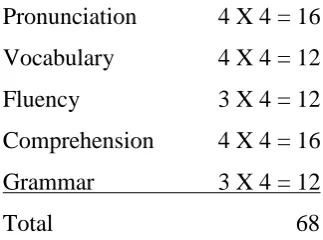
pronunciation, vocabulary, fluency, comprehension, and grammar. After using oral rating sheet from Harris the scores of each point are multiplied by four.
Therefore, the highest score is 100. For example: If the students get
5, so 5 X 4 = 20 4, so 4 X 4 = 16 3, so 3 X 4 = 12 2, so 2 X 4 = 8 1, so 1 X 4 = 4 For instance:
A student got 4 in Pronunciation, 3 in Vocabulary, and 3 in Fluency, 4 in
comprehension and 3 in grammar.
38
Pronunciation 4 X 4 = 16
Vocabulary 4 X 4 = 12
Fluency 3 X 4 = 12
Comprehension 4 X 4 = 16
Grammar 3 X 4 = 12
Total 68
It means he or she got 68 for speaking. The score of speaking based on five components can be compared in the percentage as follows:
Grammar 20%
Vocabulary 20%
Fluency 20%
Pronunciation 20%
Comprehension 20%
[image:58.595.112.274.84.204.2]Total = 100%
Table 3.1. Table of Rating Sheet Score
S’s Codes Pronoun. (1-20) Fluen. (1-20) Gram. (1-20) Voc. (1-20) Compr. (1-20) Total (1-100) A B C b. Questionnaire
The last instrument that was used in collecting the data is questionnaire. This
questionnaire was used to know students’ perceptionand satisfaction about the effect of information transfer task for their speaking class. The questionnaire consisted of 30 questions related to the teaching learning process of the
39
by the teacher. By giving this questionnaire the research would know students judgment about the teaching learning process through information transfer
task.
3.7. Data Analysis
In analyzing the data, the researcher classified the data into two categories. They
were the data of learning product and the data of leaning process. The data of learning product were the results of speaking test and the data of leaning process were the results of the students’ perception questionnaire. The data analysis was done after the data were collected from every cycle. After getting the data, the next step was analyzing the data and did reflection based on the data. From the
analysis and reflection, the weakness of the first cycle was found and it helped the researcher and also the partner to improve the treatment for the next cycle to get better result. The steps that were done in analyzing the data of learning product
and learning process will be explained bellows:
a. Learning Product
There were some steps that were done by the researcher in order to analyze the
data of learning product:
a) Transcribing Students’ Voice
40
oral language into written form. This step was done to make objective evaluation and help the raters in giving score to the students.
b) Scoring Students’ Speaking Ability
Scoring criteria adopted from Harris (1974) was used in collecting the
data of learning product. In scoring students’ speaking ability, the researcher and her partner scored per component of speaking they are
pronunciation, grammar, vocabulary fluency and comprehensibility. This technique was used in order to know which component of speaking must be improved in the next cycle.
c) Calculating Students’ Total Score
These are two formulas that will be used in calculating students’ total score:
1) Calculating the scores from 1strater and 2ndrater
R1 = Score from 1strater R2 = Score from 2ndrater P = Pronunciation
G = Grammar
V = Vocabulary
F = Fluency
C = Comprehensibility = + + + +
41
2) Calculating the total score
R1 = Score from 1strater R2 = Score from 2ndrater TR = Total Score
d) ListingStudents’ Score in The Table Of Frequency
After the total score were calculated, the next step that would be done was
listing students’ score in the table of frequency. This step was done in order to know the number of students who had reached minimum score or more. Besides that, from listing students’ score the researcher would know whether the indicator of the research had been fulfilled or not. Then the researcher could decide whether the second cycle had to be conducted
or not.
e) Calculating The Students with Minimum Score
The formula that was used to calculate the percentage of students who
have reached minimum score is as follows:
%S = Percentage of students who reach minimum score S = Number of students who reach minimum score N = Total students in class
TR =
42
b. Learning Process
Besides learning product, another data that would be analyzed in this research was the data of learning process. To collect the data of leaning process, the
researcher and her partner used questionnaire to get the data of students’ learning perception. After all the data of students’ perception had been collected, the next step would be done. The steps that were used in analyzing students’ learning perceptionwere as follows:
a) ListingStudents’ Name in The Table Of Frequency
After the questionnaire was analyzed, the next step that would be done
was listing students’ name. This step was done in order to know the number of students who were satisfied during the teaching learning
process.
b) Calculating The Students Who were Satisfied with the Teaching Learning Process Using Information Transfer Task
After listing students’ name in table of frequency, the next step was calculating the percentage of Students who were satisfied with the teaching learning process. The formula that was used to calculate the data is:
%S = Percentage of students who are active in the class
S = Number of students who are active in the class
V. CONCLUSIONS AND SUGGESTIONS
Based on the findings of the research, the conclusion and suggestion are formulated as follows:
5.1. Conclusions
Based on the result of the learning product and learning process in this classroom
action research, it can be concluded that:
1. Information transfer task can be used to increase the students’ speaking achievement. It can be seen fromstudents’ scores which increase significantly in every cycle.
2. Students are encouraged to actively involve in the teaching learning process through information transfer task. The data of students’ perception questionnaire show that most of the students state that they can reach better
learning after the researcher applying information transfer task. So, the students are able to increase their learning activities and finally their learning
product.
5.2. Suggestions
In line with the findings of the research, some suggestions are proposed as