learning
experiences,
in
the
self-evaluation
of
participants in the BA for Personal and Professional
Development (ALBA), All Hallows College, Dublin, on
completion of their first year of studies.
Ciarán Ó Mathúna B.D. H.Dip.G/C. MAM.
Supervisor: Eugene Curran D.Min.
Presented in fulfilment of the requirement for the award of PhD.
All Hallows College (DCU)
Declaration
I hereby certify that this material, which I now submit for assessment on the programme of study leading to the award of PhD is entirely my own work, that I have exercised reasonable care to ensure that the work is original, and does not to the best of my knowledge breach any law of copyright, and has not been taken from the work of others save and to the extent that such work has been cited and acknowledged within the text of my work.
i
This research and thesis is the product of much work and dedication on the part of the researcher. However no researcher can work alone. There are a number of people who deserve particular mention and a work of thanks.
Firstly there would be no research if the students of the ALBA course had not so graciously agreed to participate and tell their story.
I would like to thank Dr. Joe McCann the then director of ALBA, for his support, enthusiasm and interest in this project. I also owe him a great debt of gratitude for making available his personal and private records of meetings, conversations, emails in relation to the initial investigation as to the viability of developing the ALBA course.
Thanks in special and specific ways:
To Margaret and the administrative staff of ALBA, who patiently replied to my queries and provided me with information and statistics.
To the library staff of All Hallows College, who were always professional and patient when providing information and technical support.
To my fellow PhD students within All Hallows and in other colleges who provided support and encouragement during the fallow periods along the PhD journey deserve to mentioned and thanked.
To my proof reader and sister, Marian who worked tirelessly and at times under pressure to meet deadlines, a very heart felt appreciation.
To my partner Gabriel who unselfishly allowed me the time and space to concentrate on my studies and encouraged me throughout.
ii
Dedication
iii
Table of Contents
Page
Acknowledgements i
Dedication ii
Table of Contents iii
Abstract xii
List of Table xiii
Glossary of Terms xiv
Introduction
Background to the research 1 Personal Motivation 2 Professional Motivation 3 The Research Focus 5Methodology 5
Aims 6
Objectives 7 Justification 8 Limitations and Parameters 9 Research Outline 11 Conclusion 13
Chapter One: Adult Education: Mapping the Terrain
1. Introduction 151.1 Adult Education 16
1.1.1 Definitions of Adult Education 19
1.1.2 Historical Foundations 22
1.1.3 Philosophical Foundations 24
1.2 Seminal Thinkers 26
1.2.1 John Dewey 27
1.2.2 Eduard Lindeman 29
iv
1.2.4 Malcolm Knowles 34
1.2.5 Jack Mezirow 36
1.3 Emerging Themes 38
1.3.1 Transformational Learning 39
1.3.2 Self-Directed Learning 40
1.3.3 Lifelong Learning 42
1.3.4 Andragogy 45
1.4 Conclusion 47
Chapter Two: Adult Learning
2. Introduction 49
2.1 Adult Development 51
2.1.1 Developmental Theories 51
2.1.2 Childhood to Adult Development 53
2.1.3 Development is Multi-Linear, Multi-Faceted 54 and Cyclical
2.1.4 Developmental Implications for Learning 56
2.2 Intelligence 57
2.2.1 Recording Intelligence 58
2.2.2 Intelligence Types 59
2.2.3 Psychometric Testing 61
2.2.4 Context of Intelligence 62
2.2.5 Howard Gardner: Multiple Intelligences 64
2.3 Learning 66
2.3.1 Learning Theories 69
2.3.2 Levels of Learning 71
2.3.3 The Experience of Learning 72
2.3.4 Learning Process 74
2.3.5 Learning and Knowledge 76
2.3.6 Models of Learning 77
2.4 Learning Methodology 81
2.4.1 Kolb: Learning Style Inventory (LSI) 82 2.4.3 Myers Briggs Type Indicator (MBTI) 87
2.5 Learning in Context 89
2.5.1 Personal History 90
2.5.2 Learning Preferences 93
v
2.5.4 Learning Environment and Culture 95
2.5.5 Role of Educator 97
2.6 Conclusion 99
Chapter Three: Transformative Education
3. Introduction 101
3.1 Understanding Transformation 102
3.2 The Phases of Transformation 103
3.2.1 A Disorienting Dilemma 105
3.2.2 Self-Examination with feelings of Fear, 106 Anger, Guilt or Shame
3.2.3 Critical Assessment of Assumptions 107 3.2.4 Recognition that one’s discontent and the 108 Processes of transformation are shared
3.2.5 Exploration of options for new roles, 109 Relationships and actions
3.2.6 Planning a course of action 110
3.2.7 Acquiring knowledge and skills 110 for implementing one’s plans
3.2.8 Provisional trying of new roles 111 3.2.9 Building competence and self confidence 112 In new roles and relationships
3.2.10 A Reintegration into one’s life on the basis 112 of conditions dictated by one’s new
perspective
3.3 Elements of Transformation Theory 113
3.3.1 Meaning Perspective/Frame of Reference 114 3.3.2 Three forms of meaning perspective 118
3.3.2 (a) Epistemic 119
3.3.2 (b) Social 119
3.3.2 (c) Psychological 120
3.3.3 Habits of Mind 120
3.3.4 Points of View/Meaning Schemes 122
3.3.5 Perspective Transformation 123
3.4 Critical Reflection within Transformation Theory 125
3.4.1 Place and Definition of Critical Reflection 125
3.4.2 Critical Reflection as Social 127
vi
3.4.5 Critical Reflection on Experience 131 3.4.6 Critical Reflection the Heart of Transformation 132
3.5 Transformational Learning 133
3.5.1 Learning as part of Transformation Theory 133 3.5.2 Definitions of Transformative Learning 134 3.5.3 Transformative Learning as Process 135
3.6 Critique of Transformation Theory 139
3.7 Conclusion 142
Chapter Four: Setting the Scene: The Situational Context
4. Introduction 143
4.1 Background 144
4.1.1 Adult Education in Ireland 144
4.1.2 All Hallows College 152
4.1.3 Current Statistics 155
4.2 Development of ALBA;
the BA for Personal and Professional Development 156
4.2.1 Genesis 156
4.2.2 School for New Learning 157
4.2.3 Links between All Hallows College 159 and the School for New Learning,
DePaul University, Chicago, and the Development of ALBA
4.2.4 Research Archive 166
4.2.5 Launch 167
4.2.6 SR Technics 167
4.3 Conclusion 170
Chapter Five: Methodology
5. Introduction 171
5.1 Methodology 172
5.1.1 Qualitative Research 172
5.1.2 Narrative Research 174
vii
5.1.4 Narrative Analysis 180
5.2 Critique of Methodology 182
5.2.1Advantages 183
5.2.2 Disadvantages 184
5.2.3 Justification 184
5.3 Research Focus 186
5.3.1 ALBA Student Cohort Profile 186
5.3.2 Parameters & Limitations 192
5.3.3 Research Question 193
5.4 Conducting the Research 194
5.4.1 Interview Guide 195
5.4.2 Participant Information 195
5.4.3 Pilot 196
5.4.4 Interview Process 196
5.4.5 Data Collection, Storage and Management 198
5.4.6 Confidentiality 199
5.4.7 Transcription 199
5.4.8 Data Analysis Procedures 201
5.5 Research Considerations 203
5.5.1 Verification 203
5.5.2 Validity 204
5.5.3 Reliability 205
5.5.4 Trustworthiness 205
5.5.5 Ethics 206
5.5.6 Researcher Integrity 207
5.5.7 Researcher as Reflective Practitioner 208
5.6 Conclusion 209
Chapter Six: Findings and Analysis of Data
6. Introduction 211
6.1 Motivation for Returning to Study 212
6.1(a) Unemployment-Losing One’s Identity 212
6.1(b) Career Advancement 213
6.1(c) Degree Focus 214
6.1(d) Personal Fulfilment 215
viii
6.2 Why participants chose the ALBA course 217
6.2 (a) Degree Programme Structure 217
6.2 (b) Programme Content 219
6.2 (c) Programme Philosophy 220
6.2 (d) All Hallows College 222
6.2(e) Expectations 223
6.2.2 Relating back to theory 224
6.3. The Impact of Returning to Learning 225
6.3.1 Personal Impact 226
6.3.1(a) Apprehensions 226
6.3.1(b) On Being a Student 227
6.3.1(c) Family Life 228
6.3.1(d) Spouse/Partner 229
6.3.1(e) Personal/Social 230
6.3.1(f) Commitment 232
6.3.2 Barriers 233
6.3.2(a) Economic 233
6.3.2(b) Personal 234
6.3.2(c) Lack of Personal Information Technology 234 Ability
6.3.2(d) Lack of Support 235
6.3.2(e) Academic Language 236
6.3.3 Supports 237
6.3.3(a) Spouse/Partner 237
6.3.3(b) Family and Friends 239
6.3.3(c)Mentors 240
6.3.4 Relating back to theory 241
6.4 Experience of being on ALBA 242
6.4.1 Positives 242
6.4.1(a) Supportive Environment 242
6.4.1(b) Tutors/Mentors 245
6.4.1(c) Foundations 246
6.4.1(d) Course Content 247
6.4.1(e) Course Structure 248
6.4.1(f) Fellow Students 250
6.4.1(g) Adult Environment 251
6.4.1(h) Personal Developmental 253
ix
6.4.2 Difficulties encountered 256
6.4.2(a) Administrative Communication 256
6.4.2(b) Availability of Modules 257
6.4.2(c) Information Technology 258
6.4.2(d) Facilities 260
6.4.2(e) Foundations 261
6.4.3 Relating back to Theory 262
6.5 Transformation 264
6.5.1 Personal Transformations 264
6.5.1(a) Discovery 264
6.5.1(b) Open Mind 265
6.5.1(c) Tolerance 266
6.5.1(d) Awareness of Self 267
6.5.1(e) Change in Confidence Levels 268
6.5.1(f) Social Confidence 271
6.5.1(g) Workplace Confidence 272
6.5.1(h) Communication Skills 274
6.5.2 Academic Transformations 275
6.5.2(a) New Understanding of Education 275
6.5.2(b) Academic 276
6.5.2(c) Analytical Skills 278
6.5.2(d)Critical Thinking 279
6.5.2(e)Education 280
6.5.3 Social Transformation 281
6.5.3(a) New Horizons 281
6.5.3(b) Social Awareness 283
6.5.3(c) New Roles 284
6.5.3(d) Personal, Family and Social 286
6.5.3(e) Employment 286
6.5.3(f) Future Studies 288
6.5.4 Relating back to Theory 289
6.5.4(a) Ten Phase of Transformation 289
6.5.4(b) Frames of Reference 295
6.5.4(c) Meaning Schemes 297
6.5.4(d) Habits of Mind 298
x
Chapter Seven: Conclusions and Recommendations
7. Introduction 301
7.1 Conclusions drawn from the Research 303
7.1.1 It is Important to Facilitating Transition 304
into Third Level
7.1.2 Self-esteem as a Significant Contributing 307
Factor Affecting Entry into Third Level Education
7.1.3 Structured Specific Supports Assist 309
Students Progression
7.1.4 Flexibility and Choice are valued by 312
Adult Learners
7.1.5 An Adult Methodology is Essential 314
7.1.6 Developing Communication Skills 316
is Important
7.1.7 Participation in Adult Learning 318
Increases Confidence
7.1.8 Adult Learning Methodologies 320
Develop Critical Thinking Skills Which broaden Social and Political World View
7.1.9 Participation: Broad Impacts; it affects 321
the individual, family, workplace and Social life
7.1.9 (a) Personal 323
7.1.9 (b) Family 323
7.1.9 (c) Work Place 324
7.1.9 (d) Social 324
7.1.10 Adult Education is Transformational 325
7.1.10 (a) Personal 326
7.1.10 (b) Academic 327
7.1.10 (C) Social 328
xi
7.2.1. Transition and Orientation to Academia 329
Requires its own Dedicated Process and Programme
7.2.1.1 How ALBA Could Improve 331
7.2.2 A Foundations Course which assist adult 332
learners develop learning skills needed to be integral and necessary part of every adult education programme
7.2.2.1 How ALBA Could Improve 333
7.2.3 Adult Learners need a Proactive Support 333
System in place
7.2.3 (a) Mentoring System 334
7.2.3 (b) Career Guidance Service 334
7.2.3 (c) Counselling Services 335
7.2.3.1 How ALBA Could Improve 335
7.2.4. The Provision of Flexible, Multiple Choices, 336 of Modules that are Outcome-Based
Containing Various Assessment Methods is key to Developing Adult Friendly Education Programmes
7.2.4 (a) Flexibility 336
7.2.4 (b) Varity of Subject Choice 337
7.2.4 (c) Modular Based 338
7.2.4 (d) Outcome Based 339
7.2.4 (e) Assessment 339
7.2.4.1 How ALBA Could Improve 340
7.2.5 An Andragogical Approach is essential 341
7.2.5 (a) Tutors 342
7.2.5 (b) Course Structure 342
7.2.5.1 How ALBA Could Improve 343
7.2.6 The Theory of Transformational Learning 344
is Central to the Andragogical Approach of Adult Education
7.2.6.1 How ALBA Could Improve 346
7.2.7 Personal Development Courses must be 346
an integral Aspect of Adult Education Programmes
7.2.7.1 How ALBA Could Improve 347
xii
7.4 Recommendations for Further Research 350
7.4.1 A follow-up Interview with those who 350
Participated in this research
7.4.2 Post-Graduation research 350
7.4.3 The Female experience of being an Adult 350
Learner
7.4.4 Comparison between provision types 351
7.4.5 What is the experience of the teachers of 351
Adult Learners
7.5 Concluding Comments 352
7.6 Valediction 354
Bibliography 360
Appendices
Appendix A: Philosophical Categories of Education on the development of Adult Education
Appendix B: My Pedagogical Creed (John Dewey) Appendix C: Different settings for Adult Education
Appendix D: FETAC National Framework of Qualifications Appendix E: Adult Learning BA: Four Strands
Appendix F: Letter of Invitation to participate in a PhD research Appendix G: Research Information
Appendix H: Participant Consent Form Appendix I: Interview Guide
Appendix J: Ethics Form
xiii
Abstract Title:
Transformative Adult Education: Transformative learning experience s, in the self-evaluation of participants in the BA for Personal and Professional Development (ALBA), All Hallows College, Dublin, on completion of their first year of studies.
Educational theory tells us that adults who return to formal education often experience personal transformations as a result of their engagement with the education process. This can have a profound effect on a person’s self-concept, their relationships, work life choices and active participation in society. As a practicing adult educationalist I have many examples of witnessing adults experiencing personal change as a result of participation in a programme of study. Within an Irish context, the difficulty has been capturing these personal transformations in an empirical, validated, and trustworthy manner rather than as anecdotal stories. This thesis is a structured systematic research project to capture such transformat ions.
Through narrative interviews, the transitional and transformative experiences of thirty-two participants on the BA for Personal and Professional Development (ALBA) course were gathered, analysed and referenced to the theory of Transformative Learning and the work of Jack Mezirow. The analysis is able to confirm the existence of transformative learning and personal transformations. The results of this research show an increase in personal confidence along with broader personal, social and academic horizons. As a result of this research implications arise for education providers; most notably; students need assistance in the transition to academia; the provision of a ‘Foundations’ programme; and ongoing structured supports throughout their study.
Ciarán Ó Mathúna
xiv
List of Tables Page
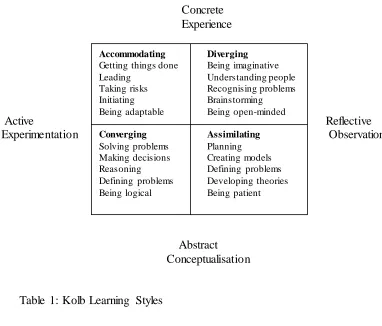
Table 1: Kolb’s Learning Styles 86
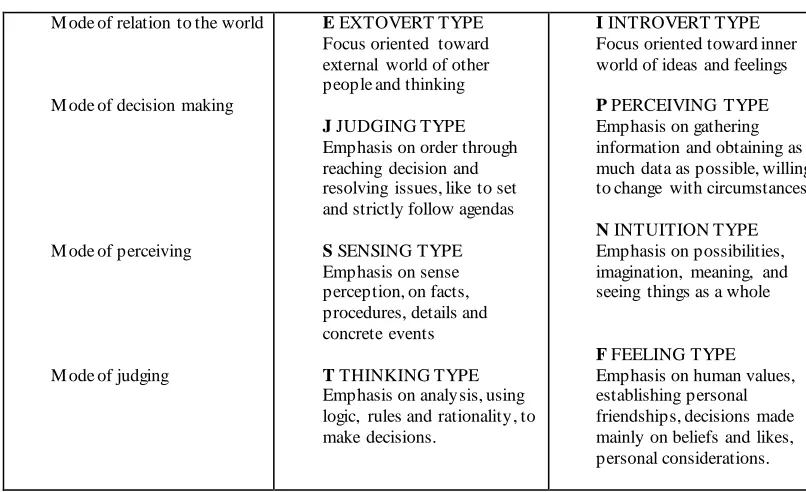
Table 2: Jung: Psychological Types 87
xv
Glossary of Terms
AHC All Hallows College
ALBA Bachelor of Arts for Personal and Professional Development (Adult Learning Bachelor of Arts)
ALCE Adult Literacy and Community Education AONTAS The National Adult Learning Organisation APL Approved Prior Learning
BA Bachelor of Arts
BETI Back to Education Initiative BPS British Psychological Society BSA British Sociological Association
CAEL Council for Adult and Experiential Learning DCU Dublin City University
DES Department of Education and Science
DES Department of Education and Skills (name change in 2011) ECTS European Credit Transfer System
EGF European Globalisation Fund ELT Experiential Learning Theory
FETAC Further Education Training and Awards Council HEA Higher Education Authority
HETA Higher Education Training Awards Council ILP Individual Learning Pursuit
LSI Learning Style Inventory MAM Master of Arts in Management MBTI Myers Briggs Type Indicator
NALA National Adult Literacy Association NQA National Qualifications Authority
OECD Organisation for Economic Cooperation and Development OSCAIL Distance Education Centre (DCU)
PLC Post Leaving Certificate SNL School for New Learning
SPIDAS Special Initiatives for Disadvantaged Adults Scheme
SRT SR Technics
TEAGASC The Agriculture and Food Development Authority
UNESCO United Nations Educational, Scientific and Cultural Organisation VTOS Vocational Training Opportunities Scheme
1
Background to the research
From adult literacy programmes to FETAC (Further Education and Training Awards Council) courses to undergraduate programmes, adult students who engage in education programmes, who achieve personal goals, experience personal joy and contentment. However, these personal transformations are not captured through the normal recording systems. I always felt there was something else that needed to be captured other than the academic achievement. I witnessed a change in people, I saw people grow in confidence, develop new skills and interact with the world in a brighter more secure manner. The question that haunted me was ‘how do you capture this’? After much soul searching, discussion and reading, I decided to undertake research at a PhD level. Research that will definitively tell the experiences of adult learners, research that will capture these personal transformations, research that will bring something new to the field of adult education in Ireland.
2
experience by each participant and the impact this learning has on each individual at a personal, academic and social level. The analysis of data received will be conducted in a narrative format, whilst using transformative learning theory as a theoretical underpinning.
For clarity of purpose background to the research is explored under two separate but interlinked headings; personal and professional motivations.
Personal Motivation
Having worked in adult education for over a decade, in a variety of roles, I have been privileged to witness the joy and excitement of an adult learner achieving personal milestones, gaining in self-confidence and discovering the innate intelligence that had lain dormant through lack of opportunity.
3
There were many occasions during the past ten years when either at education conferences or staff room meetings, professionals like me would recount stories of adult learners who had made significant personal break-through in their learning and how we had witnessed personal transformations. This research is born from a personal desire to present such experiences in an academic format so that the role of adult education will be understood, appreciated and developed within the Irish education system.
Professional Motivations
Amongst professionals involved in adult-, community- and lifelong-learning there is a recurring ‘gap’ identified; the issue of how to record the personal growth experienced and gained through the very act of participation. How can you capture personal transformations? The difficulty in accurately recording the learner’s personal achievements is unanswered. The questions I was left considering was ‘How can I record these aspects of learning’? ‘How can I confirm if adult and higher education is potentially transformative’?
4
ability to write their name and address, read menus, find a telephone number in the directory. The K-FAST test for reading and arithmetic tasks relate to everyday activities such as understanding labels on medicine bottles, following a recipe, doing a monthly budget, and making price comparisons between products. These and other similar tests focus on and identify the individual’s skills in academic ability and also in the other adaptive skills areas e.g. quality of life, home living, health and safety.
While each test has positive merits, they did not, in their totality, meet the specific needs of this research. Still of the opinion that such a test was necessary, I then undertook training with the British Psychological Society which would enable me to devise my own specific test. This option would be a worthy exercise, (and possibly a separate PhD research idea), but would still not capture the internal nature of the transition experience of the adult learner.
5
of a cohort of adult learners, through a method of narrative research informed by the theory of transformational learning, was developed.
The Research Focus
The focus of the research was developed to explore and to understand, the experiences of adult learners on the ALBA programme, to capture their experience if any of personal transformations and of transformational learning.
Through the narrative methodological approach, the research question would explore and discover, in a free, unfiltered way, the lived experiences of adult learners. It would allow for examination of the theory of transformation with the data from the individual narratives. It would present to the academic world findings as to whether transformational learning is experienced and personal transformations are experienced through engagement in this particular education programme. Accordingly, the research focus was designed as:
Transformative Adult Education: Transformative learning experiences, in the self-evaluation of participants in the BA for Personal and Professional Development (ALBA), All Hallows College, Dublin, on completion of their first year of studies.
Methodology
6
inquiry has in recent years become an accepted research methodology in various disciplines, including psychology, anthropology, sociology and education. It is increasingly used in the area of education, adult education and lifelong learning. Thus it is an appropriate method to employ in this research. A full explanation of the methodology employed, how the research was conducted and the criteria for participation are further explained in chapter five.
Aims
In undertaking this research it was the aim of this researcher to capture the self reporting of the learners, their perception of experiencing transformational learning while participating in a specific adult learning education programme. In analysing these personal experiences, I will be looking for evidence of transformational learning in accordance with transformation theory, as framed by Mezirow, in personal, academic and social spheres.
7
The second aim of the research, again based on the Mezirow’s theory of transformation, is to establish if transformational learning had taken place as a direct result of being on the ALBA course. The theory of transformation, through the lens and the work of Jack Mezirow (1978, 1985, 1990, 1991,1997) tells us that transformative learning leads to students trying out new skills, developing wider social awareness, developing social conscience and implementing learning into action. Transformational learning is not passive; thus, if it has taken place it will be experienced by the individual. Through this research, such evidence will be established under the guidelines of the theory of transformation.
Objective
The objective of this research is primarily to provide current data of the lived experience of adult learners within an Irish setting. It will provide insight into the personal and academic learning processes that take place, thus confirming or opposing Mezirow’s theory of transformation and transformative learning. As a result of gathering this information and presenting it as validated data through the process of academic research, it is envisaged that the finding will influence future education programmes established to cater for adult learners.
8
transformational learning. In knowing this information the research will be able to provide accurate and relevant information to adult education course providers, information which will inform the structure, content and methodology of such programmes.
Justification for the research
There is undoubtedly a need within higher education and lifelong-learning for the recording of the lived experience of adult learners and the presence of transformative learning. This information will be a valuable resource within the field of adult education, as many of the current reporting systems in place focus primarily on the traditional measurable outcomes, such as certification and progression. By conducting this research at PhD level, it is my hope to be able to place meaningful research data into the public arena, thus expanding the debate on how to represent the impact of adult/higher education on an individual.
9
Limitations and Parameters
With every piece of research there are natural and imposed limitations. This research is set in a particular place and time. While it is robust in its methodology and validity, it can not (nor does it set out to) cover all aspects of adult higher education. This research is conducted within Ireland, which has a relatively recent history of adult education, most of which has developed from community and women’s-based projects. It is research within the field of adult higher education, which is but one discipline within the wider field of education. The research is focused on one specific programme of education, namely the Adult Learning BA, in one specific college, All Hallows.
10
At a more personal level, as a researcher I must acknowledge my own limitations. This is the first time I have used narrative research methodology. Given that I am working full-time while studying part-time. There are time and financial constraints on my availability as a researcher. With regard to the ALBA programme, I was a member of both the ALBA programme board and the ALBA advisory committee for two years prior to ALBA enrolling their first students. I subsequently resigned from these positions when deciding to undertake this research. I believe strongly that ALBA is a model for adult education programmes to follow. I acknowledge that I have invested time, energy and emotion into the development of ALBA. I am passionate in my belief that this model of education is effective. I have on two occasions visited DePaul University, Chicago, to witness and study how the School for New Learning runs its undergraduate programmes (the model on which ALBA is based). I am bringing this passion and belief with me into this research (issues of ethics and personal limitations are discussed in chapter five).
11
Research Outline
The introduction to this thesis outlines the background to the research, the personal and professional motivations. The research question is outlined and explained as is the justification for conducting the research. The Limitations and Parameters are introduced along with the chosen methodology.
Chapter One, Adult Education: Mapping the Terrain discusses and explores the concept of adult education, its historical and philosophical foundations. It also introduces the reader to the seminal thinkers and emerging themes within this field, in particular, the work of John Dewey, Eduard Lindeman, Paulo Freire, Malcolm Knowles and Jack Mezirow. Transformational learning is introduced here as one of the emerging themes and is developed further in chapter three.
Chapter Two, Adult Learning explores the issue of what it means to be an adult, the developmental issues and understanding intelligence within the adult context. How adults learn and the various methodological understanding and approaches are examined and presented within the context of the overall sphere of adult higher education.
12
of mind and meaning schemes and transformative learning, with particular reference to the work of Jack Mezirow.
Chapter Four, Setting the Scene: The Situational Context the focus of this chapter is to present the situational context for the research. Having earlier, in chapters one and two, discussed the nature of adult education, the attention now is to focus on the Irish context. Particular reference is focused on the development of the ALBA course in All Hallows College, the links that All Hallows College has developed with Dublin City University (DCU) and De Paul University, Chicago, USA.
Chapter Five, Research Methodology sets out how the data collection consisted of narrative, qualitative interviews with students enrolled in the Adult Learning BA, in All Hallows College. It explores the use of narrative as a methodology and outlines its advantages and limitations. This chapter gives a very detailed account of how the research was conducted, the handling of the data and the analysis process.
13
transformation are examined under three major areas: personal, academic and social, reflecting the theoretical perspectives of Mezirow’s transformative learning theory.
Chapter Seven, Conclusions and Recommendations nine conclusions are presented, drawn from interpretation of the findings. The seven recommendations lay out clear challenges for ALBA and other higher educational providers as a result of this research.
Conclusion
14
15
Chapter One: Adult Education: Mapping the Terrain
1. Introduction
This brief introduction presents the broad picture regarding the nature and context of adult education. It provides a ‘setting of the scene’ of the landscape that is adult education. It establishes and recognises adult education as an independent body within the world of education and academia. In providing a ‘backdrop’ this chapter is building the foundations for that which will follow: a deeper analysis of aspects of adult education, most notably adult development and learning in chapter two followed by in-depth review of literature as to the nature of transformation theory and transformative learning in chapter three.
16
In presenting this context of adult education, various definitions are presented along with the historical and philosophical development. The seminal thinkers and theorists within the field are introduced as are emerging themes within adult education.
1.2 Adult Education
Just as our understanding of humankind and society has developed throughout history, so too has our understanding of the education of adults. Historical events and societal changes are reflected in the changing nature of adult education. Today when we refer to adult education, we can be referring to a myriad of educational aspects within the field of education; e.g. ongoing education, further education, continuing education, basic education, education and training amongst others.
There is a general consensus amongst adult educators that the year 1926 could be considered the foundation stone of modern adult education. It is this year that saw Lindeman’s (1926) seminal text, ‘The Meaning of Adult Education’
published. That year also saw the establishment of the American Association for Adult Education (AAAE). The importance of 1926 can be summed up by Peters and Jarvis (1991):
17
Association for Adult Education…the publication of Lindeman’s book ‘The Meaning of Adult Education (1991:122).
While 1926 may be a reference point for a current (Western) discussion on adult education, many authors and theorists reference the development of adult education throughout history, to include Greek philosophers Plato and Aristotle (Warnock 1977), ancient Egypt (Merriam and Brockett 2007), and the Christian Bible. What can be drawn from this is to acknowledge that the education of adults has been part of society in varying forms throughout the history and development of human kind.
According to Merriam and Brocket (2007), adult education is usually perceived as something related to basic skills, leisure activities or job training (2007:78). This reflects the traditional view of adult education being synonymous with skills and training, as noted by Jarvis (1985) who recalls Jensen (1964) claimed that adult education is focused more on the practical skills rather than the theoretical. Peters and Jarvis (1991) acknowledge the two dimensional aspects of adult education:
Adult education is both a field of practice and a field of study, but these two aspects of adult education are not altogether separate (1991:15).
18
system. He asserted that (a) adult education is a form of extension of the formal education system, to help those who ‘missed out’, and (b) that adult education is concerned with personal fulfilment (1996:34).
These two aspects reflect the strong tradition that has developed in the West regarding an understanding of adult education. However, adult education is much more complex, subtle and diverse. Courtney (1989) suggested that we can explore adult education from five basic and overlapping perspectives.
1. The work of certain institutions and organisations.
2. A special kind of relationship that requires conscious effort to learn.
3. A profession or scientific discipline, an emphasis on training or preparation.
4. Stemming from an historical identification with spontaneous social movements… developing activities…political parties…women’s movement.
5. Distinct from other kinds of education by its goals and functions. Courtney (1989:17-23)
19
research. Brookfield (1995) emphasises the need to relate to adult learners as adults and to find ways to assist them to critically reflect on their experiences.
1.1.1 Definitions of Adult Education
Adult education to understood in the broadest possible way; includes all aspects of lifelong learning activity, whether formal or informal, institutional or personal, cultural, religious, individual or societal. However a working definition that is slightly more prescriptive with specific reference to the participation of adult students in an organised programme of study. This working definition is:
The process of conscious engagement in an adult higher education programme
Schuller and Megarry (1979), referring to the United Kingdom, use the term ‘adult education’ to indicate an ‘extension of general education into adult life....’ (1979:257). Jarvis (1983) suggests education can be defined as:
Any planned series of incidents, having a humanistic basis, directed towards the participants learning and understanding (1983:5).
Later in his 2002 writings, Jarvis puts forward the meaning of adult education to refer to:
20
Houle (1972:32) speaks of adult education as ‘improving’ either the individuals or society. This idea of education being about change is taken up by Courtney (1989) who asserts that adult education is an intervention, which results in change in knowledge or in competence. Change is also the aspect take up by Darkenwald and Merriam (1982) when they propose adult education as being concerned with:
Learning activities for the purpose of bringing about changes in knowledge, attitudes, values, or skills’ (1982:9).
Knowles (1980) identifies adult education in its broadest sense as:
The process of adults learning… as a set of organised activities carried on by a wide variety of institutions for the accomplishment of specific educational objectives (1980:25).
Merriam and Brockett (2007) suggest that adult education is what happens when you are working with adults in an organised activity:
Activities intentionally designed for the purpose of bringing about learning among those whose age, social roles, or self-perception define them as adults (2007:8)
This notion of the activity being purposeful, undertaken by adults is also found in Rogers (1996) when he speaks of adult education as;
21
system, so long as such learning opportunities treat the learners as adults in decision-making, use appropriate adult learning methodologies and types and allow the learners to use the experience for their own purposes and to meet their own needs (1996:28)
and again;
Adult education then is a process by which adults, who are already engaged in continuous learning, adapting to changes in their circumstances, engage in more structured programmes of learning in a planned and purposeful way at different times throughout their lives (1996:29).
A more open flexible description of adult education can also be found in Knowles (1980) when he talks of the ‘mission’ of adult education and/or the adult educator’s responsibility to:
Help individuals satisfy their needs and achieve their goals’…with the ultimate goal being ‘human fulfilment’ (1980:27).
22
reflective learning. These concepts of andragogy, self-directed learning and transformational learning are explored in more detail later in this chapter.
One thing on which there is general agreement on is that adult education is an activity which involves ‘adults’: people who either self-define or are defined by society as having the rights and responsibilities of an adult. It is, however, the activity of these adults, that has been the cause of much debate as to what is the nature of adult education.
From these definitions, certain themes or aspects of adult education may be deduced; adult education is the concern of adults, it is organised, has a purpose and involves the aspect of change and transformation and these can occur at any stage of a person’s life.
1.1.2 Historical foundations
23
in 1814 (Smith 2004). In 1867 James Stuart, a fellow of Trinity College, Cambridge, delivered lectures regarding higher education for women. 1903 saw the establishment of the Workers Education Association, founded to promote higher education to working men. The Education Act of 1944 made local authorities responsible for providing lifelong learning and in 1947 the Universities Council for Adult Education was formed (Jarvis 2002).
24
The two World Wars appear to be common reference points for many writers when discussing the historical development of adult education. Stubblefield and Rachal (1992) put forward the proposal that three events occurred after World War 11 which popularised the term ‘adult education’: (a) a British publication reviewing the status of adult education was published, (b) the World Association for Adult Education was formed and (c) the Carnegie Corporation became actively involved in establishing adult education. For Jarvis (2002) it was not until after the Second World War and the adoption by UNESCO that the term ‘Adult Education’ became popular, with the many publications that body supported. He references the ‘Faure Report (1972) which advocated that education should be both universal and lifelong, but suggests that it is not until 1976 that lifelong learning ‘comes of age’ with the publication of the Lifelong Learning Act in the United States (Jarvis 2002:24).
1.1.3 Philosophical Foundations
25
For Lindeman (1926, 1989) the whole of life is learning, that ‘education can have no end’, this he refers to as adult education (1989:4-5). For him the aim of adult education is to improve the individual and society. He speaks of the purpose of adult education to ‘put meaning into the whole of life’, and he places what he refers to as the ‘resource of highest value’ experience as the key to this form of education (1989:4-7). Knowles (1998) attributes Lindeman (1926) as laying the foundations stones regarding the philosophy of adult education, the improvement of both the individuals’ life and of society. Freire (2009) in his ground breaking writing of 1970 is clearly in agreement with this philosophical understanding of adult education as he speaks of ‘conscientisation’, of the learner becoming aware of their social, political and economic contradictions, that the goal of education is to affect change.
26
Lawson (1991) suggests that philosophy and education are intertwined with each other. The accepted aim of all philosophy is to try and make sense of the society in which it develops. Thus a philosophy of education will try to explain and understand the aims, objectives and role of education at a given point in time.
According to Elias and Merriam (1995) philosophies of adult education are concerned with the most general principles of the educational process. The philosophies explore the relationship between theory and practice, each reflecting the society and history in which they develop. They propose six major categories of influence. These are: liberal adult education; progressive adult education; behaviourist adult education; humanistic adult education; radical adult education and analytical philosophy of adult education. See appendix one for a full description of these philosophical influences.
The philosophical influences on adult education reflect the historical and socio-cultural context in which they emerged and developed. In chapter four of this research the Irish context of adult education will be explored with specific reference to development of the Adult Learning BA in All Hallows College.
1.2 Seminal Thinkers
27
understand it today. This section will examine such theorists in a chronological fashion as each theorist builds on the knowledge which they inherited and subsequently developed.
1.2.1 John Dewey
Dewey’s understanding of education was set out in Democracy and Education
(1916). He believed firmly that education was a direct agent for social change. Throughout his career, Dewey’s work promoted practical aspects of reflective thinking and non-reflective thinking, of continually trying to show how the abstract was part of the experience of every day life. One of his major contributions to the development of adult education was his promotion of ‘hands-on’, ‘experiential’ learning, rather than the traditional authoritarian approach. He wanted to see education move away from this authoritarian model and be an agent which would help people, through reflective education, to become more valued, equal and effective members of a more democratic society. He believed that education was a social process and therefore society needed to reflect this reality.
28
On the subject of experience Dewey sees a key role for the educator to be people who can help the adult student understand, reflect and draw meaning from experience.
A primary responsibility of educators is that they not only be aware of the general principle of the shaping of actual experience by environing conditions, but that they also recognise in the concrete what surroundings are conducive to having experiences that lead to growth. Above all, they should know how to utilize the surroundings, physical and social, that exist so as to extract from them all that they have to contribute to building up experiences that are worth while (1997:40). And again;
Experience does not go on simply inside a person. It does go on there, for it influences the formation of attitudes of desire and purpose. But this is not the whole of the story. Every genuine experience has an active side which changes in some degree the objective conditions under which experiences are had (1997:39).
However, Dewey sounds a word of caution when he differentiates between experience and education not being synonymous:
The belief that all genuine education comes about through experience does not mean that all experiences are genuinely or equally educative. Experience and education can not be directly equated to each other (1997:25).
In 1897, Dewey published a pedagogical creed: ‘My Pedagogic Creed’ in The School Journal. The creed sets out the guiding principles that govern Dewey’s
29
education, the role of the educationalist and the educational environment. For a full version of the creed see appendix two.
1.2.2 Eduard Lindeman
Lindeman (1926) set out to show the academic world that adult education was a legitimate philosophical approach to education, that it had purpose and responsibilities that would bring about both personal and social change.
Education will become an agency of progress if its short-time goal of self-improvement can be made compatible with a long-time, experimental but resolute policy of changing the social order. Changing individuals in continuing adjustment to changing social functions – this is the bilateral though unified purpose of adult learning ([1926] 1989:104).
For him the purpose of education was to give meaning to a person’s life, throughout their entire life. That this form of education was to be based on the person’s experience, real life situations from which the adult needed to learn. He asserts that it is at this point that education begins. That experience is what Lindeman calls the ‘resource of highest value’ in adult education.
Every adult person finds himself in specific situation with respect to his work, his recreation, his family-life, his community-life, et cetera – situations which call for adjustments. Adult education begins at this point (1989:6). If education is life, then life is also education (1989:6).
30
bound by the physical constraints of the classroom or formal curricula., but rather a concern for educational possibilities of everyday life.
As a contemporary and colleague of Dewey, Lindeman too understood adult education to be an agent of social justice and democracy. It was the 1926 text
‘The Meaning of Adult Education’ which popularised the notion of adult education and social change. This book is still considered the seminal text and the foundation for our understanding today of adult education. It is here that he sets out this new and fresh approach to adult education when he writes;
The whole of life is learning, therefore, education can have no endings. This new venture is called adult education not because it is confined to adults but because adulthood, maturity, defines its limits… (1989: 4-7).
He further contends that the curriculum of adult education be built around the students needs, interests and experience, asserting that:
The resources of highest value in adult education is the learner’s experience (1989: 4-7).
31
1.2.3 Paulo Freire
Freire is regarded as one of the leading and most influential figures in the pedagogy of adult education. He developed his theories while working with illiterate labourers in Brazil. This background of oppression influenced his work and his subsequent writings calling on adult education to be a radical process involving social change. He talked of the need for education to have relevance for the learners.
The publication of his work ‘The Pedagogy of the Oppressed’ (1970) has had a long and profound influence on the development of adult education. Coming from the social context of poverty, and illiteracy, Freire introduces the concept of a ‘pedagogy of the oppressed’ exploring the relationship between the oppressed and the oppressor. Freire included the education system that prevailed as another oppressor of the locals. He tells us that this new pedagogy will lead people to freedom from oppression, through an education process that:
Makes oppression and its cause’s objects of reflection by the oppressed, and from that reflection will come their necessary engagement in the struggle for their liberation… (2008: 48).
This introduces a central theme of Freire, reflection and action. Again he asserts that there are two distinct stages to this pedagogy:
32
the second stage, in which the reality of oppression has already been transformed, this pedagogy ceases to belong to the oppressed and becomes a pedagogy of all people in the process of permanent liberation’ (2008:54).
Freire speaks of how traditional education transmits or ‘deposits’ knowledge from the teacher down to the learner, which he calls ‘banking’ and suggests that it maintains the oppression. He wants to see education as a mutual process which allows people to become more fully human. In the ‘banking’ system, Freire sees the act of oppression continuing, the learner is seen as ‘object’ rather than the ‘subject’ of learning:
Education thus becomes an action of depositing, in which the students are the depositories and the teacher is the depositor. Instead of communicating, the teacher issues communiqués and makes deposits which the students patiently receive, memorise, and repeat. This is the ‘banking’ concept of education, in which the scope of action allowed to the students extends only as far as receiving, filling and storing the deposits (2008:72).
Other major themes of Freire’s 1970 work are ‘dialogue’, ‘praxis’ and ‘conscientisation’ a major core element.
33
Through dialogue, the teacher of the students and the students of the teacher cease to exist and a new term emerges: teacher-student with teacher-student-teacher (2008:80).
The action which follows from the dialogue he names as ‘Praxis’. The concept of praxis is to enable learners to question and reflect on their reality, to begin to see that reality in a different, more critical way, which in turn leads to them taking action. Related to this proposition of reflection and action is his concept of ‘conscientisation’; this is the process whereby the educator must ‘tune into’ the world of the learner: vocabulary, symbols, and culture. Stressing the need to enter into that dialogue of educator-educate, Freire believes conscientisation to be a core element in the education process as it enables people to engage in the search for ‘self-affirmation’.
It is the combination of these key aspects of Freire’s work: Dialogue, Praxis and Conscientisation, which include: educative and critical reflection; learning; action; communal experiences; the importance of action and social change; and the non-neutral aspect of education, which makes Freire such an important figure in the development and understanding of adult education.
34
educational ideas lies a humanistic conception of people as learners who do not remain passive about their situation but become active participants in the world.
1.2.4 Malcolm Knowles
Malcolm Knowles is another central figure to the development of adult education, particularly in the United States. As with Lindeman and Freire, who influenced his work, the placing of how an adult learns is for Knowles, central to the learning process. The prior experience of the learner, informal learning, the concept of self-directed learning, and the role of the educator in how the learning takes place are key elements of adult education.
Knowles will always be remembered for his work in the popularisation and the development of ‘andragogy’. It is for this reason that Jarvis 2002 refers to Knowles as the ‘father of andragogy’, for Knowles it is the presenting of a clear distinction between the ways in which adults and children learn. For him the whole premise of andragogy is the assumption that adults engage with experience and learn differently from children. The concept of andragogy is developed later in this chapter.
35
learners, their readiness to learn and the adult orientation to learn i.e. problem centred not subject centred. In The Modern Practice of Adult Education: From Pedagogy to Andragogy (1980), while still presenting the four differences, he has shifted position slightly regarding the relationship between pedagogy and andragogy. Note the change in title; it is no longer pedagogy versus andragogy, but rather from pedagogy to andragogy. In reflecting on this in his autobiographical book The Making of an Adult Educator (1989) Knowles comments that andragogy accepts its relationship with pedagogy. Knowles in 1984 added to the original list of four differences to include the adult’s motivation to learn. In presenting andragogy in practice (Knowles, Holton & Swanson 1998) the list has grown to six points, with a new first entry regarding the learner’s need to know.
These changes are evidence of growth and development in the theory of adult education and the nature of adult learning. Knowles (1980) speaks originally of contrasting the differences between pedagogy and andragogy but then comes to understand that they can be used alongside each other, as two alternative modes.
36
In (1989) Knowles acknowledges his changing and developing position over the years and comments that if he were writing in another ten years his work would be revised again due to substantial changes in his thinking.
I am therefore certain that if this book is revised in ten years, it will report substantial changes in my thinking (1989:85).
1.2.5 Jack Mezirow
The key element of adult education associated with Mezirow (1977, 1981, 1990, 1991, 1997, 2000,) is the concept of education as ‘transformation’. His work describes learning as a process of making meaning from experiences, which transform our current mind-sets to new, more inclusive, more reflective, more meaningful perspectives. Mezirow’s transformational learning of individual adults involves not just the personal, it includes the academic and it also has a social dimension. Mezirow’s basic assumption is that each individual person carries constructs or ‘perspectives’ of reality which are dependent upon reinforcements from the external world. It is these very constructs or ‘perspectives’ that are transformed through the process of adult learning. He regards transformational learning as:
A development process of movement though the adult years towards meaning perspectives that are progressively more inclusive, discriminating, and integrative of experience (1977:159).
37
Reflective assessment of premises, a process predicated upon still another logic, one of movement through cognitive structures by identifying and judging presumptions (1991:5).
Critical reflection and analysis are other central aspects to transformative learning. Mezirow sets out the different levels of reflection that can occur in adult education. He speaks of reflection and self awareness; becoming aware of judgement values; acknowledging limited sets of perspective and judgement; acquiring new knowledge; building confidence; exploring options and new ways of thinking; experimenting with new knowledge and bringing this knowledge and awareness into the wider society.
Transformation takes place if certain conditions are met and outcomes achieved, - chapter three explores these stages of transformation in detail - it always involves developing new meaning from interpretation of experiences. Change in perception and understanding are the cornerstones of transformation. Mezirow speaks of transformative learning assisting the learner to accomplish such personal, epistemological and sociological changes:
Learning always involves making a new experience explicit….learning is dialectical process of interpretation which we interact with objects and events, guided by an old set of expectations….in transformative learning, however, we reinterpret an old experience (or a new one) from a new set of expectations, thus giving a new meaning and perspective to the old experience (1991:11).
38
An exploration of transformative learning follows in this chapter with a detailed description, evaluation and explanation of transformation theory will be undertaken in chapter three.
1.3 Emerging Themes
39
1.3.1 Transformational Learning
Transformational learning is focused on how adults interpret their life experience, how they make meaning and how this new awareness gives them a new perception of themselves and society, thus leading to change. Transformational learning is learning as a meaning making activity, which Mezirow describes as:
Learning is understood as the process of using a prior interpretation to construe a new or a revised interpretation of the meaning of one’s experience in order to guide future action (1996:162).
Already referred to above in relation to the work of Dewey, Lindeman, Freire, Knowles and Mezirow, learning is rooted in the experience of the learner. Each of these theorists makes the case for the individual to begin with life experience to make meaning. With Mezirow (1990) observing:
No need is more fundamentally human than our need to understand the meaning of our experience (1990:11).
40
specific assumptions about oneself and others until the very structure of assumptions becomes transformed (1981:8).
Mayo (1999) notes the social/political nature of transformative learning as ‘one which recognises the political nature of all educational interventions…’ (1999:24). Mezirow (1991) states that the purpose of transformation theory is to:
explain the way adult learning is structured and to determine by what process the frames of reference through which we view and interpret our experience (meaning perspectives) are changed or transformed’ (1991:xiii).
Chapter three explores in more detail the theory of transformation and transformative learning.
1.3.2 Self-Directed Learning
Self-directed learning is perhaps the most recognisable face of adult education. Championed by Knowles and Brookfield, it is considered to be one of the cornerstones of adult education. Knowles describes it as the learner choosing to take initiative for their own learning experience, to:
Assume the primary responsibility for planning, carrying out, and evaluating those learning experiences (1975:18).
41
with the ability of critical reflection. For him, self-directed learners become successful independent learners, developing their own expertise. He suggests that there are various elements to self-directed learning which include:
Specifying goals, identifying resources, implementing, strategies, and evaluating progress (2010:47).
Brookfield also refers to the concept of self-directed learning and its links to personal and social transformations, which he refers to as ‘internal change of consciousnesses’. He describes this aspect of self-directed learning as:
When learners come to regard knowledge as relative and contextual, to view the value frameworks and moral codes informing their behaviours as cultural constructs, and to use this altered perspective to contemplate ways in which they can transform their personal and social worlds (2010:47).
Another core element of self-directed learning within adult education is the freedom of the learner to choose that which they wish to study and the outcomes they desire to achieve. Knowles (2005) refers to this as the democratic nature of adult education:
Democratic adult education employs the method of self-directing activity, with free choice of subject matter and free choice in determining outcomes (2005:43).
42
One of only a few core concepts that have laid the foundations for the identity of adult education as a distinct field of practice… (1991:194).
Merriam and Brockett (2007) speak of self-directed learning as one of the most important developments in adult education in the past three decades, saying it is the most popular way in which adults choose to learn, that it allow adults to take control of their own learning, and intrinsically connected with a persons self concept (2007: 134,140). Merriam and Caffarella (1999) describe the goals of self-directed learning to have three core elements: to enhance the ability of adult self-directed learning; to have transformational learning a central aspect of self-directed learning; and to promote personal and social change. Brookfield (2010) describes the most developed form of self-directed learning as:
One in which critical reflection on contingent aspects of reality, the exploration of alternative perspectives and meaning systems, and the alteration of personal and social circumstances are all present (2010:59).
1.3.3 Lifelong Learning