Topical Issues of Transcranial Direct Current
Stimulation Usage Revealed through a
Cross-Sectional University-Wide Survey
Sophia Karok
Trinity College Dublin
Alice G. Witney
Trinity College Dublin
Biography
Sophia Karok recently obtained her PhD in Neuroscience and Physiology from Trinity College Dublin, where she studied the influence of neurostimulation techniques on human motor control. Dr Alice Witney is an Assistant Professor in Physiology at Trinity College Dublin with research interests in sensorimotor control.
Acknowledgments
Support for this work was provided by the Irish Research Council’s EMBARK Initiative (409.G30568).
Publication Details
Journal of Cognition and Neuroethics (ISSN: 2166-5087). January, 2017. Volume 4, Issue 3.
Citation
Journal of
Cognition
and
Abstract
Background: Non-invasive neurostimulation techniques, particularly transcranial direct current stimulation (tDCS), have recently been attracting extensive academic and public attention. Claims have been made for applications in mental enhancement and for treatment of a range of disorders including depression, drug addiction, pain relief and stroke recovery. Aims: Building on recent discussions in the field regarding the effectiveness and ethics of tDCS, this paper sought to broaden the discussion to the opinions of the wider community regarding its use and the necessity of regulating access and quality of the devices. Materials and Methods: An online university-wide survey, comprising 34 closed questions and open comments, was used to analyse awareness of different brain stimulation techniques and opinions regarding its use for clinical and self-enhancement applications. The representation of these technologies in the popular press, and the necessity of novel regulatory frameworks for these new technologies was also addressed. Results: 666 completed responses were included in the analysis. Opinions of tDCS were found to be dependent on context of use. Whilst most approved of availing of tDCS as a potential treatment option for themselves or their immediate family, more caution was expressed for tDCS as a self-enhancement device when otherwise healthy. Issues raised were mainly regarding further research corroborating its safety and effectiveness. There were significant associations between respondents’ background and answer proportions, including gender, level of education and previous exposure to neurostimulation techniques. Conclusion: This study supports a necessity of regulatory frameworks for these new technologies that are increasingly deemed to have a neurological impact.
Keywords
Transcranial Direct Current Stimulation, Neurostimulation, Survey, Ethics, Neuroenhancement
Introduction
Transcranial direct current stimulation (tDCS) was originally used in fundamental research to help explain physiological processes of brain function and plasticity (Priori et al. 1998; Fritsch et al. 2010; Nitsche and Paulus 2000; Ziemann et al. 2008). Many neurological conditions are known to be associated with alterations of neuronal excitability in particular brain circuitry. As such, since neurons necessarily use electrical signalling, the application of electrical current can directly and indirectly intervene with the firing rate of neuronal circuits and thus provide a potential alternative intervention.
Stimulation Usage Revealed through a
Cross-Sectional University-Wide Survey
Since its advent in neurophysiology, the tDCS body of research has seen a rise in interest for its therapeutic potential and has since found applications in an ever-increasing list of neurological and psychiatric disorders, including motor recovery, depression, chronic pain, epilepsy, tinnitus and Alzheimer’s dementia to name a few (for reviews see Shin et al. 2015; Kandel et al. 2012; Brunoni et al. 2012). The common rationale used is the effect of this technique in raising or lowering the resting membrane potential and so providing restitution of disturbed activity/excitability levels by neurostimulation.
The excitability-enhancing effects of tDCS together with its principal attributes of being small, inexpensive and painless make it a particularly attractive tool to be availed of in non-traditional ways. That is, to enhance function in domains such as mathematics, attention and sports in otherwise healthy persons with no known disturbed activity/ excitability levels (Cohen Kadosh et al. 2012; Hamilton et al. 2011; Davis 2013). This concept has quickly gained momentum and has extended from ‘neuroenhancement’ in the laboratory setting to ‘self-enhancement’ at home, not least due to the perpetual interest of the media and the public in finding techniques to enhance cognitive functioning (Maher 2008).
To date, the ethics and effectiveness of tDCS are largely confined to simple controlled laboratory settings with protocol and participant selection criteria approved by respective ethics committees. It is not yet known whether observed effects generalise to significant changes at the behavioural level in rich, complex real-life situations (Sehm and Ragert 2013). As well as clear methodological differences, there appears to be considerable inter-subject variation in response patterns of tDCS (López-Alonso et al. 2014; Wiethoff et al. 2014). Individual variability in the patient population remains largely unexplored, but could be less pronounced (Rosset-Llobet et al. 2014). Together, these findings certainly highlight missing fragments in the current understanding of tDCS (Horvath et al. 2014).
The field of non-invasive neurostimulation is at a critical juncture. For the translation of interventions such as tDCS to be clinically useful, more data needs to be accumulated: 1) Most suggested therapeutic interventions for tDCS are still in early stages and are waiting to be validated; 2) quite likely, the most optimal stimulation protocols are only beginning to be realised; 3) and there is a call to firmly investigate sources of variability (Horvath et al. 2014). On the other hand, the stakes to come to an eventual conclusion are high given the perceived popular demand and the fact that neurostimulation devices are already being sold commercially (see Dubljević et al. 2014), some already introducing second-generation devices. These devices use stimulation parameters based on preliminary studies, they are designed for personal, often unspecified use and are unrestricted in its distribution. There are currently no regulations in place worldwide for therapeutic or personal use of tDCS and the scientific community can no longer be passive with regard to this issue (Dubljević et al. 2014; Fregni et al. 2014; Fitz and Reiner 2013; Davis 2014).
Material and Methods
Participants
The experimental protocol and survey content was reviewed and approved by the Faculty of Health Sciences Research Ethics Committee, Trinity College Dublin, Ireland. All methods were carried out in accordance with the revised Declaration of Helsinki. The background of the study was explained in the email circulation and again on the cover page of the survey. Participants were informed of their rights and could only proceed to the survey if they consented to take part and if they stated to be ≥18 years of age.
The anonymous online survey was sent via broad email circulation to all staff and students at Trinity College Dublin, Ireland, in accordance with college policy. The first email included study background, instructions and a link to the online survey, which was followed by one reminder email 25 days after the first email. The survey was online for a total of two months. The total number of email recipients was 25,809 made up of 3,327 academic staff, 1,866 administration staff, 13,400 undergraduate students and 7,216 postgraduate students at the time of the survey. The total number of respondents was 988 (3.8% response rate), but incomplete questionnaires were excluded, leaving 666 completed questionnaires for analysis.
Survey/Instrument
Data Analyses
Summary statistics are reported in the form of frequency distributions for categorical variables and means with standard deviations for continuous variables. To evaluate the association between respondents’ answers and their background, Chi-Square tests were applied for categorical outcomes. Specifically, the study investigated if there is a relationship between demographic factors such as gender, having children, educational background as well as experience with tDCS or other neurostimulation techniques on respondents’ opinion on tDCS use. A paired-samples t-test was used to compare the suggested minimum age to receive tDCS for treatment or enhancement. Statistical significance was evaluated at the 0.05 level, with no multiple comparisons carried out. Data entry and analyses were done with SPSS v.20 (SPSS, Chicago, USA). Responses made in the comment sections were analysed thematically and assigned into one of several categories. Categories were carefully selected after all open responses were read. Each individual comment was assigned once depending on the strongest topical overlap. The response count together with unedited examples of comments are summarised in respective tables in Supplementary Material.
Results
Demographics
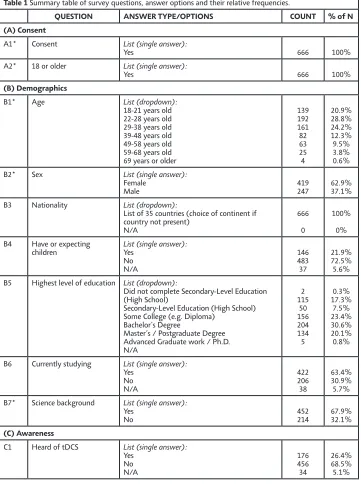
The study sample comprised of 666 completed questionnaires. There were more female (62.9%) than male (37.1%) respondents. About half (49.7%) were aged between 18 and 28 years old, the most common age bracket being 22-28 years old (28.8%), as might be expected with the majority of survey recipients being students at the university. The relative frequency decreased with the ascending age bracket. Most respondents were Irish nationals (77.2%). All other stated nationalities were widely dispersed and the next most recurring nationalities were U.K. (6.2%), U.S.A (3.0%) and Germany (1.5%). About two-thirds were currently studying (63.4%). Nearly all respondents completed at least Secondary-Level Education (98.9%) and about half indicated to hold a Master’s degree or higher (50.7%). The majority (67.9%) stated that their education to date contained a background in science. Most do not have or are expecting children (72.5%).
Awareness and Experience
electroconvulsive therapy (69.4%) and deep brain stimulation (43.8%) were more commonly heard of, followed by TMS (28.5%) and tDCS (26.4%) among others. In terms of experience with neurostimulation, only very few indicated to have worked with tDCS (1.5%) or another neurostimulation technique (5.9%), the most common being electroconvulsive therapy, TMS and tACS. Twenty-six respondents (3.9%) had previously undergone tDCS as part of a research project and only two (0.3%) indicated that they had previously self-stimulated with tDCS at home. A small proportion (4.7%) had undergone another neurostimulation technique before, mostly TMS, rTMS and tACS.
Opinions on Potential Use – for Treatment
Concerning their opinion of the potential use of tDCS for themselves or their immediate family, the majority indicated that they were happy to avail of it as a treatment option for a neurological disorder (85.9%) as well as for a psychiatric disorder (73.9%). Comments for these two questions (150 and 153 respectively) are summarised with examples in the Supplementary Material (Table A). Overall, respondents were happy to avail of tDCS as a treatment option, but this was often conditional to their concerns over effectiveness, safety or lack of knowledge among others. In the comment for psychiatric disorders, 12 independent references to electroconvulsive therapy were identified.
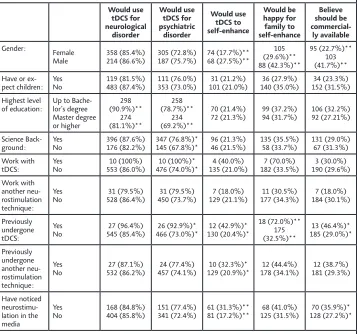
Level of education associated significantly with responses in this section (see Table
2). Respondents with a Master’s degree or higher were less likely than those holding a
level of education up to a Bachelor’s degree to potentially avail of tDCS for a neurological (81.1% and 90.9%) or psychiatric (69.2% and 78.7%) disorder (both p<0.01). A background in science was associated with an increase in the proportion of respondents that would use tDCS for a psychiatric disorder (76.8% and 67.8%) than those that do not have a background in science (p<0.05). Experience with tDCS also significantly increased the proportion of respondents that would use tDCS for a psychiatric disorder in terms of working with tDCS or having previously undergone it (both p<0.05).
Seven options were given on what would increase the likelihood of respondents to avail of tDCS as a treatment option, and up to three could be selected. The most commonly chosen answer, selected by 67.7%, was ‘once more research and clinical trials
are done’, followed by ‘after a thorough debrief on the mechanisms of action’(53.8%) and ‘if all tDCS medical devices are regulated by a body’ (40.4%). From the other options, 34.8% selected ‘if GP recommended or prescribed it’, followed by ‘if someone
else I know was using it/more embedded in clinical health care’ (28.7%), ‘if it was only used under supervision’ (22.5%) and finally ‘as a last resort/if no other treatment has worked’ (15.6%) (see Fig. 2). In keeping with this, 79.9% indicated that they would look
for an approval stamp from a regulatory body on their medical tDCS device.
On average, the respondent’s opinion about the minimum age of children to receive tDCS as a treatment option was 14.36 years (±5.1 SD). There were peaks at ages 12, 16 and 18 (Fig. 4a).
When questioned about their hypothetical treatment preference (assuming same effectiveness), 41.6% chose ‘daily treatment of tDCS for 5 days at home’, 36.8%
chose ‘daily treatment of tDCS for 5 days at GP/hospital’ and 21.6% would rather receive ‘daily treatment of medication for 4 weeks’. This is a cumulative percentage of
[image:8.432.192.362.369.493.2]78.4% that would rather receive tDCS treatment over conventional medication, assuming treatment is much shorter and as effective.
Fig. 2 FACTORS THAT WOULD INCREASE LIKELIHOOD OF POTENTIAL tDCS USE. Respondents could choose up to three of the seven option (six option for tDCS as enhancement).
[image:9.432.90.347.317.493.2]Opinions on Potential Use – for Enhancement
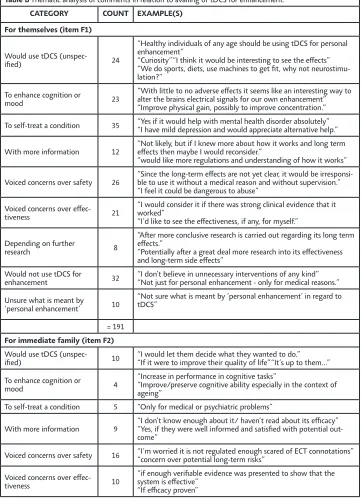
Respondents were asked their opinion on the potential use of tDCS as an enhancement device. Around one quarter of respondents indicated that they would be happy to avail of tDCS for themselves (21.3%) or their immediate family (29.0%). Potential tDCS usage for enhancement was lower compared to potential use of tDCS for therapy (Fig. 3). The comments recorded for these two questions (191 and 103 respectively) were summarised in the Supplementary Material (Table B). The most commonly stated reasons for using tDCS as an enhancement for themselves were for self-treatment of health problems such as depression and pain management, followed by improving or preserving cognitive functions such as concentration and memory. Numerous comments raised concerns over the use of tDCS for personal enhancement and many believed it should be reserved for treatment.
Male respondents were significantly more likely than female respondents to indicate that they would use tDCS for personal enhancement (27.5% and 17.7%) and that they would be happy if their immediate family used tDCS for personal enhancement (42.3% and 29.6%) (both p<0.01). Having previously undergone tDCS was also associated with an increased percentage of respondents being happy to avail of tDCS for enhancement for themselves (42.9% and 20.4%, p<0.05) or their families (72.0% and 32.5%, p<0.001). In keeping with this, respondents with direct experience with any neurostimulation technique were more likely to indicate that they would use tDCS for self-enhancement (p<0.05). Even merely having noticed neurostimulation being covered in the media increased the proportion of respondents willing to use tDCS for self-enhancement (31.3% and 17.2%) (p<0.001). See Table 2 for a full list of frequency distributions.
The order of importance in the factors determining the decision of whether or not to potentially use tDCS for personal enhancement were largely the same compared to the previous section. ‘Safety’was the most important factor for 74.8% of respondents, ‘effectiveness’ was rated second by 58.4%, ‘price’third by 44.6% and ‘ease of use/convenience’was indicated as being the least important by 55.3% (Fig. 1b).
Most respondents would be more likely to avail of tDCS for personal enhancement ‘once more research is done’ (71.0%), which is also in keeping with the previous section. For personal enhancement, however, the second most selected answer was ‘if tDCS
device was strictly regulated by a body’ (52.3%), which was followed by ‘after a thorough debrief on the mechanisms of action’ (42.0%) (see Fig. 2).
by 2.9 years (±4.5 SD) when compared with the suggested minimum age for tDCS for treatment (t574=15.25, p<0.001). The most frequently recommended age was 18 with smaller peaks at 16 and 21 (Fig. 4a). Respondent were additionally asked to indicate whether they think tDCS or other neurostimulation techniques should eventually be implemented into the education system. Only a small proportion of respondents were in favour (14.6%) (Fig. 4b).
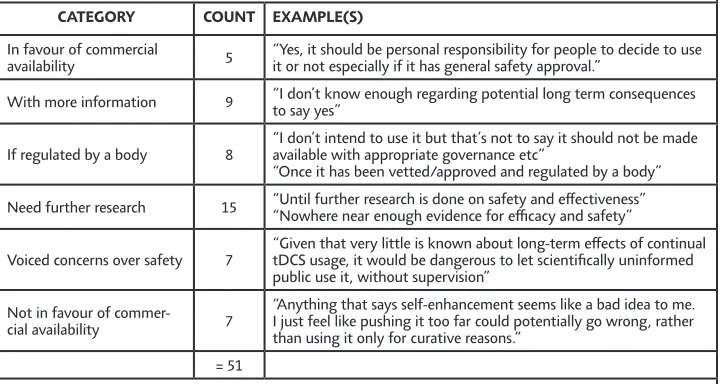
Over two-thirds of respondents (70.3%) indicated that tDCS should not be commercially available to the public as it stands (Fig. 4c). Male respondents (41.7%) were significantly more likely than female respondents (22.7%) to be in favour of commercial availability (p<0.01). Having previously undergone tDCS or noticed neurostimulation being covered in the media also increased this proportion (both p<0.05) (see Table 2). Comments (N=51) for this question are summarised thematically in the Supplementary
Material (Table C). In keeping with previous answers and comments offered so far, many
Fig. 4 tDCS AS A PERSONAL ENHANCEMENT DEVICE. a) The average suggested minimum age of children to receive tDCS is higher when used for enhancement than for treatment with a considerable peak at age 18 (** = p<0.001). b) Respondents were generally not in favour of eventually implementing tDCS in the education system and c) most do not believe that tDCS should be commercially available at this point.
Media
There has been sharp increase in the amount of publicly available information on tDCS and other neurostimulation techniques (Dubljević et al. 2014; Racine et al. 2007). Respondents indicated that they had noticed coverage on neurostimulation in the media in print or digital articles (20.7%), slightly less commonly in radio or televised documentaries (10.7%) and televised, digital or print news reports (10.2%); 70.4% indicated that they had not noticed this topic in the media. Most of the coverage was reported to be portraying neurostimulation in a positive (17.0%) or neutral (11.1%) light and 3.8% indicated that it was portrayed negatively, however, most respondents did not express any observation (68.1%). When pooling those respondents that had noticed neurostimulation in the media, there was a significant association between respondents willing to use tDCS for self-enhancement (p<0.001) and being in favour of its commercial sale (p<0.05).
Discussion
Opinions on Potential Use
The idea of availing of non-invasive electrical neurostimulation technique such as tDCS for the treatment of a disorder seems to be received favourably, despite the fact that most respondents had not heard of it before and merely relied on the basic information supplied by the questionnaire. When making a hypothetical treatment choice, more than three quarters favoured tDCS over medication, assuming treatment was as effective and much shorter. Of those, about half would prefer supervised use of tDCS at their GP/hospital and the other half would prefer treatment at home. However, ‘convenience’ was, by and large, rated as least important in light of other factors. Respondents were more inclined towards the use of tDCS for a neurological disorder than a psychiatric disorder, but the proportion for the latter was significantly different relative to educational background and experience with tDCS, though never above that of neurological disorders. Having previously undergone tDCS appeared to favour potential use of tDCS across the board.
Overall, the perception of the sample surveyed in this study is that research into tDCS and other non-invasive neurostimulation techniques has real-world value and warrants further investigation. The concerns raised over the use of tDCS reflect those from a recent international survey on 265 tDCS researchers (Riggall et al. 2015). In a clinical context, the need for further research was the most reported issue voiced by expert respondents, also the prime determinant in the current study, followed by issues over safety and effectiveness, which were the two most recurring concerns in this paper as well. Despite the difference in expertise, the wider community appears to share the opinion that more studies and clinical trials are needed at this time. From the outlook of a patient, this means forfeiting to a more extended research-to-product timeline. It would be interesting to record the opinions from a patient population with regards to this issue.
‘enhancement’ we are referring to the enhancement of a cognitive function in an otherwise healthy person.)
Opinions on the use of tDCS in children were also context-driven. This is reflected in the suggested minimum age, which was significantly higher by 2.9 years (±4.5 SD) for enhancement compared to a clinical context. In keeping with this, only few respondents (15%) indicated that they would like to see tDCS implemented in the educational system. Cognitive enhancement in otherwise healthy children is a popular topic across media articles and has been touched on by the scientific community (Cohen Kaosh et al. 2012, Rajapakse and Kirton 2013). The idea is that better mathematical skills in children can be related to their professional success and wider benefits to society. While neurostimulation in children is feasible and tolerable with adjusted parameters of stimulation (Riggall et al. 2015), there are naturally more risks involved when working with immature brains, at least with current gaps of knowledge, such as unknown (side-) effects and dosage (Davis 2014).
In particular with regards to tDCS for enhancement, respondents from this survey, as well as the survey by Riggall et al. (2015), raised concerns over safety. Many deemed it an unnecessary intervention for otherwise healthy persons. While methods such as tDCS are termed and considered non-invasive in the sense that body tissue is never visibly penetrated, it can induce activity spread to the wider neuronal network (Lang et al. 2005) and thus introduce the possibility of modulating unintended functions (Davis and Koningsbruggen 2013). It has been argued that the desire to maximise effects on one domain might indeed come at a cost on another domain (i.e. “zero-sum”) due to the balancing of metabolic consumption of finite neuronal resources (Brem et al. 2014). For example, Iuculano and Cohen Kadosh (2013) found a double dissociation between performance on subsets of a cognitive task and stimulation site, indicating that enhancement indeed might come with some mental costs. While this might be trivial when there is a clinical gain, it could render the act of self-enhancement futile. Either way, we cannot expect a uniform benefit from a neurostimulation technique that has been found to induce sustained and widespread changes in neuronal activity and cerebral blood flow (Lang et al. 2005).
The prevalence of side effects is low when practised within the normal limits (current densities ranging between 0.02 and 0.1 mA/cm2), but, at the same time, safety of tDCS
tDCS researchers (Riggall et al. 2015), which is not surprising given the paucity of studies into long-term effects and the lack of standardised tDCS application guidelines.
tDCS and the Media
Dubljević et al. (2014) recently analysed publicly available articles on tDCS and found a clear overemphasis on enhancement in print media when compared to the primary focus on therapeutic or investigative uses of tDCS in the academic literature. Its capabilities were often hyperbolised with ethical and safety issues largely unaddressed. Most of the respondents of this university-wide survey exhibited a considerable amount of scepticism when presented with some sensationalised extracts from recently published articles, regarding them premature or indeed impossible to attain. The rest indicated that they would question the source and merely 1% of respondents felt happy to accept such statements at face value. It seems that this sort of overenthusiasm generated by the media does to not wholly convince the majority when prompted. In fact, the majority of respondents agreed that hyperbolic statements could be damaging to the profile of tDCS, for which a multitude of reasons were offered with overinflated expectations at the forefront.
Comments on the Future of tDCS
There is a rapidly growing literature on the behavioural effects of tDCS in a laboratory setting. This in itself is indicative of a promising field. An issue imperative for the prospective implementation of tDCS is the translation from simple isolated effects in the laboratory to meaningful behaviour changes in more complex environments. Populations tested should span a wide range of ages and background, not unlike the community sample surveyed in this study. However, there remains a lack of clarity regarding the physiological mechanisms underlying tDCS, both from animal models through to assessment of the human physiology literature. There appears to be an imminent shift in research focus following recently uncovered large inter-subject and -session variability (Wiethoff et al. 2014; Horvath et al. 2014; Ziemann and Siebner 2015; Horvath et al. 2015). Systematically identifying and leveraging sources of heterogeneity constitutes a great opportunity to generate more robust tDCS effects and to establish its ecological validity.
It seems that drawing up specific policies or any official accreditation of non-invasive neurostimulation devices for commercial sale is premature at this time. Over two-thirds of lay respondents (70.3%) believe that tDCS should not be available to the public, nearly the same proportion (71%) reported from the expert community (Riggall et al. 2015). Only 5 of the comments offered for this question were directly in favour of the commercial sale of tDCS. Most expressed reservations due to a lack of sufficient research, information or regulation. Outside of supervised off-label treatment (Fregni et al. 2014), any ongoing commercial distribution of tDCS devices should be halted as a simple and conservative action until further systematic research is done. The responder/ non-responder ratio has been reported to be as high as 0.5 (Wiethoff et al. 2014), which, coupled with inflated expectations, could result in misuse. In the best-case scenario this may mean a waste of the consumer’s money, but could also result in somebody getting hurt. ‘Dosage’ of tDCS has not yet been appropriately established with the same rigour as pharmacological dosage. Of course, any policy implementations cannot prevent its wider use, such as that by do-it-yourself-tDCS users (Fitz and Reiner 2013), again, highlighting the need for standardised tDCS application guidelines that already exist for other neurostimulation techniques.
Limitations of the Study
Trinity College Dublin, most of them with a background in science. Opinions may change with respect to the generic population, such as a wider distribution of ages, education and regions, or patient groups who require treatment for a disorder. Future studies could explore opinions of neurostimulation use across these different communities. The final response rate was relatively low for this study, but it should be noted that recipients were a general and non-selective population and that e-mail surveys are invariably associated with lower response rates (Cook et al. 2000). At the same time, those recipients that took part in the survey may already have held an interest in the topic, which might add response bias to the survey data. That most of the respondents had not previously heard of tDCS or another neurostimulation technique, however, reduces the likelihood of any preconceptions influencing their responses.
Conclusion
References
Brem, A.-K., P.J. Fried, J.C. Horvath, E.M. Robertson et al. 2014. “Is Neuroenhancement by Noninvasive Brain Stimulation a Net Zero-Sum Proposition?” NeuroImage 85 (3):1058–1068.
Brunoni, A.R., M.A. Nitsche, N. Bolognini, M. Bikson et al. 2012. “Clinical Research with Transcranial Direct Current Stimulation (tDCS): Challenges and Future Directions.”
Brain Stimulation 5: 175–195.
Cohen Kadosh, R., N. Levy, J. O’Shea, N. Shea et al. 2012. “The Neuroethics of Non-Invasive Brain Stimulation.” Current Biology 22:108–111. doi: 10.1016/j. cub.2012.01.013.
Cook, C., F. Heath, and R.L. Thompson. 2000. “A Meta-Analysis of Response Rates in Web- or Internet-Based Surveys.” Educational and Psychological Measurement 60: 821–836.
Davis, N.J. 2013. “Neurodoping: Brain Stimulation as a Performance-Enhancing Measure.”
Sports Medicine 43 (8): 649–653. doi: 10.1007/s40279-013-0027-z.
Davis, N.J. 2014. “Transcranial Stimulation of the Developing Brain: A Plea for Extreme Caution.” Frontiers in Human Neuroscience 8:600. doi: 10.3389/fnhum.2014.00600. Davis, N.J., and M.G. van Koningsbruggen. 2013. “‘Non-Invasive’ Brain Stimulation
is Not Non-Invasive.” Frontiers in Systems Neuroscience 7: 76. doi: 10.3389/ fnsys.2013.00076.
Dubljević, V., V. Saigle, and E. Racine. 2014. “The Rising Tide of tDCS in the Media and Academic Literature.” Neuron 82: 731–736. doi: 10.1016/j.neuron.2014.05.003. FDA. 2012. “Petitions to Request Change in Classification for Cranial Electrotherapy
Stimulators.” U.S. Food and Drug Administration meeting of the Neurologic Devices
Panel.
Fitz, N.S., and P.B. Reiner. 2013. “The Challenge of Crafting Policy for Do-It-Yourself Brain Stimulation.” Journal of Medical Ethics 41:410–412. doi: 10.1136/ medethics-2013-101458.
Fregni, F., M.A. Nitsche, C.K. Loo, A.R. Brunoni et al. 2014. “Regulatory Considerations for the Clinical and Research Use of Transcranial Direct Current Stimulation (tDCS): Review and Recommendations from an Expert Panel.” Clinical Research and
Fritsch, B., J. Reis, K. Martinowich, H.M. Schambra et al. 2010. “Direct Current Stimulation Promotes BDNF-Dependent Synaptic Plasticity: Potential Implications for Motor Learning.” Neuron 66: 198–204.
Hamilton, R., S. Messing, and A. Chatterjee. 2011. “Rethinking the Thinking Cap: Ethics of Neural Enhancement Using Noninvasive Brain Stimulation.” Neurology 76: 187– 193.
Horvath, J.C., O. Carter, and J.D. Forte. 2014. “Transcranial Direct Current Stimulation: Five Important Issues We Aren’t Discussing (But Probably Should Be).” Frontiers in
Systems Neuroscience 8: 2. doi: 10.3389/fnsys.2014.00002.
Horvath, J.C., J.D. Forte, and O. Carter. 2015. “Quantitative Review Finds No Evidence of Cognitive Effects in Healthy Populations from Single-Session Transcranial Direct Current Stimulation (tDCS).” Brain Stimulation 8 (3): 535–550. doi: 10.1016/j. brs.2015.01.400.
Horvath, J.C., J.M. Perez, L. Forrow, F. Fregni et al. 2011. “Transcranial Magnetic Stimulation: A Historical Evaluation and Future Prognosis of Therapeutically Relevant Ethical Concerns.” Journal of Medical Ethics 37: 137–143. doi: 10.1136/ jme.2010.039966.
Iuculano, T., and R. Cohen Kadosh. 2013. “The Mental Cost of Cognitive Enhancement.”
Journal of Neuroscience 33: 4482–4486.
Kandel, M., J.M. Beis, L. Le Chapelain, H. Guesdon et al. 2012. “Non-Invasive Cerebral Stimulation for the Upper Limb Rehabilitation after Stroke: A Review.”. Annals of
Physical and Rehabilitation Medicine 55: 657–680.
Lang, N., H.R. Siebner, N.S. Ward, L. Lee et al. 2005. “How Does Transcranial DC Stimulation of the Primary Motor Cortex Alter Regional Neuronal Activity in the Human Brain?” European Journal of Neuroscience 22: 495–504.
López-Alonso, V., B. Cheeran, D. Río-Rodríguez, and M. Fernández-del-Olmo. 2014. “Inter-Individual Variability in Response to Non-Invasive Brain Stimulation Paradigms.”
Brain Stimulation 7: 372–380.
Maher, B.. 2008. “Poll Results: Look Who’s Doping.” Nature 452: 674–675.
Nitsche, M.A., and W. Paulus. 2000. “Excitability Changes Induced in the Human Motor Cortex by Weak Transcranial Direct Current Stimulation.” Journal of
Poreisz, C., K. Boros, A. Antal, and W. Paulus. 2007. “Safety Aspects of Transcranial Direct Current Stimulation Concerning Healthy Subjects and Patients.” Brain Research
Bulletin 72: 208–214.
Priori, A., A. Berardelli, S. Rona, N. Accornero et al. 1998. “Polarization of the Human Motor Cortex through the Scalp.” Neuroreport 9: 2257–2260.
Racine, E., S. Waldman, N. Palmour, D. Risse et al. 2007. “Currents of Hope: Neurostimulation Techniques in U.S. and U.K. Print Media.” Cambridge Quarterly of
Healthcare Ethics 16: 312–316.
Rajapakse, T., and A. Kirton. 2013. “Non-Invasive Brain Stimulation in Children: Applications and Future Directions.” Translational Neuroscience 4 (2): 10.2478/ s13380-13013-10116-13383.
Riggall, K., C. Forlini, A. Carter, W. Hall et al. 2015. “Researchers’ Perspectives on Scientific and Ethical Issues with Transcranial Direct Current Stimulation: An International Survey.” Scientific Reports 5: 10618. doi: 10.1038/srep10618.
Rosset-Llobet, J., S. Fabregas-Molas, and A. Pascual-Leone. 2014. “Transcranial Direct Current Stimulation Improves Neurorehabilitation of Task-Specific Dystonia: A Pilot Study.” Medical Problems of Performing Artists 29: 16–18.
Rossi, S., M. Hallett, P.M. Rossini, A. Pascual-Leone et al. 2009. “Safety, Ethical Considerations, and Application Guidelines for the Use of Transcranial Magnetic Stimulation in Clinical Practice and Research.” Clinical Neurophysiology 120: 2008– 2039.
Sehm, B., and P. Ragert. 2013 “Why Non-Invasive Brain Stimulation Should Not be Used in Military and Security Services.” Frontiers in Humam Neuroscience 7: 553.
Shin, Y.-I., Á. Foerster, and M.A. Nitsche. 2015. “Transcranial Direct Current Stimulation (tDCS) – Application in Neuropsychology.” Neuropsychologia 69: 154–175.
Wassermann, E.M. 1998. “Risk and Safety of Repetitive Transcranial Magnetic Stimulation: Report and Suggested Guidelines from the International Workshop on the Safety of Repetitive Transcranial Magnetic Stimulation, June 5-7 1996.”
Electroencephalography and Clinical Neurophysiology 108: 1–16.
Ziemann, U., W. Paulus, M.A. Nitsche MA, A. Pascual-Leone et al. 2008. “Consensus: Motor cortex Plasticity Protocols.” Brain Stimulation 1: 164–182. doi: 10.1016/j. brs.2008.06.006.
Ziemann, U. and H.R. Siebner. 2015. “Inter-Subject and Inter-Session Variability of Plasticity Induction by Non-Invasive Brain Stimulation: Boon or Bane?” Brain
Stimulation 8 (3): 662–663. doi: 10.1016/j.brs.2015.01.409.
Table 1 Summary table of survey questions, answer options and their relative frequencies.
QUESTION ANSWER TYPE/OPTIONS COUNT % of N (A) Consent
A1* Consent List (single answer):
Yes 666 100%
A2* 18 or older List (single answer):
Yes 666 100%
(B) Demographics
B1* Age List (dropdown):
18-21 years old 22-28 years old 29-38 years old 39-48 years old 49-58 years old 59-68 years old 69 years or older
139 192 161 82 63 25 4 20.9% 28.8% 24.2% 12.3% 9.5% 3.8% 0.6%
B2* Sex List (single answer):
Female
Male 419247 62.9%37.1%
B3 Nationality List (dropdown):
List of 35 countries (choice of continent if country not present)
N/A
666 0
100% 0% B4 Have or expecting
children List (single answer):Yes No N/A 146 483 37 21.9% 72.5% 5.6% B5 Highest level of education List (dropdown):
Did not complete Secondary-Level Education (High School)
Secondary-Level Education (High School) Some College (e.g. Diploma)
Bachelor’s Degree
Master’s / Postgraduate Degree Advanced Graduate work / Ph.D. N/A 2 115 50 156 204 134 5 0.3% 17.3% 7.5% 23.4% 30.6% 20.1% 0.8%
B6 Currently studying List (single answer):
Yes No N/A 422 206 38 63.4% 30.9% 5.7% B7* Science background List (single answer):
Yes
No 452214 67.9%32.1%
(C) Awareness
C1 Heard of tDCS List (single answer):
C2 Heard of any other
neuro-stimulation technique Multiple choice:transcranial magnetic stimulation (TMS) repeated transcranial magnetic stimulation (rTMS)
transcranial alternating current stimulation (tACS)
transcranial pulsed current stimulation (tPCS) transcranial random noise simulation (tRNS) deep brain stimulation (DBS)
electro-convulsive treatment (ECT)
190 69 56 33 28 292 462 28.5% 10.4% 8.4% 5.0% 4.2% 43.8% 69.4%
Other (open answer) 9 1.4%
C3 Work with tDCS List (single answer):
Yes No N/A 10 643 13 1.5% 96.5% 2.0% C4 Work with other
neuro-stimulation technique List (single answer):Yes No N/A 39 611 16 5.9% 91.7% 2.4%
If Yes, please specify (open answer) 44 6.6%
C5 Previously undergo tDCS Multiple choice:
Yes, as part of a research project Yes, I self-stimulated at home No 26 2 635 3.9% 0.3% 95.3% C6 Previously undergo
another neurostimulation technique
List (single answer):
Yes No N/A 31 617 18 4.7% 92.6% 2.7%
If Yes, please specify (open answer) 33 5.0%
(D) Background
D1* Read description of tDCS and tick if you have read text
List (single answer):
Yes 666 100%
(E) Opinions – treatment
E1* tDCS as treatment of
neurological disorder for
yourself or immediate family
List (single answer):
Yes
No 57294 85.9%14.1%
Comments (open answer) 150 22.5%
E2* tDCS as treatment of
psychiatric disorder for
yourself or immediate family
List (single answer):
Yes
No 492174 73.9%26.1%
Comments (open answer) 153 22.9%
E3 Min. age of children to
receive tDCS as treatment Numerical input:0-21 N/A avg. 14.36 (±5.1 SD) 44 93.4% 6.6% E4 Order of importance of
factors when deciding tDCS as treatment option
Ranking:
E5 Factors to increase likeli-hood to avail of tDCS as treatment option
Multiple choice (tick up to 3 answers):
after a thorough debrief of the mechanisms of action
if someone else I know was using it / more embedded in clinical health care
if GP recommended or prescribed it if it was only used under supervision if all tDCS medical devices are regulated by a body
as a last resort / if no other treatment has worked
once more research and clinical trials are done
358 191 232 150 269 104 451 53.8% 28.7% 34.8% 22.5% 40.4% 15.6% 67.7%
E6 Would look for industry approval stamp on tDCS device
List (single answer):
Yes No N/A 532 77 57 79.9% 11.6% 8.6% E7* Hypothetical choice
between treatment options (assuming same effectiveness)
List (single answer):
daily treatment of medication for 4 weeks daily treatment of tDCS for 5 days at home daily treatment of tDCS for 5 days at GP/hos-pital 144 277 245 21.6% 41.6% 36.8%
(F) Opinions – commercial
F1 tDCS as potential per-sonal enhancement for yourself
List (single answer):
Yes No N/A 142 461 63 21.3% 69.2% 9.5%
If Yes, please specify (open answer) 191 28.7%
F2 tDCS as potential per-sonal enhancement for immediate family
List (single answer):
Yes No N/A 193 369 104 29.0% 55.4% 15.7%
Comments (open answer) 103 15.5%
F3 Min. age of healthy children to receive tDCS for enhancement Numerical input: 0-21 N/A avg. 17.37 (±2.8 SD) 80 88.0% 12.0% F4 tDCS to eventually be
im-plemented into education system
List (single answer):
Yes No N/A 97 420 149 14.6% 63.1% 22.4% F5 Order of importance of
factors when deciding tDCS as potential person-al enhancement
Ranking:
price effectiveness
ease of use / convenience safety N/A 3rd: 297 2nd: 388 4th: 368 1st: 498 60 44.6% 58.4% 55.3% 74.8% 9.0% F6 Factors to increase
likelihood to avail of tDCS as potential personal enhancement
Multiple choice (tick up to three answers):
after a thorough debrief of the mechanisms of action
if someone else I know was using it if circumstances required it if it was only used under supervision if your tDCS device was strictly regulated by a body
once more research is done
F7* tDCS to be commercially
available to public List (single answer):Yes
No 198468 29.7%70.3%
Comments (open answer) 51 7.7%
(G) Media
G1 Noticed neurostimulation
in media Multiple choice:Yes, in the news (TV, broadsheet, radio, inter-net)
Yes, in articles (magazines, internet) Yes, in a documentary (TV, radio) No 68 138 71 469 10.2% 20.7% 10.7% 70.4%
G2 Portrayal in the media List (single answer):
positive neutral negative N/A 113 74 25 454 17.0% 11.1% 3.8% 68.1% G3 Would have accepted
these extracts of sensa-tionalized statements about neurostimulation made by media if read yesterday
List (dropdown):
Yes
Yes, depending on the source/newspaper/ channel
No, it is too early to make those statements No, these are impossible statements N/A 8 125 403 118 12 1.2% 18.8% 60.5% 17.7% 1.8%
G4 Sensationalized state-ments to damage profile of tDCS
List (single answer):
Yes No N/A 471 98 97 70.7% 14.7% 14.6%
Comments (open answer) 155 23.3%
Table 2 Comparison of frequency distributions by respondents’ background and experience with neurostimulation. Would use tDCS for neurological disorder Would use tDCS for psychiatric disorder Would use tDCS to self-enhance Would be happy for family to self-enhance Believe should be commercial-ly available Gender: Female
Male 358 (85.4%)214 (86.6%) 305 (72.8%)187 (75.7%) 74 (17.7%)**68 (27.5%)**
105 (29.6%)** 88 (42.3%)** 95 (22.7%)** 103 (41.7%)** Have or
ex-pect children: YesNo 119 (81.5%)483 (87.4%) 111 (76.0%)353 (73.0%) 101 (21.0%)31 (21.2%) 140 (35.0%)36 (27.9%) 152 (31.5%)34 (23.3%) Highest level
of education: Up to Bache-lor’s degree Master degree or higher 298 (90.9%)** 274 (81.1%)** 258 (78.7%)** 234 (69.2%)** 70 (21.4%)
72 (21.3%) 99 (37.2%)94 (31.7%) 106 (32.2%)92 (27.21%)
Science
Back-ground: YesNo 396 (87.6%)176 (82.2%) 347 (76.8%)*145 (67.8%)* 96 (21.3%)46 (21.5%) 135 (35.5%)58 (33.7%) 131 (29.0%)67 (31.3%) Work with
tDCS: YesNo 553 (86.0%)10 (100%) 476 (74.0%)*10 (100%)* 135 (21.0%)4 (40.0%) 182 (33.5%)7 (70.0%) 190 (29.6%)3 (30.0%) Work with
another neu-rostimulation technique:
Yes
No 528 (86.4%)31 (79.5%) 450 (73.7%)31 (79.5%) 129 (21.1%)7 (18.0%) 177 (34.3%)11 (30.5%) 184 (30.1%)7 (18.0%)
Previously undergone tDCS:
Yes
No 545 (85.4%)27 (96.4%) 466 (73.0%)*26 (92.9%)* 130 (20.4%)*12 (42.9%)*
18 (72.0%)** 175 (32.5%)** 13 (46.4%)* 185 (29.0%)* Previously undergone another neu-rostimulation technique: Yes
No 532 (86.2%)27 (87.1%) 457 (74.1%)24 (77.4%) 129 (20.9%)*10 (32.3%)* 178 (34.1%)12 (44.4%) 181 (29.3%)12 (38.7%)
Have noticed neurostimu-lation in the media
Yes
No 168 (84.8%)404 (85.8%) 151 (77.4%)341 (72.4%) 61 (31.3%)**81 (17.2%)** 125 (31.5%)68 (41.0%) 128 (27.2%)*70 (35.9%)*
Displayed are number of responses per category (and % of total N) and significance values from Pearson’s Chi-Square. Please note that not all questions were mandatory, hence total N may vary across questions. Responses for ‘highest level of education’ (item B5), ‘previously undergone tDCS’ (item C5) and ‘have noticed tDCS in the media’ (item G1) were pooled such as to create binary answers.
Supplementary Material
Table A Thematic analysis of comments in relation to availing of tDCS for treatment. CATEGORY COUNT EXAMPLE(S)
For neurological disorder (item E1)
Would use tDCS 19
“It seems quite safe with no observable side-effects which may cause harm (as of yet), therefore I don’t know why I would not.” “Since there are no immediate side effects I think the benefits far outweigh the potential risks.”
Only for themselves, not
for family 11 “Yes for myself not sure about my children or family”“For myself, maybe not for my children”
With more information 25 “Once I had reviewed sufficient literature, I fully understood the process and side effects and I could make an informed decision.” “Following further reading up on the treatment and its side effects.”
If appropriate or
recom-mended 25
“I believe I would if it were part of a treatment that was well man-aged professionally and if it was recommended.”
“If something would help me or my family after a stroke, it’s worth a try.”
Voiced concerns over safety 19
“There may be issues with longtime effects on normal brain func-tion.”
“Not for children, has there been any research showing it is safe for children while they are still developing?”
Voiced concerns over
effec-tiveness 15
“The evidence for the efficacy of tDCS seems not as strong as the fanfare surrounding it would imply.”
“Not particularly worried about harmful effects but seriously doubt it’s efficacy given present evidence”
More research is needed 25 “I am very interested in this method of treatment but would only wish to participate once trial stage was over and technique was proven to work, and side effects were known to the fullest.”
Would use reluctantly (if necessary or despite
concerns) 9
“Not without understanding the need and being convinced that it was a necessary treatment.”
“Only if the disorder was causing a huge impairment in my quality of life - i.e. if the risk of the unknown was worth it”
Would not use tDCS at all 2 “I think we don’t know enough how the brain works”“because there is no research on the long term effects of the thera-py”
= 150
For psychiatric disorder (item E2)
Would use tDCS 13 “Seems a pretty mild treatment in comparison to a lot of medication used.” “The wide safety margin on a short term basis is reassuring” Only for themselves, not
for family 9 “Less likely for family.”“Only for myself.”
With more information 18
“I would want to do more research/find out more before actually availing of it.”
If appropriate or
recom-mended 17
“So long as it was accompanied by suitable psychotherapy. And recommended as adjunct therapy by the psychologist.”
“If it was recommended by my doctor, based on the best available evidence”
Voiced concerns over safety 19 “Still nervous about side effects but think this is where it would be useful” “we are still unsure of long term side effects”
Voiced concerns over
effec-tiveness 20
“Instinctively less likely to believe that these are disorders treatable with this technique.”
“Only if there is a proven benefit”
More research is needed 22 “Yes but after a lot more research has been done.”“I would reconsider my position when long term effects of tDCS have been investigated”
Would use reluctantly (if necessary or despite
concerns) 18
“While I would undergo the treatment, I would be hesitant of such a dramatic approach. I would probably only avail of tDCS after trying other methods of treatment first.”
Would not use tDCS at all 17
“Less likely to avail of this as it reads as a toned-down version of electro shock treatment!”
“I’m not entirely convinced that electronic stimulation of the brain is a feasible long-term treatment option for depression or addiction issues.”
= 153
Mentioned ECT in
com-ments 12
“Would need persuasion that it was different from ECT. ECT has such a bad reputation”
“It harks back to shock treatment where they used to electrocute patients in asylums. I think gentler forms of treatment, such as therapy would be better”
Table B Thematic analysis of comments in relation to availing of tDCS for enhancement. CATEGORY COUNT EXAMPLE(S)
For themselves (item F1)
Would use tDCS
(unspec-ified) 24
“Healthy individuals of any age should be using tDCS for personal enhancement”
“Curiosity” “I think it would be interesting to see the effects” “We do sports, diets, use machines to get fit, why not neurostimu-lation?”
To enhance cognition or
mood 23
“With little to no adverse effects it seems like an interesting way to alter the brains electrical signals for our own enhancement” “Improve physical gain, possibly to improve concentration.”
To self-treat a condition 35 “Yes if it would help with mental health disorder absolutely”“I have mild depression and would appreciate alternative help.”
With more information 12 “Not likely, but if I knew more about how it works and long term effects then maybe I would reconsider.” “would like more regulations and understanding of how it works”
Voiced concerns over safety 26 “Since the long-term effects are not yet clear, it would be irresponsi-ble to use it without a medical reason and without supervision.” “I feel it could be dangerous to abuse”
Voiced concerns over
effec-tiveness 21
“I would consider it if there was strong clinical evidence that it worked”
“I’d like to see the effectiveness, if any, for myself.”
Depending on further
research 8
“After more conclusive research is carried out regarding its long term effects.”
“Potentially after a great deal more research into its effectiveness and long-term side effects”
Would not use tDCS for
enhancement 32 “I don’t believe in unnecessary interventions of any kind”“Not just for personal enhancement - only for medical reasons.”
Unsure what is meant by
‘personal enhancement’ 10
“Not sure what is meant by ‘personal enhancement’ in regard to tDCS”
= 191
For immediate family (item F2)
Would use tDCS
(unspec-ified) 10 “I would let them decide what they wanted to do.” “If it were to improve their quality of life” “It’s up to them...”
To enhance cognition or
mood 4
“Increase in performance in cognitive tasks”
“Improve/preserve cognitive ability especially in the context of ageing”
To self-treat a condition 5 “Only for medical or psychiatric problems”
With more information 9 “I don’t know enough about it/ haven’t read about its efficacy”“Yes, if they were well informed and satisfied with potential out-come”
Voiced concerns over safety 16 “I’m worried it is not regulated enough scared of ECT connotations”“concern over potential long-term risks”
Voiced concerns over
effec-tiveness 10
“if enough verifiable evidence was presented to show that the system is effective”
Depending on further
research 11
“Outside of disease treatment, thorough research would need to show that long term use in children does not adversely affect cogni-tive development.”
Would not use tDCS for
enhancement 34
“I would strongly oppose it.” “Would only use for medical purposes/ improve health”
“I don’t think you should disrupt your brains normal functioning if its not necessary.”
Unsure what is meant by
‘personal enhancement’ 4 “Not sure what you mean here by personal enhancement” = 103
Table C Thematic analysis of comments in relation tDCS being available commercially (item F7). CATEGORY COUNT EXAMPLE(S)
In favour of commercial
availability 5 “Yes, it should be personal responsibility for people to decide to use it or not especially if it has general safety approval.”
With more information 9 “I don’t know enough regarding potential long term consequences to say yes”
If regulated by a body 8 “I don’t intend to use it but that’s not to say it should not be made available with appropriate governance etc” “Once it has been vetted/approved and regulated by a body”
Need further research 15 “Until further research is done on safety and effectiveness”“Nowhere near enough evidence for efficacy and safety”
Voiced concerns over safety 7 “Given that very little is known about long-term effects of continual tDCS usage, it would be dangerous to let scientifically uninformed public use it, without supervision”
Not in favour of
commer-cial availability 7
“Anything that says self-enhancement seems like a bad idea to me. I just feel like pushing it too far could potentially go wrong, rather than using it only for curative reasons.”
= 51
Table D Reporting of neurostimulation in the media.
Headlines from recent articles in the media reporting on tDCS shown to survey respondents (item G3)
“Electricity ups knack for numbers” (The Scientist, Nov 4, 2010)
“If your math skills aren’t exactly up to par, your doctor may soon give your brain a little extra jolt to take care of the problem.”
(www.healthline.com, May 16, 2013)
“You can ‘Change your mind’ by increasing energy in certain areas or reducing excess activity in others” (www.tdcs-kit.com, November 17, 2014)
“Brain injury victims are ‘zapped back to life’” (The Daily Mail, Feb 27, 2014)
“Electric medicine – start zapping, stop popping” (New Scientist, February 22, 2014)
“schoolchildren who struggle to grasp mathematics could benefit from having their brains roused with elec-tricity”
(The Guardian, April 11, 2010)
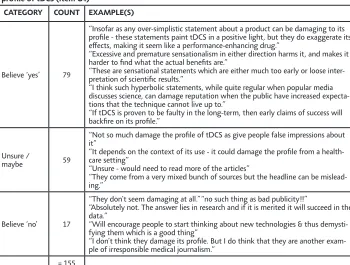
Thematic analysis of comments regarding whether sensationalised media statements could damage profile of tDCS (item G4)
CATEGORY COUNT EXAMPLE(S)
Believe ‘yes’ 79
“Insofar as any over-simplistic statement about a product can be damaging to its profile - these statements paint tDCS in a positive light, but they do exaggerate its effects, making it seem like a performance-enhancing drug.”
“Excessive and premature sensationalism in either direction harms it, and makes it harder to find what the actual benefits are.”
“These are sensational statements which are either much too early or loose inter-pretation of scientific results.”
“I think such hyperbolic statements, while quite regular when popular media discusses science, can damage reputation when the public have increased expecta-tions that the technique cannot live up to.”
“If tDCS is proven to be faulty in the long-term, then early claims of success will backfire on its profile.”
Unsure /
maybe 59
“Not so much damage the profile of tDCS as give people false impressions about it”
“It depends on the context of its use - it could damage the profile from a health-care setting”
“Unsure - would need to read more of the articles”
“They come from a very mixed bunch of sources but the headline can be mislead-ing.”
Believe ‘no’ 17
“They don’t seem damaging at all.” “no such thing as bad publicity!!”
“Absolutely not. The answer lies in research and if it is merited it will succeed in the data.”
“Will encourage people to start thinking about new technologies & thus demysti-fying them which is a good thing”
“I don’t think they damage its profile. But I do think that they are another exam-ple of irresponsible medical journalism.”
= 155