Journal of Criminal Law and Criminology
Volume 58 | Issue 2
Article 8
1967
Factors Associated with Adoption of the Inmate
Code: A Study of Normative Socialization
Charles Wellford
Follow this and additional works at:
https://scholarlycommons.law.northwestern.edu/jclc
Part of the
Criminal Law Commons
,
Criminology Commons
, and the
Criminology and Criminal
Justice Commons
This Article is brought to you for free and open access by Northwestern University School of Law Scholarly Commons. It has been accepted for inclusion in Journal of Criminal Law and Criminology by an authorized editor of Northwestern University School of Law Scholarly Commons.
Recommended Citation
Copyright @ 1967 by Northwestern University School of Law Printed in U.S.A.
FACTORS ASSOCIATED WITH ADOPTION OF THE INMATE CODE:
A STUDY OF NORMATIVE SOCIALIZATION
CHARLES WELLFORD
The author is currently a doctoral candidate in the Department of Sociology at the University of Pennsylvania, specializing in criminology. He is also Research Associate at the Institute of Cor-rections, American Foundation. He is the co-editor (with William E. Amos) of JTvenile Delinquency
Prevention, Theory anud Practice (1967).
The present paper describes the interrelationships between prisonization, length of sentence, and criminal social type-in an attempt to extend the understanding of the process of socialization in correctional communities. On the basis of research presented, the author concludes that linear and deprivational models are not adequate as descriptions, or explanations of the process, and that future research and theory must be directed by an integrative approach.
In recent years renewed and increased attention has been paid to institutions for criminal offenders by researchers, especially those from the field of sociology. It has been observed that:
The trend has been towards the study of these institutions in terms of general sociologi-cal theory, rather than in terms of social prob-lems, notably with reference to aspects of prison life commonly identified in the relevant literature as the inmate culture, the prisoner community, or the inmate social system' In line with this trend, this article represents an attempt to further the study of the prison com-munity, in terms of a more general theoretical and methodological frame of reference, and thus derive benefits from the application of more gen-eral sociological theories and interpretational models to this particular aspect of criminal reality. One concept that has received considerable at-tention in the studies of the prison community is that of "prisonization", a term introduced by Clemmer in his now classic study of inmate inter-action.2 By prisonization Clemmer meant "to in-dicate the taking on in greater or less degree of the folkways, mores, customs, and general culture of the penitentiary."' Lejins, in attempting to clarify this concept, has suggested the distinction between the concepts of institutionalization as a broader concept referring to the impact of the institutional stay in general (e.g., the impact of any "total"
Normative element of the culture of a penal and/or correctional institution (Inmate Code).
I Sykes & Messinger, Tie Inmate Social System, in THEoRETIcAL STiEs 3N SOCIAL ORGANIZATION OF THE
PRIsoN (New York: Social Science Research Council, 1960), p. 5.
2 Crx-zs , Ta PRISON CoimrNny (1940) (1958).
3Ibd. 299.
institution) and the concept of prisonization which refers to the specific impact of the penal and cor-rectional institutions for criminal offenders on their charges, over and above the impact which those institutions produce qua total institutions.4 In planning this study the need for a still further refinement of the concepts was felt. One particular aspect, specifically of the prison culture, stands out as an especially significant characteristic, that is the normative element, which is characteristic of any institution dealing with offenders. This norma-tive element generally stems from two sources: the conduct norms directed to the inmate by the ad-ministration, and the conduct norms of the in-mate community itself-the latter normally re-ferred to as the inmate code. These distinctions more accurately reflect the current usage and modifications of the term prisonization than does Clemmer's definition,5 and will therefore be uti-lized in this paper. Diagramatically this can be presented as in Figure 1.
The term inmate code will be used to refer to the adoption of the normative element of the inmate culture. In particular, this paper will report on a study that attempted to determine what factor or factors are most highly related to the degree of adoption of the inmate code by the inmate. THE INMATE CODE: AN OPERATIONAL DEFmToN
As indicated above, the inmate code is in actu-ality a series of conduct norms that define the
4 Peter P. Lejins; presented in class lectures, Univ. of Md., Fall 1962-63.
5For current definitional discussions see: SyxEs & MESSINGER, op. cit. supra note 1; OHLrN, SOCIOLOGY
AND um FIELD op CoRRECTIoN 28 (1956); Wheeler, Socialization in Correctional Communities, 24 Am.
CHARLES WELLFORD
FioiR 1
proper behavior for inmates. As it has been re-peatedly pointed out in the literature, this code, above all else, prescribes behavior that is contrary to the behavior patterns expected by the adminis-tration. The significant point is that adherence to the inmate code means rejection of the adminis-trative code of conduct. In contrast to the free community, where there are many ambiguities in value orientation, which allow the individual to fluctuate between general and specific conduct norms, in the prison the norms are mutually ex-clusive, in that the inmate must either behave in accordance with administrative rules or inmate rules.6
A survey of the literature indicates that the con-flict would seem to be greatest with regards to (1) reporting of rules violations by other inmates, (2) the value of treatment, (3) the value of work, (4) sex norms, (5) informing on escape plans and/or the possessor's of contraband, and (6) the value of group formation. To be more specific with regards to these seven (counting escape and contraband as separate areas) types of situations in which inmate and administration conduct codes conflict, it can
6 Cloward, Social Control in Prisons, THEORETICAL STUDIES IN SOCIAL ORGANIZATION OF TH PRISON
(New York: Social Science Research Council, 1960), p. 21.
be said that, at least theoretically, the administra-tion requires that the inmate (1) divulge any in-formation he has about another inmate's deviant behavior, (2) give support to the treatment facili-ties under the motivation of "bettering himself", (3) work diligently at each job assigned on the as-sumption that his work may prepare him for a future trade, (4) divulge any information he has on escape plans or the smuggling into the institution of goods or money, and (6) refrain from forming close associations with other inmates. The inmate code, as stated above, prescribes the opposite atti-tudes and behavior, with an emphasis on not in-forming, accepting treatment only as a means of impressing the staff, doing "easy time", satisfying sexual needs (particularly if the role played is that of the male), and emphasizing the need for inmate group formation in order to insure protection from the administration and other inmates.
The factors influencing the adoption of this set of normative standards have not been as unani-mously agreed upon. The remainder of this article will report on research that attempted to assess the relationship between variables, suggested in the literature as being highly correlated with the degree of adoption of the inmate code, and an actual measure of the degree of such adoption.
FACTORS RELATED TO DEGREE OF ADOPTION OF TIlE INMATE CODE
Previous theory and semi-emperical research have identified a variety of factors as being related to the degree of adoption of the inmate code. To be considered here are three of these that seem par-ticularly significant. These are length of sentence, phase of institutional career, and criminal social type.
Clemmer, using primarily the case study method identified a number of "determinants" of the de-gree of prisonization,7 including the length of sentence as being the major "determinant";8 that is, the longer the sentence the higher the de-gree of prisonization. As Garrity has observed,9 this would seem to grow out of an unstated com-mitment to Sutherland's differential association theory. The explanation of the effect of this vari-able is that the longer the exposure to the inmate
7 Clemmer, op. cit. supra note 2, at p. 301. 8 Ibid. 313.
9 Garrity, Effect of Length of Incarceration Upon Parole Adjustment and Estimation of Optimum Sen-tence (Unpublished Ph.D. Dissertation, University of
Washington, 1958).
code, the greater the likelihood that it will be in-corporated by the individual into his manner of living, because increased time and intensity will give it a more positive reinforcement value.
Stanton Wheeler, in an article that is particu-larly germaine to the present paper, offered a different factor, "phase of institutional career", as being most highly related to the degree of adoption of what is referred to in this study as the inmate code.10
This is a time factor, as is Clemmer's, but offers a different explanation of adoption of the inmate code. Wheeler determined, by the use of a group ad-ministered questionnaire, the degree of inmate code adoption for a sample of approximately two-hundred inmates of a state reformatory. He found that normative prisonization proceeded not only in a linear fashion, as Clemmer proposed, but also in a U shaped fashion"' when not length of sentence; how long the individual had been in the institu-tion in relainstitu-tionship to his perceived full sentence was the independent variable. Specifically, prisoni-zation was lowest during the early and late phases (six months or less after entering the institution and six months or less before leaving the institu-tion, respectively), and highest during the middle phase. The differences were statistically sig-nificant.2 This finding was explained in terms of the reasons why the inmate code develops. Wheeler felt the inmate code developed to mitigate the pains of imprisonment. He assumed, therefore, that it would be accepted to the greatest degree at that point where the prison experience was most acute, during the middle of the "institutional career". Glaser has since slightly reinterpreted WVheeler's findings, emphasizing that it is not the time factor, per se, that affects prisonization, but that the relationship between time and reference group orientation is important.3
Finally, Clarence Schrag has suggested (and partially demonstrated through research) that the variable "criminal social type" is related to an equivalent of what we are referring to as the degree of normative prisonization.4 By the use of
10 Wheeler, op. cit. supra note 5.
11 Ibid. 706.
"The point should be made that the significance
of Wheeler's findings are suspect as he used a stratified
disproportional random sample and then tested for significance with a nonparametric technique. For a criticism of this see BLALocK, SOCIAL STATISTICS
405 (1960).
13 Glaser, Measuring Inmate Change in Prison, TnE PRISON 381-392 (Cressey, Ed. 1961).
14 Schrag, Social Types in a Prison Community
the sociometric method, primarily, Schrag de-termined the various roles played by the inmates. He found the inmate community was comprised of a number of roles, all of which were not oriented to the inmate code (as previously defined). He also observed that these roles could be classified ac-cording to the inmate code, especially in the case of the roles called "right guy" and "square john". The right guy or anti-social inmates "perceive (role) requirements according to the norms of the prisoner society",15 or, in the terms of this paper, they are highly prisonized. By contrast, the square john or pro-social inmate "defines role requirements in terms of the prison's official social system",16 or, as herein defined, they are not normatively prisonized, or else significantly less so.
Consistent with his belief in the influences of the criminalistic subculture on the inmate code, Schrag places the determination of the criminal social type on the criteria of "career variables", with heavy emphasis on the extent of participation in criminal activities prior to commitment to the institution. The most prisonized inmate (the anti-social) is so because the conduct norms he has acquired from participation in the criminalistic subculture are those that are to be found as the basic tenets of the inmate code. As Garrity has stated:
From this analysis it became clear that time served affects inmates (on parole) in quite different ways. The differential effect is a prod-uct of the social background of the person, his attitudinal system, his philosophy of life, his value system, and the status and role he plays in prison.... Schrag's typology at-tempts to take each of these dimensions into account.7
The problem becomes one of determining the criteria to be used to establish which role an inmate is playing. This will be discussed in the next sec-tion. Schrag has not related this variable directly to prisonization, and, as will be seen later, the result has been an emphasis on the effects of the situation rather than the characteristics of the individual
(Unpublished Master's Thesis, University of Wash-ington, 1944); Crimnville: A Sociometric Study of a
Prison Community (Unpublished Ph.D. Dissertation,
Univ. of Wash., 1950); Leadership Among Prison
In-mates, 19 Am. Soc. Rv. 37-42 (1954); Toward A Unified Theory of Corrections, Tim PRIsoN 309-358
(Cressey, Ed., 1961).
1" Ibid. 347.
16
Ibid.
CHARLES WELLFORD
in explaining the degree of adoption of the inmate code.
The remainder of this article will describe a re-search project that attempted to quantify norma-tive prisonization, following Wheeler's technique, and relate this to a measurement of the three vari-ables discussed above.
RESEARCH DESIGN
The research was conducted in one of the insti-tutions serving the District of Columbia,' where a dormitory type housing is used for a population of approximately 1500, eighty-five percent of which are Negro. This latter fact may greatly restrict the generality of the findings to other institutions.
The Sample. A ten percent random sample was
taken of all available19 inmates during the month of February 1963. This yielded a sample of one-hundred and twenty-nine subjects, eighty-seven percent of which were Negro. Nine of the subjects refused to complete the questionnaires, leaving a sample total of one-hundred and twenty.20
The Research Tools. It is axiomatic that the
re-search purposes define what is to be measured. As indicated in the previous section, there were four variables that had to be quantified. These were prisonization, length of time in the institution, phase of institutional career, and criminal social
type.
The instrument to measure the dependent vari-able, adoption of the inmate code, was patterned after the tool developed by Stouffer and Toby"l and recently applied to the study of prisonization by Wheeler.n The result was seven hypothetical situations (made as realistic as possible) that de-scribed inmates in situations involving the seven areas previously discussed. The subjects were asked to evaluate (in terms of "approve" or "dis-approve") the behavior of the inmate in the situa-tion. If the subject approved of anti-administra-tion code behavior, the response was scored as
18 The author wishes to acknowledge the coopera-tion of the Institute for Criminological Research of the Department of Corrections of the District of Columbia, and its now deceased director, Donald Clemmer, in the completion of this project.
19 This excluded those in a segregation unit, and those working or temporarily housed outside the institu-tion.2 0
It is interesting to note that seven of the nine who
refused to cooperate were known to the administration as members of the Black Muslim movement.
11 Stouffer & Toby, Role Conflict and Personality,
ToWARD A GENERAL THzoRx
or
ACTION, Parsons & Shils 481-494 (Parsons & Shils, Eds.).2" Wheeler, op. cit. supra note 5.
being indicative of prisonization. If the subject disapproved of anti-administration code behavior, the response was scored as being indicative of an absence of prisonization2
The second segment of the total questionnaire was designed to measure the remaining independ-ent variables. The first two questions ascertained race and age. Question three determined the amount of time served, and question four de-termined the expected date of release.Y The com-bination of questions three and four was used to determine the phase of institutional career vari-ables. The remainder of this segment of the ques-tionnaire ascertained the information necessary to classify the respondents in the type categories de-scribed by Schrag based on a modification of the criteria developed by Garrity for
type-determina-tion.25
In classifying the responses it was decided that five or more responses that indicated agreement with the inmate code would be labeled "high adop-tion of the inmate code"; three or four medium adoption, and two or less low adoption. The score thus lost its individual value, which is desired, and more defined categories were established. Three categories of two years each were selected for the variable of length of time served, as the vast ma-jority (approximately 90%) serve six years or less in this institution. For the variable, phase of insti-tutional career, it was decided to use the period of nine months after commitment and before expected release as the measures of early and late phase, with the remainder representing the middle phase. The final variable, criminal social type, yields two already defined groups. However, it was realized that not all subjects would be able to be classified into these two extremes, so an "unclassi-fied" (combination of types) category was estab-lished.
THE FINDINGS
The relationship between length of time served and degree of adoption of the inmate code was found to be low and not significant. Table I is the contingency table that resulted from the cross 2 The content of these situations can be found in
Weilford, A Study of the Relationship Between Selected Variables and the Process of Prisonization (Unpublished
Master's Thesis, Univ. of Md. 1963).
24 It is obvious that all inmates do not know exactly when they will be released, but since, according to Wheeler, the important element is how they perceive their situation, it was felt this type of measurement was adequate.
TABLE I
CROSS CLASSIFICATION OF DEGREE OF PRISONIZATION AND THE LENGTH OF TiME SERVED
BY EACH SUBJECT
Prisonization
Time Served Total
High Medium Low
4+ yrs ... 10 13 6 29
2-4 yrs ... 15 18 8 41
0-2 yrs ... 11 20 19 50 Total 36 51 33 120
re +.158. a= <.1.
classification of these two variables. As is indicated,
the rank-order correlation was +.158, which, when tested for significance with Kendall's test of sig-nificance for tau, was found to be significant at the <.1 level. Therefore this relationship cannot be accepted as significant.
In performing the statistical computations on the relationship between the degree of prisoniza-tion and the variable, phase of instituprisoniza-tional career, it was necessary to rotate the categories of the in-dependent variable. The earlier discussion would lead one to hypothesize that the highest degree of prisonization would be during the middle phase, and the lowest degree in the early phase. There-fore, the middle and late phases were reversed from what would be their usual order of considera-tion. Table II represents the resulting contingency table. The rank-order correlation was found to be +.301, which was found to be significant at the
>.001 level. This relationship,though low, must be
considered in any further computations or dis-cussion.
Table III shows the relationship found between TABLE II
CROSS CLASSIFICATION OF DEGREE OF PRISONIZATION AND THE PHASE OF INSTITUTIONAL CAREER
Prisonization
Phase Total
High Medium Low
Middle ... 30 28 12 70
Late ... 5 14 13 32 Early ... 1 9 8 18
Total ... 36 51 33 120
r. = +.301. a = >.001.
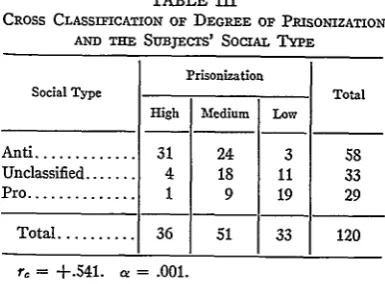
TABLE I
CROSS CLASSIFICATION OF DEGREE OF PRISONIZATION AND THE SUBJECTS' SOCIAL TYPE
Prisonization
Social Type Total
High Medium Low
Anti ... 31 24 3 58
Unclassified ... 4 18 11 33
Pro ... 1 9 19 29 Total ... 36 51 33 120
r = +.541. a = .001.
the criminal social type variable, and the degree of prisonization. The rank-order correlation was found to be +.541, which was also found to be significant at the >.001 level.
To extend the analysis, the partial rank-order correlations were computed. It was necessary to compute only first-order partials, since one of the variables was found not, to be significantly related to the dependent variable. The rank-order correla-tion between the "phase" variable and the ciminal social type variable was found to be +.072, which is not significant, which would indicate that the computation of a partial would not alter the inde-pendent relationships. In spite of this the partial was calculated and found to be +.546, between the degree of inmate code adoption and criminal social type, controlling for the effect of phase of institutional career, and +.313, between the de-pendent variable and phase of institutional career controlling for the effect of criminal social type. This finding would suggest that these two factors represent variables that are significantly related to degree of prisonization, but independent of each other for this sample.
On the basis of this finding, the question arose as to how much of the variation in the degree of normative-prisonization could be explained by both of these variables. The multiple rank-order correlation coefficient was computed to determine this, and found to be +.603. Given the exploratory nature of this research, and the lack of previous use of the instruments, it was felt this represented a very high degree of relationship.
DISCUSSION
[image:6.431.15.207.45.195.2] [image:6.431.218.411.46.188.2] [image:6.431.13.203.480.618.2]CHARLES IVELLFORD
most prominently referred to as affecting inmate code adoption, and observed that two of these (phase of institutional career and criminal social type) are significantly related to adoption of the inmate code, yet they are independent of each other. This suggests the necessity of a theory of normative prisonization that is more complex than past efforts have assumed. The purpose of this section is to offer some tentative explanations of these relationships, neglecting other more obvious implications of the findings.
It would seem that Wheeler's conception of the relationship between time and the degree of prisonization is correct, on the basis of the research described. By no means, however, should this be taken to indicate that the theoretical explanation attached to this relationship is correct. As stated earlier, Wheeler has suggested what he has come to call the "deprivational theory" of the adoption of the inmate code .2 The essence of this theory is that an inmate upon entering an institution en-counters many "pains of imprisonment" which make the inmate culture attractive to the inmate as a means to mitigate those "pains". This proposi-tion cannot be accepted, primarily because of the small amount of association that was found
(+.301). The supposition that a variable so slightly associated to the degree of prisonization can be translated into a causal explanation of the adoption of the inmate code is not sound. Also, the tendency of Wheeler to exclude the effects of the characteris-tics of the inmates is not strongly supported. In explaining the U curve findings by a deprivational approach, Wheeler ignored the rather obvious fact that ones' activities prior to incarceration would determine his degree of knowledge and commit-ment to the inmate code, since that code strongly reflects the general criminalistic sub-culture. The U curve hypothesis certainly has some validity; however, it would not seem wise to attempt to ex-plain all, or even a major portion, of the degree of normative prisonization by this variable alone. Further support for this is the demonstration of a relatively high relationship between criminal social type and the degree of inmate code adoption. It would seem more logical, therefore, to assume that degree of normative prisonization is affected by both a situational element, the depriving nature of the institution, and an actor characteristic, the criminal social type.N
26 Wheeler, The Social Sources of Criminology, 32
SocioL. INQ. 154 (1962).
27 This suggestion that both situational and
"per-The realization that not all inmates become highly prisonized indicates that adoption of the inmate culture is also not uniform. Therefore, we come to picture the inmate society as being not cohesive, but primarily organized around roles, which are in many respects conflicting. We cannot assume, however, that the inmate society is actu-ally a series of sub-societies, for there is a consensus on certain elements within the inmate code.H On the basis of this, it would seem that we should visualize the social structure, not in terms of an organized-disorganized society dichotomy, but as a social unit whose organization lies in between these extremes.
A concept that describes such a level of organiza-tion is the near-group as discussed by Yablonsky.N The near-group is described as having three levels of organization."0 The first level consists of core members, leaders of the near-group who work for the maintenance of the formation and abide by its
code. At the second level of organization are those
who claim affiliation but only participate according to their emotional needs. The third level consists of those who participate in the near-group occasion-ally but do not identify themselves as members. They are peripheral to the near-group. On the basis of this research one could hypothesize that this type of structure exists in the prison. The anti-social inmates would represent the first level of organization, while the pro-social are those who operate on the periphery of the near-group. This could explain the different degrees of adoption of the inmate code, in terms of the degree of identi-fication and commitment to the inmate culture.3' If this interpretation is correct, how can we ex-plain the significant relationship between the phase of institutional career and the degree of prisoniza-tion? The least complex explanation would be that sonality" determinants of behavior should be stressed, may at first seem, quite simple. However, it should be understood that in the past, emphasis has usually been placed on one or the other. See, for example,
Patrick Heine, The Problem of Personality in
Sociologi-cal Theory, CONCEPTs OF PERSONALrY 385-409 (Wepman & Heine, Eds. 1963).
2 There was near unanimous agreement among all
levels of prisonization with regards to escapes and informing.
2 Yablonsky, The Delinquent Gang as a Near-Group, 7 SOCIAL PROBLEMS 108-117 (1959).
3o Ibid. 113-114.
31 This is a reintroduction of this idea for Clemmer did place great emphasis on individual characteristics. Clemmer op. cit. supra note 2, at p. 301. Also, we can find support for this position in more recent research on gang delinquency. See SHORT & STRODTBECK, GRovP PROCESSES AND GANG DELiNQuENCY (1965).
the deprivational theory is in essence correct, in that all inmates proceed through a U shaped pat-tern of prisonization. However, in light of the above discussion, we would suggest that the level of prisonization is chiefly determined by the char-acteristics of the individual prior to his commit-ment, particularly with regards to his prior in-volvement in what is often referred to as the "crimiualistic subculture", with the recognition
that this may fluctuate within a small but pre-dictable range, depending upon the individual's stage in the deprivational cycle.n Future research should be directed in particular towards the more direct determination of the structure of the inmate society.
32 Change through phase analyses were not conducted