THE FRAMEWORK OF IMPROVING ON-SITE MATERIALS TRACKING FOR INVENTORY MANAGEMENT PROCESS IN CONSTRUCTION PROJECTS
SITI RADZIAH BINTI LIWAN
A project report submitted in partial
fulfilment of the requirement for the award of the Degree of Master of Technology Management.
Faculty of Technology Management and Business Universiti Tun Hussein Onn Malaysia
iv
ABSTRACT
ABSTRAK
vi
CONTENTS
TITLE i
DECLARATION ii
ACKNOWLEDGEMENT iii
ABSTRACT iv
CONTENTS vi
LIST OF TABLES xi
LIST OF FIGURES xii
LIST OF SYMBOLS AND ABBREVIATIONS xiii
CHAPTER 1 INTRODUCTION 1
1.1 Research Background 1
1.2 Problem Statement 3
1.3 Research Questions 5
1.4 Aim and Objectives 5
1.5 Scope of the Research 5
1.6 Research Methodology 6
1.7 Significance of the Research 9
1.8 Structure of the Thesis 9
1.9 Summary 10
CHAPTER 2 MATERIALS TRACKING FOR INVENTORY 11
MANAGEMENT PROCESS
2.1 Introduction 11
2.2 Inventory 11
2.2.2 The Importance of Inventory 12
2.3 Inventory Management Processes 14
2.3.1 Planning 14
2.3.2 Purchasing 15
2.3.3 Materials Delivery 15
2.3.4 Storage 16
2.3.5 Materials Issue 16
2.4 Inventory Management in Construction Projects 17
2.5 Inventory Management Problems 18
2.6 Material Tacking for Inventory Management 21 2.6.1 The Importance of Material Tracking 21 2.6.2 Current Approaches of Materials Tracking 22
2.6.3 Materials Tracking Technology 24
2.6.3.1 Bar-coding 24
2.6.3.2 Radio Frequency Identification (RFID) 26 2.6.3.3 Global Positioning System (GPS) 28 2.6.4 Benefits of ICT for Materials Tracking 29 2.7 RFID Technology for Materials Tracking 31
2.7.1 RFID Technology Application 31
2.7.2 RFID Components 33
2.7.2.1 RFID Tags 33
2.7.2.2 RFID Readers 35
2.7.3 The Advantages of RFID Technology 36 2.7.4 RFID for Materials Tracking in Construction 38
Projects
2.7.5 Issues in RFID Implementation 39
2.7.5.1 Costs 40
2.7.5.2 Standardisation 40
2.7.6 Current RFID Situations in Malaysia 41 2.8 Potential Implementation of RFID for Materials 42 Tracking in Malaysian Construction Projects
2.9 Several Materials Tracking Framework 44 2.9.1 Automated Project Schedule and Inventory 44
viii
2.9.2 Real-time Materials Tracking Framework 46
2.9.3 Ubiquitous Tracking and Locating of 48 Construction Resources using GPS, GIS and RFID
2.9.4 RFID-facilitated Construction Materials 49
Management (RFID-CMM) Framework
2.9.5 Integrating RFID, GPS and GPRS for 51
Real-time Data Collection
2.9.6 Information Lifecycle Management Framework 53 for Material Control on Construction Sites
2.10 Discussion of Materials Tracking Framework 54 2.11 Theoretical Framework for On-Site Materials Tracking 55
2.12 Summary 59
CHAPTER 3 RESEARCH METHODOLOGY 60
3.1 Introduction 60
3.2 Introduction to Research 60
3.3 Research Philosophy 62
3.4 Research Approaches 63
3.4.1 Quantitative Research 63
3.4.2 Qualitative Research 66
3.4.2.1 Case Studies 68
3.5 Research Strategy Decision 70
3.5.1 Selection of Research Methodology 71 3.5.2 Selection of Multiple Case Studies and 71
Interview Techniques
3.5.2.1 Multiple Case Studies 72
3.5.2.2 Interview Technique 75
3.6 The Methods Adopted for this Research 76
3.6.1 Literature Review 78
3.6.2 Case Studies 80
3.6.2.1 Selection of Respondents 84
3.6.3 Framework Development 85
CHAPTER 4 DATA ANALYSIS AND FINDINGS 88
4.1 Introduction 88
4.2 Objectives of Case Studies 88
4.3 Case Studies Projects 89
4.3.1 Case A: Agricultural Complex Development 90 4.3.2 Case B: School Development Project 94 4.3.3 Case C: Residential Development Project 97 4.3.4 Case D: Hypermarket Development Project 100
4.3.5 Case E: Condominium Development 103
4.3.6 Case F: Residential Development Project 107
4.3.7 Case G: Public Infrastructure Development 110
4.3.8 Case H: Residential Development Project 113
4.3.9 Case I: Public Institution Development 116
4.3.10 Case J: Public Secondary School 120
Development 4.4 Key Findings form Case Studies 124
4.4.1 Inventory Management Process 129
4.4.2 Problems in Materials Tracking 133
4.4.3 Materials Tracking Technology for Inventory 135
Management 4.4.4 Improving Materials Tracking for Inventory 140
Management 4.4.5 Integration of Inventory Management and 142
Resource Modelling 4.5 Requirement for Real-Time Materials Tracking 145
for Inventory Management Framework 4.6 Summary 147
CHAPTER 5 ON-SITE MATERIALS TRACKING 148
FRAMEWORK FOR INVENTORY MANAGEMENT 5.1 Introduction 148
x
5.3 On-Site Materials Tracking Framework 152
5.4 Key Components 153
5.4.1 Manufacturing 153
5.4.2 Materials Delivery 154
5.4.3 Materials Arrival 155
5.4.4 Storage Area 156
5.4.4.1 Materials Storage 156
5.4.4.2 Materials Use 157
5.4.5 On-site Control Centre 159
5.4.6 Report Generation 160
5.5 Summary 161
CHAPTER 6 CONCLUSIONS AND RECOMMENDATIONS 163
6.1 Introduction 163
6.2 Summary 163
6.3 Conclusions 166
6.4 Research Contributions 168
6.5 Limitations of the Research 169
6.6 Recommendations for Future Research 169
6.6.1 Recommendations for Researchers 170
6.6.2 Recommendations for Industry Practitioners 171
6.7 Concluding Remarks 171
REFERENCES 172
LIST OF TABLES
1.1 Research Objectives and Chapter Outcome 5
2.1 Summary of Inventory Management in Construction Projects 18 2.2 Inventory Management Problems in Construction Projects 19
2.3 Application of RFID Technology in Construction 27
2.4 Active versus Passive RFID Tags 34
2.5 RFID Tags Common Frequencies and their Uses 34 2.6 Summary of Materials Tracking Framework 57 3.1 Selection of Research Methodologies 61
3.2 Qualitative versus Quantitative Research 64
3.3 Comparison of Qualitative and Quantitative Data 67
3.4 Relevant Situation for Different Research Strategies 70 3.5 Project and Respondent Background 80
4.1 Project and Respondent Background 90
4.2 Summary of Cross-case Analysis 126
4.3 Inventory Management Process 129
4.4 Problems in Materials Tracking 134
4.5 The Application of Technology for Materials Tracking 136
4.6 Factors Improving Current Material Tracking Practices 140
xii
LIST OF FIGURES
1.1 The Research Process Flow Chart 7
2.1 Bar-coding Label 24
2.2 Typical RFID-based System 31
2.3 Active and Passive RFID Tags 33
2.4 Handheld Reader 35
2.5 Materials Tracking using RFID Reader 39 2.6 Automated Project Schedule and Inventory Monitoring 45 Process 2.7 Real-time Materials Tracking Framework 46
2.8 Automatic Data Collection System 48
2.9 RFID-facilitated CMM System 50
2.10 Automatic Data Collection using RFID, GPS and GPRS 52 2.11 A Conceptual ILM Framework for Material Control 53 2.12 Theoretical Framework for On-Site Materials Tracking 58 3.1 Selection of Research Methodology 62
3.2 Quantitative Research Process 65
3.3 Qualitative Research Process 66
3.4 Basic Types of Designs for Case Studies 73 3.5 Case Study Method 74
3.6 The Overall Research Process 77
5.1 On-Site Materials Tracking Framework for 151
Inventory Management 5.2 Materials Storage Process 156
5.3 Materials Use Process 158
5.4 On-Site Control Centre Process 160
LIST OF SYMBOLS AND ABBREVIATIONS
ADC Automatic Data Collection
AutoCAD Automated Computer Aided Design Auto-ID Automatic Identification BIM Building Information Modelling BQ Bill of Quantities
C-aIS Context-aware Information System CCTV Closed-Circuit Television Camera
CIDB Construction Industry Development Board DO Delivery Order
E-mail Electronic Mail
GIS Geographic Information System GHz Giga Heartz
GPS Global Positioning System GPRS General Packet Radio System
GSM Global System for Mobile Communications HQ Head Quarter
IBS Industrialised Building System
ICT Information and Communication Technology ILM Information Lifecycle Management
ISO International Organisation for Standardisation JIT Just-In-Time
kb kilo byte
kHz kilo Heartz
LADAR Laser Detection and Ranging LAN Local Area Network m metre
MHz Mega Heartz
MRO Materials Requisition Order MS Materials Storage
xiv
O&M Operation and Maintenance PDA Personal Digital Assistant PO Purchasing Order QS Quantity Surveyor RF Radio Frequency
RFID Radio Frequency Identification
RFID-CMM RFID-Facilitated Construction Materials Management UHF Ultra High Frequency
LIST OF APENDICES
APPENDIX TITLE PAGE
A Sample of Interview Questions 182 B Sample of Interview Transcript 187
CHAPTER 1
INTRODUCTION
This chapter presents the context of the research study. Firstly, it starts with brief introduction to the research background and problem statement that brings to the research interest in this study area. Secondly, this chapter states the aim and objectives of the research and the methodology adopted in order to achieve the research objectives. Finally, the chapter present the structure of the thesis.
1.1 Research Background
The demand for construction development is increasing from day to day parallel with increasing in the growth of population. A lot of development has been carried out which comprise of the housing development, infrastructure, industry, institutions, health care and others to fulfil the demand. In project development, materials are among the important elements to be taken into consideration as they are the building blocks that make up a project meanwhile material also constitute large amount of the project costs (Lu et al., 2011). Previous research identified that material cost comprise of 50-60% from the total project costs (Nasir, 2008; El-Ghazali et al.,
2011). Therefore, inventory which is part of materials also contribute significant amount to the above percentage.
2
for future use in construction process. Adequate amount of inventory is crucial to ensure the smoothness of construction processes and to maintain a healthy cash flow for contractors (Lu et al., 2011). However, inadequate amount of inventory results in job stoppage due to materials required for conducting construction works could not be specified at time they are needed.
The management of inventory in construction projects is important where significant amount of money was invested in every single activity. It involves the management of materials or components as they were unloaded to the site storage upon arrival at the project site. Several processes which considered important in inventory management are materials planning, purchasing, materials delivery, materials storage, and materials issue (Waters, 2003). Despite great demand for managing inventory, however; there are several problems which bound existing inventory management practices in construction projects. Those problems are: materials shortage (Ali et al., 2010), over ordering and double handling of inventory, missing materials; unavailability of storage space (Donyavi & Flanagan, 2009), and incomplete and lack of up-to-date information regarding on-site stock (Navon & Berkovich, 2006).
3
1.2 Problem Statement
Existing material tracking practices for inventory management in construction projects has several limitations. Material tracking practices relies on manual method of collecting and recording data related to tracking activities which is labour intensive (Ergen & Akinci, 2007). Sardroud et al. (2010) asserts that the data collected using manual method could be questioned as it depends on workers skill and level of productivity at time the data is taken during materials tracking. In addition, received materials is often improperly recorded or not recorded at all (Ala-Risku et al., 2010).
Navon and Berkovich (2006) has highlighted several limitations of manual material tracking which are labour intensive, inaccurate and subjected to error-prone which further leads to waste and surplus of materials, schedule delays, decrease in productivity, and lack of up-to-date information regarding the status of materials. Sardroud et al., (2010) also agreed that manual method of material tracking are labour intensive and data collected is unreliable as they depend on workers motivations and skills to track the materials during its arrival and at the storage area.
Moreover, the data collected through manual materials tracking are usually kept and transferred in paper-based format which is difficult to be traced and accessed in future. Hence, some information is being unavailable to the parties who need access to them in a timely manner for decision making process (Sardroud et al.,
2010). Demiralp et al. (2012) also stated that manual material tracking practices are time consuming, results in late deliveries, lead to mislocated components and incorrect installations. Meanwhile, Grau et al. (2009) addressed several limitations of material tracking in which it has raised difficulties among labour craft in accessing the required material and components at time of materials consumption. Thus, this provides less assurance for materials future identification.
Research conducted based on Malaysian construction projects have found that construction projects suffered from several inventory management problems such as improper planning and shortage of materials (Sambasivan & Yau, 2007). Ali
4
inventory management related problems that occur in Malaysian construction projects is contributed by the inexistence of appropriate material tracking practices for inventory management process.
However, the advancement in Information and Communication Technology (ICT) provided an opportunity to improve material tracking practices for inventory management process in construction projects. Previous researchers have introduced technology to overcome the drawbacks of existing material tracking practices (Chen & Li, 2006; Moselhi & El-Omari, 2006; Grau et al., 2009; Sardroud et al., 2010). Technologies such as bar-coding, Radio Frequency Identification (RFID), Global Positioning System (GPS), wireless technology and others has ability to facilitate materials tracking for the purpose of inventory management and materials control. Regarding to Moselhi and El-Omari (2006), bar-coding, RFID and other wireless technology could improve the speed and accuracy of data acquisition in construction projects in a cost effective manner.
Bar-coding technology has been used in materials tracking to provide instant and up-to-date information on quantities of materials and equipments exchanged between the store keepers and the working groups (Chen & Li, 2006). In contrast, RFID technology could provide unique identification and real-time information (Sarac et al., 2010) in construction projects. As ICT implementation offers great advantage in terms of material tracking especially in the construction industry abroad, therefore; ICT is expected to be adopted in Malaysian construction projects to overcome inventory management related problems especially in the area of materials tracking.
However, a framework is needed for successful adoption of technology for materials tracking in construction projects. Although previous researchers such as Gajamani and Varghese (2007), Kasim (2008), Sardroud et al. (2010), Ren et al.
5
1.3 Research Questions
Based on the problem statement, several research questions have been posed which comprise:
(i) What is the potential implementation of RFID technology for material tracking in Malaysian construction projects?
(ii) How does material tracking for inventory management process is practised among Malaysian construction projects?
(iii) How to improve the on-site material tracking for inventory management process in Malaysian construction projects?
1.4 Aim and Objectives
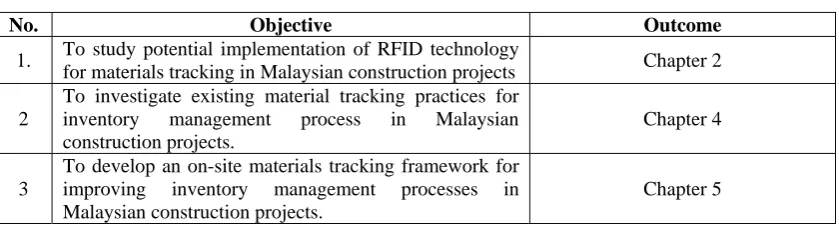
[image:18.595.111.531.472.585.2]This study aims to improve on-site materials tracking for inventory management process in construction projects particularly at the storage area. Towards reaching the aim of the research, the following objectives have been formulated as reflected in Table 1.1.
Table 1.1: Research Objectives and Chapter Outcome
No. Objective Outcome
1. To study potential implementation of RFID technology
for materials tracking in Malaysian construction projects Chapter 2
2
To investigate existing material tracking practices for inventory management process in Malaysian construction projects.
Chapter 4
3
To develop an on-site materials tracking framework for improving inventory management processes in Malaysian construction projects.
Chapter 5
1.5 Scope of the Research
6
therefore has experience in developing multi-million construction projects and has high capability for using technology in their projects. However, the samples of this research is only two hundred and thirty six (236) which consist of main contractors specialised in building construction which located in three different states namely; Johor, Selangor and Negeri Sembilan (CIDB, 2012). Those states are selected since they are moving forward among other states in terms of having progressively expanding in the volume of new construction development (Construction Industry Development Board, 2012). Case study research was adopted as a research strategy while semi-structured interview was used to gather data about the research. Respondent of the research are related personnel having experience or involved directly in inventory management and overall site management such as the project manager, the site engineer and the site supervisor. The data obtained from semi-structured interviews was analysed using matrix table and thus, presented as ‘within case’ and ‘cross-case’ reports.
1.6 Research Methodology
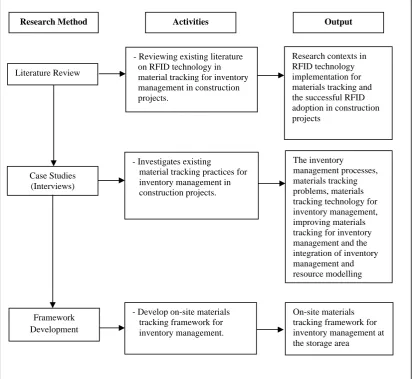
In achieving the aim and the research objectives, several research methods were adopted. This includes literature review, case studies and development of the on-site materials tracking framework for inventory management. Figure 1.1 shows the method adopted for this research with the respective output from each activity. Discussions in detail on the methodology adopted throughout the research were presented in Chapter 3.
(a) Literature Review
7
Literature Review
- Reviewing existing literature on RFID technology in material tracking for inventory management in construction projects.
Research contexts in RFID technology implementation for materials tracking and the successful RFID adoption in construction projects
Case Studies (Interviews)
- Investigates existing
material tracking practices for inventory management in construction projects.
The inventory
management processes, materials tracking problems, materials tracking technology for inventory management, improving materials tracking for inventory management and the integration of inventory management and resource modelling
Framework Development
- Develop on-site materials tracking framework for inventory management.
Research Method Activities Output
[image:20.595.118.531.157.536.2]The outputs generated from the review are the research contexts in RFID technology implementation for materials tracking and the successful RFID implementation in construction projects.
Figure 1.1: The Research Process Flow Chart
(b) Case Studies: Interviews
The case study approach was undertaken to gain primary data for this research. The case or unit of analysis involved ten construction projects in order to investigate existing material tracking for inventory management process within each case. Construction projects participate in the research are selected due to several criteria. Such criteria include the projects must be constructed by main contractors registered
8
with Construction Industry Development Board (CIDB) Grade 7 (G7) or registered with Contractor Service Centre (PKK) Grade A.
The case studies involved face-to-face semi-structured interviews in which the respondents are selected based on purposive sampling. According to Oliver (2006), purposive sampling is a type of sampling in which the decisions regarding the individuals to be participated in the research are determined by the researcher based upon variety of criteria which required by him or her. Hence, respondents for this research are selected based on their experience and involvement in inventory management and the overall site management such as the project manager, the site engineer or the site supervisor.
A list of predetermined and standardised questions was also prepared for the interview which acts as the interview guideline. This is important as according to Cavana et al. (2001), the semi-structured interview need to be carefully ordered and worded in a detailed interview schedule. Finding from case studies reveal the inventory management processes undertaken in each project, key problems related to materials tracking, implementation of technology for materials tracking, several approaches to improve materials tracking and the integration of inventory management and resource modelling.
The identification of material tracking problems from each case study enables the researcher to propose the adoption of ICT, particularly RFID technology to overcome material tracking related problems within construction projects. However, the decision to adopt RFID technology was made based on results from literature review which reveals the advantages of RFID technology for materials tracking. RFID implementation enables the material to be scanned automatically (Ozumba & Shakantu, 2008; Sardroud, 2012), reduce labour hours in scanning materials, could track work-in progress, improves antitheft protection and better inventory management (Mehrjerdi, 2011).
(c) Framework Development
9
element obtained from previous literature. The on-site materials tracking framework was developed based on the suitability of each component and elements with the actual material tracking practices for inventory management process carried out on-site. Several questions were designed for the interviews to enable the researcher to identify suitable components and important elements for the framework. The developed framework is important to successfully adopting technology in materials tracking for inventory management process in Malaysian construction projects.
1.7 Significance of the Research
This research is expected to contribute to the body of knowledge and study by:
identifying the current status of RFID implementation for material tracking in Malaysian construction projects,
exploring inventory management processes and identifying existing problems related to material tracking in Malaysian construction projects, and
propose new on-site material tracking framework for inventory management by improving the existing framework.
1.8 Structure of the Thesis
The thesis is structured into six chapters respectively. The content of each chapter are as follows:
Chapter 1 briefly introduces the content of the research. It explains the research background, problems that bring into the research initiative, the aim and objectives; and the methodology used in the research.
10
Chapter 3 reviews the overall methodology in business research and the method adopted to carry out this research project. This chapter also provide justification for the adoption of the specific research method.
Chapter 4 explains the findings from the case studies undertaken for the research. The findings were used to reveal the material tracking problems and the use of ICT to improve current material tracking practices in construction projects.
Chapter 5 focuses on development of on-site materials tracking framework. In this chapter, each component of the on-site materials tracking framework were discussed in details and their integration with RFID were discussed.
Chapter 6 presents the summary and conclusions for the thesis. This chapter discusses the research findings, conclusions, contributions and several limitations of the research. In addition, this chapter also provides some recommendations for future research.
1.9 Summary
CHAPTER 2
MATERIALS TRACKING FOR INVENTORY MANAGEMENT PROCESS
2.1 Introduction
This chapter reviews inventory management and material tracking technologies for inventory management process in construction projects. Firstly, it describes the inventory management as a whole which consist of definition, the process, the importance and problems in inventory management; and the application of information and communication technology (ICT) in managing inventory. Secondly, it explains the need for material tracking and existing material tracking practices in construction projects. Thirdly, it describes the material tracking technology and its benefits for material tracking. Finally, the chapter demonstrated the use of RFID for material tracking and issues of deployment.
2.2 Inventory
2.2.1 Definitions of Inventory
In general, inventory could be defined as the company’s raw materials; work in process, supplies used in operations, and finished goods (Muller, 2011; Sahari et al.,
2012). Inventory is the amount of raw materials, fuels, lubricants, spare parts and semi-processed material to be stocked for the smooth functioning of the plant (Chitale & Gupta, 2006). According to Maré (2006), inventory were use to mean several different things, such as;
the company’s or firms raw materials; work in process;
components/sub-assemblies; finished goods;
maintenance, repair and operational supplies; and transportation inventory (movement inventory).
In construction projects, inventory refers to materials or components on hand; which is kept by construction firms or projects as stock for the smooth functioning of construction process. In addition, inventory in construction also could be referred to as the amount of materials or components on the storage area. Regardless their definitions, it is important for businesses to manage inventory for their survival. Adequate amount of inventory helps company to fulfil customer need and demands, and vice versa; the company may incurred loss in profit margins. Therefore, there is a need for effective and efficient inventory management processes in construction projects. As according to Navon and Berkovich (2005), the main benefits arises from efficient materials management or inventory management are increased productivity, avoidance of delays, reduction of labour working hours and reduction in materials cost. Thus, effective and efficient inventory management processes is needed to help improve overall inventory management in construction projects.
2.2.2 The Importance of Inventory
13
manufacturing concept, keeping a stock or inventory is considered as a waste. However, according to Muller (2011) there are several reasons for holding inventory in organisations. Such reasons are:
Predictability
In order to engage in capacity planning and production scheduling, organisations need to control the inventory quantity (raw materials, parts, and sub-assemblies) they had processed at a given time. This is important as inventory will act as a buffer as what you need from what you want.
Fluctuations in demand
Inventory on hand acts as a protection against undesirable market conditions. Inventory of finished goods is important in protecting companies from an increase in customers demand.
Unreliability of supply
Inventory will provide organisations with a protection from unreliable suppliers and in scarce conditions where it is difficult to ensure a steady supply of materials and items.
Price protection
Buying and keeping large quantities of inventory at appropriate time helps avoid the impact of cost inflation.
Quantity discounts
Buying large amount of items such as buying in bulk is much susceptible to quantity discounts as compared to buying in smaller quantities.
Lower ordering costs
Buying large quantity of several items, but in less frequent will result in lower ordering costs. This are differed with buying a small quantities of an item, but in much frequent.
Keeping or having adequate level of inventory is important for every business. This is due to inventory carries large amount of hidden cost (Sahari et al.,
amount of inventory, the management of inventory itself is an important concern in construction projects. Therefore, current material tracking practices used in managing inventory in construction projects has successfully captured a great concern among contractors and clients.
2.3 Inventory Management Processes
In general, inventory management is specifically responsible for the management of inventory as they arrive at the construction site, their storage and the disposal of inventory wastes. According to Waters (2003), inventory management is so entwined with activities in logistics which responsible for all aspects of the movement and storage of materials in a supply chain. Inventory management in construction projects consists of five main processes. Those processes were discussed in the following sub-sections.
2.3.1 Planning
Planning is the initial process and could be considered as the most important process in inventory management. Materials planning involve determining the need for materials to carry out production process and other related works. During planning, if material is estimated wrongly; the stock level will become too high and generate other hidden costs. However if the stock level is too low, it may lead to another problems which related to the distribution (Heck, 2009).
15
2.3.2 Purchasing
Procurement or purchasing could be defined as the purchase of materials and services from other organisations in order to support the firm’s operations (Kasim, 2011). The person in charge for procuring materials or the purchasing department in case of large construction firms need to ensure that the right materials in the right quantities are purchased from suppliers or manufacturers. Such person also needs to verify the release dates at which the material is needed and to clearly specify those delivery dates and the location of delivery to the supplier (Al-Shorafa, 2009).
The purchasing and planning process are interrelated. This is due to, before the buying process; the advance planning is required in order to determine the amount of inventory needed for each time period (Hedrick et al., 2013). After the need for materials was identified, decisions regarding the buying needs need to be done which include whether to buy or not and in what quantities. Before the purchasing order were issued to suppliers or manufacturers, it is important to highlight the exact time in which the materials are going to be used and for which activities. This is important to ensure materials availability to carry out construction works.
2.3.3 Materials Delivery
Usually, materials are delivered to the project sites during the construction phase. However, in several instances the delivery of materials to the jobsites may not be feasible due to storage or access limitations (Al-Shorafa, 2009).This means that construction materials cannot be delivered to the project sites due to unavailability of the site storage space. Sometimes, the locations of the project site from the main road or main area contribute difficulties for manufacturers and suppliers to delivered or shipped construction materials.
to check the delivered material in terms of its quantity and specifications and compared the information with the purchase order (Heck, 2009). At this time, the materials which required for further storage are segregated or separated from materials which required to be used for immediate construction activities.
2.3.4 Storage
Materials were added to the stock after checking during materials delivery. The amount or quantities of materials added to the stock need to be recorded in the store database (whether using paper-based or registered in the system) for further use by the store keeper in managing the site storage area (Heck, 2009). Adequate information on materials identification at the storage area is important to enable workers to easily retrieve the materials. In addition, proper management at the site storage area is also important to ensure that materials are available at time they are needed, thus; avoiding problems related to the unavailability or lack of materials such as double handling and inadequate site storage.
2.3.5 Materials Issue
According to Heck (2009), materials or goods were issued for two reasons; each of which would depend on its environment. In a warehouse, items or goods were issued to fulfil an order placed by clients. However, in a production environment; items are retrieved from stock as they are required for production of goods (Heck, 2009). Construction materials were issued from the site storage or the unloading area; to the workers to carry out construction works. Materials which were taken out from the storage were recorded in the store database. However, materials that were taken directly from the unloading area upon their received need to be deducted directly from the inventory lists.
17
important to control the flow of materials in and out from the site storage and in construction projects.
2.4 Inventory Management in Construction Projects
In traditional settings, inventories of raw materials, work-in-process and finished goods were kept as a buffer against the possibility of running out of needed items (Sahari et al., 2012). However, large inventories consume valuable resources and generate hidden costs. Adequate inventory level is important for businesses to keep up competing in the market conditions while operating the business smoothly. On the other hand, high inventory level could burden the companies as inventories carried out hidden costs.
Inventory management is one of the most important operations management responsibilities as inventory involves great deal of capital and the delivery of goods from manufacturers to the suppliers and customers (Chitale & Gupta, 2006). Therefore, the management of inventory is important as it has great impact on the overall business functions. In construction project, materials and equipments may constitute more than 60% of the total project cost (Donyavi & Flanagan, 2009; Patel & Vyas, 2011), hence; make the management of materials and inventory as crucial.
In addition, Tersine (1994) asserts that the management of inventory is a common problem to all organisations in any economic sector. Like other sectors such as manufacturing, automotive, electronics and others; construction industry also suffered from poor inventory management especially during construction phase. In Malaysia, inventory management related factors such as materials shortage and equipment and tools shortages are among factors that contribute delay to the construction projects (Sambasivan & Yau, 2007; Alaghbari et al., 2007; Ali et al.,
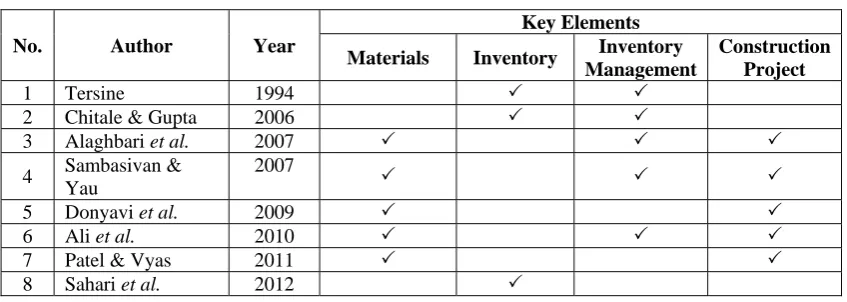
Table 2.1: Summary of Inventory Management in Construction Projects
No. Author Year
Key Elements
Materials Inventory Inventory Management
Construction Project
1 Tersine 1994
2 Chitale & Gupta 2006
3 Alaghbari et al. 2007
4 Sambasivan & Yau
2007
5 Donyavi et al. 2009
6 Ali et al. 2010
7 Patel & Vyas 2011
[image:31.595.107.534.89.238.2]8 Sahari et al. 2012
Table 2.1 summarised several researches that has been carried out regarding the inventory management in construction projects. From the table, it is clear that the inventory management in construction projects has received a great concern among researchers. Therefore, inventory in construction projects need to be managed properly or vice versa it can causes schedule and project delays which in turn contribute to the project failure. The next section discusses on the inventory management problems in construction sites.
2.5 Inventory Management Problems
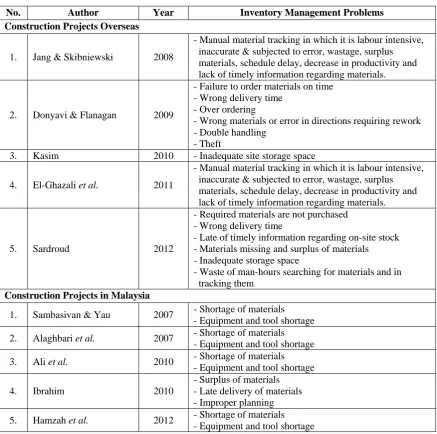
Existing inventory management in construction projects are susceptible to various problems. Table 2.2 has summarises several inventory management problems which occur in construction projects abroad and in Malaysia. From the table, Donyavi and Flanagan (2009) have found out common problems related to inventory management in construction projects. In their study; failure to order on time, wrong delivery time, over ordering, wrong materials or error in direction requiring rework, double handling and theft of materials are common inventory management problems in construction sites. Inventory management in construction projects also suffered from inadequate site storage space (Kasim, 2010). Due to inadequate site storage space, delivered materials were leave scattered everywhere around the construction area, thus; increase difficulties for materials traceability.
19
[image:32.595.101.539.203.637.2]complete and up-to-date information regarding the site stocks; missing or surplus of materials; inadequate site storage space; and waste of working hours searching for materials and in tracking them. Similar to the other inventory management problems, these problems also results in the decrease of labour productivity, schedule delays and increase the project costs.
Table 2.2: Inventory Management Problems in Construction Projects
No. Author Year Inventory Management Problems
Construction Projects Overseas
1. Jang & Skibniewski 2008
- Manual material tracking in which it is labour intensive, inaccurate & subjected to error, wastage, surplus materials, schedule delay, decrease in productivity and lack of timely information regarding materials.
2. Donyavi & Flanagan 2009
- Failure to order materials on time - Wrong delivery time
- Over ordering
- Wrong materials or error in directions requiring rework - Double handling
- Theft
3. Kasim 2010 - Inadequate site storage space
4. El-Ghazali et al. 2011
- Manual material tracking in which it is labour intensive, inaccurate & subjected to error, wastage, surplus materials, schedule delay, decrease in productivity and lack of timely information regarding materials.
5. Sardroud 2012
- Required materials are not purchased - Wrong delivery time
- Late of timely information regarding on-site stock - Materials missing and surplus of materials - Inadequate storage space
- Waste of man-hours searching for materials and in tracking them
Construction Projects in Malaysia
1. Sambasivan & Yau 2007 - Shortage of materials - Equipment and tool shortage 2. Alaghbari et al. 2007 - Shortage of materials
- Equipment and tool shortage 3. Ali et al. 2010 - Shortage of materials
- Equipment and tool shortage
4. Ibrahim 2010
- Surplus of materials - Late delivery of materials - Improper planning 5. Hamzah et al. 2012 - Shortage of materials
- Equipment and tool shortage
In addition, inventory management in construction also suffers from traditional-manual material tracking practices (Jang & Skibniewski, 2008; El-Ghazali
and lack of up-to-date information regarding the status of materials. Data collected using manual method is also unreliable as it depends on workers initiative to collect data regarding materials.
In Malaysia, shortage of materials and equipment and tool shortages are among the common problems related to inventory management in construction projects (Sambasivan & Yau, 2007; Alaghbari et al., 2007; Ali et al., 2010; Hamzah
et al., 2012) besides other factors such as surplus of materials (Ibrahim, 2010), late delivery of materials and improper planning. On the other hand, shortage of materials is also among the major factors that contribute delays of construction projects in the Klang Valley, Malaysia (Ali et al., 2010). However, little research has been carried out regarding the problems faced by Malaysian construction industry related to inventory management in construction projects (Ibrahim, 2010).
In case of material shortage, materials required to carry out specified jobs are unavailable when needed, thus; result in delay of construction works, wasting of labour hours and equipments and increase the total project cost (Ali et al., 2010). From the above study, it is expected that inventory management problems which occur among Malaysian construction projects are contributed by the inexistence of proper material tracking system for the purpose of managing inventory in construction projects. Song (2005) has highlighted the importance of proper material tracking in which it provides timely information on materials availability. Timely information on materials is important for the site manager to make proper planning on construction works based on materials availability and to make decision regarding the purchasing of materials. Hence, materials shortage, surplus of materials and other inventory management problems could be avoided.
21
2.6 Material Tracking for Inventory Management
Material tracking in construction projects is not an easy task (Navon & Berkovich, 2006). This is due to construction projects involve large amount of materials to fulfil the demand of construction activities. Thus, it is important for the project management to be able to trace every construction materials to make sure construction works could be carried out in line with the availability of resources (construction materials).
2.6.1 The Importance of Material Tracking
The term material tracking could be defined as the process of collecting and managing information related to present or real-time location of a products or items (Shamsuzzoha & Helo, 2011). Material tracking in construction project is crucial as materials constitute large portion of the total project costs. According to Green (2005), material tracking in construction projects is important because of several reasons; (i) to know exactly the location of materials, so workers do not have to waste their time searching for materials, (ii) to make sure jobs and orders are not held up because of lack of materials, (iii) to track the quality and cost of each container of material in order to make sure that the correct materials are received according to purchase orders, (iv) to make sure the manufacturers have shipped the right materials to the customer; and (v) the need for traceability.
material and real-time on-site measurement of project performance is important for the project management to make decision regarding the project.
Construction environment also demanding high materials traceability where materials need to be at predetermined locations at time they are needed (Song, 2005). This is important primarily to facilitate materials consumption during construction works. At the storage area, material tracking were used to know the specific quantity of every item within the storage. This is important in order to have correct information regarding materials in stock while at the same time making new purchase order if the inventory level is low. Therefore, materials tracking play an important role for the purpose of inventory management processes in construction projects. Fail to track materials means failed to manage inventory which could affect on the overall project performance.
2.6.2 Current Approaches of Materials Tracking
According to Sardroud et al. (2010), current material tracking practices in construction projects rely greatly on manual data collection process. Manual data collection is inefficient and ineffective as the data collected is not reliable and accurate. In construction project, accurate and timely information is primary concern among various parties in the project in order to increase the project control. However, Grau et al. (2009) has demonstrated current method of material tracking which were used to tracked pre-fabricated components such as structural steel and pipe spools in construction jobsites.
23
intensive and involve excessive paper-based as workers are required to record the location of the components in every possible movement before installation process.
Not much research has been conducted regarding material tracking in Malaysian construction projects. Kasim et al. (2013) found that existing material tracking practices among four construction projects in Malaysia was undertaken manually which has several drawback. Liwan et al. (2013) also revealed that Malaysian contractors rely on manual material tracking practices which is susceptible to several drawbacks. In addition, the CIDB master plan for occupational safety and health 2004 (CIDB Master Plan OSHA 2004) also highlighted that one of the problems facing by the Malaysian construction industry is low productivity which contribute by the low technology usage. It also show that Malaysian construction industry is lag far behind other industries in embracing technology and therefore; the overall project management were carried out manually including materials tracking.
Several case studies have been conducted to explore material tracking practices in Malaysian construction projects. It is found that each material was calculated manually one-by-one by the personnel in charge upon its arrival at the project site with referred to the Delivery Order (DO) (Liwan et al., 2013). Every time materials were delivered to the construction site, the site supervisor need to manually check and tracked the materials to ensure it is according to the DO (Kasim et al.,
2013). This is to ensure that the types, quantity, quality and specifications of materials arrived at the site is according to the DO. However, Malaysian construction projects also suffered from manual material tracking related problems. Kasim et al.
(2013) reported that manual material tracking practices are labour intensive, lack of up-to-date information regarding materials and involved excessive paper-based recording and reporting. In addition, manual method of materials tracking also involved excessive paper-based recording, lack of timely information on materials, inadequate storage space, theft and others (Liwan et al., 2013).
consuming, results in late deliveries, lead to mislocated components and incorrect installations (Demiralp et al., 2012). Although current material tracking practices has many drawbacks, however; the advancement in ICT could be manipulated to improve current practices. Several technologies could be adopted to assist and improve material tracking in construction projects. Brief explanations on those technologies were explained on the next section.
2.6.3 Materials Tracking Technology
The implementation of technology in everyday’s life has ability to assist human works while at the same time improving their life quality. Hence, the implementation of technology particularly for material tracking in construction projects is expected to facilitate and improve existing material tracking practices. From previous research, there are several technologies which were used for material tracking. Explanations on each technology were made as follows.
2.6.3.1 Bar-coding
[image:37.595.212.437.598.744.2]Bar-coding have been successfully positioned itself against other identification systems over the past two decades. Bar-coding is a binary code comprising of bars and gaps arranged together in parallel configuration. The bars and gaps were arranged according to a predetermined pattern and represent data elements that refer to an associated symbol (Finkenzeller, 2010). Figure 2.1 depicts the example of bar-coding label which available in the market.
REFERENCES
Abdul Kareem, H. I. & Abu Bakar, A. H. (2011). Identifying IT Benefits for Malaysian Construction Companies. Journal of Information Technology in
Construction (ITcon), vol. 16, pp. 477-492.
Alaghbari, W., A. Kadir, M. R., Salim, A. & Ernawati (2007). The Significant Factors Causing Delay of Building Construction Projects in Malaysia.
Journal of Engineering, Construction and Architectural Management, vol.
14(2), pp. 192-206.
Ala-Risku, T. & Karkkainen, M. (2006). Material Delivery Problems in Construction Projects: A Possible Solution. International Journal of Production Economics, vol. 104, pp. 19-29.
Ali, A. S., Smith, A. & Pitt, M. (2010). Contractors’ Perception of Factors Contributing to ProjectDelay: Case Studies of Commercial Projects in Klang Valley, Malaysia. Journal of Design and Built Environment, vol. 7. pp. 43- 57. Al-Shorafa, A. A. (2009). A Framework for Construction Materials Supply Chain Process in the Local Construction Industry. Islamic University of Gaza: Master Thesis.
Banks, J., Hanny, D., Pachano, M. A. & Thompson, L. G. (2007). RFID Applied. New Jersey: John Wiley & Sons.
Brilakis, I. Park, M. W. & Jog, G. (2011) Automated Vision Tracking of Project Related Entities. Journal of Advanced Engineering Informatics, vol. 25, pp. 713-724.
Bryman, A. & Bell, E. (2007). Business Research Methods. 2nd ed. New York: Oxford University Press.
Caldas, C. H., Torrent, D. G. & Haas, C. T. (2004). Integration of Automated Data Collection Technologies for Real-time Field Materials Management. Proc. of the 21st Int. Symposium on Automation and Robotics in Construction. Jeju, Korea.
Chitale, A. K. & Gupta, R. C. (2006). Materials Management: Text and Cases. New Delhi: Prentice-Hall.
Chen, K. M., Chen, J. C. & Cox, R. A. (2012). Real Time Facility Performance Monitoring System using RFID Technology. Journal of Assembly Automation, vol. 32(2), pp. 185-196.
Construction Industry Development Board, CIDB (2012). Dafter Projek Pembinaan Mengikut Nama Kontraktor: Januari hingga Disember 2012. Retrieved December 18, 2012 from http://www.cidb.gov.my.
Construction Industry Development Board, CIDB (2013). CIDB Master Plan for Occupational Safety and Health (CIDB Master Plan OSHA 2004).Retrieved July 6, 2014 from http://www.cidb.gov.my.
Construction Industry Development Board, CIDB (2014). Retrieved July 6, 2014 from http://www.cidb.gov.my.
Construction Industry Development Board, CIDB (2014). CIDB News: Newsletter for the Construction Industry Development Board, Issue 01 (April 2014). Cooper, D. R. & Schindler, P. S. (2008). Business Research Methods. 10th ed. United States: McGrawHill.
Demiralp, G., Guven, G. & Ergen, E. (2012). Analyzing the Benefits of RFID Technology for Cost Sharing in Construction Supply Chains: A Case Study on Prefabricated Precast Components. Journal of Automation in Construction, vol. 24, pp. 120-129.
Donyavi, S. & Flanagan, R. (2009). The Impact of Effective Material Management on Construction Site Performance for Small and Medium Sized Construction Enterprises. Proc. of the 25th Annual ARCOM Conference, Nottingham, UK. Dul, J. & Hak, T. (2008). Case Study Methodology in Business Research. USA: Elsevier.
Dziadak, K., Kumar, B. & Sommerville (2006). RFID in the Built Environment: Buried Asset Location Systems. Journal of Intelligent Computing in Engineering and Architecture, No. 4200, pp. 153-162.
El-Ghazali, Y., Lafebvre, E. & Lafebvre, L. A. (2011). RFID-Enabled Materials Management in the Industrial Construction Supply Chain. Proc. of the 5th WSEAS International Conference on Communications and Information
174
El-Omari, S. (2008). Automated Data Acquisition and Control of Construction Projects. Concordia University: PhD Thesis.
Eriksson, P. & Kovalainen, A. (2008). Qualitative Methods in Business Research.
London: Sage Publications.
Ergen, E. & Akinci, B. (2007). An Overview of Approaches for Utilizing RFID in Construction Industry. IEEE Xplore Digital Library.
Fathi, M. S., Anumba, C. Carrillo, P. & Zakiyudin, M. H. (2009). Real Time Mobile Information System for Construction Programme Management. Proc. of the
2nd Construction Industry Research Achievement International
Conference (CIRAIC2009).
Finkenzeller, K. (2010). RFID Handbook: Fundamentals and Applications in Contactless Smart Cards, Radio Frequency Identification and Near-Field
Communication. London: John Wiley and Sons.
Fellows, R. & Liu, A. (1999). Research Methods for Construction. Oxford: Blackwell Science Ltd.
Gajamani, G. K. & Varghese, K. (2007). Automated Project Schedule and Inventory Monitoring using RFID. 24th International Symposium on Automation & Roborics in Construction (ISARC 2007), Madras.
Garfinkel, S. & Rosenberg, B. (2006). RFID Applications, Security, and Privacy. Pearson Education, Inc.
Ghauri, P. & Gronhaug, K. (2005). Research Methods in Business Studies: A Practical Guide. 3rd ed. Prentice Hall Europe.
Gill, J. & Johnson, P. (1997). Research Methods for Managers: 2nd Edition. London: Paul Chapman.
Goodrum, P. M., McLaren, M. A. & Durfee, A. (2006). The Application of Active Radio Frequency Identification Technology for Tool Tracking on Construction Jobsites. Journal of Automation in Construction, 15, pp. 302.
Grau, D., Caldas, C. H., Haas, C. T., Goodrum, P. M. & Gong, J. (2009). Assesing the Impact of Materials Tracking Technologies on Construction Craft Productivity. Journal of Automation in Construction, 18, pp. 903-911.
Greener, S. (2008). EBooks: Business Research Methods. Dr. Sue Greeber & Ventus Publishing ApS.
Hair, J. F. J., Babin, B., Money, A. H. & Samouel, P. (2003). Essentials of Business Research Methods. United States: Leyh Publishing.
Hakim, C. (2000). Research Design: Successful Designs for Social and Economic Research. 2nd ed. London: Routledge.
Heck, V. G. (2009). Inventory Management: Introducing a Framework to Assess Operational Performance. Delft University of Technology: Master Thesis. Hedrick, F. D., Barnes, F. C., Davis, E. W., Whybark, D. C. & Krieger, M. (2013).
Inventory Management. Retrieved May 29, 2013 from
http://www.sbaonline.sba.gov/idc/groups/public/documents/sba_homepage/p
ub_mp22.pdf
Hunt, V. D., Puglia, A.& Puglia, M. (2007). RFID A Guide to Radio Frequency Identification. New Jersey: John Wiley & Sons.
Ibrahim, A. R., Roy, M. H., Ahmed, Z. & Imtiaz, G. (2010). An Investigation of the Status of the Malaysian Construction Industry. Benchmarking: An International Journal, vol. 17, pp. 294-308.
Idrus, A., Utomo, C. & Mubarak, I. H. (2008). Applicability of Computer Tools in Malaysia’s Construction Industry. Proc. of International Conference on Project Management (ICoPM), 18-20 November 2008, Selangor.
Jaafar, M., Abdul Aziz, A. R., Ramayah, T. & Saad, B. (2007). Integrating Information Technology in the construction industry: Technology Readiness Assessment of Malaysian Contractors. Int. Journal of Project Management, vol. 25, pp. 115-120.
Jang, W. S. (2007). Embedded System for Construction Material Tracking using Combination of Radio Frequency and Ultrasound Signal. University of Maryland: PhD Thesis.
Jang, W. S. & Skibniewski, M. J. (2008). A Wireless Network System for
Automated Tracking of Construction Materials on Project Sites. Journal of Civil Engineering & Management, 14(1), pp. 11-19.
176
Kasim, N. B. (2008). Improving Materials Management on Construction Projects. Loughborough University: PhD Thesis.
Kasim, N. B. (2010). Towards a Framework for ICT-Enabled Materials Management in Complex Projects. Journal of Techno-Social.
Kasim, N. B. & Ang, S. E. P. (2010). The Awareness of ICT Implementation for Materials Management in Construction Projects. Int. Journal of Computer and Communication Technology, vol. 2(1).
Kasim, N. B. (2011). ICT Implementation for Materials Management in Construction Projects. Journal of Construction Engineering and Project Management, vol.
1 (2011).
Kasim, N., Liwan, S. R., Shamsuddin, A. & Zainal, R. (2013). Improving Materials Tracking Practices for Inventory Management in Construction Projects. Proc. ofTheSecond International Conference on Sustainable Infrastructure and
Built Environment, Bandung, 19-20 November 2013.
Kim, C., Ju, Y. & Kim, J. H. (2009). Resource Management in Civil Construction Using RFID Technologies. The 26th International Symposium on Automation and Robotics in Construction (ISARC 2009).
Lancaster, G. (2005). Research Methods in Management: A concise Introduction to Research in Management and Business Consultancy. Oxford: Elsevier.
Lee, J. H., Song, J. H., Oh, K. S. & Gu, N. (2013). Information Lifecycle Management with RFID for Material Control on Construction Sites. Journal of Advanced Engineering Informatics, vol. 27, pp. 108-119.
Li, S., Godon, D. & Visich. J. K. (2010). An Exploratory Study of RFID Implementation in the Supply Chain. Journal of Management Research, vol.
33(10), pp. 1005-1015.
Liwan, S. R., Kasim, N. & Zainal, R. (2013). Materials Tracking Practices for Inventory Management in Construction Projects. Proc. of 1st Faculty of Technology Management and Business (1st FPTP) Colloquium, Universiti Tun Hussein Onn, Malaysia.
Lu, W., Huang, G. Q. & Li, H. (2011). Scenarios for Applying RFID Technology in Construction Project Management. Journal of Automation in Construction, 20, pp. 101-106.
Maré, S. E. (2006). Improvement of the Materials Management Function in a Shared Service Centre. University of Pretoria: Master Thesis.
Mehrjerdi, Y. Z. (2008). RFID-enabled System: A Brief Review. Journal of Assembly Automation, vol. 28(3), pp. 235-245.
Mehrjerdi, Y. Z. (2010). Coupling RFID with Supply Chain to Enhance Productivity.
Handbook of Business Strategy,vol. 11(2), pp. 107-123.
Mehrjerdi, Y. Z. (2011). RFID and Its Benefits: A Multiple Case Analysis. Journal of Assembly Automation, vol. 31(3), pp. 251-262.
Mohd Tobi, S. U. (2013). Research Methodological Cage: Understanding the Qualitative Viewpoint. Kuala Lumpur: Aras Publisher.
Molnar, M., Andersson, R. & Ekholm, A. (2007). Benefits of ICT in the Construction Industry- Characterization of the Present Situation in Building Processes. Proceedings of the W78 Conference, Maribor.
Moselhi, O. & El-Omari, S. (2006). Integrating Bar Coding and RFID To Automate Data Collection From Construction Sites. Joint Int. Conf. on Computing and Decision Making in Civil and Building Engineering. Montreal: Concordia University. pp. 1734- 1741.
Muller. M. (2003). Essentials of Inventory Management. 1st ed. New York: American Management Association (AMA).
Muller. M. (2011). Essentials of Inventory Management. 2nd ed. New York: American Management Association (AMA).
Nasir, H. (2008). A Model for Automated Construction Materials Tracking. University of Waterloo: Master Thesis.
Nasr, E., Shehab, T. & Vlad, A. (2013). Tracking Systems in Construction: Applications and Comparisons. 49th ASC Annual International
Conference Proceedings.
Navon, R. & Berkovich, O. (2005). An Automated Model for Materials Management and Control. Journal of Construction Management and Economics, 24, pp. 635-646.
Neuman, W. L. (2003). Social Research Methods: Qualitative and Quantitative
Approaches. New York: Allyn and Bacon.
178
Tracking. WSEAS Transactions on Information Science and Applications, vol. 5.
Oliver, P. (2006). Purposive Sampling. Retrieved February 24, 2015 from http://srmo.sagepub.com/view/the-sage-dictionary-of-social-research
methods/n162.xml
Ozumba, A. O. U. and Shakantu, W. M. (2008). Improving Site Management Process Through ICT.
Papageorgiou, C. (2000). Technology Adoption, Human Capital, and Growth Theory. Department of Economics, Louisiana State University, LA.
Patel, K. V. & Vyas, C. M. (2011). Construction Materials Management on Project Sites. National Conference on Recent Trends in Engineering & Technology, Gujarat.
Polonsky, M. J. & Waller, D. S. (2011). Designing and Managing a Research Project: A Business Student Guide. 2nd ed. London: SAGE Publications. Razavi, S. N.; Montaser, A. & Moselhi, O. (2012). RFID Deployment Protocols for Indoor Construction. Journal of Construction Innovation, vol. 12(2), pp. 239-258.
Ren, Z., Anumba, C. J. & Tah, J. (2011). RFID-facilitated Construction Materials Management (RFID-CMM). A Case Study of Water-supply Project. Journal of Advanced Engineering Informatics, vol. 25, pp. 198-207.
Ritchie, J.; Lewis, J.; McNaughton, N., C. & Ormston, R. (2013). Qualitative Research Practice: A Guide for Social Science Students & Researchers. London: Sage Publications Ltd.
Rivera, J. L. P. (2004). A Framework for a Decision Support Model for a Supply Chain Management in the Construction Industry. Virginia Polytechnic Institute: PhD Thesis.
Robson, C. (2002). Real World Research. USA: Blackwell.
Sahari, S., Tinggi, M. & Kadri, N. (2012). Inventory Management in Malaysian Construction Firms: Impact on Performance. SIU Journal of Management,
vol. 2(1).
Sambasivan, M. and Yau, W. S. (2007). Causes and Effects of Delays in Malaysian Construction Industry. International Journal of Project Management, 25,
pp. 517-526.
Sardroud, J. M., Limbachiya, M. C. & Saremi, A. A. (2010). Ubiquitous Tracking and Locating of Construction Resource Using GIS and RFID. 6th GIS Conference and Exhibition (GIS 88), Tehran.
Sardroud, J. M. (2012). Influence of Technology on Automated Management of Construction Materials and Components. Journal of Scientis Iranica A, vol.
19(3), pp. 381-392.
Saunders, M., Lewis, P. & Thornhill, A. (2007). Research Methods for Business Students. 4th ed. United Kingdom: Prentice Hall.
Saygin, C. & Natarajan, B. (2010). RFID-based Baggage-handling System Design. Technical Paper Retrieved from Journal of Emerald. vol. 30(4).
Shamsuzzoha, A. H. M. & Helo, P. (2011). Real-time Tracking and Tracing System: Potentials for the Logistics Network. Proceedings of the 2011 International Conference on Industrial Engineering and Operations Management, Kuala Lumpur.
Song, J. (2005). Tracking the Location of Materials on Construction Projects. University of Texas: PhD Thesis.
Straub, E. T. (2009). Understanding Technology Adoption: Theory and Future Directions for Informal Learning. Journal Review of Educational Research, vol. 79 (2), pp. 625-649.
Strauss, A. & Corbin, J. (1990). Basics of Qualitative Research: Grounded Theory Procedures and Techniques. Newbury Park: Sage Publications.
Sulaiman, S., Umar, A. U., Tang, S. H. & Fatchurrohman, N. (2012). Application of Radio Frequency Identification (RFID) in Manufacturing in Malaysia. Int. Journal of Procedia Engineering, vol. 50, pp. 697-706.
Swanborn, P. (2010). Case Study Research: What, Why and How? London: Sage Publications.
Takim, R. (2005). A Framework for Successful Construction Project Performance.
Glasgow Caledonian University: PhD Thesis.
180
Tersine, R. J. (1994). Principles of Inventory and Materials Management. 4th ed. New Jersey: PTR Prentice Hall.
Thornhill, A., Saunders, M. & Lewis, P. (2007). Research Methods for Business Students. 4th ed. Oxford: Prentice Hall.
Wan Hamid, W. H. & Hong, L. C. (2008). Development and Implementation of Radio-Frequency Identification (RFID) Technology for Inventory
Management System: A Case Study. Jurnal Mekanikal, no. 27, pp. 51-68. Waters, D. (2003). Inventory Control and Management. 2nd ed. Chichester: John Wiley.
Wilson, J. (2010). Essentials of Business Research: A Guide to Doing Your Research Project. London: Sage Publications.
Wing, R. (2006). RFID Applications in Construction and Facilities Management.
Journal of ITcon, vol. 11, pp. 711-721.
Wu, D. L., Ng, W. W. Y., Yeung, D. S. & Ding, H. L. (2009). A Brief Survey on Current RFID Applications. Proc. of the Eighth Int. Conf. on Machine Learning and Cybernetics. Baoding: University of Technology Guangzhou, China. pp. 2330-2335.
Yin, R. K. (2009). Case Study Research Design & Methods. 4th ed. United Kingdom: Sage Publications.
Yoon, W. J., Chung, S. H. & Lee, S. J. (2008). Implementation and Performance Evaluation of An Active RFID System for Fast Tag Collection. Journal of Computer Communications, vol. 31, pp. 4107-4116.
Young, D. A. (2009). Modelling the Impact of Automated Materials Locating and Tracking Technology on the Construction Supply Network. University of Waterloo: Master Thesis.