The Impact of Test Anxiety on Reading Comprehension
Test Performance in Relation to Gender among Iranian
EFL Learners
Zahra Mohammadi Salari
*, Seyed Nezam-al-din Moinzade
Department of Foreign Languages, Kerman Institute of Higher Education, Iran
Copyright © 2015 by authors, all rights reserved. Authors agree that this article remains permanently open access under the terms of the Creative Commons Attribution License 4.0 International License
Abstract
Most students experience some levels of anxiety during an exam. When anxiety affects test performance, it becomes a problem. Test anxiety can interfere with the students’ ability to perform adequately and prevent students from demonstrating their knowledge on examinations. Some students have the skills and knowledge to do very well in testing situations, but their excessive anxiety impairs their performance. Among many factors, anxiety can explain the differences in reading comprehension performance among learners and has a tremendous effect on foreign language reading. The study presented in this paper aimed to explore the effects of test anxiety on Iranian EFL learners’ reading test performance. Furthermore, it scrutinized the role of gender on reading comprehension and test anxiety. A total of 39 EFL learners 20 male and 19 female learners at Shokouh Language Institute of Kerman Iran attended the study. Participants took one TOFEL reading comprehension tests and also completed one questionnaires of Test Anxiety Scale [38]. The results of pearson correlation and t-test indicated that the relationship between test anxiety and (RC) was negative and significant. That is, the higher the level of test anxiety these students experienced, the lower the score they obtained on (RC) test and vice versa. This result indicates that test anxiety interferes with foreign language (RC). In addition, in this study females were found to be more anxious than males in reading settings and males were found to be better in (RC).Keywords
Test Anxiety, Reading Test Performance, Test Anxiety Scale (TAS), Reading Comprehension1. Introduction
In second language acquisition, Reading Comprehension (RC) has been regarded as a passive skill. Reading Comprehension involves processing ideas generated by
others that are transmitted. Reading Comprehension involves highly complex cognitive processing operations [35]. Teaching English language learners how to read is a vital issue in our current educational policy and practice. While many students do well in literacy, several ELL tend to exhibit lower academic achievement especially in reading [[10], [26]] When L2 readers read second language texts, they are trying to decode unfamiliar scripts, writing system, and cultural materials. If encountering difficulty in processing them, they may get frustrated with reading, and experience anxiety. Reading skills have come into fashion over the last two decades and have been addressed by methodologist, such as Berlitz's Direct Method, Brooks Audiolingual Method. The coleman Report in 1929 recommended a reading-based approach to foreign language teaching for use in American schools and colleges. This emphasized teaching the comprehension of texts. Rapid silent reading was the goal. Those involved in the teaching of English as a second language in the United States between the two world wars used either a modified Direct Method approach [41] Although a great deal of attention has been devoted to Reading skill in recent years, comprehension gaps (i.e. comprehension problems) often occur and special efforts to deduce meaning are required. Different factors may influence learners' Reading comprehension and lead to reading problems; for example, features of the reading text, characteristics of the writer, and learner strategies [6]. In addition affective factors can compound reading comprehension problems. One problematic affective variable that EFL learners experience in reading comprehension tests is a kind of anxiety called "test anxiety".
among students of all academic levels. It can make school very unpleasant and intimidating to the self-esteem. Students with severe test anxiety typically display a lack of self-efficacy and motivation in the classroom [4]. Test anxiety is now defined as the tendency to be overly and anxiously preoccupied with test performance, rather than focusing one’s attention on the test [4].
The “problem of anxiety” is to a significant extent, “a problem of intrusive thoughts that interfere with task-focused thinking” [38, p .929].
Anxiety is usually defined as “a complex state that includes cognitive, emotional, behavioral, and bodily reactions” [38, p. 931].
Test anxiety is not only manifested cognitively, but socially, emotionally, and physiologically as well [28]. [34] proposed that a breakdown of the comprehension process might occur when there is "anxiety about failure to understand or being accountable for a response".
Asking students whether they became tense during reading tests, [14] suggested that those who claimed to be apprehensive while reading, scored lower on a reading test than those who claimed to concentrate. Learning an additional language is both cognitively and emotionally demanding (Abu-Rabia, 2004). Anxiety, a complicated phenomenon, is a kind of emotion so the issue of anxiety in second language (L2) learning has concerned language educators and researchers for many years. A substantial amount of research has been conducted in this area and suggests that anxiety is an important factor in second language acquisition [33; 44]. However, most of the research centers on the discussion of listening, speaking, and writing. Little attention has been paid to reading. Therefore, the present study attempts to fill the gap and explore the role of anxiety in L2 reading. In line with the arguments went above this study investigated the relationship between Iranian EFL learner's reading comprehension (RC) and test anxiety. Furthermore, it scrutinized the role of gender on (RC) and test anxiety.
2. Literature Review
[39] carried out a study to investigate the effect of test anxiety on listening and speaking. Also, they studied the amount of anxiety before and after the listening test. They claimed that before taking the test, the unpredictability of the test format and content, time limit, test types, and its level of difficulty may hasten the students’ anxiety. While it is expected that the amount of anxiety reduces to a great degree after the exam the opposite may happen. In other words, some students may become more worried about the scores and anxiety may not totally disappear. In general, the results revealed that anxiety is an important factor in taking oral tests than in the listening comprehension tests. However, there was no significant difference between test anxiety before and after the listening comprehension test. Also, no relationship was found to exist between test anxiety and the
general proficiency of students General View toward Anxiety
From the fields of anthropology and education, numerous perspectives on anxiety in general have been put forward, in most of the cases concerning the notion of fear and threat to the person's personal safety or psychological wellbeing in his/her interaction with the environment. Text anxiety is prevalent among students of all academic levels. It can make school very unpleasant and intimidating to the self-esteem. Students with severe test anxiety typically display a lack of self-efficacy and motivation in the classroom [4].
In later decades anxiety was seen as a state of "apprehension, vague fear that is only indirectly associated with an object"[40], [30] saw anxiety as "an emotional response to threat to some value that an individual holds essential to his existence as a personality".
It has been considered that general anxiety is” worry and emotionality" [32], in which worry refers to cognitive aspects,” such as negative expectations and negative concerns about oneself, the situation at hand, and possible consequences, and emotionality concerns "one's perception of physiological - affective elements of anxiety experience, that is, indications of automatic arousal and unpleasant feeling states such a nervousness and tension".
Several kinds of anxiety have been described. Two of the most well-known of them are trait anxiety and state anxiety. trait anxiety has been defined as "constant condition without a time limitation" [29], and is a stable feature of personality. State anxiety on the other hand, is apprehension experienced at particular moments, for example, prior to taking exams. This anxiety can be provoked in the confrontation of the perceived threat. However, it is temporary and altered in time and it is not the characteristic of an individuals' personality.
Other researchers have introduced facilitating and debilitating anxiety [2]. Facilitating anxiety improves learning a performance but debilitating anxiety is related to poor performance. Language anxiety has usually considered as a "debilitating "anxiety [20] that must be overcome in order for learners to take full advantages of foreign language classrooms.
In order to attribute the experience to a particular source, researchers adopt situations specific perspective to the study of anxiety. This perspective focuses on the situations in which anxiety is aroused and this kind of anxiety is therefore termed as situation-specific anxiety. This kind of anxiety can be considered to be the probability of becoming anxiety in a particular type of situation, such as during tests (labeled as 'test anxiety'), when solving mathematics problems ('math anxiety')or when speaking a second language ('language anxiety').
constructs of foreign language anxiety, test anxiety is relevant to academic context where performance evaluation is frequent.
[38] defined test anxiety as the "tendency to view with alarm the consequences of inadequate performance in an evaluative situation". Test anxiety occurs when students have poor performance in the previous tests. Students develop a negative stereotype about tests and have irrational perceptions in evaluative situations .These students might have unpleasant test experience from either language class subjects, and they transplanted the unhappy image to the present English class unconsciously. Test-anxious students may have false beliefs in language learning. These students habitually put impractical demands on themselves and feel that anything less than a perfect test performance is a failure [20].
Other research also proposed that lack of test anxiety was useful to performance. Sarason, Mandler, and Craighill [2] hypothesized that "when a stimulus situations contains elements which specifically arouse test or achievement anxiety, this increase in anxiety drive lead to poorer performance in individuals who have test-irrelevant [incompatible or interfering] responses in their response repertory. For individuals without such response tendencies, these stimulus elements will raise their general drive level in improved performance.
In some testing situations, student's awarness of evaluative and competitive atomosphere of the situation causes detrimental effects on performance. [21] found that highly test-anxious students were "significantly more sensitive to environments in which competition was emphasized and teacher control was evident, than were most test-relaxed students." His findings showed that all students whether or not they were test-anxious, performed more unsatisfactory "under conditions of high evaluative threat". Test anxiety could be significantly higher under an official and unfamiliar condition [47].
In language learning, anxiety has also been considered to interfere with different points of learning and performance on test. Tobias (1986) proposed that anxiety would be a hindrance at three stages: (a) at the input stage,(b)at the processing stage, and (c)at the output stage.
At the input stage, anxiety causes distraction and lack of attentiveness, and students cannot get new materials. At the processing stage, anxiety causes interference with ordering and storage of data in memory. At the output stage, anxiety does not permit the satisfactory results on tests.
Anxious language students are often not able to show all that they have studied for a test because they forget grammatical points which must be combined at the same time [20]. Apprehensive students usually make "persistent careless errors in spelling or syntax [20], and realize after test that they did know the answers of some questions, but could not answer them because of feeling anxious". Anxious students may have studied for a test, but frequently "freeze and forget" during the test itself [46].
Unfortunately, constant evaluations by the instructor in
the foreign language classroom are rather commonplace, and "even the brightest and, most prepared students often make errors"[20] so test-anxious learners will doubtlessly suffer stress and anxiety frequently.
Chastain, considered the effective variable on achievement in Spanish, German, and French at elementary school, studied test anxiety, trait anxiety, introversion as it is against extroversion, and creativity, and reported inconsistent results. Although correlations between test anxiety and performance "were high across language", the positive relation was only found in the performance of Spanish learners. A strong negative correlation between test anxiety and scores in French that had been taught through audio-lingual method, but there were not significant connections to grades in French that had been taught through traditional method.
Reading Comprehension
General View toward Reading Comprehension
Readers in the real world read what they need or want to read. They spend a great deal of time scanning Potential reading material. They may check the back of a paperback novel, leaf through a magazine, or glance at the headlines in the newspaper. Scanning serves the important purpose of giving the reader a content preview [45]. If interested readers are not entirely convinced that the contents are worthwhile or interesting, they may skim the article or the first few pages of a novel to ascertain if their initial reaction was correct. If they are reading for pleasure, they are likely to read toward the top of their reading speed, or at a rate that permits extensive reading. If they are reading for information, especially complicated material, they are likely to read much more slowly or at a rate that permits intensive reading [8].
Investigations into Test Anxiety in Relation to the Four Skills
This section about the relationship between test-anxiety and the four skills is very important because this study is focused on the effects of test-anxiety on reading performance.
Although many studies have been conducted in this area, one conclusive research work is a meta-analysis study [19] that uses correlation coefficients between a wide range of measures of performance and test anxiety based on 562 North American Studies published from 1952 through 1986. Results show that test anxiety scores are negatively and very weakly related to grades in reading English(r=-0.24) and foreign language(r=-0.12).
In [20] pivotal study, counselors at the Learning Skills centre at the university of texas reported that many students were anxious when Listening to the 𝐿𝐿2, and had difficualties
in discriminating the sounds and structures of a target language message and with understanding their teachers in "extended target language utterances ".
in 238 Korean University students of English. There was a significant and negative correlation between proficiency in English language listening and listening anxiety.
The speaking skill is extermely anxiety-provoking in many language students. [11], Cited in von word, (2003) reported that in some students "fear of giving a speech in public exceeded such phobias as fear of snakes, elevators and heights".
Writing has long been claimed to be a very difficult skill to acquire and is dreaded by 𝐿𝐿2 students [17], [9] study in to
test anxiety and the skill of writing had two objectives: to explore associations between test anxiety and writing skill, and to ascertain whether 𝐿𝐿2 anxiety was related to other
kinds of anxiety, above all, writing anxiety in the mother tongue. There appeared to be strong relationship between test anxiety and writing skill, but there was not any significant relationship between 𝐿𝐿1writing anxiety and 𝐿𝐿2
writing anxiety.
Research on Reading Anxiety and L2 Reading
Hsu (2004) explored reading anxiety and reading comprehension of 125 junior military college EFL students and found that anxious students tended to recall less content of the text than less anxious students. Similarly, Sellers (2000) also investigated the possible relationship of language anxiety to reading comprehension with 89 Spanish as a foreign language university student. The results revealed that reading anxiety was related to, but distinguished from, language anxiety. The students with high reading anxiety and language anxiety could recall less content of Asian EFL Journal. In conclusion, previous studies on anxiety and L2 learning center on the discussion of (1) the relationship between language anxiety and language-skill-specific (i.e., speaking, listening, writing, and reading) anxiety, and (2) their roles in L2 learning. They suggest that listening, reading and writing anxiety, is related to, but can be distinguished from, language anxiety. Most of them find that there is a negative relationship between language anxiety and L2 performance [23] Also, language-skill-specific anxiety and performance are negatively correlated, meaning that students with higher listening, speaking, writing, and reading anxiety tend to have lower listening, speaking, writing, and reading performance respectively.
Though most studies conclude that students with higher language anxiety are apt to have lower performance in L2 learning, they seldom revolve around the discussion of language anxiety and L2 reading. There are also few studies examining reading anxiety and L2 reading. Moreover, studies show conflicting results regarding how language anxiety varies with learners’ gender and the length of language learning. Little research explores whether the two variables relate to reading anxiety.
Anxiety, as perceived intuitively by many language learners, negatively influences language learning and has been found to be one of the most highly examined variables in all of psychology and education [20].
Test-anxiety, especially worry, has an impact on academic performance, and also working memory Eysenck, (cited in, Keoghi.E, 2004).
Mazzone, L.et al. (2007) found among high school students, that all subjects with a high level of test anxiety had poor school performance. In another study, Keoghi Bond, French, Richards and Davis (2004) found that test anxiety was related to distraction and so school performance.
In addition, [7] found that differences in levels (low, moderate, and high) of test- anxiety had produced significant differences in GPA scores among students. For instance, students with a low-test anxiety had a higher GPA than the students with a moderate and higher test anxiety level (p=.0001) and students with a moderate test- anxiety had a higher GPA then the students with a higher test -anxiety level (p≤.05).
The current study has examined to what extent test anxiety influences reading test performance. Furthermore, it has studied the role of gender on reading comprehension and on test anxiety. Participants took a reading performance test, and answered a type of questionnaire intended to measure test anxiety.
The present study was conducted to investigate the relationship between test anxiety and reading comprehension and also considered the role of gender on these two variables. The following research questions were formulated in order to address the purposes of the study:
1. Is there any relationship between test anxiety and reading comprehension among senior EFL learners of Shokouh Institute of Kerman?
2. Is there any difference among males and females considering test anxiety of senior EFL learners of Shokouh Institute of Kerman?
3. Is there any difference among males and females considering reading comprehension of senior EFL learners of Shokouh Institute of Kerman?
The null hypotheses of this study are as follows
1. There is no relationship between test anxiety and reading comprehension.
2. There is no relationship between gender and test anxiety.
3. There is no relationship between gender and reading comprehension.
3. Method
Investigations of second/foreign language anxiety have been, for the most part, quantitative studies, primarily correlational studies [37].
Participants
study, there was limitation in the number of females. The student's age ranged from 20 to 27 years. The amount of past exposure to English of the participants, both inside and outside the classroom, was estimated by asking them about their backgrounds. They were asked about past experiences traveling to or studying in an English-speaking country, and English classes they had taken so far. Results showed that, they had been learning English in their home country for approximately five to six years.
Instruments
Reading Performance Test
One reading comprehension text with 10 questions of multiple choices was adopted from TOEFL. Since test performance may be affected by some factors, it was important to employ multiple task types to reduce such effects and to gain accurate measurements of test performance [3]
Test Anxiety Questionnaire
Sarason’s (1975) test anxiety scale (TAS) was used as the research tool to determine the students’ degree of test anxiety. Sarason’s (1975) TAS is a Likert scale with 37 items which reflect the multi-componential aspects of test anxiety. The items are based on the evidence that test anxiety is composed of test-relevant and test-irrelevant thinking. Responses range from 1 (completely disagree) to 5 (completely agree). For each item, the highest degree of anxiety receives five points and the lowest, one point. Students’ scores can range from 37 to 185, the greater the number, the stronger the degree of test anxiety. The TAS is a reliable instrument in identifying students’ anxiety experience in language learning.
Procedure
The study sppaned a 2 week period. In week 1, the participants took the test anxiety questionnaire. In week 2, they took the reading comprehension test. Correct answers to questions in reading test were scored 1 and wrong answers were scored zero. By SPSS software several statistical procedures were utilized. The results are presented in the following section.
4. Results
The data gathered on the characteristics of the subjects under study were analyzed by the following statistical methods, using version 17.0 of SPSS for windows which is a special software package developed for statistical analysis in the social sciences.
[image:5.595.325.543.349.497.2]Correlations
Table 1. Correlations
A pearson correlation analysis was run to test the correlation between test anxiety and reading comprehension test scores.
According to this table there is a highly negative correlation between test anxiety and reading comprehension. It means that when test anxiety is low reading ability is high and vice versa.
Graph
According to this graph there is a negative relationship between test anxiety and reading comprehension. It means that when test anxiety is low reading comprehension is high.
T-Test
Table 2. Group Statistics
The above table describes the relation between test anxiety and reading comprehension according to gender. The Mean for test anxiety in females is 117/4 and in males is 108/9. The Mean for reading comprehension in females is 4/2 and in males is 5/4.
1 -.626 ** .000
39 39
-.626 ** 1 .000
39 39
Pearson Correlation Sig. (2-tailed) N
Pearson Correlation Sig. (2-tailed) N Reading comprehension
Test anxiety
Reading compreh
ension Test anxiety
Correlation is significant at the 0.01 level (2-tailed). **.
Test anxiety
140.00 130.00 120.00 110.00 100.00 90.00 80.00
R
eadi
ng
com
prehensi
on10.00
8.00
6.00
4.00
2.00
[image:5.595.311.553.578.656.2]Table 3. Independent Sample Test
This table shows the relationship between test anxiety and reading comprehension according to gender. It is two samples T–test and, is independent type of T-test. The df is 37, T- test for reading comprehension is 1.8 and for test anxiety is -2.4.It shows that, regarding reading comprehension the difference in sig. 0.15 is not meaningful, but regarding test anxiety the difference in sig. 3.2 is meaningful. Based on this table, there is a meaningful relationship between gender and these two variables.
[image:6.595.85.519.328.383.2]Descriptives
Table 4. Descriptive Statistics
The table shows the descriptive analysis of two variables (test anxiety and reading comprehension). According to this table, the mean for reading comprehension is 4/8, and for test anxiety is 113. Among 39 cases the minimum range of test anxiety is 87, and the maximum range of test anxiety is 135.
Frequencies
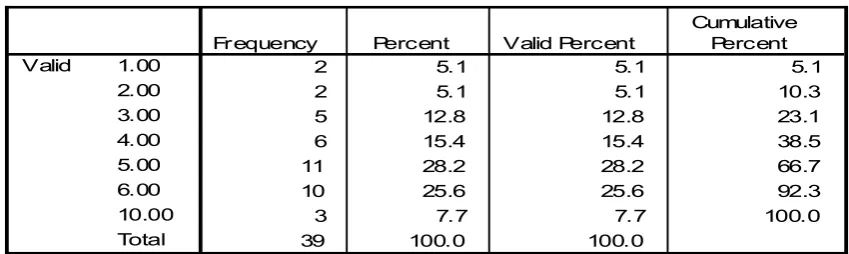
Table 5. Reading Comprehension
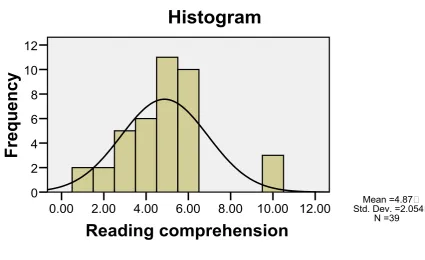
The results displayed in the above table show that 23% of participants have low reading comprehension, 69/2% have moderate reading comprehension, and 7/7% have high reading comprehension.
2 5.1 5.1 5.1
2 5.1 5.1 10.3
5 12.8 12.8 23.1
6 15.4 15.4 38.5
11 28.2 28.2 66.7
10 25.6 25.6 92.3
3 7.7 7.7 100.0
39 100.0 100.0
1.00 2.00 3.00 4.00 5.00 6.00 10.00 Total
Valid Frequency Percent Valid Percent
[image:6.595.91.516.473.600.2]Frequencies
Table 6. Test anxiety
As can be observed in this table, 20/6% of participants have low anxiety, 53/2% of them have moderate anxiety, and 25/8% of participants have high anxiety. This is also presented in the below graph.
Reading comprehension
12.00
10.00
8.00
6.00
4.00
2.00
0.00
Frequency
12
10
8
6
4
2
0
Histogram
Mean =4.87 Std. Dev. =2.054
N =39
1 2.6 2.6 2.6
2 5.1 5.1 7.7
1 2.6 2.6 10.3
2 5.1 5.1 15.4
1 2.6 2.6 17.9
2 5.1 5.1 23.1
2 5.1 5.1 28.2
2 5.1 5.1 33.3
1 2.6 2.6 35.9
3 7.7 7.7 43.6
2 5.1 5.1 48.7
1 2.6 2.6 51.3
3 7.7 7.7 59.0
2 5.1 5.1 64.1
1 2.6 2.6 66.7
2 5.1 5.1 71.8
1 2.6 2.6 74.4
1 2.6 2.6 76.9
2 5.1 5.1 82.1
1 2.6 2.6 84.6
2 5.1 5.1 89.7
1 2.6 2.6 92.3
1 2.6 2.6 94.9
1 2.6 2.6 97.4
1 2.6 2.6 100.0
39 100.0 100.0
87.00 95.00 99.00 102.00 103.00 104.00 105.00 107.00 108.00 109.00 110.00 112.00 113.00 116.00 117.00 119.00 120.00 122.00 124.00 125.00 128.00 129.00 133.00 134.00 135.00 Total
Valid Frequency Percent Valid Percent
Reading Comprehension
This graph shows the relationship between reading comprehension and gender. It means that 25% of males got scores between 3 and 6 in reading comprehension, and 50% of females got scores below 4 and 50% of them got scores above 4 in reading comprehension.
Test Anxiety
According to this graph females are more anxious than males. 50% of males have test anxiety between 108 and 119, and females have test anxiety between 118 and 130.
5. Discussion and Conclusions
In this section, the research questions presented in this article are dealt one by one. Each question will be answered based on the findings of the study. First, the results indicated that there is a significant negative correlation between test anxiety and reading comprehension. It can be concluded that the higher the level of test anxiety, the lower the level of reading comprehension and vise versa. As the level of anxiety increases the individual may lose concentration, may experience difficulty in reading comprehension. So the results of this study support previous established beliefs. For example, Keoghi, Bond, French, Richards and Davis (2004) found that test anxiety is related to reading comprehension test performance. In another study [31] found among students, that all subjects with a high level of test anxiety had poor reading comprehension test performance.
Second, the results indicated that gender plays a significant role in test anxiety. In this study, females were found to be more anxious than males. This findings echoes similar findings reported in research concerning the relation between test anxiety and gender. For instance, [9], who investigated English writing anxiety in Taiwanese learners, discovered that females were significantly more anxious than males. However, in this study the results contrasts with some other studies in which no significant relation between language anxiety and gender. For example Dewaele (2002) indicated that gender did not correlate significantly with anxiety in either French or English as a foreign language. Elkhafaifi's study (2005) indicated similar findings with females being more anxious than males. Yet, Mastuda and Gobel (2004) investigated language anxiety in 252 university students majoring in English and found no significant effect of gender on student's anxiety.
Third, the results also indicated that gender plays a
Test anxiety
140.00
130.00
120.00
110.00
100.00
90.00
80.00
Frequency
8
6
4
2
0
Histogram
Mean =113.08 Std. Dev. =11.435…
gender
females males
Readi
ng
com
prehensi
on
10.00
8.00
6.00
4.00
2.00
0.00
6 23
25
gender
females males
Test
anxi
et
y
140.00
130.00
120.00
110.00
100.00
90.00
significant role in Iranian EFL student's reading comprehension scores. [5] indicated that reading performance, as measured by recall comprehension, was significantly influenced by passage content and readers’ gender, whereas enjoyment and interest mattered little. Moreover, [36] explored whether there were any gender-differences on measures of cognitive ability and science achievement among 1,651 male and female high school students. They found that males scored higher than females on measures of science knowledge, state science test, and passage comprehension. The current study has examined to what extent test anxiety influences reading test performance. Furthermore, it has studied the role of gender on reading comprehension and on test anxiety. Participants took a reading performance test, and answered a type of questionnaire intended to measure test anxiety. Results have revealed that there is a negative and significant relationship between test anxiety and reading comprehension test. In addition, in this study females were found to be more anxious than males and males were found to have better reading comprehension than females.
REFERENCES
[1] Abu-Rabia, S. (2004). Teachers’ role, learners’ gender differences, and FL anxiety among seventh-grade students studying English as a FL. Educational Psychology.
[2] Alpert, R., & Haber, R. (1960). Anxiety in academic achievement situations. Journal of Abnormal and Social Psychology.
[3] Bachman (1990) Fundamental Considerations in Language Testing. Oxford: Oxford University press.
[4] Bembenutty, H. (2008) Self Regulation of Learning and Test Anxiety. Psychology Journal.
[5] Brantmeier, (2003). Does Gender Make a Difference? Passage Content and Comprehension in Second Language Reading.
[6] Brown, H.D. (2001). Teaching by principles: An interactive approach to language pedagogy. New York: Addison Wesley Longman
[7] Chapell (2005). Test- anxiety and academic achievement in undergraduate and graduate students, Journal of Education psychology.
[8] Chastain, K. (1988). Affective and ability factors in second language acquisition. Language Learning.
[9] Cheng (2002). Language anxiety: Differentiating Reading and speaking components. Language Learning
[10] Cheung, A., & Slavin, R.E. (2005). Effective reading programs for English language learners and other language minority students. Bilingual Research Journal.
[11] Daly, J. (1991). Understanding communication apprehension: An introduction for language educators. Elaine K. Horwitz & Dolly J. Young, Dolly [12]J. (Eds.),Language Anxiety: From
theory and research to classroom implications
[12] Dewaele, J. M. (2002) ‘Psychological and socio demographic correlates of communicative anxiety in L2 and L3 production’, International Journal of Bilingualism.
[13] Eastman, J.K. (1991). Learning to read and comprehend: The beginning stages.
[14] Elkhafaifi, H. (2005). Listening comprehension and anxiety in the Arabic language classroom. The Modern Language Journal
[15] Gobel, P., & Matsuda, S. (2004) ‘Anxiety and Predictors of Performance in the Foreign Language Classroom’, Science Direct Journal.
[16] Gupta, R. (1998).Writing with a different tool. In C. S.Ward and W. A. Renandya (Eds.)
[17] Horwitz, E. K. (2001) ‘Language Anxiety and Achievement’, Annual Review of Applied Linguistics.
[18] Hembree, R. (1988). Correlates, causes, and treatment of test anxiety. Review of Educational Research
[19] Horwitz, E. K., Horwitz, M. B., & Cope, J. A. (1986) ‘Foreign Language Classroom Anxiety’, The Modern Language Journal.
[20] Hancock, D. (2001). Effects of Test Anxiety and Evaluative Threat on Students' Achievement and Motivation. The Journal of Educational Research.
[21] Hsu, Y.C. (2004). A study on junior college students’ reading anxiety in English as a foreign language. Unpublished master’s thesis, National Chung Cheng University, Chiayi, Taiwan
[22] In’nami, Y. (2006). The effects of test anxiety on listening test performance.
[23] Keoghi Bond, French, Richards and Davis. (2004) Test-Anxiety, Susceptibility to destruction and examination performance, Journal of anxiety, stress and coping
[24] Kim, J-H. (2000). Foreign language listening anxiety, The University of Texas at Austin.
[25] Kleinmann, H.H. (1977). Avoidance behavior in adult second language acquisition. Language Learning.
[26] Klingner, J. K., Artiles, A. J., & Méndez Barletta, L. (2006). English language learners who struggle with reading: Language acquisition or learning disabilities? Journal of Learning
[27] Krashen, S. D. (1985) The Monitor Theory: Issues and Implications.
[28] Lowe, P.A., Lee, S.W., Witteborg, K.M., Pritchard, K.W., Luhr, M.E., et al. (2008) The Test Anxiety Inventory for Children and Adolescents (TAICA): Examination of the psychometric properties of a new multidimensional measure of test anxiety among elementary and secondary school students. Journal of Psycho educational Assessment.
[29] Levitt, E.E. (1980). The psychology of anxiety (2nd ed.) [30] MacIntyre, P., & Gardner, R. C. (1991) ‘Investigating
[31] May, R. (1977). The measuring of anxiety (rev. ed.). New York: Norton.
[32] Mazzone,L,.Ducci,. F., Scoto,M.C,. Passaniti,E,. D'Arrigo,V.G. and [32]Vitiello,B. (2007). The role of anxiety symptoms in school performance in a community sample of children and adolescents. BMC Public Health
[33] Morris, L. W., Davis, M. A., & Hutchings, C. H. (1981). Cognitive and emotional components of anxiety: literature review and a revised worry-emotionality scale. Journal of Educational Psychology
[34] Na, Z. (2007). A study of high school students’ English learning anxiety. Asian EFL Journal.
[35] Nagle, S. J., & Sanders, S. L. (1986). Comprehension theory and second language pedagogy. TESOL Quarterly.
[36] Nunan, David" Second language teaching & learning (2001) [37] O'Reilly, T., & McNamara, D. S. (2007). The impact of
science knowledge, reading skill, and reading strategy knowledge on more traditional "high-stakes" measures of high school students' science achievement. American Educational Research Journal.
[38] Price, M. L. (1991) ‘The Subjective Experience of Foreign Language anxiety: Interviews with High Anxious Students’, in Horwitz, E.K.
[39] Sarason, S. B., Mandler, G., & Craighill, P. G. (1952). The effect of differential instructions on anxiety and learning. Journal of abnormal and social psychology Sarason,I.G. (1978). The Test Anxiety Scale: concept and research. In CD. Spielbeger & I.G.Sarason (Eds), Stress & Anxiety. Washington DC: hemisphere
[40] Shomoossi, N., & Kassaian, Z. (2009). Variation of test anxiety over listening and speaking test performance. Iranian Journal of Language Studies (IJLS), 3(1), 65-78
[41] Scovel, T. (1978). The effect of affect on foreign language learning: A review of the anxiety research. Language Learning.
[42] Richards, J. C. & Rodgers, T. S. (2001).Approaches and Methods in Language Teaching (Second Edition). Cambridge: Cambridge University Press.
[43] Tobias, S. (1986). Anxiety and cognitive processing of instruction. In R. Schwarzer (Ed.), Self related cognitions in anxiety and motivation
[44] Von Worde, R. (2003). Students’ Perspectives on Foreign Language Anxiety.
[45] Wei, M. (2007). The interrelatedness of affective factors in EFL learning: An examination of motivational patterns in relation to anxiety in China. TESL-EJ
[46] Williams, K. (1983). Anxiety and formal second/foreign language learning. RELC Journal: A Journal of Language Teaching and Research in Southeast Asia.
[47] Woolfolk, A.E. (1995), Educational psychology (6thedition): Allyn and Bacon.
[48] Young, D. J. (eds.)Language Anxiety: From Theory and Research to Classroom Implications. Englewood Cliffs, NJ: Prentice Hall