International Journal of Emerging Technology and Advanced Engineering
Website: www.ijetae.com (ISSN 2250-2459, Volume 2, Issue 8, August 2012)225
E-Governance: An Approach towards the Integration of
Higher Education System in India
Prateek Bhanti
1, Dr. S. Lehri
2, Dr. Narendra Kumar
31Research Scholar, 3Assistant Professor, FASC-MITS, Lakshmangarh, Sikar (Raj.) 2Director, IET, Dr. B.R. Ambedkar University, Agra
Abstract - E-Governance is understood as a set of activities involving the effective contribution of information and communication technology (ICT) for strengthening administration and management in higher education system in India has declined somewhat over the past three decades due to tremendous increase in the number of colleges and universities and their privatisation. It has become very important for the government to keep track of their functioning. This paper intends to propose a roadmap to the implementation of an e-governance framework for monitoring, regulating and better administration in Indian higher education system.
KeyWords - E-Governance, Regulatory, Framework, MIS, Open Portal, digital divide.
I. INTRODUCTION
E-Governance refers to the process of using Information Technology(I.T.) for automating the internal operations of the government and external interaction with citizen and other businesses. Automation of internal operation reduces their cost and improves their response time while at the same time it allows government processes to be more elaborate in order to increase their effectiveness. Automation of interaction with the citizens reduces the overheads for both the government and the citizens. E-Governance can also be defined as the application of electronic means in the following:
Monitoring the performance of various schemes started by government from time to time Interaction between government - citizens and
government-business
Simplification processes of the government Internal government operations to simplify and
improve democratic, government and business aspects of governance
II. NEED OF E-GOVERNANCE
The state of Indian higher education has been examined by a number of education commissioners and committees and have identified the major problems and suggested the remedial actions [1] for them e.g. the system of affiliation of colleges, followed by most universities, discourages accountability due to lack of proper monitoring facilities.
When we talk of the Indian Higher Education System (IHS), there is tremendous increase in the number of colleges and universities. There are number of aspects related to the quality education like progression of course, quality of faculty members, research facilities given to teachers and students, number of students, examination system and administration. For any Government, it is very important to keep an eye on the above factors prevailed in any university. Although there are number of regulating agencies like UGC, AICTE, MCI, Pharmaceutical Council of India, BCI etc. which monitors the performance of the university on an overall basis. The quality factors are also assessed before giving NOC to the universities or also before renewing the recognition/affiliation. On these metrics, the universities and colleges are asked to explain the reason for good or bad performance. Presently, the current procedure compels universities to submit the documents to UGC, MHRD, and AICTE etc. separately for various reasons like approvals/renewal of recognition, resulting in wastage of time and lot of stationary. Ideally, a single window should exist for approval process of performance measurement. The need is to deliver services at the doorstep making it hassle free transparent and to facilitate decision makers to get all analysis and decide. As a result of such type of governance, there may be perceptible changes in both administrative and academic output of the department. Minimization of human intervention and discretion exhibits a fair, transparent accountable and responsive system. E-Governance is not doing all the activities on-line or other sort of computerization but it is actually the way to rethink and re-engineer the existing structure of the system of higher education in India with its functions, processes, etc. The fundamental difference between the computerization and e-governance is that the former seeks to replace existing processes by their electronic counterparts. The latter looks at the needs of citizens and introduces systems that can precisely meet those needs. It is the difference between citizen centric and computer centric. [2]
International Journal of Emerging Technology and Advanced Engineering
Website: www.ijetae.com (ISSN 2250-2459, Volume 2, Issue 8, August 2012)226
Faculty/ Deptt
Registrar
Finance & a/c
Exam
Planning & Development
R&D
The introduction of e-governance in higher education is one such concept that can empower the governing bodies to administer the progress of the education plan in the whole country and serves various stakeholders in a much better ways.
III. REMEDIAL TREATMENT
Governments around the world are fully aware of the benefits of employing e-governance for improving public sector management practices and relationships with internal and external stakeholders. E-Governance is becoming a global phenomenon that is increasingly attracting the attention of community citizens including politicians, economists, decision and policy makers amongst others (Naheed et al., 2009) [3].
According Info Dev Report (2002) [4] an effective e-governance satisfies these following needs:
Providing greater access to government information;
Promoting civic engagement by enabling the public to interact with government officials;
Making government more accountable by making its operations more transparent and thus reducing the opportunities for corruption; and
Providing development opportunities, especially benefiting rural and traditionally underserved communities
E-Governance in higher education system [5] will enable various stakeholders to leverage the improved operational efficiency in various key processes like grants, utilization certificates, approval processes, feedback mechanism etc. With deeper visibility and increased operational efficiency the Indian higher education system (IHS) would be implemented not only to satisfy the needs of students by making them more employable but also combat possible competition from foreign universities.
In order to remove the duplication of procedures, there should be consolidated information about each university and college to track their performance. The tools of e-governance may enable the universities or colleges to submit the documents online for approval. All agencies should internally co-ordinate to fetch the details from common pool. This would greatly reduce the unnecessary duplication of work in the university. Apart from this there may be a number of other services that can be provided with the introduction of such type of governance.
The quest to implement e-governance is motivated by policy goals of increased effectiveness, efficiency, and information quality, improved interaction mechanisms, and in turn better governance tools (Grant, 2005 and Gronlund, 2005)[6][7].
To ensure better functioning, many governments have embarked many e-governance models, upon ICT strategies (UN- Government Survey, 2008)[8]. For example, Howard (2001)[9] and Lau (2001)[10] proposed an e-governance model that had four major stages: information publishing, two-way communication, transaction, and integration. In a survey conducted by the United Nations (2008) proposed a fivstage of e-governance which are connected , transactional, interactive, enhanced, and emerging.
A. Conceptual framework
Higher education is generally understood to cover teaching, research and extension. Higher education is a source of feeder system in all walks of life and therefore supplies the much needed human resource in management, planning, design, teaching and research. There are different types of decision-makers, like students, parents, employers, legislators, planners and administrators, who are continuously engaged in the process of educational planning and management. It is important for each one of them to have reliable and relevant information they require for decision-making vis-à-vis education. But more importantly, it seems necessary that each group may be well aware about the information that others may possess. It is their mutual inter-action that makes the decision-making actually effective.
One of the prerequisite for the framework of e-governance is the understanding of various functional units (Figs. 1 and 2).The successful implementation of framework will heavily depends upon the identification of its components. The following figure depicts the functional interactivity between Government and its stakeholders.
[image:2.595.317.535.535.699.2]`
Fig. 1: Interaction between Functional units and Government[11]
Univer
si
ty
/ Go
vern
me
International Journal of Emerging Technology and Advanced Engineering
Website: www.ijetae.com (ISSN 2250-2459, Volume 2, Issue 8, August 2012) [image:3.595.60.272.201.282.2]227 The proposed e-governance framework aims to provide an integrated approach to the higher education by leveraging ICT, for the development of higher education in the country.
Fig. 2 .Road map for E-Governance
B. Computerization at University Level:
[image:3.595.61.261.414.574.2]The computerization at the university level can be seen in the context of three levels i.e. Student, staff, and administration. The management of information among these units is a challenging task which can be easily dealt with computerization. The purposes of computerization may be summarized as (Fig. 3)
Fig. 3. Computerization of university
In view of limited resource and revenue, the computerization of universities would be more challenging. The digital divide will multiply this challenge in reaching a larger segment of the stakeholders, especially the students. Lack of infrastructure, scarcity of local technical expertise, unnecessary bureaucratic and weak legal supports, makes it more difficult for universities in India to implement e-governance [11].
C. Information Management:
Information management (IM) is the collection and management of information from one or more sources and the distribution of that information to one or more audiences.
Management means the organization of and control over the structure, processing and delivery of information management in higher education should include
Information about the Regulatory bodies under Ministry
Information about the norms / rules / regulations / deadlines pertaining to courses, funds etc Information about the faculty members of all
universities
Information about the courses / syllabi
Information about admission in various universities
Online submission of applications Library resources
Result
Activities including seminars / conferences / alumni
Information on the schemes of central Govt.(U.G.C.) like career advancement
Information related to internal staff on departmental procedures like G.P.F., advance, pension, V.R.S., retirement benefits etc.
Information about the courses been offered in the various government aided and self finance colleges, admission criteria, fee structure, extra- curricular activities being offered in each of the colleges
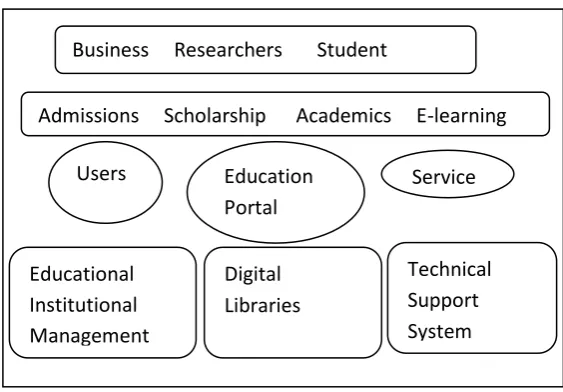
Web Based Content / Open Portal
fig. 4. Block diagram of web based content/open portal
This will provide the online access to the information to the stakeholders like placement agencies, business, researchers, faculty, parents, peer universities, other co-ordinating and accreditation bodies etc. (Fig. 4).
Users
Service
s
Business Researchers Student
faculty Parents
Admissions Scholarship Academics E-learning
Examinations
Education
Portal
Educational
Institutional
Management
System
Digital
Libraries
[image:3.595.295.577.471.667.2]International Journal of Emerging Technology and Advanced Engineering
Website: www.ijetae.com (ISSN 2250-2459, Volume 2, Issue 8, August 2012)228 With the help of proposed framework it is possible to design a system that is student centric and can provide a variety of services—informative, interactive, transactional and integrated system across the entire spectrum of the education sector.
Central Universities, State Universities, Autonomous Institute, Deemed and Private universities and affiliated colleges will enter the data and caters the need of MIS of regulating and co-ordinating bodies. The data collected from various IHE will be diverse and may be classified as follows:
Students‘Data (Enrollnment no, Name, Father‘s name etc.
Statistics of students i.e. number of current students categorised on the basis of each course, passed out students etc
Institute‘s Data i.e. name, type, location ,number of staff etc
Research Data Course Data
D. Online Management Information System(Online MIS):
Integrated MIS may have the following modules: Admission and student details
Student management system Faculty profile
Subjects / courses offered along with examination results
Knowledge resources including library Affiliation function
Administrative functions Personnel management system
Budget / accounts / finance / treasury and audit system
Smart card based system for the students and staff. it can be used by the authorized person only (having
biometric feature like finger print etc)
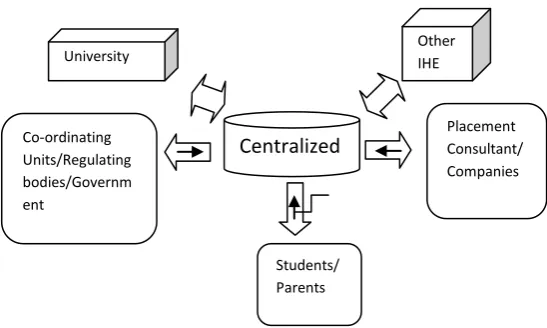
The data related to the student‘s personal record, finance, infrastructure, academics etc is collected from many different divisions of universities, colleges, autonomous bodies and other institute of higher education. This data is stored and made available for various other services of e-governance (Fig.5).
[image:4.595.289.563.140.304.2]
Fig. 5. Block diagram for data base storage
Users can tap the system and find out the related information needed. The higher education co-ordinating and regulating bodies could obtain the reports on various issues about future planning like budget, demand of courses etc.
The regulatory body has a critical role to play according to this model. These units will be responsible of data integration and will cater the need of various stakeholders. Following are the main activities required in this process.
The MIS working at this level in the model will provide the following information to the regulating and accreditation bodies
Various mathematical and computational methods may be used to obtain the plan for the development of higher education.
Information related to fund allocation, granting recognition, affiliation etc will be provided to the regulating authorities.
The fund utilization by college or university can be monitored online and analyzed even on monthly basis.
An online grievance redresser system can be made in case of some grievances with the College/University.
Centralized
database
Other IHE University
Co-ordinating Units/Regulating bodies/Governm ent
Placement Consultant/ Companies
International Journal of Emerging Technology and Advanced Engineering
Website: www.ijetae.com (ISSN 2250-2459, Volume 2, Issue 8, August 2012)229 IV. CONCLUSION
Following are the main services that can be provided by implementing above type of governance system. With the help of e-governance, the process of
allocation of fund can be made automated or time bound. All details needed for the approval of funds can be fetched by centralized system.
Centralized database of students will provide better opportunities to the bright students.
E-Governance is one such concept that can empower the government to plan the development of education system in whole country.
The governing bodies can very easily develop a mechanism to analyze which course is in heavy demand in a particular area or region.
The information obtained can help the government in analyzing employment versus passing graduates ratio. Government can plan the generation of employment according to the passing graduates in the country.
E-Governance interface can be used to get the feedback from the students related to course and performance of university. This will help to keep an eye on the institute in remote areas and help them in their full development.
e-governance will remove the need of Transfer certificates or Migration and reduce unnecessary administrative work and paper work
Interlinking of universities will enable regular updating of curriculum. Common curriculum can also be improvised.
REFERENCES
[1 ] Kumar A. and Kumar A., ―IT based knowledge management for
institutions of higher education: A need,‖ University News, Vol. 43, No. 30, pp.4-5, 2005.
[2 ] Satyanarayana J., ―E-Government: the science of the possible,‖
PHI, New Delhi, P-6, 2004.
[3 ] Naheed, A.Z., Sherif, K., and Georgios D., ―A Suggested
Framework for Assessing Electronic Government Readiness in Egypt‘, Electronic Journal of e-Government, Vol. 7 Issue 1, 2009.
[4 ] Info Dev Report (2002) ‗The E-government Handbook for
developing countries.‘ Available:
http://cdt.org/egov/handbook/2002-11-14egovhandbook.pdf [accessed 3rd December 2007].
[5 ] Rajeev S., ―e-governance in higher education‖, published at
http://egov- coe.ncc.gov.ph/index.php? option= com_content& task=view&id=55&Itemid=1.
[6 ] Grant, G., and Chau, D., ―Developing a Generic Framework for
e-Government,‖ Journal of Global Information Management, Vol. 13(1), pp.1-30, 2005.
[7 ] Gronlund, A. and Horan, T., ―Introducing e-Gov: History,
Definitions, and Issues‖, Communications of the AIS, Vol. 15(39), pp. 713-729, 2005.
[8 ] UN E-Government Survey (2008) ‗From E-Government to
Connected Governance.‘Available: http://unpan1.un.org/intradoc/
groups/public/documents/un/unpan028607.pdf [accessed 1st
November 2008].
[9 ] Howard, M., ―E-government across the globe: how will ‗E‘
Change governments?‖, Government Finance Review, Vol. 17(4), 6–9, 2001.
[10 ]Lau, E., ―Online government: a surfer‘s guide‖, Organization for
Economic Development, Vol. 224, pp. 46–47, 2001.
[11 ]Subrata Kumar Dey et al., ―Conceptual framework for Introducing
![Fig. 1: Interaction between Functional units and Government[11]](https://thumb-us.123doks.com/thumbv2/123dok_us/8741221.889679/2.595.317.535.535.699/fig-interaction-functional-units-government.webp)