Journal of Chemical and Pharmaceutical Research, 2016, 8(10):112-116
Research Article
CODEN(USA) : JCPRC5
ISSN : 0975-7384
112
Constrained Liner in Total Hip Arthroplasty
Babak Siavashi
1, Ehsan Pendar
2, Mohammad Reza Golbakhsh
1*, Dariush Gouran
Savadkoohi
1, Mohammad Javad Zehtab
1and Mir Mostafa Sadat
11
Department of Orthopedic Surgery, Tehran University of Medical Sciences, Sina Hospital, Tehran, Iran
2Orthopedic Surgeon, Tehran University of Medical Sciences, Sina Hospital, Tehran, Iran
_____________________________________________________________________________
ABSTRACT
Aim: Performing total hip artroplasty is possible even without or in weak hip abductor muscles. In nonfunctioning or malfunctioning hip abductors, the solution is dual mobility total hip arthroplasty or constrained liner. Methods: primary or revision total hip arthroplasty which needed constrained liner during 2005-2014 were included in this study. Harris hip score (pre-operative, post-operative), leg length discrepancy, type of cup (cemented or cementless), type of stem (standard or long) and approach were considered. Results: according to the results, Harris hip score improved significantly (from 54 to 88, average) after surgery. During the study, disengagement of head from the stem was seen in one case. Also, in a patient, hip dislocation observed. One case of component loosening and failure was detected. In a patient, retro-acetabular osteolysis was seen. Additionally, there was one case with deep infection. Conclusion: these results suggest functional hip score improved dramatically using constrained liner in patients with low complication rate.
Keywords: Constrained liner; Total hip arthroplasty
____________________________________________________________________________
INTRODUCTION
Total hip arthroplasty is an orthopedic procedure includes the surgical excision of the proximal neck and head of the femur and removal of the subchondral bone and acetabular cartilage [1]. In the past years, lack of abductor function was a contraindication for total hip arthroplasty [2] but todays with newer devices, it is not an absolute contraindication. Performing total hip arthroplasty is possible even without or in face with weak hip abductor muscles of hip joint [2]. Different factors are responsible for abductor malfunction including in the central nervous level with viral or autoimmune diseases such as poliomyelitis [3-5] and multiple sclerosis [6] or cerebral palsy with resultant abductor paralysis [7-9] or peripheral tissue injury to innervations of abductor muscles [superior gluteal nerve]. For instance, abductor muscle or its attachment to greater trochanter may be injured during exposure or from previous surgeries around hip and pelvis [10-12]. Additionally, greater trochanteric fracture nonunion and abductor muscle contractures which cannot be released are other causes of abductor nonfunctioning [13-15].
113
is reported constrained liner leads in 97.6% success rate (83 of 85 hips) in a 4.8 years period [25]. So, the aim of the current study was to determine effect of ten years application of constrained liner in total hip arthroplasty in patients referred to Sina hospital.
MATERIALS AND METHODS
This study was ten years follow up application of constrained liner in total hip arthroplasty in patients referred to Sina hospital, Tehran, Iran during 2005-2014. Twenty three patients met the criteria (17 males and 6 females) included into the study. The average age of the patients was 48±1 years (23-74 year) with primary or revision total hip arthroplasty needed constrained liner. Patient-specific variables including age and sex was recorded. Causes of using constrained liner, Harris Hip Score (pre-operative, post-operative), Leg length discrepancy, type of cup (cemented or cement less), type of stem (standard or long) and surgical approach were considered.
Follow up visits were done every six months and hip dislocation, disengagement of head from the stem, component loosening, osteolysis, infection and component failure were studied. Average follow up period was 5.5 years (1-9 years).
RESULTS
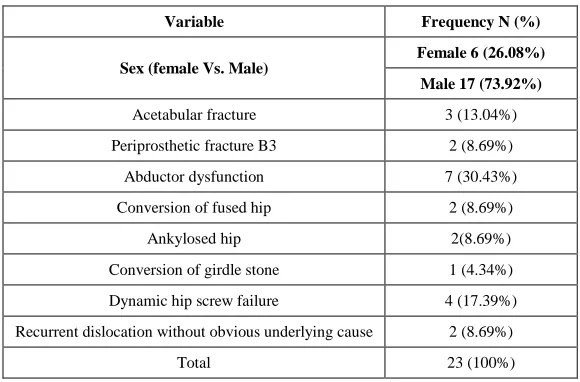
[image:2.612.161.451.380.571.2]In this study, three cases of total hip arthroplasty after acetabular fracture, two cases of periprosthetic fracture B3, seven patients with abductor dysfunction or weakness due to multiple sclerosis, poliomyelitis and cerebral palsy, two cases of conversion of fused hip to total hip arthroplasty, two cases of total hip arthroplasty in ankylosed hip, one case of conversion of girdle stone to total hip, four cases of total hip arthroplasty after dynamic hip screw failure and two patients with recurrent dislocation without obvious underlying cause and failed multiple operations were underlying disorders for using constrained liner included in this study.
Table 1: The specific variables of the patients included into study
Variable Frequency N (%)
Sex (female Vs. Male)
Female 6 (26.08%)
Male 17 (73.92%)
Acetabular fracture 3 (13.04%) Periprosthetic fracture B3 2 (8.69%)
Abductor dysfunction 7 (30.43%) Conversion of fused hip 2 (8.69%)
Ankylosed hip 2(8.69%)
Conversion of girdle stone 1 (4.34%) Dynamic hip screw failure 4 (17.39%) Recurrent dislocation without obvious underlying cause 2 (8.69%)
Total 23 (100%)
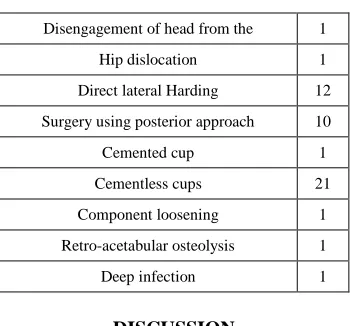
The mean preoperative Harris hip score was 54 which increased to 88 postoperatively. There average leg length discrepancy was 1.5 cm. In one case, disengagement of head from the stem and in one case, hip dislocation was seen. Direct lateral Harding approach was used in 12 patients and the other ten were gone under surgery using posterior approach.
Seven long and 15 standard stem were used. There were one cemented cup and 21 cementless cups which three of them had cemented liner inside.
114
Table 2: The frequency of injury in patients
Disengagement of head from the 1 Hip dislocation 1 Direct lateral Harding 12 Surgery using posterior approach 10
Cemented cup 1
Cementless cups 21 Component loosening 1 Retro-acetabular osteolysis 1
Deep infection 1
DISCUSSION
Among patients with acetabular fracture, one case had greater trochanteric nonunion after previous trochanteric osteotomy for acetabular surgery and two of them had abductor muscle scars; thus malfunctioning abductors and constrained liner was used. In periprosthetic B3 fracture, because of severe deficiency of bone stock in proximal
femur and insecure fixation of greater trochanter remnants to the implant or proximal femoral allograft, it is necessary to use constrained liner [26].
The use of long stem is also obligatory. Among patients with multiple sclerosis or other neuromuscular disorders such as poliomyelitis or cerebral palsy, if the patient is ambulate, total hip arthroplasty can be done but because of abductor weakness, constrained liner is a good option to prevent dislocation [27]. In these cases, it is wise to use direct lateral approach [28-31] and release flexors and adductors of the hip [30,31], put the acetabular component in more than usual anteversion [33-35] and if there is instability, constrained liner can be used. Among patients undergo total hip arthroplasty after failure of dynamic hip screw, different problem may involve the greater trochanter of femur such as fracture in the first trauma and resultant nonunion or fracture during exposure of the hip joint and acetabular reaming due to the large hole of DHS nail [36,37].
Thus, if the greater trochanter cannot be fixed to the femur, it results in abductor malfunctioning and need to be supported with constrained liner. Also, in conversion of the fused or ankylosed hip to total hip arthroplasty, there may be acetabular malfunctioning either from long standing fusion and abductor muscle atrophy or as a result of damage to abductor muscles during fibrosed tissues from previous surgeries [38-40].
We believe that functional hip scores improve dramatically in post-operative period without any additional complications such as loosening or component failure. In this study, the cemented cup inside cementless shell in three cases [41-42]. Because of recurrent dislocation of prosthesis, we planned revisional surgery for correction of cup malposition, but the cup was well fixed and the proper size constrained liner was not available, so we inserted constrained liner with cement inside the metal back. During the insertion of constrained liner with cement, one may pay attention to prevent cement entrance in the ring portion; this may interferes with locking of the ring around head and leads constrained liner be nonfunctional.
One dis engagement of the head from the stem was seen which means if soft tissue tension around the hip joint is not sufficient, the limb may be stretched and despite remaining of the head inside the constrained liner, the head can be disengaged from the stem [43-46].One complete displacement of whole cup and screws was seen in the follow up period.
CONCLUSIONS
115 REFERENCES
[1] Fottner, A., Utzschneider, S., Mazoochian, F., von Schulze, P.C., Jansson, V. Z. Orthop. Unfall. 2010, 148, 168-173.
[2] Canale T, Beaty JH. Campbell's Operative Orthopaedics, 12th edition, Elsevier saunders, 2012, 159.
[3] Krautwurst BK, Wolf SI, Heitzmann DW, Gantz S, Braatz F, Dreher T. Res Dev Disabil, 2013, 34(4), 1198-1203.
[4] Kenny P, O’Brien, P, Synnott K, Walsh MG. J Bone Joint Surg Br, 1999, 81(6), 979-981. [5] Metaxiotis D, Accles W, Siebel A, Doederlein Ld. Gait & Posture, 2000, 11(2), 86-91.
[6] Niemuth, Paul E, Johnson, Robert J Myers, Marcella J, Thieman. Clin J Sport Med, 2005,; 15(1), 14-21. [7] Bakshi R, Shaikh ZA, Miletich RS. Mult Scler, 2000, 6(3), 181-185.
[8] Lonstein JE, Beck R. J Pediatr Orthop, 1986, 5, 521-526.
[9] Karol LA. Tachdjian's Pediatric Orthopaedics, 5th edition, Elsevier saunders, 3, 35. [10] Moeina A, MHJ. Verhofstada, Bleysb , Chr van der Werken. J Injury, 2004, 7, 52. [11] Masonis, John L, Bourne, Robert. Clin Orthop Relat R,2002, 405, 46-53.
[12] Jacobs LG, Buxton RA. J Bone Joint Surg Am, 1989, 71(8), 1239-1243. [13] AS Baker, VC Bitounis. J Bone Joint Surg Br, 1989, 71(1), 47-50.
[14] Ritter, Merrill A Gioe, Terence J, Stringer, Elizabeth A. Clin Orthop Relat R, 1981, 159, 177-182. [15] RW Nutton, RG Checketts. J Bone Joint Surg Br, 1984, 66(2), 180-183.
[16] Olivier Guyen , Vincent Pibarot , Gualter Vaz , Christophe Chevillotte , Jacques Béjui-Hugues. Clin Orthop Relat R, 2009, 467(2), 465-472.
[17] Moussa Hamadouche, David J Biau, Denis Huten, Thierry Musset, François Gaucher. Clin Orthop Relat R,
2010, 468(12), 3248-3254.
[18] Claude Vielpeau, Benoit Lebel, Ludovic Ardouin, Gilles Burdin, Christine Lautridou. Int Orthop 2011, 35(2), 225-230.
[19] M Wade Shrader, Javad Parvizi, David G Lewallen . J Bone Joint Surg Am, 2003, 85(11), 2179-2183. [20] Michael J Anderson, William R Murray, Harry B Skinner. J Arthroplasty, 1994, 9(1), 17–23.
[21] Bertrand P Kaper, Philip M Bernini, Lebanon. J Bone Joint Surg Am, 1998, 80(4), 561-565.
[22] Keith R Berend, Adolph V Lombardi Jr, Thomas J Mallory, Joanne B Adams , Jackie H Russell. J Arthroplasty, 2005, 20(3), 93-102.
[23] Craig J Della Valle, Dennis Chang, Scott Sporer, Richard A Berger, Aaron G Rosenberg, Wayne G Paprosky. J Arthroplasty, 2005, 20(3), 103-107.
[24] Ran Schwarzkopf, Julius K. Oni, Scott E. Marwin. B Hosp Joint Dis Ort, 2013, 71(1), 68-78.
[25] Javad Parvizi, Venkat R, Rapuri James J Purtill, Peter F Sharkey, Richard H Rothman, William J Hozack. J Bone Joint Surg Am, 2004, 86(suppl 2), 8-16.
[26] Su EP, Pellicci PM. Clin Orthop Relat Res, 2004, 420, 122-129.
[27] Springer BD , Berry DJ, Lewallen DG. J Bone Joint Surg Am, 2003, 85, 2156-2162. [28] Mccollum, Donald E, Gray, William J. Clin Orthop Relat R, 1990.
[29] GE Lewinnek, JL Lewis , R Tarr , CL Compere , JR Zimmerman. J Bone Joint Surg Am, 1978, 60(2), 217-220. [30] RY Woo, BF Morrey. J Bone Joint Surg Am, 1982, 64(9),1295-1306.
[31] Kwon Michael S, Kuskowski Michael, Mulhal Kevin J, Macaulay, Clin Orthop Relat R, 2006, 447, 34-38. [32] Maximillian Soong, Harry E Rubash, William Macaulay. J Am Acad Orthop Surg, 2004, 12(5), 314-321. [33] G Hartofilakidis, K Stamos, TT Ioannidis. J Bone Joint Surg Br, 1988, 70(2), 182-186.
[34] Buly Robert L, Huo Michael, Root Leon, Binzer, Thomas Wilson, Philip D. Clin Orthop Relat R, 1993, 296(2), 312.
[35] Lewinnek GE, Lewis JL, Tarr R, Compere CL, Zimmerman JR. J Bone Joint Surg Am, 1978, 60(2), 217-220. [36] R Biedermann, A Tonin, M Krismer, F Rachbauer, G Eibl, B Stöckl. J Bone Joint Surg Br, 2005, 87 (6), 762-769.
[37] Tabsh, Ibrahim, Waddell, James P, Morton, Jane. J Orthop Trauma, 1997, 11(3), 166-169.
[38] Akram HAMMAD, Ahmed ABDEL-AAL, Hatem G SAID, Hatem BAKR. Acta Orthop Belg, 2008, 74, 788-792.
[39] RS Bisla , CS Ranawat , AE Inglis. J Bone Joint Surg Am, 1976, 58(2), 233-238. [40] Fhkam W M, Tang, KY Chiu. J Arthroplasty, 2000, 15(1), 52-58.
[41] S Sweeney, R Gupta, G Taylor, A Calin. J Rheumatol, 2004, 28(8), 1862-1866.
116
[43] Paul E Beaulé, Michel J LeDuff, Frederick J Dorey, Harlan C Amstutz. J Bone Joint Surg Am, 2003, 85(12), 2288-2293.
[44] Anthony Spinnickie, Stuart B Goodman. J Arthroplasty, 2007, 22(4), 634-637. [45] David A Fisher, Kevin Kiley. J Arthroplasty, 1994, 9(3), 325-329.