DEVELOPMENT OF KNEE JOINT ANGLE TRAJECTORY TRACKING FOR LEG SUPPORT MECHANISM
WAN MOHD SHUKRI BIN WAN SALLEH
A project report submitted in partial
fulfillment of the requirement for the award of the degree of Master of Electrical Engineering
Faculty of Electrical and Electronic Engineering Universiti Tun Hussein Onn Malaysia
ABSTRACT
iv
ABSTRAK
CONTENTS
TITLE i
DECLARATION ii
ABSTRACT iii
ABSTRAK iv
ABSTRACT iii
ABSTRAK iv
CONTENTS v
LIST OF TABLES viii
LIST OF FIGURES ix
LIST OF APPENDICES xi
CHAPTER 1 INTRODUCTION 1
1.1 Project Background 1
1.2 Problem Statement 2
1.3 Aim and Objective of Project 2
1.4 Scope and Limitation 3
1.5 Organization of Thesis 3
CHAPTER 2 BRIEF REVIEW OF HUMAN SUPPORT DEVICES 5
2.1 Introduction 5
2.2 Lower Limb Impairment Diseases 6
2.2.1 Poliomyelitis and Post-polio Syndrome (PPS) 6
vi
2.3 Convention of Knee Joint Angle 7
2.4 Fundamental of Human Gait Analysis 8
2.5 Overview of Assistive Orthotic and Exoskeleton 9 2.6 Leg Support Mechanism for Walking Assistance 13 2.7 Design Considerations of Walking Assistive Orthotic 15
CHAPTER 3 METHODOLOGY 17
3.1 Introduction 17
3.2 Project Development 17
3.3 System Description 18
3.3.1 Leg Support Mechanism 19
3.3.2 Knee Joint Angle Trajectory 20
3.3.3 DC Actuator 20
3.3.4 Motor Driver Circuit 21
3.3.5 Arduino Microcontroller Board 22
3.4 PID Control Design 22
3.5 System Operation Flowchart 23
CHAPTER 4RESULT AND ANALYSIS 25
4.1 Introduction 25
4.2 Leg Support Mechanism 25
4.3 Knee Joint Angle Measurement Sensor 26
4.4 Real-time Knee Joint Angle Measurement 28
4.5 Trajectory Data of Knee Joint Angle 31
4.6 Actuator Characteristics 33
4.6.1 Modeling of the DC Actuator 35
4.7 PID Controller 37
4.7.2 Step Response 40
4.7.3 Angle Trajectory Tracking Response 41
CHAPTER 5CONCLUSION 45
5.1 Conclusion 45
5.2 Recommendations for Future Work 46
REFERENCES 47
APPENDIX A 49
APPENDIX B 50
APPENDIX C 52
APPENDIX D 55
APPENDIX E 58
viii
LIST OF TABLES
2.1 Comparison between gait assistive orthoses/exoskeleton 12
4.1 Minimum and Maximum Potentiometer Voltage 28
4.2 Matlab GUI Features and Function 29
4.3 Knee Joint Angle Trajectory Point Data 32
LIST OF FIGURES
2.1 Lower Extremities Joints Angle 7
2.2 Phases in gait cycle [8] 8
2.3 Knee joint angle of a gait cycle [9] 9
2.4 HAL-5 LB system configuration 10
2.5 ReWalk 11
2.6 eLEGS 11
2.7 Vanderbilt powered orthotic 12
2.8 Exoskeleton knee torque control system 13
2.9 Knee-ankle-foot orthosis by Hongtao Guo et al. 14 2.10 New version of Knee-ankle-foot orthosis by Hongtao Guo et al. 15
3.1 Project Development Flowchart 18
3.2 System Block Diagram 19
3.3 Leg Support Mechanism with Actuator and Bevel Gear 19
3.4 DC planetary geared motor 21
3.5 DC planetary geared motor characteristic 21
3.6 Motor driver circuit MD10C 21
3.7 Block diagram of PID control system for knee joint angle tracking 22
3.8 System Operation Flowchart 24
4.1 Leg Support Mechanism 26
4.2 Potentiometer for Angle Measurement 27
4.3 Potentiometer Connection 27
4.4 Block Diagram of Real-time Knee Joint Angle Measurement 29 4.5 GUI for Real-time Knee Joint Angle Measurement 29 4.6 Flowchart for Real-Time Knee Angle Measurement 30
4.7 Measured Knee Joint Angle Trajectory 31
4.8 Knee Joint Angle Trajectory for One Gait Cycle 32
4.9 Desired Knee Joint Angle Trajectory 33
x
4.11 Simulink block library for Arduino 35
4.12 Data acquisition hardware setup 36
4.13 System Identification Tool 36
4.14 Tuning a PID Controller 37
4.15 Flowchart for Realization of PID Controller 39
4.16 Dead Time in Step Output Response 40
LIST OF APPENDICES
APPENDIX TITLE PAGE
A Mechanical Drawing of Leg Support Mechanism 49 B Matlab GUI Coding for Knee Joint Angle
Trajectory Measurement 50
C Matlab GUI Coding for Knee Joint Angle
Trajectory Tracking 52
D Arduino Coding for Knee Joint Angle Trajectory
Measurement 55
E Arduino Coding for Knee Joint Angle Trajectory
Tracking 58
F Root Means Squared Error for Different Types of
CHAPTER 1
INTRODUCTION
1.1 Project Background
The study and research about human assistive device or known as orthotics and prosthesis was started since late 1940s, as reported by [1]. The purpose of this device is to help human with disability and impairment problems to perform their Activities of Daily Living (ADL) as normal person such as eating, bathing, dressing and transferring. Examples of transfer activities are sit to stand and stand to sit (STS) movement, walking, stair ascent and stair descent. Many types of orthotics have been designed to assist patients that suffer from upper and lower limb disabilities due to many neuromuscular diseases such as Spinal Cord Injury (SCI), Muscular Dystrophy (MD) and Spinal Muscular Atrophy (SMA). The type of orthotics is categorized according to the supported parts of human body such as Ankle-Foot Orthotic (AFO), Knee-Ankle Foot Orthotic (KAFO), Hip-Knee Ankle Foot Orthotic (HKAFO) and Hip Guidance Orthotic (HGO). The operations of these orthotics are either passive, powered or by using functional electrical stimulation (FES).
obtain the characteristics of knee actuator and design the PID controller of the system. The performance of this assistive device is evaluated by using MATLAB simulation and real time testing on the hardware.
1.2 Problem Statement
Patients who suffer from lower limb impairment problems such as muscle weakness due to Spinal Cord Injury (SCI), muscular dystrophy and Post-polio syndrome have difficulty to perform leg flexion and extension during walking movement. An external physical support device is identified as one of beneficial method to assist the patients to perform both leg flexion and extension as a normal person, mostly by using active powered assistive device.
Active powered assistive device that were developed since years ago show a trend of incorporating a control system that able to control leg flexion and extension during walking movement. The purpose of the control system is to produce movement according to natural human behaviour, increase stability of the system, and reduce power consumption. Among the widely used control systems are PID, fuzzy logic, and genetic algorithm combined with sensory systems as feedback such as actuator encoder and Electromyogram (EMG) signal. However there is a big challenge of using this kind of human physiological signal as feedback which is requiring complex human body modeling algorithm. Therefore this project introduces a more simple yet convincing PID control system with external sensory system to infer intended walking motion of the user.
1.3 Aim and Objective of Project
3 i. To develop a prototype of leg support mechanism consists of thigh and shank braces equipped with knee actuator to provide leg support during walking movement.
ii. To obtain knee joint angle trajectory data for normal healthy person during walking movement.
iii. To develop PID control system for knee joint angle trajectory tracking and evaluate its performance.
1.4 Scope and Limitation
This project is intended to be used by patients with muscle weakness and incomplete paraplegic patients who still have minimum ability to perform walking movement with their own effort.
The project development is focused on the hardware and software implementation based on dynamics and control system theory of joint in the mechanism. The dynamics of the actuator and controller design are obtained from data-driven modeling approach of the system.
The performance of the device that to be evaluated is based on the specification and limitation of proposed mechanism by means of actuator types, control scheme, and sensory feedback method adopted in the system.
1.5 Organization of Thesis
This thesis is organized in five chapters that explain the theoretical aspect and development process of the project. These chapters are arranged in sequence order as follows:
Chapter III: Methodology. This chapter describes the approaches used throughout the development of this project which covers the hardware system of the device and software implementation to control the whole operations of the device.
Chapter IV: Result and Analysis. This chapter presents the findings, observation and data collections of this project. Each result is presented, analysed and discussed part by part based on the sub-topic.
CHAPTER 2
BRIEF REVIEW OF HUMAN SUPPORT DEVICES
2.1 Introduction
Many studies and researches have been conducted regarding the development of human support devices known as orthotics and prosthetics since late 1940s, as reported by [1]. An orthotic is defined as an externally applied device that is designed and fitted to the body in order to achieve control of biomechanical alignment, protect and support and injury, assist rehabilitation and increase mobility. While the term prosthesis refers to an artificial device attached to the body for replacement of missing part [2].
The early study of this area focused on the passive type of orthotics and prostheses, then upgraded to the active type by introducing powered mechanism of the devices. The early development of powered orthotic or known as robotic orthotic began since 1970s, introduced by Miomir Vukobratovic from the Mihailo Pupin Institute in Belgrade who constructed active lower limb assistive device by using hydraulic actuators to provide flexion and extension of the hip, knee and ankle [3]. Recently the term assistive orthotics also called as exoskeleton which means external skeleton that refers to the orthotics that fitted to external human body.
2.2 Lower Limb Impairment Diseases
Many people around the world suffers from various diseases that result in lower limb impairment problems. The category of the diseases can be classified into three types which are peripheral neurological diseases (such as poliomyelitis and post-polio syndrome, spina bifida and poly nueropathy), muscular diseases (such as duchenne muscular dystrophy), and central neurological diseases (such as multiple sclerosis, cerebral palsy and spinal cord injury) [4]. According to [5], the diseases that may require use of assistive orthosis includes cerebral palsy, spina bifida, arthritis, diabetes, spinal cord injury, cerebral vascular accident, peripheral nerve injury, and various ligamenious and tendon injuries.
A brief explanation about selected diseases among the outlined previously are discussed in the following sub topic.
2.2.1 Poliomyelitis and Post-polio Syndrome (PPS)
Poliomyelitis is one of motor neuron diseases that related to neurological disorders. This acute viral disease is caused by a virus that attacks the human nervous system. People at any age are possible to be infected by this disease, however it mainly affects children under 5 years old [6].
Post-polio Syndrome (PPS) is a condition that occurs to the polio survivors years after recovery of initial acute attack of polio virus. The symptom of this syndrome includes gradual muscle weakness and decrease of muscle size or known as muscle atrophy. Consequently, this syndrome affects the patients’ independency such as lost of mobility and ambulatory [7].
2.2.2 Muscular Dystrophy (MD)
7 The effects of the muscle weakness due to MD include respiratory problem, functionality disorder, and loss of walking ability. The treatment for MD patients normally involves physical therapy, respiratory therapy, and use of physical orthopaedic appliance support as well as assistive devices.
2.3 Convention of Knee Joint Angle
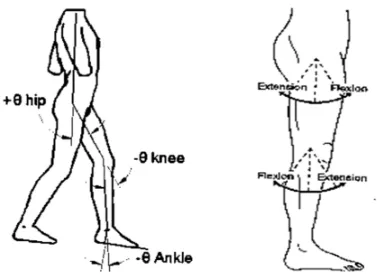
The knee joint angle measurement used throughout this project is based on the convention shown in Figure 2.1.
[image:17.612.230.420.406.543.2]Based on the figure, human lower extremities are comprises of segments which are hip, thigh, shank, ankle and foot. Normally there are two types of angle named as absolute angle and relative angle that used to describe the kinematics of human body segments. Knee joint angle is a type of relative angle measured between the longitudinal axis of two adjacent segments; knee and foot. Knee flexion refers to the movement of shank that increases knee joint angle while knee extension reduces knee joint angle.
Figure 2.1: Lower Extremities Joints Angle
2.4 Fundamental of Human Gait Analysis
[image:18.612.183.491.261.435.2]Gait analysis is a study of biomechanics of human movement considering the parameters related to the functioning of lower extremities [8]. Referring to Figure 2.2, one cycle of gait is defined as the period between subsequent heel contact of the same foot. The cycle consists of stance phase and swing phase of a leg, where 60% of the gait cycle is made up of stance phase and the remaining 40% is swing phase. Stance phase means one of the foot is in contact with ground, while swing phase refers to the leg swings until next heel contact of the same foot.
Figure 2.2: Phases in gait cycle [8]
The gait pattern of a human is unique and differs between a person and the other. There are many parameters characterizing the gait pattern of a person, among the parameters are stride time and length, step time and length, cadence, velocity and joints angle. The kinematic of gait in terms of displacement, velocity and acceleration are determined by factors including gender, walking speed, age, weight, height and body mass index.
9 reaches maximum extension at about 35% to 40% of the gait cycle as the heel rises from the ground. The knee flexes again for second time and reaches to maximum of 70° approximately at 65% of the gait cycle. Then knee extension continues until reaches to maximum just before ground contact.
Figure 2.3: Knee joint angle of a gait cycle [9]
Normally a person with gait disorders exhibits deviations from the standard gait pattern such as maximum knee flexion and timing for each phase. The knee angular displacement pattern of a normal person is important as a guideline for generating trajectory data for the powered gait assistive orthotic. The trajectory data can be used as input to the orthotic system in order to drive the actuator according to the desired position throughout the gait cycle.
2.5 Overview of Assistive Orthotic and Exoskeleton
The research and development of assistive orthotic especially for lower extremities have been conducted years ago starting with passive orthotic that designed only for supporting the impaired limbs without providing additional force from active actuators. With the increase number of lower limbs impairment problems, there was a great demand for enhancement of previous passive orthotic to be powered with active actuator to extend the capability of the orthotic system. Recently, the active orthotic has emerged with the incorporating of a control system to provide a system that able to imitate natural human movement.
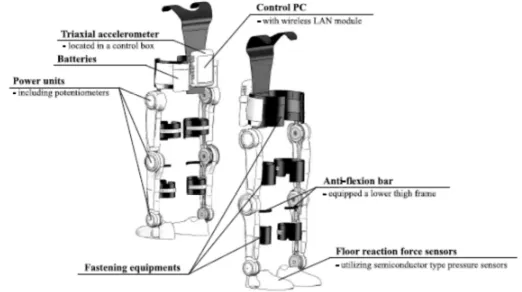
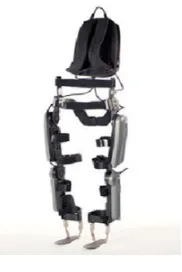
REX, ReWalk, Honda Walk Assist, eLEGS and Vanderbilt exoskeleton. HAL is invented by Yoshiyuki Sankai from Japan. This exoskeleton robot suit able to expand and improves physical capabilities of a human from healthy person to completely paraplegic patient. The purpose of HAL is mainly in industry for lifting weights and for medical purposes such as rehabilitation. It is considered as the most advance exoskeleton since it has specialized control algorithms named as ‘Cybernic voluntary control’ and ‘Cybernic autonomous control’. Cybernic voluntary control is used to control the actuator torque to augment joint torque of the wearer according to the voluntary muscle activity, while Cybernic autonomous control has the capability to support a functional motion that is desired by the wearer which is inferred from a preliminary motion before the desired motion is implemented [10]. Figure 2.4 shows the system configuration of HAL-5.
Figure 2.4: HAL-5 LB system configuration
11
Figure 2.5: ReWalk
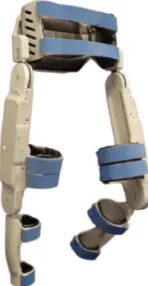
Meanwhile, in 2010 Berkeley Bionics developed eLEGS, a lower limbs exoskeleton for the paralyzed patients to regain stand up and walk. eLEGS actively supports the knee and hip flexion/extension. The hip abduction/adduction is loaded with a stiff elastic component to minimize the unnatural posture, and it is equipped with spring-loaded ankle to reduce toe drop. It applied an artificial intelligence control combined with gesture recognition technologies realized by pressure sensors, potentiometers and accelerometer gyroscope board [3]. eLEGS users still need to use crutches to support the upper limb during walking. This exoskeleton suits for patients with heights between 157 to 193 cm and maximum weight of 100 kg, while the weight of this exoskeleton is 20 kg.
Figure 2.6: eLEGS
[image:21.612.274.377.453.628.2]with DC brushless motor through a 24:1 gear reduction. The knee motors are equipped with electrically controlled normally locked brake. The knee joints are locked during stance phase of gait and released during sit to stand or stand to sit movements and during swing phase of gait [11].
Figure 2.7: Vanderbilt powered orthotic
[image:22.612.127.525.473.714.2]The comparison between previous mentioned orthotics and exoskeletons in terms of type, actuator type, and method of control is summarized in the following Table 2.1.
Table 2.1: Comparison between gait assistive orthoses/exoskeleton
Previous research Orthotic type Actuator type Method of Control
Vanderbilt (2011)
Hip Knee Ankle Foot Orthotic
DC brushless motor. Use a finite state
machine to control
joints by defining
trajectory for each
state.
eLEGS (2010)
Hip Knee Ankle Foot Orthotic
DC motor Artificial intelligence
and gesture recognition
to interpret user
intention of movement.
ReWalk (2008)
Hip Knee Ankle Foot Orthotic
DC motor Sensors on the chest
determine angle of
13 Table 2.1 (continued)
Previous research Orthotic type Actuator type Method of Control
HAL-5 (2005)
Full-body exoskeleton Servo motors. Intention-based
walking support. The intention to perform walking is inferred by measurement of floor reaction force and shift of Center of Gravity (COG)
2.6 Leg Support Mechanism for Walking Assistance
Leg support mechanism for walking assistance is a type of partial lower limbs exoskeleton since it supports only the function of leg during walking movement. There were related works have been conducted that similar to the developed project in this thesis in terms of orthotic type and its purpose.
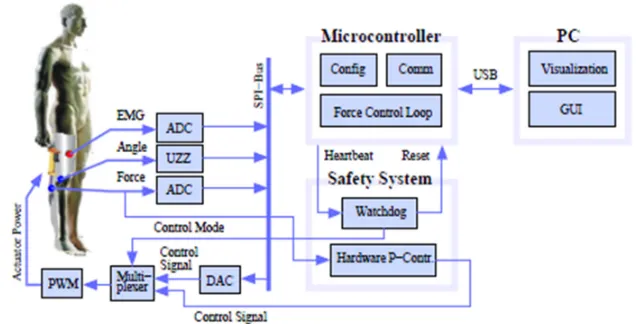
[image:23.612.127.519.109.233.2]Christian Fleischer and Gunter Hommel (2006) developed a knee exoskeleton whose torque was controlled by Electromyography (EMG) Signal. The aim of this research was to provide additional torque at knee to perform flexion and extension movement by recognizing the intended motion of the user through EMG signal from the muscle [12]. The block diagram of this exoskeleton system is depicted in Figure 2.8
[image:23.612.166.487.514.676.2]The exoskeleton consists of an orthotic attached to the right knee and powered by Maxon DC motor with ball screw shaft. The EMG signal activation is measured by using differential electrodes and sampled by 12-bit Digital to Analog Converter. The system uses Hall sensor to measure knee joint angle, while the force sensor is measured by force sensor. The microcontroller read EMG signal and knee joint angle to infer intended movement and then determine required knee torque for the movement. At the same moment, the actuator force and knee joint angle readings are used to calculate current knee torque produced by the actuator. The required knee torque is compared to the target (set point) of knee torque, then the controller decides either to increase, decrease or maintain the torque by giving PWM control signal to the actuator [12].
Another related work was done by Hongtao Guo et al. (2011) who conducted two studies regarding the knee brace orthotic as reported in [13] and [14] purposely to assist elderly or disabled people improving their mobility. This knee orthotic developed by Hongtao Guo et al. (2011) adopted a multifunctional actuator that comprises of two main parts which are the motor part and the clutch/brake part. A special fluids, magneto-rheological (MR) fluid is used inside the actuator to provide sufficient torque for the knee. The MR fluid and the clutch/brake part able to transfer
the torque generated from the motor part to outside as a clutch or provide
controllable semi-active torque as a brake with less power consumption than a
[image:24.612.249.436.475.644.2]conventional electric motor. The orthotic configuration is shown in Figure 2.9.
15 In [13], a preliminary experimental study on kinematics and kinetics was carried out pertaining this orthotic to evaluate the changes between normal walking without using the orthotic and walking with the orthotic in ‘off’ mode. Hongtao Guo et al. found that the use of this orthotic in ‘off’ mode without actuation results in almost similar gait kinematics, kinetics, spatial and temporal parameters compared to the normal walking without the orthotic. Thus, they conclude that the design of the orthotic is suitable to be applied with assistive torque with a controlled actuator.
[image:25.612.244.407.356.554.2]While in [14], Hongtao Guo et al. suggested an alteration of the previous orthotic to improve the knee flexion and rotation angle and also to find possible position of the actuator. The modification involved change of actuator position from subject’s knee joint to hip joint, installation of hinge joint with bearing at the knee joint position, and one metal bar with two steel cables to form a linkage. This new version of orthotic is shown in Figure 2.10. The same experiments were conducted to evaluate the performance of this new version orthotic, however the results show that its performance is not improved compared to the earlier version.
Figure 2.10: New version of Knee-ankle-foot orthosis by Hongtao Guo et al.
2.7 Design Considerations of Walking Assistive Orthotic
lightweight structure, safety, comfortable, portable and low power consumption, and high degree of reliability [15].
The mass of the orthotic has to be minimized to improve user comfort, reducing energy required to move the structure. A lower mass also results in low inertia during limb movements such as leg swing that eventually decrease the uncontrolled mechanical error.
As the device is applied directly to the human body, the safety is very crucial and topmost issue need to be considered. The device should not potentially harm the wearer or other neighbouring people either from electrical or mechanical aspects.
The user comfort means that the orthotic needs to have anthropomorphic design which suits to human body and able to imitate natural human movements. The orthotic also should not causing fatigue to the wearer even after long period of operation.
The portable and low power consumption of active actuators enables the user to use the orthotic for a long time period, however there is a trade-off between available power source such as battery and required actuator power required in the design.
CHAPTER 3
METHODOLOGY
3.1 Introduction
This chapter describes the methodology used in the development of this project. The method for developing this project is divided to two main sections. The first section is about the hardware identification for developing the overall system, and second section is about controller design approach involving use of MATLAB Simulink and microcontroller software.
3.2 Project Development
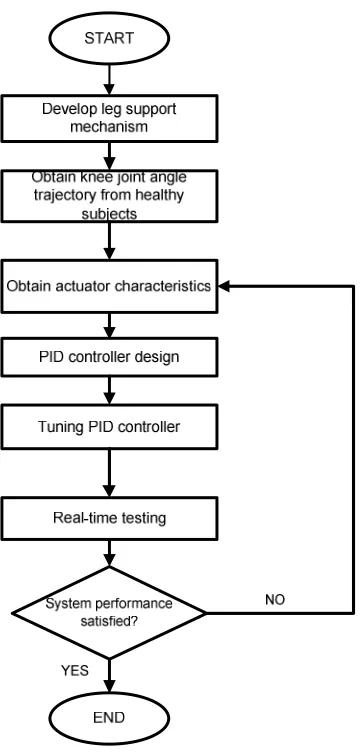
The development of this project is divided into several phases which covers hardware development, actuator characteristics identification and implementation of control system algorithm. These phases are shown by the following flowchart of Figure 3.1.
Figure 3.1: Project Development Flowchart
3.3 System Description
19
ADC
Start Button
Potentiometer
ON/OFF
Actual Knee Joint Angle (in Voltage)
Microcontroller
Knee Joint Angle Trajectory Data
– configured inside microcontroller
Actual Knee Joint Angle (in degree)
PID Controller
Feedback Gait intention
detection Motor Driver & Motor
[image:29.612.135.507.73.256.2]PWM
Figure 3.2: System Block Diagram
3.3.1 Leg Support Mechanism
The leg support mechanism of this project consists of two braces made of aluminium that cover thigh and shank at the peripheral side. Both braces are attached with a thermoplastic splint for supporting backside of thigh and shank. The overall knee orthotic system can be represented as 2 links robot with 1-DOF joint for one leg.
The knee joint actuator is positioned at lateral side of the knee. A pair of bevel gear is assembled to the motor shaft and shank brace to provide 90o change of drive direction and increase the torque output at the knee joint. Figure 3.3 shows the structure of this mechanism.
Figure 3.3: Leg Support Mechanism with Actuator and Bevel Gear Thigh brace
DC motor Bevel gear
[image:29.612.217.466.529.677.2]3.3.2 Knee Joint Angle Trajectory
The input of the system is knee joint angle trajectory data that gathered through experimental method on normal healthy subjects. The selected subjects with certain range of age and weight are selected to provide knee joint angle trajectory during gait cycle by wearing the leg support mechanism without activating the actuator.
The knee joint angle is measured by using a potentiometer attached to the orthotic at backside of the knee. An analog output voltage from the potentiometer is measured during knee flexion/extension that equivalent to the knee joint angle displacement. This analog voltage is then read by a microcontroller and converts it to digital form by using internal Analog to Digital Converter (ADC) module for further analysis.
In order to obtain relationship between output voltage of the voltage divider circuit and knee joint angle, a calibration need is conducted by using an angle measurement tool which is fixed to the braces. This measurement tool is a protractor scale that able to measure rotation angle up until 180o with 1o resolution.
3.3.3 DC Actuator
The actuator used in this project is DC planetary geared motor that operated with 12V DC source and rated 5.5 Amp current. This planetary geared motor has gearbox reduction ratio of 1:104, producing rated torque of 1.96N.m and rated speed of 63 rpm.
21
[image:31.612.231.422.203.307.2]Figure 3.4: DC planetary geared motor
Figure 3.5: DC planetary geared motor characteristic
3.3.4 Motor Driver Circuit
A motor driver circuit is required to drive the DC motor from microcontroller. The selection of motor driver circuit is based on maximum current and motor control method. The selected motor driver circuit to be used in this project is MD10C model from Cytron that able to support motor voltage rating between 5V to 25V and continuous current of 30A peak.
This motor driver circuit provides speed control by using PWM signal with frequency up to 20 kHz. The PWM signal is generated by microcontroller and connected to this motor driver circuit through PWM input pin.
[image:31.612.243.409.568.662.2]3.3.5 Arduino Microcontroller Board
The Arduino Uno microcontroller board is used in this project. It is powered by ATmega328 microcontroller used for controlling the overall functions of the leg gait support mechanism system.
The main specifications of this Arduino Uno board that makes it suitable for this project are small size, operates with 5V DC source, has Analog to Digital internal (ADC) module, 6 channel of PWM signal and interrupt function. The availability of ADC, PWM and interrupt modules enable the implementation of PID control system algorithm by using C programming language embedded into the microcontroller.
3.4 PID Control Design
A closed loop control system will be used in this project rather than open loop system since its purpose is to produce output according to the desired input with minimum error and higher stability. A closed loop control system exhibits less sensitive to noise, disturbance, and changes in the environment [16].
[image:32.612.151.498.538.678.2]Figure 3.7 describes the PID control block diagram for tracking knee joint angle trajectory. A PID control is proposed in this project which consists of Proportional, Integral and Derivative terms. Each of this term has constant gain which is KP, KI, and KD. The output of PID controller, u(t) is the summing result of proportional, integral and derivative terms as shown in Equation 3.1.
23
= . + . + . (3.1)
Where e(t) is the error or difference between desired and actual knee joint angle. The output response of knee joint angle control system is influenced by the controller constants, KP, KI, and KD. Proportional gain, KP will reduce the rise time and steady-state error of the system. The integral gain, KI will eliminate steady-state error but might produces worse transient response. The derivative gain, KD increases the system stability, reducing overshoot percentage, and improves the transient response of the system. A tuning process shall be conducted to find the most suitable value for KP, KI, and KD in order to obtain the optimum output response of the system.
The PID controller tuning process can be conducted once the characteristics of the actuator are obtained. An experimental method is conducted to obtain characteristic of this actuator in terms of relationship between PWM value from microcontroller and the actuator speed. A program is constructed in Arduino board microcontroller to give different PWM output values. This PWM value is fed into motor driver board starting at 0 degree knee joint angle position and it is stopped when reaches 90 degree position. During movement of the actuator, the angle and captured time are continuously gathered and plotted in Matlab GUI. The same procedure is repeated by using other PWM values, and finally an analysis regarding PWM effect to the angular displacement and acceleration is conducted. From this experiment, a range of suitable PWM value from minimum to maximum is decided to be used in the PID controller.
3.5 System Operation Flowchart
The system operation of this leg support mechanism is summarized in the following flowchart of Figure 3.8. Upon activated by power ON the device, the overall system is initialized by repositioning the knee joint at default condition as the user standing up with both foots are in contact with the floor.
with the desired trajectory data continuously. Once controller detects deviation from desired trajectory data, the microcontroller will adjust the actuator speed by regulating the PWM signal to attain the trajectory. The operation continues for next gait cycle and will stop when both force sensors under the heels are in contact with the floor.
Figure 3.8: System Operation Flowchart
START
END Check start button condition
Actuator turns ON
Read knee join angle from potentiometer
Maintain actuator speed Actual angle follows
trajectory data? Compare with trajectory data
Adjust actuator speed by PWM
NO
YES
Start button is pressed?
YES
NO
REFERENCES
1. Lusardi, M.M, Jorge, M., and Nielsen, C.C. Orthotics and Prosthetics in Rehabilitation. 3rd Ed. Missouri. Elsevier Saunders, 2013.
2. The Australian Orthotic Prosthetic Association Inc. (AOPA) (2014). About Orthoses and Prostheses. Retrieved on May 15,2014, from www.aopa.org.au/careers/what-are-orthoses-and-prostheses.
3. Viteckova, S., Kutilek, P., & Jirina, M. Wearable lower limb robotics: A review. Biocybernetics and Biomedical Engineering, 2013. 33(2), 96–105. doi:10.1016/j.bbe.2013.03.005.
4. Cullell, A., Moreno, J. C., Rocon, E., Forner-Cordero, A., & Pons, J. L. Biologically based design of an actuator system for a knee–ankle–foot orthosis. Mechanism and Machine Theory, 2009. 44(4), 860–872. doi:10.1016/j.mechmachtheory.2008.04.001
5. Seymour, R. (2002). Prosthetics and Orthotics: Lower Limb and Spinal (p.485). Lippincott Williams & Wilkins. Retrieved on May 16,2014, from http://books.google.com/books?hl=en&lr=&id=2KIqqHS5fVoC&pgis=1 6. World Health Organization (WHO) (2014). Poliomyelitis Fact Sheets.
Retrieved on May 16, 2014, from
http://www.who.int/mediacentre/factsheets/fs114/en/
7. Post-Polio Syndrome Fact Sheet: National Institute of Neurological Disorders and Stroke (NINDS) (2012). Retrieved on May 16, 2014, from http://www.ninds.nih.gov/disorders/post_polio/detail_post_polio.htm
8. Zhang, J., Shen, L., Shen, L., & Li, A. Gait analysis of powered bionic lower prosthesis. 2010 IEEE International Conference on Robotics and Biomimetics, 25–29. doi:10.1109/ROBIO.2010.5723297
Ubiquitous Robots and Ambient Intelligence (URAI), 364–367. doi:10.1109/URAI.2013.6677388
10. Kawanishi, R., Hasegawa, Y., Sankai, Y., & Tsukahara, A. Sit-to-Stand and Stand-to-Sit Transfer Support for Complete Paraplegic Patients with Robot Suit HAL. Advanced Robotics, 2010. 24(11), 1615–1638. doi:10.1163/016918610X512622
11. Quintero, H. a., Farris, R. J., & Goldfarb, M. Control and implementation of a powered lower limb orthosis to aid walking in paraplegic individuals. 2011 IEEE International Conference on Rehabilitation Robotics, 19(6), 1–6. 12. Fleischer, C., & Hommel, G. (2006). Torque control of an exoskeletal knee
with EMG signals. Vdi Berichte. Retrieved from http://citeseerx.ist.psu.edu/viewdoc/download?doi=10.1.1.87.1068&rep= rep1&type=pdf
13. Hung, A. S.-L., Guo, H., Liao, W.-H., Fong, D. T.-P., & Chan, K.-M. Experimental Studies on Kinematics and Kinetics of Walking with an Assistive Knee Brace, IEEE International Conference on Information and Automation, Shenzhen, China 2011 (June), 45–50.
14. Guo, H., Hung, A. S.-L., Liao, W.-H., Fong, D. T.-P., & Chan, K.-M. Gait analysis for designing a new assistive knee brace. 2011 IEEE International Conference on Robotics and Biomimetics, 1990–1995. doi:10.1109/ROBIO.2011.6181583
15. Caldwell, D. G., Tsagarakis, N.G., Kousidou, S., Costa, N., Sarakoglou, I. Soft exoskeletons for upper and lower body rehabilitation – design, control and testing, International Journal of Humanoid Robotics, Vol. 4, No. 3 (2007), 1-24.
16. Nise, Norman S. Control Systems Engineering. Fourth Edition. John Wiley & Sons, Inc, 2004.
![Figure 2.2: Phases in gait cycle [8]](https://thumb-us.123doks.com/thumbv2/123dok_us/8765891.896405/18.612.183.491.261.435/figure-phases-in-gait-cycle.webp)
![Figure 2.3: Knee joint angle of a gait cycle [9]](https://thumb-us.123doks.com/thumbv2/123dok_us/8765891.896405/19.612.194.461.144.293/figure-knee-joint-angle-gait-cycle.webp)