OPTIMIZATION OF STAND-ALONE PHOTOVOLTAIC SYSTEM BY IMPLEMENTING FUZZY LOGIC MPPT CONTROLLER
MOKHTAR BIN HASHIM
A project report submitted in partial fulfillment of the requirement for the award of the
Degree of Master of Electrical Engineering
Faculty of Electrical and Electronic Engineering Universiti Tun Hussein Onn Malaysia
ABSTRACT
ABSTRAK
CONTENTS
TITLE i
DECLARATION ii
DIDICATION iii
ACKNOWLEDGEMENT iv
ABSTRACT v
CONTENTS vii
LIST OF TABLES x
LIST OF FIGURES xi
CHAPTER 1 INTRODUCTION 1
1.1 Motivation
1.2 Project Background
1.2.1 PV Equivalent Circuit 1.2.2 PV Module Characteristic
1.2.3 Need for Maximum Power Tracking 1.2.4 How Maximum Power Point is Obtain 1.2.5 Methods of Peak Power Tracking 1.3 Problem Statement
1.4 Project Objectives 1.5 Project Scopes
1 2 3 4 5 8 9 10 11 12
CHAPTER 3 METHODOLOGY 18
3.1 Modelling PV Devices
3.2 Modelling of DC-DC Boost Converter 3.2.1 Boost Converter and It Operation 3.2.2 Design of The Boost Converter 3.3 MPPT algorithm used for simulation in
MatlabR/SimulinkR.
3.3.1 Perturb and Observation (P&O) 3.3.2 Fuzzy Logic MPPT Controller
18 25 25 28 30 30 32
CHAPTER 4 SIMULATION AND RESULTS 34
4.1 Simulink Model of PV Devices 34 4.1.1 Simulink model of the new calculated current 4.1.2 Simulink model of diode saturation current
(Io)
4.1.3 Simulink model of nominal saturation current (Ion)
4.1.4 Simulink model of PV module
4.1.5 Simulation result of PV module characteristic curve.
4.2 Simulation result of PV module is directly connected to resistive load
4.3 Simulation result for BP SX 150 PV module coupled with boost converter and the P&O MPPT algorithm. 4.4 Simulation comparison between the P&O MPPT
algorithm and Fuzzy Logic MPPT controller.
CHAPTER 5 CONCLUSION AND RECOMMENDATION 46
5.1 Conclusion 5.2 Recommendation
46 47
LIST OF TABLES
3.0 Fuzzy logic controller rules base 33
LIST OF FIGURES
1.0 Typical diagram of MPPT in a PV System 2
1.1 Typical circuit of PV solar cell 3
1.2 Characteristics of a typical solar PV module 5 1.3 Changes in the characteristics of the solar pv module due to change in
insolation level.
6
1.4 Change in the module characteristics due to the change in temperature 7
1.5 Block diagram of a typical MPPT system 7
1.6 DC/DC converter helps in tracking the peak power point 9 1.7 PV module is directly connected to a (variable) resistive load. 10 1.8 I-V curve of PV module and various resistive load 11 3.0 The equivalent circuit of the Practical photovoltaic cell 18 3.1 Characteristic I–V curve of the PV cell. The net cell current I is composed
of the light-generated current Ipv and the diode current Id .
19
3.2 Characteristic I–V curve of a practical PV device and the three remarkable points: short circuit (0, Isc), MPP (Vmp, Imp), and open
circuit (Voc ,0).
22
3.3 Physical structure of a PV cell. 22
4.4 Circuit diagram of boost converter 25
3.5 The OFF state diagram of the boost converter 26 3.6 The ON state diagram of the boost converter 26
3.7 Inductor current waveform 27
3.9 Perturb and Observation (P&O) Flow Chart 31
3.10 Fuzzy logic controller design 32
4.0 Picture of BP SX 150S PV module 34
4.1 Simulink model of new calculated current 35 4.2 Simulink model of diode saturation current (Io) 35 4.3 Simulink model of nominal saturation current (Ion) 36
4.4 Simulink model PV modules 36
4.5 I-V curves of BP SX 150S PV module at various irradiances and simulated with temperature 25oC.
37 4.6 P-V curves of BP SX 150S PV module at various irradiances and
simulated with temperature 25oC
37 4.7 I-V curves of BP SX 150S PV module at various temperatures and
simulated with irradiance 1000 W/m2.
38 4.8 P-V curves of BP SX 150S PV module at various temperatures and
simulated with irradiance 1000 W/m2.
38 4.9 Simulink model of PV module is directly connected to the resistive load 39 4.10 Simulation result of PV module is directly connected to the resistive load
at irradiance 1000 W/m2 and temperature 25 oC.
40
4.11 Simulation result of PV module is directly connected to the resistive load at various irradiances and temperature 25 oC.
40
4.12 Simulink model of P&O MPPT algorithm 41 4.13 Simulink model of PV module coupled with DC-DC Boost converter and
P&O MPPT algorithm
41
4.14 Simulation result of PV module coupled with DC-DC Boost converter and P&O MPPT algorithm
42
4.15 Fuzzy membership functions for input E(k). 42 4.16 Fuzzy membership functions for input CE(k). 43 4.17 Fuzzy membership functions for output dD(k). 43
4.18 fuzzy rules surface 43
4.19 Simulink model for comparison of tracking power between P&O algorithm and Fuzzy Logic MPPT controller.
44
4.20 Comparison of tracking power between P&O algorithm and Fuzzy Logic MPPT controller at irradiance 1000 W/m2 and temperature at 25oC.
CHAPTER 1
INTRODUCTION
1.1 Motivation
In the last years global warming and energy policies have become a hot topic on the international agenda. Developed countries are trying to reduce their greenhouse gas emissions. Renewable energy sources are considered as a technological option for generating clean energy. Among them, photovoltaic (PV) system has received a great attention as it appears to be one of the most promising renewable energy sources. Photovoltaic power generation has an important role to play due to the fact that it is a green source. The only emissions associated with PV power generation are those from the production of its components.
Therefore, the motivation of this thesis is to obtain the maximum power point (MPP) of photovoltaic (PV) system by using Fuzzy Logic Controller (FLC). Hence, this thesis focused on the well-known Perturb and Observe (P&O) algorithm and compared to a design fuzzy logic controller (FLC). A simulation work dealing with MPPT controller, a DC/DC Boost converter feeding a load is achieved. The result will show the validity of the proposed Fuzzy Logic MPPT in the PV system.
1.2 Project Background
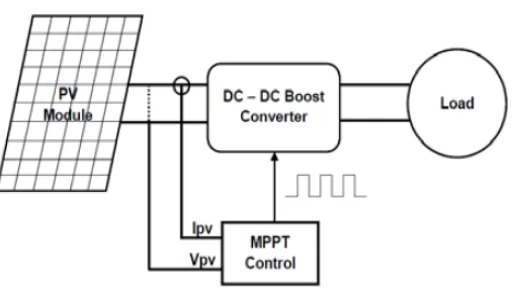
A photovoltaic system for isolated grid-connected applications as shown in Fig. 1.0 is a typically composed of these main components:
i. PV module that converts solar energy to electric power
ii. DC-DC converter that converts produced DC voltage by the PV module to a load voltage demand.
[image:11.595.192.448.481.628.2]iii. Digital controller that drives the converter operation with MPPT capability.
1.2.1 PV Equivalent Circuit
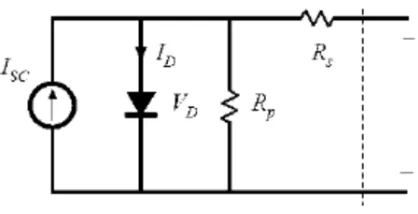
[image:12.595.211.420.291.398.2]The model of solar cell can be categorized as p-n semiconductor junction; when exposed to light, the DC current is generated. As known by many researchers, the generated current depends on solar irradiance, temperature, and load current. The typical equivalent circuit of PV cell is shown in Fig. 2.0.
Fig. 1.1 Typical circuit of PV solar cell
The basic equations describing the I-V characteristic of the PV model are given in the following equations: [11]
…………(1.0)
…………(1.1)
Where:
IPV is the cell current (A).
ISC is the light generated current (A). ID is the diode saturation current (A). Rs is the cell series resistance (ohms). RP is the cell shunt resistance (ohms). VD is the diode voltage (V).
VT is the temperature voltage (V). VPV is the cell voltage (V).
1.2.2 PV Module Characteristic
Fig.1.2 Characteristics of a typical solar PV module.
1.2.3 Need for Maximum Power Tracking
Power output of a Solar PV module changes with change in direction of sun, changes in solar insolation level and with varying temperature as shown in the Fig. 1.3&1.4.
Fig.1.3 Changes in the characteristics of the solar PV module due to change in insolation level.
Fig.1.4 Change in the module characteristics due to the change in temperature
1.2.4 How Maximum Power Point (MPP) is obtained.
The maximum power point is obtained by introducing a dc/dc converter in between the load and the solar PV module. The duty cycle of the converter is changed till the peak power point is obtained.
Considering a step up converter is used Vo= (1/(1-D))*Vi……(1.3) ( Vo is output voltage and Vi is input voltage) solving for the Impedance transfer ratio
Ro = (1/(1-D))2*Ri….(1.4)
(Ro is output impedance and Ri is input impedance as seen by the source.) Ri = (1-D)2*Ro…….(1.5)
Fig.1.6 DC/DC converter helps in tracking the peak power point
1.2.5 Methods of Peak Power Tracking.
The peak power is reached with the help of a dc/dc converter by adjusting its duty cycle such that the resistance corresponding to the peak power is obtained. Now question arises how to vary the duty cycle and in which direction so that peak power is reached. Whether manual tracking or automatic tracking? Manual tracking is not possible so automatic tracking is preferred to manual tracking. An automatic tracking can be performed by utilizing various algorithms.
i. Perturb and observe [3],[4],[7]. ii. Incremental Conductance [5],[9]. iii. Parasitic Capacitance [9].
v. Current Based peak power Tracking [9].
vi. Computational Intelligent (e.g. fuzzy logic, neural network) [1],[2] The algorithms are implemented in a microcontroller or a personal computer to implement maximum power tracking. The algorithm changes the duty cycle of the dc/dc converter to maximize the power output of the module and make it operate at the peak power point of the module. P&O and fuzzy logic algorithm are explained in detailed in the chapter 3.
1.3 Problem Statement
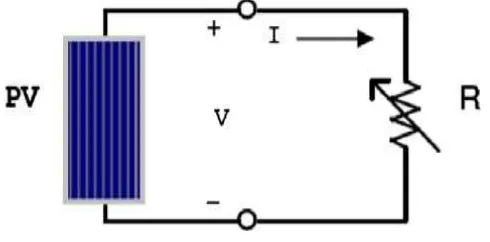
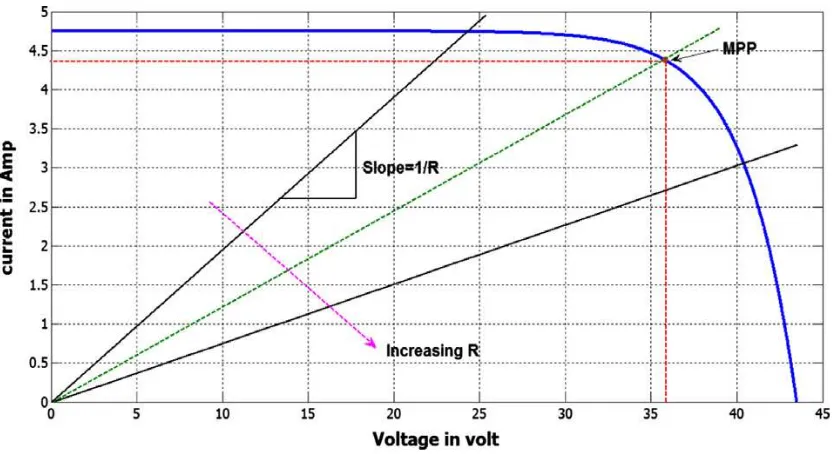
[image:19.595.198.443.403.524.2]When a PV moduleis directly coupled to a load, the PV module’s operating pointwill be at the intersection of its I–V curve and the load linewhich is the I–V relationship of load.
Fig. 1.7 PV module is directly connected to a (variable) resistive load.
Fig. 1.8 I-V curve of PV module and various resistive loads
To mitigate this problem, a maximum power point tracker(MPPT) can be used to maintain the PV module’s operatingpoint at the MPP. MPPTs can extract more than 97% of thePV power when properly optimized [51].
1.4 Project Objectives
The objectives of this project are:-
i. To track the maximum power point (MPP) of PV module by using Fuzzy Logic MPPT controller.
1.5 Project Scopes
The scopes of this project are:-
i. To develop a SIMULINK model of PV module that converts solar energy to electric one.
ii. To develop a SIMULINK model of DC-DC boost converter that converts produced DC voltage by the PV module to a load voltage demand.
CHAPTER 2
LITERATURE REVIEW
The following literature survey for the current report consists of various papers publishedin the IEEE conferences and the journals.
[1]. Control of DC/DC Converters for Solar Energy System with Maximum PowerTracking. [4].
ChihchiangHua and ChihmingShen.
Paper proposes that the Step up converter is the best option for the use in the MPPT systemas it gives higher efficiency.
[2]. Maximum photovoltaic power tracking: an algorithm for rapidly
changingatmospheric conditions.[5]
K.H. Hussein, I. Muta, I. Hoshino &, M. Osakada.
The authors have developed a new MPPT algorithm based on the fact that theMPOP (maximum peak operating point) of a PV generator can be tracked accurately bycomparing the incremental and instantaneous conductance of the PV array. The workwas carried out by both simulation and experiment, with results showing that thedeveloped incremental conductance (IntCond) algorithm has successfully tracked theMPOP, even in cases of rapidly changing atmospheric conditions, and has higherefficiency than ordinary algorithms in terms of total PV energy transferred to the load
[3]. Microcomputer Control of a Residential Photovoltaic Power
ConditioningSystem. [5].
B.K. Bose, P.M. Szczesny and R.L. Steigerwald,
[4]. An Improved Perturbation and Observe Maximum Power Point TrackingAlgorithm for PV Arrays. [8].
Xuejun Liu and A.C.Lopes,
The corresponding authors have proposed a new kind of maximum power point trackingalgorithm based on perturb and observe algorithm. The algorithm is fast acting andeliminates the need of a large capacitor which is normally used in perturb and observealgorithm to eliminate the ripple in the module voltage. The module voltage and currentthat are taken for processing are not averaged but are instantaneous this speed ups theprocess of peak power tracking. Also the paper implements the new algorithm on the real-time platform. The software used was dSPACER.
5]. Comparative Study of Maximum Power Point Tracking Algorithms Using anExperimental, Programmable, Maximum Power Point Tracking Test Bed. [9]
D. P. Hohm, M. E. Ropp.
The authors have compares all the different kinds of algorithm that are used for themaximum power point tracking. This helps in proper selection of the algorithm.Preliminary results indicate that perturb and observe compares favorably withincremental conductance and constant voltage. Although incremental conductance is ableto provide marginally better performance in case of rapidly varying atmospheric conditions, the increased complexity of the algorithm will require more expensivehardware, and therefore may have an advantage over perturb and observe only in largePV arrays.
[6]. Theoretical and Experimental Analyses of Photovoltaic Systems With VoltageandCurrent-Based Maximum Power-Point Tracking. [10]
Detailed theoretical and experimental analyses of two simple, fast and reliable maximumpower-point tracking (MPPT) techniques for photovoltaic (PV) systems are presented.Voltage-based (VMPPT) and the Current-based (CMPPT) approaches. Amicroprocessor-controlled tracker capable of online voltage and current measurementsand programmed with VMPPT and CMPPT algorithms is constructed. The load of thesolar system is either a water pump or resistance. The paper has given a simulink model of the DC/DC converter and a solar PV module.
[7]. Maximum Power Point Tracking using FuzzyLogic Control for Photovoltaic
Systems. [11]
PongsakorTakun, SomyotKaitwanidvilai and ChaiyanJettanasen.
In this paper, a fuzzy logic control (FLC) is proposed to control the maximum power point tracking(MPPT) for a photovoltaic (PV) system. The proposed technique uses the fuzzy logic control to specify the size of incremental current in the current command of MPPT. As results indicated, the convergence time of maximum powerpoint (MPP) of the proposed algorithm is better than that of the conventional Perturb and Observation (P&O) technique.
[8]. Advanced Fuzzy MPPT Control Algorithm for Photovoltaic Systems. [12]
MayssaFarhatandLassaadSbita.
load is achieved. Significant extracted results are given to prove the validity of the proposed overall PV system control scheme. The result show that the FLC has better performance and closed to the P&O ideal and FLC has better response time, less oscillation and much more accurate tracking.
CHAPTER 3
METHODOLOGY
3.1 Modeling PV Devices
The PV panel model is based on the recombination mechanism of p-n junctions. The I-V characteristic of the PV modules is extremely nonlinear and varies significantly with temperature and solar irradiation. These disturbances affect the normal operation of the PV panels and may lead to a tracking of incorrect maximum power point which gives the necessity for the development of an accurate mathematical model. The equivalent circuit of a PV cell is shown is shown in Fig.3.0.
Fig. 3.0 shows the equivalent circuit of the ideal PV cell. The basic equation from the theory of semiconductors that mathematically describes the I–V characteristic of the ideal PV cell is
……….(3.0)
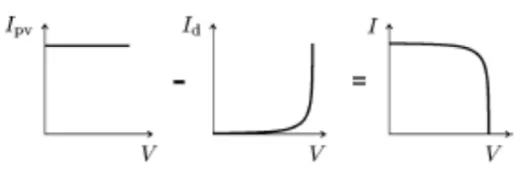
where Ipv,cell is the current generated by the incident light (it is directly proportional to the Sun irradiation), Id is the Shockley diode equation, I0,cell is the reverse saturation or leakage current of the diode, q is the electron charge (1.60217646 × 10⁻¹⁹ C), k is the Boltzmann constant (1.3806503 × 10⁻²³ J/K), T (in Kelvin) is the temperature of the p– n junction, and a is the diode ideality constant. Fig. 3.1 shows the I–V curve originated
from (3.0).
Fig. 3.1. Characteristic I–V curve of the PV cell. The net cell current I is composed of the light-generated current Ipv and the diode current Id .
[image:28.595.249.513.203.248.2] [image:28.595.183.444.455.541.2]PV cells and the observation of the characteristics at the terminals of the PV array requires the inclusion of additional parameters to the basic equation
………(3.1)
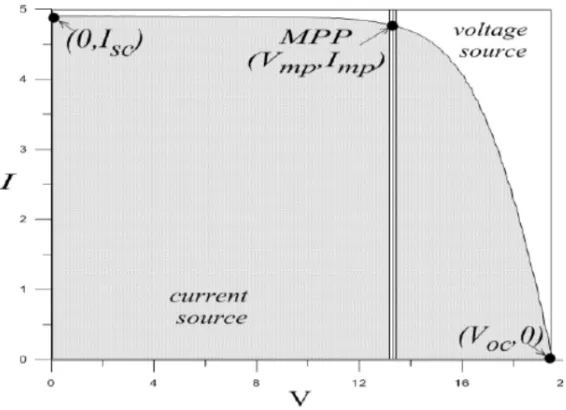
Where Ipv and I0 are the photovoltaic (PV) and saturation currents, respectively, of the array and Vt = NskT/q is the thermal voltage of the array with Ns cells connected in series. Cells connected in parallel increase the current and cells connected in series provide greater output voltages. If the array is composed of Np parallel connections of cells the PV and saturation currents may be expressed as Ipv = Ipv,cellNp, I0 = I0,cellNp. In (3.1), Rs is the equivalent series resistance of the array and Rp is the equivalent parallel resistance. This equation originates the I–V curve in Fig. 3.2, where three remarkable points are highlighted: short circuit (0, Isc), MPP (Vmp, Imp), and open circuit (Voc, 0).
Equation (3.1) describes the single-diode model presented in Fig. 3.0. Some authors have proposed more sophisticated models that present better accuracy and serve for different purposes. For example, in [14]–[18] an extra diode is used to represent the effect of the recombination of carriers. A three-diode model is proposed in [19] to include the influence of effects that are not considered by the previous models.
For simplicity, the single diode model of Fig. 3.0 is proposed in this research. This model offers a good compromise between simplicity and accuracy [20], and has been used by several authors in previous works, sometimes with simplifications but always with the basic structure composed of a current source and a parallel diode [21]– [34].
the band-gap energy of the semiconductor. All PV array datasheets bring basically the following information: the nominal open-circuit voltage (Voc,n), the nominal short-circuit current (Isc,n), the voltage at the MPP (Vmp), the current at the MPP (Imp), the open-circuit voltage/temperature coefficient (KV), the shortcircuit current/temperature coefficient (KI), and the maximum experimental peak output power (Pmax,e). This information is always provided with reference to the nominal condition or standard test conditions (STCs) of temperature and solar irradiation. Some manufacturers provide I–V curves for several irradiation and temperature conditions. These curves make easier the adjustment and the validation of the desired mathematical I–V equation. Basically, this is all the information one can get from datasheets of PV arrays.
Electric generators are generally classified as current or voltage sources. The practical PV device presents hybrid behavior, which may be of current or voltage source depending on the operating point, as shown in Fig. 3.2. The practical PV device has a series resistance Rs whose influence is stronger when the device operates in the voltage source region and a parallel resistance Rp with stronger influence in the current source region of operation. The Rs resistance is the sum of several structural resistances of the device. Fig. 3.3 shows the structure of a PV cell. Rs basically depends on the contact resistance of the metal base with the p semiconductor layer, the resistances of the p and n bodies, the contact resistance of the n layer with the top metal grid, and the resistance
Fig. 3.2. Characteristic I–V curve of a practical PV device and the three remarkable points: short circuit (0, Isc), MPP (Vmp, Imp), and open circuit (Voc ,0).
Fig. 3.3. Physical structure of a PV cell.
[image:31.595.205.494.455.538.2]resistances, is difficult to determine. Datasheets only inform the nominal short-circuit current (Isc,n), which is the maximum current available at the terminals of the practical device. The assumption Isc≈ Ipv is generally used in the modeling of PV devices because in practical devices the series resistance is low and the parallel resistance is high. The light-generated current of the PV cell depends linearly on the solar irradiation and is also influenced by the temperature according to the following equation [30], [42]–[44]:
(3.2)
Where Ipv,n (in amperes) is the light-generated current at the nominal condition (usually 25 ◦C and 1000 W/m2 ), ∆T = T − Tn (T and Tn being the actual and nominal temperatures [in Kelvin], respectively), G (watts per square meters) is the irradiation on the device surface, and Gn is the nominal irradiation.
The diode saturation current I0 and its dependence on the temperature may be expressed by as shown [42], [43], [45]–[48]:
(3.3)
whereEg is the band-gap energy of the semiconductor (Eg = 1.12 eV for the polycrystalline Si at 25 ◦C [23], [42]), and I0,n is the nominal saturation current:
With Vt,n being the thermal voltage of Ns series-connected cells at the nominal temperature Tn .
The value of the diode constant a may be arbitrarily chosen. Many authors discuss ways to estimate the correct value of this constant [20], [23]. Usually, 1 ≤ a ≤ 1.5 and the choice depend on other parameters of the I–V model. Some values for aare found in [42] based on empirical analyses. As is given in [20], there are different opinions about the best way to choose a. Because anexpresses the degree of ideality of the diode and it is totally empirical, any initial value of a can be chosen in order to adjust the model. The value of a can be later modified in order to improve the model fitting, if necessary. This constant affects the curvature of the I–V curve and varying a can slightly improves the model accuracy.
Modeling accurate Photovoltaic Arrays has been discussed in many papers. For the purposes of this research we will be using the method describer in [13]. This modeling algorithm includes only Rs and Rp, is assumed a very large value and it takes into consideration the effect of an array of solar modules and a panel of solar arrays. The PV datasheets always provide the following information:
i. Standard Operating Conditions: 25o C and 1000W/m2 ii. Isc at standard operating conditions.
iii. Vocat standard operating conditions.
iv. Impp: I at the maximum power point at standard operating conditions. v. Vmpp: at the maximum power point at standard operating conditions. vi. Kv: the open-circuit voltage/temperature coefficient.
vii. Ki: the shot-circuit current/temperature coefficient.
REFERENCES
[1] Subiyanto, A Mohamed, M A Hannan, “Maximum Power Point Tracking in Grid Connected PV System Using A Novel Fuzzy LogicController”, IEEE Student Conference on Research and Development, November 2009.
[2] L Chun-Hua, Z. Xin- Jian, S. Sheng, and H Wan-Qi, “Maximum Power Point Tracking Of A Photovoltaic Energy System UsingNeural Fuzzy Techniques,” Journal Shanghai University Vol 13 (1) : 29-36, 2009.
[3].ChihchiangHua, ,Jongrong Lin, and ChihmingShen,“Implementation of a DSPControlledPhotovoltaic System with Peak Power Tracking”,IEEE TRANSACTIONS ONINDUSTRIAL ELECTRONICS, VOL. 45, NO. 1, FEBRUARY 1998 pp 99-107.
[4].ChihchiangHua and ChihmingShen, “Control of DC/DC Converters for Solar EnergySystem with Maximum Power Tracking”.
[5]. K. H. Hussein et al, “Maximum Photovolatic Power Tracking: An Algorithm forrapidly changing atmospheric conditions,” Proc. Inst. Elect. Eng. vol. 142, pt. G, no. 1,pp. 59–64, Jan. 1995.
[6].C.R. Sullivan and M.J. Powers,“A High-Efficiency Maximum Power Point Trackingfor Photovoltaic Arrays in a Solar-Power Race Vehicle”, IEEE PESC‘93, 1993, pp.574-580.
[7].B.K. Bose, P.M. Szczesny and R.L. Steigerwald,,“Microcomputer Control of aResidential Photovoltaic Power Condictioning System”, IEEE Trans. on IndustryApplications, vol. IA-21, no. 5,Sep. 1985, ppll82-1191.
[8].Xuejun Liu and A.C.Lopes,,“An Improved Perturbation and Observe Maximum PowerPoint Tracking Algorithm for PV Arrays”IEEE PESC ‘2004, pp.2005-2010. [9].D. P. Hohm, M. E. Ropp,“Comparative Study of Maximum Power Point TrackingAlgorithms Using an Experimental, Programmable, Maximum Power Point TrackingTest Bed”,IEEE,2000.pp.1699-1702.
Current-BasedMaximum Power-Point Tracking”, IEEE TRANSACTIONS ON ENERGYCONVERSION, VOL. 17, NO. 4, DECEMBER 2002.
[11] PongsakorTakun, SomyotKaitwanidvilai and ChaiyanJettanasen,” Maximum Power Point Tracking using Fuzzy Logic Control for Photovoltaic Systems,” in Proc. International Multi Conference 0f Engineers and Computer Scientists 2011 vol . II,
IMECS 2011, March 16-18, 2011, Hong Kong
[12] MayssaFarhat andLassaadSbita,” Advanced Fuzzy MPPT Control Algorithm for Photovoltaic Systems,” Science Academy Transactions on Renewable Energy Systems Engineering and Technology Vol. 1, No. 1, March 2011, United Kingdom
[13] M. G. Villalva and E. R. Filho, “Modeling and circuit-based simulation ofphotovoltaic arrays,” Brazilian Journal of Power Electronics, vol. 14, no. 1, pp. 35– 45, May, 2009.
[14] J. A. Gow and C. D. Manning, “Development of a photovoltaic arraymodel for use in power-electronics simulation studies,” IEE Proc. Elect.Power Appl., vol. 146, no. 2, pp. 193–200, 1999.
[15] J. A. Gow and C. D. Manning, “Development of a model for photovoltaicarrays suitable for use in simulation studies of solar energy conversionsystems,” in Proc. 6th Int. Conf. Power Electron. Variable Speed Drives,1996, pp. 69–74.
[16] N. Pongratananukul and T. Kasparis, “Tool for automated simulation ofsolar arrays using general-purpose simulators,” in Proc. IEEE WorkshopComput. Power Electron.,2004, pp. 10–14.
[17] S. Chowdhury, G. A. Taylor, S. P. Chowdhury, A. K. Saha, and Y. H. Song,“Modelling, simulation and performance analysis of a PV array in an embeddedembeddedenvironment,” in Proc. 42nd Int. Univ. Power Eng. Conf. (UPEC), 2007, pp. 781–785.
[18] J. Hyvarinen and J. Karila, “New analysis method for crystalline siliconcells,” in Proc. 3rd World Conf. Photovoltaic Energy Convers., 2003,vol. 2, pp. 1521–1524.
[20] C. Carrero, J.Amador, and S. Arnaltes, “A single procedure for helping PVdesigners to select silicon PV module and evaluate the loss resistances,”Renewable Energy, vol. 32, no. 15, pp. 2579–2589, Dec. 2007.
[21] E. Koutroulis, K. Kalaitzakis, and V. Tzitzilonis.(2008). Development ofa FPGA-based system for real-time simulation of photovoltaic modules,Microelectron.J. [Online].
[22] G. E. Ahmad, H. M. S. Hussein, and H. H. El-Ghetany, “Theoretical analysisand experimental verification of PV modules,” Renewable Energy, vol. 28, no. 8, pp. 1159 1168, 2003.
[23] G. Walker, “Evaluating MPPT converter topologies using a matlab PVmodel,” J. Elect. Electron. Eng., Australia, vol. 21, no. 1, pp. 45–55,2001.
[24] M. Veerachary, “PSIM circuit-oriented simulator model for the nonlinearphotovoltaic sources,” IEEE Trans. Aerosp.Electron. Syst., vol. 42, no. 2,pp. 735–740, Apr. 2006.
[25] A. N. Celik and N. Acikgoz, “Modelling and experimental verificationof the operating current of mono-crystalline photovoltaic modules usingfour- and five-parameter models,” Appl. Energy, vol. 84, no. 1, pp. 1–15,Jan. 2007.
[26] Y.-C. Kuo, T.-J.Liang, and J.-F. Chen, “Novel maximum-power-pointtrackingcontroller for photovoltaic energy conversion system,” IEEETrans. Ind. Electron., vol. 48, no. 3, pp. 594–601, Jun. 2001.
[27] M. T. Elhagry, A. A. T. Elkousy, M. B. Saleh, T. F. Elshatter, andE. M. Abou-Elzahab, “Fuzzy modeling of photovoltaic panel equivalentcircuit,” in Proc. 40th Midwest Symp. Circuits Syst., Aug. 1997, vol. 1,pp. 60–63.
[28] S. Liu and R. A. Dougal, “Dynamic multiphysics model for solar array,”IEEE Trans. Energy Convers., vol. 17, no. 2, pp. 285–294, Jun. 2002.
[29] Y. Yusof, S. H. Sayuti, M. Abdul Latif, and M. Z. C. Wanik, “Modelingand simulation of maximum power point tracker for photovoltaic system,”in Proc. Nat. Power Energy Conf. (PEC), 2004, pp. 88–93.
[31] M. A. Vitorino, L. V. Hartmann, A. M. N. Lima, and M. B. R. Correa,“Using the model of the solar cell for determining the maximum powerpoint of photovoltaic systems,” in Proc. Eur. Conf. Power Electron. Appl.,2007, pp. 1–10.
[32] D. Dondi, D. Brunelli, L. Benini, P. Pavan, A. Bertacchini, and L. Larcher,“Photovoltaic cell modeling for solar energy powered sensor networks,”in Proc. 2nd Int. Workshop Adv. Sens. Interface (IWASI), 2007, pp. 1–6.
[33] H. Patel and V. Agarwal, “MATLAB-based modeling to study the effectsof partial shading on PV array characteristics,” IEEE Trans. EnergyConvers., vol. 23, no. 1, pp. 302–310, Mar. 2008.
[34] W.Yi-Bo,W. Chun-Sheng, L. Hua, andX.Hong-Hua, “Steady-state modeland power flow analysis of grid-connected photovoltaic power system,”in Proc. IEEE Int. Conf. Ind. Technol. (ICIT’08), pp. 1–6.
[35] K. Khouzam, C. Khoon Ly, C. Koh, and P. Y. Ng, “Simulation and realtimemodeling of space photovoltaic systems,” in Proc. IEEE 1st WorldConf. Photovoltaic Energy Convers., Conf. Record 24th IEEE PhotovoltaicSpec. Conf., 1994,
vol. 2, pp. 2038–2041.
[36] M. C. Glass, “Improved solar array power point model with SPICE realization,”in Proc. 31st Intersoc. Energy Convers. Eng. Conf. (IECEC), Aug. 1996, vol. 1, pp. 286
291.
[37] I. H. Altas and A. M. Sharaf, “A photovoltaic array simulation modelfor matlab– simulink GUI environment,” in Proc. Int. Conf. Clean Elect.Power (ICCEP), 2007, pp. 341–345.
[38] E. Matagne, R. Chenni, and R. El Bachtiri, “A photovoltaic cell modelbased on nominal data only,” in Proc. Int. Conf. Power Eng., Energy Elect.Drives, POWERENG, 2007, pp. 562–565.
[41] N. D. Benavides and P. L. Chapman, “Modeling the effect of voltageripple on the power output of photovoltaic modules,” IEEE Trans. Ind.Electron., vol. 55, no. 7, pp. 2638–2643, Jul. 2008.
[42] W. De Soto, S. A. Klein, andW. A. Beckman, “Improvement and validationof a model for photovoltaic array performance,” Solar Energy, vol. 80,no. 1, pp. 78–88, Jan. 2006.
[43] Q. Kou, S. A. Klein, and W. A. Beckman, “A method for estimating thelong-term performance of direct-coupled PV pumping systems,” SolarEnergy, vol. 64, no. 1–3, pp. 33–40, Sep. 1998.
[44] A. Driesse, S. Harrison, and P. Jain, “Evaluating the effectiveness ofmaximum power point tracking methods in photovoltaic power systemsusing array performance models,” in Proc. IEEE Power Electron. Spec.Conf. (PESC), 2007, pp. 145–151.
[45] R. A. Messenger and J.Ventre, Photovoltaic Systems Engineering. BocaRaton, FL: CRC Press, 2004.
[46] F. Nakanishi, T. Ikegami, K. Ebihara, S. Kuriyama, and Y. Shiota, “Modelingand operation of a 10 kW photovoltaic power generator using equivalentelectric circuit method,” in Proc. Conf. Record 28th IEEE PhotovoltaicSpec. Conf., Sep. 2000, pp. 1703–1706.
[47] J. Crispim, M. Carreira, and R. Castro, “Validation of photovoltaic electricalmodels against manufacturers data and experimental results,” inProc. Int. Conf. Power Eng., Energy Elect. Drives, POWERENG, 2007,pp. 556–561.
[48] K. H. Hussein, I. Muta, T. Hoshino, and M. Osakada, “Maximum photovoltaicpower tracking: An algorithm for rapidly changing atmosphericconditions,” in Proc. IEE Proc.-Generation, Transmiss. Distrib., Jan.1995, vol. 142, pp. 59–64. [49]. Muhammad H. Rashid, “Power Electronics Circuits, Devices and Applications”, Third Edition.
[50]. Modelling and Control design for DC-DC converter, Power Management group, AVLSI Lab, IIT-Kharagpur.