© 2018, IRJET | Impact Factor value: 6.171 | ISO 9001:2008 Certified Journal | Page 2469
Classification of Age and Gender using Deep Learning
Shivangi Gautam
1, Subham Singh
2, Simran Singh
3, Pavan Sharma
41,2,3
Scholar, Dept. of CSE, ABES Institute of Technology, Uttar Pradesh, India
4Professor, Dept. of CSE, ABES Institute Of Technology,Uttar Pradesh, India---***---Abstract -
With time, the gender classification and ageclassification has picked up significance and has turned into a dynamic zone of research[1]. Face recognition is an extremely difficult issue in the field of image analysis and computer vision on the grounds that the human face being a dynamic question is vulnerable to a high level of changeability in its appearance. Programmed age estimation from true and unconstrained face pictures is quickly picking up importance[2]. In our proposed work, a profound CNN demonstrate that was prepared on a database for face recognition undertaking is utilized to appraise the age data . The paper talks about a way to deal with order images or a video stream as indicated by gender and age in light of Convolutional Neural Networks and furthermore traces a comparison of CNN with the consequences of traditional ML strategies, for example, SVM and Logistic Regression.
Key Words: Convolutional Neural Network, Gender Classification, Age Classification, Face Images
1.
INTRODUCTION
Age and gender orientation assume crucial parts in social interactions. Dialects hold distinctive salutations and punctuation rules for men or ladies, and all the time unique vocabularies are utilized while tending to older folks contrasted with youngsters. In spite of the essential parts these traits play in our everyday lives, the capacity to naturally evaluate them precisely and dependably from confront pictures is still a long way from addressing the necessities of business applications. This is especially confounding while considering late claims to super-human abilities in the related assignment of face recognition[3,4]. As of late, numerous applications from biometrics, security control to amusement utilize the data removed from confront pictures that contain data about age, sexual orientation, ethnic foundation, and enthusiastic state. Automated age estimation from facial pictures is one of the prominent and testing undertakings that have diverse fields of utilizations, for example, controlling the substance of the watched media relying upon the client's age. Programmed estimation of the age is a testing procedure since the maturing procedure among people is non-uniform. Furthermore, extricating a powerful list of capabilities from a 2D picture for age estimation is another test to overcome. CNNs demonstrated critical achievement in confront acknowledgment, picture order, and protest acknowledgment. It comprises of various convolutional layers where each layer forms the yield of the past layer keeping in mind the end goal to deliver a vigorous and conservative yield. CNNs can be portrayed as profound networks if the quantity of layers inside the network is
generally a substantial number. In the event that a CNN is portrayed as a profound network, thus a huge database is expected to enhance the parameters amid the preparation procedure.
There are a wide range of strategies utilized as a part of naturally breaking down pictures. Every system might be helpful for a little scope of errands, however there still aren't any known strategies for picture investigation that are sufficiently nonexclusive for wide scopes of undertakings, contrasted with the capacities of a human's picture examining abilities. Computer Image Analysis largely contains the fields of PC or machine vision, and medical imaging, and makes substantial utilization of example acknowledgment, computerized geometry, and signal processing. It is the quantitative or subjective portrayal of two-dimensional (2D) or three-dimensional (3D) digital images. There are a wide range of systems utilized as a part of consequently investigating pictures. Every system might be helpful for a little scope of assignments, however there still aren't any known techniques for picture investigation that are non sufficiently specific for wide scopes of undertakings, contrasted with the capacities of a human's picture dissecting abilities.
Deep Learning-Deep Learning is a subfield of machine learning worried about calculations roused by the structure and function of the brain called artificial neural networks. A profound Q-network (DQN) is a sort of deep learning model that joins a deep CNN with Q-taking in, a type of reinforcement learning.
1.1 Why is CNN suitable for image analysis
© 2018, IRJET | Impact Factor value: 6.171 | ISO 9001:2008 Certified Journal | Page 2470 Again utilizing the standard neural framework that would be
vague to a CNN, in light of the way that the measure of parameters would be amazingly higher, the arranging time would correspondingly increase proportionately. In a CNN, since the measure of parameters is undeniably lessened, arranging time is proportionately reduced. Essentially, enduring faultless setting we up, would layout be able to a standard neural framework whose execution would be same as a CNN. Regardless, in down to business setting up, a standard neural framework like CNN would have more parameters, which would incite more mayhem advancement amidst the status technique. Subsequently, the execution of a standard neural framework commensurate to a CNN will dependably be poorer.
2.
Methodology
Machine inclining is a walled in area of computer science that utilizes statistic procedures to give computer systems the fitness to "learn and adjust" (i.e., continuously enhance execution on an express assignment) with data, without being independently customized. Machine learning is mindfully identified with (and much of the time covers with) computational demography, which also bases on desire making utilizing PCs. It has strong ties to mathematical accumulation, which passes on systems, theory and machine zones to the alcove. Machine learning is all over conflated with data mining, where the last sub fenced in zone focuses more on preparatory data examination and is known as unsupervised learning. Machine learning can in like manner be unsupervised and be used to learn and develop measure behavioral profiles for various entities and by then used to find essential deviation.
SVM is one of the most suitable image analysis technique. It is one of the best classifier. It is a classifier which can be used when the number of features and number of training data is very large. SVM can be used in a situation when the sparsity in the problem is very high. It performs very well for problems like image classification, etc. where number of features are high. It is the best for document classification problems where sparsity is high and features/instances are also very high. It is one of the best classifier because it is Optimal margin based classification technique in Machine Learning. The figure 1 describes the original data plotting through SVM.
Deep learning (also called as deep organized learning or hierarchical learning) is a piece of a more distant family of machine learning strategies based on information in unique assignments, as at odds to undertaking particular calculations. Learning can be supervised, semi-administered or unsupervised. Profound learning figures are similarly identified with edification preparing and correspondence designs in an organic nervous framework, such as neural coding that break down to assign a connection between's various lifts and related neuronal perceives in the brain. Significant learning architectonics such as deep neural networks, deep conviction networks and recurrent neural
[image:2.595.343.524.165.313.2]networks have been associated with fenced in territory including computer vision, speech recognition, natural lingo taking care of, sound affirmation, relational association isolating, machine translation, bio informatics and drug design, where they have made comes to fruition equi-potential to and now and again superior to human masters.
Fig-1 : original data plotting through SVM
Deep learning is a class of machine learning algorithms that cause a precipitation of voluminous layers of nonlinear processing units for feature extraction and change. Each succeeding layer utilizes the yield from the previous layer as information, learn in supervised (e.g., grouping) and/or unsupervised (e.g., design investigation) conduct and furthermore learn expanded levels of models that compare to various levels of reflection; the levels frame a progressive system of ideas. A profound neural system (DNN) is an artificial neural network (ANN) with heterogeneous concealed layers between the info and yield layers. DNNs can speak to complex non-straight connections. DNN structures create compositional models where the question is imparted as a layered sythesis of primitives. The extra layers enable composition of features from lower layers, potentially representing complex data with fewer units than a similarly performing shallow network. The fig 2 describes a graph of the amount of data vs deep learning.
Fig-2 : why deep learning
[image:2.595.333.534.563.689.2]© 2018, IRJET | Impact Factor value: 6.171 | ISO 9001:2008 Certified Journal | Page 2471 to portray neural systems with in excess of one
imperceivable lamina.
Back propagation is an uncommon instance of a more established and more run of the mill approach called automatic separation. With regards to learning, back spread is normally utilized by the gradient descent accumulation calculation to change the heaviness of neurons by inclinating the gradient of the depletion activity. This approach is likewise some of the time known as backward proliferation of blunders, in light of the fact that the mistake is inclined at the yield and allotted back through the system lamina. The back proliferation calculation has been consistently recovered and is practically equivalent to programmed separation in turn around aggregation way. Back spread need a known, desiderate yield for each info esteem—it is in this manner analyzed to be a supervised learning method (despite the fact that it is utilized as a part of some unsupervised networks such as auto encoders). Back causing is in like manner a theory of the delta rule to multi-lamina feed-forward frameworks, made accessible by using the chain rule to iteratively enlist inclines for each lamina. It is solidly partnered to the Gauss– Newton calculation, and is enunciation of persevering exploration in neural back propagation. Back engendering can be utilized with any slope based streamlining agent, such as L-BFGS or truncated Newton.
[image:3.595.71.244.494.622.2]Back Propagation in RNN- Back propagation through time (BPTT) is a gradient-based approach for training assertive category of frequent neural networks. It can be used to train Elman networks. The algorithm was individually derived by numerous researchers. The fig 3 describes back propagation in RNN
Fig-3 : backward propagation in RNN
A recurrent neural network (RNN) is a class of artificial neural network where associations between units shape a directed graph along a succession. This enables it to show dynamic transient conduct for a period arrangement. Unlike feed-forward neural systems, RNNs can utilize their interior state (memory) to process groupings of sources of info. This makes them appropriate to undertakings, for example, unsegmented, connected handwriting acknowledgment or speech acknowledgment. Recurrent neural systems are
utilized to some degree aimlessly around two wide classes of systems with a comparable general structure, where one is finite impulse and the other is infinite motivation. The two classes of systems display temporal dynamic conduct. A limited drive repetitive system is a directed non-cyclic graph that can be unrolled and supplanted with an entirely feed-forward neural system, while an unbounded motivation intermittent system is a directed cyclic graph that can not be unrolled. There are two methods of training by RNN i.e Gradient descent and Global optimization methods.
Convolutional Neural Network(CNN)- In pattern recognition or in machine learning, convolutional Neural Network(CNN or Covnet) is a class of deep learning. It is used as a classifier for recognition of any pattern. Feed forward Artificial Neural Network(ANN) is successfully applied for analyzing the visual imagery. CNN uses, Requirement for Minimal pre processing which is designed by the variation of Multilayer Perceptrons. this is also called as shift invariant or space invariant artificial neural network(ANN), construct on their some characteristics of translation in-variance and shared weights architecture. Convolutional systems were imposing by the natural procedures, in that the associate of example dilemma neurons takes after the institutionalization of the creature visual cortex. Specific cortical neurons recognizes to boosts in a restricted area of the visual field which is called as open field. The open field of unique neurons mostly cover is a way, that they cover the whole visual field.
CNNs utilizes similarly pre-handling related to other picture characterization calculations. This measure the system adjust the channels that is conventional calculations were hand built. This autonomy from earlier learning and human exertion in highlight configuration is a noteworthy favorable position.
The outline of the CNN remain of a data and yield layer,as well as the diverse covered layers. The covered layers of CNN all things considered endure convolutional layers, pooling layers, totally related layers and institutionalized layers. Continually the method as a convolution in neural framework is by custom. Numerically it is a cross-relationship rather than a convolution. Appropriately it has recently the significance for the indices in the system, and ,by which weights are set at which record. Enter the convolution operator. Given a two-dimensional image, II, and a little matrix, KK of size h×wh×w, (known as a convolution parcel), which we expect encodes a strategy for removing a captivating picture feature, we enlist the convolved image,
I∗KI∗K, by overlaying the bit over the photo in all possible
ways, and recording the aggregate of part insightful things between the photo and the bit:
(I∗K)xy=∑i=1h∑j=1wKij⋅Ix+i−1,y+j−1(I∗K)xy=∑i=1h∑j =1wKij⋅Ix+i−1,y+j−1
© 2018, IRJET | Impact Factor value: 6.171 | ISO 9001:2008 Certified Journal | Page 2472 Cconvolutional lamina accredit convolution application to
the information, see the outcome to the following lamina. The convolution fight the affirmation of a particular neuron to visual boosts. Each convolutional neuron propel data just for its responsive field. Despite the fact that completely related bolster forward neural system can be use to adjust the highlights and in addition arrange information, it isn't common sense to relegate this engineering of picture. An exceptionally considerable number of neurons would be fundamental, even in a shallow(opposite of profound) design, because of extremely gigantic info estimate subsidiary with pictures, where every pixel is a pertinent variable. For example, a completely related lamina for a (little) picture of size 100 x 100 has 10000 weights for each neuron in the second lamina. The convolution application lead an announcement to this contention as it condense the quantity of free structures, enabling the system to be far off with less framework. For occasion, paying little respect to picture estimate, tiling locales of size 5 x 5, each with the same shared weights, hungers for just 25 versatile structures. Along these lines, it plan the vanishing or detonating slopes situation in preparing conventional multi-layer neural systems with numerous lamina by utilizing back propagation.
Notation - The complex conjugate of z ∈ C is denoted by z. We write Re(z) for the real, and Im(z) for the imaginary part of z ∈ C. The Euclidean inner product of x, y ∈ C d is hx, yi := Pd i=1 xiyi , with associated norm
|x| := p hx, xi.
We denote the identity matrix by E ∈ R d×d . For the matrix M ∈ R d×d , Mi,j designates the entry in its i-th row and jth column, and for a tensor T ∈ R d×d×d , Ti,j,k refers to its (i, j, k)-th component.
The supremum norm of the matrix M ∈ R d×d is defined as |M|∞ := supi,j |Mi,j |, and the supremum norm of the tensor T ∈ R d×d×d is |T|∞ := supi,j,k |Ti,j,k|. We write Br(x) ⊆ R d for the open ball of radius r > 0 centered at x ∈ R d . O(d) stands for the orthogonal group of dimension d ∈ N, and SO(d) for the special orthogonal group.
For a Lebesgue-measurable function f : R d → C, we write R Rd f(x)dx for the integral of f w.r.t. Lebesgue measure µL. For p ∈ [1, ∞), L p (R d ) stands for the space of Lebesgue-measurable functions f : R d → C satisfying kfkp := (R Rd |f(x)| pdx) 1/p < ∞. L∞(R d ) denotes the space of Lebesgue-measurable functions f : R d → C such that kfk∞ := inf{α > 0 | |f(x)| ≤ α for a.e.3 x ∈ R d} < ∞. For f, g ∈ L 2 (R d ) we set hf, gi := R Rd f(x)g(x)dx. For R > 0, the space of R-band-limited functions is denoted as L 2 R(R d ) := {f ∈ L 2 (R d ) | supp(fb) ⊆ BR(0)}. For a countable set Q, (L 2 (R d ))Q stands for the space of sets s := {sq}q∈Q, sq ∈ L 2 (R d ), for all q ∈ Q, satisfying |||s||| := (P q∈Q ksqk 2 2 ) 1/2 < ∞
Id : L p (R d ) → L p (R d ) denotes the identity operator on L p (R d ). The tensor product of functions f, g : R d → C is (f⊗ g)(x, y) := f(x)g(y), (x, y) ∈ R d×R d . The operator norm of
the bounded linear operator A : L p (R d ) → L q (R d ) is defined as kAkp,q := supkfkp=1 kAfkq. We denote the Fourier transform of f ∈ L 1 (R d ) by fb(ω) := R Rd f(x)e −2πihx,ωidx and extend it in the usual way to L 2 (R d ). The convolution of f ∈ L 2 (R d ) and g ∈ L 1 (R d ) is (f ∗ g)(y) := R Rd f(x)g(y − x)dx. We write (Ttf)(x) := f(x − t), t ∈ R d , for the translation operator, and (Mωf)(x) := e 2πihx,ωif(x), ω ∈ R d , for the modulation operator. Involution is defined by (If)(x) := f(−x). A multi-index α = (α1, . . . , αd) ∈ N d 0 is an ordered d-tuple of non-negative integers αi ∈ N0. For a multiindex α ∈ N d 0 , Dα denotes the differential operator Dα := (∂/∂x1) α1 . . .(∂/∂xd) αd , with order |α| := Pd i=1 αi . If |α| = 0, Dαf := f, for f : R d → C. The space of functions f : R d → C whose derivatives Dαf of order at most N ∈ N0 are continuous is designated by C N (R d , C), and the space of infinitely differentiable functions is C∞(R d , C). S(R d , C) stands for the Schwartz space, i.e., the space of functions f ∈ C∞(R d , C) whose derivatives Dαf along with the function itself are rapidly decaying in the sense of sup|α|≤N supx∈Rd (1+|x| 2 ) N |(Dαf)(x)| < ∞, for all N ∈ N0. We denote the gradient of a function f : R d → C as ∇f. The space of continuous mappings v : R p → R q is C(R p , R q ), and for k, p, q ∈ N, the space of k-times continuously differentiable mappings v : R p → R q is written as C k (R p , R q ). For a mapping v : R d → R d , we let Dv be its Jacobian matrix, and D2v its Jacobian tensor, with associated norms
kvk∞ := supx∈Rd |v(x)|, kDvk∞ := supx∈Rd |(Dv)(x)|∞, and kD2vk∞ := supx∈Rd |(D2v)(x)|∞. II. SCATTERING NETWORKS We set the stage by reviewing scattering networks as introduced in, the basis of which is a multi-layer architecture that involves a wavelet transform followed by the modulus non-linearity, without subsequent pooling. Specifically, defines the feature vector ΦW (f) of the signal f ∈ L 2 (R d ) as the set4
© 2018, IRJET | Impact Factor value: 6.171 | ISO 9001:2008 Certified Journal | Page 2473 translation parameter b ∈ R d is left unsampled. We refer to
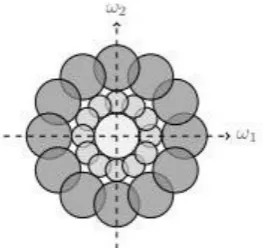
for a frequency-domain illustration of a semi-discrete directional wavelet frame. In Appendix A, we give a brief review of the general theory of semi-discrete frames, and in Appendices B and C we collect structured example frames in 1-D and 2-D, respectively. 4We emphasize that the feature vector ΦW (f) is a union of the sets of feature vectors Φn W (f). ω1 ω2 Partitioning of the frequency plane R2 induced by a semi-discrete directional wavelet frame with K = 12 directions. The fig 4 is used to describe this partitioning of frequency plane.
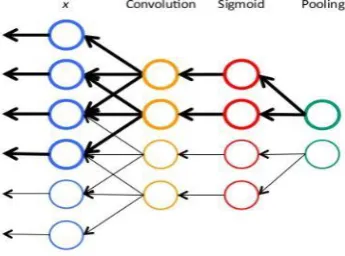
The design relating to the feature extractor ΦW in, outlined is known as scattering network, and utilizes the casing ΨΛW and the modulus non-linearity |·| in each system layer, yet does exclude pooling. For given n ∈ N, the set Φ n W (f) relates to the highlights of the capacity f produced in the n-th organize layer, see Fig.5
Fig.4 - Partitioning of frequency plane induced by a semi-discrete directional wavelet frame with k=12 directions
Fig.5 - Network Layers CNN
Fig.6 - Feature Flow CNN
3.
RESULT
[image:5.595.315.561.243.501.2]The Support Vector Machine (SVM) and Convolutional Neural Network (CNN) Can be compared in the sense that the support vector machine are linear classifier and the convolutional neural network are non-linear classifier. There is no way to increase the model complexity in case of the support vector machines and on the other hand in case of convolutional neural network, adding more layers can increase the model complexity. The comparison between support vector machine and convolutional neural network is shown in Fig 7. and the accuracy rate of the is shown in Fig-8.
Fig.7 - CNN vs SVM accuracy
Fig.8 - Accuracy vs Trial number.
4.
Conclusion
[image:5.595.86.218.293.417.2]© 2018, IRJET | Impact Factor value: 6.171 | ISO 9001:2008 Certified Journal | Page 2474 grouping, characteristic dialect preparing, and discourse
acknowledgment. Another favorable position is that you need to stress less over the element designing part. Once more, practically speaking, the choice which classifier to pick truly relies upon your dataset and the general many-sided quality of the issue - that is the place your experience as machine learning professional kicks in.. So we can finish up in light of the trials completed that CNN(convolutional neural network) is more appropriate for this errand than SVM(support vector machine).
REFERENCES
1. Y. Fu, G. Guo, and T. S. Huang, "Age synthesis and estimation via faces: A survey," IEEE transactions on pattern analysis and machine intelligence, vol. 32, pp. 1955-1976, 2010.
2. Zakariya Qawaqneh, Arafat Abu Mallouh, Buket D. Barkana, “Deep Convolutional Neural Network for Age Estimation based on VGG-Face Model,”
3. Gil Levi and Tal Hassner, “Age and Gender Classification using Convolutional Neural Networks,”2015
4. Y. Sun, X. Wang, and X. Tang. Deep learning face representation from predicting 10,000 classes. In Proc. Conf. Comput. Vision Pattern Recognition, pages 1891–1898. IEEE, 2014.
5. https://pdfs.semanticscholar.org/bbf7/b5bdc39f9b 8849c639c11f4726e36915a0da.pdf
6. Eran Eidinger, Roee Enbar, Tal Hassner, “Age and Gender Estimation of Unfiltered Faces” Volume: 9 Is Issue: 12, 2014