© 2017, IRJET | Impact Factor value: 5.181 | ISO 9001:2008 Certified Journal
| Page 5728
Investigation on Crushed Materials as Aggregate in Concrete
Ramesh J
1, Kalaiarasi M S
21
Assistant Professor, Prince Shri Venkateshwara Padmavathy Engineering College, Chennai, Tamil Nadu, India.
2Student, civil engineering, Prince Shri Venkateshwara Padmavathy Engineering College, Tamil Nadu, India
---***---Abstract -
The crushed materials have found the greatestscope in the field of construction due to the constant decline in the availability of conventional building materials. The solid wastes such as coconut shell and rubber tyres in the form of crumb which pose serious environmental hazards were taken in this study which in turn proves to be more beneficial. Replacements were made for both fine and coarse aggregates. Concrete mix with crumb rubber as fine aggregate in proportions of 2%, 4%, 6%, 8%, 10% were casted. In the same way concrete mix with coconut shell as coarse aggregate in proportions of 5%,7%,9%,11%,13% were casted and a comparative study on both mixes were made. With 2% replacement of sand the concrete showed 18% increase in compressive strength and with 5% replacement of gravel it showed 1.3% increase in compressive strength. Concrete mix made with 2% of crumb rubber and 5 % of coconut shell showed 10 % increase in compressive strength.
Key Words:Crushed materials, Coconut shell concrete,
Rubberized concrete
1. INTRODUCTION
Concrete is the single most material used in the world as it serves as a remarkably good building material. Concrete has a number of performance characteristics that can improve the sustainability of a building or structure. Due to increase in the infrastructural development, there has been a gradual decline in the availability of raw materials which lead to its increasing demand. In order to overcome such problems and to facilitate economy in construction several crushed materials like crushed glass, granite, rocks, bricks, limestone and many other alternatives are employed in construction [1]. The solid waste pose a serious threat to the environment as their disposal becomes tedious and harmful [2] Thus rather than disposal reuse of these generated wastes are preferred and one such attempt is the utilization of solid and agricultural wastes as a construction material [3] [4].
Of the various solid wastes available coconut shell and crumb rubber were taken in this study. The coconut shell is found to have less density, good absorbance to shock, high resistance against crushing, impact and abrasion compared to other materials and found to reduce the material cost in construction [5]. The properties of coconut shell like impact value, water absorption were studied [6]. The crumb rubber also shows good resistance against sulphate attack, waterproofing properties, freezing and thawing properties,
crack resistant and improved toughness .Their physical properties were tested as per IS standards.
Crushed coconut shell and crumb rubber were utilized in this study as a replacement of coarse and fine aggregate respectively in separate concrete mixes[7] [8]. An effective analysis is made on the workability and compressive strength of concrete containing both coconut shell and crumb rubber in a single concrete mix.
After 7, 14 and 28 days of curing the specimens were tested for their compressive strength. The coconut shell concrete showed appreciable compressive strength at 28 days at 5% replacement of coarse aggregate and the 2% of crumb rubber in concrete proved to be efficient with 18% increase in compressive strength. The combined mix with simultaneous replacement of both fine and coarse aggregates showed 10% increase in the overall compressive strength. Moreover the fresh concrete mix was found to have good workability.
2. EXPERIMENTAL INVESTIGATION
2.1 Materials
2.1.1 Coconut Shell
© 2017, IRJET | Impact Factor value: 5.181 | ISO 9001:2008 Certified Journal
| Page 5729
Fig-1: Crushed Coconut Shells2.1.2 Crumb Rubber
Crumb rubber is generally a form of scrap tyre obtained from automobile and truck tyres [11]. Generally the scrap tyres consist of 20% carbon, 7% hydrogen, 1.2% zinc oxide, 1.3% sulfur, 15% iron and 5.5% other components [12]. The crumb rubber is produced by reducing the size of scrap tyres by removing 99% or more of the steel and fabric from scrap tyres. Most commonly ambient process and cryogenic process were employed in their production [13]. Utilization of crumb rubber as fine aggregate in concrete reduces the landfill problems thus reducing the environmental hazard. Also the rubberized concrete is more flexible and prevents brittle failure.
Fig-2 Crumb Rubber
2.1.3 Aggregates
The coarse and fine aggregates of desired sizes as per Indian standards were collected from the locally available sources. Preliminary tests were conducted in order to study their properties as per various codes.
2.2 Mix Proportions
In this study PPC confirming to IS 1489-1991 (part 1) with a specific gravity of 2.91 was employed. The mix proportion was found to be 1:1.35:3.3. No other additives were added. The water cement ratio was taken as 0.5.
Table -1: Mix Proportion with Crumb Rubber
Mix ID % Replacement Fine aggregate
(g/m3)
Sand Crumb Rubber
0 0 514.31 0
1 2 504.048 10.262
2 4 495.738 20.572
3 6 483.451 30.859
4 8 473.165 41.145
[image:2.595.298.567.117.342.2]5 10 462.879 51.431
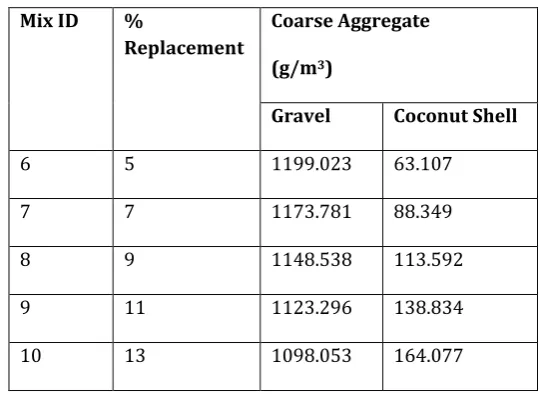
Table-2: Mix Proportion with Coconut Shell
Mix ID %
Replacement
Coarse Aggregate
(g/m3)
Gravel Coconut Shell
6 5 1199.023 63.107
7 7 1173.781 88.349
8 9 1148.538 113.592
9 11 1123.296 138.834
10 13 1098.053 164.077
Table-3: Mix Proportion for Combined Mix
Mix ID
%
Replacement
Fine Aggregate
(g/m3)
Coarse Aggregate
(g/m3)
FA CA sand CR gravel CS
[image:2.595.297.567.382.579.2]© 2017, IRJET | Impact Factor value: 5.181 | ISO 9001:2008 Certified Journal
| Page 5730
2.
3 Mixing and Casting of Concrete Cubes
The mixing duration is a major parameter to attain a homogeneous mix with uniform consistency of concrete. Initially the source material and aggregates were mixed in the pan in dry condition and then required quantity of water is added. Cubes were casted in moulds of size 150x150x150 mm. 9 cubes were casted for each mix totally counting to 108 specimens.
2.4 Curing of Concrete
After the concrete was casted, they were demoulded after 24 hours followed by curing in the ambient condition. The curing period was taken as 7, 14 and 28 days.
Fig-3: Curing of Concrete Cubes
3. RESULTS AND DISCUSSION
3.1 Compressive Strength
The average strength of concrete was tested after 7, 14 and 28 days of curing. The compressive strength was found to decrease with increase in percentage of replacement but the workability was found to be good. The average compressive strength was shown in the following figure. The combined mix showed 10% increase in the final compressive strength. The rubberized concrete proved to be efficient with 18% increase in strength and the coconut shell concrete showed comparable strength to that of the conventional concrete.
0% 2% 4% 6% 8% 10%
trial 1 7.211 8.103 6.63 6.489 6.13 4.43
trial 2 7.244 8.158 6.62 6.649 6.1 4.22
trial 3 7.667 8.208 6.439 6.679 6.13 4.435
0 1 2 3 4 5 6 7 8 9
co
m
press
iv
e
st
re
ng
th
Chart-1: 7 days Compressive Strength of Crumb Rubber Concrete
0% 2% 4% 6% 8% 10%
trial 1 7.566 8.649 7.975 7.196 6.251 4.316 trial 2 7.87 8.158 7.908 7.319 6.298 4.22 trial 3 7.598 8.588 8.08 7.136 6.386 4.435
0 1 2 3 4 5 6 7 8 9 10
Co
m
press
iv
e
st
re
ng
th
Chart-2: 14 days Compressive Strength of Crumb Rubber Concrete
0% 2% 4% 6% 8% 10%
trial 1 10.46 12.117 11.723 11.057 9.648 7.317 trial 2 10.503 12.208 11.742 10.926 9.577 7.897 trial 3 10.059 12.311 11.472 10.96 9.436 8.166
0 2 4 6 8 10 12 14
Co
m
press
iv
e
st
re
ng
th
© 2017, IRJET | Impact Factor value: 5.181 | ISO 9001:2008 Certified Journal
| Page 5731
0% 5% 7% 9% 11% 13%
trial 1 7.211 6.631 6.187 5.733 5.394 4.967 trial 2 7.244 6.452 6.178 5.764 5.212 5.034 trial 3 7.667 6.581 5.99 5.501 5.518 5.114
0 1 2 3 4 5 6 7 8 9
co
m
press
iv
e
st
re
ng
th
Chart -4: 7 days Compressive Strength of Coconut Shell Concrete
0% 5% 7% 9% 11% 13%
trial 1 7.566 8.11 6.98 6.484 6.13 5.255
trial 2 7.87 7.872 7.191 6.572 5.842 4.876 trial 3 7.598 7.815 7.285 6.471 6.011 5.114
0 1 2 3 4 5 6 7 8 9
co
m
press
iv
e
st
re
ng
th
Chart-5: 14 days Compressive Strength of Coconut Shell Concrete
0% 5% 7% 9% 11% 13%
trial 1 10.46 10.34 9.003 6.996 6.609 6.464 trial 2 10.5 9.781 9.781 7.563 6.517 6.383 trial 3 10.06 10.66 8.455 6.972 6.27 6.459
0 2 4 6 8 10 12
co
m
press
iv
e
st
re
ng
th
Chart-6: 28 days Compressive Strength of Coconut Shell Concrete
7 days 14 days 28 days
trial 1 7.86 9.015 11.308
trial 2 7.804 8.883 11.5
trial 3 8.484 9.104 11.282
0 2 4 6 8 10 12
14
Co
m
p
ress
iv
e
st
re
n
g
th
Chart-7: Compressive Strength of Combined Mix
4. CONCLUSIONS
Based on the inference from the test results it can be concluded as following:
1. Replacement of fine aggregate by crumb rubber concrete proved to be efficient up to 6 %.
2. Replacement of coarse aggregate by coconut shell proved to be efficient up to 5 % of replacement.
3. In both the cases the compressive strength was found to decrease with increase in percentage of replacement. This may be attributed to the increase in porosity and air voids.
4. The workability was found to increase in both the mix with higher percentage of replacement.
5. When 2 % of fine aggregate and 5 % of coarse aggregate was replaced in the same mix by crumb rubber and coconut shell respectively, the compressive strength was found to increase by 10% with good workability. It can be seen that appreciable compressive strength was obtained with good workability and this reduces the problem of high cost of conventional aggregates. It can be implemented in low cost housing and preferably non load bearing structures.
Further investigations can be carried out on the following: 1.Use of suitable admixtures in the concrete mix can be
tested to provide high compressive strength at higher percentages.
2.Properties of the crumb rubber used can be studied in a more detailed manner.
© 2017, IRJET | Impact Factor value: 5.181 | ISO 9001:2008 Certified Journal
| Page 5732
REFERENCES
[1] Dewanshu Ahlawat1, L.G. Kalurkar,”Coconut shell as
partial replacement of coarse aggregate in concrete”, International Conference on Advances in Engineering & Technology – 2014, PP 61-64.
[2] A. Mansoorn Ali, A. Saravanan, “Experimental study on
concrete by partial replacement of fine aggregate by crumb rubber”, International Conference on Engineering Trends and Science & Humanities, ISSN: 2348 – 8352, 2015.
[3] K. C. Pand, P. S. Parhi and T.Jena, “Scrap-tyre-rubber
replacement for aggregate in cement concrete: Experimental Study”, International Journal of earth sciences and engineering. Volume 05, No.06 (01) December 2012,P.P.1692-1701.
[4] Amaranth Yerramalaa and Rama chandrudu, “Properties
of concrete with coconut shells as aggregate replacement”, International Journal of Engineering Inventions, Volume 1 Issue 6 October 2012 PP: 21-31.
[5] Sreenivasulu Dandagala, Praveen K, Satish K, Sri Harsha
K, Mahesh V Anil Kumar P, “Laboratory investigation on coconut shell in concrete: An alternative low cost building material”, National Conference on Green Engineering and Technologies for Sustainable Future-2014 issue 4 December Future-2014.
[6] B.Damodhara Reddy, S.Aruna Jyothy, Fawaz
Shaik, “Experimental analysis of the use of coconut shell as coarse aggregate”, Journal of Mechanical and Civil Engineering, Volume 10, Issue 6 (Jan. 2014), PP 06-13.
[7] Alaa M. Rashad, “A comprehensive overview about
recycling rubber as fine aggregate replacement in traditional cementitious materials”, International Journal of Sustainable Built Environment, 24 December 2015.
[8] S. A. Kakade, Dr. A. W. Dhawale,“Light weight aggregate
concrete by using coconut shell”, International Journal of Technical Research and Applications, Volume 3, Issue 3 (May-June 2015), PP. 127-129.
[9] Tomas U. Ganiron Jr,“Sustainable management of waste
coconut shells as aggregates in concrete mixture”, Journal of Engineering Science and Technology Review 6 (5) (2013) 7-14.
[10] Apeksha Kanojia, S.K. Jain,” Performance of coconut shell
as coarse aggregate in concrete: A review”, Volume: 02 Issue: 04, July-2015.
[11] S. Selvakumar, R.Venkatakrishaiah “Strength properties
of concrete using crumb rubber with partial replacement of fine aggregate”, International Journal of Innovative Research in Science, Engineering and Technology, Vol. 4, Issue 3, March 2015.
[12] Laura Granzotto and Rafael Alves de Souza, “Mechanical
properties of structural concrete with partial replacement of fine aggregate by tire rubber”, Acta Scientiarum. Technology, v. 35, n. 1, p. 39-44, Jan.-Mar., 2013.
[13] Nithiya P and Portchejian, “Behavior of partial
replacement of fine Aggregate with crumb rubber
concrete, International journal of structural and civil engineering research, Vol. 3, No. 3, August 2014.
[14] M S Shetty, Concrete technology theory and
practice,Chand Publications, ISBN : 81-219-0003-4.
[15] IS 1489(part 1): 1991- Indian standard specification for
Portland pozzolonacement part-1 fly-ash based, 2000.
[16] IS 456:2000-Indian standard code of practice for plain
and reinforced concrete,2000.
[17] IS 516:1959-Indian standard for method of test for
strength of concrete.
[18] IS 2386(Part 1):1963 Methods of test for aggregates for
concrete: Part 1 Particle size and shape.
[19] IS 2386(Part 2):1963- Methods of test for aggregates for
concrete: Part 2 Estimation of deleterious materials and organic impurities.
[20] IS 2386(Part 3):1963- Methods of test for aggregates for
concrete: Part 3 Specific gravity, density, voids, absorption and bulking.
[21] IS 4031(Part 4):1988 Methods of physical tests for
hydraulic cement: Part 4 Determination of consistency of standard cement paste.
[22] IS 4031(Part 5):1988 Methods of physical tests for