http://dx.doi.org/10.4236/jmp.2015.64053
MLG vs. MOND
Kamal BarghoutPrince Mohammad University, Dhahran, Saudi Arabia Email: [email protected]
Received 1 February 2015; accepted 24 March 2015; published 27 March 2015
Copyright © 2015 by author and Scientific Research Publishing Inc.
This work is licensed under the Creative Commons Attribution International License (CC BY). http://creativecommons.org/licenses/by/4.0/
Abstract
In a recently published paper Metal-Like Gravity (MLG) and Its Cosmological Applications [1], it was determined that a new modification of Newtonian gravity could explain many of the cosmo-logical mysteries such as the nature of dark matter and dark energy. The theory provided a gravi-tational physical system and explained the flatness of the galactic rogravi-tational curves (RC). A RC fit that was identical to MOND’s RC fit for spiral galaxies was generated with α as a fitting parameter determined as equal to 1.345. In this paper I am elaborating more on the theory’s cosmological extrapolation of MOND’s critical acceleration a0. This is done by further assessing the gravitational interaction between the galactic baryonic mass and the halo-DM mass in the star-galaxy overlap-ping volume estimated in MLG framework interpreting a0 as only a factor induced from the reduc-tion of the galactic luminous mass. It is asserted that MOND and MLG dynamic equareduc-tions are equiva-lent with MOND’s form, only expressing the equation with an intermediate solution by equating the magnitudes of δ (a parameter that defines a scaled surface galactic DM-density perpendicular to the galactic radial direction in the galaxy-star halo overlapping volume) and G.
Keywords
MLG, MOND, Antigravity, Flat Rotation Curves
1. Introduction
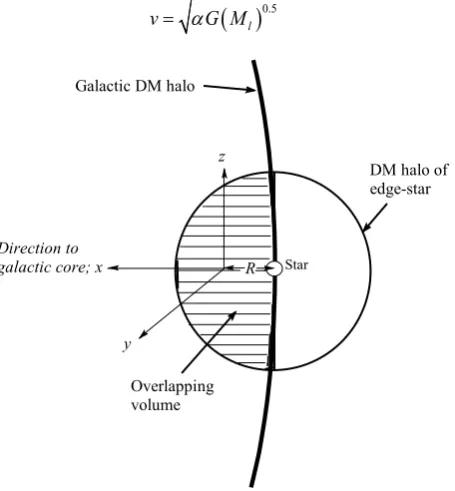
be-tween the galactic DM-mass in the galaxy-edge star overlapping volume of their halos and the star’s baryonic mass (see Figure 1). Since the galactic DM density in the galaxy-star overlapping volume is proportional to the galactic luminous mass, the edge-star’s dynamics is seen proportional to the galactic luminous mass (see [1]).
Modified Newtonian Dynamic theory (MOND) is a theory that modifies Newton’s gravitational law by in-troducing an empirical formula that describes well flat galactic rotation curves (RC) in spiral galaxies by intro-ducing a critical acceleration a0 at which galactic rotation curves are flat. MOND’s empirical formula is 4
0 l
a GM , where Ml is the galactic luminous mass [2]. MOND by far solved the mystery of fine-tuning problem of ΛCDM
cosmological model on galaxy scales and pointed to new physics for the nature of DM particles and/or to mod-ification of gravity, but among others failed to account for the dynamics and lensing of galaxy clusters [3]. MLG is believed to add faith to MOND’s success by projecting a physical meaning to its abstract formulation. In the original paper [1], the author compared MLG cosmological dynamics with that of MOND and found out that they were identical, thereby introducing a physical system that explained the success of MOND and probably presented a system that played a fundamental role in a new quantum gravity theory, i.e. the self-repulsive DM- particles’ bonding medium in MLG could introduce the required conditions for the plasma needed for superfluid vacuum theory. For example, an analogy to a superconductor would be, the cosmological self-repulsive DM- vacuum representing the condensed self-repulsive “electron-sea” and the self-repulsive baryons representing the cations in the superconducting metal. Here, I argue that MOND’s critical acceleration parameter a0 arises from the fact that the bonding agent “DM mass” in the galactic halo interacts with much smaller magnitude of galac-tic baryonic mass than that of the galacgalac-tic luminous mass. In pargalac-ticular, I further describe galacgalac-tic dynamics under the eyes of MLG theory and extrapolate that MOND’s critical acceleration a0 arises from the process of shiel-ding of the galactic luminous mass by the body of the enclosed galactic DM-halo at the location of the edge-star.
2. Edge-Star’s Dynamics
In the original paper, MLG edge-star’s dynamics yields flat rotation curves, with galactic luminous mass as the sole determining factor of the rotational velocity, characterized by the formula,
( )
0.5l
v= αG M (1)
Galactic DM halo
Overlapping volume
DM halo of edge-star
Direction to galactic core; x
y
z
[image:2.595.199.427.409.655.2]R Star
where Ml is the galactic luminous mass, αis a fitting parameter.
MLG describes the edge-star dynamics as governed by Equation (1) where a fitting parameter αis determined with magnitude 1.345. In the original paper, a first order approximation is considered when evaluating the gra-vitational force between a galactic DM-halo particle and the galactic luminous mass [1]. To better estimate the parameter αand describe a physical interpretation to it, the approximation can be removed and the galactic lu-minous mass is suggested to be reduced by a numerical factor of that of the magnitude of MOND’s a0 of the or-der of 10−10.
3. MLG Extrapolation of MOND’s Critical Acceleration
a
0MLG describes a DM-halo density for any baryonic object as inversely proportional to the radial distance from its center due to the self-repelling nature of DM particles. This configurational analysis of galactic DM halos al-lows the derivation of the fitting constantαas a function of DM halo’s density in Equation (2). The sequence of derivation is as follows,
We assume that the galaxy-star overlapping volume for an edge-star is invariable and dominated by the star’s potential since the edge star is far away from the galactic core while the galactic component of the DM-mass in the overlapping volume is variable with its density increasing the closer the edge star to the galactic core asFigure 2 shows (see reference [1]).
The halo’s DM particle dynamics is obtained by balancing the repulsive force between a DM particle in an arbitrary location in the halo and the one preceding it from the galactic core (as described in the original paper to first order approximation) and the attractive force between that DM particle and the galactic baryonic (luminous)
mass as 2 2
l
Gmm l =GmM r , which yields,
l
m l= M r (2) where m is the DM particles’ mass, Ml is the galactic luminous baryonic mass, r is the star’s radial distance to
the center of the galactic core, and l is the spacing between DM particles (Figure 1).
MOND introduces critical acceleration a0 at which cosmological dynamics is described by MOND’s regime that departs from Newtonian one and produces flat rotation curves mainly for spiral galaxies. Unlike MOND, MLG asserts that the transition acceleration at which galactic centripetal acceleration of edge-stars deviates to produce constant galactic rotational velocity is due to configurational transition from galactic core dynamics to halo dynamics. This is interpreted as that the dynamics transition occurs when the star is located far away from the ga-lactic coreas MLG describes the dynamics of the star in the gaga-lactic core as governed by a star-star interaction and not a star-galactic-core interaction as in the galactic halo. Under MLG, MOND’s critical acceleration must have gravitational origin. In this regard, it is very tempting to assume that the magnitude of a0
(
1.2 10× −10)
can safely be associated with the gravitational source, that is to say the galactic luminous mass, if we want to assume the form of Newton’s law assuming its integrity at all times as MLG demands (proportional to the product of the two masses and the inverse square of the distance). In MLG, the magnitude of the fitting parameter α can safely be treated as unity for the sake of comparison with MOND. But when MLG dynamic equation was fitted in the original paper it considered the source of gravity in the galactic core as the total luminous mass (as MOND did).Galactic core
Galactic halo's DM particle
[image:3.595.190.440.571.685.2]l m
This is not the case though as only first approximation for balancing the gravitational forces at the location of the edge-star was considered.
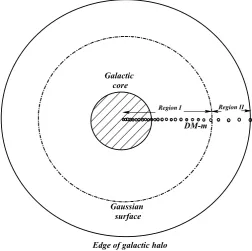
To describe an effective “net” galactic luminous mass at the location of the edge-star as ordained by MLG, we need to describe the repulsive gravitational force between two halo-DM particles as balanced by the attractive force with the “net” luminous mass as shown inFigure 3 where the DM-mass enclosed by the Gaussian surface (Region I) can be deducted from the total galactic luminous mass to produce the “net” galactic luminous mass. Region I contains most of the halo’s DM-mass since it contains the core. The DM-mass enclosed in Region II should equal the net galactic luminous mass since the whole galaxy is mass-neutral.
MOND’s cosmological dynamic equation can be rewritten in the following form,
(
)
0.5 0.50 l
v= a G GM (3) Notice that this is exactly the MLG dynamic equation with the fitting parameter as
(
a G0)
0.5. The dimen-sions are satisfied when the dimension of the parameter αis considered since we are only associating the mag-nitude of a0 to the luminous mass.Here I estimate that the reduction factor of the luminous mass in MLG dynamic equation as in the order of the magnitude of that of a0 but may not be conclusively estimated unless we identify the mass of the DM particle. This may be justified as the following line of reasoning;
It happens that MOND considers the reduction factor of Ml is in the same order as that of the gravitational
constant G (or a0) of about 10−10. If we insert this factor to
l
M in MLG dynamic Equation (1), the fitting pa-rameter α should be adjusted by an inverse of that factor of the square root of 1 10−10 to maintain its unity magnitude as determined by the process of galactic fitting. Note that to maintain the unity magnitude of α, the numerator (luminous mass reduction factor) as well as the denominator δ(a parameter that defines a scaled sur-face galactic DM-density perpendicular to the galactic radial direction [4] in the overlapping volume should be of the same magnitude. The magnitude of the denominator as G−1 2 only suits MOND’s form. It is not surpris-ing now that a0 and G both have about the same magnitude.
Galactic core
Gaussian surface
Edge of galactic halo
DM-m
[image:4.595.185.438.406.657.2]Region I Region II
Inserting the reduction factor
( )
a0 to Ml and adjusting for the fitting parameter α, Equation (1) becomes,(
)
0.50.5 1.2 1010
l
v= δ− G × − M (4) Equation (4) describes a gravitationally effective “net” luminous mass of the order of 1010
l
M
− and fitting
parameter of units of kg m in the order of 105 with actual dimensions of a parameter 0.5
(
2)
DMm l R
δ− = ,
where l is the spacing distance between DM particles perpendicular to the galactic radial direction in the over-lapping volume and 2
DM
m l represents the invariable galactic halo’s DM surface density, R is the volume’s radius (where the volume is taken as spherical for simplification), and mDM is the DM-particle’s mass (see
original paper). It is worth noting that unless a DM particle is identified, R and l-spacing cannot be estimated. To further illustrate the close relationship between MLG and MOND, we configurationally can see that the parameter αremains “~unity” if the effective luminous mass is taken as the total luminous mass (representing one solution to the equation, as taken by MOND) because the magnitude of the parameter δis proportional to the magnitude of the reduction factor of the galactic luminous mass at all times. The author believes that the lu-minous mass reduction factor as the magnitude of a0 appears when galactic stars are located just beyond the ga-lactic core announcing the beginning of the MONDian regime where the magnitudes of δ and G are equal. The reduction factor assumes a smaller magnitude and continues with this trend to the galactic border but is also ac-companied by similar reduction of the parameter δ since the galactic DM radial density decreases proportional to the radial distance; see Equation (2), maintaining a constant ~αQualitatively, this is because as we approach
the galactic core the reduction factor gets larger but so does R since the galaxy-star overlapping volume inflates when the star is closer to the galactic core due to higher galactic halo DM-density, see original paper and Figure 1.
4. The Significance of the Parameter
α
The parameter 𝛼𝛼 can be treated as nearly a constant in the MONDian regimeas it describes the square root of the ratio of luminous mass reduction factor to the term δ. It represents a scaled DM surface density of magnitude of
(
)
0.50
a G in MOND’s regime when the baryonic mass is considered the sole source of galactic gravity without reduction as MOND asserts. It is also clear that from Equation (3) the parameter
(
)
0.50
a G can be as-sociated with the luminous mass Ml to become v= G a G M(( / ) )0 l 0.5 . The parameter
(
a G0)
can be inter-preted as the transition (critical) surface baryonic density at which the DM dominates the dynamics of galaxies [5]. Here, this is interpreted as the transition from core-dynamics to halo dynamics. Milgrom (MOND’s creator) also attempted to attribute the assumed missing mass in MOND’s regime as a “phantom” nonrelativistic nega-tive mass [6]. The parameter αcan be treated as nearly a constant that equals in the MONDian regime as it de-scribes the square root of the ratio of luminous mass reduction factor to the term δ. The choice of a0 in MOND’s dynamic formula as a critical acceleration of its regime limits the power of the dynamical aspect of the parame-ter αin MLG dynamic formula where only the ratio of the luminous mass reduction factor to the parameter δ is significant. It is clear that MOND and MLG dynamic equations are equivalent with MOND’s form only expressing the equation with an intermediate solution by equating the magnitudes of δand G. The significance of the para-meter αin MLG is that it provides a physical meaning to the MOND’s critical acceleration a0.5. Conclusion
I have compared the critical acceleration calculated in the framework of MOND with a possible reduction factor of “net” galactic baryonic mass in the frame work of MLG and have predicted that MOND’s critical acceleration only arises as a consequence of that mass reduction. I conclude that the appearance of a0 in MOND’s dynamic equation is only a coincidence and results in ignoring a dynamical process of a true physical system. MLG theory describes well this physical system and attributes a configurational parameter α whose magnitude remains equal to the magnitude of ~
(
)
0.50
a G at all times if the total galactic luminous mass is used in MLG/MOND dynamic equation. Analysis of MLG fitting parameter αalso reveals that MOND’s critical acceleration a0 must have the same magnitude as the gravitational constant G since it only describes an intermediate solution of MLG dynamic equation.
References
[2] Milgrom, M. (1983) Astrophysical Journal, 270, 365-370. http://dx.doi.org/10.1086/161130
[3] Angus, G.W., Shan, H.Y., Zhao, H.S. and Famaey, B. (2007) Astrophysical Journal, 654, L13.
http://dx.doi.org/10.1086/510738
[4] Donato, F., Gentile, G., Salucci, P., Frigerio Martins, C.,Wilkinson, M.I., Gilmore, G., Grebel, E.K., Koch, A. and Wyse, R. (2009) MNRAS, 397, 1169-1176. http://dx.doi.org/10.1111/j.1365-2966.2009.15004.x
[5] Milgrom, M. (1989) Astrophysical Journal, 338, 121-127. http://dx.doi.org/10.1086/167184