© 2017, IRJET | Impact Factor value: 6.171 | ISO 9001:2008 Certified Journal | Page 1618
Optimization of Fuzzy Logic controller for Luo Converter using Genetic
Algorithm
N. Nachammai
1, R. Kayalvizhi
21
Associate Professor, Department of Electronics and Instrumentation Engineering, Annamalai University,
Annamalanagar-608 002, Tamil Nadu, India.
2
Professor, Department of Electronics and Instrumentation Engineering, Annamalai University,
Annamalanagar-608 002, Tamil Nadu, India.
---***---Abstract - Negative output elementary Luo converter
performs the conversion from positive DC input voltage to negative DC output voltage. Since Luo converters are non-linear and time-variant systems, the design of high performance controllers for such converters is a challenging issue. The controllers should ensure system stability in any operating condition and good static and dynamic performances in terms of rejection of supply disturbances and load changes. To ensure that the controllers work well in large signal conditions and to enhance their dynamic responses, soft computing techniques such as Fuzzy Logic Controller (FLC) and Genetic Algorithm based FLC (GA-FLC) are suggested. Fuzzy logic is expressed by means of the human language. A fuzzy controller converts a linguistic control strategy into an automatic control strategy and fuzzy rules are constructed by expert experience or knowledge database. Genetic Algorithm is a powerful optimizing tool that is based on the mechanism of natural selection and natural genetics. Since fuzzy parameters are obtained by trial and error method, Genetic Algorithm can be used to optimize the fuzzy rules, membership functions and scaling gains thereby improving the performance of the Luo converter. In order to test the robustness of the designed GA-Fuzzy and Fuzzy based Luo converter, the controllers and converter have been modeled using Matlab – Simulink software. From the simulation results, it is seen that GA- FLC gives fast response, good transient performance and robustness to variations in line and load disturbances. Performance comparison show improvement of transient responses in terms of settling time, peak overshoot and ISE in the GA-Fuzzy than FLC for Luo converter.Key Words: Fuzzy Logic Controller, Genetic Algorithm, Luo Converter, Membership Functions
1. INTRODUCTION
The tuning of the parameters of PID accurately becomes difficult because most of industrial plants are highly complex, nonlinear and higher order system with time delay. Due to the complexity of most industrial plants and the limitation of PID controller, soft computing techniques such as FLC, GA, PSO, BF etc. are introduced for intelligent regulation of power electronic converter. The FLC does not require complete mathematical model of the system to be controlled and it can work properly with nonlinearities
and uncertainties. Although fuzzy logic controllers have been applied in many complex industrial processes, they experience a deficiency in knowledge acquisition and depend to a great extent on empirical and heuristic knowledge. There is no generalized method for the formulation of fuzzy control strategies and design of fuzzy parameters are based on trial-error method.
Genetic algorithm is a search algorithm based on the mechanism of natural selection and genetics. These are easy to implement and efficient for multivariable optimization problems. Hence by strengthening fuzzy logic controllers with genetic algorithm, the searching and attainment of optimal fuzzy logic rules, scaling gains and high-performance membership functions can be obtained. The performance of the GA optimized fuzzy logic controller is compared with that of the fuzzy controller. MATLAB/ SIMULINK software is used to design the controller and converter. The objective of optimization is to reduce settling time, peak overshoot and ISE and the results demonstrate that compared with fuzzy logic control strategy, genetic-fuzzy control strategy gives better control of Luo converter. Simulation results indicate that the output voltage of the closed loop system can be regulated to a desired reference voltage regardless of the variations in input voltage and changes in output load.
2. NEGATIVE OUTPUT ELEMENTARY LUO
CONVERTER (NOELC)
The negative output elementary Luo converter circuit shown in Fig. 1 performs step-down and step-up DC-DC conversions. Switch S is a N-channel power MOSFET (NMOS) device. It is driven by a PWM switching signal with repeating frequency ‘ ’ and duty ratio ‘ ’. The switching period is so that the switch-ON period
is and the switch-OFF period is .
The elementary circuit can be considered as a combination of an electronic pump S-L1-D-C and a type low-pass filter
C-L2-C0. The pump injects certain energy into the low-pass
filter every cycle. Capacitor C acts as the primary means of storing and transferring energy from the source to the load.
When the MOSFET is ON, inductance L1 absorbs energy
© 2017, IRJET | Impact Factor value: 6.171 | ISO 9001:2008 Certified Journal | Page 1619
Fig -1: Circuit Diagram of Negative Output Elementary LuoConverter
Fig -2: Equivalent Circuit During Switch-ON (Mode 1)
Fig -3: Equivalent Circuit During Switch-OFF (Mode 2)
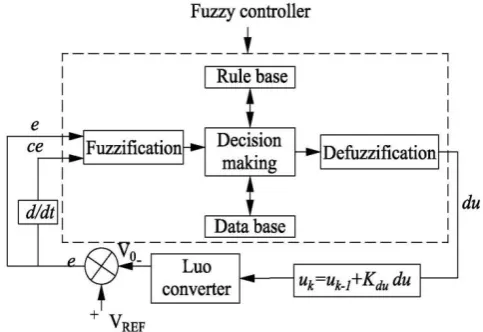
Fig -4: Block Diagram of Fuzzy Logic Controller for Luo Converter
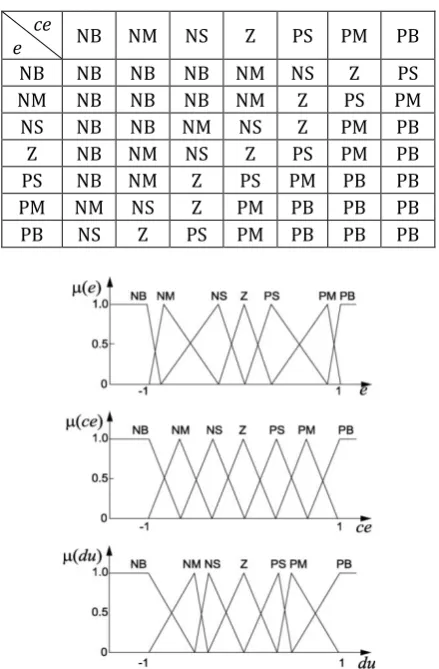
Design of fuzzy logic controllers mainly involves three steps, namely fuzzification, fuzzy rule base and defuzzfication which is shown in Fig.4. Fuzzification is a process in which the inputs are fuzzified between a range of 0 to 1. Rule base is formed by the experts knowledge and depending on the inputs, the rule base generates the corresponding linguistic variable output. This output is defuzzified from 0 to 1 to a global value. The designed FLC has two inputs, error (e) and rate of change of error (ce) and a controller output (du). The number of necessary fuzzy sets and their ranges are designed based upon the experience gained on the process. A Madmani based system architecture has been realized. Max-min composition technique and center of gravity method have been used in the inference engine and defuzzification. In the present work, seven triangular fuzzy sets are chosen as shown in Fig. 5 and are defined by the following library of fuzzy set values for the error , change in error and for the change in duty cycle . NB: Negative Big, NM:
[image:2.595.312.554.241.407.2] [image:2.595.40.284.267.394.2] [image:2.595.41.285.450.576.2] [image:2.595.40.281.620.752.2]© 2017, IRJET | Impact Factor value: 6.171 | ISO 9001:2008 Certified Journal | Page 1620
Fig -5: Triangular Type Membership Function for Error,Change in Error and Change in Duty cycle
A rule table is derived and is shown in Table 1.
The inference mechanism seeks to determine which rules fire to find out which rules are relevant to the current situation. The inference mechanism combines the recommendations of all the rules to come up with a single conclusion.
Table -1: Rules for Mamdani-Type Fuzzy System
ce
e NB NM NS Z PS PM PB
NB NB NB NB NB NM NS Z
NM NB NB NB NM NS Z PS
NS NB NB NM NS Z PS PM
Z NB NM NS Z PS PM PB
PS NM NS Z PS PM PB PB
PM NS Z PS PM PB PB PB
PB Z PS PM PB PB PB PB
Since the inferred output is a linguistic value, a defuzzification operation is performed to obtain a crisp value. In this work, the centre of gravity or centroid method is used for de-fuzzification.
4. GENETIC ALGORITHM
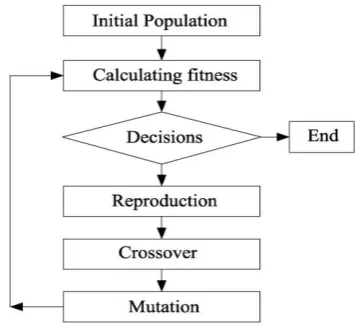
GA is a simulation of biological genetic and evolution in the natural environment and formation of an adaptive global optimization probability search algorithm.
The basic process of GA is shown in Fig. 6. GA uses three main operators which are selection, crossover and mutation:
a) Selection: It is the mechanism for selecting the individuals with high fitness to produce new individuals for the next population. The selection type used in this work is the roulette wheel method.
Fig -6: Flow chart of Genetic algorithm
b) Crossover: This operation involves the combination of genes from two parents to produce off springs.
c) Mutation: This process involves the reproduction of an erroneous copy of the individual, in which a random number is generated where if it is greater than a threshold value then the zero binary value is changed to one. This part is added to increase the diversity.
d) Copying: This process involves the reproduction of an exact copy of the individual.
e) Termination: Where a certain number of generations is reached or an acceptable solution is reached or no change in the optimal solution is reached.
The fitness function is defined as
∫
e(t) = Vref – vo(t)
where e(t) is the error ,Vref is the reference voltage and
vo(t) is the actual output voltage.
5. GA BASED FUZZY LOGIC CONTROLLER
[image:3.595.50.274.79.249.2] [image:3.595.345.523.87.251.2]© 2017, IRJET | Impact Factor value: 6.171 | ISO 9001:2008 Certified Journal | Page 1621
[image:4.595.42.289.85.195.2]and one de-normalization parameter (kdu) for output (du) are defined. In normalization process, the input variables are scaled in the range of (-1, +1) and in de-normalization process, the output values of fuzzy controller are converted to a value depending on the terminal control element. The determination of normalization and de-normalization parameters of fuzzy controller is important for system stability. Hence a performance index is defined along with an algorithm to search for the optimal values of (Ke Kce Kdu), (ae, be, ace, bce, adu,, bdu) and (C1 C2 ……..C49) corresponding to normalization factors, membership functions and control rules. The optimized fuzzy logic rules are listed in Table 2.
Table -2: Optimized Fuzzy Logic Rules
ce
e NB NM NS Z PS PM PB
NB NB NB NB NM NS Z PS
NM NB NB NB NM Z PS PM
NS NB NB NM NS Z PM PB
Z NB NM NS Z PS PM PB
PS NB NM Z PS PM PB PB
PM NM NS Z PM PB PB PB
PB NS Z PS PM PB PB PB
[image:4.595.324.540.103.291.2]Fig -8: GA Optimized Membership Functions of FLC
Table -4: GA Parameters
Number of Generations 100
Population Size 30
Crossover Rate 0.8
Crossover Type Single Point
Mutation Rate 0.09
Selection Type Roulette wheel
6. SIMULATION RESULTS AND DISCUSSION
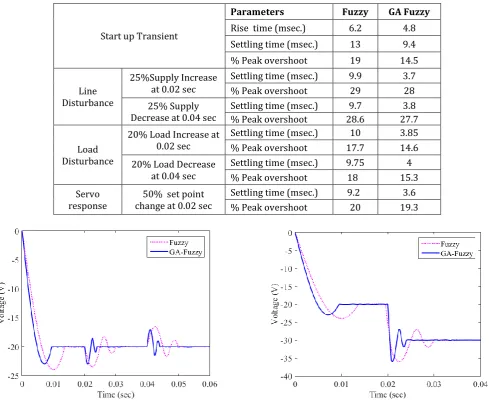
In order to evaluate the performance of the proposed controllers, simulation has been carried out for set point change, source and load variations. The circuit parameters of the chosen Luo converter or listed in Table 3. Table 4 shows the GA parameters of a GA-fuzzy controller for the Luo converter. The controllers were made to maintain the output voltage constant at -20 V which is shown in Fig. 9 Fig. 10 shows the measured responses of the output voltage with fuzzy and GA-fuzzy controllers with ± 25% supply disturbances at 0.02 sec and 0.04 sec. For the supply change from 10 V to 12.5 V and R = 10Ω, the output voltage is regulated within 9.9 msec and 3.7 msec and the % peak overshoot is 29 and 28 for fuzzy and GA-fuzzy controllers respectively. When the supply voltage is changed from 12.5 V to 10 V, the settling time is 9.7 msec and 3.8 msec with % peak overshoot of 28.6 and 27.7 for FLC and GA-FLC.
[image:4.595.338.533.269.343.2] [image:4.595.52.272.425.760.2]© 2017, IRJET | Impact Factor value: 6.171 | ISO 9001:2008 Certified Journal | Page 1622
Fig -9: Closed Loop Responses of Luo Converter with [image:5.595.56.543.77.250.2]Fuzzy and GA-Fuzzy Controllers Fig -10: Output Voltage Regulation under Disturbances 25% Line
Table -5: Performance Comparison of GA-Fuzzy and Fuzzy Controllers for NOELC
Start up Transient
Parameters Fuzzy GA Fuzzy
Rise time (msec.) 6.2 4.8
Settling time (msec.) 13 9.4
% Peak overshoot 19 14.5
Line Disturbance
25%Supply Increase at 0.02 sec
Settling time (msec.) 9.9 3.7
% Peak overshoot 29 28
25% Supply
Decrease at 0.04 sec Settling time (msec.) % Peak overshoot 28.6 9.7 27.7 3.8
Load Disturbance
20% Load Increase at 0.02 sec
Settling time (msec.) 10 3.85
% Peak overshoot 17.7 14.6
20% Load Decrease at 0.04 sec
Settling time (msec.) 9.75 4
% Peak overshoot 18 15.3
Servo
response change at 0.02 sec 50% set point
Settling time (msec.) 9.2 3.6
% Peak overshoot 20 19.3
Fig -11: Regulatory responses of Luo Converter under
[image:5.595.50.540.317.723.2]© 2017, IRJET | Impact Factor value: 6.171 | ISO 9001:2008 Certified Journal | Page 1623
REFERENCES
[1] Luo. F. L. and Hong Ye. , Advanced DC/DC Converters, First edition, CRC Press, LLC, London, 2014.
[2] Nemat Changizi, Mahbubeh Moghadas, Mohamadreza Dastranj and Mohsen Farshad (2012), Design a Fuzzy Logic Based Speed Controller for DC Motor with Genetic Algorithm Optimization, Journal of Applied Mechanics and Materials, Vol. 110-116, pp.2324-23330.
[3] Amin Chegeni, AbdollahKhoei, KhayrollahHadidi
(2007), Improved Genetic Algorithm-Based
Optimization of Fuzzy Logic Controllers, First Joint Congress on Fuzzy and Intelligent Systems , Iran,
[4] Ghoshal, S.P. and Goswami, S.K. (2003), Application of GA based optimal integral gains in fuzzy based active power-frequency control of non-reheat and reheat thermal generating systems, Electric Power Systems Research, Vol. 67(2), pp.79-88.
[5] Hemalatha, C., MridulPandey, Amit Kumar Sinha and
Srijita Singha Roy (2016), GA Based Fuzzy Logic Controller for A Pressure Process Station, International Journal of Latest Trends in Engineering and Technology, Vol. 6(3), pp. 310-317.
[6] Luo,F.L. (1997), Luo Converters: New DC-DC step-up
Converters,Proceedings of IEEE International
Symposium on Integrated Circuit-97, Singapore, Vol.2, Jun., pp. 227-230.
[7] Sheroz Khan, Salami Femi Abdulazeez, Lawal