© 2017, IRJET | Impact Factor value: 6.171 | ISO 9001:2008 Certified Journal | Page 332
Hybrid Optimization Approaches to Economic Load Dispatch Problems
– A Comparative Study
Prakash Arumugam
1, C S Ravichandran
21
Assistant Professor, Dept. of EEE, Sri Krishna College of Technology, Coimbatore, Tamilnadu
2Professor, Dept. of EEE, Sri Ramakrishna Engineering College, Coimbatore, Tamilnadu
---***---Abstract -
The main objective of the Economic Load Dispatch (ELD) problem is to minimize the total fuel cost by considering both the equality and inequality constraints. To obtain the aforesaid objective, all the online generators are to be operated in optimum power simultaneously. Many optimization techniques have been formulated in the past decades for solving various types of ELD problems. Hybrid optimization technique is the combination of two or more optimization algorithms, in which the output depends upon the best qualities of the combined algorithms. A study on various hybrid optimization techniques is carried out in this article.Key Words: Economic load dispatch - Equality constraints -
Fuel cost - Inequality constraints – Optimization techniques.
1. INTRODUCTION
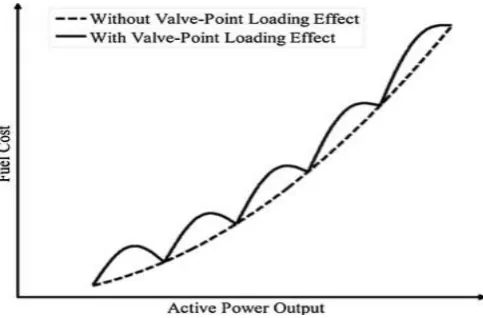
Nowadays, managing the electrical power generating system is the major concern. The demand for the consumption of power increases day by day and this binds the optimal combination of operating the generating units. The ELD problem comprises the pre-dispatch and online dispatch problems: pre-dispatch problem requires the optimal selection of the generating units and the online dispatch problem is to reduce the total cost required for the dynamic requirements of the system. Consider a system with n power generating units. The objective function of the ELD problem is given in equation 1. Figure 1 represents the economic load dispatch considering the point effects and no valve-point effects.
n i
c P b Pi a F
i i i i
t
1
2 (1)
n refers to the total number of generation units,
ai, bi, ci - the cost coefficients of ith power generation unit
Pi - the output of ith power generation unit
Ci - the cost function of ith generating unit and i = 1, 2 … n.
2. Hybrid approaches to economic load dispatch
problems
[image:1.595.313.555.198.357.2]Many optimization techniques have been proposed from the past for solving the ELD problems. Though the algorithms gave best results as per their characteristics, few limitations exists which reduces the performance of the system chosen.
Fig. – 1: Representation of ELD considering VPL and not considering VPL
To overcome the limitations of the classical optimization techniques, many hybrid approaches has been proposed. In this section, different hybrid methods are analyzed. The purpose of finding the hybrid combination is to generate high quality solution with stable convergence, flexibility and robustness and less computational time compared to other soft computing techniques.
2.1 Particle Swarm Optimization—Direct Search
Method (PSO-DS):
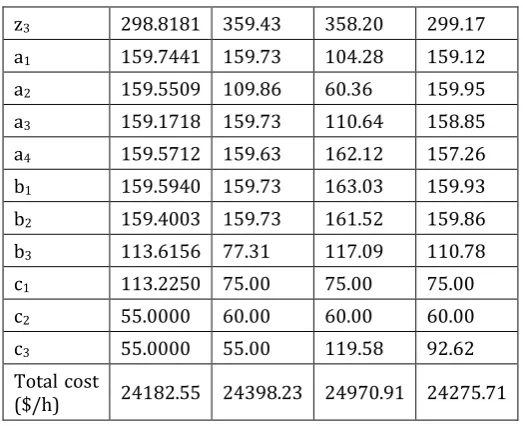
The PSO-DS technique (Victoire, et al., 2003)[1] was formulated to solve the ELD problem, to demonstrate the flexibility and the efficiency. The PSO-DS was tested in different scenario and the results are tabulated in Table 1. It is found that the generating units were expected to supply the load demands of 2400 MW, 2500 MW, 2600 MW and 2700 MW. In case of scenario 2, the PSO-DS method is compared with Numerical Method (NM), Enhanced Lagrangian Neural Network (ELNN) method, GA, and EP. The authors ended up with the obtained results that the PSO-DS outperforms the other algorithms compared.
Table -1: Output for the proposed PSO-DS method with PD=2520 MW with 13 units
Generator Cost / unit generation (MW)
PSO-DS GA SA GA-SA
z1 628.3094 628.32 668.40 628.23
© 2017, IRJET | Impact Factor value: 6.171 | ISO 9001:2008 Certified Journal | Page 333
z3 298.8181 359.43 358.20 299.17
a1 159.7441 159.73 104.28 159.12
a2 159.5509 109.86 60.36 159.95
a3 159.1718 159.73 110.64 158.85
a4 159.5712 159.63 162.12 157.26
b1 159.5940 159.73 163.03 159.93
b2 159.4003 159.73 161.52 159.86
b3 113.6156 77.31 117.09 110.78
c1 113.2250 75.00 75.00 75.00
c2 55.0000 60.00 60.00 60.00
c3 55.0000 55.00 119.58 92.62
Total cost
[image:2.595.31.293.78.291.2]($/h) 24182.55 24398.23 24970.91 24275.71
Table -2: Output for the proposed PSO-DS method with 10 units for various power demands
PD(MD)
Fuel Cost ($/h)
PSO-DS NM ELNN GA EP
2400 481.72 488.50 481.74 482.00 481.79 2500 526.24 526.70 526.27 526.24 526.24 2600 574.03 574.41 574.40 574.39 574.38 2700 625.18 623.88 623.81 623.81 623.81
2.2 Chaotic Particle Swarm
Optimization—Quasi-Newton Implicit Filtering Algorithms (PSO or
Chaotic PSO–IF):
The application of hybrid chaotic PSO-IF method (Coelho, et al., 2007)[2] to ELD problems was examined. Implicit filtering is the Quasi-Newton DS method which generalizes the gradient projection algorithm. To avoid the local minima, the step sizes are identically changed, which attributed to low-amplitude oscillations. In this approach, all possible state is visited only once called chaotic motion. The authors deliver the report on a test case which involves 13 thermal units of generation along with VPL. In the reported test case, the total load demand was 1800MW. The outcomes are illustrated in table 3.
Table -3: Convergence results for 50 runs
Optimization method
Mean time (s)
Minimum cost($/h)
Mean cost ($/h)
Maximum cost ($/h) IF 1.4 18812.3852 18962.0139 19111.6426 PSO 2.6 18874.7634 19159.3967 19640.4168 Chaotic PSO 3.3 18161.1013 18809.8275 19640.7556 PSO-IF 17.8 18605.1257 18854.1601 19111.6426 Chaotic
PSO-IF 15.3 17963.9571 18725.2356 19057.2663
2.3 Evolutionary Programming—Efficient Particle
Swarm Optimization (EP-EPSO):
The joint performance of EP and EPSO was formulated by (Pandian, et al., 2010)[3] to solve the economic load dispatch problem with transmission losses. In the EP sub-problem, a new population is formed by the addition of Gaussian random
number with zero mean and fixed standard deviation. Among all the generated new solutions, stochastic tournament method is implemented for the selection of best solution. The basic PSO is modified by updating the position, velocity, Pbest
[image:2.595.309.557.301.401.2]and gbest values by satisfying the required constraints in a newer way. The EP-EPSO method is tested with 40-unit system considering two different problems. The proposed method outperforms when compared with Neural Network (NN), EP, EPSO and hybrid NN-EPSO as shown in Table 4.
Table -4: Simulation results for 40 generating units
Method Cost ($/h) Simulation time (s)
NN 146069.74 28.07
EPSO 130330.36 7.232
EP 143799.00 9.242
NN-EPSO 130328.32 8.3529
EP-EPSO 130227.33 7.7590
2.4
Genetic
Algorithm—Particle
Swarm
Optimization (GA-PSO):
[image:2.595.29.295.335.434.2]The formulation of hybrid GA-PSO was proposed by (Younes, et al., 2011)[4] to solve the ELD problems. The execution of both algorithms is carried out simultaneously. Among all those individuals, the value with larger fitness is selected. The proposed approach is carried out with five different load demand situations for IEEE 25-bus system and the obtained results are compared with the classical optimization methods viz., Broyden-Fletcher-Goldfarb-Shanno (BFGS) and some intelligent methods such as Binary-Coded Genetic Algorithm (BCGA), Real-Coded Genetic Algorithms (RCGA), and PSO. The comparative results are tabulated in the Table 5.
Table -5: Simulation results for IEEE 25-bus system
PD(MW) BFGS BCGAs RCGAs PSO GA-PSO P1 211.30 206.72 213.68 197.45 211.54 P2 126.30 121.64 127.46 114.93 122.46 P3 151.29 151.82 141.93 168.29 140.117 P4 71.24 33.21 29.53 29.08 27.358 P5 211.31 358.05 258.86 259.29 267.514 Total
[image:2.595.43.564.596.796.2]© 2017, IRJET | Impact Factor value: 6.171 | ISO 9001:2008 Certified Journal | Page 334
2.5 Fuzzy Adaptive Particle Swarm Optimization
(FA-PSO):
[image:3.595.35.291.279.358.2]The FA-PSO hybrid optimization method was proposed by (Soni, et al., 2012)[5] which is more suitable for solving ELD problems. PSO often causes the long-time stagnation issue. To eliminate the aforesaid issue, fuzzy technique is introduced in PSO. Here, the learning factors (c1, c2) and the inertia weight (w) are the parameters to be adjusted with respect to the input variables. The bounded values for (w) is given by 0.2 ≤ w ≤ 1.2, for c1 it is 1≤ c1 and for c2 it is c2≤ 2. Table 6 gives the performance values for FA-PSO algorithm. The proposed hybrid algorithm was tested with 6 generators, 46 transmission lines and 26 buses with 1263 MW demand.
Table -6: Test results for IEEE 6 unit system with PD = 1263 MW
Method Best Cost ($) Worst cost
($) Average Cost ($) FA-PSO 15445.24 15451.60 15448.05 SOH-PSO 15446.00 15451.17 15450.3 Simple PSO 15466.61 15451.7 15450.3
2.6 Artificial Bee Colony—Particle Swarm
Optimization (ABC-PSO):
The combined ELD problem involving ABC and PSO technique was formulated by (Manteaw, et al., 2012)[6]. The main objective was combined using weighting function and the best objective was determined by cardinal priority ranking method. Initially ABC is executed till the terminal criterion is reached and the best solutions are generated. After this execution, the best individual solutions are fed as input to PSO. This hybrid approach was tested for IEEE 10-generator system with 2000 MW load demand. The comparison with the other methods such as DE, Non-sorting Genetic Algorithm (NSGA) and Strength Pareto Evolutionary Algorithm (SPEA) reveals that the proposed hybrid approach outruns the existing algorithms as given in Table 7.
Table -7: Test results for IEEE 10 unit system with PD= 2000 MW
ABC-PSO DE NSGA-II SPEA-II
FuelCost ($/h) 113,420 113,480 113,540 113,520
2.7 Simulated Annealing—Clonal Selection
Algorithm (SA-CSA):
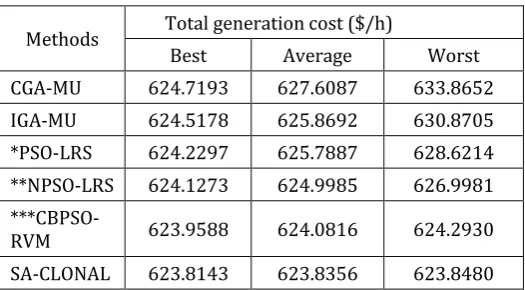
A hybrid approach namely Simulated Annealing Clonal Selection Algorithm (SA-CSA) was proposed by (Amjadi, et al., 2010)[7]. The selection step of CSA consists of two levels of selection: the initial is done by CSA and then using SA. The selection of antibodies from the whole population is proceeded with the help of CSA. The values of initial population are compared with the previous level. After CSA,
the SA is applied for the purpose of selection with the help of the following equation:
[image:3.595.303.566.372.517.2]In the above equation, the difference between the parent and the offspring objective function has been chosen for the eliminating the effect of diversity of the objective functions. The authors tested this hybrid approach with 10-unit system and a load of 2700 MW. The proposed method is validated with the other contemporary methods and it reveals the performance. Table 8 gives the simulation results of SA-CSA method.
Table -8: Test results for IEEE 10 unit system with PD= 2700 MW
Methods Total generation cost ($/h)
Best Average Worst
CGA-MU 624.7193 627.6087 633.8652
IGA-MU 624.5178 625.8692 630.8705
*PSO-LRS 624.2297 625.7887 628.6214 **NPSO-LRS 624.1273 624.9985 626.9981
***CBPSO-RVM 623.9588 624.0816 624.2930
SA-CLONAL 623.8143 623.8356 623.8480
(*PSO-LRS - Particle Swarm Optimization; Local Random Search, *NPSO-LRS-New PSO Local Random Search; ***CBPSO-RVM-Combined PSO-Real Value Mutation)
2.8 Bacterial Foraging-Differential Evolution
(BF-DE):
© 2017, IRJET | Impact Factor value: 6.171 | ISO 9001:2008 Certified Journal | Page 335 has been simulated with 6-unit system with PD=1263 MW
and outruns are tabulated in the Table 9.
Table -9: Simulation results for IEEE 6 unit system with PD= 1263 MW
BF-DE PSO GA NPSO-LRS CPSOI Minimum
cost 15444.1564 15450 15459 1540 15447
2.9 Genetic Algorithm—Active Power Optimization
(GA-APO):
A new hybrid approach combining GA and APO was proposed by (Malik, et al., 2006)[9], to solve the ELD problems along with VPL. On combining the GA and APO, it is capable of fine tuning the results produced by GA. APO is formulated with the technique of storage optimization and classical linear system solution method. In this approach, GA acts as a global optimizer which produces the near optimal solution and APO works on this schedule, where the power output of the generating buses is replaced. This approach mainly aims at reducing the cost and also producing the optimum generation schedule. This hybrid approach is performed in a framework referred to as PED Frame under visual C environment. Through this PED frame, the input curve (cost) and other ELD specific information can be given and at the other end, the output can be obtained in a standard format. The implementation was done with three different test systems viz., 3 machines 6 bus system, IEEE 5 machine 14 bus system, and IEEE 6 machine 30 bus system. Table 10 shows the comparison results between GA and GA-APO. To convert the quadratic convex cost curve into non-convex cost curves, the VPL effects are introduced into the existing system.
Table -10: Simulation results for 3, 5 and 6 machine IEEE systems
System Cost of GA GA-APO Cost of IEEE 6 Bus 3 machine system –
PD=210MW 3463.37 3205.99
IEEE 14 Bus 5 machine system –
PD=259MW 1012.44 905.54
IEEE 30 Bus 6 machine system -
PD =283.4 MW 1117.13 984.94
2.10 Differential Evolution—Biogeography-Based
Optimization (DE-BBO):
A hybrid DE-BBO method was formulated by (Bhattacharya, et al., 2010) [10] to solve the ELD problem that includes transmission losses and constraints such as ramp rate limits, valve-point loading and prohibited operating zones. Though DE yields many advantages, one of the major disadvantages is that it cannot map all the unknown variables together when the system complexity and size increases. The quality of the good fitness value often gets decreased due to the crossover operation in DE. When BBO is concerned, there is no crossover stage and so the solutions get mature gradually and
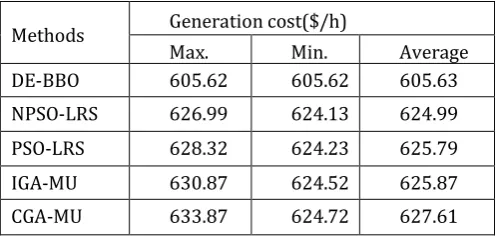
[image:4.595.310.559.201.319.2]lead to the operation of migration. In this hybrid approach, development of new features takes place due to the mutation process by DE and migration process by BBO. As both the processes are involved, the good solutions are less destroyed. The results obtained are compared for a system for 10 generating units with other hybrid approaches. Table 11 gives the highest, lowest and the mid values of the proposed and the other hybrid approaches.
Table -11: Simulation results for IEEE 10 unit system
Methods Generation cost($/h)
Max. Min. Average
DE-BBO 605.62 605.62 605.63
NPSO-LRS 626.99 624.13 624.99
PSO-LRS 628.32 624.23 625.79
IGA-MU 630.87 624.52 625.87
CGA-MU 633.87 624.72 627.61
2.11 Hybrid Immune Genetic Algorithm (HIGA):
HIGA was proposed by (Hosseini, et al., 2012) [11] for solving the ELD problems. Immune Algorithm and Genetic Algorithm (GA) combine together to form HIGA. The outrun of the initial solution created by Immune Algorithm is iteratively improved by affinity factor, hyper-mutation operator and clonal selection. The hypermutation in HIGA is similar to that of mutation operator in GA. The probability of mutation is inversely proportional to the affinity factor of the solution. Thus if the affinity factor is low, it will be still mutated to improve the solution space and vice-versa. The crossover operator is used to propagate the attributes of high-quality solutions among others. Table 12 and 13 represents the cost comparisons of HIGA optimization for 6 unit and 40 unit power generation systems respectively.
Table -12: Simulation results for 6 unit system with PD= 1263 MW
BFO PSO NPSO-LRS GA HIGA
Total
cost 15443.85 15450.14 15450.00 15457.96 15443.10
Table -13: Simulation results for 40 unit system with PD = 10500 MW
DE-BBO BBO QPSO HIGA
Total
cost 121420.90 121426.95 121448.21 151416.94
2.12 Fuzzified Artificial Bee Colony Algorithm
(FABC):
© 2017, IRJET | Impact Factor value: 6.171 | ISO 9001:2008 Certified Journal | Page 336 demands and specific constraints. With definite number of
[image:5.595.309.558.138.349.2]bees, ABC functions to locate the food sources in a multidimensional search space. With each generation cycle, the best result is chosen from the Pareto optimal set using fuzzy fitness. The best and the final solution correspond to the maximum value in the entire search space implying food sources with highest quality of nectar information. The authors tested the proposed algorithm for IEEE 30 bus system with two different load conditions (2.834 MW and 2.8339 MW). Table 14 gives the comparison with the other reported methods.
Table -14: Simulation results for IEEE 6 unit system with PD=1263 MW
Load 2.834 MW 2.8339 MW
Method MOPSO FABC NSGA MOHS MBFA FABC
Total
Cost 938.91 938.75 938.46 939.92 938.33 938.24
2.13 Firefly Algorithm-Ant Colony Optimization
(FFA-ACO):
A modern approach involving FFA and ACO algorithm was proposed by (Younes, et al., 2013) [13]. In this approach, initial population n of fireflies xi is generated. The objective function is used to determine the light intensity of the firefly. As and when the firefly i moves towards j, the new possible solutions or attractiveness of the fireflies are evaluated. The best solutions are passed as initial points of the fireflies. According to the scheduled activities, the response of the ant’s is compared and the best solution is found by the communication with the best ant response. The FFA-ACO algorithm is tested with modified IEEE 30 bus system consisting of 6 generators. The power demand is 283.40 MW. Table 15 shows the comparison with the other approaches.
Table -15: Test results for IEEE 6 unit system with PD=283.40 MW
MDE-OPF PSO ACO FFA FFA-ACO
Cost($/h) 802.62 801.77 801.77 801.01 800.79 Time (s) 23.07 16.26 14.97 13.83 10.73
2.14 Particle Swam Optimization—Gravitational
Search Algorithm (PSO-GSA):
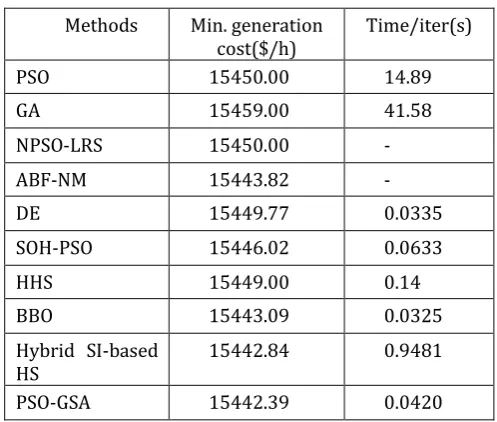
The PSO-GSA was proposed by (Dubey, et al., 2013)[14] to solve the ELD problems. The main aim of this approach is to combine the social behaviour (gbest) in PSO along with local search capability of GSA. In this approach, all the agents are initialized randomly. After its initialization, the force acting on agents, mass and acceleration are calculated. The best fitness function will be updated after each iteration. The algorithm was tested for a 6 unit generator system with 1263 MW total demand. The effectiveness of the algorithm was validated by optimizing the ED considering the non-equality constraints like ramp rate limits and generator prohibited
[image:5.595.30.295.535.599.2]zones. Table 16 presents the comparison values with nine other optimization methods.
Table -16: Simulation results for IEEE 6 unit system with PD=1263 MW
Methods Min. generation
cost($/h) Time/iter(s)
PSO 15450.00 14.89
GA 15459.00 41.58
NPSO-LRS 15450.00 -
ABF-NM 15443.82 -
DE 15449.77 0.0335
SOH-PSO 15446.02 0.0633
HHS 15449.00 0.14
BBO 15443.09 0.0325
Hybrid SI-based
HS 15442.84 0.9481
PSO-GSA 15442.39 0.0420
2.15 Particle Swarm Optimization—Ant Colony
Optimization Algorithm (PSO-ACO):
In the above subsections, some hybrid methods have been discussed that are used to obtain the optimized solution for ELD problems. The researches confirm that the PSO method itself can be used as a powerful and useful technique for obtaining the optimal solution. If the global best and local best positions are identical, the algorithm might get stuck into local optima. It is a major drawback of PSO. To eliminate this drawback, many hybrid methods combining PSO with other global optimization algorithms like GA, IF, EP, FA, ABC, GSA has been formulated. In addition to above formulated hybrid approaches, a new hybrid PSO is suggested by the author (Santra, et al., 2016) [15]. This approach combines the PSO and ACO algorithm together. Here new solutions or members can be generated at each iteration using PSO and then ACO can be applied for the fine-tuning of the members.
3. DISCUSSION
© 2017, IRJET | Impact Factor value: 6.171 | ISO 9001:2008 Certified Journal | Page 337 two or more algorithm parameters from various
optimization techniques. Examples of hybrid algorithms are PSO-DS, PSO-IF, EP-EPSO, GA-PSO, FA-PSO, ABC-PSO, SA-CSA, BF-DE, GA-APO, DE-BBO, HIGA, FABC, FFA-ACO, PSO-GSA. Due to the combination of best aspects of two or more algorithms, these methods eliminate the drawbacks of earlier methods and provide global optimum solutions with multi objectives.
4. CONCLUSION
With evolving of new and hybrid optimization methods, ELD problem from small scale to large scale systems has been optimized to a greater extent. Considering the recent and past researches, it is inferred that there is a large and enough scope for research to address the challenges related to power systems. Some of these challenges are: (i) Optimal Power Flow(OPF) problem, (ii) optimization of multiple objectives like Reliable Emission and Economic Dispatch (REED) problem and Combined Economic and Emission Dispatch (CEED) problem, (iii) Extended ELD problem for large number of units(40–90 units) and for more complex objective and constraint function (like exponential function and higher order polynomial).
REFERENCES
[1] T. Aruldoss Albert Victoire, A. Ebenezer Jeyakumar,
“Hybrid PSO-DS for Non-Convex Economic Dispatch Problems”, Digest of the proceedings of the WSEAS conferences, 2003.
[2] L. Dos Santos Coelho, V.C.Mariani, “Economic Dispatch
Optimization using Hybrid Chaotic Particle Swarm Optimizer”. IEEE International Conference Systems, Man and Cybernetics, 2007.
[3] S. Muthu Vijaya Pandian, K. Thanushkodi, “Considering
transmission loss for an economic dispatch problem without valve-point loading using an EP-EPSO algorithm”, Int J Comput Electr Eng, Volume 2, Number 3 (2012) 1793–8163..
[4] M. Younes, F. Benhamida, “Przeglad Elektrotechniczny
(Electrical Review)”, ISSN:0033-2097, R. 87 NR 10/2011.
[5] N. Soni, Dr. M. Pandit, “A Fuzzy Adaptive Hybrid Particle
Swarm Optimization Algorithm to solve Non-Convex Economic Dispatch Problem”, Int J Engineering Innov Technol (IJEIT), Volume 1, Number 4, 2012.
[6] E.D. Manteaw, N. Abungu Odero, “Multi-objective
Environmental and Economic Dispatch solution using ABC-PSO hybrid algorithm”, Int J Sci Res Publ., Volume 2 Number 12, 2012.
[7] N. Amjadi, H. Sharifzadeh, “Solution of Non-Convex
Economic Dispatch Problem considering Valve Point Loading effect by a New Modified Differential Evolution Algorithm”, Electr Power Energy Syst, 2010.
[8] A. Biswas, “Hybrid Artificial Intelligence Systems
Lecture Notes in Computer Science” (2009) 252–260.
[9] T.N. Malik, A.Q. Abbasi, A. Ahmad, “Computational
Framework for Power Economic Dispatch using Genetic Algorithm”, Proceeding of the Third International Conference on Informatics In Control, Automation and Robotics (ICINCO), Stubal, Portugal, Aug 1–5 (2006) 191–194.
[10] A. Bhattacharya, P.K. Chattopadhyay,
“Biogeography-Based Optimization for different Economic Load Dispatch Problems”, IEEE Trans Power Syst., Volume 25, (2010) 1064–1073.
[11] M. M. Hosseini, H. Ghorbani, A. Rabii, Sh. Anvari, “A
Novel Heuristic Algorithm for solving Non-convex Economic Load Dispatch Problem with non-smooth cost function”, J Basic Appl Sci Res, Volume 2 Number 2 (2012) 1130–1135.
[12] C. Koodalsamy, S.P. Simon, “Fuzzified Artificial Bee
Colony Algorithm for Non-smooth and Non-Convex multiobjective economic dispatch problem”, Turkish J Electr Eng Comput Sci Volume 21 (2013) 1995–2014.
[13] M. Younes, “A Novel Hybrid FFA-ACO Algorithm for
Economic Power Dispatch”, Control Eng Appl Inf, Volume 15 Number 2 (2013) 67–77.
[14] H.M. Dubey, M. Pandit, B. K. Panigrahi, M. Udgir,
“Economic Load Dispatch by Hybrid Swarm Intelligence based Gravitational Search Algorithm”, Int J Intell Syst Appl, Volume 5 Number 8 (2013) 21–32.
[15] D. Santra, A. Mondal, A. Mukherjee, “Study of Economic