How to cite this paper: Krishnappa, R. and Paramasivam, R. (2015) Primers for Dengue Virus Strains Based on Their Se-quence Variability. Open Access Library Journal, 2: e1104. http://dx.doi.org/10.4236/oalib.1101104
Primers for Dengue Virus Strains Based on
Their Sequence Variability
Raghavendra Krishnappa, Rajendran Paramasivam
Department of Microbiology, Karpagam University, Coimbatore, India Email: [email protected]Received 26 February 2015; accepted 13 March 2015; published 18 March 2015
Copyright © 2015 by authors and OALib.
This work is licensed under the Creative Commons Attribution International License (CC BY). http://creativecommons.org/licenses/by/4.0/
Abstract
Since DENV-1, 2, 3, and 4 determine the strains for dengue virus, their gene sequence can be used as marker for diagnosis, amplifying and genotyping subtypes in molecular screening reaction which includes RT-PCR, real-time RT-PCR, nucleic acid sequence-based amplification, microsphere- based duplexed immunoassay, and DNA microarrays. There are many gene based PCR diagnostic kits available for screening and quantifying dengue virus, which one to choose? Decisions on choosing the diagnostic kit are debatable, mainly because of sequence variation of endemic den-gue virus, which emphasizes us to use region specific primer diagnostic kits for isolating denden-gue of the prevailing country. But if diagnoistic industry focuses on the homologous regions obtained af-ter aligning sequences, each representing the country of origin, we can design primers which can be used to detect dengue strains from any country of origin. Gene based diagnostics kits should have primers that should be covered for all entries present in the NCBI database with 100% total coverage similarity and specifically only to which they were designed for.
Keywords
NCBI, EBI, PCR, Primers, Dengue, Diagnostics, DENV-1, DENV-2, DENV-3, DENV-4, MSA-ClustalO
Subject Areas: Genetics, Microbiology
1. Introduction
OALibJ | DOI:10.4236/oalib.1101104 2 March 2015 | Volume 2 | e1104
viruses classified together based on their antigens on the surface of the virus. These four subtypes are different strains of dengue virus that have 60% - 80% homology between each other, therein hinting us for the potential marker regions. The major difference for humans lies in subtle differences in the surface proteins of the different dengue subtypes. Infection induces long-life protection against the infecting serotype, but it gives only a short time cross protective immunity against the other types. The first infection causes mostly minor disease, but sec-ondary infection has been reported to cause severe diseases (DHF or DSS) in both children and adults which is called Antibody-Dependent Enhancement.
2. Dengue Virus RNA Genome
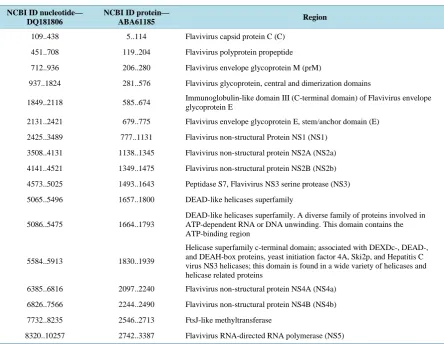
[image:2.595.89.534.376.720.2]DENV is a 50 nm virus enveloped with a lipid membrane. There are 180 identical copies of the envelope (E) protein attached to the surface of the viral membrane by a short transmembrane segment. The virus has a ge-nome of about 11000 bases that encodes a single large polyprotein that is subsequently cleaved into several structural and non-structural mature peptides. The polyprotein is divided into three structural proteins, C, prM, E; seven nonstructural proteins, NS1, NS2a, NS2b, NS3, NS4a, NS4b, NS5; and short non-coding regions on both the 5′ and 3′ end. The structural proteins are the capsid (C) protein, the envelope (E) glycoprotein and the mem-brane (M) protein, itself derived by furine-mediated cleavage from a prM precursor. The E glycoprotein is re-sponsible for virion attachment to receptor and fusion of the virus envelope with the target cell membrane and bears the virus neutralization epitopes. In addition to the E glycoprotein, only one other viral protein, NS1, has been associated with a role in protective immunity. NS3 is a protease and a helicase, whereas NS5 is the RNA polymerase in charge of viral RNA replication. Data provided in Table 1 maps DENV genes on its genomic and protein sequence which is first basic step researches have to perform for primer design.
Table 1. Structural and non-structural region of the dengue virus mapped on NCBI nucleotide and protein sequence, DQ181806 is of DENV-2 strains.
NCBI ID nucleotide— DQ181806
NCBI ID protein—
ABA61185 Region
109..438 5..114 Flavivirus capsid protein C (C)
451..708 119..204 Flavivirus polyprotein propeptide
712..936 206..280 Flavivirus envelope glycoprotein M (prM)
937..1824 281..576 Flavivirus glycoprotein, central and dimerization domains
1849..2118 585..674 Immunoglobulin-like domain III (C-terminal domain) of Flavivirus envelope glycoprotein E
2131..2421 679..775 Flavivirus envelope glycoprotein E, stem/anchor domain (E)
2425..3489 777..1131 Flavivirus non-structural Protein NS1 (NS1)
3508..4131 1138..1345 Flavivirus non-structural protein NS2A (NS2a)
4141..4521 1349..1475 Flavivirus non-structural protein NS2B (NS2b)
4573..5025 1493..1643 Peptidase S7, Flavivirus NS3 serine protease (NS3)
5065..5496 1657..1800 DEAD-like helicases superfamily
5086..5475 1664..1793
DEAD-like helicases superfamily. A diverse family of proteins involved in ATP-dependent RNA or DNA unwinding. This domain contains the ATP-binding region
5584..5913 1830..1939
Helicase superfamily c-terminal domain; associated with DEXDc-, DEAD-, and DEAH-box proteins, yeast initiation factor 4A, Ski2p, and Hepatitis C virus NS3 helicases; this domain is found in a wide variety of helicases and helicase related proteins
6385..6816 2097..2240 Flavivirus non-structural protein NS4A (NS4a)
6826..7566 2244..2490 Flavivirus non-structural protein NS4B (NS4b)
7732..8235 2546..2713 FtsJ-like methyltransferase
OALibJ | DOI:10.4236/oalib.1101104 3 March 2015 | Volume 2 | e1104
3. Background
Dengue is endemic in more than 110 countries [1]. It infects 50 to 100 million people worldwide a year, leading to half a million hospitalizations [2] and approximately 12,500 - 25,000 deaths [3] [4]. There are many diagnos-tic kits available for screening and quantifying dengue virus, which one to choose? Decisions on choosing the diagnostic kit are debatable one, mainly because of sequence variation of endemic dengue virus.
4. Methods
Total of 257 countries listed from online source (http://www.listofcountriesoftheworld.com/) were searched in NCBI Nucleotide database for dengue virus complete genome using the search criteria “dengue virus ‘strain type’ ‘region’ complete genome” in Nucleotide Database (http://www.ncbi.nlm.nih.gov/nuccore/ 29th Oct 2014). Out of 257 countries only 36, 44, 38 and 14 countries had submitted the complete genome sequence of dengue 1, 2, 3 and 4 virus respectively in to NCBI database.
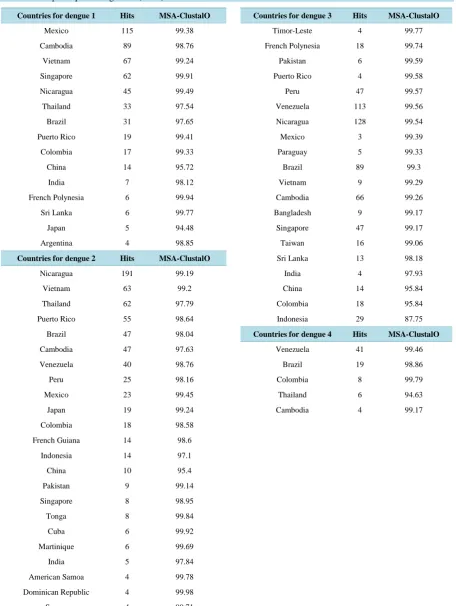
Total of 547 complete genomic sequences were obtained from 36 countries for DENV-1. Sequence alignment with in the country using online EBI MSA-ClustalO (http://www.ebi.ac.uk/Tools/msa/clustalo/) tool provided 98.58 similarities (shown in Table 2). When some of the sequences (AY277666.2, JX669475.1, HM631853.1, GQ868570.1, DQ672560.1, JN903581.1, AB204803.1, KJ189369.1, FJ898437.1, KJ189367.1, EU081281.1, HQ891316.1, JN638336.1, GU131842.1) from 14 countries were picked randomly and MSA performed we found 93.71 similarities.
For DENV-2 total of 721 sequences were obtained from 44 countries. Sequence alignment with in the country using EBI MSA-ClustalO tool provided 98.78 similarities (shown in Table 2). When some of the sequences (HM582106.1, JX669488.1, FJ639718.1, AF204178.1, GQ868552.1, AY702038.1, EU920847.1, GQ398268.1, AF169678.1, EU920843.1, GQ868516.1, FJ882594.1, KF041237.1, KC294223.1, GQ868600.1, HM582107.1, EU081180.1, FJ906958.1, HM582117.1, FJ898466.1, FM210246.2) from 21 countries were picked randomly and MSA performed we found 93.48 similarities.
For DENV-3 total of 693 sequences were obtained from 38 countries. Sequence alignment with in the country using online public EBI MSA-ClustalO tool provided 98.34 similarities (shown in Table 2). When sequence (AY496873.2, GU131878.1, FJ639731.1, KF954948.1, GU131953.1, AY744679.1, FJ644564.1, AB189128.1, FJ898442.1, JF937652.1, KF041259.1, JF808129.1, KJ189301.1, KF955468.1, EU081225.1, FJ882574.1, DQ675533.1, FJ744740.1, AB214882.1, FJ898474.1, JQ045695.1) from 21 countries were picked randomly and MSA performed we found 96.15 similarities.
And finally for DENV-4 total of 95 sequences were obtained from 14 countries. Sequence alignment with in the country using EBI MSA-ClustalO tool provided 98.38 similarities (shown in Table 2). When some of the sequences (JQ513345.1, JN638572.1, GQ868585.1, JF262780.1, AY618993.1, FJ882592.1) from 6 countries were picked randomly and MSA performed we found 93.05 similarities.
5. Conclusions
Currently it is very tough to dig out the dengue virus from online NCBI database based on region of isolation and year of occurrence, which implies not just to dengue virus but to all organisms. But user can try out “Nuc-leotide Advanced Search Builder” using “dengue virus 1 (organism name)” “complete genome” and “brazil (country name)” to get the list of dengue virus 1, complete genome reported from Brazil.
OALibJ | DOI:10.4236/oalib.1101104 4 March 2015 | Volume 2 | e1104 Table 2. MSA score for DENV strains with in the region. Hits from the other countries which are less than 4 counts were not used for multiple sequence alignment (MSA).
Countries for dengue 1 Hits MSA-ClustalO Countries for dengue 3 Hits MSA-ClustalO
Mexico 115 99.38 Timor-Leste 4 99.77
Cambodia 89 98.76 French Polynesia 18 99.74
Vietnam 67 99.24 Pakistan 6 99.59
Singapore 62 99.91 Puerto Rico 4 99.58
Nicaragua 45 99.49 Peru 47 99.57
Thailand 33 97.54 Venezuela 113 99.56
Brazil 31 97.65 Nicaragua 128 99.54
Puerto Rico 19 99.41 Mexico 3 99.39
Colombia 17 99.33 Paraguay 5 99.33
China 14 95.72 Brazil 89 99.3
India 7 98.12 Vietnam 9 99.29
French Polynesia 6 99.94 Cambodia 66 99.26
Sri Lanka 6 99.77 Bangladesh 9 99.17
Japan 5 94.48 Singapore 47 99.17
Argentina 4 98.85 Taiwan 16 99.06
Countries for dengue 2 Hits MSA-ClustalO Sri Lanka 13 98.18
Nicaragua 191 99.19 India 4 97.93
Vietnam 63 99.2 China 14 95.84
Thailand 62 97.79 Colombia 18 95.84
Puerto Rico 55 98.64 Indonesia 29 87.75
Brazil 47 98.04 Countries for dengue 4 Hits MSA-ClustalO
Cambodia 47 97.63 Venezuela 41 99.46
Venezuela 40 98.76 Brazil 19 98.86
Peru 25 98.16 Colombia 8 99.79
Mexico 23 99.45 Thailand 6 94.63
Japan 19 99.24 Cambodia 4 99.17
Colombia 18 98.58
French Guiana 14 98.6
Indonesia 14 97.1
China 10 95.4
Pakistan 9 99.14
Singapore 8 98.95
Tonga 8 99.84
Cuba 6 99.92
Martinique 6 99.69
India 5 97.84
American Samoa 4 99.78
Dominican Republic 4 99.98
OALibJ | DOI:10.4236/oalib.1101104 5 March 2015 | Volume 2 | e1104
Since DENV-1, 2, 3, and 4 determine the strains for dengue virus, their gene sequence can be used as marker for diagnosis, amplifying and genotyping subtypes in molecular screening reaction which includes RT-PCR, real-time RT-PCR, nucleic acid sequence-based amplification, microsphere-based duplexed immunoassay, and DNA microarrays. Conserved region obtained after aligning 4 sequences of different strains occurring in that re-gion help in identifying strains, if the sample is of many strains, than in that case five primers in one PCR well, with proper optimization will lead to identification of all dengue 4 strains in one well. One of the primers (which can be either forward or reverse) can be common for all strains and other four primers obtained from their con-served region, which are specific for their strains. By this, the experimental design will be able to genotype/ am-plify all the strains in single PCR well. Use of SyBr Green in Real Time PCR will be very economical for the above mentioned experimental design. For more specificity, user can switch over to Taqman probes; probes can be deigned on conserved region and a primer pair designed on aligned common region, but it will increase the number of primers as well as expenditure. In case of diagnosis, it is always better to select the strains pertaining to the region of occurrence for accurate region specific markers (primers).
References made below will tell us why primer NCBI BLAST result of 100% total coverage similarity hit to the sequence for which they were designed for are very cricial in selecting primers for detection, which is again critical for diagnostic market. In many applications of PCR the template DNA is a mixture of homologous genes, it is important to find out how a primer-template mismatch can affect the accurate interpretation of the results and the effect of a single internal primer-template mismatch is variable but can greatly decrease PCR efficiency, depending on its position and on the primer used [5]. Such an effect of primer-template mismatches can distort the data used in drawing conclusions on the structure of a microbial community in a PCR-based approach, due to bias in the estimation of the relative proportions between groups possessing and not possessing mismatches with the primers. The presence of mismatches could also bias real-time PCR assays by leading to an underesti-mation of the actual gene copy number if measured against a perfectly matched standard. The effects of matches depend on numerous factors, such as oligonucleotide length and the nature and position of the mis-matches. Several studies have investigated the effects of primer-template mismatches at the 3′ end of the primer sequence, and it has been demonstrated that PCR was prevented by a single mismatched base at the 3′ end [6]- [9]. Hence, mismatches located closer to the 3′ end of the primers were more critical for PCR efficiency. For the forward primers, a single mismatch at position -5, -6, or -8 of the 3′ end was sufficient to lead to an underesti-mation of 1 log of the gene copy number [5].
In contrast to single mismatches, the effect of several internal mismatches on PCR has been more widely de-scribed in the literature [10] as reported that a few mismatches reduced the sensitivity of detection of Giardia, as seen by an increase in the cycle threshold values. Recently [11] using an equal mixture of two strains as tem-plate, showed a preferential amplification of the strain that perfectly matched the primer sequence compared to the amplification of the strain exhibiting three mismatches close to the 5′ end of the primer sequence. A more- pronounced reduction in PCR efficiency with an increasing number of mismatches is shown in the literature [12].
References
[1] Ranjit, S. and Kissoon, N. (2010) Dengue Hemorrhagic Fever and Shock Syndromes. Pediatric Critical Care Medicine, 12, 90-100. http://dx.doi.org/10.1097/PCC.0b013e3181e911a7
[2] Whitehorn, J. and Farrar, J. (2010) Dengue. British Medical Bulletin, 95, 161-173. http://dx.doi.org/10.1093/bmb/ldq019
[3] Varatharaj, A. (2010) Encephalitis in the Clinical Spectrum of Dengue Infection. Neurology India, 58, 585-591. http://dx.doi.org/10.4103/0028-3886.68655
[4] Knoop, K.J., Stack, L.B., Storrow, A. and Thurman, R.J. (2010) Tropical Medicine. Atlas of Emergency Medicine. 3rd Edition, McGraw-Hill Professional, New York, 658-659.
[5] Bru, D., Martin-Laurent, F. and Philippot, L. (2008) Quantification of the Detrimental Effect of a Single Primer-Tem- plate Mismatch by Real-Time PCR Using the 16S rRNA Gene as an Example. Applied and Environmental Microbiol-ogy, 74, 1660-1663. http://dx.doi.org/10.1128/AEM.02403-07
[6] Ayyadevara, S., Thaden, J.J. and Shmookler Reis, R.J. (2000) Discrimination of Primer 3'-Nucleotide Mismatch by Taq DNA Polymerase during Polymerase Chain Reaction. Analytical Biochemistry, 284, 11-18.
http://dx.doi.org/10.1006/abio.2000.4635
OALibJ | DOI:10.4236/oalib.1101104 6 March 2015 | Volume 2 | e1104 Microbiological Methods, 55, 541-555. http://dx.doi.org/10.1016/j.mimet.2003.08.009
[8] Huang, M.M., Arnheim, N. and Goodman, M.F. (1992) Extension of Base Mispairs by Taq DNA Polymerase: Implica-tions for Single Nucleotide Discrimination in PCR. Nucleic Acids Research, 20, 4567-4573.
http://dx.doi.org/10.1093/nar/20.17.4567
[9] Kwok, S., Kellogg, D.E., McKinney, N., Spasic, D., Goda, L., Levenson, C. and Sninsky, J.J. (1990) Effects of Primer- Template Mismatches on the Polymerase Chain Reaction: Human Immunodeficiency Virus Type 1 Model Studies. Nucleic Acids Research, 18, 999-1005. http://dx.doi.org/10.1093/nar/18.4.999
[10] Guy, R.A., Xiao, C. and Horgen, P.A. (2004) Real-Time PCR Assay for Detection and Genotype Differentiation of Giardia Lamblia in Stool Specimens. Journal of Clinical Microbiology, 42, 3317-3320.
http://dx.doi.org/10.1128/JCM.42.7.3317-3320.2004
[11] Sipos, R., Székely, A.J., Palatinszky, M., Révész, S., Márialigeti, K. and Nikolausz, M. (2007) Effect of Primer Mis-match, Annealing Temperature and PCR Cycle Number on 16S rRNA Gene-Targetting Bacterial Community Analysis. FEMS Microbiology Ecology, 60, 341-350. http://dx.doi.org/10.1111/j.1574-6941.2007.00283.x