© 2017, IRJET | Impact Factor value: 5.181 | ISO 9001:2008 Certified Journal | Page 2013
Security in Grid Computing Using Globus and Legion
Prof. Sarita Khedikar
1, Krushna Jadhav
2, K Govind Kumar
3, Atul Rajanale
41
Professor Sarita Khedikar, Dept. of Computer Engineering, smt Indira Gandhi college, Maharashtra, India
2Student Krushna Jadhav, Dept. of Computer Engineering, smt Indira Gandhi college, Maharashtra, India
3Student K Govind Kumar, Dept. of Computer Engineering, smt Indira Gandhi college, Maharashtra, India
4
Student Atul Rajanale, Dept. of Computer Engineering, smt Indira Gandhi college, Maharashtra, India
---***---Abstract—
Grid computing is a type of distributedcomputing that share their resources between individual computers such as coordinating and sharing computational power, data storage and network resources across dynamic and geographically dispersed organizations. Till now we are having many scheduling algorithm but in all such scheduling algorithm there are some advantage and disadvantage. So we cannot perfectly say that this scheduling algorithm is best of all.
So a research on that is mandatory but by using any one scheduling algorithm we can fulfill our needs so before doing research on that we have to see on other fields also which is more important than that from all of this can make our work. The other field is security. Resources which we are shared between server and clients should be secure and the third party cannot use it without any proper authorization. As resources are transferred between client and server using network so there may be chance of any misuse of these resources. So our main goal is to provide such a security which will prevent the misuse of these transferring resources. Motivation of the survey is to encourage the future researcher to research in this field of grid computing, so that they can understand easily the concept of security in grid computing and can provide other security to this system. This will benefit interested researchers to carry out further work in this thrust area of research. We are providing this security combining the best security features present in different architectures into a single architecture to overcome the disadvantages of different architectures.
Keywords---Grid computing, Resources utilization, Security mechanisms.
1.
INTRODUCTION
Grid computing is a term in distributed computing systems which allow the management of heterogeneous, geographically distributed and dynamically available resources in an efficient way, extending the boundaries of what we perceive as distributed computing. For running applications, resource management, providing security and job scheduling are the most crucial problems in grid computing systems. In recent years, the researchers have proposed several efficient security algorithms that are used in grid computing to provide security in grid computing. With further development of grid technology, it is very likely that corporations, universities and public institutions will
exploit grids to enhance their computing infrastructure. This survey paper is organized as follows: In which we deal with the definition of different models of grid computing and how to combine this different models to get a hybrid architecture which provide maximum security to the shared resources.
2. BASIC GRID MODEL
The grid model actually consists of a number of clients and a server, each composed of several computational resources, which may be homogeneous or heterogeneous. The server is used to provide computational resources and security to these resources while sharing between different clients. The four basic building blocks of grid model are user, resource broker or sever, grid information service (GIS) and lastly resources. When user requires high speed execution, the job is submitted to the server in grid. Server splits the job as needed by the clients into various small tasks and distributes it to several resources according to user’s requirements and availability of resources. GIS keeps the status information of all resources which helps the Broker for scheduling.
3.
Grid Security Overview
© 2017, IRJET | Impact Factor value: 5.181 | ISO 9001:2008 Certified Journal | Page 2014
1. Authentication: The process of identifying the usersusually based on a username and password.
Authentication ensures that the user who he or she claims to be, but nothing says about the rights of these users. 2. Authorization: Specific user can do specific things so
these rights are checked at authorization.
3. Delegation: In this there is a software mechanism in which it check automatically that what are the rights which a user is having and if he/she want to access something else then provide it depend upon some security levels.
4. Message integrity: The messages received by the client or user should be same as send by the sender. If any changes was done in the message then that should be indicated.
5. Single Sign in: In this the user or admin should enter there username and password. After having match of this username and password with the one present at the database. It will send the OTP to the email ID. Once you enter this OTP then only you can enter inside your system,
6. Confidentiality: Protecting confidentiality of underlying transport and message content and between OGSA-compliant components in either point-to-point or store and forward mechanisms Privacy: Allowing both a service requester and a service provider to define and enforce privacy policies.
7. Policy exchange: Allowing security context negotiation mechanism between service providers and service requesters based on security policy information
8. Credential life span and renewal: Every user should provide a life span till which only he can access the system. After that the user should again login. 9. Secure logging: Providing a foundation for
non-repudiation and auditing that enables all services to time-stamp and log various types of information without interruption or information alteration by adverse agents.
10. Assurance: User should have knowledge about all the security which we are providing to our system. This information is useful in deciding whether to deploy a service in the environment.
11. Manageability: This requirement mainly deals with various security service management issues such as identity management, policy management, and so on.
12. Firewall traversal: Ability to traverse firewalls without compromising local control of firewall policy to enable cross-domain grid computing environment
Securing the OGSA infrastructure:
This refers to securing core OGSA components. The security challenges faced in a Grid environment can be grouped into three categories
Integration with existing systems and technologies: Interoperability with different “hosting environments” Trust relationships among interacting hosting environments. Because of the dynamic and multi-institutional nature of the grid environments, we need new technical approaches to solve security problem.
4. Grid Security Infrastructure (GSI)
In order to overcome the security challenges, Globus proposes the Grid Security Infrastructure (GSI). GSI is composed of a set of command-line tools to manage certificates, and a set of GSS-API to easily integrate security into other web services. GSI offers the following functions;
Transport-level Security
Message-level security (WS-Security and WS-Secure Conversation)
Authentication through X.509 digital certificates several authorization schemes
Credential delegation and single sign-on Different levels of security: container, service, and resource
GSI has satisfied basic Grid security requirements, such as authorization, delegation, authentication and message protection’s provides two levels security: Message-level Security and Transport-level Security. Our research survey will focus on message-level interoperability. For both levels, we have server and client side security.
LEGION
© 2017, IRJET | Impact Factor value: 5.181 | ISO 9001:2008 Certified Journal | Page 2015
FIG.4.1 LEGION ARCHITECTUREGLOBUS
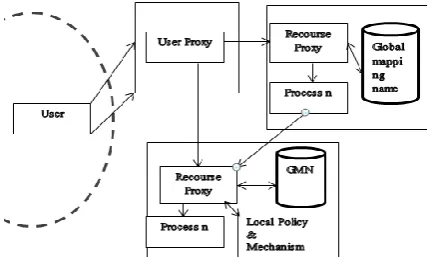
[image:3.595.34.252.424.555.2]According to Globus architecture it assumes that the Grid computing is large and dynamic. Due to which it think that the number of user who are going to use it is also in a large amount. So by considering this in mind this architecture provide all type of security measure which includes integrity, access control,
FIG 4.2 GLOBUS ARCHITECTURE
privacy, authentication, and non-repudiation. In security it gives more preference to authentication and access control. As stated earlier that Globus is also a system that includes numerous trust domains. User, resource, process is a participant called subject (both global and local with a different name), whereas a resource that is being protected by security policy is called object.
The process in which subject makes another subject to prove its identity with its credential is called authentication. One a user get authenticated by the server, after that user can use/access an object on the local machine by authorization. All the access control, Decision of an object is made locally by the administrator or server.
CRISIS
The main aim of this architecture is to make the grid computing system act as a component within WebOS. WebOS is a wide area application which provides support to network application and a basic function as a common OS services. As security is using WebOS so the resources are present at the different end. Hence due the which the security issues in crisis architecture include Redundancy, Least Privilege, Accountability, and Local Autonomy (Access control). Although it covers a lot of security problems, the main security issues are authentication, authorization and least privilege. Hence we should have to focus on it.There is some Process Managers (PM) and a Security Manager (SM), the PM listens to a certain request, e.g. login and resource request;depend uponthe request the SM will provide the credentials of a user/resource and validates the certificate transmitted by others
.
These PMs identify the administrative domain within a request, and then ask the Security Manager whether they have the privilege to access remote resource.FIG.4.3 CRISIS ARCHITECTURE
5. DIFFERENCE BETWEEN THE ARCHITECTURES OF
GLOBUS, CRISIS AND LEGION
© 2017, IRJET | Impact Factor value: 5.181 | ISO 9001:2008 Certified Journal | Page 2016
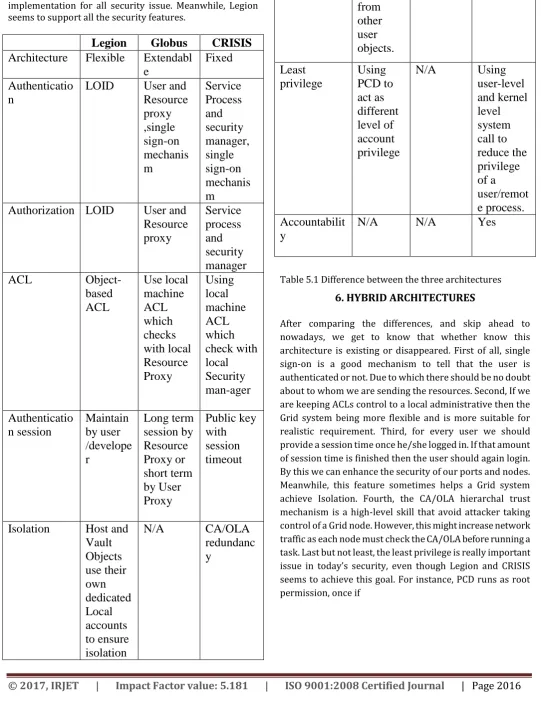
implementation for all security issue. Meanwhile, Legionseems to support all the security features.
Legion
Globus
CRISIS
Architecture
Flexible
Extendabl
e
Fixed
Authenticatio
n
LOID
User and
Resource
proxy
,single
sign-on
mechanis
m
Service
Process
and
security
manager,
single
sign-on
mechanis
m
Authorization LOID
User and
Resource
proxy
Service
process
and
security
manager
ACL
Object-based
ACL
Use local
machine
ACL
which
checks
with local
Resource
Proxy
Using
local
machine
ACL
which
check with
local
Security
man-ager
Authenticatio
n session
Maintain
by user
/develope
r
Long term
session by
Resource
Proxy or
short term
by User
Proxy
Public key
with
session
timeout
Isolation
Host and
Vault
Objects
use their
own
dedicated
Local
accounts
to ensure
isolation
N/A
CA/OLA
redundanc
y
from
other
user
objects.
Least
privilege
Using
PCD to
act as
different
level of
account
privilege
N/A
Using
user-level
and kernel
level
system
call to
reduce the
privilege
of a
user/remot
e process.
Accountabilit
y
[image:4.595.28.570.100.825.2]N/A
N/A
Yes
Table 5.1 Difference between the three architectures
6. HYBRID ARCHITECTURES
© 2017, IRJET | Impact Factor value: 5.181 | ISO 9001:2008 Certified Journal | Page 2017
attacker handle this PCD process, the system will break. Sowe are entering the data in PCD in such a manner which cannot be understood by the attacker. This mechanism provides the better security in PCD. The PCD gain the root permission such as “sudo” command in Ubuntu Linux cannot help attacker to gain full access.
7. FUTURE WORK
We do experiment in reducing the size of the encrypted data.
We produce a way to make double encryption of public and private key and also to change the random key whenever the user is going to send a message.
We encrypt our database in such a manner that an external person cannot see it even though he can come to our database.
We make a program in such a way that automatically the OTP value will be entered if you login to your email-ID because it is sometime become difficult to write a complex OTP in your system.
8. CONCLUSION
Security architecture Legion, Globus, and CRISIS has common features include authentication, authorization, least privilege, isolation, and Access control. Focusing on these features, we shortly indicate the differences between these systems. Furthermore, we discuss the pro and cons among these systems, and make a conclusion how to combine this
architecture and form a hybrid architecture which provide better security..
For instance, the CA/OLA hierarchal trust mechanism could be added to a Globus based system in order to achieve Isolation. In addition, the flexibility of Legion could provide researcher a test environment of new security issues. Having such review of security in Grid Computing helps me understanding in different major studies, security concerns depend on vary requirement.
9. REFERENCES
[1]Security in Grid Computing TakLon Wu B534 project 3 Computer Science Dept. Indiana University Bloomington, IN 47405 [email protected]
[2]Security Implications of Typical Grid Computing Usage Scenarios Marty Humphrey Computer Science Department University of Virginia Charlottesville, VA 22904 [email protected] Mary R. Thompson And Distributed Security Research Group Lawrence Berkeley
National Laboratory Berkeley, CA
[3]Book Grid Computing by C.S.R. Prabhu
[4]A Survey of Job Scheduling and Resource Management in Grid Computing from World Academy of Science, Engineering and Technology International Journal of Computer, Electrical, Automation, Control and Information Engineering Vol:4, No:4, 2010 by Raksha Sharma, Vishnu Kant Soni, Manoj Kumar Mishra, Prachet Bhuyan.