© 2017, IRJET | Impact Factor value: 5.181 | ISO 9001:2008 Certified Journal | Page 1623
EXPERIMENTAL INVESTIGATION ON CONCRETE WITH PARTIAL
REPLACEMENT OF FINE AGGREGATE BY GRANITE POWDER
S.ARULKESAVAN
1, M.JOTHI
2,
M.SATHEESHKUMAR
3, V.TAMILSELVI
4,
K.B.USHA
5.
Department of civil engineering
The kavery engineering college, Mecheri, Tamilnadu, India
Anna University, Chennai, Tamil Nadu, India
---***---Abstract:This project report summarizes the strength
behavior of partial replacement of fine aggregate in concrete by Granite fine. Granite fines are the byproduct of granite industries while cutting huge granite rocks to the desired shapes. The granite powder from factory is carried by the water and stored in tanks. After evaporation of water the granite dust remained in the tank. Then it is transported and disposed on the land. The major problem of disposing the fines in land leads to various environmental hazards like pollution in air and land. The granite fines exhibit the properties of fine aggregate such as size, fineness and filler capabilities.
Concrete is prepared with granite fines as a partial replacement of fine aggregate in different proportions namely 10%, 15%, and 20%. The various tests to be conducted on concrete such as compressive strength, split tensile strength and flexural strength. The tests values are computed and compared with the conventional concrete.
Keywords:
Ordinary Portland cement, Fine aggregate, Coarse aggregate & Granite fines.1.
INTRODUCTION
Concrete is the most popular building material in the
world. Construction Industry contributes huge amounts to Indian economy and concrete is one of the best materials used in construction. The ingredients used in it include Cement, Sand, Gravel and Water. Now-a-days sand is not easily available. The world wide consumption of sand as fine aggregate in concrete production is very high, and several developing countries have encountered some strain in the supply of natural sand in order to meet the increasing needs of infrastructural development in recent years. A situation that is responsible for increase in the price of sand, and the cost of concrete.Expensive and scarcity of river sand which is one of the constituent material used in the production of conventional concrete. The use of Crushed Granite Fine (CGF) as an alternative to natural sand. The Granite fines use up to 20% as a partial replacement for natural sand in the production of concrete.
2. MATERIAL PROPERTIES
Material Used
Cement
Coarse Aggregate
Fine Aggregate
Replacement of Granite fines (partial Replacement of fine aggregate 10%, 15% & 20%)
Admixture (Roff)
Water
2.1 Cement:
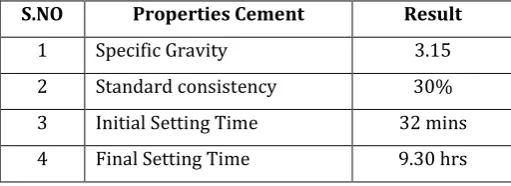
[image:1.595.303.559.605.698.2]The materials of cement was used in an ordinary Portland cement super grade (53grade) is used. This cement is most commonly used in concrete construction.
TABLE I. Physical Properties of Cement
S.NO Properties Cement Result
1 Specific Gravity 3.15
2 Standard consistency 30%
3 Initial Setting Time 32 mins
4 Final Setting Time 9.30 hrs
2.2. Coarse Aggregate:
© 2017, IRJET | Impact Factor value: 5.181 | ISO 9001:2008 Certified Journal | Page 1624 shrinkage and effect economy. One of the most important
factors for producing workable concrete is good gradation of aggregates. Analysis of combined aggregates confirms the specifications for graded aggregates.
TABLE II Properties of Coarse Aggregate
2.3. Fine aggregate
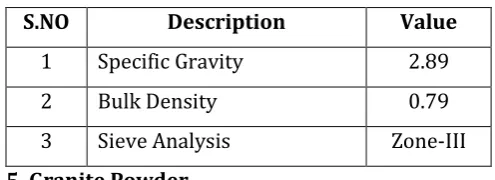
[image:2.595.307.563.121.210.2]Sand collected from nearby river is used for this project. The various properties of sand are tabulated in Table III.
TABLE III. Properties of Fine Aggregate
S.NO
Description
Value
1
Specific Gravity
2.89
2
Bulk Density
0.79
3
Sieve Analysis
Zone-III
2.5. Granite Powder
Granite belongs to igneous rock family. The density of the granite is between 2.65 to 2.75 g/cm3 and compressive strength will be greater than 200MPa. Granite powder obtained from the polishing units and the properties were found. Since the granite powder was fine, hydrometer analysis was carried out on the powder to determine the particle size distribution. From hydrometer analysis it was found that coefficient of curvature was 1.95 and coefficient of uniformity was 7.82. The specific gravity of granite powder was found to be 2.5.
TABLE IV. Physical Properties of Granite Fines
S.NO
Description
Value
1
Specific Gravity
2.63
2
Bulk Density
0.72
3
Sieve Analysis
Zone-IV
2.6. Water
Water is an important ingredient of the concrete as it
actually participates in the chemical reaction with cement. In general, water fit for drinking purpose is suitable for mixing concrete. Impurities in the water may affect setting time, strength, shrinkage of concrete or promote corrosion of reinforcement. Locally available drinking water was used in the present work.3. EXPERIMENTAL INVESTIGATION
TEST ON
HARDENED CONCRETE
1. The Compressive Strength
2. The Split Tensile Strength
3. The Flexural Strength
Compressive Strength Test
The concrete cubes were crushed at 7, 14, and 28 days in order to determine the compressive strength of the cubes. The compressive strength is determined by dividing the maximum of failure load of the specimen during the test by the cross sectional area of the specimen.
Compressive strength = ( N/mm2 )
Where,
P - Load (N)
A - Area (mm²)
Split Tensile Strength:
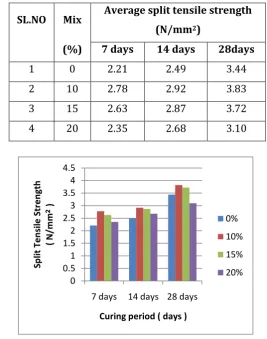
Split tensile strength of concrete is usually found by testing plain concrete cylinders. Cylinders of size150mm x 300 mm were used to determine the split tensile strength. After curing, the specimens were tested for split tensile strength using a calibrated compression testing machine of 4000kN capacity. It can be observed that at a 10,15,20% replacement of granite powder, an optimum for 7,14 & 28 days.
S.NO
Properties of Coarse
Aggregate
Result
1
Specific Gravity
2.90
2
Impact value
39.7
3
Water absorption
2.3
4
Bulk Density
0.75
5
Crushing Test
12.5
6
Flakiness Test
20.1
7
Elongation Test
26.00
[image:2.595.42.290.504.594.2]© 2017, IRJET | Impact Factor value: 5.181 | ISO 9001:2008 Certified Journal | Page 1625 Split tensile strength = ( N/mm2 )
Where,
P - Load (N)
D - Diameter of specimen (mm)
L - Length of the specimen (mm)
Flexural Strength:
The determination of flexural strength is essential to estimate the load at which the concrete members may crack. The flexural strength at failure is the modulus of rupture.
The modulus of rupture is determined by testing standard test specimens of size 100 X 100 X 500 mm.
Flexural Strength = ( N/mm2 )
Where,
P - Load (N)
a - Diameter of specimen (mm)
b - Breath of the specimen (mm)
d - Depth of the specimen (mm)
RESULT AND DISCUSSIONS
Table V.
Compressive Strength of Conventional Vs Granite Fine Concrete:SL.NO
Mix
Average compressive strength
(N/mm
2)
(%)
7 days
14 days
28days
1
0
19.24
24.15
33.6
2
10
21.92
24.15
35.84
3
15
21.16
24.44
34.66
4
20
20.45
23.70
30.95
0 5 10 15 20 25 30 35 40
7 days 14 days 28 days
Co
m
p
re
ssi
ve
S
tr
e
n
gth
(
N
/m
m
²
)
Curing period (days)
0%
10%
15%
20%
[image:3.595.304.562.63.266.2]Chart: 1 Compressive Strength of Conventional Vs Granite Fine Concrete
Table: VI The Split Tensile Strength of Conventional Vs Granite Fine Concrete
SL.NO
Mix
Average split tensile strength
(N/mm
2)
(%)
7 days
14 days
28days
1
0
2.21
2.49
3.44
2
10
2.78
2.92
3.83
3
15
2.63
2.87
3.72
4
20
2.35
2.68
3.10
0 0.5 1 1.5 2 2.5 3 3.5 4 4.5
7 days 14 days 28 days
Sp
lit
Te
n
sil
e
St
re
n
gt
h
(
N
/m
m
²
)
Curing period ( days )
0%
10%
15%
20%
Chart:2
Split Tensile Strength of Conventional Vs [image:3.595.294.562.350.690.2]© 2017, IRJET | Impact Factor value: 5.181 | ISO 9001:2008 Certified Journal | Page 1626
Table: VII Flexural Strength of Conventional Vs
Granite Fine Concrete
S.NO
Mix
Average Flexural strength
(N/mm
2)
(%)
7 days
14
days
28days
1
0
3.025
3.326
6.27
2
10
3.17
4.75
7.12
3
15
3.18
4.46
6.95
4
20
3.10
4.27
5.89
0 2 4 6 8
7 days 14 days 28 days
Fl
e
xu
ral
Str
e
n
gth
(
N
/m
m
²
)
Curing period ( days )
0%
10%
15%
20%
Chart:
3 Flexural Strength Of Conventional Vs GraniteFine Concrete
RECOMMENDATION:
Based on the results of the test, it is
recommended that 10% CGF is optimum for
replacement Fine aggregate. it is as well economical for
use in concrete works.
4. CONCLUSION:
This project Report suggests that the specimen cast with 10% replacement of fine aggregate by granite fines gives better compressive strength of 1.06% increased, Split tensile strength of 1.11% increased and Flexural strength of 1.14% increased. When to compare to conventional concrete. With addition of admixture.
The specimen cast with 15% replacement of fine aggregate by granite fines gives better compressive strength of 1.03% increased, Split tensile strength of 1.08% increased and
Flexural strength of 1.01% increased .When to compare to conventional concrete.
The Replacement of granite fine at 20% gives less result when compare to conventional concrete. The management of waste granite powder is a main goal of this project. The granite fine concrete has better strength at 10% replacement. The Replacement of granite fine in concrete gives more Economical and provides better performance.
REFERENCE:
1. N.Kiran Kumar, Dr.B.Damodhara Reddy, Smt.S.Aruna Jyoth “An Experimental Investigation on Strength Of Granite-Fines Concrete”-International Journal of science & Technology; ISSN(online):2250-141X, Vol.4 Issue 2,September 2014.
2. DIGE S.S., Prof. G. N. Shete – “An Experimental Investigation Of Strength Of Granite Fines Concrete” SSN: 2455-2631,June 2016 IJSDR , Volume 1, Issue 6
3 .Karthik, Mr.KR.Keerthiraman –“Experimental Investigation On Concrete With Partially Replacement Of Cement And Fully Replacement Of Sand” International Journal of Advanced Research in Biology Engineering Science and Technology (IJARBEST), Vol. 2, Issue 4, April 2016, ISSN 2395-695X.
4. K.Chiranjeevi reddy, Y.Yaswanth Kumar,P.Poornima “Experimental Study on Concrete with Waste Granite Powder as an Admixture” K.Chiranjeevi reddy Int. Journal of Engineering Research and Applications, ISSN : 2248-9622,Vol. 5, Issue 6, ( Part -2) June 2015, pp.87-93
5. A.Arivumangai1, T. Felixkala – “Strength and Durability Properties of Granite Powder Concrete” Journal of Civil Engineering Research 2014, 4(2A): 1-6DOI: 10.5923/c.jce.201401.01
6. Manasseh JOEL –“Use of Crushed Granite Fine as Replacement to River Sand in Concrete Production” Leonardo Electronic Journal of Practices and Technologies ISSN 1583-1078 Issue 17, July-December 2010p. 85-96
© 2017, IRJET | Impact Factor value: 5.181 | ISO 9001:2008 Certified Journal | Page 1627 Journal of Engineering and Technology Volume 2
No. 8, August, 2012
8 .Dr.T. Felix Kala –“Effect of Granite Powder on Strength Properties of Concrete” Research Inventy: International Journal Of Engineering And Science Vol.2, Issue 12 (May 2013), Pp 36-50 Issn(e): 2278-4721, Issn(p):2319-6483
9. Dr.G.Prince Arulraj, Mr.A.Adin and Mr.T.Suresh Kannan – “Granite Powder Concrete” IRACST – Engineering Science and Technology: An International Journal (ESTIJ), ISSN: 2250-3498, Vol.3, No.1, February 2013
10. G.L. Oyekan and O.M.Kamiyo – “Effect Of Granite Fines On Structural And Hygrothermal Properties Of Sandcrete Block” Journal of Engineering and Application Sciences 3(9):135-741,2008 : ISSN: 1816-949X, 2008.
BIOGRAPHIES
Mr.S.Arulkesavan working as a Assistant professor in The Kavery Engineering College, Mecheri, Salem.
Mr.M.Jothi studying BE Civil Engineering Final year in The Kavery Engineering College, Mecheri, Salem.
Mr.M.Satheeshkumar studying BE Civil Engineering Final year in The Kavery Engineering College, Mecheri, Salem.
Miss.V.Tamilselvi studying BE Civil Engineering Final year in The Kavery Engineering College, Mecheri, Salem.