© 2017, IRJET | Impact Factor value: 5.181 | ISO 9001:2008 Certified Journal
| Page 1288
A Cluster Based Adaptive Broadcasting scheme for Overhead Reduction
in MANET
Dr.B.Sundaravadivazhagan
1R.Sankari
21
Professor, Renganayagi Varatharaj College of Engineering, Thayalpatti(via),salavarpatti, India
Email: [email protected]
---***---Abstract
-
Mobile ad hoc network (MANET) has distributedand decentralized architecture with mobile nodes. Since the nodes are mobile in nature, maintaining the route and link between the source and destination are difficult. The routing process increases the routing overhead and decreases the throughput, due to the large routing table used by the mobile nodes. To overcome this issue, several approaches are developed to make more efficient routing. But they have not focused on failures of link and path. We propose Cluster based Adaptive Broadcasting (CBAB) scheme to attain the correct balance between overhead and end to end delay. In first phase of this scheme, we create cluster routing procedure and election of cluster head based on neighbour coverage metric. In second phase, overhead is reduced with the help of link expiration time and removing redundant rebroadcast massages. By implementing these solutions, we have achieved better stability and less overhead towards the ultimate goal of cluster routing scheme. We have implemented our proposed scheme within Network Simulator (NS2.34) tool environment. The simulation results, proves that the proposed scheme achieves better delivery ratio, less communication overhead, reduced control overhead, less computation overhead and very low end to end delay than existing schemes namely AODV, Neighbour based Probabilistic Rebroadcast (NBPR) and Dynamic Route Discovery (DRR).
Keywords: MANET, Cluster, overhead reduction, delivery ratio, control overhead, and end to end delay.
1.INTRODUCTION
Mobile ad hoc networks (MANETs) have become an active research area in recent years. MANETs consist of wireless hosts that communicate with each other in the absence of a fixed infrastructure. The nodes in a MANET interchange information via single-hop and multi-hop paths in a peer-to-peer fashion. Collaborative computing and communications in smaller areas can be set up using ad hoc network technologies. The task of route maintenance in the MANET is significant since the mobile host nodes cause frequent random topological changes. Many routing
protocols, such as Ad hoc On-demand Distance Vector Routing (AODV) [1] and Dynamic Source Routing (DSR) [2], have been proposed for MANETs. These protocols are based on demand routing, and they can be used to improve the MANETs scalability by reducing the routing overhead [3]. AODV is the most popular usable algorithm and it is useful in MANET routing with minimum number of nodes. Minimum delay is required in the path set up process and wired networks can be utilized in MANETs with less alteration.
Route Maintenance is a mechanism used to repair routes when they are invalidated or have broken links. If the broken links are encountered, error is propagated to neighbors that have used this node as their next hop. AODV necessitates an even update of their routing tables that consumes battery poor and a minimum amount of bandwidth while the network is in idle state and this protocol is not desirable for dynamic networks and it has no commercial execution of such algorithm. The major function of AODV is to deal the looping trouble of the formal distance vector routing protocol and to create the distance vector routing more desirable for mobile ad hoc networks routing. However, due to node mobility in MANETs, frequent link breakages may lead to frequent path failures and route discoveries, which could increase the overhead of routing protocols and reduce the packet delivery ratio and increasing the end-to-end delay [4]. Thus, reducing the routing overhead and delay in route discovery is an essential problem in routing algorithms.
© 2017, IRJET | Impact Factor value: 5.181 | ISO 9001:2008 Certified Journal
| Page 1289
assure connectivity. In this paper, we propose a newbroadcasting algorithm known as Cluster based Adaptive Broadcasting. In first phase of this scheme, we create cluster routing procedure and election of cluster head based on neighbour coverage metric. In second phase, overhead is reduced with the help of link expiration time and removing redundant rebroadcast massages. In this algorithm, a novel clustering method has been used to reduce the control message exchanges. After reducing control messages exchange, the broadcasting traffic is divided into flow inside a cluster and flow among the clusters. If the broadcasting traffic is inside the cluster, cluster-heads and gateways are utilized for re-broadcasting. If it is among the cluster, border nodes are used for rebroadcasting purpose.
2. RELATED WORK
Clustering approaches generally categorized into six categories Mobility aware clustering approaches, Combined-metrics based clustering approaches; Dominating Set based clustering approaches, Energy efficient clustering approaches, Load balancing clustering approaches and Low maintenance clustering approaches [6]. The energy efficient clustering approach is used for this situation which avoids unnecessary consumption of energy or equilibrating energy consumption for nodes in mobile ad hoc networks in order to sustain the network life-time i.e., the life-time of mobile nodes. In the location-based scheme, messages are rebroadcasted only when the additional coverage concept [7] determines the location of the mobile nodes to broadcast. In distance-based scheme messages are rebroadcasted according to the decision made between the relative distance of mobile node and the previous sender. In cluster-based scheme, the network is divided into number of clusters; each cluster has a single cluster head and several gateways. Each cluster head, in turn, acts as a source for rebroadcast within its own cluster and the gateways can communicate with external clusters and are responsible for transmitting the broadcast message externally.
Hybrid schemes [8] combine between the advantages of probabilistic and counter-based schemes to achieve the performance improvement. The second category is known as a deterministic broadcast scheme and includes multipoint relaying [9], node-forwarding [10], neighbour elimination [11], and clustering [12]. Solutions suggest that under the conventional back-pressure algorithm in which the end-to-end packet delay first reduces and then enhances as an occasion the network load or the rate of arrival [13]. Such storming minimum-load behaviour is explicated owing
to the fact that the conventional back-pressure algorithm efforts entire paths even while the traffic load is very low. It adaptively chooses a set of paths according to the load of the traffic so only long routes are utilized merely when necessary. In addition, it provides lower end-to end delay and better performance as compared to the conventional back-pressure algorithm [14].
Distributed Clustering Algorithm and Distributed Mobility Adaptive Clustering algorithm are two popular clustering approaches, in which each and every node is allotted a weight based on their suitableness of living a cluster head. A node is selected to be a cluster head if their weight is greater than whatever of its neighbour node’s weight or otherwise it connects a cluster head of neighbouring node [15].
3. CLUSTER BASED ADAPTIVE
BROADCASTING SCHEME
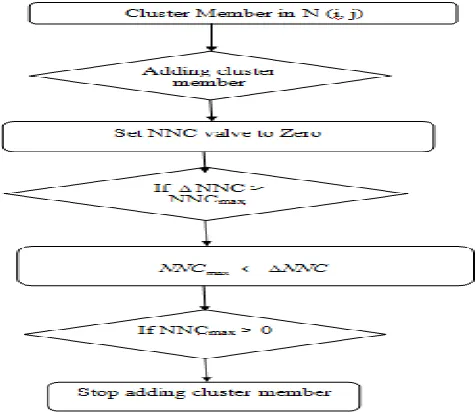
The proposed scheme consists of two phases. In first phase a hybrid clustering algorithm is developed based on neighbour coverage metric. In this phase, cluster pattern is designed and cluster head is chosen based on cluster starting value. In second phase of the scheme, estimation of link stability is determined to reduce redundant messages which lead to reduction of overhead. These phases of proposed routing scheme are described below. The detailed steps are provided in figure 1.
[image:2.595.313.551.500.706.2]© 2017, IRJET | Impact Factor value: 5.181 | ISO 9001:2008 Certified Journal
| Page 1290
In this phase, cluster is formed from the group ofmobile nodes based on Neighbour node coverage (NNC). This metric is used to represent the inter connectedness of a cluster compared with the intra-connectivity between that cluster and the mobile nodes that border it. The range of NNC is [0,1], with 1 representing a fully connected cluster with no connections outside the cluster. An NNC of zero indicates that a vertex is clustered by itself. First a vertex is considered to be a cluster by itself. The current cluster adds any neighbouring mobile nodes which will result in a positive NNC gain for the nodes that are already in the cluster.
Connected
ed
notconnect
j
i
j
i
t
Aij
1
0
)
(
(3)Aij(t) has the Markov property. The link connectivity
is mainly getting affected by the radio channel characteristics when both nodes are fixed or move at a fairly low speed. The probability of incorrect reception of a packet is generally indicated by the error probability, which is independent of whether the previous packet has been received successfully. Let tp denote the present time, the link
stability probability is evaluated when the link remains connected for time k,
tpke
k
s
G
k
Gr
(
)
10
( ) (4)The probability that the link recovers within time τ after a link failure,
tpkr
k
P
s
k
e
G
(
)
01
1
( ) (5)3.1 Proposed algorithm for Overhead
reduction
The algorithm for overhead reduction is explained in the following steps:
i) The source node sends a route request to all nodes within range. The receiving node checks for duplication or correct sequence.
ii) If it is correct, it will then check whether it can provide the requested data, else it will mark its own address and sequence number to the request packet and rebroadcast the packet.
iii) A new route discovery is initiated prior to the link expiry.
iv) Set a maximum lifetime for packets so that it minimizes broadcasting overhead and control traffic
v) By reducing control traffic, more data traffic can be transmitted over the network. For example, let
4. PERFORMANCE ANALYSIS
The performance of the proposed approach is evaluated in this section. The simulation model is discussed and the simulated results are presented and described below. We have simulated our results using ns 2.34 simulator. Here we made the assumption that adopted for simulation is all nodes are moving dynamically including the direction and speed of nodes. Mobility scenario is generated by using random way point model with 300 nodes in an area of 900 m × 900 m. The simulation parameters are mentioned below in Table 1.
4.1 Performance metrics
The performance of any algorithm may be evaluated using the following metrics.
Packet delivery ratio: The packet delivery ratio is defined as the ratio between the number of packets sent by constant bit rate sources and the number of received packets at destination. The best routing methods employing this metric are those that guarantee delivery in which message delivery is guaranteed assuming “reasonably” accurate destination and neighbor location and no message collisions
Control overhead: The control overhead is defined as the total number of routing control packets normalized by the total number of received data packets. The control traffic overhead of a protocol is heavily related to the stability of the connectivity graph in MANETs.
© 2017, IRJET | Impact Factor value: 5.181 | ISO 9001:2008 Certified Journal
| Page 1291
Routing overhead: The overhead associated with QoS Routing is an important limitation to its deployment. Namely, the flooding process used to distribute the state of the network is one important factor in QoS Routing overhead. Mechanisms used to overcome the cost of QoS Routing, such as the ones that limit the frequency of the emission of updates, introduce new problems, namely routing information inaccuracy
End-to-End Delay: This is also referred to as latency, and is the time needed to deliver the message. Data delay can be divided into queuing delay and propagation delay. If queuing delay is ignored, propagation delay can be replaced by hop count, because of proportionality.
Simulation settings and parameters are summarized in table 1.
Table-1: Simulation and Settings parameters
No. of Nodes 300
Area Size 900 X 900
Mac 802.11
Radio Range 250m
Simulation Time 100 sec
Traffic Source CBR
Packet Size 128 bytes
Mobility Model Random Way Point
Protocol AODV
4.2 Results
We compared our proposed CBAB scheme with AODV, Neighbour based Probabilistic Rebroadcast (NBPR) and Dynamic Route Discovery (DRR). The results are examined by using performance metrics end-to-end delay, packet delivery percentage and control overhead. When varying the network size and the parameters throughput, Packet delivery ratio, control load and delay are analyzed by trace analysis. It is clearly shown that the network varies from 60 nodes to 300 nodes. It analyzed all the four parameters with existing and proposed protocols with different mobility conditions. Maximum theoretical throughput is closely related to the channel capacity of the
system and is the maximum possible quantity of data that can be transmitted under ideal circumstances.
In chart 1, the performance of networks that uses CBAB scheme compared with AODV, NBPR and DRR using throughput and network size. The network that employs the CBAB scheme has better throughput. Since it uses minimum control load for route initialization process, but other protocols requires increased control load at the time increase in network size. The throughput comparison shows that the three algorithms performance margins are very close under traffic load of 50 and 100 nodes in MANET scenario and have large margins when number of nodes increases to 300. In this comparison, CBAB achieves 1.3 Mbps out of available 2 Mbps. The rest of the 0.7 Mbps is used by control load. chart 2 shows the graphical comparison between CBAB and existing protocol in terms of delay. Compared to existing, proposed technique used lesser time to transmit the data packets. Delay of AODV is 0.38 seconds, since it support more node connectivity. However, the proposed CBAB supports more connectivity with a delay of 0.21 sec for network size of 50 and maximum of 0.29 sec for 300 nodes.
© 2017, IRJET | Impact Factor value: 5.181 | ISO 9001:2008 Certified Journal
| Page 1292
Chart -2: Graphical comparison in terms of Delay
In chart 3, the performance of CBAB with other techniques is compared and particularly the delivery rate is compared. The network that employs the CBAB protocol possesses high delivery rate and packet rate. The PDR value for the CBAB is 80% for 50 nodes and 46% for a network size of 300 nodes. The other protocols this value is between 60 to 30%. Most of these protocols maintain a high packet delivery ratio except traditional AODV which shows a major difference in PDR values as compared to the other protocols. The best PDR results for CBAB is observed for 0 pause time scenario only and for higher values of pause time its PDR is reasonably lesser against other protocols. The control messages usually decrease the performance of network due to interaction. Chart 4 shows that the proposed technique used the lesser amount of control message to update the routing table, and hence it increases the performance of the network.
Chart -3: Graphical representation of Network Size Vs Delivery rate
Chart -4: Graphical comparison of Control overhead
In chart 5, the performance of networks that uses AODV protocol with other protocol is compared and specifically the routing overhead is compared. The network which uses the NBPR protocol has less overhead and CBAB has high routing overhead.
Chart -5: Graphical analysis in terms of Routing overhead
5. CONCLUSION
© 2017, IRJET | Impact Factor value: 5.181 | ISO 9001:2008 Certified Journal
| Page 1293
layer framework in the stable link routing scheme to adoptminimum energy consumption among the mobile nodes.
REFERENCES
1. H. AlAamri, M. Abolhasan, and T. Wysocki, “On Optimising Route Discovery in Absence of Previous Route Information in MANETs,” Proc. IEEE Vehicular Technology Conf. (VTC), pp. 1-5, 2009.
2. X. Wu, H.R. Sadjadpour, and J.J. Garcia-Luna-Aceves, “Routing Overhead as a Function of Node Mobility: Modeling Framework and Implications on Proactive Routing,” Proc. IEEE Int’l Conf. Mobile Ad Hoc and Sensor Systems (MASS ’07), pp. 1- 9, 2007.
3. Seon Yeong Han, Member, IEEE, and Dongman Lee, Member, IEEE, “An Adaptive Hello Messaging Scheme for Neighbor Discovery in On-Demand MANET Routing Protocols” , IEEE Communications Letters, Vol. 17, No. 5, May 2013, pp.1040-1043.
4. N. Karthikeyan, V. Palanisamy and K. Duraiswamy, “Reducing Broadcast Overhead Using Clustering Based Broadcast Mechanism in Mobile Ad Hoc Network”, Journal of Computer Science 5 (8): 548-556, 2009. 5. Xin Ming Zhang, Member, IEEE, En Bo Wang, Jing Jing Xia,
and Dan Keun Sung, Senior Member, IEEE, “An Estimated Distance-Based Routing Protocol for Mobile Ad hoc Networks”, IEEE Transactions on Vehicular Technology, Vol. 60, No. 7, September 2011, pp.3473-3484.
6. Narendra Singh Yadav, Bhaskar P Deosarkar and R.P.Yadav, “A Low Control Overhead Cluster Maintenance Scheme for Mobile Ad hoc NETworks (MANETs)”, International Journal of Recent Trends in Engineering, Vol 1, No. 1, May 2009, pp.100-104.
7. Ha Dang, Member, IEEE, and Hongyi Wu, Member, IEEE, “Clustering and Cluster-Based Routing rotocol for Delay-Tolerant Mobile Networks”, IEEE Transactions on Wireless Communications, Vol. 9, No. 6, June 2010, pp.1874-1881.
8. Samer A. B. Awwad, Chee Kyun Ng* and Nor K. Noordin, “Cluster Based Routing Protocol with Adaptive Scheduling for Mobility and Energy Awareness in Wireless Sensor Network”, Proceedings of the Asia-Pacific Advanced Network 2010 v. 30, p. 57-65.
9. Dr.G.Mary Jansi Rani and Dr. S. Arumugam, “Control overhead reduction: A Hierarchical Routing Protocol in Mobile Ad hoc Networks”, International Journal on Computer Science and Engineering, Vol.5, No.5, 5, No.5, 2013, pp.275-279.
10. J. Cartigny, D. Simplot, Border node retransmission based probabilistic broadcast protocols in ad-hoc networks, in: Proceedings of HICSS-36, 2003.
11. Xin Ming Zhang, Member, IEEE, En Bo Wang, Jing Jing Xia, and Dan Keun Sung, Senior Member, IEEE, “A Neighbor Coverage-Based Probabilistic Rebroadcast for Reducing Routing Overhead in Mobile Ad Hoc Networks”, IEEE
Transactions on Mobile Computing, Vol. 12, No. 3, March 2013, pp.424-433.
12. A. Mohammed, M. Ould-Khaoua, L. Mackenzie, J. Abdulai, Improving the performance of counter-based broadcast scheme for mobile ad hoc networks, in: Proceedings of 2007 IEEE International conference on Signal Processing and Communications, 2007, pp. 1403–1406.
13. Qayyum, L. Viennot, A. Laouiti, Multipoint relaying for flooding broadcast messages in mobile wireless networks, in: Proceedings of the 35th Annual Hawaii International Conference on System Sciences, 2002, pp. 60–65.
14. G. Calinescu, I. Mandoiu, P.-J. Wan, A.Z. Zelikovsky, Selecting forwarding neighbors in wireless ad hoc networks, Mobile Networks and Applications 9 (2004) 101–111.