EFFICIENT GROWCUT BASED IMAGE SEAM COVERING WITH
QUANTIZATION MATRIX ESTIMATION USING ANFIS FOR
JPEG ERROR ANALYSIS
S. Vishnu Priyan
1and S. K. Srivatsa
2 1St. Peter’s University, Chennai, India
2
Prathyusa Institute of Technology and Management, Chennai, India E-Mail: [email protected]
ABSTRACT
The recognition of JPEG compression plays a significant part in digital forensics. Earlier, JPEG image can be compressed upto n times. However, in the JPEG compression error analysis in the JPEG images are not primarily concentrated. To solve this problem size of the JPEG image is reduced based on Growcut based seam covering technique. For the purpose of assessing the influence of image compression for JPEG image samples, Discrete Cosine Transform-Singular Value Decomposition (DCT-SVD) was computed for single and double image compression, images were quantized through quantization matrices, and quantization matrix results are assessed using Adaptive Neuro Fuzzy Inference System (ANFIS). Extensive experiments and evaluations with previous techniques reveal that the proposed DCT-SVD-ANFIS scheme can discover the double JPEG compression efficiently; it has extremely much significance in the field of digital forensics. The results of the proposed DCT-SVD-ANFIS it is measured based on the parameters like, Peak Signal to noise Ratio (PSNR) and Mean Square Error (MSE).
Keywords: JPEG image compression, image resizing, growcut seam covering (GCSC), adaptive neuro fuzzy inference system (ANFIS) and error analysis, discrete cosine transform (DCT).
1. INTRODUCTION
Digital image forensics has come forward as a new discipline to assist rescuing some trust in digital photographs, by discovering clues regarding the history of content [1]. In the nonexistence of any form of digital watermarks or signatures, this department works on the assumption that most forms of tampering will upset certain features of the image. To the degree that these perturbations can be quantified and identified, they can be employed to validate a photo. Practices in digital forensics can be classified as: (1) Pixel-based, discovering statistical patterns at the pixel level [2]; (2) Format-based, discovering statistical patterns particular to an image compression format (e.g., JPEG or GIF) [3]; (3) Camera-based, utilizing artifacts introduced by the camera lens, sensor or on-chip post-processing [4]; (4) Physically based, modeling and computing the contacts between physical objects, light and the camera [5]; and (5) Geometry-based, utilizing the principles of image construction as governed by projective geometry [6].
JPEG is the one of the most recent subject in the image compression technique that is employed today. The JPEG format is accepted in the majority of the digital cameras and image processing instruments; numerous forensic instruments have thus been investigated to notice the existence of tampering in this class of images. Recognition of double compression of the JPEG images is extremely helpful for applications in steganography. Primarily it is having two uses; first of all it portrays an efficient scheme for discovering double compression of the JPEG images with the assistance of Support Vector Machines (SVM). A vital characteristic of this scheme is that, it is capable of identifying double compression of the
cover images as well as the images processed with steganographic approaches. Secondly, it assists in creating a highest probability estimator of the prime quality factor in double compressed JPEG images.
In this work consider JPEG double image compression, initially the image was transformed into resized image by means of Growcut based seam covering resizing scheme, subsequently noise in the images are eliminated with the help of NLFMT filtering methods, then it is quantized by means of DCT transformation matrix is called the primary quantization matrix, the quantization matrix employed in second compression is called the secondary quantization matrix. These quantization matrixes are examined using Adaptive Neuro Fuzzy Inference system (ANFIS). Several quality factors are employed to analyze quantization results of single and double compression quantization matrix.
2. RELATED WORK
JPEG can be regarded as an algorithm that can be handy for image compression and also that approach can be transformed to meet the different requirements of the users. By means of JPEG image compression, it can accomplish extremely high compression ratios. When the compression ratios increase, the quality of the image diminishes considerably. However, those images are still exceptionally helpful in several applications. For transferring extremely compressed image by means of internet, it will utilize incredibly small bandwidth.
in the literature make use of the characteristic footprint left in the DCT coefficients distribution of an image at some stage in compression, aiming at determining traces of previous JPEG compression and approximating the employed quantization step [7]. Current results demonstrate that even multiple instances of JPEG compression can be identified [8]. Unfortunately, the above mentioned approaches have certain drawbacks in real life circumstances, where chains of operators might have been executed to the content.
In earlier works [9], revealed that linear image processing, for instance, filtering, frequently executed to the whole image (full-frame) as post processing for image improvement, however probably also for forensic footprints elimination, might modify the characteristic artifacts introduced by the JPEG compression scheme. Considering the quantization phase to be known, such knowledge can be utilized with the intention of retrieving the applied filter kernel by measuring the difference among the derived models and the real distribution of a to-be-tested image.
A quick and efficient technique is given in [10] to decide whether an image has been formerly JPEG compressed. Subsequent to noticing a compression signature, compression constraints are approximated. A technique for the maximum likelihood evaluation of JPEG quantization phases has been formulated. An adaptive regression scheme implemented to the standard JPEG compression for archiving elevated compression ratios presented in [11]. Constraints of the last JPEG compression from the file header, and as a result, their schemes will not be appropriate for the forensic scenarios, with the intention of solving this complication and estimate the image quantization matrix results, eliminate noise from images, diminish the space of the image, proposed work carry out image resizing, image denoising framework, then execute image quantization matrix by means of the classification method.
3. PROPOSED METHODOLOGY
In this work, a well-organized double compression schema is formulated for JPEG images by improved DCT-SVD Methods. In order to diminish the size of the images following JPEG compression of images are resized by means of improved seam covering schemes. Initially the JPEG images in the DCT compression image samples are resized with improved Growcut based Seam Covering (GCSC) techniques. Executed quantization step from [12] to examine the error of compression techniques with the help of Adaptive Neuro Fuzzy Inference System (ANFIS), it precisely carried out assessment of error results from quantization matrix in both single and double compression techniques.
A. Images resizing using Growcut based Seam Covering (GCSC)
In this work, initially the JPEG images in the DCT compression image samples are resized with improved seam covering techniques (See Figure-1).
Figure-1. Growcut based image seam covering.
This resizing technique primarily choose anyone of the pixel value in the JPEG images pairs and then fragment the most significant substance of the JPEG Images. Let original JPEG images as
J =
{J , J , … . . J }
wherej ∈ n
represents the number of JPEG image samples in the training phase. Improved Seam Carving approach is proposed for the purpose of image resizing. Image segmentation Grow Cut [13] is integrated with the original Seam Carving approach to automatically choose the region of significance by draw one line inside the object and one line exterior to the object. An energy function is employed to calculate the energy of each pixel. It is utilized to discover and eliminate the seam of lowest significance of the pixels for JPEG image compression. In case of the original seam carving by Avidan and Shamir [19], the energy functions are described by gradient magnitude as given below,e JIP = |
∂∂JIP | + |
∂∂JIP |
(1)where
JIP
represent the pixel value of JPEG image. A seam is discovered by tracing the pathway from one edge of the JPEG image to the contradictory edge through the path with the smallest amount of energy given by the Equation (2) below:S
∗= min E s = min ∑ e(JIP s )
= (2)
energy is fixed low. Subsequent to successively eliminating seams, the output JPEG image will accomplish the preferred resized resolution.
B. Image compression and decompression process with DCT -SVD
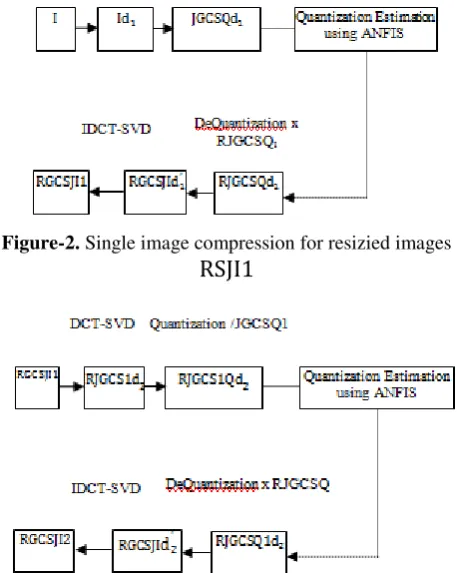
Figure-2 and Figure-3 demonstrates the representation of DCT-SVD-ANFIS based single and double compressed images samples.
[image:3.595.55.284.252.539.2] [image:3.595.58.283.418.549.2]Figure-2. Single image compression for resizied images
RSJI
Figure-3. Double image compression for resizied images
RSJI
.At first, take LENA images as input image
I
, subsequently execute DCT-SVD transform function to input image. The transformed frequency coefficientId
results from DCT are resized with the help of the GCSC. In order to analysis the results of DCT compression techniques, an error value is introduced in this phase, is regarded as quantization and the quantization coefficient values of DCT compression results is examined with the help of ANFIS. In last stage, the resultant bit from ANFIS is integrated to header file to generate specific JPEG file. In JPEG image decompression stage, the compressed JPEG file turned out to be one of significant entropy measures to decode and recover the quantization coefficientJSQd
results precisely and it is multiplied byquantization table
JGSQ JPEG GCSC QUANTIZATION
to acquirethe dequantized coefficient
JSd
′. DCT-ANFIS inverse transformation function is employed to dequantized outcome. Subsequently dequantized images samples results is given as input to second compression technique, it carries out the similar procedure from single compression process, until the entire images are compressed and decompressed again.With the aim of reducing the complexity in the DCT transformation technique, employ the singular value decomposition technique for resized JPEG image compression phase. The SVD approach is implemented to DCT compression matrix
DCTC k
, is defined as given below:DCTC
=
√N∑
N−f
=
JGCS
(3)DCTC k = √
N∑
N−f
=
RJGCS COS
c +N π(4)
k = , . . N −
The above
DCTC k
is transformed into four quadrants by means of Zig-Zag mapping. Size of each quadrant is×
. The SVD is employed to every quadrant, and subsequently can obtain a diagonal matrix with×
. The SVD of am × n
matrixJGCS
is characterized by the operation:RJGCS
= U × S × V
(5)Where
U ∈ R
× ,V ∈ R
× are unitary andS =
diag σ , … σ
represents a diagonal matrix. The diagonal matrix are called as singular value ofJGCS
and are considered to be organized in descending orderσ > σ
+ . The columns of the matrix are taken as the left singular vectors at the same time the columns of the matrix are taken as the right singular vectors of . Each singular valueσ
indicates the luminance of a data layer at the same time the equivalent pair of singular vectors indicates the geometry of the data layer. Subsequently, inverse discrete cosine transform is given as follows,f(RJGCS
) =
√N
DCTC
+ √
N∑
N−=DCTC k
(6)COS
( RJGCS
N
+ )kπ
,
RJGCS
= , … , N −
initially required to compute the association of frequency coefficient among the first image and second images are taken as,
RJGCSd = DCT − SVD I
(7)= DCT − SVD [IDCT − SVD RJGCSd
′]
= DCT − SVD IDCT RJGCSd
′+ RE
= DCT − SVD IDCT − SVD RJGCSd
′+ DCT
− SVD RE
= RJGCSd
′+ ε = [
RJGCSd
RJGCSQ ] × RJGCSQ + ε
Where
RE
represents the rounding error from previous DCT-SVD compression stages. Considering thatε i, j
is approximated Gaussian distribution through zero mean and their variance is/
. In DCT-SVD compression techniques, the transformed frequency coefficient location values are taken asi, j ∈ ,
correspondingly and their quantization matrixes is given asRJGCSQ = RJGCSQ i, j
. The outcome of quantization matrix is assessed in accordance with the rounding error function. The rounding error function is not simple to accomplish results for various sizes of images. With the aim of overcoming this complication, in this work an ANFIS algorithm is employed to estimate quantization of single and double compressed image samples.C. Adaptive Neuro Fuzzy Inference System (ANFIS) to estimate quantization matrix
ANFIS classification method is employed in this paper to estimate the quantization results of
JGCSQ i, j
andJGCSQ i, j
through the association amongst two compression images. The proposed system primarily obtains histogram based features from resized images to approximate quantization results into two different classes, for instance, single quantization and double quantizationresult. It builds the fuzzy inference progression by the use of known quantization matrix from DCT-SVD and their corresponding fuzzy membership values for histogram features of the JPEG resized image are fine-tuned automatically with the help of well-known back propagation approach. The ANFIS is employed for estimation of quantization matrix results by permitting for only two most important classes
rd
&rd
. With the intention of representing the ANFIS framework, it is considered in the form of fuzzy–if then rules. The generalized form of fuzzy-if then rules is characterized in the following method:Rule1: If (
RJGCSh
− Vx i, j
isA
) and (RJGCSh
− Vy S i, j
isB
) thenf =
p RJGCSh
− Vx +
q RJGCSh
− Vy + r
Rule2: If (
RJGCSh
− Vx
isA
) and (RJGCSh
− Vy
isB
) then (f =
p RJGCSh
− Vx +
q RJGCSh
− Vy + r
)Where inputs that are histogram dependent features from the DCT-SVD technique is characterized as variables
RJGCShx
andRJGCShy
.A
andB
are the fuzzy sets for estimation of the quantization matrix from the DCT-SVD with obtained histogram features,f
represent the outputs of quantization estimation matrix results within the fuzzy region indicated by the fuzzy rule,p , q
andr
are the design parameters that are established at some stage in the training process. The ANFIS construction for development of fuzzy-if then rules is illustrated in Figure-4, in which fixed node of the structure is indicated by circle, where adaptive node of the structure is indicated by square.Figure-4. ANFIS architecture for quantization matrix estimation.
In ANFIS framework, the input nodes are regarded as adaptive nodes where input of these nodes
membership ranking of the quantization matrix results, which are denoted by:
O = μ (RJGCSh
− Vx ) i = ,
(8)O = μ
−(RJGCSh
− Vy) i = ,
(9)Where fuzzy membership function of the layer is
μ (RJGCSh
− Vx)
,μ
−(RJGCSh
− Vy)
. Required to compute membership functions to estimate the layer 1 results areμ x
is given as:μ (RJGCSh
− Vx) =
+{( JG − V k x− ) }
(10)
where
a
,b
andc
represents the parameters of fuzzy membership function for quantization matrix results from DCT-SVD, foremost the bell shaped functions accordingly. In case of the first layer, the nodes are fixednodes. They are indicated with , envoy that they complete as a simple multiplier. The outputs of the second layer can be indicated as:
O = w = μ (RJGCSh
− Vx)
(11)μ (RJGCSh
− Vy) i = ,
This is also regarded as the evident strengths of the fuzzy-if then rules. In case of the third layer; the nodes are also fixed nodes. These nodes are indicated with a parameter that designates the normalization to the evident strengths of the fuzzy-if then rules from the second layer. The outputs of third layer can be indicated as:
O = w
̅̅̅ =
i + (12)which are the presumed normalized evident strengths. In case of the fourth layer, the nodes are adaptive nodes. The output of each node in fourth layer is predominantly the multiplication of the normalized evident strength and a first order polynomial. Accordingly, the outputs of fourth
layer are indicated as:
O = w
̅̅̅f = w
i̅̅̅(p RJGCSh
i − Vx + q RJGCSh
− Vy + r )i = ,
(13)In the fifth or concluding layer, there is only one fixed node indicated with . This node carries out the summing up of the entire received eye movement signals. As a result, the complete output of the representation is indicated as:
O = ∑ w̅ f
==
∑=+ (14)In the first layer, there are 3 fuzzy membership function associated adjustable parameters
a
,b
andc
for each one of the quantization matrix with histogram feature obtained, it is regarded as basis parameters. With theintention of influencing the first order polynomial function in fourth layer with the help of three adjustable parameters
p
,q
andr ,
the result of the ANFIS representation can be given as:f =
+f +
+f
(15) Subsequently, the equation is transformed into,f = w̅ f + w̅ f
(16)Replacement of fuzzy if then rules above equation, it transformed as,
f = w̅ p RJGCSh
− Vx + q RJGCSh
− Vy + r + w̅ p RJGCSh
− Vx +
q RJGCSh
− Vy + r
(17)which is a linear grouping of the adjustable resultant parameters from . The least squares technique is employed to categorize the optimal quantization matrix results of the single and double compression image values of these resulting parameters merely. At last, completion of the previously mentioned steps quantization matrix result is found. A model is allocated to single quantization and double quantization class (
rd &�d
with the maximum class membership value with less error values. In this paper, take five different quantization error valuesto approximate quantization matrix results and it values depends on
QF
such asQF =
, QF =
, QF =
, QF =
, QF =
;QF = {QF , QF , QF , QF , QF }
. In the ANFIS outcome from the quantization estimation first quantization factorQF
error values are approximated depending on the error valueQF = .
, second quantization factor error values are fixed toQF = .
, third quantization factor error values are fixed toQF =
fixed to
QF = .
, concluding quantization factor error values are fixed toQF = .
. In order that every quantization factor at last belongs toJSd
among the association between single and double compressed quantization results with feature vectors. The histogram dependent features is allocated to quantization estimation class with less quantization error for each quantization matrix and precisely it is given as,RJGCSd (h ) = F
cRJGCSd ≥
F (RJGCSh )∀j ∈ , , , … . . , C and j ≠ C
(18)Where
F RJGCSd
indicates the activationfunction value of
j
neuron in ANFIS and it is taken as output of ANFIS system. From these phases, the fuzzification outcome of histogram quantization classF
c(RJGCSh )
result is compared with multiple quantization steps to approximate quantization outcome. Based on analyzed outcome, how to eliminate rounding errorRE
and how to carry out dequantizationJGCSd
′ becomes most important concerns, it can be solved by using following equation,RJGCSd = RJGCSd
′+ DCT − SVD RE =
RJGCSd
′+ ε
(19)Proposed DCT-SVD-ANFIS appropriately observe the quantization matrix results from DCT compression and their matching error values in the quantization step results also founded in ANFIS system, it
is employed to categorize the quantized image samples into single and double compressed images independently.
4. EXPERIMENTAL RESULTS
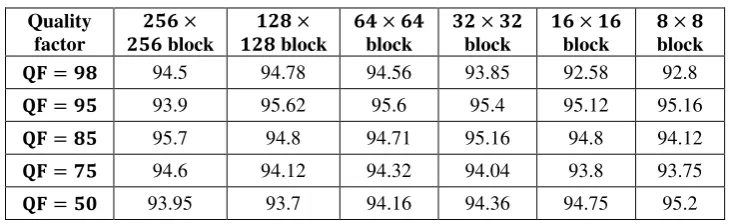
[image:6.595.115.480.541.653.2]In the experimentation to evaluate the proposed system for FNN based on DCT compression, make use of the Matlab JPEG Toolbox [14] for JPEG compression. Then 1000 images are randomly selected from each image dataset. At last, there are 5000 uncompressed color images. Those images are initially transformed into gray-scale images, which are then center-cropped into little blocks with sizes varying from × to × . The experimental outcome for JPEG history estimation is specifically recognizing JPEG images, estimating quantization steps, and discovering quantization table. To correctly assess the proposed feature histogramJSh , initially use a minimum risk classification rule [15] to discover a threshold. For a specified image size in the training stage, part of the uncompressed images and the matching JPEG compressed images with QF = , the maximum quality factor the proposed feature can discover consistently, are employed to achieve a proper threshold. These threshold values are then employed to recognize the rest of the JPEG images withQF = { , , }, and , correspondingly. The experimental results are given in Table I. At this point, define the False Positive Rate (FPR) as the possibility of the uncompressed images being incorrectly determined as JPEG images, and consequently it is permanent, once the threshold is specified for the same uncompressed image dataset. It can be observed that this method can accomplish adequate accuracy of around 95% even when the image size decreases to × and the quality factor is as high as 95, which demonstrates that the proposed feature is extremely robust to the quality factors employed previously as well as the image sizes.
Table-1. Experimentation results.
Quality factor
×
block
×
block
×
block
×
block
×
block
×
block
�� = 94.5 94.78 94.56 93.85 92.58 92.8 �� = 93.9 95.62 95.6 95.4 95.12 95.16 �� = 95.7 94.8 94.71 95.16 94.8 94.12 �� = 94.6 94.12 94.32 94.04 93.8 93.75 �� = 93.95 93.7 94.16 94.36 94.75 95.2
Figure-5. Quantization results for AC (1, 1).
Figure-6. Quantization results for AC (2,2).
Figure-7. Detection accuracy as a function of the quality factors.
Figure-7 shows the average accuracy evaluated on the test images in different cases. The detection accuracy of proposed DCT-SVD-ANFIS system also significant how well algorithm properly detects single and double quantization matrix efficiently detects for DCT-SVD compression images, in view of the fact that the
proposed system eliminates noise from image samples. It is also high in DCT–SVD-ANFIS compression for different quality factors than existing, DCT-FNN [16], DCT double compression methods.
CONCLUSION AND FUTURE WORK
This paper proposes a novel JPEG error analysis method with estimation of quantization matrix results using ANFIS. Prior to carrying out image resizing DCT-SVD is applied and then images are resized by means of Growcut based seam carving approach that maintains content-aware image resizing for both size reduction and development. Following the images are resized, ANFIS concentrated on the complication of estimating quantization steps for chosen histogram based feature vector for DCT-SVD coefficients. Experimental results demonstrated the efficiency and the adaptability of the proposed ANFIS approach. This DCT-SVD-ANFIS framework may be regarded as a foremost approach to examine quantization factors in JPEG images. Further the present work is applied to it is feasible to enhance the quality by applying the filtering methods are left as future work and will motivate further research towards understanding and removing noise in real images.
REFERENCES
E. Delp, N. Memon, and M.Wu, 2009. Digital forensics, IEEE Signal Processing Magazine. vol. 2, no. 26, pp. 14-15.
JA. Redi, W. Taktak, and JL. Dugelay, 2011, Digital image forensics: a booklet for beginners. Multimedia Application Tools. Vol. 51, 133162.
RN. Neelamani, RD. Queiroz, Z. Fan, S. Dash and RG Baraniuk., “JPEG compression history estimation for color images”, IEEE Transactions on Image Processing. 2006, vol. 15, no. 6, pp. 1365-1378.
M.Chen, J. Fridrich, M. Goljan, and J. Lukás, “Determining image origin and integrity using sensor noise”, IEEE Transactions on Information Forensics and Security. 2008, vol. 3, no. 1, pp. 74-90.
JF. O'Brien and H. Farid, “Exposing photo manipulation with inconsistent reflection”, ACM Transactions on Graphics. 2012, vol.1, no.31, pp. 1-11.
V. Conotter, JF. O'Brien and H. Farid, “Exposing digital forgeries in ballistic motion”, IEEE Transactions on Information Forensics and Security. vol. 7, no. 1, pp. 283-296, 2012.
W. Luo, J. Huang and G. Qiu, “JPEG error analysis and its application to digital image forensics”, IEEE Transactions on Information Forensics and Security. vol. 5, no. 3, pp. 480-491, 2010.
2 4 6 8 10 12 14
0 0.1 0.2 0.3 0.4 0.5 0.6 0.7 0.8 0.9 1
Quantization results for AC(1,1)
Quantization Steps A cc u ra cy DCT-SVD-ANFIS DCT-FNN DCT
2 4 6 8 10 12 14
0 0.1 0.2 0.3 0.4 0.5 0.6 0.7 0.8 0.9 1
Quantization results for AC(2,2)
Quantization Steps A c c u ra c y DCT-SVD-ANFIS DCT-FNN DCT
10 20 30 40 50 60 70 80 90 100
S. Milani, M. Tagliasacchi, and S. Tubaro, “Discriminating multiple JPEG compression using first digit features”, International Conference on Acoustic, Speech ans Signal processing (ICASSP). pp. 2253-2256, 2012.
V. Conotter, P. Comesaña and F. Pérez-González, “Forensic analysis of full-frame linearly filtered JPEG images”, International Conference on Image Processing (ICIP). 2013, pp. 4517-4521.
Z. Fan and RL. de Queiroz, “Identification of Bitmap Compression History: JPEG Detection and Quantizer Estimation”, IEEE Transactions on Image Processing. vol. 12, no. 2, pp. 230-235. 2003.
CC .Chang and YP. Lai, “An Enhancement of JPEG Still Image Compression with Adaptive Linear Regression and Golomb-Rice coding”, Ninth International Conference on Hybrid Intelligent Systems. vol. 3, pp. 35-40, 2009.
S. Avidan and A. Shamir, “Seam carving for content -aware image resizing”, ACM Transactions on Graphics, vol.26, no. 3, pp. 20-32, 2007.
V. Vezhnevets and V. Konouchine, “GrowCut - interactive multi-label N-D image segmentation by cellular automata”, Proceeding of International Conference on Graphics, 2005, pp. 150-156.
Sallee, P., Matlab JPEG Toolbox [Online]. Available: http://www. philsallee.com/jpegtbx/index.html.
S. Theodoridis and K. Koutroumbas, Pattern Recognition (Second Edition). Beijing, China: China Machine Press, 2003.