ScholarWorks @ Georgia State University
ScholarWorks @ Georgia State University
CEPRIN Dissertations Center for Process Innovation
12-14-2011
Towards Information Polycentricity Theory: Investigation of a
Towards Information Polycentricity Theory: Investigation of a
Hospital Revenue Cycle
Hospital Revenue Cycle
Rajendra Singh
Georgia State University
Follow this and additional works at: https://scholarworks.gsu.edu/ceprin_diss
Recommended Citation Recommended Citation
Singh, Rajendra, "Towards Information Polycentricity Theory: Investigation of a Hospital Revenue Cycle." Dissertation, Georgia State University, 2011.
https://scholarworks.gsu.edu/ceprin_diss/4
This Dissertation is brought to you for free and open access by the Center for Process Innovation at ScholarWorks @ Georgia State University. It has been accepted for inclusion in CEPRIN Dissertations by an authorized
Singh | Dissertation 1 In presenting this dissertation as a partial fulfillment of the requirements for an advanced degree
from Georgia State University, I agree that the Library of the University shall make it available
for inspection and circulation in accordance with its regulations governing materials of this type.
I agree that permission to quote from, to copy from, or publish this dissertation may be granted
by the author or, in his/her absence, the professor under whose direction it was written or, in his
absence, by the Dean of the Robinson College of Business. Such quoting, copying, or publishing
must be solely for the scholarly purposes and does not involve potential financial gain. It is
understood that any copying from or publication of this dissertation which involves potential
gain will not be allowed without written permission of the author.
Singh | Dissertation 2 All dissertations deposited in the Georgia State University Library must be used only in
accordance with the stipulations prescribed by the author in the preceding statement.
The author of this dissertation is:
Rajendra Singh
Center for Process Innovation
J. Mack Robinson College of Business Georgia State University
35 Broad Street, NW, Suite 400, Atlanta, GA 30303
The director of this dissertation is:
Dr. Lars Mathiassen
GRA Eminent Scholar
Professor, Computer Information Systems
Academic Director, Executive Doctorate in Business Center for Process Innovation
J. Mack Robinson College of Business Georgia State University
35 Broad Street, NW, Suite 427 Atlanta GA 30303
E-mail: [email protected] Phone: +1-404-413-7855
Singh | Dissertation 3 – INVESTIGATION OF A HOSPITAL REVENUE CYCLE
By
RAJENDRA SINGH
A Dissertation Submitted in Partial Fulfillment of the Requirements for the Degree
Of
Doctor of Philosophy
In the Robinson College of Business
Of
Georgia State University
GEORGIA STATE UNIVERSITY
J. MACK ROBINSON COLLEGE OF BUSINESS
Singh | Dissertation 4 Copyright by
Rajendra Singh
Singh | Dissertation 5 This dissertation was prepared under the direction of Rajendra Singh’s Dissertation Committee.
It has been approved and accepted by all members of that committee, and it has been accepted in
partial fulfillment of the requirements for the degree of Doctor of Philosophy in Business
Administration in the J. Mack Robinson College of Business of Georgia State University.
_______________________
H. Fenwick Huss
Dean, J. Mack Robinson College of Business
DISSERTATION COMMITTEE:
_______________________
Dr. Lars Mathiassen (Chair), Center for Process Innovation, Georgia State University
_______________________
Dr. Richard Baskerville, Computer Information Systems, Georgia State University
_______________________
Dr. Mark Keil, Computer Information Systems, Georgia State University
_______________________
Singh | Dissertation 6 TOWARDS INFORMATION POLYCENTRICITY THEORY
– INVESTIGATION OF A HOSPITAL REVENUE CYCLE
By
RAJENDRA SINGH
December 14th, 2011
Committee Chair: Dr. Lars Mathiassen
Major Academic Unit: Center for Process Innovation
This research takes steps towards developing a new theory of organizational information
management based on the ideas that, first, information creates ordering effects in transactions
and, second, that there are multiple centers of authority in organizations. The rationale for
developing this theory is the empirical observation that hospitals have great difficulty in
managing information relating to transactions with patients. The research illustrates the detailed
workings of an initial conceptual framework based on an action research project into the revenue
cycle of a hospital. The framework facilitates a deeper understanding of how information
technology can help to transform information management practices in complex organizations,
such as hospitals. At the same time, this research adds to the literature on Polycentricity Theory
by linking its two core concepts—multiple nested centers of decision making and
context-dependent governance—with Transaction Cost Theory and information management theories to
establish a new foundation for understanding the role of information technology in
Singh | Dissertation 7 It seems a long time ago, the moment still etched clearly in my mind, when I met Professors
Arun Rai, Lars Mathiassen, and Richard Welke in early 2005 and discussed my interest in
joining the Ph.D. program at the Center for Process Innovation (CEPRIN). I had already worked
in industry for nearly a decade and a half and was looking for something more intellectually
challenging. Little did I know at that time about the extent of intellectual challenge that pursuing
a Ph.D. would offer, not to mention the associated physical, emotional, and financial challenges.
Six years later, as I reflect on my academic journey as a Ph.D. student, I am happy that I took the
decision to pursue this path. However, that decision was just the first step—it was the help and
support of many people that made the journey possible, even enjoyable.
First, I want to acknowledge my gratitude to Lars, who has been a great friend, an incredible
mentor, and an outstanding dissertation supervisor. I have spent countless hours with him
collaborating on papers, driving nearly two hundred miles each way to our research site every
month for over two years, and discussing research-related and other matters in person, through
Skype, via e-mail, and over the phone. I have always enjoyed interacting with him and thank him
for his patience, empathy, flexibility, and full engagement. He encouraged me to explore
unfamiliar theoretical realms and supported me immensely during my dissertation and other
research. In many ways, his mentorship has shaped me, and I hope that at least some of his
outstanding qualities as a researcher and his positive outlook on life will rub off on me. I believe
that the opportunity to know and work with Lars has been a blessing in itself; the fact that his
guidance led to my Ph.D. degree is a much-appreciated bonus.
Next, I want to thank the incredibly creative and thoughtful faculty members at Georgia State
University who have inspired me over the last six years. In particular, I want to thank Professors
Arun Rai and Richard Welke for their continuous guidance and encouragement in pursuing
process-innovation-related research. I also want to thank my dissertation committee members,
Professors Mark Keil, Richard Baskerville, and Patricia Ketsche for their encouragement and
support during the dissertation process. Their comments and suggestions helped to improve my
dissertation. I also want to thank Professors Dan Robey and Detmar Straub for their patient and
Singh | Dissertation 8 my research practice and professional development.
I also thank my CEPRIN colleagues Mark Lewis, Vijay Kasi, Brett Young, and Robert Hornyak
for their friendship and continuous encouragement over the years. Talking to them always lifted
my spirits and made life as a Ph.D. student bearable. They even endured my metaphors. I also
want to thank all of my friends, in the US and in India, whose affection and support I will always
treasure.
Finally, I want to acknowledge the tremendous role of my family who supported me throughout
this long journey. I will always be grateful to my parents for instilling the importance of lifelong
learning and for travelling from India several times to stay with us for extended periods and help
with the kids. My pursuit of a Ph.D. would have been impossible without the phenomenal
patience, love, and support of my dear wife, Meenakshi. She endured my long absences while I
was away in Atlanta and when I remained cooped up in my room with books and papers all
around. I cannot thank her enough. My biggest regret during the entire duration of Ph.D. was that
I could not spend as much time as I wanted with my two beautiful daughters, Sara and Meera.
They bring me great joy, and I promise to spend more time with them in the years to come—
listening to their stories and telling my own.
Singh | Dissertation | 9 TABLE OF CONTENTS
ACKNOWLEDGEMENTS ... 7
LIST OF TABLES AND FIGURES... 12
ABBREVIATIONS ... 14
ABSTRACT ... 15
►PART A: SETTING THE STAGE ... 16
1 INTRODUCTION ... 17
1.1 Research Domain ... 17
1.2 Research Perspective... 19
1.3 Research Approach ... 22
1.4 Summary of Dissertation ... 24
2 THE HOSPITAL REVENUE CYCLE ... 27
2.1 The Revenue Cycle in Hospitals ... 27
2.2 The Complexity of the Revenue Cycle ... 34
2.3 Managing Information in the Revenue Cycle ... 36
2.4 Role of IT in the Revenue Cycle ... 37
2.5 Research Opportunity #1 ... 40
►PART B: THEORETICAL FOUNDATIONS ... 42
3 INFORMATION MANAGEMENT THEORY ... 43
3.1 Nature of Information in Organizations ... 43
3.2 Information Management in Organizations ... 46
3.3 Critique of Information Management Theory ... 52
4 TRANSACTION COST THEORY... 57
4.1 Conceptual Foundations of Transaction Cost Theory ... 57
4.2 Transaction Cost Approach to Information Systems ... 62
5 POLYCENTRICITY THEORY ... 66
5.1 Conceptual Foundations of Polycentricity ... 66
Singh | Dissertation | 10
5.3 Polycentricity and Complexity... 73
5.4 Key Theoretical Elements of Polycentricity ... 74
5.5 Research Opportunity #2 ... 76
►PART C: EMPIRICAL FOUNDATIONS ... 77
6 RESEARCH METHODOLOGY ... 78
6.1 Research Setting ... 78
6.2 Research Design ... 80
6.3 Action Research Methodology... 82
7 PROBLEM-SOLVING CYCLE ... 92
7.1 Problem Situation at EMC ... 92
7.2 Diagnostic Mapping of Problem Situation at EMC ... 93
7.3 Proposed Interventions at EMC ... 97
8 DATA COLLECTION AND ANALYSIS ... 100
8.1 Data Collection ... 100
8.2 Data Analysis ... 103
►PART D: THEORY DEVELOPMENT ... 108
9 INFORMATION POLYCENTRICITY FRAMEWORK ... 109
9.1 Premises of IPF ... 109
9.2 Components of IPF ... 118
10 APPLICATION OF IPF ... 130
10.1 Information Management in EMC’s Revenue Cycle ... 130
10.2 Interventions into Information Management at EMC ... 145
►PART E: THEORY EVALUATION ... 169
11 EVALUATION OF IPF ... 170
11.1 Empirical Evaluation of IPF ... 170
11.2 Theoretical Evaluation of IPF ... 174
12 CONTRIBUTIONS AND LIMITATIONS... 177
Singh | Dissertation | 11
12.2 Contribution to Information Management Theory ... 178
12.3 Contribution to Practice ... 179
12.4 Limitations ... 182
12.5 Future Research ... 185
REFERENCES ... 187
APPENDIX A: DIAGNOSTIC MAPPING AT EMC ... 199
A.1 – Diagnostic Mapping of Problem Situation ... 199
APPENDIX B: INTERVENTIONS AT EMC ... 208
B.1 – Intervention A: Registration Exception Trend ... 208
B.2 – Intervention B: Exception Management System ... 209
B.3 – Intervention C: Billing Exception Trend ... 210
B.4 – Intervention D: Key Revenue Cycle Indicators... 211
APPENDIX C: EMC’S FINANCIAL PERFORMANCE ... 212
Singh | Dissertation | LIST OF TABLES AND FIGURES 12
LIST OF TABLES AND FIGURES
List of Tables
Table 1.3-1 Contributions of this Research ... 24
Table 2.1-1 Stages and Activities in a Typical Revenue Cycle ... 29
Table 2.4-1: The Role of IT in the Revenue Cycle ... 38
Table 5.2-1: Polycentricity – Literature Analysis ... 70
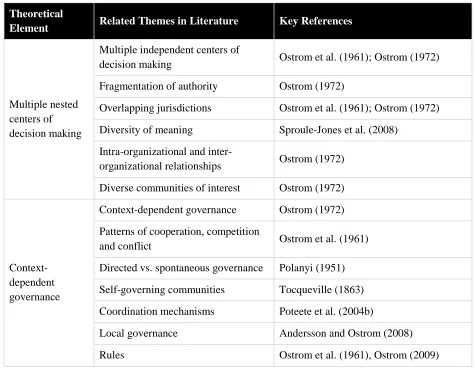
Table 5.4-1: Key Theoretical Elements in Polycentricity ... 75
Table 6.3-1 Criteria for the Researcher-Client Agreement ... 87
Table 6.3-2 Criteria for the Cyclical Process Model ... 88
Table 6.3-3 Criteria for the Principle of Theory ... 89
Table 6.3-4 Criteria for the Principle of Change through Action ... 90
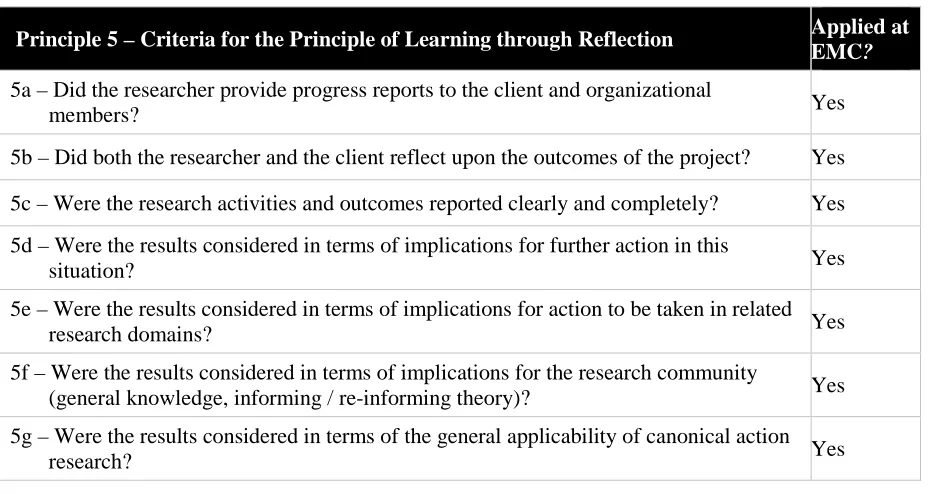
Table 6.3-5 Criteria for the Principle of Learning through Reflection ... 91
Table 7.3-1 Initial Diagnosis and Proposed Interventions at EMC ... 98
Table 8.1-1 Primary and Secondary Data Sources at EMC ... 102
Table 9.2-1 Components of IPF ... 129
Table 10.1-1 Examples of Governance Mechanisms for Transaction at EMC ... 131
Table 10.1-2 Information Processing in EMC’s Revenue Cycle ... 138
Table 10.1-3 Illustrative Technology Configurations of Revenue Cycle at EMC ... 143
Table 10.2-1 Summary of Interventions in Case 1 ... 151
Table 10.2-2 Examples of Common Registration-related Exceptions at EMC ... 152
Table 10.2-3 Summary of Interventions in Case 2 ... 157
Table 10.2-4 Summary of Interventions in Case 3 ... 162
Table 10.2-5 Summary of Intervention in Case 4 ... 167
Table 11.2-1 Summary of IPF based on Bacharach’s Framework ... 175
Singh | Dissertation | LIST OF TABLES AND FIGURES 13 List of Figures
Figure 2.1-1 Revenue Cycle in a Hospital ... 28
Figure 3.2-1 Mintzberg’s Organizational Structuring Model ... 49
Figure 3.2-2 Information Production and Consumption Scenarios ... 50
Figure 3.2-3 Organizational Information Services Model ... 52
Figure 4.1-1 Transaction Costs and Organizational Design ... 60
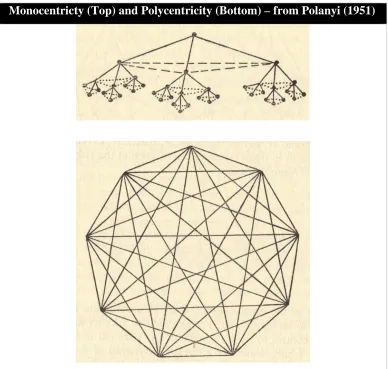
Figure 5.1-1 Monocentric and Polycentric Arrangements ... 68
Figure 6.1-1 Organization of the Collaboration at EMC ... 79
Figure 6.3-1 Dual Cycle Model of Action Research at EMC ... 85
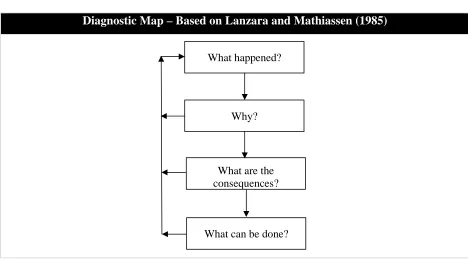
Figure 7.2-1 Basic Pattern of a Diagnostic Map ... 94
Figure 8.2-1 Data Analysis Strategy for Theory Building ... 104
Figure 9.1-1 Ordering Effects of Information... 115
Figure 9.2-1 Representation of a Transaction ... 120
Figure 9.2-2 Governance for a Transaction ... 121
Figure 9.2-3 Information Processing During a Transaction ... 123
Figure 9.2-4 Governance for Information Processing ... 124
Figure 9.2-5 Technology Configuration ... 126
Figure 9.2-6 Governance for Technology Configuration ... 128
Figure 10.1-1 Health Delivery Transaction at EMC ... 135
Figure 10.1-2 Expanded View of Health Delivery Transaction ... 136
Singh | Dissertation | ABBREVIATIONS 14
ABBREVIATIONS
List of Abbreviations (in Alphabetical Order) CEPRIN – Center for Process Innovation (at Georgia State University)
CMS – Centers for Medicare and Medicaid Services (www.cms.gov)
CPOE – Computerized Physician Order Entry
CPSI – Computer Programs and Systems Incorporated
DRG – Diagnosis Related Grouping
EMC – Pseudonym for the research site (“the hospital” or “the provider”)
EMR – Electronic Medical Record
ER – Emergency Room
ICD – International Classification of Diseases
ICU – Intensive Care Unit
IPF – Information Polycentricity Framework
IS – Information Systems
IT – Information Technology
JCAHO – Joint Commission on Accreditation of Healthcare Organizations (www.jcaho.org)
MRI – Medical Resonance Imaging
Singh | Dissertation | ABSTRACT 15
ABSTRACT
This research takes steps towards developing a new theory of organizational information
management based on the ideas that, first, information creates ordering effects in transactions
and, second, that there are multiple centers of authority in organizations. The rationale for
developing this theory is the empirical observation that hospitals have great difficulty in
managing information relating to transactions with patients. The research illustrates the detailed
workings of an initial conceptual framework based on an action research project into the revenue
cycle of a hospital. The framework facilitates a deeper understanding of how information
technology can help to transform information management practices in complex organizations,
such as hospitals. At the same time, this research adds to the literature on Polycentricity Theory
by linking its two core concepts—multiple nested centers of decision making and
context-dependent governance—with Transaction Cost Theory and information management theories to
establish a new foundation for understanding the role of information technology in
Singh | Dissertation | ►PART A: SETTING THE STAGE 16
►
PART A: SETTING THE STAGE
This section sets the stage by introducing the study and describing the business context of
interest. It covers the following chapters:
• Introduction (Chapter 1): This chapter introduces the research setting, the research approach, and the key contributions of this research.
• The Hospital Revenue Cycle (Chapter 2): This chapter discusses the revenue cycle in hospitals and describes the activities involved in each stage. It also discusses the inherent
complexity of the revenue cycle, the challenges of managing information within and
across organizational boundaries, and the role of information technology (IT). This lays
Singh | Dissertation | INTRODUCTION 17
1
INTRODUCTION
1.1
Research Domain
In recent years, most hospitals in the United States have struggled to deliver healthcare services
to patients in the face of rising costs, low or declining rates of reimbursement, and an increasing
number of uninsured and Medicaid-eligible patients (Bazzoli et al. 2005; Friedman 2005;
Woolhandler et al. 2003). As a result, many hospitals across the nation have already closed or are
on the verge of closing down, while others have substantially reduced the healthcare services
they provide (Friedman 2005). The closure of hospitals seriously affects the provision of
healthcare to underserved local communities (Fleming et al. 1995). These closures affect the
community’s economic health as well, because hospitals are typically large employers (Holmes
et al. 2006). Favorable policy changes, such as enhanced insurance coverage, included in the
recent Healthcare Reform (US Government 2010), and availability of grants to improve IT
infrastructure as part of the Economic Stimulus (US Government 2009), might relieve some cost
pressures for hospitals. However, it is imperative that they continue to make efforts to sustain
their healthcare delivery in response to downward pressure on public and private reimbursement
rates and labor shortages that exacerbate the financial pressures on hospitals.
In response to these challenges, hospitals have focused on cost-cutting measures through
improved operations (Devaraj and Kohli 2000). They have used various medical and information
technologies, such as electronic medical records (EMR), computerized physician order entry
(CPOE), nursing and pharmacy automation, picture archiving and communication (PACS),
telehealth, and remote monitoring to improve effectiveness and efficiency of healthcare delivery
(Cho et al. 2008; Davidson and Heslinga 2007; Furukawa et al. 2008; Menachemi et al. 2007;
Paré et al. 2007). These IT-enabled innovations have yielded dividends in the form of better
management of patient care and improved clinical outcomes (Bhattacherjee et al. 2007;
McCullough et al. 2010; Schoen et al. 2006), particularly in underserved communities (Custodio
and Graham 2009). However, most of the resulting transformations have occurred in the areas of
clinical decision-making or focused transactional processing (such as billing and registration)
rather than in the form of improving the overall revenue cycle. The revenue cycle includes all
activities related to the delivery of health services to patients and receiving reimbursements for
IT-Singh | Dissertation | INTRODUCTION 18 enabled revenue cycle transformation has resulted in heterogeneous IT systems and fragmented
information management. Multiple actors collect and distribute large amounts of information
within and across organizational boundaries using an assortment of IT and non-IT systems. This
results in multiple hand-offs and media breaks while information becomes error-prone,
unreliable, and disjointed (Gronau and Weber 2004; Leape et al. 2000). In addition, the revenue
cycle involves multiple independent centers of decision making, and related governance
arrangements. Consequently, information management of the revenue cycle is a major challenge
in hospitals.
This research originated from an earlier engagement in 2007 with a group of rural hospitals and
community health centers in Georgia, in which the goal was to learn how these institutions could
strengthen their position through IT-enabled collaboration. Through this engagement, it became
clear that all these healthcare organizations found it challenging to manage their revenue cycles
in ways that ensured a sustainable basis for their operation. In March 2008, this led to a more
focused involvement with one of the hospitals. Over the next two years, my dissertation
supervisor and I worked closely with key stakeholders to improve the hospital’s financial
performance using IT-enabled transformation of its revenue cycle. We made a final follow-up
visit in June 2011.
In its nature and function, this hospital is like any other non-profit hospital in US: providing
emergency room (ER) care and other health services to insured and uninsured patients alike with
flat or decreasing revenues and increasing costs of care. A key aspect of this financial duress, as
we learned during our first few visits to the hospital, was a loss of revenue1 due to avoidable
factors, such as rejection of some claims by third-party payers because of errors, non-collection
of co-payments from some patients during registration, and missed charges on some medical
services provided to patients. Further, we learned that the hospital’s billing department was
spending about 80% of its time handling exceptions created upstream in the revenue cycle. A
1
Singh | Dissertation | INTRODUCTION 19 majority of these exceptions occurred in the registration department. As the billing manager told
us, they saw the same exceptions created all the time. For example, incorrect insurance payer
information and missing pre-authorizations were among the top exceptions each month.
Apparently, these problems suggested broken information management throughout the revenue
cycle. Therefore, the research team embarked on an action research project (involving several
cycles of interventions) in collaboration with key stakeholders at the hospital with the goal of
improving information management in specific areas of the revenue cycle.
During the two-year collaboration, it became evident that the hospital had great difficulty in
managing information relating to transactions with patients. It also became clear that it was
considerably more difficult and challenging to understand, diagnose, and innovate the hospital’s
revenue cycle than we had expected. In fact, the more we became engaged in problem solving,
the more complex the issues appeared. This motivated our approach to study information
management in the revenue cycle by viewing the hospital as a complex system (Plsek 2001;
Rouse 2008; Tan et al. 2005). This “complex system” view was essential to uncovering the
hospital’s information management requirements and to understanding the basis of any effort to
improve its revenue cycle. Further, our initial data analysis suggested that there were multiple
levels of governance involved in the hospital’s revenue cycle. This added to the complexity of
decision making and information management. It also led us to consider alternative ways of
looking at the delivery of health services to a patient: an exchange-oriented perspective rather
than a task-oriented perspective. These observations, which resulted from ongoing discussions
between the two researchers, shaped the theoretical analysis of the study.
1.2
Research Perspective
The recent World Health Report, published by the World Health Organization, refers to the
healthcare sector as “extraordinarily complex” (Wim Van Lerberghe et al. 2008). Existing
literature has also viewed hospitals as complex systems (Plsek 2001; Rouse 2008; Tan et al.
2005). This view draws on Complexity Theory, which defines a complex system as having large
number of interdependent parts that together work as a whole and are interdependent with larger
Singh | Dissertation | INTRODUCTION 20 definition, hospitals are complex systems (Tan et al. 2005). As a result, decision making and
information management in hospitals involve considerable challenges.
Hospitals exhibit complexity at internal and external levels. At the internal level, a hospital
consists of various functional departments—some that are directly associated with clinical
decision-making and patient care, and others (such as registration, billing, and business office)
that support delivery of care to the patient. To provide care for a typical patient, these
departments interact with each other and with non-clinical departments within the hospital (such
as administration and finance) and exchange information that relates directly or indirectly to
patient care. At the external level, some of these departments interact with a variety of payers,
clinical providers, laboratories, billing service providers, and collection agencies. Thus, for each
patient encounter (which involves a patient arriving at the hospital to receive healthcare services,
including emergency services), the process not only includes delivering clinical care at the
hospital, but also communicating care-related financial and clinical information to several
internal and external partners. Consequently, the information management relating to even a
simple patient encounter becomes very complex. In addition, a variety of factors—such as the
super-specialized and fragmented nature of healthcare, diversity of payers, large volume of
transactions, ever-changing coding and diagnostic standards, and the need to integrate new
scientific evidence into the daily practice—make the task of managing care-related information,
and any attempts to improve its management, extremely challenging (Chaudhry et al. 2006).
Information technology can support the hospital revenue cycle by facilitating the management of
clinical, administrative, and financial information within the hospital and with external partners.
For example, an EMR system can facilitate sharing of patient-related information in various
stages of the revenue cycle, including registration, patient encounter, documentation, coding, and
billing. IT-enabled information management can also support the organization of the revenue
cycle by identifying opportunities for improvement of the overall revenue cycle. For example,
the billing clerks can use an IT application to share information related to patient accounts (such
as missing or incorrect payer information) with the clerks in the registration department. This
sharing of information across the revenue cycle can improve healthcare delivery and overall
hospital performance. However, the current health-IS literature has not focused on the role of IT
Singh | Dissertation | INTRODUCTION 21 study was to examine how IT-enabled information management can support the revenue cycle in
a hospital.
Many recent studies have used the transaction cost approach to explain how and why IT can help
organizations to reduce coordination costs and improve overall productivity (Ang and Straub
1998; Kauffman and Mohtadi 2004; Kumar and van Dissel 1996; Lacity and Willcocks 1995;
Sankaranarayanan and Sundararajan 2010). However, except for a few studies, such as Ciborra
(1981; 1993), the potential of the transaction cost approach to build IS theory has been
under-utilized. Further, no researchers have drawn on the transaction cost approach for theory building
in relation to IT-enabled information management, especially in the context of complex
organizations. Therefore, drawing on the Transaction Cost Theory developed by Coase (1937),
Williamson (1975; 1981), Ouchi (1980) and others, and building on the conceptualization of IS
from a transaction cost perspective developed by Ciborra (1981; 1993), this research investigates
information management in a complex organization—a hospital. This choice focuses attention on
the basic transactions involved in the delivery of healthcare services in a hospital.
However, our observations led us to appreciate additional limitations in extant theories on
organizational information management. First, these theories typically assume a central authority
in the organization with decision-making responsibility. Organizations, however, exist not only
as large pyramidal structures that are managed as a bureaucracy, but also as a network of small
firms, functional departments, work groups, teams, and informal peer groups (Piore and Sabel
1984). Second, decision making (and by implication, information management) also occurs at
multiple levels within an organization and across organizational boundaries. Further, these
multiple levels of decision making have heterogeneous and (often) diverging interests, and
require context-dependent governance. Extant theories on information management fail to
account for this fragmented authority with diverging interests.
To understand the multiple levels of decision making and governance requirements relating to
information management in complex organizations, such as hospitals, this research draws on
Polycentricity Theory (Ostrom 1972; Ostrom et al. 1961). Over the last 50 years, researchers
have applied Polycentricity Theory to various contexts, ranging from the political governance of
urban areas (Ostrom et al. 1961) to the management of multinational subsidiaries (Perlmutter
Singh | Dissertation | INTRODUCTION 22 function independently or constitute an inter-dependent system of relations, and it requires
context-dependent governance (Ostrom et al. 1961). A hospital is polycentric since it exchanges
clinical, financial, and administrative information with internal and external partners, it has
multiple centers of decision making (such as physicians, nurses, payers, billing specialists, and
business office managers), and it requires different governance structures and contractual
arrangements to facilitate coordination among the different decision-making units. As a result,
Polycentricity Theory offers a promising theoretical base for investigating the dynamics of
information management in a hospital. However, to our knowledge, no studies have explored the
potential of this theory to investigate information management in such complex organizational
contexts. Therefore, the second objective of this study was to examine how Polycentricity
Theory can develop our understanding of information management in complex organizations.
1.3
Research Approach
Given the complexity and changing nature of problems (for example, insurance payers’
frequently changing payment rules) relating to revenue cycle management in hospitals, no
optimal solutions can make significant improvements in a hospital’s financial performance.
However, if hospitals are to improve their financial performance, they need to have a
comprehensive approach to managing their revenue in addition to cost control initiatives. The
advantage of a polycentric approach is that it encourages experimental efforts at multiple levels
as well as the development of methods for assessing the benefits and costs of particular strategies
adopted in one organizational process (or unit) and comparing these with results obtained in
others. A strong commitment to finding ways of reducing inefficiencies in key activities related
to the revenue cycle is an important element for improving a hospital’s financial performance.
Building such a commitment, and the trust that all involved actors are also taking responsibility,
can be undertaken in an action research project involving several cycles of interventions enacted
throughout the revenue cycle and linked through information networks, monitoring, and
feedback at all levels.
Against this backdrop, we conducted action research (Baskerville and Wood-Harper 1996;
Checkland and Holwell 1998; Davison et al. 2004; Rapoport 1970; Susman and Evered 1978)
Singh | Dissertation | INTRODUCTION 23 Similar to any other rural, non-profit hospital in the United States, EMC operates in a
resource-constrained environment. It is especially vulnerable to reducing reimbursements as it serves a
large indigent and Medicaid population and has few resources (Gamm et al. 2002; Moscovice
and Stensland 2002; Ricketts 2000). EMC’s small size facilitated our research objectives because
we could easily focus on all parts of its revenue cycle. It helped too that EMC’s chief financial
officer gave us full access to investigate revenue cycle problems at the hospital.
Over a period of two years, we worked closely with key stakeholders at EMC and assisted them
in designing and implementing IT-enabled interventions to improve information management
across the entire revenue cycle—from patient registration to receiving reimbursements for
medical services provided to patients. Action research has previously proven useful for studying
complex issues related to health IT (Braa et al. 2007; Braa et al. 2004; Kohli and Kettinger
2004). We relied on collaborative practice research (Mathiassen 2002), which involves iterative
and collaborative problem solving and research. To ensure rigor, we adopted principles of
canonical action research (Davison et al. 2004) to provide practical solutions to EMC while at
the same time investigating the specific challenges related to effective design of IT-support for
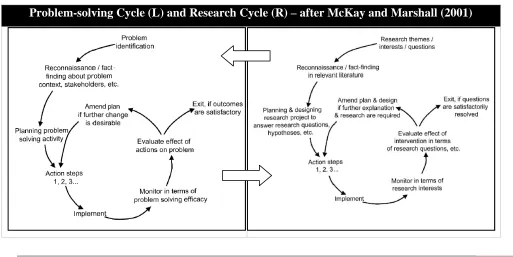
information management in the revenue cycle. Following McKay and Marshall (2001), we
engaged in multiple cycles, each focusing on problem-solving and research interests. Overall, the
research was designed as a longitudinal, qualitative field study (Miles and Huberman 1994;
Pettigrew 1990) aimed at investigating phenomena in the context of social practice in an
organization, namely, the provision of health service delivery in a hospital. The research also
reports on the institutional changes that resulted from the researchers’ interventions.
Accordingly, besides contributing to EMC’s practical concerns (that is, the problem situation
related to its revenue cycle), this research has a dual theoretical focus: on the one hand, it
contributes to the IS literature, and on the other hand, it contributes to the health-IS literature.
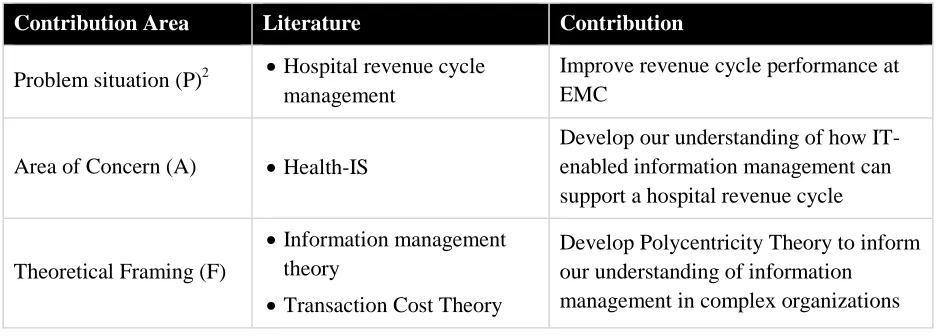
Table 1.3.1 summarizes the contributions of this research. Contributing to IS, this research
explains how IT can support information management in complex organizations. We draw on
Transaction Cost Theory to develop Polycentricity Theory as a conceptual lens to inform our
understanding of the dynamics of information management in complex organizational settings,
such as hospitals. On a broader level, we seek to explain two phenomena that are of great
Singh | Dissertation | INTRODUCTION 24 difficult to manage information in complex organizations, and 2) Why it is so challenging to
implement IT-enabled innovations in the healthcare context.
Contributing to the health-IS literature, this research investigates the challenges of information
management in a hospital and explains how IT-enabled information management can improve
revenue cycle performance. In doing so, we investigate how the polycentric nature of
information (and the organization) affects information management practices in the revenue
cycle. In addition, on a practical level, the objective of this study is to design interventions to
[image:25.612.72.540.290.458.2]improve the revenue cycle at EMC.
Table 1.3-1 Contributions of this Research
Contribution Area Literature Contribution
Problem situation (P)2 • Hospital revenue cycle management
Improve revenue cycle performance at EMC
Area of Concern (A) • Health-IS
Develop our understanding of how IT-enabled information management can support a hospital revenue cycle
Theoretical Framing (F)
• Information management theory
• Transaction Cost Theory
Develop Polycentricity Theory to inform our understanding of information
management in complex organizations
1.4
Summary of Dissertation
The following structure of the dissertation summarizes the argument:
• Part A: Setting the Stage
o Chapter 1 introduces the research setting, the research approach, and the key
contributions of this research.
o Chapter 2 discusses the revenue cycle in a hospital and describes the activities
involved in each stage. It also discusses the inherent complexity of the revenue cycle,
2 The notations P (problem situation), A (area of concern), and F (theoretical framing) are drawn from Checkland,
Singh | Dissertation | INTRODUCTION 25 the challenges of managing information within and across organizational boundaries,
and the role of IT. This lays the foundation for the first research question.
• Part B: Theoretical Foundations
o Chapter 3 discusses the nature of information in organizations and reviews extant
theories on information management. Next, it presents a critique of traditional
approaches to information management. This allows us to identify gaps in current
understandings and state the foundation for developing our theoretical contribution.
o Chapter 4 provides the conceptual foundations of the transaction cost approach to
organizational analysis and then presents related literature. Next, it presents the role
of information systems and information management in transaction cost analysis.
Subsequently, it considers the limitations of the transaction cost approach to
information systems, which leads us to explore a complementary lens to understand
information management in complex organizations.
o Chapter 5 provides the additional, new theoretical framing by reviewing the
conceptual foundations and current applications of Polycentricity Theory. The chapter
highlights the key theoretical elements of Polycentricity Theory and identifies a
research opportunity to use the theory to understand information management in
complex organizations.
• Part C: Empirical Foundations
o Chapter 6 describes the research setting and the overall research design. This chapter
also describes our application of action research methodology, collaborative practice
research, and our employment of the principles of canonical action research.
o Chapter 7 details the problem context, the problem-solving cycles we engaged in, and
the areas and sequence of the involved interventions.
o Chapter 8 presents the approach to data collection and data analysis in the research
cycle.
• Part D: Theory Development
o Chapter 9 draws on Polycentricity Theory, Transaction Cost Theory, and existing
theories of information management to develop an initial conceptualization—
Singh | Dissertation | INTRODUCTION 26 information management in complex organizations and lay the foundation for further
theoretical development. The chapter discusses the premises and components of IPF.
o Chapter 10 illustrates the detailed workings of IPF by applying its four components to
information management in the revenue cycle of a hospital, EMC. Next, it provides a
detailed contextual account of ten interventions (grouped into four cases) to improve
EMC’s revenue cycle as part of the action research study. For each case, I interpret
the findings based on IPF.
• Part E: Theory Evaluation
o Chapter 11 evaluates IPF based on the empirical results from the action research
interventions at a hospital and based on conceptual notions of theory.
o Chapter 12 discusses the study’s contributions to theory and practice, and its
Singh | Dissertation | THE HOSPITAL REVENUE CYCLE 27
2
THE HOSPITAL REVENUE CYCLE
In this chapter, I describe the context of our research: the revenue cycle in hospitals. First, I
describe a typical revenue cycle and highlight key stages and activities that are involved in
delivering health services to patients. Next, I discuss the complex nature of the revenue cycle and
identify some challenges related to managing information. Subsequently, I discuss the role of IT
in healthcare delivery in general and in the hospital revenue cycle in particular. Finally,
drawing on a discussion of how IT-enabled information management can support the revenue
cycle in a hospital, I present the first research question.
2.1
The Revenue Cycle in Hospitals
With hospitals facing stricter regulations and billing requirements from public (that is,
governmental) and commercial (including for-profit and not-for-profit) third-party payers,
revenue cycle management has become critical to hospital performance (Rauscher and Wheeler
2008). As a result, most hospitals in the United States are trying to find ways to implement
effective revenue cycle management practices, although many of them struggle in their efforts to
do so. The revenue cycle involves all activities related to delivering healthcare services to
patients and receiving payment for those services (Berger 2008; Porn and Minugh 2004;
Rauscher and Wheeler 2008). Thus, the revenue cycle begins when a patient or a physician
determines the need for a medical service and ends when the charges associated with the service
have been resolved through the application of insurance payments, contractual allowances,
write-offs, or payments by the patient (Porn and Minugh 2004, p34). While the hospital staff manages
and executes the revenue cycle, the cycle itself is an intrinsic part of a larger transaction
involving patients; a variety of payers including Medicare, Medicaid, and commercial insurers;
state and federal regulators; and other stakeholders such as consulting clinical specialists,
laboratories, blood banks, collection agencies, and other service providers. Figure 2.1-1 provides
Singh | Dissertation | THE HOSPITAL REVENUE CYCLE 28 Figure 2.1-1 Revenue Cycle in a Hospital
A Typical Hospital Revenue Cycle
Typically, the first stage of the revenue cycle is patient scheduling, during which a scheduling
coordinator receives physician’s referral information for a patient and schedules an outpatient
procedure, test, or admission into the hospital. It may also involve verifying eligibility from the
patient’s insurance company.3 The next stage is patient registration, during which a registration
clerk verifies the patient’s contact and insurance information, collects appropriate co-payment,
and registers the patient using the hospital’s EMR system. Subsequently, the patient encounter
occurs, during which a physician on medical staff examines the patient, conducts any scheduled
procedure, or admits the patient for surgical intervention or continued observation. Clinical
documentation occurs next, during which a nurse documents all the examinations, procedures,
and medical services provided to the patient. In the subsequent stage, medical charge coding, a
coding specialist receives the documented procedures from the nurse and creates standards-based
3
In some hospitals, a scheduling coordinator conducts the insurance eligibility verification; in other hospitals, the registration staff conducts the verification.
Reimbursement by patient / payers
Patient leaves the
hospital 8. Revenue
Recovery
3. Patient encounter 1. Patient
scheduling
7. Payment Posting
6. Billing
5. Medical charge coding
2. Patient registration
4. Clinical documentation
Patient enters the
hospital
Singh | Dissertation | THE HOSPITAL REVENUE CYCLE 29 codes according to appropriate diagnosis-related grouping (referred to as DRGs). During the
billing stage, a billing clerk receives the coded charges, generates claims, and sends the claims to
the patient or to third-party payers such as Medicare, Medicaid, and commercial insurance
companies (including for-profit and not-for-profit), as appropriate. During payment posting, the
business office receives all payments from the individual and the third-party payers and posts
relevant information to the patient’s account. During the revenue recovery stage, a clerk in the
business office follows up with patients (or their insurance providers) for late or denied
reimbursements.
Each of these stages4 involves several activities performed by one or more individuals in
different functional departments within the hospital. However, the same department may handle
more than one activity (for example, a hospital’s business office may handle payment posting
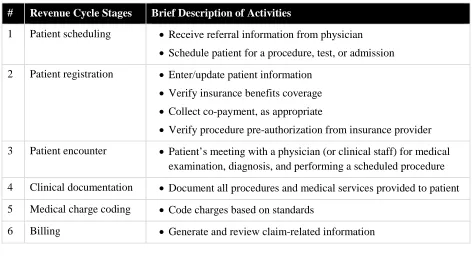
and account recovery). Table 2.1-1 shows the major stages in the revenue cycle, and examples of
[image:30.612.70.542.392.648.2]specific activities involved. A brief description of these activities follows.
Table 2.1-1 Stages and Activities in a Typical Revenue Cycle
# Revenue Cycle Stages Brief Description of Activities
1 Patient scheduling • Receive referral information from physician
• Schedule patient for a procedure, test, or admission
2 Patient registration • Enter/update patient information
• Verify insurance benefits coverage
• Collect co-payment, as appropriate
• Verify procedure pre-authorization from insurance provider
3 Patient encounter • Patient’s meeting with a physician (or clinical staff) for medical examination, diagnosis, and performing a scheduled procedure
4 Clinical documentation • Document all procedures and medical services provided to patient
5 Medical charge coding • Code charges based on standards
6 Billing • Generate and review claim-related information
4 The exchanges, and flow of the associated information, occur not only within the revenue cycle, but also with
Singh | Dissertation | THE HOSPITAL REVENUE CYCLE 30
• Submit claims to appropriate payers
• Resubmit denied claims after modifications
7 Payment posting • Manually or automatically post claims to patient account
8 Revenue recovery • Follow-up with payers
• Negotiate discounts
• Arrange for debt collection
• Write-offs
2.1.1 Patient Scheduling
The first stage in the revenue cycle is patient scheduling.5 Typically, a scheduling clerk receives
referral information from a physician, contacts the patient, and schedules an outpatient procedure
or admission into the hospital. Some hospitals have centralized scheduling in which a dedicated
department handles the scheduling responsibilities for all patients, while other hospitals have
distributed scheduling in which individual clinical departments handle scheduling for their
patients (for example, an X-Ray laboratory that schedules patients independently). Scheduling
may also include verifying insurance eligibility (that is, checking if a pre-authorization approval
or medical necessity certification from payers is available). Some insurance payers require the
eligibility verification before conducting particular procedures, and in its absence, the payer may
refuse payment.
2.1.2 Patient Registration
Patient registration forms the basis of interaction with patients, irrespective of whether the
patient comes for admission (for example, to deliver a baby) or for an outpatient procedure (such
as a blood test or a CT-Scan). Upon arrival at the hospital, the patient meets a registration clerk
who collects key demographic information, including name, social security number, and
insurance benefits coverage. If a patient’s record already exists in the hospital’s EMR system
(because of a prior visit), the clerk verifies and updates the information. This information serves
as foundation for payment of services. During this interaction with the patient, the registration
clerk also collects any co-payment as determined by the patient’s insurance coverage, and enters
5
Singh | Dissertation | THE HOSPITAL REVENUE CYCLE 31 this point-of-service collection information into the EMR system. The clerk also verifies that any
pre-authorizations6 (if required by an insurance payer) are available before accepting the patient.
Upon completion of registration activities, the clerk allocates a patient account number and a
patient tag that are unique to that visit. The hospital staff uses the patient account number7 in
subsequent stages of the revenue cycle, including patient encounter, documentation, coding, and
billing.
2.1.3 Patient Encounter
Once a patient has obtained the necessary pre-authorization approvals, the registration staff
completes registration-related formalities and releases the patient to the clinical staff. The
clinical staff then begins preparations to provide medical services to the patient. An outpatient
receives the scheduled procedure (for example, an X-Ray, a CT-Scan, or a blood test) and can
typically go home after a brief observation period. In case of an inpatient, a nurse transfers the
patient to a private room or a general ward for treatment and observation. If needed, the inpatient
may receive appropriate clinical interventions (for example, a knee surgery). Following
physicians’ orders, the nursing staff transfers critical patients to an intensive care unit (ICU) and
relatively stable patients to an observation ward. Once the patient recovers sufficiently, the
hospital discharges the patient to home or community setting.
2.1.4 Clinical Documentation
Clinical documentation includes a physician’s orders on primary diagnosis, a physician’s notes
about any associated diagnosis, nurses’ notes on procedures and treatment, and any other
material relevant to billing for the medical services provided to the patient. Accurate and timely
clinical documentation is critical for revenue cycle management. It ensures that all medical
services (and materials) provided to the patient produce payable claims. Often there are
procedures-to-charges gaps. For example, while the nurse responsible for clinical documentation
6 If a pre-authorization approval or medical necessity certification is required by the payer but not yet received by
the hospital, the registration clerk may ask the patient to wait until it becomes available or sign an agreement to pay personally in case the insurance denies payment for the medical services.
7
A patient may have multiple account numbers, but each visit refers to only one patient account number.However,
Singh | Dissertation | THE HOSPITAL REVENUE CYCLE 32 includes an X-Ray (such as, for a broken bone), the application of a plaster cast may not be
included in the list of services provided. This would ultimately result in a missed charge and loss
of revenue to the hospital. If a nurse identifies such cases quickly, she may amend the clinical
documentation. In addition, the physician may fail to provide accurate diagnosis-related
information (for example, ordering tests for diabetes without mentioning the reason) or to
document such information in a timely manner.
2.1.5 Medical Charge Coding
The coding specialist (coder) typically receives the physicians’ orders related to diagnosis and
the nurses’ notes on procedures and treatment within 24 to 48 hours after patient discharge.
These clinical documents could be hand-written, transcribed and printed, or available digitally in
real-time in hospitals that have implemented CPOE. The coder reviews the documentation to
identify the elements required for accurate medical coding8 by using classification standards9
approved by the Health Insurance Portability and Accountability Act of 1996 (HIPAA). In case
of missed charges (for example, a patient gets an X-Ray for a broken bone, but the charge for
application of plaster cast or wound dressing may be missing), the coder coordinates with the
physician or nursing staff to clarify. Typically, there is a lag of three to five days (after the
patient discharge) before the coders begin processing charges for a particular patient account.
Late or incomplete reporting of clinical documentation and errors in coding (for example,
applying the wrong code for a procedure) are the most common issues. If these errors remain
uncorrected, the hospital cannot claim reimbursement from the insurance payers.
2.1.6 Billing
After all charges for any service or procedure provided to a patient are coded, a billing specialist
collects all patient accounts that are ready for billing, generates claims, and reviews them. In case
8 According to American Health Information Management Association (AHIMA), medical coding is the
“transformation of narrative descriptions of diseases, injuries, and healthcare procedures into numeric or alphanumeric designations (i.e., code numbers). The code numbers are detailed in order to accurately describe the diagnoses (i.e., what is wrong with the patient) and the procedures performed to test or correct these diagnoses.” [http://www.ahima.org/coding/]
Singh | Dissertation | THE HOSPITAL REVENUE CYCLE 33 of any edits10 (for example, missing payer information for a particular patient account), the
billing specialist contacts the relevant department (in this example, registration) to seek
additional information. The claims are typically bundled together and submitted to the patient’s
payer. For self-pay patients, the billing occurs separately—in-house in the billing department or
outsourced to an external provider. The billing department also processes denied claims, often
requesting reconsideration from the payer with additional information from the physicians,
coders, or registration staff.
2.1.7 Payment Posting
Payment posting involves receiving payment for all claims from various payers. It can occur
through an electronic process (as in case of Medicare) or manually. A business office clerk
updates patient accounts to reflect all received payments and contractual allowances (that is,
pre-agreed discounts negotiated between the hospital and a payer). Payers may deny some claims for
reasons such as late submission, insufficient documentation, and coding or diagnosis errors. The
billing department typically reviews such cases, follows up with other departments to provide
missing or additional documentation, and resubmits claims, if allowed by a particular payer.
2.1.8 Revenue Recovery
Different payers have different rules for reimbursement. For example, Medicare reimburses any
“clean” claim (that is, with no errors) usually within two weeks, while other insurers may take
between two weeks and two months to send reimbursement checks (or electronic payments) to
the hospital. Inaccuracies in claims lead to delayed payments. Follow-up for self-pay accounts
typically occur on a monthly cycle. A business office clerk may negotiate discounts or easier
payment terms with some patients to encourage them to pay the balance amount. Any account
becomes delinquent if it remains unpaid for a specified period (typically over 120 days), and may
then be referred to an external collection agency for balance recovery. Finally, after exhausting
all attempts of revenue recovery, the business office may write off some account balances.
10 An edit is the outcome of an automated check that informs a billing specialist of an error in the claim. Vendors
Singh | Dissertation | THE HOSPITAL REVENUE CYCLE 34
2.2
The Complexity of the Revenue Cycle
A recent World Health Report, published by the World Health Organization, refers to the
healthcare sector as “extraordinarily complex” (Wim Van Lerberghe et al. 2008). Drucker (2002)
described hospitals as “altogether the most complex organization ever devised.” Existing
literature has also viewed hospitals as complex systems (Plsek 2001; Rouse 2008; Tan et al.
2005). This view draws on Complexity Theory, which defines a complex system as having a
large number of interdependent parts that together work as a whole and are interdependent with
larger organizational structures or external environments (Simon 1981; Thompson 1967).
Following these definitions, hospitals are complex systems as they have many interdependent
and interacting parts that are also interdependent with the external environment (Tan et al. 2005).
The discussion of challenges in various stages of the revenue cycle in the previous section attests
to this complexity.
However, hospitals are unique in their complexity. Explaining this uniqueness, Malvey (1981,
p17) reflected,
A hospital has few characteristics which find exact parallels in business firms. The structure itself, the multiplicity of professional viewpoints, the effects of status [for example, physicians vs. other hospital staff] are not easily accommodated within profit-seeking firms. Even the number of actors capable of influencing policy would create chaos in business firms.
Hospitals face a constant struggle to manage restrictions and demands placed on them (Malvey
1981, p22). The restrictions arise from federal and state agencies, professional organizations, and
public groups that limit activities of hospitals through reimbursement policies, regulations,
licensures, accreditations, and reporting requirements. The demands arise from the increasing
need for medical services by the local community, which stresses the scarce resources of
hospitals (Malvey 1981, p23). Moreover, the physicians and nurses concern themselves with
treating patients, not primarily with the cost11 of treatment, leaving the problem of managing
efficiency, cost containment, and service volume to the financial administrators (Malvey 1981,
11
Singh | Dissertation | THE HOSPITAL REVENUE CYCLE 35 p23). In addition, the super-specialized and fragmented nature of healthcare, large volume of
transactions, and the need to integrate new scientific evidence into practice further complicate
information management (Chaudhry et al. 2006). These unique characteristics of the healthcare
sector place a heavy load on financial and clinical management—thus, in effect, the entire
revenue cycle—in hospitals.
Further, a typical revenue cycle exhibits multiple levels of complexity—both internal and
external. At the internal level, the revenue cycle involves coordination between various
functional departments, some that are directly associated with clinical decision making and
patient care, and others (such as registration, billing, documentation, coding, and business office)
that support delivery of care to the patient. To provide care for a typical patient, these internal
departments interact with each other and with other organizational departments such as
administration and finance. These departments exchange complex information that relates,
directly or indirectly, to patient care. For example, an ER receives trauma or accident patients,
stabilizes them and, depending on the patient’s condition, discharges them, admits them to an
inpatients facility, or transfers them to a larger hospital with improved critical-care facilities.
However, a typical ER encounter involves not only the ER physicians and nurses, but also a
large team of clinical, technical, and administrative personnel who support delivery of care to
each patient. As a result, the related decision-making becomes highly complex.
At the external level, some functional departments interact with a variety of payers, clinical
providers, laboratories, billing service providers, and collection agencies. For example, the
billing department in the hospital that we studied interacts with a variety of payers, among them
about a dozen different insurance payers, including Medicare, Medicaid, the Georgia state
government, the Georgia prisons department, and the department of Veterans Affairs. For each
payer, a separate contract prescribes payments for each documented charge item for a patient.
Some services, such as billing and initial follow-up for self-paying patients and laboratory have
been outsourced. Thus, for each patient encounter, the process not only involves delivering
clinical care at the hospital, but also communicating care-related information to several internal
and external partners. This inherent complexity of healthcare delivery may explain why many
Singh | Dissertation | THE HOSPITAL REVENUE CYCLE 36
2.3
Managing Information in the Revenue Cycle
A hospital revenue cycle is highly information intensive (Anderson 1997) and involves
managing large amounts of clinical and administrative information. As discussed earlier, the
revenue cycle involves collaboration across administrative and clinical boundaries (Kohli and
Kettinger 2004), which leads to increasing levels of information requirements. Healthcare
delivery for any patient requires information exchanges between clinical departments (such as
radiology, physicians, and nursing), administrative departments (such as registration, billing,and
business office), and with a variety of payers, clinical providers, laboratories, billing service
providers, and collection agencies. Thus, managing exchanges of such a large amount of clinical
and financial information relating to even a simple patient encounter becomes demanding, and
any attempt to improve related practices is extremely challenging.
The challenge of managing information in hospitals becomes even greater because hospitals
typically utilize IT to a varying degree to fulfill the clinical, administrative, and financial
activities associated with care delivery. This heterogeneous IT enablement—including an
assortment of IT and non-IT systems across the revenue cycle—results in fragmented
information as various actors collect and distribute information using different systems. These
assorted IT systems often have different architectures, including user interfaces, application
servers, and back-end databases. These IT systems may also connect to multiple legacy operating
systems, applications, and databases. Over time, the heterogeneity and complexity of these
systems increases as the IT departments try to extend functionality by customizing or by
integrating with other systems.
In our investigation of the revenue cycle at EMC, we identified two types of information
management: one that supported individual revenue cycle activities and another that supported
the organization of the revenue cycle. The first type focused on the content of the revenue cycle
activities, matched information availability with requirement for a particular activity, and thus
directly supported the revenue cycle. For example, billing involved collecting medical charges
for a patient after those charges have been coded using standards-based procedure and
diagnosis-related grouping as prescribed by Medicare, matching charge information to that patient’s