Open Access
Research article
Complementary and conventional medicine: a concept map
Carol M Baldwin*
1,2, Kendall Kroesen
1, William M Trochim
3and
Iris R Bell
1,4Address: 1Southern Arizona VA Health Care System, Research Service Line, Tucson, AZ, USA, 2University of Arizona Departments of Medicine and
Psychology, Arizona Respiratory Center, Mel and Enid Zuckerman Arizona College of Public Health, Tucson, AZ, USA, 3Cornell University, Policy
Analysis and Management, Ithaca, NY, USA and 4University of Arizona Departments of Medicine, Psychiatry, Psychology, Surgery, Program in
Integrative Medicine, Mel and Enid Zuckerman Arizona College of Public Health, Tucson, AZ, USA
Email: Carol M Baldwin* - [email protected]; Kendall Kroesen - [email protected]; William M Trochim - [email protected]; Iris R Bell - [email protected]
* Corresponding author
Abstract
Background: Despite the substantive literature from survey research that has accumulated on complementary and alternative medicine (CAM) in the United States and elsewhere, very little research has been done to assess conceptual domains that CAM and conventional providers would emphasize in CAM survey studies. The objective of this study is to describe and interpret the results of concept mapping with conventional and CAM practitioners from a variety of backgrounds on the topic of CAM.
Methods: Concept mapping, including free sorts, ratings, and multidimensional scaling was used to organize conceptual domains relevant to CAM into a visual "cluster map." The panel consisted of CAM providers, conventional providers, and university faculty, and was convened to help formulate conceptual domains to guide the development of a CAM survey for use with United States military veterans.
Results: Eight conceptual clusters were identified: 1) Self-assessment, Self-care, and Quality of Life; 2) Health Status, Health Behaviors; 3) Self-assessment of Health; 4) Practical/Economic/ Environmental Concerns; 5) Needs Assessment; 6) CAM vs. Conventional Medicine; 7) Knowledge of CAM; and 8) Experience with CAM. The clusters suggest panelists saw interactions between CAM and conventional medicine as a critical component of the current medical landscape.
Conclusions: Concept mapping provided insight into how CAM and conventional providers view the domain of health care, and was shown to be a useful tool in the formulation of CAM-related conceptual domains.
Background
There is an increasing amount of research on the use of complementary and alternative medicine (CAM) in the United States [1-7], Canada [8-10], and Europe [11-14]. In general, these studies employ survey research approaches to determine aspects of CAM use, such as
prevalence rates, costs, patterns of and trends in use [2,4,6,9,10,14], reasons for CAM use [1,7], social-psycho-logical factors and attitudes associated with CAM use [11,12], as well as comparisons of CAM users and non-users [3,5,8].
Published: 03 February 2004
BMC Complementary and Alternative Medicine 2004, 4:2
Received: 19 August 2003 Accepted: 03 February 2004
This article is available from: http://www.biomedcentral.com/1472-6882/4/2
Wootton and Sparber [15] provided an extensive overview of trends and demographic groups relevant to CAM survey research. In addition to several of the above-cited studies, information on CAM use in special groups, such as chil-dren and ethnic minorities, have also been described [15]. Despite the substantive literature from survey research that has accumulated on CAM in the United States and elsewhere, however, very little research has been done on conventional and CAM providers' perspectives on CAM, or the inclusion of these perspectives in the development of CAM surveys.
Development of survey questionnaires is often based on data gathered through inductive qualitative methods [16-19], and involves such procedures as items and scoring [20,21]. One qualitative approach for use in the develop-ment of surveys is that of focus groups [19]. Focus groups can elucidate points of view, provide unique insights regarding preferences for health care, quality of care, or other factors in the delivery of health care. For example, twelve focus groups were conducted with veterans and their significant others, who used or were interested in CAM, during Phase 1 of the current study. Thematic anal-ysis of the focus groups oriented researchers to veterans' understanding of the relationship between CAM and con-ventional medicine [7]. Phase 2 of the study consists of the concept mapping process and interpretation pre-sented in this paper. Phase 3 will result in the construction of a CAM survey instrument containing items from the focus groups and concept mapping process that will be validated for use with United States military veterans.
Concept mapping, another qualitative method, gathers input from panel members in the form of list sorting and rating tasks, which produces a multidimensional scaling and cluster analysis that is then interpreted by the group [22-24]. The resulting map shows individual statements in two-dimensional (x, y) space with similar statements located nearer each other, and displays the ways in which statements are grouped into clusters that partition the space on the map. Participants are led through a struc-tured interpretation session to assist them in understand-ing the maps, and labelunderstand-ing them in a meanunderstand-ingful way.
Traditionally, the concept mapping process has been uti-lized by businesses, organizations, and research teams to build, from the ground up, a visual image, or map, of important concepts that can be used to give direction to an undertaking [23,25,26]. Concept mapping is seeing more widespread use, and has been applied to diverse aspects of health care, such as assessing chronic low back pain sufferers [27], quality of life among persons with chronic mental health problems [28], and the health care preferences of elderly patients [29]. The intent of this study is to apply the concept mapping process in
address-ing substantive issues in CAM from conventional and CAM provider perspectives, and provide an analysis and interpretation of the data produced. The conceptual domains derived from the map will be used to provide direction for the construction of a CAM survey to be used with U.S. military veterans.
Methods
Panelists
Panelists for the concept mapping process were chosen based on the need to sample a wide variety of back-grounds rather than demographics. Three groups were represented: SAVAHCS conventional providers (n = 11); community-based CAM providers (n = 11); and Univer-sity of Arizona faculty with expertise in CAM and/or CAM research (n = 4). Panelists reflected expertise from a broad variety of health care backgrounds. The study was based at the Southern Arizona Veterans Affairs Health Care Service (SAVAHCS) in Tucson, Arizona, and was reviewed and approved by the SAVAHCS Research and Development Committee, and the University of Arizona Institutional Review Board. Subjects gave written informed consent for their participation.
SAVAHCS panelists
An effort was made to provide for diversity within as well as between the groups of panelists. Panelists recruited from SAVAHCS providers came from a range of sub-specialties, including geriatrics, hospice, pharmacy, clinical dietetics, and internal medicine. A variety of qualifications were represented, including 3 physicians (MD), 4 nurse practi-tioners (NP), 1 registered nurse (RN), 1 registered phar-macist (RPh), 1 registered dietitian (RD), and 1 doctor of pharmacy (PharmD). A few of the SAVAHCS providers were familiar with some CAM modalities, such as nutri-tional and herbal supplements, reflexology, and guided imagery. In general, however, the SAVAHCS providers practiced conventional medicine within a conventional medical institution. All of the providers had worked at the SAVAHCS for at least three years.
CAM panelists
each one had at least five years of experience in their area(s) of expertise.
University faculty panelists
Panelists recruited from University of Arizona faculty con-sisted of a professor of Pharmacy Sciences (Ph.D) versed in pharmaco-economics, an RN/MSN in the College of Nursing with a Ph.D. in anthropology, a psychologist (Ph.D.) with expertise in energy medicine, and an admin-istrator for the Program in Integrative Medicine (MD).
Concept mapping process
Trochim [30] first described the concept mapping process used in this study. Concept mapping consists of three-stages: brainstorming; rating and card sorting; and inter-pretation of the map. While all three stages may be done in person, in this study the first two stages were done by mail due to participants' busy schedules. All concept map-ping analyses were accomplished using The Concept Sys-tem© (Version 1.75, Concept Systems Incorporated,
Ithaca, NY).
Brainstorming
Participants were instructed to give as many endings as possible to the "brainstorming" prompt, "One thing we should ask in a survey of SAVAHCS patients regarding complementary and alternative medicine is…". This phrasing functioned to elicit well-defined and grammati-cally consistent answers. Ample blank lines were provided for responses. Twenty-four of 26 participants returned this portion of the exercise, with responses numbering from 5 to 31 (average 15.2). The two participants who did not return this part of the exercise were from the academic group. Duplicate statements were eliminated and the final master list consisted of 121 statements.
During the brainstorming component of concept map-ping, steps were taken to ensure validity and reliability of data [19]. In order to assure saturation of issues among the brainstormed ideas, additional responses to the prompt were generated based on concerns expressed by focus group members in Phase 1 of this study. Two of the authors (CMB, KWK), who co-facilitated the focus groups, acted as proxies for focus group members. The statements generated from focus group transcripts were checked for redundancy with the practitioner-generated list. After eliminating redundant statements between focus group and provider lists, a total of 44 new statements were com-bined with the practitioner-generated statements for a total of 165 statements.
Rating and card sorting
Stage 2 of the concept mapping process allowed the panel to establish collectively a smaller number of more inclu-sive categories for the statements that were generated. To
do this, panel members were asked to rate the importance of each statement from the master list, then perform a "card sort" to provide "similarity data." Importance rat-ings used a five-point Likert scale (1 = "minimally impor-tant" to 5 = "extremely imporimpor-tant"). If asked to define "important," panelists were told that it was the weight the research team should give that statement when consider-ing what questions to ask on a CAM survey questionnaire. Twenty-five of 26 panelists returned the rating exercise (one SAVAHCS panelist did not return the rating sheet).
Each of the 165 statements was also printed on 2.25-inch × 4.25-inch cards. Panelists were asked to perform a card sort, sorting the statements into categories. Panelists were instructed to organize the cards into as many categories as they wanted (more than one and less than the total number of the cards), using any criteria they wished. Pan-elists then wrote a descriptive label for each pile. Twenty-five of 26 panelists returned the card sort task (one Uni-versity of Arizona panelist did not return the card sort). These activities provided the research team with some insights into the way CAM and conventional providers think about CAM.
Data analysis
The initial analysis of the Concept System© software
manipulation of this data was a similarity matrix that con-tained numerical representations of how similar the group judged any two statements to be. Briefly, a similar-ity matrix was constructed for each participant with 165 rows and 165 columns, one for each brainstorming state-ment. For any two statements, if that participant sorted them in separate piles, the cell for those two statements contained a "0." If sorted in the same pile, that cell con-tained a "1." Next it calculated a "group similarity table." This also has as many rows and columns as there are state-ments, and it contained a summation of the similarity data for all participants. In this table, the higher the number in a cell, the more times participants sorted together the two cards corresponding to that cell, thus the more similar the group as a whole judged those two statements.
of fit of the two-dimensional configuration to the original similarity matrix is called the Stress Value. A lower stress value indicates a better fit. In a study of the reliability of concept mapping [31], the average Stress Value across 33 projects was .285 with a range from .155 to .352. The Stress Value in this analysis was .268.
Statements often form clusters on the map that can be taken to have a common theme. Identification of these themes can help to categorize priorities – in this case, to arrive at broad categories of questions that should be included in the development of a CAM survey of military veterans. However, on a point map, it is difficult for par-ticipants to separate clusters visually. Therefore, a hierar-chical cluster analysis was used to partition the 165 statements displayed in Figure 1. The result is a cluster map on which each statement is within a polygonal clus-ter of similar statements. The software calculates these
clusters by considering each statement to be its own clus-ter. It then combines "nearby" clusters until the number of clusters remaining reaches a preset (but adjustable) number. Calculations are based on the X-Y coordinate data from the MDS rather than from the original similar-ity matrix. Figure 2 shows clusters with more "layers" con-taining statements that, on average, had been judged more "important" via the statement rating exercise. This is the "concept map" that was interpreted and labeled by the panelists.
Interpretation of the cluster map
The final stage of the concept mapping process was a panel meeting for the purpose of interpreting the cluster map. The meeting was held at a hotel conference room in Tucson, AZ and lasted approximately three hours. Twenty-two of the 26 panelists attended the meeting (9 of 11 SAVAHCS providers, 9 of 11 CAM providers, and the 4 Point map derived from the concept mapping process
Figure 1
University of Arizona faculty). Panelist attendees were provided with dinner and reimbursed $200 for their time. During dinner, panelists heard a short presentation on the rationale and method for the study. After dinner, panelists were presented with the cluster-rating map (Figure 2). Their task was to interpret and label the map clusters, and to discuss their meaning and importance with the research team. To facilitate this, the concept map was projected onto a screen using a computer image projector. The Con-cept System software allowed for the on-screen identifica-tion of the statement that corresponded to any particular point on the map. It also allowed panelists to see the card pile labels they had used that best corresponded with the clusters on the map.
Panel members were also given a printout of the state-ments contained in each cluster, with those statestate-ments
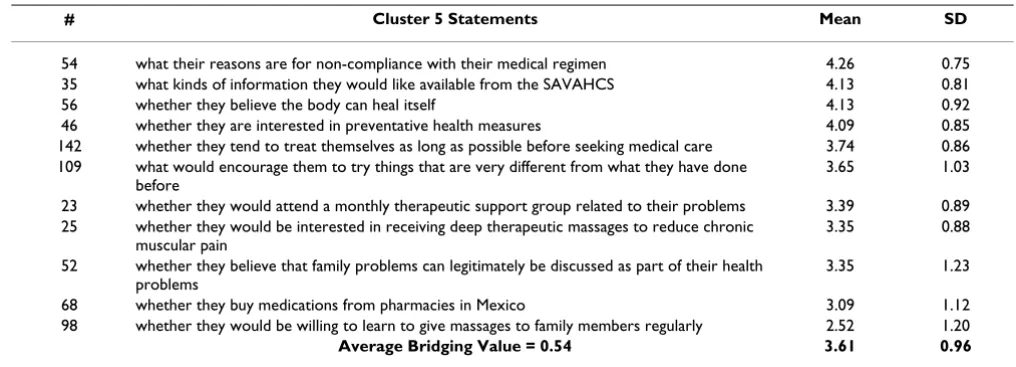
listed first that were most representative of that cluster. Statements were ordered by "bridging value," which is an expression of how often statements were sorted together with statements in other clusters. Statements with lower bridging values were less often sorted with statements from outside that cluster; therefore, they are assumed to be more central to the interpretation of their own cluster.
Results
Number of clusters, cluster labels, and bridging values
The first activity was to determine the final number of clusters. The default number of clusters was eight. The panel tried reducing and enlarging the number of clusters. Reducing the number seemed to lump too many distinct concepts together, while increasing the number seemed to split clusters that seemed reasonably coherent. Panel con-sensus remained at eight clusters. Members of this large Cluster rating map derived from the concept mapping process
Figure 2
and diverse a panel, however, may have thought that reaching consensus at eight clusters might be faster than doing so for nine or more. After some debate, the clusters were assigned the following eight labels: 1) Self-assess-ment, Self-care, and Quality of Life; 2) Health Status, Health Behaviors; 3) Self-assessment of Health; 4) Practi-cal/ Economic/Environmental Concerns; 5) Needs Assess-ment; 6) CAM vs. Conventional Medicine; 7) Knowledge of CAM; and 8) Experience with CAM.
"Bridging values," ranging from 0 to 1, tell how often a statement was sorted with others that are close to or fur-ther away from it on the map. Lower bridging values indi-cate a "tighter" relationship with other statements in the cluster. Clusters 1,2,3,6,7, and 8 had low bridging values (.12–.24). Statements in Clusters 4 and 5 had high bridg-ing values (.60 and .54 respectively), suggestbridg-ing less agree-ment in terms of the way stateagree-ments were sorted.
Description of clusters
Cluster 1: Self-assessment, self-care, and quality of life
Like all statements in the top portion of the map, Cluster 1 asked for information or attitudes that SAVAHCS patients could give about themselves (Table 1). These statements focused on patients' qualitative appraisals of mood, stress, and the role spirituality and relationships played in their lives. After lengthy discussion, the panel
could not come to an agreement on a single label. Pan-elists settled on the composite "Self-assessment, Self-care, and Quality of life."
Conventional providers indicated that statements in this cluster referred to patient self-care or self-assessment, making a distinction between provider versus patient responsibility. Conventional providers seemed to see the areas covered in Cluster 1 as the pervue of patient respon-sibility (ergo, "self-care"). Alternatively, while the empha-sis was on self-assessment, CAM providers seem to emphasize what was being evaluated (a holistic set of quality of life issues) rather than who was responsible for the evaluation. The importance ratings averaged across statements in Cluster 1 suggested that panel members rated this cluster as more important than some other clusters.
Cluster 2: Health status, health behaviors
[image:6.612.56.553.109.376.2]The label for Cluster 2 resulted less from disagreement among group members than from the inability to find a single phrase that would encompass both a status ques-tions, such as "whether they have had a recent blood test" (114) and a behavior question, such as "how much tobacco they use" (153). Similar to Cluster 1, the state-ments in Cluster 2 asked for information that patients could assess about themselves (Table 2). In contrast to Table 1: Cluster 1 "Self-assessment, self care, and quality of life" statements in descending order of average importance (n = 23 respondents).
# Cluster 1 Statements Mean SD
82 whether they believe they have some control over their health 4.22 1.09 65 what is most important to them in improving their quality of life 4.09 1.08
29 what they think would help them feel better 4.09 1.00
75 what prevents them from doing the things they think would improve their quality of life right now 4.04 1.26 11 whether personal religion or spirituality (excluding spiritual healers) plays a part in healing for them 4.04 0.77 136 how motivated they are to make changes in their lifestyle or outlook on life 3.96 1.26 158 how much time they are willing to spend to improve their quality of life or change their lifestyle 3.91 1.16 160 what five goals they would set for themselves if they wished to attain better health and well-being 3.91 1.35
128 whether they meditate/pray 3.87 1.01
102 how would they rate their level of enthusiasm for living or enjoyment of life 3.87 1.06
26 what they care about most in their life 3.78 1.20
95 whether, and how, they believe military service has impacted their health or well-being 3.78 1.38
20 how would they rate their level of stress 3.61 0.94
111 what their emotional state is (e.g. worried, happy, sad, anxious, depressed) 3.52 1.08
1 whether stress management is important to them 3.52 1.08
113 how they cope with stress, worries, and concerns 3.48 1.08
108 how many people in their lives do they discuss their worries, concerns, problems or challenges with 3.48 1.31 8 whether they would be willing to practice a stress management technique such as relaxation,
biofeedback or meditation for 15–20 minutes a day
3.43 0.73
12 what relaxation techniques they practice 3.35 0.93
132 how often do they talk to people about their worries, concerns, problems or challenges 3.22 0.90
125 whether they love their jobs 3.00 1.41
Cluster 1, Cluster 2 seemed to focus on more quantitative or factual appraisals of risk factors, medical conditions, demography, preventive factors, medications, adherence, and some markers of health. Several statements also referred to topics some participants believed patients should know about themselves, including bowel regular-ity and the results of medical evaluations such as imaging, blood type, and other blood tests. Some participants asked about risky behaviors (tobacco and alcohol use) while others asked about preventive measures that might reduce risk (exercise, good nutrition).
As with most of the other clusters, Cluster 2 contained statements regarding knowledge and behavior (Clusters 7 and 8 were exceptions). In its concern with health (over institutional, or other personal concerns), Cluster 2 shared a general affinity with the entire right side of the map. Statements in Clusters 2, 3, 7, and 8 tended to refer to actual health conditions, health care and, in particular, decisions about using CAM for medical conditions.
Cluster 3: Self-assessment of health
Cluster 3 contained a relatively small number of state-ments and showed a low bridging value, suggesting it was a tight cluster with a potentially concise interpretation. The panel labeled Cluster 3 "Self-assessment of Health." Like adjacent clusters at the top of the map, it contained statements that elicited personal information about patients (Table 3). While Cluster 1 dealt with more gen-eral characteristics of patients' lives, such as goals or stress,
and Cluster 2 focused on positive health behaviors and negative risk factors, Cluster 3 statements referred to knowledge about patients' actual mental and physical health status.
As with other items positioned toward the right side of the map, Cluster 3 statements assessed actual health related issues. Statements addressed subjective health ratings, mood, self-care, and coping skills. Like Cluster 2, behavior and knowledge-related questions were represented. Clus-ter 3 statements related to care for health conditions whereas behavior-related statements in Cluster 2 centered on risk and risk-diminishment.
Cluster 4: Practical/economic/environmental concerns
[image:7.612.63.556.100.338.2]Cluster 4 had a high bridging value, suggesting that the statements may cover a broader and more heterogeneous range of conceptual territory. Panelists labeled Cluster 4 "Practical/ Economic/Environmental Concerns," reflect-ing this broad range of statements (Table 4). Cluster 4 pri-marily consisted of statements regarding the health care costs (especially CAM) and experience with the SAVAHCS. One statement had to do with health insur-ance, while all other finance-related statements were spe-cifically about paying for CAM treatments. Some statements combined financing of CAM treatments and SAVAHCS-related issues. Several statements in Cluster 4 addressed satisfaction with SAVAHCS care. The "environ-mental" concern in the label came from statement 62, Table 2: Cluster 2 "Health status, health behaviors" statements in descending order of average importance (n = 23 respondents).
# Cluster 2 Statements Mean SD
99 whether they have a terminal or life-threatening condition 4.17 0.83 37 what kind and how many prescription medications they are currently taking 4.13 0.81 10 how compliant they are with taking their medications 4.04 0.88
57 what their present diagnosis is 4.04 1.19
7 general demographic questions such as age, sex, marital status, income, education 4.00 1.13 78 whether they follow a specific diet or a nutritional lifestyle, and if so which (e.g. vegetarian) 3.91 0.79
59 how much alcohol they consume 3.78 1.00
50 whether they exercise regularly and, if so, what kind of exercise they do 3.78 0.95 150 the number and types of serious health complaints they have 3.70 1.22 161 whether they have any side-effects from their present medications 3.70 1.22
153 how much tobacco they use 3.57 1.12
53 how much caffeine they consume 3.57 1.08
58 whether they are seeing any health changes caused by their diet 3.39 1.20
159 whether they have any known allergies 3.30 1.52
114 whether they have had a recent blood test 2.74 1.25
118 whether they have had recent x-rays, MRI, or CT scans 2.57 1.12
76 how often they have a bowel movement 2.43 1.16
129 whether they own a juicer or blender 2.35 1.19
124 whether they know their blood type 2.00 1.04
which asked what environmental changes the SAVAHCS could make to enhance healing.
Interestingly, some statements in Cluster 4 made direct reference to CAM. The vast majority of CAM statements were located on the bottom, bottom right, and right extremes of the map (Clusters 6–8). Statements about access to CAM (e.g., how much was paid out of pocket, and whether CAM should be available through the SAVAHCS) were deemed to be distinct from CAM state-ments in Clusters 6–8, which focused on CAM modalities, CAM provider issues, and interaction between CAM and conventional care. The presence of non-contiguous, CAM-related statements in Cluster 4 suggests that panel members considered CAM access to be distinct from other CAM issues. It may suggest that both SAVAHCS and CAM providers saw CAM access as an administrative or policy issue rather than a provider issue.
Cluster 5: Needs assessment
Cluster 5 was perhaps the least definable on the map, and was simply labeled "Needs Assessment" (Table 5). In a sense, this label was a common background for many of the clusters, as well as a major goal of the resultant ques-tionnaire. The central position of Cluster 5 on the map (see Figure 2) made it subject to overlap with several other clusters. A number of statements (109, 142, 52), for exam-ple, shared the reflexive nature of the clusters at the top of the map. These statements addressed factors that would encourage veterans to try new things, whether veterans treated themselves as long as possible before seeking med-ical care, and whether they believed family problems could be discussed as part of their health care. Statement 35 was about the SAVAHCS, and was positioned near other SAVAHCS-related statements in Clusters 4, 6 and 7. Statements 25 and 98 addressed massage therapy, which
could be interpreted as similar to CAM statements in adja-cent Clusters 6–8. The practical and economic aspects of medications purchased in Mexico (Statement 68) bor-dered Cluster 4.
Cluster 6: CAM vs. conventional medicine
The most noticeable theme in Cluster 6 was the relation-ship between CAM and conventional medicine (Table 6). The vast majority of statements referencing conventional medical care as a system (independent of individual pro-vider concerns) were contained in this cluster, and several statements suggested the perceived shortcomings of con-ventional care that CAM might address. Statements referenced CAM in the context of its interaction with con-ventional care, such as whether concon-ventional doctors knew about the CAM treatments being used (5), conventional doctors' comments about CAM use (165, 107), and whether a physician provided CAM education (6).
Panelists named this cluster "CAM vs. Conventional Med-icine." There was some debate about "versus" in the title. Some conventional providers perceived the relationship as antagonistic. Some of the statements (e.g., 21, 165, 107, and 151) appeared to have antagonistic undertones. Other statements intimated tension between patients and conventional care without mentioning CAM explicitly (e.g., 149, 116, 77). However, several CAM providers suggested that Cluster 6 should reflect "integration," and that the label should have read, "CAM and Conventional Medicine."
While there were many statements about CAM in other clusters, particularly Clusters 7 and 8, it is notable that statements mentioning conventional medicine and its relationship to CAM segregated into Cluster 6. This rela-Table 3: Cluster 3 "Self-assessment of health care" statements in descending order of average importance (n = 23 respondents).
# Cluster 3 Statements Mean SD
85 how they currently take care of themselves physically, mentally, and spiritually 4.13 0.87 84 what are they doing to treat or cope with their current condition 4.04 0.98
164 how they would rate their general health 3.83 1.07
67 how much they know about their own health problems 3.83 1.07 139 how well they are able to take care of themselves 3.65 0.98
39 whether they are currently depressed 3.61 0.89
92 how they feel about their health 3.57 1.20
27 whether they are currently in psychological therapy 3.43 0.95 15 whether there was a time in their lives when their health declined seriously 3.30 1.11
34 whether they are a combat veteran 3.17 0.83
31 if they had to change their diet, what foods would be hardest to give up 3.09 1.24 119 whether they have somebody who helps take care of them at home 3.09 0.95
32 what activities they do for fun (e.g. hobbies) 2.83 1.15
[image:8.612.50.556.99.275.2]tionship seems to be a crucial topic to panelists from both medical traditions, whether they are striving to better define their differences, or hoping to find a more integra-tive approach to patient care.
Cluster 7: Knowledge of CAM
Notably, Clusters 7 and 8 together contained over 40% of the master list statements (34 and 33 statements respec-tively). These clusters contained questions about CAM, a topic of obvious importance for the development of a CAM survey. Clusters 7 and 8 were roughly divided along the knowledge vs. behavior dimension that was seen ear-lier within some of the clusters.
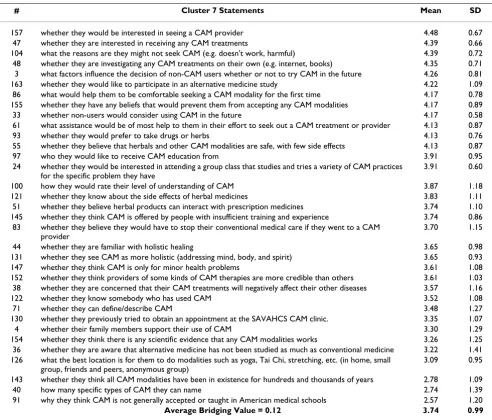
Panelists labeled Cluster 7 "Knowledge of CAM." Several statements in this cluster, particularly statements having the lowest bridging values, appeared to be asking if veter-ans were well versed in CAM (Table 7). Statements addressed general familiarity with CAM (100, 40, 71), understanding of its origins (143), and how veterans had sought out information about CAM (48, 61). There were more specific questions regarding side effects of herbal medicine (121), factors that influenced CAM use (3), interest in group CAM classes (24), and beliefs that would prevent the use of CAM (155).
There were relatively few statements about providers in Clusters 7 and 8, where most of the statements about CAM were located. Statements about providers tended to be associated with conventional care reported in Cluster 6. It may be that providers realize that many veterans' experiences with CAM circumvent providers of any kind, allowing for direct access to healing modalities, such as
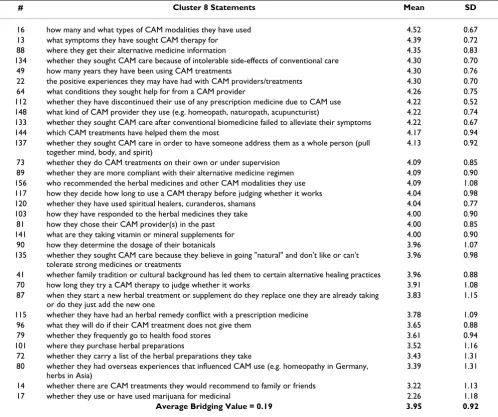
herbal remedies. The few statements referring to CAM providers in Cluster 7 dealt with credibility and training, and veterans' recruitment of CAM providers. Cluster 8 statements related to the kind of CAM provider used (148), the use of spiritualists and shamans (120), and how a CAM provider was chosen (81). The vast majority of statements in these clusters, however, did not mention providers.
Since there were both pro-CAM and anti-CAM panel members (and since panelists were the originators of most of the statements), there were statements in Cluster 7 with different "spins" regarding CAM. Some of these statements really asked more for attitudes about, rather than familiarity with, CAM. For example, statements reflected the skepticism of some conventional providers, such as scientific evidence for CAM (154), adequate train-ing and experience of CAM providers, and application of CAM to "minor" health complaints (147).
Cluster 8: Experience with CAM
[image:9.612.53.555.110.311.2]Because the statements in this cluster dealt heavily with actual CAM experience, panelists labeled cluster 8 "Expe-rience with CAM." Statements asked about types of CAM use (16), length of use (49), reasons for using CAM (134, 135), and successes with CAM (22) (Table 8). Cluster 8 also asked pragmatic questions about decisions and choices regarding CAM modalities, such as how long a CAM therapy was used before judging its success, self-treatment with CAM (73), CAM use when conventional biomedicine is perceived to have failed (133), and the kinds of CAM providers used (148).
Table 4: Cluster 4 "Practical/economical/environmental concerns" statements in descending order of average importance (n = 23 respondents).
# Cluster 4 Statements Mean SD
62 what changes in the environment at the SAVAHCS they believe would enhance their healing experience
4.30 0.82
146 how much they spend per month out-of-pocket on CAM 4.09 0.75 110 whether they are satisfied with the health care they are currently receiving at the SAVAHCS 3.96 1.07 9 whether they would like the SAVAHCS to provide herbals or supplements through the pharmacy 3.83 0.83 106 what their specific suggestions for the VA health care system are 3.61 1.27 74 how much they would be willing to spend out-of-pocket on CAM 3.61 0.94 60 whether they can afford all the CAM treatments they would desire 3.57 1.24 63 whether they believe they would have to pay for CAM out of their pockets 3.43 1.24 94 whether vets in outlying areas would prefer to see private CAM providers and have the SAVAHCS
pay for it
3.43 1.20
2 how much they would be willing to pay for herbals or supplements through the SAVAHCS pharmacy
3.09 1.12
42 whether in spite of the veteran's English proficiency, if English-only providers do not completely understand them because of a language or cultural divide
3.09 1.16
66 what kind of health insurance coverage they have 2.91 1.12
Discussion
Concept mapping with panelists comprised of conven-tional and CAM providers, and academicians with exper-tise in CAM and/or conventional care yielded interesting information in both the CAM and conventional health care domains. A common strategy used to discuss concept map findings is to look at variation across each of the dimensions (see Figures 1 and 2). Moving from top to bottom along the Y-axis, for example, statements are ori-ented toward characteristics of health care consumers, and especially their own assessment of their attitudes, internal states, and health. Moving through the middle of the map, statements tend to assess individuals' decisions and prac-tices regarding health and treatment. Near the bottom, statements are about treatments and providers. The Y-axis might be termed the "locus of treatment and healing," with individual attitudes and actions emphasized at the top, and medical institutions and providers emphasized at the bottom.
Moving left to right along the X-axis, statements at first are about expenses for health care and patients' evaluation of SAVAHCS services. Through the middle of the map, issues are eclectic, seeming to deal with attitudes and decision making regarding the SAVAHCS, CAM, and conventional medicine. Toward the right side of the map, issues have much more to do with health status and health-related practices (both CAM and conventional). The X-axis repre-sents, in a sense, "locus of control." Psychologists gener-ally use this phrase to describe an individual's internal appraisal of interior versus exterior control. In this case, however, it is used more objectively to describe factors that are out of consumers' control, such as the treatment setting at the SAVAHCS, the cost of care, insurance
coverage (all on the left side), and the actual health-related actions that consumers might take (on the right).
With regard to the X-axis, it is interesting to note that state-ments referring to both conventional and CAM modalities are clustered along the bottom and bottom-right portion of the map. Moving from left to right along the bottom of the map, statements change from referring to conven-tional medicine to CAM. Statements referring to CAM, therefore, tend to be closer to the "individual action" side of the map. Notably, statements that mentioned a health care provider (whether conventional or CAM) are gener-ally found in Cluster 6 and the left side of Cluster 7. As one moves to the right and encounters more statements about CAM, there are fewer statements referring to provid-ers. This observation suggests that panelists perceive CAM to be more accessible to individuals, without using pro-viders as "gatekeepers." Another possibility is that they perceive people to be more empowered in a CAM setting, whereas in the conventional setting empowerment for treatment decisions lies mostly with the provider.
Non-clustering themes
[image:10.612.49.557.99.282.2]There are brainstorming statements containing certain themes that do not cluster together. Apparently, these themes were not seen as salient enough during the card sort task to get sorted together. Non-clustering themes include military service shared by SAVAHCS patients, and the role of relationships in patients' lives. For example, statements referring to military service, or veteran status, are found in Cluster 1 (whether they believed their mili-tary service impacted their health), Cluster 3 (whether they were a combat veteran) and Cluster 8 (whether over-seas experience exposed them to CAM modalities). State-ments referring to important relationships are found in Table 5: Cluster 5 "Needs assessment" statements in descending order of average importance (n = 23 respondents).
# Cluster 5 Statements Mean SD
54 what their reasons are for non-compliance with their medical regimen 4.26 0.75 35 what kinds of information they would like available from the SAVAHCS 4.13 0.81
56 whether they believe the body can heal itself 4.13 0.92
46 whether they are interested in preventative health measures 4.09 0.85 142 whether they tend to treat themselves as long as possible before seeking medical care 3.74 0.86 109 what would encourage them to try things that are very different from what they have done
before
3.65 1.03
23 whether they would attend a monthly therapeutic support group related to their problems 3.39 0.89 25 whether they would be interested in receiving deep therapeutic massages to reduce chronic
muscular pain
3.35 0.88
52 whether they believe that family problems can legitimately be discussed as part of their health problems
3.35 1.23
68 whether they buy medications from pharmacies in Mexico 3.09 1.12 98 whether they would be willing to learn to give massages to family members regularly 2.52 1.20
Cluster 1 (to whom, and how often, they could talk about important things), Cluster 3 (in-home caregiver), Cluster 5 (support groups; family problems as part of health problems), and Cluster 7 (family support for CAM use). There are relatively few statements on these themes, and it is important to remember that the same panel members whose pile sorts determined the cluster map also created the majority of the brainstorming statements. Hence, it should not be surprising that these themes failed to cluster on the map.
There are other themes that only partly clustered. One could be termed "health maintenance behaviors and pre-ventive medicine." Many statements that touch on this theme are incorporated into Cluster 2; although related themes are found in other clusters. Seen across clusters are statements that mention the SAVAHCS. These statements are clustered primarily in the middle of the bottom half of the map. Participants probably had some notion of the coherence of these items, but not enough to cause them to all fall in one cluster.
CAM and conventional providers alike believe that it is necessary to ask patients a variety of questions about their health and health-related activities. Standard demo-graphic and "wellness" questions are mixed with more
holistic questions regarding stress, mood, spirituality, and willingness to experiment with new modalities. During their card sorts, panelists recognized the likeness of these "patient data" questions, which converged at the top of the map in Clusters 1–3. Access to medical care (CAM or conventional) is seen as an issue clearly separate (in Clus-ter 4) from other concepts on the map.
[image:11.612.55.555.101.390.2]CAM-related statements grouped primarily in Clusters 6– 8. Cluster 6 housed statements having to do with availa-bility of CAM through conventional medical institutions and conventional provider's advice about CAM. This par-ticular grouping makes it clear that panelists see interac-tion between CAM and conveninterac-tional medicine as a critical part of today's medical landscape. The grouping of other CAM-related issues in Clusters 7 and 8 suggest that pan-elists distinguish between provider-mediated care and the tendency, good or bad, for much CAM decision-making and use not to be provider-mediated. The array of CAM-related issues in Clusters 7 and 8 suggest the complex nature of this topic and the efficacy of using data-gather-ing efforts, such as focus groups and concept mappdata-gather-ing, to expose and sort through these issues.
Table 6: Cluster 6 "CAM vs. conventional medicine" statements in descending order of average importance (n = 23 respondents).
# Cluster 6 Statements Mean SD
162 why they don't tell their health care professional about the herbals/ supplements they use 4.39 0.66 5 whether their health care professional knows the CAM modalities they are using 4.39 0.94 77 whether they feel they are getting the best possible relief of symptoms from conventional care 4.39 0.58 28 whether they are dissatisfied with conventional medicine 4.35 0.78 123 which CAM modalities they would most like to see adopted by the SAVAHCS, if any 4.26 1.01 165 whether they would listen to their primary care provider if he/she said to avoid CAM 4.17 0.98 105 whether they would listen to their primary care provider if he/she said to try CAM 4.17 0.83 107 whether they would stop using a CAM treatment if their primary care provider told them to 4.13 0.97 69 whether they would like to see a sub-specialty provider with knowledge of CAM 4.00 0.80
140 whether they tend to mistrust doctors 3.96 1.02
19 whether they would accept help from health care providers who are not physicians 3.96 1.15 127 whether they make fewer visits to conventional doctors when they are using CAM 3.96 1.15 138 whether they talk to their health care provider about possible drug/drug interactions 3.96 1.02 149 whether they think doctors often over-prescribe medications and/or tests 3.83 0.83 6 whether their primary care provider has educated them on the use of CAM 3.61 1.27 45 what expectations they have of their doctor in regards to spending time with them 3.61 1.20 21 whether they expect their conventional doctors to be knowledgeable about alternative health
care practices
3.52 1.24
18 whether they want their conventional doctors to tell them more about nutrition and exercise 3.52 1.04 43 whether is it important to them that their doctor cares about their welfare 3.43 1.38 116 whether they have had arguments with their conventional medical provider(s) 3.39 1.23 151 whether they think most conventional doctors disapprove of CAM 3.39 1.16
30 whether it is important to them that their doctor accepts a chronic health care problem and still wants to treat them and provide supportive service
3.17 1.23
Application of findings to CAM survey development
This study illustrates the need for researchers to obtain diverse perspectives on CAM that includes CAM and con-ventional providers. The concept mapping process is a salient procedure for doing so. For example, if the concept mapping panel had consisted of conventional providers only, little emphasis would have been placed on Cluster 1, particularly quality of life and spirituality issues. On the other hand, if the panel had been comprised of CAM pro-viders only, issues relevant to herbal remedy and drug interactions might have been underplayed or overlooked.
The 44 additional "proxy" statements on behalf of the CAM using military veteran focus group participants enriched the process and contributed to the reliability of the conceptual domains through triangulation across
focus group and concept mapping methods. Focus group statements oftentimes supported both conventional (e.g., the need for more evidence-based studies) and CAM (e.g., the importance of looking at the whole person) approaches, and expanded knowledge within the concep-tual domains (e.g., crossing the border into Mexico to pur-chase less expensive herbs, or to seek the help of native healers).
The creation of a SAVAHCS CAM survey will be guided by the eight concepts delineated by the panelists, and serve as guidelines for the research team. Statements within each of the eight categories (Tables 1, 2, 3, 4, 5, 6, 7, 8) will be selected for inclusion in the survey knowing that input came from SAVAHCS users of CAM (focus group partici-pants), as well as SAVAHCS conventional and commu-Table 7: Cluster 7 "Knowledge of CAM" statements in descending order of average importance (n = 23 respondents).
# Cluster 7 Statements Mean SD
157 whether they would be interested in seeing a CAM provider 4.48 0.67 47 whether they are interested in receiving any CAM treatments 4.39 0.66 104 what the reasons are they might not seek CAM (e.g. doesn't work, harmful) 4.39 0.72 48 whether they are investigating any CAM treatments on their own (e.g. internet, books) 4.35 0.71 3 what factors influence the decision of non-CAM users whether or not to try CAM in the future 4.26 0.81 163 whether they would like to participate in an alternative medicine study 4.22 1.09 86 what would help them to be comfortable seeking a CAM modality for the first time 4.17 0.78 155 whether they have any beliefs that would prevent them from accepting any CAM modalities 4.17 0.89 33 whether non-users would consider using CAM in the future 4.17 0.58 61 what assistance would be of most help to them in their effort to seek out a CAM treatment or provider 4.13 0.87
93 whether they would prefer to take drugs or herbs 4.13 0.76
55 whether they believe that herbals and other CAM modalities are safe, with few side effects 4.13 0.87
97 who they would like to receive CAM education from 3.91 0.95
24 whether they would be interested in attending a group class that studies and tries a variety of CAM practices for the specific problem they have
3.91 0.60
100 how they would rate their level of understanding of CAM 3.87 1.18 121 whether they know about the side effects of herbal medicines 3.83 1.11 51 whether they believe herbal products can interact with prescription medicines 3.74 1.10 145 whether they think CAM is offered by people with insufficient training and experience 3.74 0.86
83 whether they believe they would have to stop their conventional medical care if they went to a CAM provider
3.70 1.15
44 whether they are familiar with holistic healing 3.65 0.98
131 whether they see CAM as more holistic (addressing mind, body, and spirit) 3.65 0.93 147 whether they think CAM is only for minor health problems 3.61 1.08 152 whether they think providers of some kinds of CAM therapies are more credible than others 3.61 1.03 38 whether they are concerned that their CAM treatments will negatively affect their other diseases 3.57 1.16
122 whether they know somebody who has used CAM 3.52 1.08
71 whether they can define/describe CAM 3.48 1.27
130 whether they previously tried to obtain an appointment at the SAVAHCS CAM clinic. 3.35 1.07 4 whether their family members support their use of CAM 3.30 1.29 154 whether they think there is any scientific evidence that any CAM modalities works 3.26 1.25 36 whether they are aware that alternative medicine has not been studied as much as conventional medicine 3.22 1.41 126 what the best location is for them to do modalities such as yoga, Tai Chi, stretching, etc. (in home, small
group, friends and peers, anonymous group)
3.09 0.95
143 whether they think all CAM modalities have been in existence for hundreds and thousands of years 2.78 1.09
40 how many specific types of CAM they can name 2.74 1.39
91 why they think CAM is not generally accepted or taught in American medical schools 2.57 1.20
[image:12.612.58.550.98.518.2]nity-based CAM providers. The framework of the survey will be guided by the dimensions of the map to ensure that locus of treatment and healing, locus of control, indi-vidual action, and such non-clustering themes as health maintenance, preventive medicine, and general patient data issues are not overlooked in the construction of the survey.
Limitations
A disadvantage of using a diverse panel of conventional and CAM providers is the difficulty of seeking agreement on the meaning of cluster contents, and the somewhat contentious nature of the meeting itself. Many members of the group are strong individual thinkers with their own medical worldview and well-formed hypotheses regarding CAM, conventional medicine, their relationship, and the
behavior of health care consumers. Perspectives of pan-elists include the attitude that CAM should be, but is not, evidence-based, as well as the belief the conventional medicine is fatally flawed by its failure to treat the whole person and its inability to take a wider perspective on healing.
[image:13.612.56.554.101.518.2]It should not have been surprising that there was some difficulty in coming to agreement. The concept mapping process is, in part, a consensus-building process. Panelists were asked to agree on a conceptualization for each clus-ter, notwithstanding that the statements in a given cluster might suggest somewhat different things to diverse pan-elists. Some panel members were not as flexible in their views in order to agree on labels for the clusters which Table 8: Cluster 8 "Experience with CAM" statements in descending order of average importance (n = 23 respondents).
# Cluster 8 Statements Mean SD
16 how many and what types of CAM modalities they have used 4.52 0.67
13 what symptoms they have sought CAM therapy for 4.39 0.72
88 where they get their alternative medicine information 4.35 0.83 134 whether they sought CAM care because of intolerable side-effects of conventional care 4.30 0.70 49 how many years they have been using CAM treatments 4.30 0.76 22 the positive experiences they may have had with CAM providers/treatments 4.30 0.70 64 what conditions they sought help for from a CAM provider 4.26 0.75 112 whether they have discontinued their use of any prescription medicine due to CAM use 4.22 0.52 148 what kind of CAM provider they use (e.g. homeopath, naturopath, acupuncturist) 4.22 0.74 133 whether they sought CAM care after conventional biomedicine failed to alleviate their symptoms 4.22 0.67
144 which CAM treatments have helped them the most 4.17 0.94
137 whether they sought CAM care in order to have someone address them as a whole person (pull together mind, body, and spirit)
4.13 0.92
73 whether they do CAM treatments on their own or under supervision 4.09 0.85 89 whether they are more compliant with their alternative medicine regimen 4.09 0.90 156 who recommended the herbal medicines and other CAM modalities they use 4.09 1.08 117 how they decide how long to use a CAM therapy before judging whether it works 4.04 0.98 120 whether they have used spiritual healers, curanderos, shamans 4.04 0.77 103 how they have responded to the herbal medicines they take 4.00 0.90
81 how they chose their CAM provider(s) in the past 4.00 0.85
141 what are they taking vitamin or mineral supplements for 4.00 0.90 90 how they determine the dosage of their botanicals 3.96 1.07 135 whether they sought CAM care because they believe in going "natural" and don't like or can't
tolerate strong medicines or treatments
3.96 0.98
41 whether family tradition or cultural background has led them to certain alternative healing practices 3.96 0.88 70 how long they try a CAM therapy to judge whether it works 3.91 1.08 87 when they start a new herbal treatment or supplement do they replace one they are already taking
or do they just add the new one
3.83 1.15
115 whether they have had an herbal remedy conflict with a prescription medicine 3.78 1.09 96 what they will do if their CAM treatment does not give them 3.65 0.88
79 whether they frequently go to health food stores 3.61 0.94
101 where they purchase herbal preparations 3.52 1.16
72 whether they carry a list of the herbal preparations they take 3.43 1.31 80 whether they had overseas experiences that influenced CAM use (e.g. homeopathy in Germany,
herbs in Asia)
3.39 1.31
14 whether there are CAM treatments they would recommend to family or friends 3.22 1.13 17 whether they use or have used marijuana for medicinal 2.26 1.18
contributed to the need for composite labels for several clusters.
Even without labels, however, the clusters formed by the analysis of participants' card sorts would have been valu-able. They helped the research team think about catego-ries of questions to be included in the questionnaire, and suggested some new priorities in the formulation of the questionnaire. Had the panel been less diverse, it may have come to conclusions that were not representative of all the people ultimately interested in the CAM phenom-enon. It was more valuable to have diversity on the panel than to have the panel come to a clear consensus.
It could also be argued that there was not adequate sentation of military veteran CAM user statements repre-sented within the conceptual domains. However, when focus group statements were compared with the brain-stormed statements provided by the conventional and CAM panelists, overlap was noted among all of the groups. The 44 statements (approximately 27% of all the statements used in the concept mapping process) were distinct from those of the panelists and academicians, and reflected concerns regarding CAM-using military veterans. Furthermore, while saturation of categories is not relevant to concept mapping per se, the degree of overlap in the statements generated between the focus groups and the panelists, and between the conventional and CAM provid-ers, indicated sufficient statement samples to assure satu-ration [32]. Finally, the triangulated design in which different qualitative methods are combined (focus group statements to the brainstorming component of the con-cept mapping process) contributes to the construct valid-ity and reliabilvalid-ity of the CAM survey tool that will be constructed.
Conclusions
The findings from the concept mapping process described in this study stand on their own as a contribution to understanding the field of CAM. In order to study a topic as multifaceted as CAM, it is critical that panelists are as broadly based as possible. It is important to remember, however, that a mixed group of panelists often have well-constructed and stable schemas about their fields, and a consensus-seeking exercise like concept mapping will have unique challenges. Despite these challenges, the eight conceptual domains, with their respective state-ments, as well as the structure of the map domains will serve as heuristic devices in the construction of a quantita-tive survey tool. Contributions from all stakeholders (SAVAHCS conventional and community-based CAM providers, academicians, and CAM-using military veteran focus group participants) will also serve to enhance the generalizability of the instrument's findings in VA health care facilities across the United States.
Competing interests
None declared.Authors' contributions
CMB participated in the study design, carried out the study, participated in writing the paper, submitting it for publication, editing, and approving the final manuscript.
KK participated in writing the paper and interpretation of the data.
WMT participated in writing the paper and data interpretation.
IRB participated in writing the paper and overall coordi-nation of the study.
Acknowledgements
We wish to gratefully acknowledge the research staff for their tremendous efforts in organizing the expert panel, the panelists who gave so generously of their time and talent, and the SAVAHCS Health Services Research and Development Office, Research Office Staff, and SAVAHCS librarians for their support and efforts in carrying out this project. This research was funded by the Department of Veterans Affairs, Veterans Health Adminis-tration, Health Services Research and Development Service Project number PCC-98033-1 (PI IR Bell) and, in part, by NIH K24 AT00057-01 (IR Bell) and NIH cooperative agreement supplement U01HL53938-07S1 (CM Baldwin).
References
1. Astin JA: Why patients use alternative medicine. JAMA 1998, 279:1548-1553.
2. Astin JA, Pelletier KR, Marie A, Haskell WL: Complementary and alternative medicine use among elderly persons: one-year analysis of a Blue Shield Medicare supplement. J Gerontol 2000, 55A:M4-M9.
3. Baldwin CM, Long K, Kroesen K, Brooks AJ, Bell IR: A profile of military veterans in the southwestern United States who use complementary and alternative medicine. Arch Intern Med
2002, 162:1697-1704.
4. Eisenberg DM, Davis RB, Ettner SL, Appel S, Wilkey S, Van Rompay M, Kessler RC: Trends in alternative medicine use in the United States, 1990–1997: results of a follow-up national survey. JAMA 1998, 280:1569-1575.
5. Eisenberg DM, Kessler RC, Van Rompay MI, Kaptchuk TJ, Wilkey SA, Appel S, Davis RB: Perceptions about complementary thera-pies relative to conventional therathera-pies among adults who use both: results from a national survey. Ann Intern Med 2001, 135:344-351.
6. Kessler RC, Davis RB, Foster DF, Van Rompay MI, Walters EE, Wilkey SA, Kaptchuk TJ, Eisenberg DM: Long-term trends in the use of complementary and alternative medical therapies in the United States. Ann Intern Med 2001, 135:262-268.
7. Kroesen K, Baldwin CM, Brooks AJ, Bell IR: US military veterans' perceptions of the conventional medical care system and their use of complementary and alternative medicine. Fam Prac 2002, 19:57-64.
8. Blaise R, Maiga A, Aboubacar A: How different are users and non-users of alternative medicine? Can J Pub Health 1997, 88:159-162. 9. Millar WJ: Use of alternative health care practitioners by
Canadians. Can J Pub Health 1997, 88:154-158.
10. Verhoef MJ, Russel ML, Love EG: Alternative medicine use in rural Alberta. Can J Public Health 1994, 85:308-309.
Publish with BioMed Central and every scientist can read your work free of charge
"BioMed Central will be the most significant development for disseminating the results of biomedical researc h in our lifetime."
Sir Paul Nurse, Cancer Research UK
Your research papers will be:
available free of charge to the entire biomedical community
peer reviewed and published immediately upon acceptance
cited in PubMed and archived on PubMed Central
yours — you keep the copyright
Submit your manuscript here:
http://www.biomedcentral.com/info/publishing_adv.asp
BioMedcentral 12. Furnham A, Forey J: The attitudes, behaviors and beliefs of
patients of conventional vs. complementary (alternative) medicine. J Clin Psychol 1994, 50:458-469.
13. Moore J, Phipps K, Marcer D: Why do people seek treatment by alternative medicine? BMJ 1985, 290:28-29.
14. Thomas KT, Carr J, Westlake L, Williams BT: Use of non-orthodox and conventional health care in Great Britain. BMJ 1991, 302:207-210.
15. Wootton JC, Sparber A: Surveys of complementary and alter-native medicine: part I. General trends and demographic groups. J Alt Comp Med 2001, 7:195-208.
16. Bauman LJ, Adair EG: The use of ethnographic interviewing to inform questionnaire construction. Health Ed Quar 1992, 19:9-23.
17. Hughes D, DuMont K: Using focus groups to facilitate culturally anchored research. Am J Com Psychol 1993, 21:775-806.
18. O'Brian K: Improving survey questionnaires through focus groups. In Successful Focus Groups: Advancing the State of the Art Vol-ume 156. Edited by: Morgan DL. Thousand Oaks, CA: Sage; 1993:105-117.
19. Pope C, Mays N: Qualitative Research in Health CareLondon: BMJ Books; 2000.
20. Dillman D: Mail and Telephone Surveys: The Total Design MethodNew York: John Wiley and Sons; 1978.
21. Oppenheim AN: Questionnaire Design and Attitude MeasurementNew York: Basic Books; 1966.
22. Southern DM, Batterham RW, Appleby NH, Young D, Dunt K, Guib-ert R: The concept mapping method: an alternative to focus group inquiry in general practice. Aust Fam Phys 1999, 28:S35-S40.
23. Trochim WMK: An introduction to concept mapping for plan-ning and evaluation. Eval Prog Plan 1989, 12:1-16.
24. Wiener RL, Wiley D, Huelsman T, Hilgemann A: Combining quali-tative interviews and concept mapping methodology. Eval Rev
1994, 18:227-240.
25. Eitel F, Kanz KG, Hortig E, Tesche A: Do we face a fourth para-digm shift in medicine – algorithms in education? J Eval Clin Prac 2000, 6:321-333.
26. Watson GR: What is…concept mapping? Med Teach 1989, 11:265-269.
27. Knish S, Calder P: Beliefs of chronic low back pain sufferers: a concept map. Can J Rehab 1999, 12:165-177.
28. Wolf J, Boevink W: Mapping the quality of life of people with severe and enduring mental health problems. Ment Health Care
1999, 2:228-231.
29. Carpenter BD, Van Haitsma K, Ruckdeschel K, Lawton MP: The psy-chosocial preferences of older adults: a pilot examination of content and structure. Gerontologist 2000, 40:335-348.
30. Trochim WMK, Linton R: Conceptualization for evaluation and planning. Eval Prog Plan 1986, 9:289-308.
31. Trochim WMK: Reliability of Concept MappingPaper presented at the Annual Conference of the American Evaluation Association Association, Dal-las, Texas; 1993.
32. Glaser B, Strauss AL: The Discovery of Grounded Theory: Strategies for Qualitative ResearchChicago, IL: Aldine; 1967.
Pre-publication history
The pre-publication history for this paper can be accessed here: