M
M
ICROW
WAVE
U
SIN
E
P
OW
NG STA
Gü
TNO
Ir. M
UT
Pro
11
WER
A
ACK T
By
ürhan Vu
O
Superv
Marc van
Supervis
f.dr.ir. Fr
1-08-2011
A
MPLI
TOPOL
ural
visor:
Heijning
sor:
rank van V
FIER
D
LOGY
gen
Vliet
D
ESIG
3
1. INTRODUCTION ... 5
1.1 Goal of design ... 6
1.2 active device technologies in power amplifiers for radar applications ... 6
1.3 Organization of Thesis ... 9
2. Overview of power amplifiers ... 10
2.1 Power amplifiers working as a current source ... 10
2.1.1. CLASS A Amplifier ... 11
2.1.2. CLASS B Amplifier ... 12
2.1.3 Class C power amplifiers ... 13
2.1.4 Class AB power amplifiers ... 13
2.2 switch mode power amplifiers ... 13
2.2.1 class F Power amplifiers ... 14
2.2.2 class E Power amplifiers... 14
2.3 Disadvantages of switch mode PAs ... 20
3. cascode architecture ... 20
3.1 POSSIBLE CASCODE CONFIGURATIONS ... 21
3.2 why an additional capacitor must be added on the gate of the second transistor? ... 22
4. performance analysis of stacked mmic power amplifier in GaAstechnology using ads ... 28
4.1 Linear pa design to verify the stacked structure concept for s band system ... 28
4.1.1 Linear single gate design ... 28
4.1.1 stacked Configuration Biased in Class AB-mode ... 33
4.1.2 performance of designed unmatched class ab pa ... 36
4.2 switch mode design as an alternative approach to linear design in order to improve the efficiency ... 37
4.2.1 Single stage class –E @3.2 GHz ... 38
4.2.2 stacked switch mode design ... 41
4.2.3 performance summary of designed switch mode pa ... 44
4.3 impedance matching network design for linear power amplifier ... 45
4.3.1 Input/output matching circuit design for common source stage PA ... 46
5. circuit schematic of the designed cascode ‘linear’ pa with non‐ideal components ... 59
5.1 performance of the pa with non ideal components ... 62
4
Figure 5.7: The layout of the whole circuit ... 65
6 conclusions and recommendations ... 65
5
1.INTRODUCTION
Power amplifiers for radar applications require a relatively wide bandwidth (for example from 8.0 -12 GHz) and need to deliver as much output power as possible. Therefore these
amplifiers are designed to the limit of what is offered by the used processing technology. The main limit is the voltage breakdown of the transistors. For typical GaAs processing
technologies this gate-drain voltage breakdown limit is around 16 to 20 V, and typical drain bias voltage is around 8 V.
In standard class- AB amplifier designs the voltage swing at the output of the transistors is around 2 times the drain bias. Therefore the maximum drain bias is around half of the breakdown voltage limit (with some correction for the knee region and extra margin for reliability). This maximum drain bias (together with the maximum current) defines the maximum output power.
Given a fixed technology and transistor size the current cannot be increased. The only way to increase the output power any further is to increase the voltage swing. One way of doing this is to use a cascode transistor: the combination of a common gate transistor (either as two separate transistors or as one dual gate transistor). This approach is often used in low voltage CMOS technology, where the bias voltage is limited to only 1.1 V
This approach is also often used in very high frequency designs, where the gain offered by the cascode is higher than that of a single common source transistor. A cascode configuration also offers more bandwidth and is therefore often applied in very wide band distributed amplifiers.
In this thesis following study questions will be investigated.
For what applications are cascodes currently used, and why? (What is the theory
behind cascodes?)
Can cascode transistors be used to increase the output power of microwave power
amplifiers in the range of S- band (2 to 4 GHz)?
Are cascode devices useful for other operating classes, such as Class-E, Class-F, etc.,
where higher drain voltage peaks can occur?
Can a microwave power amplifier with cascodes offer more bandwidth (while
delivering at least the same output power and efficiency) than standard power amplifiers (using only common source devices)?
What specific modeling is required for cascodes (especially for the common-gate
device)?
What implementation of cascodes is most useful: 2 separate devices (common source
+ common gate, or a dual-gate device)?
Demonstrate the use of cascodes by designing a microwave integrated power amplifier
6
To be able to answer the above described research questions, literature information will be provided together with simulation results in ADS. Following design goals will be achieved with employing aforementioned cascode concept at S band.
1.1
G
OAL OF DESIGNIncrease the output power of microwave power amplifiers and/or increase the maximum Power Added Efficiency,
For:
• Microwave (>2 GHz) integrated power amplifiers (MMICs)
• In GaAs technology ( 0.5um pHEMT, TNO model)
Target specifications
For S-band Bandwidth: 2.9 – 3.5 GHz
We start with background information about the power amplifiers for radars.
1.2
ACTIVE DEVICE TECHNOLOGIES IN POWER AMPLIFIERS FOR RADAR APPLICATIONSThere are several active device technologies that are mostly used in radar applications. Most important technologies that are used are based on GaAs, LDMOS and GaN which is the new generation amplifier technology.
LDMOS-based Amplifiers
LDMOS is an enhanced MOSFET structure especially suited for high power applications. It is used from point-to-multipoint communications to Radar. The most pervasive application is in cell phone base-stations. [5]
These technologies are best known to operate with supply voltages of 28V with recent improvements allowing 50V operation
GaAs-b In today provide operatin Higher p applicat indispen sense of GaN- b As men higher t higher o GaN HEM The wi supply v amplifie amplifie are both Figure 1 based Amp
y radar syste high-effici ng from sup
power radar tions GaAs nsable for th f bandgap a
based Amp
ntioned befo than the GaA
output. Com
MTs have sm
de bandgap voltage up t ers for radar ers. The maj h costly and
1.1 summar
Figu
lifiers:
ems GaAs i ency and th pply voltage
r applicatio device has hose applica and power d
plifiers
ore GaN tech As devices
mpared to sil maller paras
p character o to 1000 volt r application ajority of Ga d limited in s
ries the abov
re 1.1: Radar
is the one of hat operate i es ranging fr
ns require d power dens ations. GaN density whic
hnology has [32]. This h
icon LDMOS sitic capacita
of GaN resu t. It is the be ns today. Bu aN HEMTs
size.
ve mentione
Amplifier Te
f the most u in microwav rom 5V to 2
devices with sity limitatio N has better
ch omit thes
s a very hig higher densi
S FETs and G ances. [28]
ults in a high est candidat ut the cost i are produc
ed PA techn
echnology Ada
used technol ve and milli 28V. [28]
h higher pow on. Therefo
physical pr se limitation
gh power de ity results in
GaAs MESFE
her breakdo te for the ne is the main ed on silico
nologies
aptation Proje
logy. GaAs imeter frequ
wer density re power co operties tha ns of GaAs.
nsity which n a smaller t
ETs of simila
own voltage ext-generati drawback o on carbide su
ection [4]
-based amp uency range
y. For these ombining is an GaAs in
h is about te transistor d
ar output po
e and allow ion power of these type
In semicon
T
Because technolo
Fig
frequen
n de table 1 nductor mat
Table 1.1: S
e of the goo ogies at hig
gure1.2: Po cy.[33]
.1 we see th terials for R
Semiconduc
od power pe gh frequenci
ower perfor
he comparis RF and micro
ctor materia
erformance o ies we will d
rmance of H
son of mater owave appl
als for RF an
of GaAs PH design our P
EMTs, MESF
rial properti lications.
nd microwa
HEMT comp PAs with us
FETs and HB
ies of GaN w
ave applicati
pared to the sing this as
BTs as a fun
with other
tions [29]
e other devi active devic
nction of
8
9
1.3
O
RGANIZATION OFT
HESISThe goal of this thesis is, to increase the output power and/or increase the maximum power added efficiency (PAE) of a microwave power amplifier in GaAs technology.
Introduction and power amplifiers for radar applications are described above in chapter 1
The thesis is organized as follows:
Chapter 2 presents the specification for the high power amplifier (HPA) design and selected operating HPA operating class.
Chapter 3 deals with explanation of the functioning, use and advantages of cascode structure.
Chapter 4 discusses the design issues. Unit cell (cascode) performance and bias point
selection, output matching, input matching, total performance of the whole circuit and layout is presented in this chapter.
Chapter 5 represents the designed PA with design kit components and the layout
10
2.
O
VERVIEW OF POWER AMPLIFIERS
Power amplifiers can be categorized into two major groups [5]: Linear PAs and Nonlinear PAs. Linear PAs are able to generate output power proportional to the input power with a negligible amount of harmonic power generated. On the contrary, non-linear Pas operate near the cut-off region with a significant amount of harmonics generated besides the fundamental signal. The input and output power are no longer proportionally related.
Furthermore, amplifiers can also be classified into 2 categories: biasing class and switching class. In biasing class, amplifiers such as Class A,B, AB and C amplifiers are classified based
on their quiescent point (bias point) or output Current Conduction Angle (CCA) θ. θ is
defined as the fraction of RF input drive signal where non-zero current is flowing through the device [5].
In this thesis we will investigate the benefits of stacked topology with circuits both in linear and non linear characteristics. This will provide us a good comparison opportunity whether we can make use of power efficiency enhancement using switch mode power amplifiers for MMIC power amplifiers at high frequencies. In this way we will try to increase the output power about 2 times more than a common source stage and at the same time keeping a relative high PAE.
For linear PA design case the circuit will be biased in class AB mode according to reason that will be explained in the coming section. In non linear case we will use a class E switch mode power amplifier because of the reasons which are also be explained in the coming sections.
2.1
P
OWER AMPLIFIERS WORKING AS A CURRENT SOURCEIn PAs working as a current source, different bias points result in different conduction angles, and therefore different classes of operation with each having own pros and cons. Here we will briefly describe each class of operation. The detailed analysis and derivation of the linear power amplifiers are fully discussed elsewhere (see e.g. [7], [8])
Efficiency for linear PA can be given in general form as follows [9].
For the voltage and current we have (see fig 4.1),
cos
in b in
v v V t, (2.1)
cos q
i I I ; For -θ<ωt<θ; otherwise i=0, (2.2)
in which Vb is the bias voltage, Iq is the quiescent current, θ is the half of the conduction
angle, and Vin and I are amplitude of the input voltage and the output current respectively
Since θ is the half of the conduction angle, it can be determined at the moment when current
11
cos 0 cos q (cos cos ) 0
q
I
I I i I t t
I
(2.3)
In order to determine the efficiency for each class of operation, first the DC component of the current and the fundamental component of it should be calculated using (2.4) and (2.5),
0
1
(cos cos ) (sin cos ) 2
I
I I t d t
(2.4)1
1
(cos cos ) cos ( sin cos ) 2
I
I I t td t
(2.5)Knowing that the efficiency is the ratio of power at the fundamental to the power at DC, and assuming an ideal condition of zero saturation voltage (voltage peak factor (Vin/Vcc) is equal to 1, in which Vcc is the DC supply voltage), we have,
1 1
0 0
2 0 0
1 1 ( sin cos ) 2 2 (sin cos )
2
P I
P I
V P
R
(2.6)
Depending on the conduction angle, efficiency and linearity of each class is determined. More details on different classes of operation of this category will be provided in the following sections.
2.1.1.
CLASS
A
A
MPLIFIERA Class A amplifier is a linear amplifier, which has conduction angle of 360°. The 360° conduction angle means that the transistor in this class is turned on and conducts over the entire sinusoidal cycle. Most of the small-signal amplifiers are designed in this class because of its simplicity and the best linearity among all classes of amplifiers. Because of the 360° conduction angle of Class A, these amplifiers have the lowest efficiency and are only suitable for low-power applications. The transfer characteristic of a Class A amplifier and its
corresponding voltage and current waveforms are shown in Fig.2.1
The class A amplifier is cheap, because it only requires a single active device. It is biased in the active linear region and amplifies the signal over the entire input cycle. Fig. 2.1 shows how a class A amplifier operates. Its performance is good in terms of linearity (it contains no harmonics at the output), but undesirable in terms of efficiency. In other words, it is very inefficient because it is always conducting even when there is no input signal. According to
2.1.2.C
Unlike c operatio dissipat not pure linear. U obtainab
Figu
CLASSBAM
class A, a c on is shown tion, but on ely sinusoid Using (2.6) ble for a cla
ure 2.1: Volt
MPLIFIER
lass B ampl n in Fig. 2.2. the other ha dal anymore
with θ=90°
ass B power
Figu
tage and curr
lifier amplif . Turning of and, increas e. Therefore (half the cy r amplifier.
ure 2.2: Cla
rent waveform
fies only ha ff the ampli ses the harm e, class B is
ycle) shows
ass B operati
ms in
Class-alf of the cyc ifier for half monic conten
more effici s that a max
on
A operation.
cle of the in f of the cycl nt of the ou ient than cla ximum effici .
nput signal. le reduces p utput signal
ass A but le iency of 78
12
Its power
13 2.1.3CLASSCPOWERAMPLIFIERS
A class C amplifier conducts even less than half of the cycle of the input signal (θ is less than
90°), which makes it more efficient than class B. But it should be noted that the advantage of high efficiency comes with the disadvantage of high distortion at the output.
2.1.4CLASSABPOWERAMPLIFIERS
The class AB amplifier is a classical compromise, which has higher efficiency than class A, but inevitably increased nonlinearity [8]. In other words, the class AB amplifier is biased somewhere between class A and class B (which means less than full cycle but more than half a cycle conduction). Therefore, the ideal efficiency will be between 50% and 78.5% (feasible PAE 40-50%), and the linearity will be better than a class B, but worse than a class A
amplifier.
Since in our design, efficiency and output power is more important than the linearity; our choice for biasing will be in class AB mode.
Following section will analyzes the switch mode power amplifiers. Among different class of switch mode power amplifiers class E type power amplifiers gain more attention since class E power amplifiers can better tolerate real circuit variation[10] and also it has a relative simple configuration compared to the other switching modes PAs. Therefore our attention will be focused mainly on this class of amplifiers.
2.2
SWITCH MODE POWER AMPLIFIERSIn this category, power amplifiers are designed so that the transistor acts as an RF switch, rather than as a voltage-controlled current source. In other words, the output networks provide non-overlapping waveforms. Furthermore, efficiency of this category is improved, because of operation in the saturation region at the cost of more complex load networks (which means at lower powers, switching mode power amplifiers will have poor efficiency). On the other hand, linearity is sacrificed due to operation in a strongly nonlinear region, which results in nonlinear voltage and current waveforms.
2.2.1CL Class F overlap termina Fig.2.3 As show wave sh harmon harmon 2.2.2CL As men gain mo variatio
In the C the curr voltages power a amplifie [11]. There ar shunt ca wave tra
LASSFPOW
power amp between cu ations. Ideal
Figu
wn in Fig. 2 hape. The cu
ics. It result ics. Theoret
LASSEPOW
ntioned in 2 ore attention
n[10].
Class E pow rent and vol s do not ove amplifier eff er by an app
re different apacitance,
ansmission
WERAMPLIF
plifiers are a urrent and v current and
ure 2.3 Ideal
2.3, the curre urrent conta
ts in non ov tically, an id
WERAMPLIF
2.1.4 , betwe n since class
wer amplifier tage wavefo erlap simult fficiency. Su propriate ch
class E pow even harmo line. Here w
FIERS
analyzed in voltage is do d voltage wa
current and
ent wavefor ains the even verlapping h
deal efficien
FIERS
een the swit s E power a
r, the transis orms provid taneously, to uch an opera hoice of the
wer amplifie onic Class E we will shor
the frequen one in the fr aveforms of
voltage wav
rm is half-si n harmonic harmonics a ncy of 100%
tching mode amplifiers ca
stor operate de a conditio
o minimize ation mode
values of th
ers configur E, parallel-c
rtly deal wi
ncy domain. requency do f a class F p
veforms of cl
inusoidal an s, while vol and reductio % is predict
e amplifiers an better to
es as an on-o on where th the power
can be real he reactive e
rations avai circuit Class ith these con
In other wo omain using power ampli
ass F power
nd the volta ltage consis on of the pow
ted.
s class E typ olerate real c
off switch a he high curr
dissipation ized for the elements in
ilable namel s E, and Cla
nfigurations
ords, cance g harmonic lifier are sho
amplifier
age has a squ sts of odd
wer loss du
pe power am circuit
and the shap rent and hig
and maxim e tuned pow n its load net
ly; Class E ass E with q s and in the
followin wave tra
2.2.2.1
The bas where th
L, a seri
transisto fundam as their differen 2.2.2.2 The sec than ide Class E resonan output v resonan tuned on 2n The loa capacita collecto ng sections, ansmission
1ClassEw
sic circuit of he load netw ies fundame or is connec mental freque electrical b ntial equatio
Figu
2Evenhar
cond-order C eal RF chok
, the DC fee nce conditio
voltage acro nce conditio
n any even
1
LC Wher
d network o ance Cxis n
or voltage (a
, we will als line in orde
withshunt
f a class E p work consis entally tune cted to the s ency. Such behavior in t ons. (See for
ure 2.4 Basic
rmonicCla
Class E load ke with infin ed inductan n and it is a oss the load n means tha harmonic c
re n =1, 2, 3,
of the even h needed to co
a) and curre
so provide t er to compar
tcapacitan
power ampl sts of a capa
d L C0 0 circ
supply volta a simplified time domain r more detai
c circuits of C
assE
d network im nite reactanc nce is restric
assumed tha have a pha at the parall omponent:
, …
harmonic C ompensate th
nt (b) wave
the ADS sim are the perfo
nce
ifier with a acitance C s
cuit and a lo age by RF c d load netwo
n can be ana ils [12]).
Class-E pow
mplies the f ce at any ha cted to value at the fundam
se differenc lel inductan
Class E is sh he required eforms for id
mulation res ormance of t
shunt capac shunting the oad resistanc hoke having ork represen alytically de er amplifier finite value armonic com
es that satis mental volt ce of π/2. G
nce L and sh
hown in Figu phase shift dealized op
sults of Clas this SMPA
citance is sh e transistor,
ce R. The co
g high react nts a first-or escribed by
with shunt c
of DC feed mponents. F
fy an even h age across t enerally, ev hunt capacita
(2
ure 2.5 whe . In Figure 2 timum even
ss E with qu with the lin
hown in Fig a series ind ollector of t tance at the rder Class E y the first-or
capacitance. [
d inductance For even har harmonic the switch a ven harmoni ance C can
2.7)
mode ar similar t the curr configu DC curr driving current
F
re plotted. A to the collec rent wavefor uration, the c rent, at the e signal it is i is smoothly
Figure 2.5 E
Figu
Although th ctor voltage rm is substa collector cu end of the c impossible y reducing t
Equivalent ci
ure 2.6 Norm
o
e collector v e waveform antially diff urrent reache
conduction i to provide t o zero. [12]
rcuit of the e
malized collec optimum eve
voltage wav m of Class E
ferent. So, fo es its peak v interval. Co the maximu ]
even-harmon
ctor voltage en harmonic
veform of e with shunt for the even value, which onsequently um collector
nic Class-E p
(a) and curre Class E. [12
ven harmon capacitance harmonic C h is four tim , in the case r current wh
power amplif
ent (b) wavef ]
nic Class E e, the behav Class E mes greater
e of the sinu hen the inpu
fier. [9]
forms for ide
16
is very vior of
than the usoidal
ut base
2.2.2.3 The loa circuit i voltage paramet parallel-Figure 2 optimum resistan
QLassu
F
3Parallel‐
d network o is tuned to th
and current ters, a paral -circuit Cla 2.8, the norm m condition nce R, parall
umption for
R
Figure 2.7: E
Fig
circuitCla
of a parallel he fundame t waveform llel inductan
ss E mode, malized col ns are shown
lel inductan the series L
2 1.365 cc out V P Equivalent c
gure 2.8: No
(b) For a
assE
l-circuit Cla ental frequen
s is provide nce L, a shu
no addition llector volta n. For the p ce L and pa
0 0
L C circuit
L
ircuit of the
ormalized co an idealized
ass E amplif ncy and the ed by the pr unt capacitan
nal series ph age (a) and c arallel-circu arallel capac t [12]: 0.732R parallel-circu ollector volt optimum pa
fier is shown e required ph oper choice nce C and a
hase-shifting current (b) w uit Class E m citance C ca
C
uit Class E p
tage (a), and arallel circu
n in Figure hase shift to e of the three a load resista g elements a waveforms mode, the o an be obtain
0.685
R
power amplif
d current wa uit Class E. [
2.7. The se o realize ide
e parallel ci ance R. In t
are required for idealize optimum loa ned, with the
[image:17.595.160.380.453.642.2]2.2.2.4
The ide transmis
0 0
L C ci
current transmis
R with h
[image:18.595.146.403.441.517.2]Class E even an the shun At even the freq conditio with a q conditio circuit. Figure 2 The the (see [9] simple l this case impedan even ha compon output m quarter-circuit c
4ClassEw
alized Class ssion line is ircuit is show
(b) wavefor ssion line ar
high QLassu
R
mode with nd odd harm nt capacitan n harmonics quency prop ons at odd h quarter wave ons typical f
[12]
2.9: Equivale
oretical resu for detail m load networ e, the shunt nce at the fu armonics. Th nent. Conseq matching cir -wave transm condition at withquart
s E load net s connected wn in Figur rms for an i re shown. T umption for 2 0.465 cc out V P
a quarter w monics. At o
nce as it is re , the optimu erties of a g harmonics an
e transmissi for both Cla
ent circuit of
ults obtaine mathematica
rk to realize t capacitanc undamental hen, an open quently, wh rcuit, the op mission line t the third-h
erwavetr
twork with a d between th
re 2.9. In Fi idealized op The series in r series L C0
L wave transm dd harmoni equired for um impedan grounded qu nd short cir ion line to c ass E with a
f Class E pow
ed for Class al derivation e the optimu
e C and ser
and the qua n circuit con hen the idea
ptimum imp e can be pra armonic com
ransmissi
a shunt cap he series ind
igure 2.10, t ptimum Clas
nductance L
0
C circuit ca
1.349R
mission line ics, the optim
all harmoni nces are rea uarter wave rcuit conditi combine sim a shunt capa
wer amplifier
E mode wi n of these re um impedan ries inductan
arter wave t ndition is re al series L C0
pedance con actically ful mponent. (S ionline acitance wh ductance and the normaliz ss E mode w
L, shunt cap
an be obtain
C
shows diffe mum imped ics in Class alized using
transmissio ions at even multaneousl acitance and
r with quarte
ith a quarter esults) that nce conditio
nce L provid
transmission equired for
0
C circuit in
nditions for lly realized b
See figure 2
here a quart d fundamen zed collecto with a quart acitance C a
ned from
0.2725
R
erent impeda dances can b E with a sh a parallel L on line, with n harmonics
y the harmo d Class E wi
er wave trans
r wave trans it is enough ons even for de optimum n line realiz the third ha n figure 2.9
Class-E loa by simply p 2.10)
ter wave ntally tuned
or voltage (a ter wave and load res
(2.9)
dance proper be establish hunt capacit LC circuit. h its open c s, allow Cla onic impeda ith a paralle
smission line
smission lin h to use a ve r four harmo m inductive
zes the redu armonic is replaced ad network providing an 18 series a) and sistance rties at hed by tance. Thus, ircuit ss E ance el e [12]. ne show ery onics. In uction of
open-Figure 2 [9] The par equation harmon reactanc it is eno to provi the stan normall Thus wi simple c perform
2.10 Schema
rameters of ns that are g
ic compone ce of the pa ough to use ide the requ ndard load im
ly the case f
ith this type circuit. Bec mance with t
atic of quarter
the matchin given in 2.1 ent is used a
rallel third h the shunt ca uired impeda mpedance o for high-pow 1.34 0.27 0.46 L C R
e of class E ause of this this type of
r-wave-line C
ng-circuit el 0. Here the
and Cb repre
harmonic ta
apacitance C
ance matchi
of RL 50
wer or low-v
2 49 725 65 dd out R R V P
PA, one can s reason we
switch mod
Class-E pow
lements can e parallel re esents the b ank circuit i
C2 composi
ing of the o
. In this ca
voltage pow
Q
C
L
C
n achieve a will investi de PA.
wer amplifier
n be calculat esonant L C1
locking or b is inductive ng the L-typ ptimum Cla ase, it is assu wer amplifie 2 0 1 0 1 2 0 1 8 9 1 9 L L L L L R Q R Q C R Q R L C L good harm igate our ca
with lumped
ted accordin
1 circuit tun
bypass capa at the funda pe low-pass ass-E load r umed thatR ers.
1
monic termin scode PA st
d matching c
ng to the fol ned to the th acitor. Since damental fre
s matching resistance R
L
RR , whic
(2.10
nation with r tructure 19 circuit. llowing hird e the equency, circuit
R with
ch is
)
[image:19.595.151.410.74.230.2]20
2.3
D
ISADVANTAGES OF SWITCH MODEPA
SIt is also important to note that switch mode amplifiers are not suited for microwave application where broadband width is required since the design procedure of these class of operations is based on considering a single fundamental frequency, which makes it
narrowband and unsuitable for broadband power amplifiers. Another drawback of switch mode PAs is that although switch mode PAs achieves much higher efficiencies they generate strong nonlinearities.
A large output capacitance and switch on resistance (Ron) are also limiting factors at high
frequencies. At very high frequencies (at -wave range) this can cause deviation from the
ideal drain/collector voltage- current waveform for switch mode PAs which in turns result in an overlapping of both signal quantity. This will have then, of course, deleterious effect on the efficiency.
However there are some papers have been published with promising results at S band with switch mode PAs. In [6] PAE of greater than 70% over 3.0-3.7 GHz is obtained for 15.0 dBm input power drive, and a peak PAE of more than 90% is obtained at around 3.25 GHz when the amplifier is driven by only 12.0 dBm of input power. Over 10% bandwidth in S-Band, an inverse class-F amplifier exhibits [13] more than 60% drain efficiency and 10W output power. Also in [14] and [15] peak PAE performances close to 80% have been published for class-F and inverse class-F GaN power amplifiers operating at around 2GHz. We have to also stress out here that these designs are not all of them MMIC applications. A more general conclusion will be given after comparing the performance results of class AB PA with switch mode class E PA.
In the coming sections we will compare the performance of both, linear and switch mode PAs through simulation results. In this way we want to conclude that despite of those
aforementioned disadvantages of switch mode PAs, whether we can still achieve an acceptable relative broadband characteristic and enough output power and PAE for S band system with the aid of stacked- switch mode PA.
3.
CASCODE ARCHITECTURE
The cascode configuration is formed by a cascade of a common source (CS) stage driving a common gate (CG). (See figure 3.1) The cascode configuration is usually used for low-noise amplifier applications when a mixer is the next stage [B.Razavi et.al]. Then the load will be capacitive which will limit the frequency response of the LNA due to Miller effect. Also it is frequently used in wideband amplifiers because of high reverse isolation and high gain characteristic of the cascode configuration.
3.1
PO
There ar gate dev A dual-g cascode CS/CG vector n causes a The cas simpler The disaOSSIBLE
C
re two type vices (as CSFi
gate device e pair, but oc
pair as it is network ana accuracy pr
code cell (d CS stage: The effe The but Ano swin The depe line A du
effic Dua
devi
advantages
ASCODE
C
s of cascode S+CG) andigure 3.1 Sch
is electrica
ccupies less
a three por alyzer which
oblems [18]
dual gate an
output to in ct capacitan output imp the cascode other possib ngs at the ou
effective G endent on in arity perfor ual gate dev ciency could al gate devic
ice. [17, 18]
associated
CONFIGU
e arrangemea dual gate
hematic diag
ally equivale
s die area.
rt device and h needs a m
]
nd/or CS+CG
nput feedba nce is small pedance is h e cell is less ble advantag
utput before
Gds (output nput voltage
mance than vice has mu d be obtaine ce has highe
]
with dual g
URATIONS
ent possible device. (Segram of
dual-ent to a com [17]. Dual d only two-more comple
G combinat
ack capacita ler thereby a higher. Not o s sensitive to ge of the cas e FET break
conductanc e Vgs than t n single gate uch lower G
ed.
er maximum
gate device:
S
e one with a ee fig 3.1)
-gate FETs a
mmon-sourc -gate FET d port S-para ex modeling
tion) has som
ance is reduc allowing wi
only is the r o change in scode config kdown is re
ce) of the du the single g e device. Gds (higher R
m stable gai
a combinatio
and CS. /CG
ce (CS) / com differs in mo
meters are m g techniques me advanta ced; therefo ider bandwi reverse isola ds
r (drain s guration is h
ached.
ual gate dev gate device,
Rds), lower
n (MSG) th
on of two si
pair
mmon-gate odeling than measured u s which in tu
ages over th
ore, the Mill idths.
ation is very source resis
higher volta
vice is less resulting in
r loss hence
han single g
22
Number of gates per device is twice of a single gate one, hence higher yield is
required during the processing, this practically becomes an issue
A dual Gate device has higher knee voltage Vknee than the single gate one.
Due to the complexity, it is difficult to get an accurate nonlinear model for the
dual gate device. [17,18]
Following argument explains the lower feedback of the cascode configuration. For better understanding of this argument, definition of Miller effect has to be given first. The Miller effect accounts for the increase in the equivalent input capacitance of an inverting voltage amplifier due to amplification of the capacitance between the input and output terminals. The additional input capacitance due the Miller effect is given by [2]
(1 )
m v gd
C A C (3.1)
Loaded with the input impedance 1
m
g of the common gate circuit, the small signal gain, Av,
of the common source stage with transconductance gm exhibits a low value of -1 since
m L
Av g R .
According to Eq. (3.1) we get
(1 ) 2
m v gd gd
C A C C (3.2)
In comparison to the common source circuit this result in a much smaller Miller capacitance than the one for the common source circuit. Consequently, the low pass characteristic
associated with the input capacitance is less pronounced yielding higher cutoff frequencies for the voltage, current and power gain. [3] .The nearly unilateral nature of cascode cell helps improving the stability as well.
As it can be seen from the figure 3.1 an additional capacitor is added on the gate of the 2nd
transistor. Next section will highlight the reason of this configuration.
3.2
WHY AN ADDITIONAL CAPACITOR MUST BE ADDED ON THE GATE OF THE SECOND TRANSISTOR?
The capacitor at the gate of the common gate transistor enables to equalize the output
Figu
On the o transisto transisto cell by c
Howeve stability the drain To get m should b the both
The out source d
ure 3.2: Schem
other hand, or makes it or. It enable considering
er during th y problems. n. Therefor more output be the same h transistor i
tput power o device Pout
Pou
In op
matic of balan
the addition possible to es to equaliz g that Ca2 m
he simulation This is due e in our des t power, the e. Thus both is achieved
of the balan tCS is derive
1 . [ 2
cas
ut
ptimum pow
V
nced cascode c
n of a Ca2 c obtain twic ze the outpu meets the fol
2
n it is obser e to the fact sign Ca2 is r
voltage sw h have nearl by means o
nced cascode ed as follow
Vds1Vds2wer case:
1
2 .
2 dd
Vg V
cell with the a
capacitor be ce the outpu ut impedanc llowing requ
2 ∗
rved that ad that adding removed. wing across t
ly the same of the gate c
e configura ws in [16] (S
2 1 .( . .( 2 gm V 1d Vg
additive capaci
etween the d ut conductan ces of both t
uirement [1
dding this ad g of Ca2 gen
the top tran load line. T capacitor Ca
tion Poutcas
See also figu
1 2)
Vgs Vgs
itors: Ca1 and
drain and th nce of a sing
transistors w 6]:
dditional cap nerates nega
sistor and th This equal v
a1.
is twice tha ure 3.2). 1 2 Vds Vds Z
d Ca2. [16]
he source of gle common within the c
(3.3)
pacitor Ca2 ative resista
he bottom o voltage swin
at of a comm
2)]
ds
(3.4)
(3.5)
In [31] for N-ce
For the are sma
And th
the authors ell stacked F
sake of sim all and can b
V
V
he total imp
Z
So that:
cas
Pout
s provide ma FET. We w
[image:24.595.160.433.526.657.2]mplicity Rg, be removed
Figure 3. 1
Vgs
Vgs
1 2
Vds Vds
edance at th
1 (
ds
Z j
R
1 . [ 2.
2 Vd
_
2.Pouttr
athematical will do the s
Rd, Rs, Rg in the analy
.4: Intrinsic S
2 opt
s
Vgs
opt
Vgs
he output is
1
. . ds)
jC
.( . optVds gm V
_cs
l analysis of ame analys
gs, and Cgd ysis.
Small-Signal
:
2 o opt
Vds Vgs
Z
f calculation is for the 2
is ignored i
l FET Equiv
)] opt
Z
n of the gate cell stacked
in figure 3.5
alent Circuit
(3.6)
(3.7)
(3.8)
(3.8)
e capacitanc d FET.
5 since their
t
24 ce value
I current device.
V
F
F
Figu
In order to a source, gmV Based on th
Vm is the vo
For equal de
Figure 3.6 sh
ure 3.5: Smal
achieve max Vc, and the his approach
oltage swing
evices curre
F
hows a capa
V
l-Signal Equ
ximum pow intrinsic el h, the follow
1
N
V
g across drai
N
V
ents Vc is a c
Figure 3.6 : C
acitive divid
,
,
g N c
g N
C V
C
uivalent Circu
wer the volta lements in e wing condit
N m
V V
in and sourc
. m
N V
constant:
Cgs and Cg f
der, hence
. ( N
m gs
V N
C
uit of a 2-Ce
age swing a each device tions must b
(3.9)
ce of each de
(3.10)
form a capac
1)
(3.11)
ell stacked FE
across the de should be t be fulfilled:
evice, Hence
citive divide
)
ET
evice termin the same for
e
er
26 Simplifying this result gives eq (3.12)
,
,
( 1)
1
m c gs N
gs g N
N V
V V
C
C
(3.12)
Since Vc is constant the current sources in all cells have the same magnitude Im
,
( 1) .
1
m m m c m
gs g N
N V
I g V g
C
C
(3.13)
If we assume that Yopt is optimum admittance needed at the drain terminal of a common source single FET, then we get:
( ) /
opt m ds m m
Y I j C V V (3.14) From (3.13) and (3.14)
,
( 1) .
1 opt ds m
gs g N
N
Y j C g
C
C
(3.15)
Hence
,
( 1) / ( ) 1 gs
g N
m opt ds
C C
g N Y j C
(3.16)
And for 2 cell stacked structure this will be equal to:
,2
/ ( ) 1
gs g
m opt ds
C C
g Y j C
(3.17)
27 opt opt opt
Y G j C (3.18)
Assuming Copt =Cds and from (3.16 and 3.18)
,
( 1) / ( ) 1
gs g N
m opt opt ds
C C
g N G j C j C
( 1) / 1 gs
m opt
C
g N G
(3.19)
The mathematical analysis above show us why the stacked topology gives more output power compared to a common source stage and the following analysis after that establishes the relation of gate capacitance with other circuit parameters.
The more accurate value for the gate capacitance will be found through performing simulation which also take account of ignored parasitic.
28
4.
PERFORMANCE ANALYSIS OF STACKED MMIC POWER AMPLIFIER
IN
GaAs
TECHNOLOGY USING ADS
In order to demonstrate whether stacked FET can be used to increase the output power of microwave power amplifiers in the range of S- band, we will design a linear power amplifier and a switch mode PA in ADS. These will give us also an opportunity whether we can make use of efficiency benefit of switch mode power amplifiers (SMPA) with enough bandwidth for radar systems.
4.1
L
INEAR PA DESIGN TO VERIFY THE STACKED STRUCTURE CONCEPT FOR S BAND SYSTEMTo show that the output power will be doubled as mentioned in [16] when it is designed in stacked topology, we start with a power amplifier that is biased in class AB mode for optimum tradeoff between power and PAE (see fig 4.1).
4.1.1LINEARSINGLEGATEDESIGN
One of the first steps in designing a power amplifier is that you guarantee the stability of the power amplifier. The following section highlights this issue.
STABILITY ISSIUES
Stability is an important consideration when designing an amplifier. In order to fulfill to have a two-port be stable for all combinations of passive impedance terminations; conditions, which is called Rollet’s stability criterion, in eq (4.1) has to be satisfied. Two relations must be fulfilled to have a necessary and sufficient criterion for unconditionally stability.
2 2 2 11 22
21 12
1
1 2
S S
K
S S
, (4.1)
11 22 12 21 1
S S S S
Here K is called Rollet stability factor and is being the determinant of the S parameter
29
Another useful criterion that combines the S parameters in a test involving only a single
parameter,, defined as [19]
2 11 *
22 11 12 21
1
1
S
S S S S
(4.2)
Where is again the determinant of the S-parameter matrix
Thus, if >1, the device is unconditionally stable. In addition, larger values of imply
greater stability. In contrast, the Rollett factor itself cannot give secure prediction about
unconditional stability. An additional auxiliary condition such as |Δ| < 1 is necessary and
sufficient for unconditional stability of a two-port (see eq. 4.1).
Figure 4.1: verification of unconditional stabilization according to Rollet stability
criteria K (stabFact1)>1 and (Mag_delta) 1
Rollet’s criterion in our circuit is achieved by adding a parallel RC combination at the gate of our active device. The values of these components are chosen such that at low frequencies the circuit shows a relative high resistance in order to suppress the unwanted oscillation, because of high small signal gain at those frequencies. Further, the values are optimized with the tuning tool in ADS. The result is given in fig 4.1.
In the coming section load pull analysis will be performed in order to determine the optimum load. The circuit will be biased in AB mode, operating at 3.2 GHz with an input drive level of 27 dBm.
m6 freq=
StabFact1=1.006 3.200GHz
m15 freq=
Mag_delta=0.394 Max
1.000GHz
1.5 2.0 2.5 3.0 3.5 4.0 4.5
1.0 5.0
0.4 0.6 0.8 1.0 1.2
0.2 1.4
freq, GHz
St
a
b
F
a
c
t1
m6
M
a
g
_del
ta
m15
m6 freq=
StabFact1=1.006 3.200GHz
m15 freq=
Mag_delta=0.394 Max
1.000GHz PRC
PRC1
C=3.1 pF R=88 Ohm
PP50_20_TNO_8x250um_v1_1 F3
LOAD P
At the f observe power a
PULL ANALY
first stage w ed from the added effici
YISIS AND B
we perform l smith chart ency (PAE)
BIAS POINT
oad pull an in figure 5. ) and output
T SELECTIO
nalysis in AD .2 that Z=36 t power.
ON
DS to find t 6,108+j13.4
he optimum 415 results o
m load. It is optimum be
31
Figure4.2: Setup for load pull analysis and bias point selection
Figure 4.3: Load pull analysis for determining the optimum load
5 10 15 20 25
0 30
100 200 300
0 400
VGS=-2.800 VGS=-2.600 VGS=-2.400 VGS=-2.200 VGS=-2.000 VGS=-1.800 VGS=-1.600 VGS=-1.400 VGS=-1.200 VGS=-1.000 VGS=-0.800 VGS=-0.600 VGS=-0.400 VGS=-0.200 VGS=0.000
VDS(V)
ID
S
.i
, m
A
m1
m1 VDS= IDS.i=0.024 VGS=-1.400000
14.000
indep(PAE_contours_p) (0.000 to 68.000)
P
A
E
_
c
ont
ou
rs
_p m8
indep(Pout_contours_p) (0.000 to 90.000)
P
o
ut
_c
ont
ou
rs
_p
m8 indep(m8)=
PAE_contours_p=0.222 / 127.146 level=45.104355, number=1 impedance = 36.108 + j13.415
32
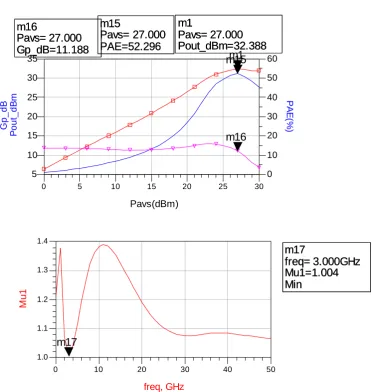
PERFORMANCE PARAMETERS FOR COMMON SOURCE PA
In the figures below following results are achieved at 3.2 GHz with 27dBm input drive signal.
Output Power = 32.38 dBm Power added efficiency=52.23 %
Power Gain=11.18dB
Optimum Load= 36.1+j13.4 Ohm
[image:32.595.114.491.271.664.2]
Figure 4.4: Performance results of unmatched common source PA
m1 Pavs=
Pout_dBm=32.388 27.000 m15
Pavs= PAE=52.296
27.000 m16
Pavs=
Gp_dB=11.188 27.000
5 10 15 20 25
0 30
10 15 20 25 30
5 35
10 20 30 40 50
0 60
Pavs(dBm)
P
out
_
d
B
m
m1
PA
E(
%)
m15
Gp
_d
B
m16 m1
Pavs=
Pout_dBm=32.388 27.000 m15
Pavs= PAE=52.296
27.000 m16
Pavs=
Gp_dB=11.188 27.000
m17 freq= Mu1=1.004 Min
3.000GHz
10 20 30 40
0 50
1.1 1.2 1.3
1.0 1.4
freq, GHz
Mu
1
m17
m17 freq= Mu1=1.004 Min
33
Figure 4.5: Frequency (in GHz) characteristic of Pout and PAE for the common source stage
PA
4.1.1 STACKED CONFIGURATION BIASED IN CLASS AB-MODE
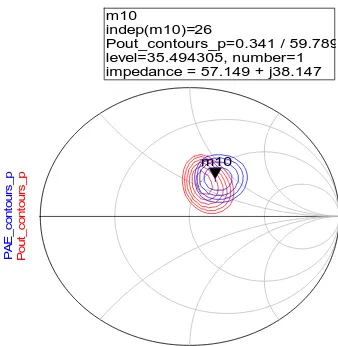
As for the single stage, after determining the DC bias condition, the next step was determining the optimum load to be presented to output of transistor. For the cascode configuration we have found Zopt= 57.149+j*38.147
Figure 4.6: Load Pull analysis result of stacked configuration
m3 RFfreq= PAE=51.230 2.700E9 m12 RFfreq= PAE=49.980 4.000E9 m13 RFfreq= PAE=51.158 3.700E9
2.6E9 2.8E9 3.0E9 3.2E9 3.4E9 3.6E9 3.8E9
2.4E9 4.0E9 46 47 48 49 50 51 52 53 54 45 55 RFfreq PAE m3 m12 m13 m3 RFfreq= PAE=51.230 2.700E9 m12 RFfreq= PAE=49.980 4.000E9 m13 RFfreq= PAE=51.158 3.700E9 m1 RFfreq= Pout_dBm=32.142 2.500E9 m10 RFfreq= Pout_dBm=32.066 3.700E9 m11 RFfreq= Pout_dBm=31.812 4.000E9 2.6E9 2.8E9 3.0E9 3.2E9 3.4E9 3.6E9 3.8E9
2.4E9 4.0E9 30.5 31.0 31.5 32.0 32.5 30.0 33.0 RFfreq P out _dB m m1 m10 m11 m1 RFfreq= Pout_dBm=32.142 2.500E9 m10 RFfreq= Pout_dBm=32.066 3.700E9 m11 RFfreq= Pout_dBm=31.812 4.000E9
indep(Pout_contours_p) (0.000 to 62.000)
P o u t_c ont our s _ p m10
indep(PAE_contours_p) (0.000 to 52.000)
P A E _ c ont our s _ p m10 indep(m10)=
Pout_contours_p=0.341 / 59.789 level=35.494305, number=1 impedance = 57.149 + j38.147
34
Figure 4.7: Unmatched stacked class AB PA
Figure 4.8: Unconditional stability, K>1 and ∆ 1 is satisfied
Vg1 Vground
Vd Vg
Vin vload
PRC
PRC1
C=50 pF {t} R=25 Ohm {t} VAR
STIMULUS
Vg=-1.6V Vd=28 V RFf req=3.2 GHz Pav s=27_dBm
EqnVar V_DC
SRC1 Vdc=10 V
R
R2 R=100 Ohm {-t}
R
R1 R=100 Ohm {-t}
V_DC V_g Vdc=Vg
C
C2 C=3 pF {-t}
Term
Term3
Z=57.14+j*38 Num=2 F4
PP50_20_TNO_8x250um_v1_1
F3 I_Probe
Iin
P_1Tone PORT1
Freq=RFf req P=dbmtow(Pav s) Z=Z_s Num=1
DC_Block
DC_Block3
I_Probe Ig1
DC_Block
DC_Block2
DC_Feed
DC_Feed3 I_Probe
Ig V_DC
Vground Vdc=0
I_Probe Iload
V_DC V_d Vdc=Vd I_Probe Id
DC_Feed
DC_Feed1
10 20 30 40
0 50
10 20 30 40
0 50
freq, GHz
St
a
b
F
a
c
t1
m3
M
a
g
_de
lt
a
m2 m3
freq=
StabFact1=1.042 Min
1.300GHz m2freq=
Mag_delta=0.845 Max
35
Figure 4.9: Source and Load stability Circles
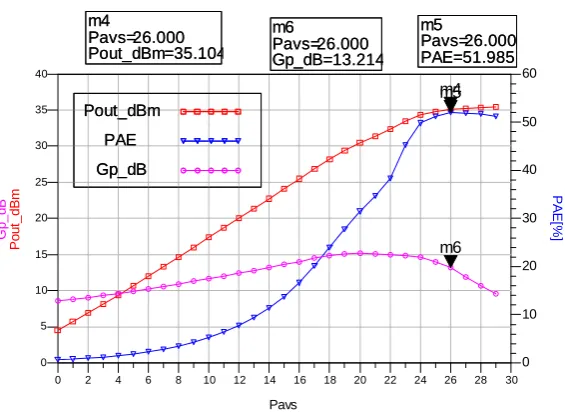
Figure 4.10: Power performance of the stacked amplifier @ 3.2GHz and VDD=28[V]
indep(S_StabCircle1) (0.000 to 51.000)
S_
S
ta
b
C
ir
c
le
1
indep(L_StabCircle1) (0.000 to 51.000)
L_
S
tab
C
irc
le
1
m4 Pavs=
Pout_dBm=35.10426.000
Pout_dBm
PAE
Gp_dB
m5 Pavs=
PAE=51.98526.000
m6 Pavs=
Gp_dB=13.21426.000
2 4 6 8 10 12 14 16 18 20 22 24 26 28
0 30
5 10 15 20 25 30 35
0 40
10 20 30 40 50
0 60
Pavs
P
o
ut
_d
B
m
m4
P
AE[
%
]
m5
Gp
_
d
B
m6 m4
Pavs=
Pout_dBm=35.10426.000
Pout_dBm
PAE
Gp_dB
m5 Pavs=
PAE=51.98526.000
m6 Pavs=
[image:35.595.173.456.396.605.2]36
[image:36.595.146.494.116.328.2]
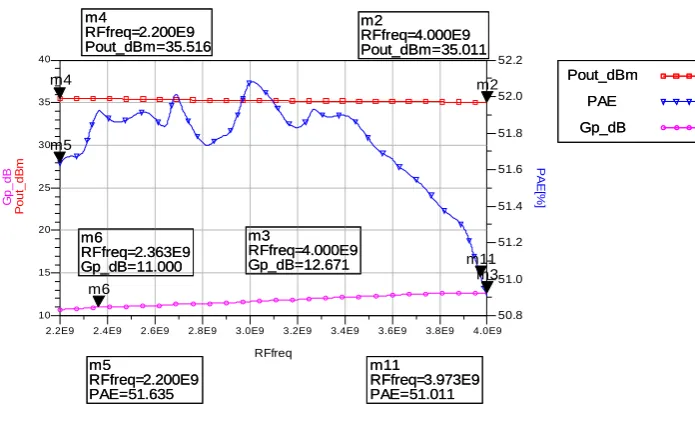
Figure 4.11: PAE, Pout and Power gain versus Frequency of the cascode stage amplifier @ S band
4.1.2
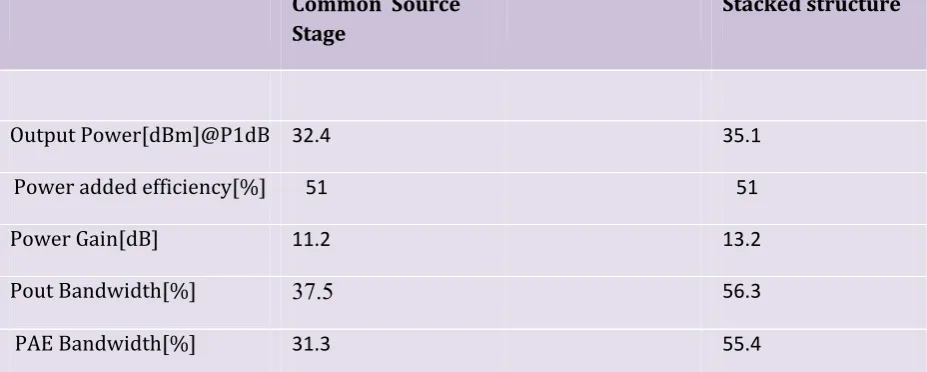
PERFORMANCEOFDESIGNEDUNMATCHEDCLASSABPAThe performance comparison of common source stage ‘linear’ PA with stacked PA is given in table 4.1
The output power is increased almost 2 times in stacked topology compared to the common source stage as expected from the literature information. Other important points are the increased output power bandwidth and PAE bandwidth (about 20% increasing) along with increased power gain in stacked topology.
m4 RFfreq=
Pout_dBm=35.516 2.200E9
m5 RFfreq= PAE=51.6352.200E9 m6
RFfreq= Gp_dB=11.000
2.363E9
m2 RFfreq=
Pout_dBm=35.011 4.000E9
m11 RFfreq= PAE=51.0113.973E9 m3
RFfreq= Gp_dB=12.671
4.000E9
Pout_dBm PAE Gp_dB
2.4E9 2.6E9 2.8E9 3.0E9 3.2E9 3.4E9 3.6E9 3.8E9
2.2E9 4.0E9
15 20 25 30 35
10 40
51.0 51.2 51.4 51.6 51.8 52.0
50.8 52.2
RFfreq
P
o
ut
_dB
m
m4 m2
PAE[
%
]
m5
m11
Gp
_
d
B
m6
m3 m4
RFfreq=
Pout_dBm=35.516 2.200E9
m5 RFfreq= PAE=51.6352.200E9 m6
RFfreq= Gp_dB=11.000
2.363E9
m2 RFfreq=
Pout_dBm=35.011 4.000E9
m11 RFfreq= PAE=51.0113.973E9 m3
RFfreq= Gp_dB=12.671
4.000E9
37 Table 4.1: Performance summary of common source ‘linear’ PA and Stacked PA
In the next section we will deal with the same analysis but this time we will do it for a switch mode PA.
4.2
SWITCH MODE DESIGN AS AN ALTERNATIVE APPROACH TO LINEAR DESIGN IN ORDER TO IMPROVE THE EFFICIENCYSwitching-mode power amplifiers (SMPA) use active transistors as switches. That is, the active device is ideally fully on (short-circuit) or fully off (open-circuit). The theoretical efficiency of the SMPA’s is 100%. However this is in practice never the case. Especially in the high frequency range, optimum drain current and voltage waveforms deviate substantially from the ideal non-overlapping situation.
We will perform some simulations with a class E power amplifier with quarter wave transmission line configuration. The reason of chosen configuration is explained in section 4.2.2.4. But it could be also done in other kind of configuration of class E PA.
Common Source Stage
Stackedstructure
Output Power[dBm]@P1dB 32.4 35.1
Power added efficiency[%] 51 51
Power Gain[dB] 11.2 13.2
Pout Bandwidth[%] 37.5 56.3
4.2.1SI
As to ai class E
F
INGLESTAG
[image:38.595.76.575.155.533.2]im to increa PA with qu
Figure 4.12:
GECLASS–E
ase the PAE uarter wave
: Single stag
along with transmissio
ge class E po
Z
h output pow on line whic
ower amplif
wer using st ch is given b
fier with qu
ack structur below in the
uarter wave
re, we desig e figure 4.12
transmissio
38 gned a
2
39
Figure 4.13: Unconditional stability verification
Figure 4.14: Load and Source stability Circles
m2 freq=
StabFact1=1.533 Min
50.00GHz
10 20 30 40
0 50
10 20 30 40
0 50
freq, GHz
St
a
b
F
a
c
t1
m2 m2
freq=
StabFact1=1.533 Min
50.00GHz m3freq=
Mag_delta=1.000 Max
0.0000Hz
10 20 30 40
0 50
0.5 0.6 0.7 0.8 0.9
0.4 1.0
freq, GHz
M
a
g
_del
ta
m3 m3 freq=
Mag_delta=1.000 Max
0.0000Hz
indep(L_StabCircle1) (0.000 to 51.000)
L
_
S
ta
bC
ir
c
le1
indep(S_StabCircle1) (0.000 to 51.000)
S
_
S
tabC
ir
c
40
[image:40.595.107.450.101.380.2]
Figure 4.15: Simulated PAE, Pout, and Power Gain vs. frequency bias (Vd=10 [V], Vg=-1.75[V]
Figure 4.16: Drain Voltage and current vs. time and load signal vs. time
As it can be seen from the figures 4.13 and 4.14 unconditional stability is satisfied( Rollett stability criteria has been fulfilled). Also from figure 4.16 we observe that the optimum class E condition is not satisfied but further improvement of this condition would make the
bandwidths for output power and PAE much narrower which would be also an unwanted situation moreover the aim of this project is not to desing a best perfomed PA at S band but
2.6E9 2.8E9 3.0E9 3.2E9 3.4E9 3.6E9 3.8E9
2.4E9 4.0E9
5 10 15 20 25 30
0 35
30 40 50 60
20 70
RFfreq
PA
E[%]
m11 m12
Po
ut_
d
B
m
m9 m10
Gp_d
B
m13
m11 RFfreq= PAE=60.355
2.990E9 m12RFfreq=
PAE=60.612 3.320E9 m9
RFfreq=
Pout_dBm=30.523
2.500E9 m10
RFfreq=
Pout_dBm=30.004 3.090E9 m13
RFfreq=
Gp_dB=14.274 Max
2.970E9
0.2 0.4 0.6 0.8 1.0 1.2 1.4 1.6 1.8
0.0 2.0
5 10 15 20
0 25
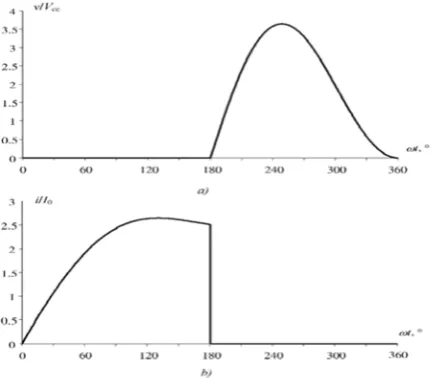
0.0 0.1 0.2 0.3 0.4 0.5
-0.1 0.6
time, sec
ts
(V
d
in
t[0
,::])
ts(
-I
d
in
t.i
[0
,::]
)
0.2 0.4 0.6 0.8 1.0 1.2 1.4 1.6 1.8
0.0 2.0
-10 -5 0 5 10
-15 15
time, sec
ts
(v
load[
0
to show this resu
4.2.2ST
Below t compare
In figur in these
w the benefit ult and go fu
TACKEDSW
the stacked e the perfor
e 4.18 the lo e figures tha
ts of cascod further with
WITCHMODE
version of t rmance of si
Figure 4
oad and sou at the uncon
de structure cascode con
EDESIGN
the previous ingle stage w
4.17: Stacke
urce stability ditional stab
at high freq nfiguration
s class E PA with cascod
d Switch mo
y circles alo bility is sati
quencies.So of this clas
A is given. de version o
ode PA
ong with Ro isfied.
it is decide s E PA.
This circuit of the SMPA
ollet’s criter
ed to satisfy
t will be use A.
rion given. W
41 y with
ed to
42
Figure 4.18: Unconditional stability verification; above the load and source stability circles beneath that
[image:42.595.118.473.101.377.2]the K factor and Δ are given
Figure 4.19: Drain current and Voltage waveforms of bottom and top transistors indep(S_StabCircle1) (0.000 to 51.000)
S_ St a b C ir c le 1
indep(L_StabCircle1) (0.000 to 51.000)
L_ S ta b C ir c le 1 m4 freq= StabFact1=15.570 26.20GHz m9 freq= StabFact1=4.108 Min 4.300GHz
10 20 30 40
0 50 10 20 30 40 0 50
f req, GHz
S tabF ac t1 m4 m9 m4 freq= StabFact1=15.570 26.20GHz m9 freq= StabFact1=4.108 Min 4.300GHz m12 freq= Mag_delta=0.911 Max 19.70GHz
10 20 30 40
0 50 0.2 0.4 0.6 0.8 0.0 1.0
f req, GHz
M ag_ delt a m12 m12 freq= Mag_delta=0.911 Max 19.70GHz
0.2 0.4 0.6 0.8 1.0 1.2 1.4 1.6 1.8
0.0 2.0 2 4 6 0 8 0.0 0.1 0.2 0.3 -0.1 0.4 time, sec ts (F 3 .V d in t[ 0 ,: :]) ts (-F 3 .Id in t.i [0 ,::] )
0.2 0.4 0.6 0.8 1.0 1.2 1.4 1.6 1.8
43
Figure 4.20: PAE, Power Gain and PAE vs. Pavs
Figure 4.21: Pout and PAE vs. frequency( in GHz) characteristic
2 4 6 8 10 12 14 16 18 20 22 24 26
0 28 0 5 10 15 20 25 30 -5 35 10 20 30 40 50 0 60 Pavs Po ut _dB m m15 PAE[ % ] m14 G p_dB m17 m15 Pavs= Pout_dBm=33.51923.000 m14 Pavs= PAE=56.909 23.000 m17 Pavs= Gp_dB=15.843 23.000 Pout_dBm PAE Gp_dB m3 RFfreq= Pout_dBm=31.957 2.500E9 m16 RFfreq= Pout_dBm=32.906 4.000E9 m13 RFfreq= Pout_dBm=33.517 3.200E9 m20 RFfreq= Pout_dBm=33.2632.900E9 m21 RFfreq= Pout_dBm=33.349 3.900E9
2.6E9 2.8E9 3.0E9 3.2E9 3.4E9 3.6E9 3.8E9
2.4E9 4.0E9 26.5 28.0 29.5 31.0 32.5 34.0 25.0 35.0 RFfreq P ou t_ dB m m3 m16 m13 m20 m21 m3 RFfreq= Pout_dBm=31.957 2.500E9 m16 RFfreq= Pout_dBm=32.906 4.000E9 m13 RFfreq= Pout_dBm=33.517 3.200E9 m20 RFfreq= Pout_dBm=33.2632.900E9 m21 RFfreq= Pout_dBm=33.349 3.900E9 m7 RFfreq= PAE=57.025 Max 3.300E9 m18 RFfreq= PAE=53.742
2.900E9 m19RFfreq=
PAE=55.413 3.900E9 m22 RFfreq= PAE=56.918 3.200E9 2.6E9 2.8E9 3.0E9 3.2E9 3.4E9 3.6E9 3.8E9
2.4E9 4.0E9 45 50 55 60 40 65 RFfreq PA E m7 m18 m19 m22 m7 RFfreq= PAE=57.025 Max 3.300E9 m18 RFfreq= PAE=53.742
2.900E9 m19RFfreq=
44
4.2.3
PERFORMANCESUMMARYOFDESIGNEDSWITCHMODEPAIn table 4.2 the performance comparison of single stage SMPA with stacked version given. We see here again an increase in the bandwidth and the output power for the stacked topology. Also the power gain is greater for the stacked configuration as it was the case for linear PA.
Table 4.2: Performance summary of single stage SMPA with stacked SMPA
The increase in bandwidth for PAE is pretty high but this is due to the fact that we have used here class E power amplifier with quarter wave transmission line that possess 4 harmonic termination which makes the output characteristics more selective for single stage SMPA. We do not expect that much increasing in the bandwidth for other kinds of class E PAs but still the increasing would be about 2 times more for stacked topology compared to the single stage.
Another important observation is that the switch mode PAs do not perform very well in the sense of PAE and output power when we compare it with ‘linear’ PAs at S band. This is because of the difficulties in achieving the optimum class E conditions at high frequencies. The maximum output power that is achieved with SMPA is almost 2 dBm less than linear PA but it also provides 3dB more output power when using stacked structure compared to single stage version as it was for the linear PA.
In the figure below we see the improvement in the bandwidth characteristic for the SMPA
SingleStage CascodeStage
Output Power[dBm]@P1dB 30.5 33.3
Power added efficiency[%] 60 55
Power Gain[dB] 14.3 15.8
Pout Bandwidth[%] 15.6 31.2
45
[image:45.595.97.452.103.411.2]
Figure 4.22: Improvement in the bandwidth characteristic for the SMPA: first two belong to the single stage
SMPA and below that the cascode stage SMPA frequency characteristic.
Having finishing the comparison of unmatched circuit performances, it is now time to design the impedance matching circuits for the PAs in order to have a more realistic performance merits.
4.3
IMPEDANCE MATCHING NETWORK DESIGN FOR LINEAR POWER AMPLIFIERMatching networks provide a transformation of impedance to a desired value to maximize the power dissipated by a load. The input impedance of the transistor is highly nonlinear, i.e., dependent on the operating point. Thus, the device operating under large-signal conditions
2.6E9 2.8E9 3.0E9 3.2E9 3.4E9 3.6E9 3.8E9
2.4E9 4.0E9
45 50 55 60 65
40 70
RFfreq
PAE
2.6E9 2.8E9 3.0E9 3.2E9 3.4E9 3.6E9 3.8E9
2.4E9 4.0E9
28 29 30 31
27 32
RFfreq
P
ou
t_
dB
m
2.6E9 2.8E9 3.0E9 3.2E9 3.4E9 3.6E9 3.8E9
2.4E9 4.0E9
26.5 28.0 29.5 31.0 32.5 34.0
25.0 35.0
RFfreq
P
o
ut
_dB
m
2.6E9 2.8E9 3.0E9 3.2E9 3.4E9 3.6E9 3.8E9
2.4E9 4.0E9
50 60
40 70
RFfreq
(and esp Therefo As expl counterp matchin
4.3.1IN
After co the f0 of
transfor
Through of ZLopt=
network
In the fi the outp
pecially in s ore it is one lained in sec
part. Theref ng networks
NPUT/OUTP
onnecting th f 3.2 GHz. W rms 50ohm
h load Pull =36,108+j1 k match circ
Output
igure below put and inpu
switched-mo of most imp ction 4.2.3 t fore we will s for this PA
PUTMATCHI
he load netw We then des Zsource into Z
analysis the 3.415 for th cuit that wil
t matching
[image:46.595.74.521.445.708.2]w, the concep ut of the circ
Figure 4
ode PAs), w portant step the perform l focus on th A.
INGCIRCUIT
work we wil sign a lowp Zin* at f0=3.
e optimum o he common ll transform
circuit Des
ptual design cuit.
4.23: PA wit
will exhibit ps in the des mance of SM he ‘linear’ P
TDESIGNFO
ll determine pass impedan
.2 GHz
output powe n source clas
50 Ohms to
sign for com
n schematic
th input/outp
Zin
Z*in
dynamicall sign of a PA MPA at S ban
PA and desi
ORCOMMON
e the large-s nce transfor
er was deter ss AB PA.
o the optim

![Figure 2[9] 2.10 Schemaatic of quarterr-wave-line CClass-E powwer amplifier with lumpedd matching ccircuit](https://thumb-us.123doks.com/thumbv2/123dok_us/1201575.643613/19.595.151.410.74.230/figure-schemaatic-quarterr-cclass-amplifier-lumpedd-matching-ccircuit.webp)