R E S E A R C H A R T I C L E
Open Access
Acupuncture for insomnia after stroke: a
systematic review and meta-analysis
Sook-Hyun Lee and Sung Min Lim
*Abstract
Background:Insomnia is the common complaint among patients with stroke. Acupuncture has increasingly been
used for insomnia relief after stroke.
The aim of the present study was to summarize and evaluate evidence on the effectiveness of acupuncture in relieving insomnia after stroke.
Methods:Seven databases were searched from inception through October 2014 without language restrictions.
Randomized controlled trials (RCTs) were included if acupuncture was compared to placebo or other conventional therapy for treatment of insomnia after stroke. Assessments were performed using the Pittsburgh sleep quality index (PSQI), the insomnia severity index (ISI), the Athens insomnia scale (AIS), and the efficacy standards of Chinese medicine.
Results: A total of 165 studies were identified; 13 RCTs met our inclusion criteria. Meta-analysis showed that acupuncture appeared to be more effective than drugs for treatment of insomnia after stroke, as assessed by the PSQI (weighted mean difference, 4.31; 95 % confidence interval [CI], 1.67–6.95;P= 0.001) and by the efficacy standards of Chinese medicine (risk ratio, 1.25; 95 % CI, 1.12–1.40;P< 0.001). Intradermal acupuncture had significant effects compared with sham acupuncture, as assessed by the ISI (weighted mean difference, 4.44; 95 % CI, 2.75–6.13; P< 0.001) and the AIS (weighted mean difference, 3.64; 95 % CI, 2.28–5.00;P< 0.001).
Conclusions:Our results suggest that acupuncture could be effective for treating insomnia after stroke. However, further studies are needed to confirm the role of acupuncture in the treatment of this disorder.
Keywords: Acupuncture, Intradermal acupuncture, Stroke, Insomnia, Review
Background
Stroke is the second-leading global cause of death be-hind heart disease, accounting for 11.13 % of total deaths worldwide [1]. In addition, survivors often suffer from not only pain and various physical disabilities but also mood disorders such as depression [2]. Such physical and emotional consequences of stroke could have mul-tiple effects on a patient’s sleeping pattern. Previous studies have reported that the sleep-wake cycle is fre-quently disturbed after stroke [3, 4].
Insomnia is the most common sleep complaint, affect-ing approximately 40–60 % of stroke patients [3]. This frequency is higher than what observed in patients
without a stroke (10–40 %) [5]. Insomnia after stroke is caused mainly by anxiety resulting from hyperactivity of the sympathetic nervous system [3–6]. In addition, post-stroke insomnia might be affected by damaged brain lesions resulted from the stroke, age, degree of disability after stroke, anxiety disorder, antipsychotic drugs, depression, and other comorbidities [6, 7]. During stroke recovery, psychological stress due to in-somnia affects the effectiveness of therapy and the prognosis; it also affects quality of life, mental health, and rehabilitation [8–10].
Although effective pharmacological treatments are available, significant side effects have limited their clin-ical applications and long-term use [10]. Of the comple-mentary treatment modalities, acupuncture has been one of the most popular and safest [11].
* Correspondence:[email protected]
Department of Clinical Research on Rehabilitation, Korea National Rehabilitation Research Institute, 58 Samgaksan-ro, Gangbuk-gu, Seoul 142-070, Republic of Korea
© 2016 The Author(s).Open AccessThis article is distributed under the terms of the Creative Commons Attribution 4.0 International License (http://creativecommons.org/licenses/by/4.0/), which permits unrestricted use, distribution, and reproduction in any medium, provided you give appropriate credit to the original author(s) and the source, provide a link to the Creative Commons license, and indicate if changes were made. The Creative Commons Public Domain Dedication waiver (http://creativecommons.org/publicdomain/zero/1.0/) applies to the data made available in this article, unless otherwise stated.
Lee and LimBMC Complementary and Alternative Medicine (2016) 16:228
Acupuncture has been widely used to treat a variety of clinical conditions, particularly those involving patho-logical changes in neuroendocrinology, such as meno-pause, depression, and insomnia [12]. Acupuncture is able to regulate the functioning of the heart and brain through stimulation of certain acupoints on the body. Many published clinical studies, including randomized controlled trials (RCTs), have explored acupuncture as a treatment for insomnia. Most reports have demonstrated positive clinical effects of acupuncture in the treatment of insomnia. Acupuncture treatment has also been re-ported to reduce sleep onset latency and increase sleep duration and sleep efficiency [13].
A few recent systematic reviews have examined the ef-fectiveness of acupuncture in the treatment of insomnia [12, 14, 15]. However, none has focused on insomnia after stroke. Furthermore, the effectiveness of acupunc-ture in treating insomnia after stroke has not been fully determined. The aim of the present study was to summarize and evaluate evidence on the effectiveness of acupuncture for insomnia relief after stroke.
Methods
Search methods for identification of studies
The search was performed without restriction to language or year of publication. We searched Medline, EMBASE, and the Cochrane Central Register of Controlled Trials from database inception through October 2014. For Korean publications, we searched three Korean med-ical databases (Research Information Service System, National Discovery for Science Leaders, and OASIS). For Chinese articles, we searched the China National Knowledge Infrastructure (CNKI). The keywords used
for the search were “stroke OR apoplexy OR cva OR
cerebrovascular attack OR cerebrovascular accident OR cerebral infarction OR cerebral hemorrhage” AND “acupuncture OR acupoints OR electroacupunc-ture OR electro-acupuncelectroacupunc-ture OR auriculotherapy OR
auriculoacupuncture” AND “insomnia” in each
data-base language. The search strategy was adjusted for each database (Appendix).
Inclusion/exclusion criteria
Relevant clinical trials were included if the following criteria were met: 1) they were randomized, controlled trials (RCTs); 2) they included patients diagnosed with insomnia after stroke; 3) stroke patients with insomnia at baseline were enrolled, and 4) they studied insomnia as an outcome measure. Trials were excluded if the study design did not allow evaluation of the effects of acupuncture on insomnia after stroke; that is, studies were excluded if they 1) compared different types of acupuncture, 2) adopted complex treatment without
examining the effects of acupuncture alone, or 3) re-ported insufficient information.
Data extraction
Two reviewers (L.S.H. and L.S.M.) independently ex-tracted data using a standardized data extraction form and reached consensus on all items. Extracted data in-cluded authors, year of publication, sample size, inter-ventions, main outcomes, and adverse events.
Instruments of the outcome measurements that were reported in the included studies were the Pittsburgh sleep quality index (PSQI), the efficacy standards of Chinese medicine, the Insomnia Severity Index (ISI), and the Athens insomnia scale (AIS).
The PSQI consists of 19 self-rated questions, which are grouped into seven component scores ranging from 0 to 3 each. The seven component scores are then summed to yield a global PSQI score, which has a range of 0 to 21, with higher scores indicating worse sleep quality. Specifically, a score of“0”indicates no difficulty, whereas a score of“21”indicates severe difficulties in all areas [16]. The ISI is a brief self-report instrument meas-uring a patient’s perception of insomnia. The seven items are rated on a 0-to-4 scale, and the total score ranges from 0 to 28. A higher score indicates more se-vere insomnia [17]. The AIS is a self-administered psy-chometric instrument consisting of eight items. Each item of the AIS can be rated from 0 to 3 for a total score range of 0–24, with a score of“0”indicating no problem at all and a score of “24” indicating very serious prob-lems in all areas [18]. We extracted data on the mean change from baseline measures (the“Mean”, Fig. 3). The standard deviation of changes from baseline was deter-mined using a correlation coefficient from a previously published study [19].
The efficacy standards of Chinese medicine is a meas-urement tool for the assessment of the states of the pa-tients with complete improvement (recovery of normal sleep duration), partial improvement (increased sleep duration more than three hours), and no improvement after treatment [12]. Response rate was calculated based on proportion of the effective (complete or partial im-provement) and not effective (no imim-provement) patients. We also considered measures of general safety reported for acupuncture as a treatment. We extracted data on the number of participants with improvement as an “Event”(Fig. 3).
Quality assessment
The two reviewers independently assessed the meth-odological quality and the risk of bias of the included studies by means of the risk of bias (ROB) tool in the Cochrane Handbook for Systematic Reviews of Inter-ventions (Version 5.0.2). This instrument consists of 8
domains: random sequence generation; allocation con-cealment; blinding of patients, personnel, and out-come assessors; incomplete outout-come data; selective outcome reporting; and other sources of bias. The tool ranks evidence from research studies as having “high,” “low,” or “unclear” levels of bias; it is also ap-propriate for evaluating the methodological quality of RCTs. In cases in which the reviewers’ opinions dif-fered, a joint opinion was reached through discussion.
Statistical analysis
All statistical analyses were performed with Reviewer Manager Software, version 5.3 (Cochrane Collabor-ation, Oxford, UK). Summary estimates of treatment effects were calculated using a random-effects model. The impact of acupuncture on dichotomous data was expressed as the risk ratio (RR); for continuous outcomes, the mean difference was calculated with a 95 % confidence
interval (CI). The statistical heterogeneity in the
subgroups was analyzed using theI2test and was consid-ered to be significant whenI2was greater than 50 %. Even when a low heterogeneity was detected, a random-effects model was applied, because the validity of tests of hetero-geneity can be limited with a small number of component studies. Publication bias was detected using a funnel plot.
Results
Study description
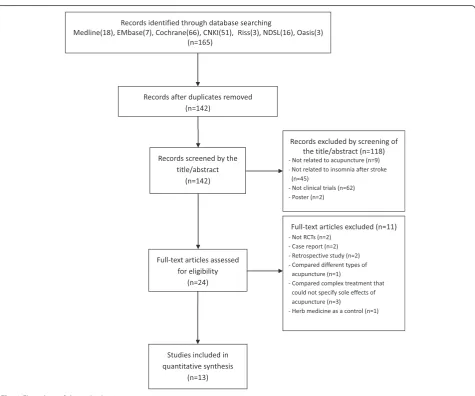
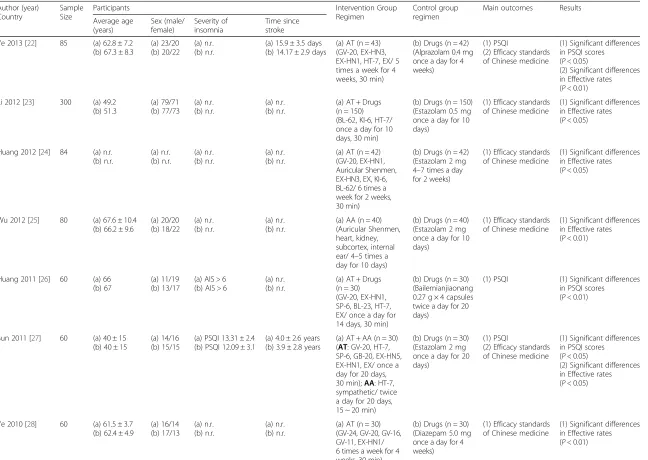
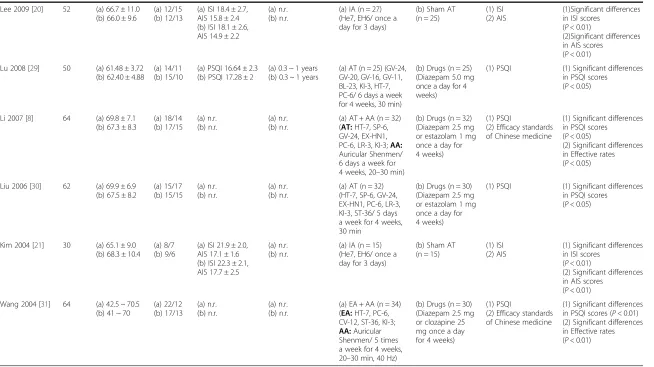
We identified 165 publications; 13 met the eligibility cri-teria (Fig. 1). The articles included in the analysis are summarized in Table 1. The 13 articles were published from 2004 to 2012. Two originated in Korea [20, 21] and 11 were from China [8, 22–31]. The language of publication was English [20, 21] or Chinese [8, 22–31].
Study quality
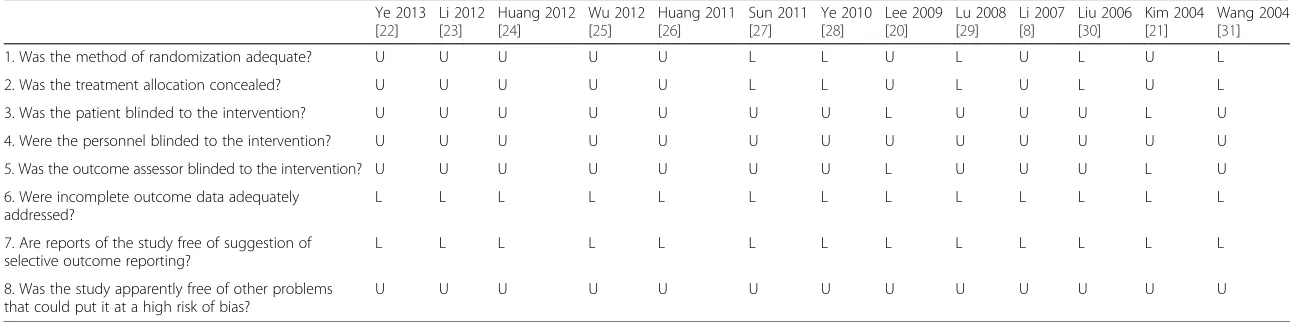
The ROB results are shown in Table 2. With regards to random sequence generation and allocation concealment,
Fig. 1Flow chart of the trial selection process
[image:3.595.62.538.324.720.2]Table 1Summary of randomized controlled trials of acupuncture for insomnia after stroke Author (year)
Country
Sample Size
Participants Intervention Group
Regimen
Control group regimen
Main outcomes Results
Average age (years) Sex (male/ female) Severity of insomnia Time since stroke
Ye 2013 [22] 85 (a) 62.8 ± 7.2 (b) 67.3 ± 8.3
(a) 23/20 (b) 20/22
(a) n.r. (b) n.r.
(a) 15.9 ± 3.5 days (b) 14.17 ± 2.9 days
(a) AT (n = 43) (GV-20, EX-HN3, EX-HN1, HT-7, EX/ 5 times a week for 4 weeks, 30 min)
(b) Drugs (n = 42) (Alprazolam 0.4 mg once a day for 4 weeks)
(1) PSQI
(2) Efficacy standards of Chinese medicine
(1) Significant differences in PSQI scores
(P< 0.05)
(2) Significant differences in Effective rates (P< 0.01)
Li 2012 [23] 300 (a) 49.2 (b) 51.3 (a) 79/71 (b) 77/73 (a) n.r. (b) n.r. (a) n.r. (b) n.r.
(a) AT + Drugs (n = 150) (BL-62, KI-6, HT-7/ once a day for 10 days, 30 min)
(b) Drugs (n = 150) (Estazolam 0.5 mg once a day for 10 days)
(1) Efficacy standards of Chinese medicine
(1) Significant differences in Effective rates (P< 0.05)
Huang 2012 [24] 84 (a) n.r. (b) n.r. (a) n.r. (b) n.r. (a) n.r. (b) n.r. (a) n.r. (b) n.r.
(a) AT (n = 42) (GV-20, EX-HN1, Auricular Shenmen, EX-HN3, EX, KI-6, BL-62/ 6 times a week for 2 weeks, 30 min)
(b) Drugs (n = 42) (Estazolam 2 mg 4–7 times a day for 2 weeks)
(1) Efficacy standards of Chinese medicine
(1) Significant differences in Effective rates (P< 0.05)
Wu 2012 [25] 80 (a) 67.6 ± 10.4 (b) 66.2 ± 9.6
(a) 20/20 (b) 18/22 (a) n.r. (b) n.r. (a) n.r. (b) n.r.
(a) AA (n = 40) (Auricular Shenmen, heart, kidney, subcortex, internal ear/ 4–5 times a day for 10 days)
(b) Drugs (n = 40) (Estazolam 2 mg once a day for 10 days)
(1) Efficacy standards of Chinese medicine
(1) Significant differences in Effective rates (P< 0.01)
Huang 2011 [26] 60 (a) 66 (b) 67
(a) 11/19 (b) 13/17
(a) AIS > 6 (b) AIS > 6
(a) n.r. (b) n.r.
(a) AT + Drugs (n = 30) (GV-20, EX-HN1, SP-6, BL-23, HT-7, EX/ once a day for 14 days, 30 min)
(b) Drugs (n = 30) (Bailemianjiaonang 0.27 g × 4 capsules twice a day for 20 days)
(1) PSQI (1) Significant differences in PSQI scores
(P< 0.01)
Sun 2011 [27] 60 (a) 40 ± 15 (b) 40 ± 15
(a) 14/16 (b) 15/15
(a) PSQI 13.31 ± 2.4 (b) PSQI 12.09 ± 3.1
(a) 4.0 ± 2.6 years (b) 3.9 ± 2.8 years
(a) AT + AA (n = 30) (AT: GV-20, HT-7, SP-6, GB-20, EX-HN5, EX-HN1, EX/ once a day for 20 days, 30 min);AA: HT-7, sympathetic/ twice a day for 20 days, 15 ~ 20 min)
(b) Drugs (n = 30) (Estazolam 2 mg once a day for 20 days)
(1) PSQI
(2) Efficacy standards of Chinese medicine
(1) Significant differences in PSQI scores
(P< 0.05)
(2) Significant differences in Effective rates (P< 0.05)
Ye 2010 [28] 60 (a) 61.5 ± 3.7 (b) 62.4 ± 4.9
(a) 16/14 (b) 17/13 (a) n.r. (b) n.r. (a) n.r. (b) n.r.
(a) AT (n = 30) (GV-24, GV-20, GV-16, GV-11, EX-HN1/ 6 times a week for 4 weeks, 30 min)
(b) Drugs (n = 30) (Diazepam 5.0 mg once a day for 4 weeks)
(1) Efficacy standards of Chinese medicine
(1) Significant differences in Effective rates (P< 0.01)
Table 1Summary of randomized controlled trials of acupuncture for insomnia after stroke(Continued)
Lee 2009 [20] 52 (a) 66.7 ± 11.0 (b) 66.0 ± 9.6
(a) 12/15 (b) 12/13
(a) ISI 18.4 ± 2.7, AIS 15.8 ± 2.4 (b) ISI 18.1 ± 2.6, AIS 14.9 ± 2.2
(a) n.r. (b) n.r.
(a) IA (n = 27) (He7, EH6/ once a day for 3 days)
(b) Sham AT (n = 25)
(1) ISI (2) AIS
(1)Significant differences in ISI scores
(P< 0.01)
(2)Significant differences in AIS scores
(P< 0.01)
Lu 2008 [29] 50 (a) 61.48 ± 3.72 (b) 62.40 ± 4.88
(a) 14/11 (b) 15/10
(a) PSQI 16.64 ± 2.3 (b) PSQI 17.28 ± 2
(a) 0.3 ~ 1 years (b) 0.3 ~ 1 years
(a) AT (n = 25) (GV-24, GV-20, GV-16, GV-11, BL-23, KI-3, HT-7, PC-6/ 6 days a week for 4 weeks, 30 min)
(b) Drugs (n = 25) (Diazepam 5.0 mg once a day for 4 weeks)
(1) PSQI (1) Significant differences in PSQI scores
(P< 0.05)
Li 2007 [8] 64 (a) 69.8 ± 7.1 (b) 67.3 ± 8.3
(a) 18/14 (b) 17/15 (a) n.r. (b) n.r. (a) n.r. (b) n.r.
(a) AT + AA (n = 32) (AT:HT-7, SP-6, GV-24, EX-HN1, PC-6, LR-3, KI-3;AA:
Auricular Shenmen/ 6 days a week for 4 weeks, 20–30 min)
(b) Drugs (n = 32) (Diazepam 2.5 mg or estazolam 1 mg once a day for 4 weeks)
(1) PSQI
(2) Efficacy standards of Chinese medicine
(1) Significant differences in PSQI scores
(P< 0.05)
(2) Significant differences in Effective rates (P< 0.05)
Liu 2006 [30] 62 (a) 69.9 ± 6.9 (b) 67.5 ± 8.2
(a) 15/17 (b) 15/15 (a) n.r. (b) n.r. (a) n.r. (b) n.r.
(a) AT (n = 32) (HT-7, SP-6, GV-24, EX-HN1, PC-6, LR-3, KI-3, ST-36/ 5 days a week for 4 weeks, 30 min
(b) Drugs (n = 30) (Diazepam 2.5 mg or estazolam 1 mg once a day for 4 weeks)
(1) PSQI (1) Significant differences in PSQI scores
(P< 0.05)
Kim 2004 [21] 30 (a) 65.1 ± 9.0 (b) 68.3 ± 10.4
(a) 8/7 (b) 9/6
(a) ISI 21.9 ± 2.0, AIS 17.1 ± 1.6 (b) ISI 22.3 ± 2.1, AIS 17.7 ± 2.5
(a) n.r. (b) n.r.
(a) IA (n = 15) (He7, EH6/ once a day for 3 days)
(b) Sham AT (n = 15)
(1) ISI (2) AIS
(1) Significant differences in ISI scores
(P< 0.01)
(2) Significant differences in AIS scores
(P< 0.01)
Wang 2004 [31] 64 (a) 42.5 ~ 70.5 (b) 41 ~ 70
(a) 22/12 (b) 17/13 (a) n.r. (b) n.r. (a) n.r. (b) n.r.
(a) EA + AA (n = 34) (EA:HT-7, PC-6, CV-12, ST-36, KI-3;
AA:Auricular Shenmen/ 5 times a week for 4 weeks, 20–30 min, 40 Hz)
(b) Drugs (n = 30) (Diazepam 2.5 mg or clozapine 25 mg once a day for 4 weeks)
(1) PSQI
(2) Efficacy standards of Chinese medicine
(1) Significant differences in PSQI scores (P< 0.01) (2) Significant differences in Effective rates (P< 0.01)
Notes. AAauricular acupuncture,AISAthens insomnia sale,ATacupuncture therapy,EAelectro-acupuncture,IAintradermal acupuncture,ISIinsomnia severity index,n.rnot reported,PSQIPittsburgh sleep quality index. Adverse effects were not reported for any study
Table 2Risk of bias of the studies included in the present review Ye 2013 [22]
Li 2012 [23]
Huang 2012 [24]
Wu 2012 [25]
Huang 2011 [26]
Sun 2011 [27]
Ye 2010 [28]
Lee 2009 [20]
Lu 2008 [29]
Li 2007 [8]
Liu 2006 [30]
Kim 2004 [21]
Wang 2004 [31]
1. Was the method of randomization adequate? U U U U U L L U L U L U L
2. Was the treatment allocation concealed? U U U U U L L U L U L U L
3. Was the patient blinded to the intervention? U U U U U U U L U U U L U
4. Were the personnel blinded to the intervention? U U U U U U U U U U U U U
5. Was the outcome assessor blinded to the intervention? U U U U U U U L U U U L U
6. Were incomplete outcome data adequately addressed?
L L L L L L L L L L L L L
7. Are reports of the study free of suggestion of selective outcome reporting?
L L L L L L L L L L L L L
8. Was the study apparently free of other problems that could put it at a high risk of bias?
U U U U U U U U U U U U U
Notes. Based on the risk of bias assessment tool from the Cochrane handbook for systematic reviews of interventions, high risk of bias: H, low risk of bias: L, uncertain risk of bias: U
Lee
and
Lim
BMC
Complementa
ry
and
Alternative
Medicine
(2016) 16:228
Page
6
of
five studies had a low ROB [27–31] and eight studies had an unclear ROB [8, 20–26]. With regards to blinding of pa-tients and outcome assessors, two studies had a low ROB [20, 21], and 11 studies had an unclear ROB [8, 22–31]. All RCTs had a low ROB in incomplete outcome data and se-lective outcome reporting [8, 20–31]. All RCTs had an un-clear ROB in other sources of bias [8, 20–31].
Descriptions of acupuncture treatment
The majority of the included RCTs stated that the ra-tionale for acupuncture point selection was drawn from Traditional Chinese Medicine theory. Two studies used intradermal acupuncture [20, 21], five used acupuncture alone [22, 24, 28–30], two used acupuncture and auricu-lar acupuncture [8, 27], two used acupuncture and drugs [23, 26], one used auricular acupuncture [25], and one used electroacupuncture and auricular acupuncture [31]. A total of 33 acupuncture points (24 meridian points and nine auricular acupuncture points) were used for the treatment of insomnia. Acupoints used for insomnia treatment in most trials were Shenmen (HT-7) and Sishencong (EX-HN1) (Fig. 2). The number of acupoints used in each study ranged from two to 11.
Effects of acupuncture treatment according to PSQI assessment scales
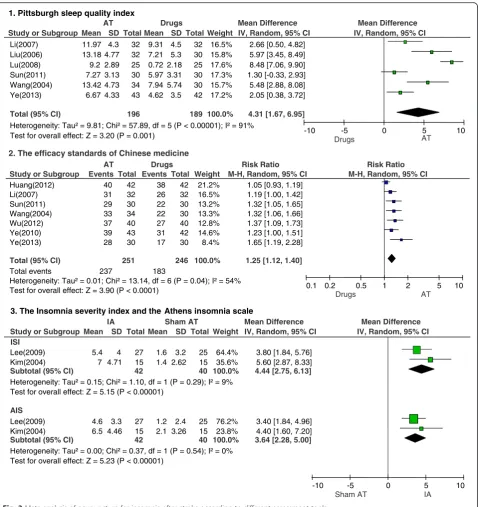
We conducted a meta-analysis of the study results based on the insomnia assessment scales used (Fig. 3). In six studies that used the PSQI to assess treatment results, acupuncture appeared to be more effective
than drugs for treatment of insomnia after stroke (weighted mean difference, 4.31; 95 % CI, 1.67–6.95;
P= 0.001; n= 385, I2= 91 %).
Effects of acupuncture treatment according to the efficacy standards of Chinese medicine
In seven studies that used the efficacy standards of Chinese medicine to compare the effects of acupuncture with those of drugs, acupuncture was observed to have a significant difference in reducing insomnia after stroke (RR, 1.25; 95 % CI, 1.12–1.40;P< 0.001; n = 497,I2= 54 %).
Effects of intradermal acupuncture according to ISI or AIS assessment scales
Studies comparing the effects of intradermal acupunc-ture with those of sham acupuncacupunc-ture used the ISI or the AIS. In these studies, intradermal acupuncture had a significant difference on insomnia after stroke, as assessed both by the ISI (weighted mean difference, 4.44; 95 % CI, 2.75–6.13; P< 0.001; n = 82, I2= 9 %) and by the AIS (weighted mean difference, 3.64; 95 % CI, 2.28–5.00; P< 0.001; n = 82,I2= 0 %).
Publication bias
We assessed the publication bias using a funnel plot. However, it was difficult to determine any pattern indi-cative of publication bias based on the funnel plot’s sym-metry owing to the small sample size (fewer than 10 studies, Additional file 1: Figure S1).
b
EX-HN1a
HT-7Fig. 2Location of Shenmen (HT-7) and Sishenchong (EX-HN1) acupoints. HT-7 is located in the depression radial to the proximal border of the pisiform bone on the palmar wrist crease. EX-HN1 is a group of four acupoints on the vertex of the head located 1 cun posterior, anterior and lateral to GV 20
[image:7.595.57.542.456.694.2]Discussion
The present review suggested that compared to drug treatment, acupuncture might be an effective treatment for insomnia after stroke, and that compared to sham treatment, intradermal acupuncture might have signifi-cant effects on insomnia after stroke.
Insomnia is a common complication following
stroke, often interfering with activity, recovery, and rehabilitation [32]. Sleep problems have both immedi-ate and long-term health effects. The immediimmedi-ate
effects of sleep disturbances include well-being, day-time sleepiness, fatigue, and impaired performance, with their resulting impact on safety [33]. Long-term health effects include hypertension, inflammation, obesity, and glucose intolerance. These long-term ef-fects can lead to chronic diseases and premature death [34]. Additionally, a strong relationship has been found between sleep disturbances and cognitive functioning, regulation of emotions, social problems, and substance abuse [35].
Study or Subgroup ISI
Lee(2009) Kim(2004)
Subtotal (95% CI)
Heterogeneity: Tau² = 0.15; Chi² = 1.10, df = 1 (P = 0.29); I² = 9% Test for overall effect: Z = 5.15 (P < 0.00001)
AIS
Lee(2009) Kim(2004)
Subtotal (95% CI)
Heterogeneity: Tau² = 0.00; Chi² = 0.37, df = 1 (P = 0.54); I² = 0% Test for overall effect: Z = 5.23 (P < 0.00001)
Mean 5.4 7 4.6 6.5 SD 4 4.71 3.3 4.46 Total 27 15 42 27 15 42 Mean 1.6 1.4 1.2 2.1 SD 3.2 2.62 2.4 3.26 Total 25 15 40 25 15 40 Weight 64.4% 35.6% 100.0% 76.2% 23.8% 100.0%
IV, Random, 95% CI
3.80 [1.84, 5.76] 5.60 [2.87, 8.33]
4.44 [2.75, 6.13]
3.40 [1.84, 4.96] 4.40 [1.60, 7.20]
3.64 [2.28, 5.00]
IA Sham AT Mean Difference Mean Difference
IV, Random, 95% CI
-10 -5 0 5 10
Sham AT IA
Study or Subgroup
Huang(2012) Li(2007) Sun(2011) Wang(2004) Wu(2012) Ye(2010) Ye(2013)
Total (95% CI)
Total events
Heterogeneity: Tau² = 0.01; Chi² = 13.14, df = 6 (P = 0.04); I² = 54% Test for overall effect: Z = 3.90 (P < 0.0001)
Events 40 31 29 33 37 39 28 237 Total 42 32 30 34 40 43 30 251 Events 38 26 22 22 27 31 17 183 Total 42 32 30 30 40 42 30 246 Weight 21.2% 16.5% 13.2% 13.3% 12.8% 14.6% 8.4% 100.0%
M-H, Random, 95% CI
1.05 [0.93, 1.19] 1.19 [1.00, 1.42] 1.32 [1.05, 1.65] 1.32 [1.06, 1.66] 1.37 [1.09, 1.73] 1.23 [1.00, 1.51] 1.65 [1.19, 2.28]
1.25 [1.12, 1.40]
AT Drugs Risk Ratio Risk Ratio
M-H, Random, 95% CI
0.1 0.2 0.5 1 2 5 10
Drugs AT
Study or Subgroup
Li(2007) Liu(2006) Lu(2008) Sun(2011) Wang(2004) Ye(2013)
Total (95% CI)
Heterogeneity: Tau² = 9.81; Chi² = 57.89, df = 5 (P < 0.00001); I² = 91% Test for overall effect: Z = 3.20 (P = 0.001)
Mean 11.97 13.18 9.2 7.27 13.42 6.67 SD 4.3 4.77 2.89 3.13 4.73 4.33 Total 32 32 25 30 34 43 196 Mean 9.31 7.21 0.72 5.97 7.94 4.62 SD 4.5 5.3 2.18 3.31 5.74 3.5 Total 32 30 25 30 30 42 189 Weight 16.5% 15.8% 17.6% 17.3% 15.7% 17.2% 100.0%
IV, Random, 95% CI
2.66 [0.50, 4.82] 5.97 [3.45, 8.49] 8.48 [7.06, 9.90] 1.30 [-0.33, 2.93] 5.48 [2.88, 8.08] 2.05 [0.38, 3.72]
4.31 [1.67, 6.95]
AT Drugs Mean Difference Mean Difference
IV, Random, 95% CI
-10 -5 0 5 10
Drugs AT
1. Pittsburgh sleep quality index
3. The Insomnia severity index and the Athens insomnia scale
2. The efficacy standards of Chinese medicine
Fig. 3Meta-analysis of acupuncture for insomnia after stroke according to different assessment tools
[image:8.595.60.539.86.594.2]Zhao [12] documented that the clinical efficacy of acupuncture appeared to be supported by evidence obtained from basic neuroendocrinological studies. The evidence has suggested that the clinical efficacy of acupuncture in the treatment of insomnia is poten-tially mediated by a variety of neurotransmitters, including norepinephrine, melatonin, gamma-aminobutyric acid, and beta-endorphin. Huang [14] reviewed not only clinical trials but also case series and demonstrated that acupunc-ture is potentially beneficial for the treatment of insomnia. Cheuk [15] reported that acupuncture, when used as an adjunct to other treatments, improved sleep quality as compared with other treatments used alone in a popula-tion of patients with diverse medical condipopula-tions.
The current review offered significant perspectives. First, we aimed to identify all studies on this topic. There were no restrictions on the review publication language, and a large number of databases were searched. We are therefore confident that our search strategy located all relevant data on the subject. Second, the outcome mea-sures including the PSQI, the efficacy standards of Chinese medicine, the ISI, and the AIS were widely used in practice for the measurements of sleep quality [36]. Significant differences were found between acu-puncture treatment and drugs or sham treatment in all of the included assessment tools.
This review also had certain limitations. The scarcity of studies and the methodologically low to moderate quality of the primary data preclude us from drawing confirmative conclusions. The highI2values were prob-ably because of substantial clinical and methodological variations. Most of the included studies had an unclear risk of bias for blinding, random sequence generation, and allocation concealment; therefore, a preponderance of positive results was observed. Although blinding of the therapists who perform acupuncture would be dif-ficult, blinding of patients, other care providers, and outcome assessors should be attempted in order to minimize the performance and assessment bias of trials.
Therefore, we recommended that any future trial evaluating the effectiveness of acupuncture should have a well-designed protocol in place prior to the trial’s initi-ation, which is appropriate to properly answer the re-search questions. Of the many important aspects of improving the quality of trial design, it is critical for any future studies to provide sufficient information about blinding, random sequence generation, and allocation concealment in order to clarify the risk of bias.
Future trials should address the methodological issues through rigorous trial designs, reasonable appraisals, and critical analyses to allow more robust conclusions re-garding each treatment’s effectiveness for relieving in-somnia after stroke. Future researchers should follow not only the basic guidelines for reporting clinical trials,
such as the CONSORT statement, but also the STRICTA recommendations, which provide specific guidelines for reporting acupuncture trials [37, 38]. A large-scale study of multicenter trial is recommended. Long-term follow-up studies are needed to determine the efficacy and safety of treatments for insomnia after stroke and to assess their long-term effects. Moreover, a cost analysis should be considered.
Conclusions
The results of this study suggested that acupuncture could be effective in relieving insomnia after stroke. Further studies using large samples and a rigorous study design are needed to confirm the role of acupuncture in the treat-ment of insomnia after stroke.
Appendix
Search strings used for databases MEDLINE
1. “stroke”OR“apoplexy”OR“cva”OR“cerebrovascular attack” OR “cerebrovascular accident” OR “cerebral infarction”OR“cerebral hemorrhage”239,345 2. “acupunct” OR “acupress” OR “acupoints” OR
“electroacupunct” OR “electro-acupunct” OR
“auriculotherapy” OR “auriculoacupunct” 21,349 3. “insomnia”OR“sleep initiation and maintenance
disorder”OR“sleep”OR“wakefulness”142,430
4. 1 AND 2 AND 3 18
EMBASE
1. ‘stroke’/exp OR stroke OR‘apoplexy’/exp OR apoplexy OR‘cva’/exp OR cva OR cerebrovascular AND attack
OR cerebrovascular AND (‘accident’ /exp OR
accident) OR cerebral AND (‘infarction’/exp OR infarction) OR cerebral AND (‘hemorrhage’/exp OR hemorrhage) 42,950
2. acupunct OR acupress OR acupoints OR electroacupunct OR ‘electro acupunct’ OR ‘auriculotherapy’ /exp OR auriculotherapy OR auriculoacupunct 36072 3. insomnia OR sleep AND initiation AND maintenance
AND disorder OR sleep OR wakefulness 248,699
4. #1 AND #2 AND #3 7
Cochrane
1. stroke OR apoplexy OR cva OR cerebrovascular attack OR cerebrovascular accident OR cerebral infarction OR cerebral hemorrhage 36368
2. acupunct or acupress or acupoints or
electroacupunct or electro-acupunct or auriculo-therapy or auriculoacupunct 9101
3. insomnia or sleep initiation and maintenance disorder or sleep or wakefulness 17865
4. #1 AND #2 AND #3 66
CNKI
1. 脑卒中AND针AND失眠4
2. 中风AND针AND失眠10
3. 脑出血AND针AND失眠1
4. stroke AND acupuncture AND insomnia 36
Korean data bases RISS
1. stroke AND acupuncture AND insomnia 3
2. 뇌졸중AND침AND불면0
NDSL
1. stroke AND acupuncture AND insomnia 16
2. 뇌졸중AND침AND불면0
OASIS
1. stroke AND acupuncture AND insomnia 3
2. 뇌졸중AND침AND불면1
Additional file
Additional file 1: Figure S1.The funnel plot analysis for identifying publication bias for the meta-analysis of PSQI and efficacy standards of Chinese medicine. MD, mean difference; RR, risk ratio. (DOCX 23 kb)
Abbreviations
AIS, athens insomnia scale; CI, confidence interval; ISI, insomnia severity index; PSQI, Pittsburgh Sleep Quality Index; RCTs, randomized controlled trials; ROB, risk of bias; RR, risk ratio
Acknowledgements
This research was supported by a grant of the development of Korean medicine industry (Monitoring center for Korean medicine and Western medicine collaboration) by Ministry of Health & Welfare. Also this research was supported by a grant (12-D-02) from the Korea National Rehabilitation Center.
Availability of data and materials
The datasets supporting the conclusions of this article are included within the article.
Authors’contributions
SHL and SML developed the study concept and design, performed data acquisition and analysis, and drafted the manuscript. Both authors read and approved the final manuscript for submission.
Competing interests
The authors declare that they have no competing interests.
Consent for publication
Not applicable.
Ethics approval and consent to participate
Not applicable.
Received: 7 January 2016 Accepted: 14 July 2016
References
1. Mozaffarian D, Benjamin EJ, Go AS, et al. Heart disease and stroke statistics-2015 update: a report from the American Heart Association. Circulation. 2015;131(4):e29–322.
2. Kim J, Choi KS. Poststroke depression and emotional incontinence: Correlation with lesion location. Neurology. 2000;54:1805–10.
3. Leppavuouri A, Pohjasvaara T, Kaste M, et al. Insomnia in ischemic stroke patients. Cerebrovasc Dis. 2002;14:90–7.
4. Pearce SC, Stolwyk RJ, New PW, et al. Sleep disturbance and deficits of sustained attention following stroke. J Clin Exp Neuropsychol. 2016;38(1):1–11. 5. Hohagen F, Rink K, Scharamm E, et al. Prevalence and treatment of
insomnia in general practice. A longitudinal study. Eur Arch Psychiatry Clin Neurosci. 1993;242:329–36.
6. Palomaki HA, Berg E, Meririnne MK, et al. Complaints of post stroke insomnia and its treatment with Mianserin. Cerebrovasc Dis. 2003;15(1–2):56–62. 7. Hermann DM, Siccoli M, Brugger P, et al. Evolution of neurological,
neuropsychological and sleep-wake disturbances after paramedian thalamic stroke. Stroke. 2008;39:62–8.
8. Li TB. Effect of Acupuncture on Poststroke Insomnia. Chin J Rehabil Theory Pract. 2007;13(7):656–7.
9. Schuiling WJ, Rinkel GJ, Walchenbach R, et al. Disorders of sleep and wake in patients after subarachoid hemorrhage. Stroke. 2005;3(6):578–82. 10. Jacob TC, Michels G, Silayeva L, et al. Benzodiazepine treatment induces
subtype-specific changes in GABA(A) receptor trafficking and decreases synaptic inhibition. Proc Natl Acad Sci U S A. 2012;109(45):18595–600. 11. Shah SH, Engelhardt R, Ovbiagele B. Patterns of complementary and
alternative medicine use among United States stroke survivors. J Neuro Sci. 2008;271:180–5.
12. Zhao KC. Acupuncture for the Treatment of Insomnia. Int Rev Neurobiol. 2013;111:217–34.
13. Yao HF, Zhang HF, Chen XL. Observation on therapeutic effect of scalpacupoint catgut embedding for 33 cases of insomnia patients. Zhen Ci Yan Jiu. 2012;37(5):394–7.
14. Huang W, Kutner N, Bliwise DL. A systematic review of the effects of acupuncture in treating insomnia. Sleep Med Rev. 2009;13:73–104. 15. Cheuk DKL, Yeung WF, Chung KF, et al. Acupuncture for insomnia (Review).
Cochrane Libr. 2012;9:1–181.
16. Buysse DJ, Reynolds CF, Monk TH, et al. The Pittsburgh Sleep Quality Index: a new instrument for psychiatric practice and research. Psychiatry Res. 1989; 28(2):193–213.
17. Bastien CH, Vallières A, Morin CM. Validation of the Insomnia Severity Index as an outcome measure for insomnia research. Sleep Med. 2001;2(4):297–307. 18. Soldatos CR, Dikeos DG, Paparrigopoulos TJ. Athens Insomnia Scale:
validation of an instrument based on ICD-10 criteria. J Psychosom Res. 2000; 48(6):555–60.
19. Higgins J, Green S, Cochrane Handbook for Systematic Reviews of Interventions [updated March 2008]. The Cochrane collaboration and John Wiley & Sons Ltd. 2008; 171–7, 485–8
20. Lee SY, Baek YH, Park SU, et al. Intradermal acupuncture on shen-men and nei-kuan acupoints improves insomnia in stroke patients by reducing the sympathetic nervous activity: a randomized clinical trial. Am J Chin Med. 2009;37(6):1013–21.
21. Kim YS, Lee SH, Jung WS, et al. Intradermal acupuncture on shen-men and nei-kuan acupoints in patients with insomnia after stroke. Am J Chin Med. 2004;32(5):771–8.
22. Ye CH, Ou CD, Xu ZJ, et al. Clinical observation on acupuncture treatment of post-stroke insomnia. Chinese J New Clin Med. 2013;6(7):665–7. 23. Li G, Zhang Y, Luo HQ. Effect of acupuncture combined with estazolam
therapy of poststroke insomnia. Med J Nat Defending Forces SW Chin. 2012; 22(6):641–2.
24. Huang M, Gao SH. Effect of acupuncture on poststroke patients with sleep disorders. J Clin Acu mox. 2012;28(10):15–6.
25. Wu XL, Chen Q, Liu CX. Clinical effect of ear acupuncture in syndrome differentiation-based treatment of insomnia after stroke: an analysis of 40 cases. J Anhui Tradit Chin Med. 2012;31(5):45–6.
26. Huang JM, Wang KH. Clinical Effect of combined acupuncture with medicine on poststroke insomnia of 30 cases. Shaanxi J Tradit Chin Med. 2011;32(9):1227–8.
27. Sun YZ, Xia KP. Acupuncture plus auricular point sticking for treating post-stroke insomnia. Shanghai J Acu-mox. 2011;30(6):363–5.
28. Ye FW, Xu YL, Chen JW, et al. Clinical effect of Baihui acupuncture treatment on poststroke insomnia of 30 cases. Pract Clin J Inte Tradit Chin & W Med. 2010;10(5):21.
29. Lu YY, Li ZZ, Ye FW. Clinical observation on treatment of poststroke insomnia of 25 cases by kidney-reinforcing and Du channel-regulating acupuncture method. Jiangsu J Tradit Chin Med. 2008;40(7):59–61. 30. Liu JH, Huang JH, Chen XH. Effect of acupuncture on poststroke insomnia
of 32 cases. Int Med Health Guid News. 2006;15:107–9.
31. Wang Y, Zhao ZF, Wu Y, et al. Clinical therapeutic effect of acupuncture on poststroke depression with insomnia. Chin Acu mox. 2004;24(9):603–6. 32. Ferrie JE, Kumari M, Salo P, et al. Sleep epidemiology-a rapidly growing
field. Int J Epidemiol. 2011;40:1431–7.
33. Lillehei AS, Halcon LL. A systematic review of the effect of inhaled Essential oils on sleep. J Altern Complement Med. 2014;20(6):441–51.
34. Harvey RC, Bruce M. Sleep disorders and sleep deprivation. Committee on Sleep Medicine and Research. 2006. p. 75–9.
35. Bootzin RR, Epstein DR. Understanding and treating insomnia. Annu Rev Clin Psychol. 2011;7:435–58.
36. Sateia MJ, Daniel B. Insomnia: Diagnosis and Treatment. Informa healthcare. 2010. p. 90–2.
37. Begg C, Cho M, Eastwood S, et al. Improving the quality of reporting of randomized controlled trials. The CONSORT statement. JAMA. 1996;276(8): 637–9.
38. MacPherson H, White A, Cummings M, et al. Standards for Reporting Interventions in Controlled Trials of Acupuncture: the STRICTA recommendations. J Altern Complement Med. 2002;8(1):85–9.
• We accept pre-submission inquiries
• Our selector tool helps you to find the most relevant journal
• We provide round the clock customer support
• Convenient online submission
• Thorough peer review
• Inclusion in PubMed and all major indexing services
• Maximum visibility for your research
Submit your manuscript at www.biomedcentral.com/submit