R E S E A R C H A R T I C L E
Open Access
Ultra-performance liquid
chromatography-quadrupole/time-of-flight mass
spectrometry analysis of the impact of
processing on toxic components of Kansui
Radix
Xin Shu
1, Xi-Wen Jiang
1, Brian Chi-Yan Cheng
1, Shuang-Cheng Ma
2, Guang-Ying Chen
3and Zhi-Ling Yu
1*Abstract
Background:Kansui Radix (Gansuiin Chinese), the dried tuber ofEuphorbia kansui, is a Chinese medicinal herb commonly used for the treatment of oedema and ascites with dyspnea. Because of its toxic nature, the herb is usually processed with vinegar to reduce the toxicity. A report has shown that the contents of toxic terpenoids inGansuidecreased after processing with vinegar. However, comprehensive comparison of the chemical profiles between vinegar-processed and rawGansuihas not yet been conducted.
Methods:An ultra-high-performance liquid chromatography in conjunction with ultra-high resolution quadrupole
time-of-flight mass spectrometry (UHPLC UHD Q-TOF MS/MS) method was developed for the analysis of chemical profiles of vinegar-processed and rawGansuiin this study.
Results:Results showed that processing with vinegar caused conspicuous chemical changes. Among the altered
components, 11 toxic terpenoids, 3-O-benzoyl-13-O- dodecanoylingenol/20-O-benzoyl-13-O-dodecanoylingenol, kansuinine D, kansuinine A, 3-O-benzoyl-13-O-dodecanoylingenol/20-O-benzoyl-13-O-dodecanoylingenol, 3-O -benzoylingenol/20-O-benzoylingenol, 20-O-(2′E,4′Z-decadienoyl)ingenol/20-O-(2′E,4′E- decadienoyl)ingenol/3-O-(2′
E,4′Z-decadienoyl)ingenol/3-O-(2′E,4′E-decadienoyl)ingenol, 3-O-(2′E,4′Z-decadienoyl)-20-deoxyingenol,3-O-(2′E,4′
Z-,ecadienoyl)-5-O-acetylingenol,3-O-(2′E,4′Z-decadienoyl)-20-O-acetylingenol,3-O-(2,3-dimethylbutanoyl)-13-O -dodecanoylingenol, were tentatively identified. The contents of most of these terpenoids were obviously decreased after processing with reductions of 6.66–95.25 %.
Conclusion: Our findings could help us understand the chemical basis for the toxicity reduction of Gansui
afforded by processing with vinegar. Further investigations are warranted to establish the relationship between processing-induced chemical changes and the reduction of toxicity ofGansui.
Keywords:Ultra-performance liquid chromatography-quadrupole/time-of-flight mass spectrometry, Kansui Radix, Processing with vinegar, Chemical profile, Toxic components
* Correspondence:[email protected]
1Consun Chinese Medicines Research Centre for Renal Diseases, School of
Chinese Medicine, Hong Kong Baptist University, Kowloon Tong, Hong Kong Full list of author information is available at the end of the article
Background
Kansui Radix (Gansuiin Chinese), the dried tuber of
Eu-phorbia kansuiT.N. Liou ex T.P. Wang., is a well-known traditional Chinese medicinal herb. It was first recorded in Shennong’s Compendium of Materia Medica (Shennong
Bencao Jing)issued 2000 years ago. Studies have revealed
Gansui’s antitumor [1–5], antivirus [6], antileukemia [4, 7], antiallergic [8] and nerve growth factor-promoting activities [9]. However, it also exhibited skin-irritating, tumor-promoting and inflammatory activities [6, 10]. Among the chemical constituents including diterpe-noids, triterpenoids and phenolic derivatives [2, 3, 6, 9, 11] that had been identified in Gansui, ingenol type diterpenoids were proposed to be the main toxic components [12]. In order to reduce the toxicity,
Gansui is usually processed with vinegar [13]. The content of six toxic terpenoids inGansuiand their hep-atotoxicity were found to be decreased after processing with vinegar in a recent report [14]. However, the processing-induced chemical changes are still not fully understood. In the present study, a comprehensive com-parison of the chemical profiles between vinegar-processed and raw Gansui was conducted. Eleven toxic compounds, which were reduced after processing, were tentatively identified using an established UHPLC UHD Q-TOF MS/MS method.
Method
Herbal materials
Gansui, the dried tuber of E. kansui. was purchased from Zisun Group (Hong Kong) Limited, and morpho-logically authenticated by Professor Zhi-Ling Yu (School of Chinese Medicine, Hong Kong Baptist Uni-versity). A voucher specimen (Gansui-01) has been de-posited at the School of Chinese Medicine, Hong Kong Baptist University.
Vinegar-processed Gansui was prepared by the fol-lowing procedures: 10 g of cleaned herbal material was sliced (3–4 mm in thickness) and mixed evenly with 3 g vinegar in a beaker. The beaker was sealed until the vinegar was fully absorbed. After that, the herbal material was stir baked at a high temperature until the color deepened and scorched spots appeared slightly. The vinegar-processed Gansui and its corre-sponding raw Gansui were dried in a drying oven at 37 °C overnight.
After cooling down, both vinegar-processed and raw
Gansui were crushed into powder and passed through a 24-mesh sieve. Each of the herbal materials (5 g, accur-ately weighed) were extracted 3 times with 50 ml 95 %, 70 %, 30 % ethanol separately by sonication for 1.5 h. The extracts were centrifuged at × 1800 g for 10 min. The su-pernatants were combined as the extraction solution. All
extraction solutions were filtered through a 0.45μm PTFE filter prior to UHPLC UHD Q-TOF MS/MS.
Chemicals
Acetonitrile was of LC/MS grade (Fisher Scientific, Pittsburgh, PA, USA) and formic acid was of HPLC grade (Sigma-Aldrich, St. Louis, MO, USA). Ultra-pure water was prepared using a Milli-Q Plus water purification system (Millipore, Billerica, MA, USA). All other re-agents used for extraction was of analytical grade. The reference compound kansuiphorin D was pro-vided by Prof. Shuangcheng Ma (National Institutes for Food and Drug Control,Beijing,China), its retention time (tR) was 10.07 min under the UHPLC conditions de-scribed in the next section. Vinegar which complies with the standards of the Chinese Pharmacopoeia was obtained from the Pat Chun International Limited.
Equipment and chromatographic conditions
The UHPLC conditions for LC-MS analysis were as fol-lows: chromatography was performed on an Acquity UPLC T3 C18 column, 2.1 × 100 mm i.d., 1.8μm (Waters Corp., Milford, MA, USA). The column was maintained at 40 °C. A gradient elution of solvent A (0.1 % formic acid in Milli-Q water) and solvent B (0.1 % formic acid aceto-nitrile) was applied as follows: 0–10 min, 50–75 % B; 10– 15 min, 75–85 % B; 15–25 min, 85–95 % B; 25–30 min, 95–99 % B; 30–35 min, 99 % B; 35–40 min, 99–100 % B; 40–45 min, 100 % B. An equilibration period of 4.0 min was used between individual runs. The flow rate was 0.4 mL/min with 1μL injection volume.
Mass spectrometry conditions
Data acquisition
The Q-TOF mass spectrometer was tuned in the low mass range (from 100 to 1700 Da) and in the extended dynamic range mode (2 GHz). All MS data were ac-quired with reference masses at m/z 112.9856 and 966.0007 in the negative ESI mode, and atm/z121.0509 and 922.0098 in the positive ESI mode to ensure the mass accuracy and reproducibility.
Results and discussion
The established ultra-high-performance liquid chroma-tography in conjunction with ultra-high resolution quad-rupole time-of-flight mass spectrometry (UHPLC UHD Q-TOF MS/MS) was a quick and versatile method for comprehensive analysis of the chemical profiles of vinegar-processed and rawGansuisamples. The UHPLC coupled with sub-2-micron liquid chromatography pro-vided strategies to improve resolution while maintaining or even shortening the overall running time. Q-TOF MS allowed accurate automated mass measurement of prod-uct ions for strprod-uctural analysis. The prominent chroma-tographic resolution of MS and MS/MS was provided by the exact mass measurement of UHPLC UHD Q-TOF MS/MS.
Comparison of the chemical profiles of vinegar-processed and raw Gansui samples
To compare the vinegar-processed and rawGansui sam-ples, global chemical profiling was conducted by UHPLC UHD Q-TOF MS in positive and negative ion modes. The representative total ion current (TIC) chromato-grams of both samples are shown in Fig. 1. The changes were more remarkable in the positive-ion mode (Fig. 1a, b) in comparison with the negative-ion mode (Fig. 1c, d). As shown in Fig. 1a, b, the intensities of several peaks decreased significantly after processing with vinegar, sug-gesting a processing-induced chemical change in
Gansui.
Identity elucidation of detectable components in vinegar-processed and raw Gansui samples
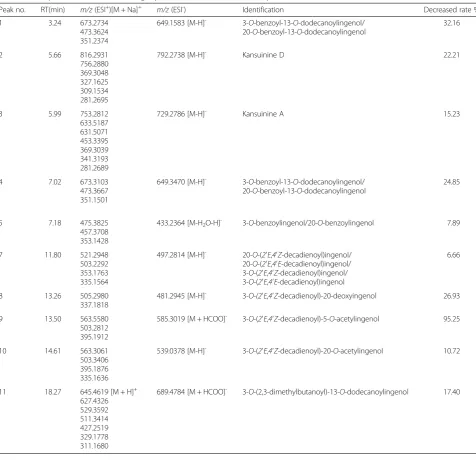
Among the changed components, 11 peaks were tenta-tively identified. Their chemical structures were shown in Fig. 2. One of them was confirmed by comparing the mass spectra and retention time with those of the reference compounds, and the others were tentatively assigned by matching the empirical molecular formula deduced by matching mass values of quasi-molecular ions and frag-ment ions with its theoretical values and those of the known compounds in the literature.
Peak 1 showed a [M-H]- ion at m/z 649.1583 in the negative-ion mode and a [M + Na]+ ion at m/z 673.2734 in the positive-ion mode. The ion at m/z 673.2734 could be further fragmented into ions at m/z
473.3624 [M + Na-C12H24O2]+ and 351.2374 [M + Na-C12H24O2-C7H6O2]+. These fragmented ions corre-sponded to the loss of a long chain and a benzoyloxy group. It was tentatively identified as 3-O-benzoyl-13-O -dodecanoylingeno or 20-O-benzoyl-13- O -dodecanoylin-genol according to the MS data in the literature [15, 16]. These compounds are the skin-irritative ingenol-type diterpenoids in Gansui [17]. However, to unambiguously identify the isomeric compounds, other spectroscopic methods such as NMR were needed.
Peak 2 was tentatively identified as kansuinine D, which is a skin-irritative [17] and inflammatory [15] diterpenoid. It displayed a [M-H]- ion at m/z 792.2738 in the negative-ion mode, a precursor ion at
m/z 816.2931 [M + Na]+ and a fragment ion at m/z 756.2880 [M-C2H4O2+ Na]+ in the positive-ion mode, suggesting the presence of an acetoxy group. Several ions with low mass to charge ratio (at m/z 369.3048, 327.1625, 309.1534 and 281.2695) in the positive-ion mode were observed, which might be the fragments of the main skeleton. The MS data were in agreement with those in the literature [15, 16].
Peak 3 gave a [M-H]- ion at m/z 729.2786 in the negative-ion mode and a [M + Na]+ion atm/z753.2812 in the positive-ion mode. In the MS/MS spectrum, the ions at m/z 633.5187 [M + Na-2C2H4O2]+, 631.5071 [M + Na-C7H6O2]+ and 453.3395 [M + Na-5C2H4O2]+ were observed, indicating the existence of five acetoxys and a benzoyloxy groups. The ions at m/z 369.3039, 341.3193 and 281.2689 might be the fragments of the main skeleton. Comparing with the literature [15, 16], peak 3 was characterized tentatively as kansuinine A. It has inflammatory activity [15] and cytotoxicity against human normal liver cell line L-O2 and gastric epithelial cell line GES-1 [18].
Peak 4 showed a [M-H]- ion at m/z 649.3470 in the negative-ion mode and a [M + Na]+ion atm/z673.3103 in the positive-ion mode. In the MS/MS spectrum, the ions atm/z473.3667 [M + Na-C12H24O2]+and 351.1501 [M + Na-C12H24O2-C7H6O2]+ were observed, indicating the existence of a long-chain group and a benzoyloxy group. Comparing with the literature [15, 16], peak 4 was characterized tentatively as 3-O-benzoyl-13-O -dode-canoylingenol or 20-O-benzoyl-13-O-dodecanoylingenol. They are skin-irritative diterpenoids inGansui[17].
an aversion-inducing compound [19] with tumor pro-motion and skin-irritating activities [4]. However, to unambiguously identify the isomeric compounds, other spectroscopic method such as NMR was needed.
Peak 6 was confirmed as kansuiphorin D by com-paring the mass spectra and the retention time
(tR= 10.07 min) with those of the reference com-pound, which is a tumor promoting, skin-irritating [4] compound isolated from Gansui. As there was almost no change in the intensity of this peak in raw and processed Gansui samples, it would not be discussed in detail.
[image:4.595.58.539.85.620.2]For peak 7, a sodium adduct molecular ion at m/z 521.2948 [M + Na]+ in the negative-ion mode, and a fragment ion atm/z497.2814 [M-H]-in the positive-ion mode were observed. In MS/MS spectrum, the ions at
m/z 503.2292 [M + Na-H2O]+, 353.1763 [M + Na-C10H16O2]+ and 335.1564 [M + Na-C10H16O2-H2O]+ were observed, suggesting the presence of a long chain group. According to the MS data of published data [15, 16], it was tentatively identified as 20-O-(2′E,4′
Z-decadienoyl) ingenol or 20-O-(2′E,4′E-decadienoyl) ingenol or 3-O-(2′E,4′Z-decadienoyl) ingenol or 3-O -(2′E,4′E-decadienoyl) ingenol. 3-O-(2′E,4′Z-decadienoyl) ingenol, 3-O-(2′E,4′E-decadienoyl) ingenol and 20-O-(2′
E,4′Z-decadienoyl) ingenol are skin-irritating ingenols, and 3-O-(2′E,4′E-decadienoyl) ingenol has tumor promotion activity [4, 17]. 20-O-(2′E,4′E-decadienoyl) ingenol has in-flammatory activity [15].
Peak 8 showed a [M-H]- ion at m/z 481.2945 in the negative-ion mode, a [M + Na]+ ion at m/z 505.2980 in the positive-ion mode and a fragment ion at m/z 337.1818 [M + Na-C10H16O2]+ by the loss of a long chain group. In agreement with reported data [15, 16], therefore, peak 9 was tentatively characterized as 3-O-(2′E,4′Z-decadienoyl)-20-deoxyingenol. It has inflamma-tory activity [15] and cytotoxicity against human normal liver cell line L-O2 [18].
Peaks 9, as shown in Table 1, gave the [M + HCOO] -ion atm/z585.3019 in negative -ion mode and a [M +
Na]+ ion at m/z 563.5580 in the positive-ion mode. In the MS/MS spectrum, the ions at m/z 503.2812 [M + Na-C2H4O2]+ and 395.1912 [M + Na-C10H16O2]+ were observed, suggesting the presence of an acetoxy and a long chain groups. For peak 10, it gave the [M-H]- ion atm/z539.0378 in the negative-ion mode and the [M + Na]+ ion at m/z 563.3061 in the positive-ion mode. In the MS/MS spectrum, the ions at m/z 503.3406 [M + Na-C2H4O2]+, 395.1876 [M + Na-C10H16O2]+ and 335.1636 [M + Na-C10H16O2- C2H4O2]+ were observed, suggesting the existence of an acetoxy and a long chain groups. Therefore peaks 9 and 10 were tentatively identified as 3-O-(2′E,4′Z-decadienoyl)- 5-O -acetylin-genol and 3-O-(2′E,4′Z-decadienoyl)-20-O -acetylin-genol, respectively, which were further confirmed by comparing the retention time and MS data with published data in the literature [15, 16, 20, 21]. 3-O-(2′E,4′Z- deca-dienoyl)-5-O-acetylingenol has inflammatory activity [14, 15] and 3-O-(2′E,4′Z-decadienoyl)-20-O -acetylin-genol is a skin-irritating component inGansui[17].
For peak 11, a formate adduct molecular ion at m/z 689.4784 [M + HCOO]- was observed in negative ion mode, molecular ion at m/z 645.4619 [M + H]+ and a series of fragment ions at m/z 627.432 [M + H-H2O]+, 529.3592 [M + H-C6H12O2]+, 511.3414 [M + H-C6H12O2 -H2O]+, 427.2519 [M + H-C12H24O2-H2O]+, 329.1778 [M + H-C6H12O2- C12H24O2]+ and 311.1680 [M + H-C6H12O2-C12H24O2-H2O]+ were observed in positive
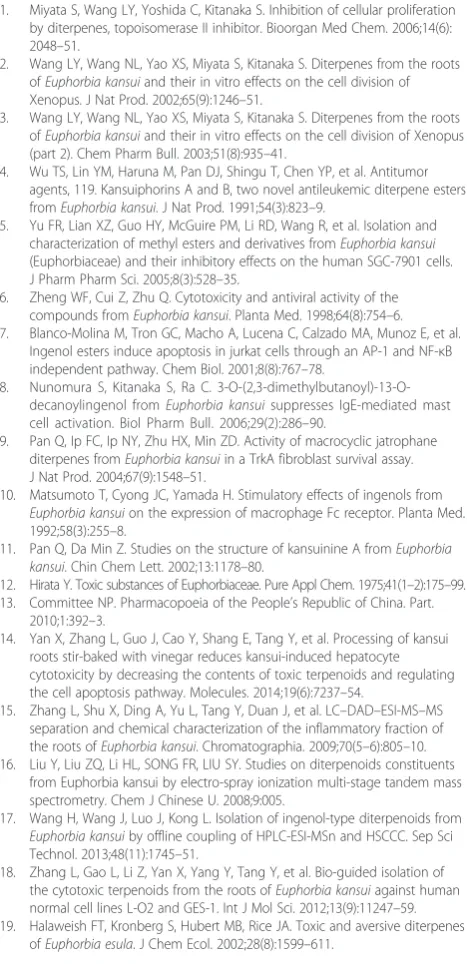
Reference
Kansuinine A R = Ac [11]
Kansuinine D R = Nic [9]
R1 R2 R3 R4 Reference
Kansuiphorin D Bz Ac H H [24]
20-O-(2'E,4'Z-decadienoyl)ingenol H H O-2'E,4'Z-decadienoyl H [2]
20-O-(2'E,4'E-decadienoyl)ingenol H H O-2'E,4'E-decadienoyl H [2]
3-O-(2'E,4'Z-decadienoyl)ingenol 2'E,4'Z-decadienoyl H OH H [2]
3-O-(2'E,4'E-decadienoyl)ingenol 2'E,4'E-decadienoyl H OH H [2]
3-O-(2'E,4'Z-decadienoyl)-20-deoxyingenol 2'E,4'Z-decadienoyl H H H [3]
3-O-(2'E,4'Z-decadienoyl)-5-O-acetylingenol 2'E,4'Z-decadienoyl Ac OH H [2]
3-O-(2'E,4'Z-decadienoyl)-20-O-acetylingenol 2'E,4'Z-decadienoyl H OAc H [2]
3-O-(2,3-dimethylbutanoyl)-13-O-dodecanoylingenol 2,3-dimethylbutanoyl H OH O-decanoyl [3]
3-O-benzoyl-13-O-dodecanoylingenol Bz H OH O-dodecanoyl [3]
20-O-benzoyl-13-O-dodecanoylingenol H H OBz O-dodecanoyl [3]
3-O-benzoylingenol Bz H OH H [16]
20-O-benzoylingenol H H OBz H [25]
[image:5.595.57.543.88.370.2]Table 1Diterpenoids identified in vinegar-processed and rawGansuisamples
Peak no. RT(min) m/z(ESI+)[M + Na]+ m/z(ESI-) Identification Decreased rate %
1 3.24 673.2734
473.3624 351.2374
649.1583 [M-H]- 3-O-benzoyl-13-O-dodecanoylingenol/ 20-O-benzoyl-13-O-dodecanoylingenol
32.16
2 5.66 816.2931
756.2880 369.3048 327.1625 309.1534 281.2695
792.2738 [M-H]- Kansuinine D 22.21
3 5.99 753.2812
633.5187 631.5071 453.3395 369.3039 341.3193 281.2689
729.2786 [M-H]- Kansuinine A 15.23
4 7.02 673.3103
473.3667 351.1501
649.3470 [M-H]- 3-O-benzoyl-13-O-dodecanoylingenol/
20-O-benzoyl-13-O-dodecanoylingenol
24.85
5 7.18 475.3825
457.3708 353.1428
433.2364 [M-H2O-H]- 3-O-benzoylingenol/20-O-benzoylingenol 7.89
7 11.80 521.2948
503.2292 353.1763 335.1564
497.2814 [M-H]- 20-O-(2′E,4′Z-decadienoyl)ingenol/ 20-O-(2′E,4′E-decadienoyl)ingenol/ 3-O-(2′E,4′Z-decadienoyl)ingenol/ 3-O-(2′E,4′E-decadienoyl)ingenol
6.66
8 13.26 505.2980
337.1818
481.2945 [M-H]- 3-O-(2′E,4′Z-decadienoyl)-20-deoxyingenol 26.93
9 13.50 563.5580
503.2812 395.1912
585.3019 [M + HCOO]- 3-O-(2′E,4′Z-decadienoyl)-5-O-acetylingenol 95.25
10 14.61 563.3061 503.3406 395.1876 335.1636
539.0378 [M-H]- 3-O-(2′E,4′Z-decadienoyl)-20-O-acetylingenol 10.72
11 18.27 645.4619 [M + H]+
627.4326 529.3592 511.3414 427.2519 329.1778 311.1680
689.4784 [M + HCOO]- 3-O-(2,3-dimethylbutanoyl)-13-O-dodecanoylingenol 17.40
ion mode, suggesting the presence of two long-chain groups. In agreement with the data in the literature [15, 16, 22], peak 11 was tentatively identified as 3-O -(2, 3-dimethylbutanoyl)- 13-O-dodecanoylingenol. It has cytotoxicity against human normal liver cell line L-O2 [14] and can enhance the replication of HIV-1 (human immunodeficiency virus type1) [23].
In addition to those 11 tentatively identified com-pounds, there were more changes (peaks 12-17) ob-served. An overlapped total ion current chromatograms of raw Gansui (indicated by green line) and vinegar-processed Gansui (indicated by red line) was shown in Fig. 3 with peaks 12-17 highlighted in blue color. Unfor-tunately, peaks 12-17 could not be identified according to the available data. Further work is required to assign them with potential identities. The results showed that the ion chromatograms prior to and after processing with vinegar actually varied, with several peaks signifi-cantly altered.
Conclusions
In the present study, a comprehensive comparison of the chemical profiles between vinegar-processed and raw
Gansui has been conducted using the UHPLC UHD Q-TOF MS/MS method. Results indicated that processing with vinegar caused conspicuous chemical changes in
Gan-sui. Among the changed compounds, 11 toxic terpe-noids, 3-O-benzoyl-13-O- dodecanoylingenol/20-O -benzoyl-13-O-dodecanoylingenol, kansuinine D, kansuinine A, 3-O -benzoyl-13-O-dodecanoylingenol/20-O-benzoyl-13-O -dodecanoylingenol, 3-O-benzoylingenol/20-O -benzoylin-genol, 20-O-(2′E,4′Z-decadienoyl)ingenol/20-O-(2′E,4′E -decadienoyl)ingenol/3-O-(2′E,4′Z
-decadienoyl)ingenol/3-O-(2′E,4′E-decadienoyl)ingenol, 3-O-(2′E,4′Z -decadienoyl)-20-deoxyingenol,3-O-(2′E,4′Z-decadienoyl)-5-O -acetylin-genol,3-O-(2′E,4′Z-decadienoyl)-20-O-acetylingenol,3-O -(2,3-dimethylbutanoyl)-13-O-dodecanoylingenol, were tentatively identified. The contents of most of these terpenoids were significantly decreased after process-ing with reductions of 6.66-95.25 %. These findprocess-ings can help us understand the chemical basis for the toxicity reduction ofGansui afforded by processing with vinegar. To establish the relationship between processing-induced chemical changes and the reduction of toxicity ofGansui, further investigations are warranted.
Competing interests
The authors declare that they have no competing interests.
Authors’contributions
XS, XJ, BCC carried out the experiments, participated in the statistical analysis. XS drafted the manuscript. ZLY conceived of the study, participated in its design, and revised the manuscript. SM offered experimental materials. GC critically revised the manuscript. All authors read and approved the final version of the manuscript.
Acknowledgments
This work is partially supported by grants UIM/238 from Innovation and Technology Commission of Hong Kong, JCYJ20120829154222473 and JCYJ20140807091945050 from the Science, Technology and Innovation Commission of Shenzhen, HKBU 262512 from the Research Grants Council of Hong Kong, HMRF 11122521 from Food and Health Bureau of Hong Kong, and FRG2/15-16/020, FRG1/14-15/061 from the Hong Kong Baptist University.
Author details
1Consun Chinese Medicines Research Centre for Renal Diseases, School of
Chinese Medicine, Hong Kong Baptist University, Kowloon Tong, Hong Kong.
2
National Institutes for Food and Drug Control, Beijing, China.3College of chemistry & chemical engineering, Hainan Normal University, Haikou, China.
Received: 26 July 2015 Accepted: 4 February 2016
References
1. Miyata S, Wang LY, Yoshida C, Kitanaka S. Inhibition of cellular proliferation by diterpenes, topoisomerase II inhibitor. Bioorgan Med Chem. 2006;14(6): 2048–51.
2. Wang LY, Wang NL, Yao XS, Miyata S, Kitanaka S. Diterpenes from the roots ofEuphorbia kansuiand their in vitro effects on the cell division of Xenopus. J Nat Prod. 2002;65(9):1246–51.
3. Wang LY, Wang NL, Yao XS, Miyata S, Kitanaka S. Diterpenes from the roots ofEuphorbia kansuiand their in vitro effects on the cell division of Xenopus (part 2). Chem Pharm Bull. 2003;51(8):935–41.
4. Wu TS, Lin YM, Haruna M, Pan DJ, Shingu T, Chen YP, et al. Antitumor agents, 119. Kansuiphorins A and B, two novel antileukemic diterpene esters fromEuphorbia kansui. J Nat Prod. 1991;54(3):823–9.
5. Yu FR, Lian XZ, Guo HY, McGuire PM, Li RD, Wang R, et al. Isolation and characterization of methyl esters and derivatives fromEuphorbia kansui (Euphorbiaceae) and their inhibitory effects on the human SGC-7901 cells. J Pharm Pharm Sci. 2005;8(3):528–35.
6. Zheng WF, Cui Z, Zhu Q. Cytotoxicity and antiviral activity of the compounds fromEuphorbia kansui. Planta Med. 1998;64(8):754–6. 7. Blanco-Molina M, Tron GC, Macho A, Lucena C, Calzado MA, Munoz E, et al.
Ingenol esters induce apoptosis in jurkat cells through an AP-1 and NF-κB independent pathway. Chem Biol. 2001;8(8):767–78.
8. Nunomura S, Kitanaka S, Ra C. 3-O-(2,3-dimethylbutanoyl)-13-O-decanoylingenol fromEuphorbia kansuisuppresses IgE-mediated mast cell activation. Biol Pharm Bull. 2006;29(2):286–90.
9. Pan Q, Ip FC, Ip NY, Zhu HX, Min ZD. Activity of macrocyclic jatrophane diterpenes fromEuphorbia kansuiin a TrkA fibroblast survival assay. J Nat Prod. 2004;67(9):1548–51.
10. Matsumoto T, Cyong JC, Yamada H. Stimulatory effects of ingenols from
Euphorbia kansuion the expression of macrophage Fc receptor. Planta Med. 1992;58(3):255–8.
11. Pan Q, Da Min Z. Studies on the structure of kansuinine A fromEuphorbia
kansui. Chin Chem Lett. 2002;13:1178–80.
12. Hirata Y. Toxic substances of Euphorbiaceae. Pure Appl Chem. 1975;41(1–2):175–99. 13. Committee NP. Pharmacopoeia of the People’s Republic of China. Part.
2010;1:392–3.
14. Yan X, Zhang L, Guo J, Cao Y, Shang E, Tang Y, et al. Processing of kansui roots stir-baked with vinegar reduces kansui-induced hepatocyte cytotoxicity by decreasing the contents of toxic terpenoids and regulating the cell apoptosis pathway. Molecules. 2014;19(6):7237–54.
15. Zhang L, Shu X, Ding A, Yu L, Tang Y, Duan J, et al. LC–DAD–ESI-MS–MS separation and chemical characterization of the inflammatory fraction of the roots ofEuphorbia kansui. Chromatographia. 2009;70(5–6):805–10. 16. Liu Y, Liu ZQ, Li HL, SONG FR, LIU SY. Studies on diterpenoids constituents
from Euphorbia kansui by electro-spray ionization multi-stage tandem mass spectrometry. Chem J Chinese U. 2008;9:005.
17. Wang H, Wang J, Luo J, Kong L. Isolation of ingenol-type diterpenoids from
Euphorbia kansuiby offline coupling of HPLC-ESI-MSn and HSCCC. Sep Sci Technol. 2013;48(11):1745–51.
18. Zhang L, Gao L, Li Z, Yan X, Yang Y, Tang Y, et al. Bio-guided isolation of the cytotoxic terpenoids from the roots ofEuphorbia kansuiagainst human normal cell lines L-O2 and GES-1. Int J Mol Sci. 2012;13(9):11247–59. 19. Halaweish FT, Kronberg S, Hubert MB, Rice JA. Toxic and aversive diterpenes
20. Wang HY, Wang JS, Wei DD, Wang XB, Luo J, Yang MH, et al. Bioactivity-guided isolation of antiproliferative diterpenoids from
Euphorbia kansui. Phytother Res. 2012;26(6):853–9.
21. Shen J, Mo X, Tang Y, Zhang L, Pang H, Qian Y, et al. Analysis of herb-herb interaction when decocting together by using ultra-high-performance liquid chromatography-tandem mass spectrometry and fuzzy chemical identification strategy with poly-proportion design. J Chromatogr A. 2013;1297:168–78.
22. Wang YB, Li YY, Wang HB, Qin GW. Chemical constituents from the roots of
Euphorbia kansui. Chin J Nat Med. 2007;5(3):182–5.
23. Fujiwara M, Okamoto M, Ijichi K, Tokuhisa K, Hanasaki Y, Katsuura K, et al. Upregulation of HIV-1 replication in chronically infected cells by ingenol derivatives. Arch Virol. 1998;143(10):2003–10.
24. Pan DJ, Hu C, Chang JJ, Thomas TYL, Chen YP, Hsu HY, et al. Kansuiphorin C and D, cytotoxic diterpenes fromEuphorbia kansui. Phytochemistry. 1991; 30(3):1018–20.
25. Appendino G, Tron GC, Cravotto G, Palmisano G, Annunziata R, Baj G, et al. Synthesis of modified ingenol esters. Eur J Org Chem. 1999; 1999(12):3413–20.
• We accept pre-submission inquiries
• Our selector tool helps you to find the most relevant journal
• We provide round the clock customer support
• Convenient online submission
• Thorough peer review
• Inclusion in PubMed and all major indexing services
• Maximum visibility for your research
Submit your manuscript at www.biomedcentral.com/submit

![Fig. 2 The chemical structures of diterpenoids identified in Gansui samples. [2, 3, 9, 11, 16, 24, 25]](https://thumb-us.123doks.com/thumbv2/123dok_us/9277278.999344/5.595.57.543.88.370/fig-chemical-structures-diterpenoids-identified-gansui-samples.webp)