Characterization and Optimization of Heavy Metals Biosorption by Fish
Scales
Norzila Othman
1,a, Nabilah Zayadi
2,b1,2 Department of Water and Environment, Faculty of Civil and Environmental Engineering, Universiti Tun Hussein Onn Malaysia, Beg Berkunci 101, 86400, Parit Raja, Batu Pahat, Johor,
Malaysia
a[email protected], b[email protected]
Keywords: Biosorption; Ferum; Plumbum; Tilapia fish scale; Zinc
Abstract. The pollution of water with heavy metals has been a great concern due to their toxic nature and adverse effect. Various techniques were employed to remove heavy metal namely physical, chemical, and biological treatment. Biosorption is one of the biological treatment that has emerged as a new technology for the removal and recovery of metal ions from aqueous solutions which is more environmental friendly. Biosorption using Tilapia fish scale was studied with the intention to remove zinc, plumbum, and ferum ions from synthetic wastewater. The optimum adsorption capacities of fish scale was investigated under several condition namely, pH, biosorbent dosage, initial heavy metals concentration, and contact time while final concentration was obtained by using Inductively Coupled Plasma-Mass (ICP-MS). The results revealed that 92.3% of zinc, 89.33% of plumbum, and 64.2% of ferum able to be sequestered under best adsorption conditions. The maximum percentage removals were observed at pH 6, 5.5, 4.5 and dosage 0.02 g, 0.001 g, 0.8 g at concentration 10 ppb, 0.3 ppb, 300 ppb for zinc, plumbum, and ferum ions, respectively. Maximum removal achieved at 3 hours contact time for ferum and zinc while 2 hours for plumbum. The results indicate that Tilapia fish scale is a promising method in removing ferum, zinc, and plumbum ions from aqueous solution.
Introduction
Wastewater contains large amount of contaminants, especially heavy metals, organic toxicants, and human pathogens. All heavy metals are non-biodegradable and persistent in the environment. Therefore, the removal of heavy metal from wastewater has become one of the most imperative environmental issues [1-3]. Conventional wastewater treatment such as ion exchange, membrane technologies and adsorption on activated carbon are particularly costly and not economical [4].
In recent years, attention has been focused towards biosorption method where it has natural potential of the biomass to immobilize dissolved components for instance, heavy metal ions, on its surface [3]. Biosorption process is non-polluting, easy to operate, offers high efficiency of treatment of wastewaters containing low metal concentrations and possibility of metal recovery [5]. One of the potential biosorbent for heavy metal removal is fish scale. A number of fish scale namely Labeo Rohita, Catla catla and Atlantic Cod had been reported and give promising result world widely [6-8]. Therefore, this research will explore the unexploited property of local fish scales (Tilapia), as a new biosorptive approach to remove target heavy metals such as ferum, zinc, and plumbum from wastewater. Moreover, it is important to investigate optimum condition for heavy metal removal such as pH, biosorbent dosage, initial heavy metals concentration, contact time.
Materials and Methods
Experimental Design. All experiments were conducted using batch method by varying pH, fish scale dosage, contact time, and initial metal ion concentration. The prepared solution were shaken at 125 rpm. Biosorbent were filtered through 0.45 µm filter paper and kept in airtight container for further analysis using Scanning Electron Microscopy (SEM), X-Ray Fluorescence (XRF) and Fourier Transform Infrared (FTIR). Finally, the supernatants were kept in airtight plastic bottles and analysed by using ICP-MS. Table 1 shows working range of ferum, zinc, and plumbum.
Table 1: Working range of ferum, zinc, and plumbum
Heavy metals
pH Biosorbent dosage
(g)
Contact time (hr) Initial metal ion concentration (ppb) Ferum 4.5, 5, 5.5, 6 0.6, 0.8, 1.1, 1.3, 1.6 0.5, 1, 2, 2.5, 3, 4 300, 400, 500, 600, 700
Zinc 5, 5.5, 6, 6.5 0.01, 0.02, 0.025,
0.035, 0.040
0.5, 1, 2, 2.5, 3, 4 10, 11, 12, 13, 14
Plumbum 4, 4.5, 5.5, 6, 6.5 0.0005, 0.001, 0.002, 0.003, 0.004
0.5, 1, 2, 2.5, 3, 4 0.3, 0.4, 0.5, 0.6, 0.7
*underline indicate optimum condition
Results and Discussion
X-Ray Fluorescence (XRF). Table 2 shows XRF analysis of fish scales use in this study. The present of CaO with 63.8% confirm that high potential of fish scale to be adsorbent. XRF was conducted to verify the absent of ferum, zinc, and plumbum in preparation of biosorbent.
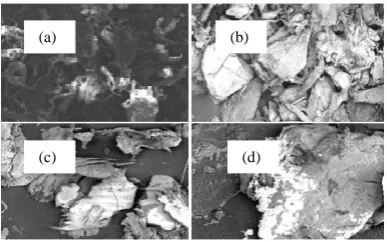
Scanning Electron Microscopy (SEM) Fig. 1 shows SEM micrographs of Tilapia scale. Native biosorbent is shown in Fig. 1a. The fish scale appears to have a rough surface and are characterized by having two regions, one being darker and the other being white. The white region is rich in inorganic material containing high proportion of calcium and phosphorus whereas the dark region is rich in protein because it has high proportion of carbon and oxygen [8]. Fig. 1b, Fig. 1c, and Fig. 1d represents the micrograph of ferum, zinc, and plumbum loaded biosorbent. From energy dispersive X-ray (EDX) analysis, ferum, zinc, and plumbum was confirmed in the fish scales after biosorption take place. This micrograph clearly shows that the presence of new shiny bulky particles over the surface of heavy metals loaded biosorbent which are absent in the native biosorbent [8]. These results confirm the binding of metal ion in fish scale through biosorption.
Fourier Transform Infrared (FTIR) Analysis Fig. 2 shows FTIR spectra of fish scale before and after heavy metals adsorption. FTIR spectra of native biosorbent (Fig. 2a) shows peak at 1718 cm-1 between the region 1808 cm-1 and 1644 cm-1(C=O stretch). The sharp peak observed at 1478 cm-1 (N=O stretch) and shows a strong bands in the infrared spectrum. Besides, the peaks at 1176 cm-1 in the region of wave number 1244 cm-1 to 1032 cm-1 are representative of ethers (C-O stretch). Fig. 2b shows FTIR spectra of ferum loaded with fish scale. Band ranging from 1554 cm-1 to 1432 cm-1 shows peak at 1490 cm-1 refer to C=C ring stretch of aromatic rings while peak at 1168 cm-1 produced from 1250 cm-1 to 1022 cm-1 are due to amines (C-N stretch). Fig. 2c shows FTIR spectra of zinc loaded with fish scale. The peak at 1498 cm-1 in the region 1550 cm-1 to 1434 cm-1 shows the present of nitro compounds (N=O). This spectra also shows C-N stretching adsorption at peak 1186 cm-1 occurs in the region 1246 cm-1 to 1022 cm-1 as medium to strong band for amines [10].
(ayat atas betulkan no fig
XXXXXX
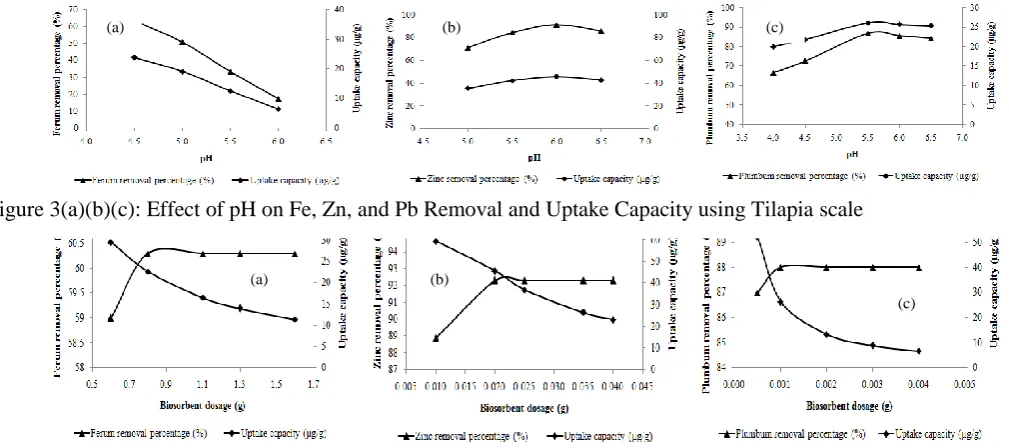
Effect of pH on Ferum, Zinc, and Plumbum Removal and Uptake Capacity. Fig. 3a shows ferum removal depends on pH and uptake capacity of aqueous solution. The optimum ferum removal of 63.33% and uptake capacity of 23.75 µg/g is achieved at pH 4.5. Ferum shows a gradual decrease in sorption with pH due to the weakening of electrostatic force of attraction between the oppositely charged adsorbate and adsorbent and finally cause the reduction in sorption capacity [11]. Increasing pH tend to precipitate biosorbent as insoluble hydroxides or hydrated oxides, thereby lowering its availability for biosorption [12]. The effect of pH on zinc and plumbum removal and uptake capacity is shown in Fig. 3b and Fig. 3c. The optimum zinc and plumbum removal of 91.38% and 87% is achieved at pH 6 and pH 5.5 with uptake capacity 45.69 µg/g and 26.1 µg/g respectively. At pH values above the isoelectric point, there is a net negative charge on the cells and the ionic state of ligands such as carboxyl, phosphate, and amino groupswill be such
as to promote reaction with metal ions. As the pH is lowered, however, the overallsurface charge
on the cells will become positive, which will inhibit the approach of positively charged metal cations. Protons will then compete with metal ions for the ligands and thereby decrease the interaction of metal ionswith the cells [13].
Effect of Biosorbent Amount on Ferum, Zinc, and Plumbum Removal and Uptake Capacity.
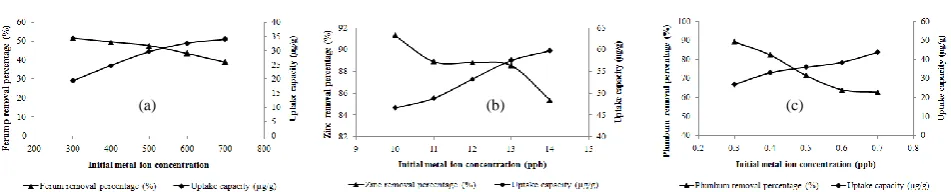
Fig. 4a, Fig. 4b, and Fig. 4c show ferum, zinc, and plumbum removal and uptake capacity depended on amount of biosorbent. The results show that ferum, zinc, and plumbum reach at equilibrium state at 0.8 g, 0.02 g, and 0.001 g with 60.3%, 92.3%, and 88% respectively. At initial stage, percentage removal is increased as biosorbent amount increased and remain constant as it reach equilibrium. This is due to the greater availability of the exchangeable sites at higher concentration of the sorbent [14]. The uptake capacity is observed at value 22.63 µg/g for ferum, 45.63 µg/g for zinc, and 26.4 µg/g for plumbum. Higher uptake at low biosorbent concentrations could be due to an increased metal-to-biosorbent ratio, which decreases upon an increase in dry biomass dose [8][15].
Formula Concentration
Original (g) 7
Added (g) 3
CO2 0.10%
CaO 63.80%
P2O5 32.40%
SO3 2.64%
MgO 0.24%
SiO2 0.24%
Na2O 0.21%
[image:3.595.20.533.68.350.2]SrO 0.17%
Table 2: Chemical Composition and Concentration of Fish Scales
Figure 1: SEM Micrograph of Tilapia Scale. (a) Native Biosorbent, (b) Fe Loaded Biosorbent, (c) Zn Loaded Biosorbent, (d) Pb Loaded Biosorbent.
Figure 2: FTIR Spectra of Tilapia Scale. (a) FTIR Spectra of Native Biosorbent, (b) FTIR Spectra of Fe Loaded Biosorbent, (c) FTIR Spectra of Zn Loaded Biosorbent.
(a) (b)
(c) (d)
[image:3.595.277.471.71.192.2]Effect of Contact Time on Ferum, Zinc, and Plumbum Removal and Uptake Capacity. Fig. 5a, Fig. 5b, and Fig. 5c show the biosorption efficiency of ferum, zinc, and plumbum removal and uptake capacity by Tilapia scales as a function of contact time. Increase in contact time lead to an increase in metal removal and uptake capacity. The optimum ferum, zinc, and plumbum removal of 64.2%, 91%, and 86% is achieved at 3 hours (Fe & Zn), and 2 hours of contact time while uptake capacity reach equilibrium at state 24.07 µg/g, 45.5 µg/g and 25.8 µg/g respectively. Initially, a large number of vacant surface sites are available for adsorption. After a lapse of some time, the remaining vacant surface sites are difficult to be occupied due to repulsive forces between the adsorbate molecules on the Tilapia fish scales surface and in the bulk phase. During the initial stage of adsorption, metal ions are adsorbed into the mesopores that get almost saturated with metal ions. Therefore, the driving force for mass transfer between the bulk liquid phase and the solid phase decreases with the passage of time. The metal ions have to traverse further and deeper into the pores encountering much larger resistance and result in the slowing down of the adsorption during the later phase of adsorption. It was possible that a longer contact time allowed the fish scale to be released into the solution [16,17
Effect of Initial Metal Ion Concentration on Ferum, Zinc, and Plumbum Removal and Uptake Capacity. The influence of initial metal ion concentration of ferum, zinc, and plumbum removal and uptake capacity by Tilapia scale is shown in Fig. 6a, Fig. 6b, and Fig. 6c. The percentage removal of all heavy metal studied at higher initial concentration level shows a decreasing trend. The optimum removal of ferum, zinc, and plumbum at 51.67%, 91.33%, and 89.33% was obtained at 300 ppb, 10 ppb, and 0.3 ppb of initial metal ion concentration while uptake capacity is observed at value 19.38 µg/g, 46.67 µg/g, and 26.8 µg/g respectively. The number of available binding sites on the biomass surface is high at low concentration of metal ions. The uptake capacity increased with increase in initial concentration, due to the availability of more number of metal ions in solution for sorption. The number of available binding sites on the biomass surface is high at low concentration of metal ions, hence biosorption of metals was very effective [2].
Figure 3(a)(b)(c): Effect of pH on Fe, Zn, and Pb Removal and Uptake Capacity using Tilapia scale
Figure 4(a)(b)(c): Effect Of Biosorbent Dosage on Fe, Zn, Pb Removal and Uptake Capacity using Tilapia scale
(a) (b)
(c)
[image:4.595.33.538.460.684.2]
Conclusion
This work revealed that Tilapia fish scales has a potential to use as biosorbent for heavy metals removal in aqueous solution. Among other heavy metals, zinc ion reached the highest removal with 92.3%. This removal achieved at pH 6, biosorbent dose 0.02 g, 10 ppb concentration, and 3 hours contact time.
References
[1] I. Villaescusa, N. Fiol, M. Martinez, N. Miralles, J. Poch, J. Serarols, Removal of copper and nickel ions from aqueous solutions by grape stalks wastes, Water Res. 38 (2004) 992–1002.
[2] T. Akar, S. Tunali, Biosorption characteristics of Aspergillus Flavus biomass for removal of Pb(II) and Cu(II) ions from an aqueous solution, Bioresour. Technol. 97 (2006) 1780-1787.
[3] A. Witek-Krowiak, R.G. Szafran, S. Modelski, Biosorption of heavy metals from aqueous solutions onto peanut shell as a low-cost biosorbent, J. Desalination. 265 (2011) 126-134.
[4] A. Sonune, R. Ghate, Developments in wastewater treatment methods, Desalination. 167 (2004) 55-63. [5] J. Febrianto, A.N. Kosasih, J. Sunarso, Y-S. Ju, N. Indraswati, S. Ismadji, Equilibrium and kinetic
studies in adsorption of heavy metals using biosorbent: A summary of recent studies. J. Hazard. Mater. 162 (2009) 616–645.
[6] R. Nadeem, T.M. Ansari, A.M. Khalid, Fourier transform infrared spectroscopic characterization and optimum of Pb(II) biosorption by fish (Labeo Rohita) scales, J. Hazard. Mater. 156 (2008) 64-73. [7] M.S. Rahaman, A. Basu, M.R. Islam, The removal of As(III) and As(V) from aqueous solutions by
waste materials, Bioresour. Technol. 99 (2008) 2815-2823.
[8] K. Srividya, K. Mohanty, Biosorption of hexavalent chromium from aqueous solution by catla catla scales: Equilibrium and kinetics studies, Chem. Eng. J. 155 (2009) 666-673.
[9] H.E. Amjad, A.S. Jamal, Sorption of trace metals on fish scales and application for lead and cadmium pre-concentration with flame atomic absorption determination, Jordan J. Chem. 3 (2008) 87-97.
[10] L.P. Pavia, G.M. Lampman, G.S. Kriz, Introduction to Spectroscopy, Brooks Cole, 1996, pp. 13-82. [11] S.S. Baral, S.N. Das, P. Rath, Hexavalent chromium removal from aqueous solution by adsorption on
treated sawdust, Biochem. Eng. J. 3 (2006) 216–222.
[12] G. Bayramoglu, A. Denizli, S. Bektas, M.Y. Arica, Entrapment of Lentinus sajor-caju into Ca-alginate gel beads for removal of Cd(II) ions from aqueous solution: Preparation and biosorption kinetics analysis, Microchem. J. 72 (2002) 63–76.
[13] Y. Sag, D. Ozerb, T. Kutsal, A comparative study of the biosorption of lead(II) to Z.Ramigera and R.Arrhizus, Process Biochem. 30 (1995) 169-174.
[14] B. Yu, Y. Zhang, A. Shukla, S.S. Shukla, K.L. Dorris, The removal of heavy metal from aqueous solutions by sawdust adsorption-Removal of copper, J. Hazard. Mater. B80 (2000) 33–42. Figure 6(a)(b)(c): Effect of Concentration on Fe, Zn, and Pb Removal and Uptake Capacity using Tilapia scale
Figure 5(a)(b)(c): Effect of Contact Time on Fe, Zn, Pb Removal and Uptake Capacity using Tilapia Scale
(a) (b) (c)
[image:5.595.45.539.70.288.2] [image:5.595.60.535.71.162.2] [image:5.595.59.535.187.283.2][15] E. Romera, F. Gonzalez, A. Ballester, M.L. Blazquez, J.A. Munoz, Comparative study of biosorption of heavy metals using different types of algae, Bioresour. Technol. 98 (2007) 3344–3353.
[16] V.C. Srivastava, I.D. Mall, I.M. Mishra, Equilibrium modelling of single and binary adsorption of cadmium and nickel onto bagasse fly ash, Chemical Engineering Journal. 117 (2006) 79–91.