Journal of Chemical and Pharmaceutical Research, 2013, 5(12):8-14
Research Article
CODEN(USA) : JCPRC5
ISSN : 0975-7384
Mesh belt with volleyball detection based on the improved Hough transform
theory in the application of game scene analysis
Xiaomin Zhang
Institute of Physical Education, Changchun Normal University, Changchun, China
_____________________________________________________________________________________________
ABSTRACT
The continuous development of computer technology and internet technology promotes the improvement of analysis techniques on sports image and video files. In practical sport, being able to quickly extract useful information receives more and more coaches and sports researchers' attention, also in image analysis of volleyball, the demand is also growing day by day. In this paper, for the detection technology of mesh belt and volleyball in volleyball scene it conducts status analysis, first it introduces the application of the traditional Hough transform in mesh belt and volleyball detection, and then analyzes the shortcomings of traditional Hough transform algorithm and proposes improvement direction for the algorithm aiming at the defects of the characteristics, explores the improved linear transform and random Hough circle transform, and also explores the improved Hough circle transform algorithm combined with self-adaptive search algorithm, and analyzes the advantages and detection effects of the improved algorithm, provides a theoretical basis for the information detection technology of volleyball scene by the analysis process and research findings in the text.
Keywords: Hough transformation; threshold, random hough circle transformation, self-adaptive search algorithm. _____________________________________________________________________________________________
INTRODUCTION
The technological development of volleyball is inseparable from the research of all scholars, also cannot be separated from the development of computer technology; computer technology with its unique high and strong computing power, makes the information analytical results of sports video and images made great improvement; in volleyball the detection technology with volleyball and mesh nets in volleyball scene helps to improve the analysis on the spiking and the padding technology[1]. For the improvement technology of image information detection algorithm and Hough transform many scholars have made their efforts, which has certain role on the development of sports image and video analysis techniques and the enhancement of volleyball technology; some domestic scholars have contributed some of his views and findings.
Based on previous studies this paper conducts research on the detection technology of mesh belt and volleyball in volleyball scene, analyzes the application of traditional Hough transform algorithm and improved Hough transform algorithm in the mesh belt and volleyball detection, in order to provide a theoretical basis and development detection for volleyball scene detection technology by the algorithm research.
2. THE APPLIED THEORY OF TRADITIONAL HOUGH TRANSFORM IN MESH BELT AND VOLLEYBALL DETECTION
In volleyball match mesh belt and volleyball are both very important information; there are eight camera positions in volleyball venue, you can the extracted location information of the mesh belt to determine the location of the camera shooting; in the database of volleyball image, when there is a close-up information on the volleyball it is often the volleyball players’ spiking or padding the ball exciting action, so long as we know the contour information of the volleyball we can know the size of the volleyball; the Hough transform discussed in the paper is used to find the mesh belt and volleyball, which can map the feature points of the image to the parameter space, and obtain the relationship between the image feature points[8]. Hough transform can detect the shape of a target, and the noise is less affected by the curve intermittent, which has a strong anti-interference. In this study, it analyzes the linear transform and circular transform of Hough changes, proposes the defects of the traditional transform, and provides guidance directions for improving the Hough transform.
2.1. Straight line of the traditional Hough transform
Hough straight line is the basis of the Hough transform; for a straight line and a point
(
x ,
iy
i)
on the straight line asshown in the linear equation (1), there are myriad straight lines through the point, and these straight lines are
intersected at this point; in the formula (1) different
a,
b
corresponds to different linear equations, and therefore formula (1) can be rewritten as the equation parameters shown in the form of formula (2).b
ax
y
i=
i+
(1)
i i
a
y
x
b
=
−
+
(2)
For the linear equation with slope of
a
′
and intercept ofb
′
, if two points(
x
i,
y
i)
,
(
x
j,
y
j)
on the straight line aretransformed to parameter equation, they must intersect in
(
a
′
,
b
′
)
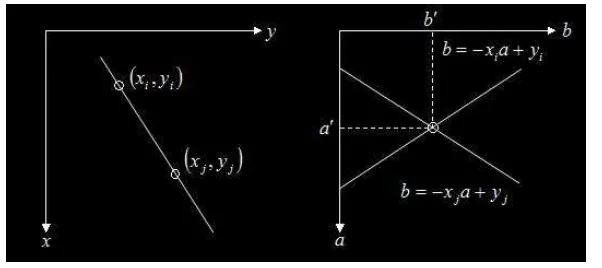
of the parameter space, and the image condition of [image:2.595.158.459.480.614.2]the
x
−
y
plane and the parameter plane is shown in Figure 1.Figure 1: The relationship image of the point and straight line in the
x
−
y
plane and the parameter planeFigure 1 in the left shows a straight line image through the point
(
x
i,
y
i)
,
(
x
j,
y
j)
in thex
−
y
plane, the right figure represents the image that two straight lines intersect in point(
a
′
,
b
′
)
in the parameter plane.Hough transform can divide parameter space further into the accumulator unit as shown in Figure 2; in Figure 2
(
a
max,
a
min) (
,
b
max,
b
min)
respectively represents the desired range of the slope and intercept values; For point( )
i,
j
in the image calculate the equation parameters as shown in the formula (2), we can get one matrix ona,
b
,max min
min
,
a
a
1
,
,
a
a
a
a
=
=
+
L
=
(3)
In the matrix
b
can take the approximate value; if the obtained solution isb
q for a valuea
p , then set( )
p
q
A
,
satisfies the equation (4); In the last calculation process of the formula (4), the valueQ
ofA ,
( )
i
j
iscorresponding to the point
Q
on the straight line in thex
−
y
plane as shown in Formula (1), the number of segments in the plane determines the accuracy of these points’ collinearity.( ) ( )
p
,
q
=
A
p
,
q
+
1
[image:3.595.198.414.204.289.2]A
(4)Figure 2: The further division schematic of parameters plane for Hough transform
2.2. Circle of the traditional Hough transform
The basic idea of Hough circle is to first map the point in the image to the parameter space, then put the center and radius corresponding to the parameter space into the accumulator, finally determine the circle according to the value
of accumulator; for any point
( )
x,
y
in the image, if it is in the circle with the center of( )
a,
b
, and the radius ofr
, then the point satisfies the formula (5).(
) (
2)
2 2r
b
y
a
x
−
+
−
=
(5)For formula (5) it can be converted to the parameter equations about
(
a ,
,
b
r
)
, as shown in formula (6) below.( )
( )
−
=
−
=
θ
θ
sin
cos
r
y
b
r
x
a
(6)
In Formula (6)
θ
∈
[
0
,
2
π
]
, for the Hough circular transform, the radius of the circle to be detected can be set asr
∈
[
R
1,
R
2]
, and one point( )
x,
y
in the image, thenθ
,
r
traverse[
0
,
2
π
]
and[
R
1, R
2]
by the step lengthof
∆
θ
,
∆
r
, after traversing all points of the image, obtain the accumulator arrayA
, wherein any one element(
a
b
r
)
A
,
,
of the array represents radiusr
, the center of the circle is the accumulated value of( )
a
,
b
; when the(
a
b
r
)
A
,
,
is larger, it means the possibility of the existence of a circle with the center of( )
a
,
b
and radius ofr
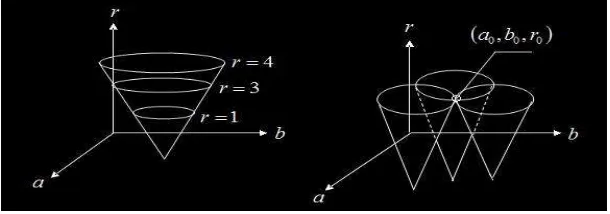
isgreater; meanwhile the physical meaning of the changes from the formula (5) to the formula (6) can be considered as in the image space a circle is corresponding to a three-dimensional upright cone in parameter space, as shown in Figure 3.
[image:3.595.154.459.637.744.2]The circle of the three-dimensional upright cone image on the left of the figure 3 is mapped to the parameter space
on the right, then form the equation about
(
a ,
,
b
r
)
; If substitute the three points of the image into the parametric equations and in the premise that the parametric equations are solvable, in the parameter space the three uprightcones certainly intersect at one point, points
(
a
0,
b
0,
r
0)
are shown on the right in Figure 3.2.3. The improvement direction of traditional Hough Transform
The traditional Hough line transform has significant flaws due to its large amount of calculation and the large space of calculation, etc. The traditional Hough transform uses method of exhaustion to transform every point in the image
to the parameter space, and gets a range of
( )
ρ
,
θ
values; and then solve the local maxima of( )
ρ
,
θ
, but accordingto the actual situation of the mesh belt detection experiment, in the volleyball scene the mesh belt has the following three features:
A. Mesh belt is consisted of several straight lines, and it has certain height and length;
B. In the volleyball image mesh belt generally accounts for between a quarters to four-fifths of the total width;
C. In volleyball court the camera has a limited shoot angle.
Feature A shows that as long as a straight line can be detected, there is no need to use Hough transform exhaustive manner to traverse out all the line segment; Feature B indicates when the mesh belt width in the image is a quarters total of the total width, the most cases are due to the camera photographed parts of the mesh belt or the athlete keeps out parts of the mesh belt, and in volleyball scene in addition to mesh line there is no other straight lines that can account for a quarter of the total width of the image; so in the improvements of Hough line retrieval it should be noted that when the length of the line segment is higher than a set threshold it can be considered as a mesh belt; Feature C indicates that when the camera is directly facing the volleyball court, it cannot shoot the mesh belt, when the camera is directly facing the mesh belt the captured mesh belt is substantially parallel to the width direction of the image, when the camera is broadside on the mesh belt the shooting angle ranges 10° -30°.
In the traditional Hough circle transform for a given point on the image we need to use method of exhaustion to determine coordinate values of enormous center and radius, in view of this the calculation amount conventional circular Hough transform is huge; in order to avoid the defects of large amount of calculation caused by exhaustion, we can use the randomized Hough transform; random Hough circle transform is a multi-to-one mapping, that is to map the non-collinear scatter point randomly generated by the image space to a point in the parameter space, thus avoiding the one to many mapping in traditional Hough circular transform; in order to avoid the blindness caused by random Hough ideology, you can use the adaptive search method and color information characteristics of the image to improve the efficiency of the algorithm combining with random Hough circle changes.
3. APPLICATION OF IMPROVED HOUGH CHANGES IN THE MESH BELT AND VOLLEYBALL DETECTION
In view of the analysis in 2.3, this paper for the improvement direction of Hough transform, designs improved Hough straight line detection method and improved random Hough circle volleyball detection method.
3.1. Straight line of improved Hough Transform
When the camera is broadside on the mesh belt, the image captured is shown in Figure 4; the left and right figure in Figure 4 reflects two directions of the captures mesh belt; in analytic geometry the direction can be reflected by the slope, the left figure represents the case when the slope of the mesh belt is negative, the right figure represents the case when the slope of the mesh belt is positive; in the experiment for both directions we take a different algorithm to process; Since the mesh belt has a certain height, especially when the camera is facing in the side of the mesh belt they are all close-up scenes, the mesh belt height is much greater, so the straight line slope of the mesh belt detection is variable.
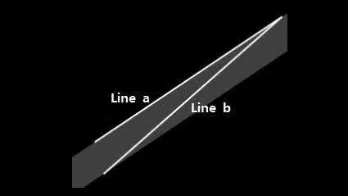
In Figure 5 the gray part is the mesh belt, straight line
a
andb
are both mesh belt that can be detected, but the slopeof the two straight lines are not equal; apparently straight line
a
is parallel to the mesh belt which is the best case,while straight line
b
has a certain angle with the mesh belt; according to the experiments, the straight line segmentin the detection of the mesh belt is mainly to determine the position of the camera, it doesn’t have exorbitant
five degrees as step long and take {0○, 5○, ..., 30○}, values of angle
θ
have been greatly improved compared with the traditional Hough transform .Figure 4: The schematic diagram of positive and negative performance of mesh belt’s slope
Figure 5: The condition of straight line segment detected in the belt
The algorithm of improved Hough line changes has the following four steps:
Step1 the case of infinite slope will not occur in the straight lines from detection to the mesh belt, so we follow the traditional linear equation of formula (7) below.
b
ax
y
=
+
(7)Step2 set the image width as
d
, minimum length of the mesh belt’s straight line isd
min,(
x
′
,
y
′
)
means one point ofthe image, and then from left to right, from the top to down traverse the image to find a straight line; thus it is
divided into two cases, namely when the mesh belt is in the case of
2
d
x
′
<
as shown in the left of Figure 4 and the
slope of the mesh belt is positive, the line can be detected; similarly when the mesh belt is in the case of
2
d
x
′
>
as shown in the right of Figure 4 and the slope of the mesh belt is negative, the line can be detected; take the left figure
for an example
{
}
O O
O
30
tan
,
,
5
tan
,
0
tan
=
=
=
a
a
a
L
; and first fix the value ofa
and set it asa
′
, andincrease
x
′
in steps of 1; suppose the cumulative length is∆
x
and∆
x
≤
d
min , and the final value ofx
is
x
′′
=
x
′
+
∆
x
, then the determining field∆
x
ofy
′′
is relevant and the expression is in the formula (8) below.y
x
a
y
x
y
′′
=
tan
θ
⋅
∆
+
′
=
⋅′
∆
+
′
(8)Step3 to determine whether the point
(
x
′′
,
y
′′
)
on the image is white dots of the mesh belt, and if it is then it will beclassified as a point on the straight line
y
′
=
a
′
x
′
+
b
; and here we need to set an accumulator and an interval pointaccumulator
interval
_
sum
to remember the number of points in the straight liney
′
=
a
′
x
′
+
b
on the image,interval
represent the maximum number of points not on the straight liney
′
=
a
′
x
′
+
b
; when∆
x
increasesto
d
min, we can usesum
andinterval
two values to determine whether the straight line segment with the slopeof
a
′
and length ofd
min at point(
x
′
,
y
′
)
exist in the image, finally, whensum
is more than a set threshold, the3.2. Circle of improved Hough transform
Suppose the image is
I
, the set of pixel points in the space isE
; randomly select three points fromE
to calculatethe circle with radius of
R
and center of( )
x,
y
, which is referred to asp
c andsum
pc=
1
,putp
c into the linkedlist set
P
; and then randomly select three points fromE
; and if the center and the radius are equal to a certain nodein the linked list set
P
, it is supposedp
c andsum
pc=
sum
pc+
1
, then determine whethersum
pc is more than athreshold
N
t; if it is greater thanN
t then the circle with radius ofR
and center of( )
x,
y
is considered as acandidate circle; determine pixel points number
M
pc ofE
in the candidate circle, ifM
pc is greater than athreshold
M
, then the candidate circle is considered as formal circle, so it cycles like this and the cycle stops whenthe cycle time is equal to
K
max, at this time the lookup process of Hough circle ends. The above search process isthe basic idea to find the Hough circle transform.
Three points may determine a circle, so for given three points
v
1,
v
2,
v
3 we can calculate the coordinate of the centerand radius, which is calculated by formula (9) below.
(
)
(
)
(
)
(
)
(
)(
) (
)(
)
[
]
(
)
(
)
(
)
(
)
(
)(
) (
)(
)
[
]
(
) (
)
,
1
,
2
,
3
4
2
2
4
2
2
2 123 2 123 123 1 2 1 3 1 3 1 2 2 1 2 1 2 3 2 3 1 3 2 1 2 1 2 2 2 2 1 2 123 1 2 1 3 1 3 1 2 1 3 2 1 2 1 2 3 2 3 1 2 2 1 2 1 2 2 2 2 123=
−
+
−
=
−
−
−
−
−
+
−
+
−
+
−
+
−
=
−
−
−
−
−
−
+
−
+
−
+
−
+
=
i
b
y
a
x
r
y
y
x
x
y
y
x
x
y
x
y
x
x
x
y
x
y
x
x
x
b
y
y
x
x
y
y
x
x
y
y
y
x
y
x
y
y
y
x
y
x
a
ii (9)
The mathematical expression of the circle in formula (9) is as in formula (11),
( )
a,
b
represents the center of a circle,r
represents the radius,v
i=
(
x
i,
y
i)
,
i
=
1
,
2
,
3
; to judge whether the points around are on the circle determined bythe selected three points, then we take
v
4=
(
x
4, y
4)
; whend
4satisfies the formula (11), it meansv
4is on thecircle, the
δ
in the formula (10) represents a threshold value.(
) (
)
<
−
−
+
−
=
−
−
=
δ
123 2 123 4 2 123 4 4 2 2 2r
b
y
a
x
d
b
a
r
d
(10) 2 22
2
⋅
x
⋅
a
+
⋅
y
⋅
b
+
d
=
x
+
y
(11)To realize random Hough circle transform algorithm requires randomly finding three points on the image, and then determine the center and radius by three points, but the three obtained points may have no association in the original image, while the probability of three points in the actual circle of the original image is very small; so for the way of selecting sample points of the random Hough transform we put forward corresponding improvements, the corresponding improvement idea is to first identify a point on the image; when this point is not an isolated point, continue the adaptive search along this point and we will get a line segment, this line segment is likely part of a circle; randomly select three points on this line segment, calculate the center and radius through these three points, thus greatly improving the algorithm efficiency of the random Hough circle transform.
Self-adaptive search algorithm includes the following three aspects:
2) When it is not the starting point and there are multiple directions to choose from, if the other direction is similar to the main direction then the search is stopped; when there is no direction to search, then the endpoint also needs to stop the search;
3) The search for the next node is primarily based on the direction of last node.
CONCLUSION
This paper first introduces the application theory of linear transform and circle transform in traditional Hough transform in the volleyball scene detection, discusses the algorithm defects of the traditional Hough transform, and proposes an improved direction for the algorithm; it detail studies the improved algorithm of Hough linear transform, and analyzes the advantages of improved Hough linear transform and its effect in mesh belt detection; based on the study of improved algorithm of Hough circle transform - random Hough circle transform, analyzes the defects of random Hough circle transform algorithm, puts forward an self-adaptive search algorithm, if the self-adaptive search algorithm can be combined with random Hough circular transform algorithm then we can receive better volleyball detection effect.
REFERENCES
[1]Bing Zhang, International Journal of Applied Mathematics and Statistics, 2013, 44(14), 422-430.
[2]Bo Chang-bing, Opto-Electronic Engineering, 2005, 32(9),75-78.
[3]Haibin Wang, Shuye Yang, International Journal of Applied Mathematics and Statistics, 2013, 39(9), 243-250.
[4]Lei Gu, International Journal of Applied Mathematics and Statistics, 2013, 44(14), 177-184.
[5]Tang Min, Chinese Journal Of Computers, 1999, 22(1),56-60.
[6]Yi Liu, International Journal of Applied Mathematics and Statistics, 2013, 44(14), 245-252.
[7]Zhou Feng, Chinese Journal of Scientific Instrument, 2013, 34(3),622-628.