Journal of Chemical and Pharmaceutical Research
__________________________________________________
ISSN No: 0975-7384 CODEN(USA): JCPRC5
J. Chem. Pharm. Res., 2011, 3(6):277-287
Formulation and evaluation of solid dispersions of Flurbiprofen for
dissolution rate enhancement
Otra Kumar1*, A. Prameela Rani2 and D. Vijay Kumar3
1
Drugs Control Administration, Eluru, West Godavari District 2
University College of Pharmaceutical Sciences, Acharya Nagarjuna University, Guntur 3
Department of Pharmaceutics, Aditya Institute of Pharmaceutical Sciences and Research
______________________________________________________________________________
ABSTRACT
Flurbiprofen is a potent anti inflammatory analgesic agent indicated for acute and chronic treatment of rheumatoid arthritis, osteoarthritis, and ankylosing spondylytis. Flurbiprofen is poorly water soluble and may show dissolution limited absorption. The Solid dispersions (SD) of Flurbiprofen by fusion method were prepared using 1:1, 1:4 and 1:5 ratios of drug and polymers (PEG 6000, PVP K30 and Urea). The Solid dispersions (SD) were characterized for physical appearance, solubility, FT-I.R. and in vitro dissolution studies. FT-IR study revealed that drug was stable in Solid dispersions (SD). Solubility of Flurbiprofen from Solid dispersions increased in distilled water. The drug content was found to be high and uniformly distributed in all formulations. The in vitro dissolution studies were carried using USP type XXVII (paddle) type dissolution apparatus. The prepared Solid dispersions showed marked increase in the dissolution rate of Flurbiprofen than that of pure Flurbiprofen drug. The dispersion with PEG 6000 (1:5) by fusion method showed faster dissolution rate (99.56%) as compared to other dispersions with PVP K30 and Urea (1:1, 1:4 and 1:5) whichever prepared by physical mixture (PM) and fusion method. Of the three carriers used, dissolution of the drug was more in PEG 6000 based Solid dispersions. It is concluded that dissolution of the Flurbiprofen could be improved by the Solid dispersion and PEG 6000 based solid dispersions were more effective in enhancing the dissolution.
Keywords: Flurbiprofen, Solid dispersion, PEG 6000, PVP K30, Urea, In vitro release.
INTRODUCTION
The enhancement of oral bioavailability of poorly water soluble drugs remains one of the most challenging aspects of drug development [1]. Together with the permeability, the solubility behavior of a drug is a key determinant of its oral bioavailability. There have always been certain drugs for which solubility has presented a challenge to the development of a suitable formulation for oral administration. The formulation of poorly soluble compounds for oral delivery now presents one of the most frequent and greatest challenges to formulation scientists in the pharmaceutical industry. However, the most attractive option for increasing the release rate is improvement of the solubility through formulation approaches. Although salt formation, solubilization, and particle size reduction have commonly been used to increase dissolution rate and thereby oral absorption and bioavailability of low water soluble drugs [2-4], there is practical limitation of these techniques. In 1961, Sekiguchi and Obi [5] developed a practical method whereby many of the limitations with the bioavailability enhancement of poorly water-soluble drugs can be overcome. This method, which was later termed solid dispersion, involved the formation of eutectic mixture of drugs with water-soluble carriers by the melting of their physical mixtures.
More than 90% of the drugs arrowed since 1995 have poor solubility, poor permeability and more than 40% of new chemical entities have little or no water solubility. Absorption of drug into the systemic blood circulation by dermal, pulmonal, nasal, sublingual, or gastro-intestinal administration always involves transport of separate (dissolved) drug molecules through an absorbing membrane. Solubility places a great role in the investigations of the poorly soluble drug compounds. Flurbiprofen, a Non steroidal anti-inflammatory drug has poor water solubility there by posing problems in their formulations in absorption leads to poor bioavailability. As it is Non steroidal anti-inflammatory drug it has to be absorbed rapidly for the treatment of Inflammation and Pain. Therefore enhancement of the solubility of drug is very important in those cases. Now-a-days, different techniques are available to enhance the solubility and bioavailability of drug like co-solvent, change in dielectric constant, chemical modification of drug and complexation methods. In the present study an attempt was made to enhance the drug solubility by using Fusion method. PEG 6000, PVP K30, Urea were used as carriers. Pharmaceutical marketing and pharmaceutical manufacturers to develop a given drug entity in a new and improved dosage form. A new dosage form allows a manufacturer to extend market exclusivity, while offering its patient population a more convenient dosage form[15-17].
EXPERIMENTAL SECTION
Flurbiprofen was obtained from Oceanic Pharma Chem, Mumbai as a gift sample. PEG 6000, PVP K30, Urea, Sodium hydroxide (NaOH) and Hydrochloric acid were purchased from S. D. fine chemicals limited, Mumbai. Magnetic stirrer and vacuum pump were purchased from Scientific International, Chennai. All the carriers and solvents used were of analytical grade.
Construction of Standard calibration curve
blank. A plot of concentrations of drug versus absorbance was plotted. The linear regression analysis was done on absorbance data points and given in Figure 1.
Preparation of Solid dispersion [10-13]
Solid dispersions were prepared by melting the accurately weighed amounts of carriers (PEG 6000, PVP K30 and Urea) in a water bath and the drug was dispersed in the molten solution. Fusion method was used for the preparation of solid dispersions. Briefly appropriate amount of Flurbiprofen was taken in china dish and required amount of carriers (PEG 6000, PVP K30 and urea) were added to prepare required drug to carrier ratio for formulations as shown in Table 1. Then the mixture was heated under controlled temperature to melt drug and carrier with continuous stirring. The melted preparation was transferred to porcelain tile to solidify and cooled in an ice bath. The Solid dispersions prepared were pulverized and sifted (80#) and stored in a desiccator.
Preparation of physical mixture and drug content uniformity
Drug and carriers physical mixture were prepared by slightly grinding drug Flurbiprofen and carriers (PEG 6000, PVP K30 and Urea) in mortar for 2 min at the required drug/carriers ratio as shown in Table 2. Then the powder was passed through the sieve no ‐ 80. The resulted product was stored in desiccator to carry out further analysis. The drug content uniformity was estimated using solid dispersion of 100 mg equivalent of flurbiprofen in pH 5.8 phosphate buffer as solvent. The estimation was done in a UV/Visible spectrophotometer at 254nm.
Evaluation of solid dispersions
Physical characterization and saturation solubility study [9]
The excess amount of the Physical mixture and Solid dispersion formulation (PMs and SDs) was added to conical flasks containing 10 ml of distilled water and subjected to shaking on a rotary shaker for 48 hours at 37°C. Then the flasks were removed and filtered. Suitable aliquots were withdrawn from the filtered solution and analyzed for the drug content after appropriate dilution with distilled water and compared with pure drug solubility.
FT-IR Study of pure drug and all preparations [14]
For all the formulations and Flurbiprofen the pellets have been prepared using potassium bromide (KBr) for FT‐IR study. The pellets were subjected to FT‐IR instrument ‘Perkin Elmer FT-IR spectrometer, spectrum 1000 Germany’ for the collection of IR spectra.
Drug content analysis
Preparations equivalent to 20 mg was weighed accurately and transferred to 100 ml volumetric flask and dissolved in phosphate buffer pH 6.8. The volume was made up with phosphate buffer pH 6.8 up to the mark. After suitable dilution, the absorbance of the above solution was measured at 254 nm using appropriate blank solution. The drug content of Flurbiprofen was calculated using calibration curve.
In vitro dissolution release studies [6-8]
the medium. The volume withdrawn at each time intervals were replaced with same quantity of fresh medium.
Stability studies
Each Solid dispersion formulation was prepared in duplicate and each analysis was duplicated. Effect of formulation variables release parameters t50% and t80%) were tested for significance by using analysis of variance (ANOVA: single factor) with the aid of Microsoft® Excel 2002. Difference was considered significant when P <0.05.
RESULTS AND DISCUSSION
Physical characterization and saturation solubility study
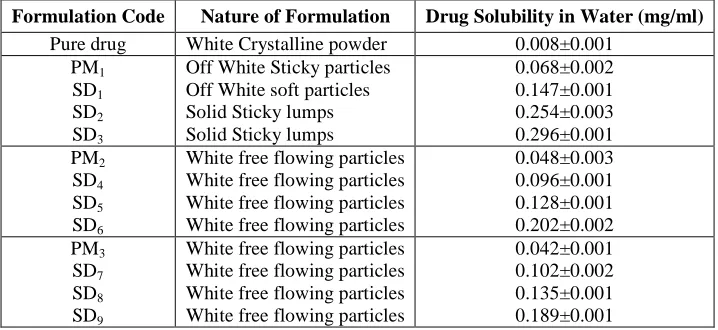
Flurbiprofen is practically insoluble in water as the intrinsic solubility of flurbiprofen in pure water at room temperature is found to be 0.084mg/ml. Among PMs and SDs (1:5) the carrier PEG 6000 containing PM and SD showed highest saturation solubility. This may be due to the inherent differences between the carriers in terms of hydration, dissolution and possible complexation of drug with different carriers. Details of Physical mixtures and Solid dispersions were illustrated in Table 3.
Drug content analysis
Drug content is found to be between 95.72 % and 102.48 %. All the Physical mixtures and Solid dispersions showed presence of high drug content and low standard deviations of results. It is indicated that the drug is uniformly dispersed in the powder formulation. Therefore, the method used in this study appears to be reproducible for the preparation of Solid dispersions.
In vitro dissolution study
The formulation of solid dispersion of Flurbiprofen with various carriers like PEG 6000, PVP K30 and Urea were screened for the selection of suitable carriers. These carriers were found to be encouraging since they did not undergo any chemical change during the preparation of solid dispersion. The solid dispersion of Flurbiprofen with carriers PEG 6000, PVP K30, and Urea showed a marked increase in the dissolution rate in pH 6.8 phosphate buffer. Dissolution of the flurbiprofen increased with increasing proportions of carriers and from all the formulations, the ratio of Flurbiprofen : PEG 6000 (SD3) showed (1:5) maximum proving that higher
concentration of matrix formed with PEG 6000 of ratio 1:5 increased the dissolution rate. These observations indicate the enhanced dissolution of Solid dispersions with increase in the concentration of carriers possibly due to the increased wet‐ability of the drug by the carrier, drug particle size reduction in the course of the solid dispersion preparation, polymorphic transformation of drug crystals and chemical interactions between drug and carrier.
Stability studies
Solid dispersion (SDs) of Flurbiprofen with different carrier (PEG 6000, PVP K30 and Urea) with Fusion method and their physicochemical characterization using FT‐IR spectroscopy, Solubility studies, Drug content analysis, Dissolution studies and Stability studies. All Physical mixtures and Solid dispersions shows high drug content (>95 %).
Table I: Composition of Various Solid dispersions of Flurbiprofen
Ingredients F1 (1:1) F2 (1:4) F3 (1:5) Flurbiprofen (mg) 100 100 100 PEG 6000 (mg) 100 400 500 PVP K30 (mg) 100 400 500
[image:5.595.143.453.283.440.2]Urea (mg) 100 400 500
Table II: Details of Formulations
[image:5.595.119.478.475.640.2]Formulation Code Carrier Drug:carrier ratio Method PM1 SD1 SD2 SD3 PEG 6000 1:1 1:1 1:4 1:5 Physical Mixture Solid Dispersions (Fusion Method) PM2 SD4 SD5 SD6 PVP K30 1:1 1:1 1:4 1:5 Physical Mixture Solid Dispersions (Fusion Method) PM3 SD7 SD8 SD9 Urea 1:1 1:1 1:4 1:5 Physical Mixture Solid Dispersions (Fusion Method)
Table III: Physical Characters and Solubility of formulations (PMs and SDs) in distilled water
Formulation Code Nature of Formulation Drug Solubility in Water (mg/ml) Pure drug White Crystalline powder 0.008±0.001
PM1 SD1 SD2 SD3
Off White Sticky particles Off White soft particles Solid Sticky lumps Solid Sticky lumps
0.068±0.002 0.147±0.001 0.254±0.003 0.296±0.001 PM2 SD4 SD5 SD6
White free flowing particles White free flowing particles White free flowing particles White free flowing particles
0.048±0.003 0.096±0.001 0.128±0.001 0.202±0.002 PM3 SD7 SD8 SD9
White free flowing particles White free flowing particles White free flowing particles White free flowing particles
0.042±0.001 0.102±0.002 0.135±0.001 0.189±0.001
ambient room conditions showed no change in the physical character and drug content. It is concluded that dissolution of the Flurbiprofen could be improved by solid dispersions and PEG 6000 based Solid dispersions are more effective in the enhancing the dissolution. The dissolution of a poorly/sparingly soluble drug is based on the bioavailability and method employed for the particle size reduction of different methods used for the preparation of Solid dispersion was briefly reviewed in the introduction. The spectrophotometric method was most suitable for estimation of the drug content and dissolution study of various Solid dispersion of Flurbiprofen which was adopted throughout the investigation. The formulation of Solid dispersion of Flurbiprofen with various carriers like PEG 6000, PVP K30 and Urea were screened for the selection of suitable carriers. These carriers were found to be encouraging since they did not undergo any chemical change during the preparation of Solid dispersion. Solid dispersions of Flurbiprofen in pH 6.8 phosphate buffer were prepared using the dissolution apparatus described in the USP Paddle‐II. The results obtained in the dissolution study were found to be satisfactory. This revealed that the solid dispersion of Flurbiprofen with carriers PEG 6000, PVP K30, and Urea showed a marked increase in the dissolution rate in pH 6.8 phosphate buffer. Above all the formulations the ratio of Flurbiprofen : PEG 6000 (SD3) showed (1:5) maximum proving that
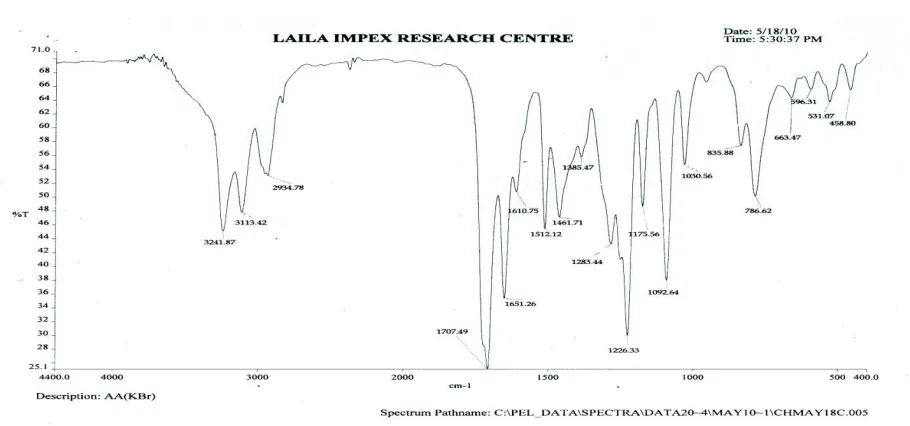
higher concentration of matrix formed with PEG 6000 of ratio 1:5 increased the dissolution rate. The increase in the in vitro characteristics can be attributed due to the formation of Solid dispersion of Flurbiprofen with carriers, with resulting size reduction. In addition to the size reduction of the crystalline substance, the faster dissolution rate of the drug may be due to excellent wettability and dispersability of drug from a Solid dispersion system prepared with water soluble carriers. A comparative study of in vitro dissolution profile of different ratios of Flurbiprofen and its various carriers were studied and shown in Figure 2, 3, 4 and FT-IR spectra of Solid dispersions were shown in Figure 5, 6, 7.
Invitro dissolution data for PEG6000, PVP K30,
Flurbiprofen-Urea Solid dispersion formulations
Table-IV: Dissolution data of Flurbiprofen-PEG6000 Solid Dispersion
Time Pure drug Solid Dispersion (Flurbiprofen : PEG 6000) Physical mixture 1:1 1:4 1:5 15 15.06±1.8 16.02±1.6 18.03±1.3 21.03±1.5 25.03±1.9 30 29.78±1.6 32.43±1.5 44.12±1.8 47.12±2.2 56.12±1.4 60 46.42±2.1 50.29±2.4 76.68±2.3 81.68±2.4 89.68±2.9 90 59.62±1.9 68.38±1.8 80.56±2.0 92.56±2.3 99.56±2.1
Table-V: Dissolution data of Flurbiprofen-PVP K30 Solid Dispersion
Table-VI: Dissolution data of Flurbiprofen-Urea Solid Dispersion
Time Pure drug Solid Dispersion (Flurbiprofen : Urea) Physical mixture 1:1 1:4 1:5 15 15.06±1.8 39.01±1.3 43.18±1.2 58.01±1.5 66.02±1.7 30 29.78±1.6 50.53±1.6 60.12±1.0 71.13±1.9 78.56±1.2 60 46.42±2.1 60.49±2.5 72.42±1.1 83.65±1.5 88.19±2.4 90 59.62±1.9 78.32±1.1 88.62±2.6 93.32±2.8 97.33±1.0
Fig.1: Calibration curve for the estimation of Flurbiprofen in 0.1 N HCl at 254nm
dispersions (1:1, 1:4, 1:5)
Fig.3: Dissolution profiles in phosphate buffer pH 6.8 of Flurbiprofen: PVP K30 Solid dispersions (1:1, 1:4, 1:5)
Fig 5: FT-IR spectra of Flurbiprofen-PEG6000 Solid dispersion (1:5)
[image:9.595.76.531.378.591.2]Fig 7: FT-IR spectra of Flurbiprofen-Urea Solid dispersion (1:5)
Acknowledgement
The authors are thankful to Oceanic Pharma chem laboratories, Chennai for providing free gift samples of Flurbiprofen. We thank Principal, A. Prameela Rani Acharya Nagarjuna University, for supporting to carry out the entire research work.
REFERENCES
[1] Aulton, Aulton’s Pharmaceutics, The Design and manufacture of medicine, 3rd ed, p 293. [2] AA Noyes; WR Whitney. J Am Chem Soc., 1897, 19, 930‐4.
[3] W Nernst. Zeitschrift Physik Chemie., 1904, 47, 52‐5.
[4] E Galia; ENicolaides; D Horter; R Lobenberg; C Reppas; B Dressman. Pharm Res., 1998, 15, 698‐705.
[5] K Sekiguchi; N Obi. Chem Pharm Bull 1961, 9, 866‐72. [6] ATM Serajuddin. Bull Technique Gattefosse 1997, 90, 43‐50. [7] C Leuner; J Dressman. Eur J Pharm Biopharm 2000, 50, 47‐60.
[8] DM Brahmankar; SB Jaiswal. Bioavailability and bioequivalence biopharmaceutics and pharmacokinetics‐A Treatise. 1st ed. New Delhi (India): Vallabh Prakashan, 1995.
[9] QM Duncan; T Craig. Int J Pharm 2002, 231, 131‐144.
[10]T Tachibana; A Nakamura. Kolloid Z Polym 1965; 203, 130‐133.
[11]AS Kearney, DL Gabriel, SC Mehta, GW Radebaugh. Int J Pharm 1994; 104, 169‐174. [12]M Ahmad; A Fattah; HN Bhargava. Int J Pharm 2002; 235, 17‐33.
[13]H Joshi et al. Int J Pharm 2004; 269:251‐258.
[14]S Tripathy; PK Sharma; AK Banthia. Ind J Pharm Sci 2005; 42(9), 618‐620.
[15]L Lachman, HA Liberman, JB Schwartz. Pharmaceutical Dosage Forms: Tablets, 2 Nd Edition, Marcel Dekker Inc., USA, 1989, 367- 414.