
Contents lists available atScienceDirect
Physics
Letters
B
www.elsevier.com/locate/physletb
String
breaking
by
light
and
strange
quarks
in
QCD
John Bulava
a,
Ben Hörz
b,
c,
Francesco Knechtli
d,
∗
,
Vanessa Koch
d,
e,
Graham Moir
f,
Colin Morningstar
g,
Mike Peardon
eaCP3-Origins,UniversityofSouthernDenmark,Campusvej55,5230OdenseM,Denmark
bPRISMAClusterofExcellenceandInstituteforNuclearPhysics,JohannesGutenberg-Universität,55099Mainz,Germany cNuclearScienceDivision,LawrenceBerkeleyNationalLaboratory,Berkeley,CA94720,USA
dDept.ofPhysics,UniversityofWuppertal,Gaussstrasse20,D-42119,Germany eSchoolofMathematics,TrinityCollegeDublin,Dublin2,Ireland
fDept.ofMathematics,HurstpierpointCollege,CollegeLane,Hassocks,WestSussex,BN69JS,UnitedKingdom gDept.ofPhysics,CarnegieMellonUniversity,Pittsburgh,PA15213,USA
a
r
t
i
c
l
e
i
n
f
o
a
b
s
t
r
a
c
t
Articlehistory:
Received13February2019
Receivedinrevisedform29April2019 Accepted11May2019
Availableonline14May2019 Editor:B.Grinstein
Keywords: LatticeQCD Stringbreaking Heavyquarks
Theenergyspectrumofasystemcontainingastaticquarkanti-quarkpairiscomputedforawiderange ofsourceseparationsusinglatticeQCDwithNf=2+1 dynamicalflavours.Byemployingavariational methodwithabasisincludingoperatorsresemblingboththegluonstringandsystemsoftwoseparated staticmesons, thefirstthreeenergylevelsare determineduptoand beyondthe distancewhereit is energeticallyfavourableforthevacuumtoscreenthestaticsourcesthroughlight- orstrange-quarkpair creation,enablingboththesescreeningphenomenatobe observed.Theseparation dependenceofthe energyspectrumis reliablyparameterised overthissaturationregionwithasimplemodel whichcan beusedasinputforsubsequentinvestigationsofquarkoniaabovethresholdandheavy-lightand heavy-strangecoupled-channelmesonscattering.
©2019TheAuthors.PublishedbyElsevierB.V.ThisisanopenaccessarticleundertheCCBYlicense (http://creativecommons.org/licenses/by/4.0/).FundedbySCOAP3.
1. Introduction
QCD is believed to be responsible for confinement, the ex-perimentalobservation that quarksare never seen asasymptotic states [1].AfullunderstandingofwhyQCDconfinesremains elu-sive.Thesimplesttheoreticalprobeofthephenomenonisprovided by thepotential energy V
(
r)
of asystem madeofa static quark and anti-quark pair immersed in the QCD vacuum in a colour-lesscombination. This energy dependson the distance between thesources,andintheYang-Millstheoryofgluonsaloneitgrows linearly at asymptotically large separations. The rate of increase isthe well-known stringtension,σ
. Ifthestatic sources interact with the full QCD vacuum including light-quark dynamics, pair-creationoflight quarksmeansthesystemcan alsoresemble two separately-colourlessstatic-lightmesonsallowingthepotential en-ergytosaturateatlargeseparations.Thisphenomenon,inducedby light-quarkpaircreation,istermed‘stringbreaking’.Arisingfrompurelynon-perturbativeeffects,thestaticpotential requiresa robust method fordirect determination fromthe QCD
*
Correspondingauthorat:Dept.ofPhysics,UniversityofWuppertal,Gaussstrasse 20,D-42119,Germany.E-mailaddress:[email protected](V. Koch).
Lagrangian. LatticeQCD providessuch a framework, butstudying string breaking on the lattice is a technical and numerical chal-lenge.Thesimplestapproachwouldbetoevaluatetheexpectation value of largeWilson loopsin theQCD vacuum andobserve de-viation from an area law. However, Monte Carlo determinations of large loops suffer from poor signal-to-noise properties. Also, viewedintermsofeigenstatesoftheLatticeQCDHamiltonian,the creationoperatorcomprisingtheWilsonlineformingoneedgeof therectangularWilsonloophasverysmalloverlapontothe two-mesonsystemdominatingthegroundstateatlargeseparations.As a consequence,the saturation effectproves impossible toresolve from MonteCarlo studies ofWilson loops alone. Instead,a mix-ing analysisincludingtwo-meson‘broken’ stringstatesis needed [2–6].
In this work, by building a suitably diverse basis of creation operators, mixingbetweenthestate madebya gluonicfluxtube andthe brokenstring state resembling two static-lightor static-strange mesons is investigated fullyin the Nf
=
2+
1 theory on the lattice forthe firsttime. This enablesusto compute reliably the energies of the lowest three Hamiltonian eigenstates up to separationswherestringbreaking saturationoccurs.Asimple pa-rameterisationoftheresultingspectrum inthebreakingregion is given, which should provide invaluable first-principles input intohttps://doi.org/10.1016/j.physletb.2019.05.018
models of coupled-channel scattering of heavy-lightmesons and thedecaysofquarkonianearthreshold.
2. Methodology
We compute the potential energy of a system containing a heavyquark
Q
atspatialpositionxandaheavyanti-quark Q¯
atyinthestaticapproximation.Inthislimit,thequarksremain sepa-ratedbyr
=
y−
x,wherexandyareconservedquantumnumbers. Todeterminetheenergiesofthegroundstateaswellasthe first-andsecond-excitedstatearisingfrommixinginQCD,avariational technique isemployed. The input forthismixing calculationis a matrixoftemporalcorrelationfunctionsbetweentheinterpolator foraWilsonlineO
W,thetwo-static-lightO
BB¯ andthe two-static-strange meson statesO
BsB¯s. It is essential that the interpolators transformirreduciblyundertheappropriatesymmetrygroup.2.1. Interpolators
Asuitable interpolator
O
W creatinga gluonstring connecting sitesxandyattimet
isgivenbyO
W(y,
x,t)
= ¯
Q(y,
t)
γ
·
rr
W
(y,
x,t)
Q(x,
t),
(1) whereγ
isthethree-vectorofspatialDiracmatricesandthe Wil-son lineW
(
y,
x,
t)
isa product of spatial lattice links withtime argumentt
connectingxandy.Wilsonlinesareconstructedusing avariantoftheBresenhamalgorithm[7] toapproximatethe short-estconnectionbetweenxandy,cf.[8].Theheavy-quarkspinsare coupledsymmetricallyviaγ
·
r/
r,whichhasazerocomponentof angularmomentumprojectedalongr.Inthestaticlimit,boththe symmetric andantisymmetric combinations give an energylevel inthe+g irreduciblerepresentationoftherotationgrouparound raftertheheavy spinsaredecoupled.Decouplingtheheavyspins inthetwo-static-meson systemsimilarlyyieldsacomposite oper-atorinthe
+g irrep.Detailsofthisconstructioncanbe foundin Ref. [6].Withlight-quarkflavours
q
i,i
= {
u,
d,
s}
,suitable interpo-latorsfora two-static-light- ortwo-static-strange-mesonstateare givenbyO
BB¯(x,y,
t)
=
1√
2
i=u,d
¯
Q
(y,
t)
γ
5qi(y,
t)
q¯
i(x,
t)
γ
4γ
5Q(x,
t),
O
BsB¯s(x,
y,t)
= ¯
Q(y,
t)
γ
5qs
(y,
t)
q¯
s(x,
t)
γ
4
γ
5Q(x,
t).
(2)For the two-static-light-meson state, the sum projects onto the isospin-zerochannel.Notice thatourinterpolators Eq. (2) contain a
γ
4 because for theinversion of the Diracoperator we usethe conventionofRef. [9].2.2. Correlation matrix
Forthe Nf
=
2+
1 theory, a 3×
3 matrixcan be constructed fromthepair-wisecorrelationsofthetwoisospin-zeromeson-pair creationandannihilationoperatorsincombinationwiththestring interpolationoperatorC
(r,
t)
=
⎛
⎝
O
W(
t)
O
W(
0)
O
BB¯(
t)
O
W(
0)
O
BsB¯s(
t)
O
W(
0)
O
W(
t)
O
BB¯(
0)
O
BB¯(
t)
O
BB¯(
0)
O
BsB¯s(
t)
O
BB¯(
0)
O
W(
t)
O
BsB¯s(
0)
O
BB¯(
t)
O
BsB¯s(
0)
O
BsB¯s(
t)
O
BsB¯s(
0)
⎞
⎠
.
(3)
Whenmixingoccurs, theabovebasisstatesarenotenergy eigen-statesanymoreandoff-diagonalelementsofthecorrelationmatrix
Table 1
Theparametersofthequark-lineestimationmethodemployedinthiswork.Nv=
192 eigenvectorswereusedtoformthedistillationoperator.Quarklinesstarting andterminatingat thesametimeslicets=tf arereferredtoas‘relative’,while
quarklineswithts=tf arecalled‘fixed’.FordefinitionoftheLapHsubspaceand
specificationofdilutionschemes,see[9].Fortheseschemes,atotalof32·5·2+ 32·2·8=832 (light)and32·2·2+32·8=384 (strange)solutionsoftheDirac equationarerequiredpergaugeconfiguration,whichhowevercanbereusedfor otherspectroscopyprojects,seee.g.[18].
light strange
Type Dilution scheme Source times,ts/a Nr ninv Nr ninv
fixed (TF,SF,LI8) {32, 52} 5 320 2 128
relative (TI8,SF,LI8) {32, 33, . . . , 95} 2 512 1 256
are non-vanishing. Following the method presented in [10], all gauge-linksaresmeared usingHYP2parameters[11,12]
α
1=
1.
0,α
2=
1.
0,α
3=
0.
5, where the smearing of the temporal links amounts to a modification of the Eichten-Hill static action and propagator [13] which reduces the divergent mass renormalisa-tionandimprovesthesignal-to-noiseratioatlargeEuclideantimes [12]. As a second step, we construct a variational basis for the string state using 15and 20 levels of HYP-smeared spatial links withparameters:α
2=
0.
6,α
3=
0.
3,extendingEq. (3) toa 4×
4 matrix.Some correlation functions in C
(
r,
t)
include multiple light-quark field insertions. The light-quark fields must be integrated analytically prior to Monte Carlo evaluation of C(
r,
t)
and the resulting Wick contractions involve numerically challenging dis-connectedcontributions.Inordertocalculatethesecontributions, andtoreducestatisticalvariancebyexploitingtranslational invari-ance ofthelattice,propagatorsbetweenallspace-timepoints are needed.Forthis,weemploythestochasticLapHmethod[9].Based on distillation [14], the method facilitates all-to-all quark prop-agation in a low-dimensionalsubspace spanned by Nv low-lying eigenmodes ofthethree-dimensionalgauge-covariant Laplace op-erator, whichisconstructed usingstout-smearedgauge links[15] with parametersρ
=
0.
1, nρ=
36. This projection onto theso-calledLapHsubspaceamountstoaformofquarksmearing,where Nv increasesinproportiontothespatialvolumeforafixed physi-calsmearingradius.IntroducingastochasticestimatorintheLapH subspaceincombinationwithdilution[16,17] helpstoreducethe riseincomputationalcostsasthevolumeincreases.Itwasshown [9] thatforcertain dilutionschemes,thequalityofthestochastic estimator remains approximatelyconstant forincreasing volume, whilemaintainingafixednumberofdilutionprojectors.Thetriplet b
=
(
T,
S
,
L)
specifiesa dilutionschemewithtime T,spin S and LapHeigenvectorprojectorindexL
,whereF
indicatesfulldilution and In theinterlacing ofdilutionprojectorsinindexn.The dilu-tionschemeandotherstochastic-LapH parametersusedaregiven inTable1.2.3. Variational analysis
Acorrelationmatrixisevaluatedforasetofstatic-source sep-arations r and time separations t. The energy spectrum of the system foreach spatial separation can be extracted by solving a generalisedeigenvalueproblem(GEVP)foreachr [19,20],
C
(
t)
vn(
t,
t0)
=
λ
n(
t,
t0)
C(
t0)
vn(
t,
t0) ,
n=
1, . . . ,
N,
t>
t0,
(4)Tosimplifytheanalysis,theGEVPisfirstsolvedforafixedpair oftimeseparations,
(
t0,
td)
wheret
0isareferenceseparationandtd isthe diagonalisation time [21]. The correlation matrixof the resultinginterpolatorsfromthisoptimisation isthendefinedas
ˆ
Ci j
(
t)
=
vi(
t0,
td),
C(
t)
vj(
t0,
td)
,
(5)wheretheparenthesesdenote aninner product overthe original operatorbasis.Apotentialsourceofsystematicerrorisintroduced, asoff-diagonal elements of C
ˆ
i j are not exactly zero.We control thisbyassessingthestabilityoftheGEVPagainstvaryingthe op-eratorbasisandusingdifferentpairs(
t0,
td)
.Comparingtheresults forsome sample distancesto theGEVPasgiveninEq. (4) shows agreementbetweenbothmethods.Weareinterestedinthedifferencebetweentheenergies
V
n(
r)
oftheground(
n=
0)
,first(
n=
1)
andsecondexcitedstate(
n=
2)
andtwicetheenergyofthestatic-lightmeson2EB,whichcanbe directlyextractedfromfitstotheratioRn
(
t)
=
ˆ
Cnn(
t)
C2B
(
t)
,
(6)ofthediagonalelementsoftherotatedcorrelationmatrixofEq. (5) andthecorrelationfunctionofasingle static-lightmesonsquared C2B
(
t)
.Theenergydifferenceisextractedusingasingle-exponential fit.Thefittedenergiestypicallyvarylittleasdiagonalisation times(
t0,
td)
oroperatorbasisarevaried.3. Numericalresults
Monte Carlo samples are evaluated on a subset of evenly-spacedconfigurations of the N200 CLS (Coordinated Lattice Sim-ulations)ensemblewith Nf
=
2+
1 flavoursofnon-perturbativelyO
(
a)
-improved Wilson fermions. The lattice size is Nt×
N3s=
128×
483 withanestimatedlatticespacingof0.064 fmandpion andkaon massesof mπ=
280 MeV and mK=
460 MeV respec-tively [22]. Open temporal boundary conditions are imposed on thefields.Theimprintonobservablesisexpectedtofall exponen-tiallywithdistancefromtheboundary[23] someasurements are madeonthecentralhalfofthelatticeonly.Previousstudies found thesignal quality to be limitedby the Wilson-loopcorrelation functions[6], whicha preliminary analy-sisonasubsetofourdatacorroborated.Wemitigatethisissueby measuring Wilson loops on 1664 configurations, while diagrams containing light or strange propagators are evaluated on a sub-setof104samples.TheWilson loopsarethen averagedinto104 binscontaining16configurationseach,withthecentreofthebin alignedwithone entryin the104-configuration subset. For each separationr
=
(
r1,
r2,
r3)
,weexploit cubicsymmetry andaverage overspatialrotationstoincreaseourstatistics.Asexpected,no de-pendence on the directionis observed in our data. The analysis usesaJupyternotebook1 adaptedfromRef. [18].Statistical uncer-taintiesareestimatedusing800bootstrapresamplings[24,25] and the uncertainty quoted is given by 1σ
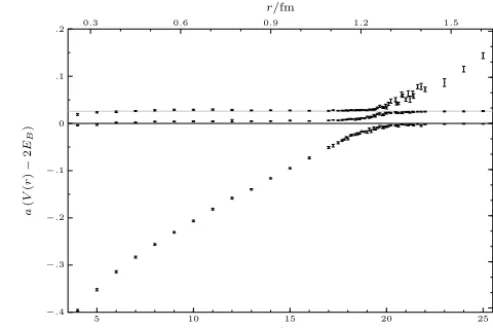
bootstrap errors. The co-variance matrix entering the single exponential fits to Eq. (6) is estimatedonceandkeptconstantoneverybootstrapsample.In Fig. 1, the potential energy relative to 2EB is shown; this subtraction removes the divergent mass renormalisation of a staticquark. Thegreylinecorrespondsto twicethestatic-strange mass, with an energy difference 2EBs
−
2EB=
0.
028(
5)
a−1=
85
(
16)
MeV. As expecteddue to the choice of light and strange quark masses, the difference issmaller than the physical energy differencebetweenB
andBsmesons. [image:3.612.311.558.71.235.2]1 https://github.com/ebatz/jupan.
Fig. 1.Staticpotentialdeterminedusingthefullmixingmatrix;thethreelowest lyingenergylevelsVn(r),n=0,1,2 areshown.Thegreylinecorrespondstotwice
thestatic-strangemesonmass, itserroristoosmalltobevisible.Theblackline correspondstotwicethestatic-lightmesonmass;theerrorisautomaticallytaken intoaccountbyusingtheratiogiveninEq. (6).Foralldistances,thefixedGEVP witht0/a=5,td/a=10 isused.
The avoided level crossing between the ground- and first-excited statesis clearly visible andthe expected second avoided crossingduetotheformationoftwostatic-strangemesonsisalso evident for the first time. As the distance over which this phe-nomenonoccursissmall,thiseffectcannotberesolvedusingonly on-axisseparations[26].Fordistancesbeyondthestringbreaking scale,thegroundstatetendsrapidlytowardsthemassoftwo non-interactingstatic-lightmesons.
The matrix of correlation functions Eq. (3) we use contains three very different operators, which should have strong over-lap onto the three lowest physical energy eigenstates. Following Ref. [19],weexpectproblemswithdeterminingenergiesfromthe GEVPusinga finitebasis willarise whenhigher statesforwhich nogoodoperatorappearsinthebasisarecloseinenergy.Wecan estimatewherethenextenergylevelsshouldbearoundthe break-ing region andthey are all higherby a scale of about500 MeV, substantiallylargerthanthegapsobserved.
The string breaking region is reproduced in more detail in Fig. 2. Both avoided crossingsare visibleandthe energygap be-tween the groundstate andfirst levelis larger thanthe gap be-tweenfirstandsecondlevels.Qualitatively,thefirstmixingregion appearstobe broader,butitisnotpossibletodeterminethe dif-ference betweenthe firststringbreakingdistance
r
c andthe sec-ondstringbreakingdistancer
cs byeye.Thequantificationofstringbreakinginvolvingthreelevels ismorecomplexincomparisonto thetwo-levelsituation.Forthe
N
f=
2 vacuum,thestringbreaking distancer
c canbedefinedbytheminimumoftheenergygapE [6]. When thestrange quark isincluded,an alternative definition ofthetwostringbreakingdistances
r
c andr
cs isneededasthereisnotnecessarilyaminimumenergygap.
4. Amodelofthestringbreakingspectrum
Wedescribethepotential-energyspectruminthebreaking re-gionusingasimpleHamiltonianthatextendsthemodelfor
N
f=
2 givenin[27].Considerathree-statesystemwithHamiltonian:H
(
r)
=
⎛
⎝
Vˆ
g1(
r)
gE1ˆ
1 g02 g2 0 Eˆ
2⎞
⎠
.
(7)Fig. 2.Six-parameterfittothestringbreakingdataofFig.1overthefitranger/a= [11,25].Theerrorbandindicates1σ bootstraperrors.
ofstatic-light andstatic-strangemesons, respectively. As with V
ˆ
, theseenergies are measured relative to 2EB. g1 and g2 are two couplingconstantsdescribingthestrengthofthemixingbetween the gluon flux and the separated colour-screened static sources. The off-diagonaltermthat wouldmix the two-static-light-meson statewiththetwo-static-strange-mesonstateissettozero.There isnoconstraintonthismixingintheenergyspectrumaloneasa basis rotationshows anynon-zerovalue of thisparameter yields an equivalent spectrum to the Hamiltonian of Eq. (7). Moreover, settingthisvaluetozeroensures thediagonalelementsof H cor-respondtotheasymptoticenergyeigenvaluesuptocorrectionsatO
(
r−1)
inthelimitr
→ ∞
.Asuitablechoice forthe functionrepresentingthestringstate is the Cornell potential [28]. Since we are modelling the string breakingregionandnotthepotential atsmalldistances,onlythe linearpartoftheCornellpotential
ˆ
V
(
r)
= ˆ
V0+
σ
r,
(8)withstringtension
σ
,is constrainedbyour data.Noticethat we assume that the modelparameters Eˆ
1, Eˆ
2, g1 and g2 in Eq. (7) are independent of the distance. We will see that this simplest possiblechoice modelsour dataverywell in theregionof string breaking.Theeigenstates oftheHamiltonianaremixturesofthe unbro-kenstringandthetwo static-light- andtwo static-strange-meson stateswhiletheeigenvaluesof
H
correspondtothethreeextracted energylevels. Afterdiagonalising H,we perform an uncorrelated six-parameterfittothespectrum,whoseresultisshowninFig.2. Wefindforourfitparameters:aE
ˆ
1=
0.
0019(
2),
aEˆ
2=
0.
0262(
6),
(9) ag1=
0.
0154(
4),
ag2=
0.
0080(
5),
a2
σ
=
0.
0229(
3),
aVˆ
0= −
0.
434(
5).
The model in Eq. (7) assumes a three state system. While it ispossiblethatthephysicaleigenstatesreceivecontributionsfrom higherlyingstatesFig.2showsthatourdataiswell-describedby thefitparameters.
We now turn to a quantitative definition ofthe string break-ingdistanceinthe
N
f=
2+
1 case.Toinvestigatethedependence of the string breaking distance on the sea quark masses, a ro-bust definition is needed. By using the asymptotic states of our model,whichforlargedistancesr
aregivenbythediagonalentriesFig. 3.Energygapbetweengroundandfirst-excitedstate(E1(r)),aswellas first-excitedandsecond-excitedstate(E2(r))fromthemodelfitaswellasfromour data.Theerrorbandanderrorbarsindicate1σ bootstraperrors.
Table 2
Numberofbound-statesolutionsEnl<0 forbottomoniumandcharmoniumofthe
Schrödingerequation.
mQ l=0 l=1 l=2 l=3 l=4
mb 3 3 2 2 1
mc 2 1 1 – –
of our Hamiltonian, we extract two distinct string breaking dis-tancescorrespondingtothelightandstrangemixingphenomenon. The string breaking distance,rc associated withtheformation of two static-light quarks is given by the crossing distance where
ˆ
V
(
rc)
= ˆ
E1andacorrespondingdefinitioncanbeemployedto de-finer
cs usingVˆ
(
rcs)
= ˆ
E2.Ourcalculationyieldsrc
=
19.
053(
82)
a=
1.
224(
15)
fm,
rcs
=
20.
114(
87)
a=
1.
293(
16)
fm.
(10)Thequotederrorsforthephysicalunitstakeintoaccount the un-certaintyof
a
=
0.
06426(
76)
fm [29].Fig. 3 showsthat the energy gap
E1
(
r)
=
V1(
r)
−
V0(
r)
be-tween thegroundandfirst-excitedstate doesnotexhibit a mini-mum, thusmakingit impossibletousethe minimalgapdistance to define rc. It can also be observed that in the string breaking region,E1
(
r)
istwiceaslargeasE2
(
r)
=
V2(
r)
−
V1(
r)
,the en-ergygapbetweenthefirst-excitedandsecond-excitedstate.Onlyone previousstudy[6] ofstringbreaking forNf
=
2 QCD on the lattice exists withmπ=
640 MeV. However, the differingdefinitionsandquark contentofthevacua meanitisnotpossible to makea statement onquark massdependence.Using the posi-tionoftheminimalenergygap,theyfindr
ˆ
c≈
1.
248(
13)
fm.Even though in thisstudythe pionmasswas relatively heavy,rˆ
c isof the sameorderofmagnitudeasour resultandfallsbetweenour valuesforr
c andr
cs.4.1. Phenomenology
To make a first, simple comparison between our data and the experimentally observed quarkonium spectrum, we use the ground-state energy computed from our model Eq. (7) as input potential intheSchrödingerequationandextracttheboundstate energies of quarkonia in the Born-Oppenheimer approximation. We useinput bottom- and charm-quark masses
m
b=
4977 MeV, [image:4.612.306.551.72.236.2]Thenumberofbottomonium boundstatesislistedinthefirst row of Table 2. We observe three S-wave states in agreement withthe physicalspectrum of
ϒ
mesons. We donot find bound states beyond l>
4. For the states closest to the threshold for each angular momentum, the size of the wave function as de-termined from the root mean-square radius is between 0.
63rc and0.
79rc.WealsosolvedtheSchrödingerequationwhensettingV
(
r)
=
min{
σ
r+ ˆ
V0,
0}
andfindchangesinenergies oflessthan 10 MeV,withintheerrorsfromthefitparameters,sothe bound-statespectrumisnotsensitive tothewidthofthemixingregion. ThesecondrowofTable2showsthenumberofboundstateswe findforcharmoniumforcomparison.Thiscalculationisonlyacheckthat countingtheboundstates leads to sensible results. Our model Eq. (7) provides input for more refined calculations of the coupled-channel scattering of heavy-light mesons and the decays of quarkonia around thresh-old.
5. Conclusions
This work presents a first calculation of string breaking with Nf
=
2+
1 dynamicalquarksfromlatticeQCD onasingle ensem-blewith light/strange quark massesthat are heavier/lighter than innature, corresponding to mπ=
280 MeV and mK=
460 MeV. Wecompute thethree lowestenergylevels ofa staticquarkand anti-quark pair and observe the avoided level crossings due to pair-creationoflightandstrangeseaquarks.Ourmainresultcan be summarised in the model of Eq. (7) which provides a very good description ofour spectrum, shown inFig. 2. In particular, weextract the valuesofthe parameters g1=
47.
2(
1.
4)
MeV andg2
=
24.
5(
1.
6)
MeV which describe themixingbetweenthe glu-onicfluxtubeandthebrokenstring.Furtheranalysistostudythedependenceofstringbreakingon thequarkmassesisinprogress.
Acknowledgements
We thank Tomasz Korzec for suggesting a test of the code of the correlation matrix. The authors wish to acknowledge the DJEI/DES/SFI/HEA Irish Centre for High-End Computing (ICHEC) forthe provision of computational facilities andsupport. We are grateful to our colleagues within the CLS initiative for sharing ensembles. The code for the calculations using the stochastic LapH method isbuilt on the USQCD QDP++/Chroma library [32]. BH was supported by Science Foundation Ireland under Grant No. 11/RFP/PHY3218. CJM acknowledges support by the U.S. Na-tionalScience Foundation under awardPHY-1613449. VK has re-ceivedfundingfromtheEuropean Union’sHorizon 2020research and innovation programme under the Marie Sklodowska-Curie grantagreementNumber642069.
References
[1] K.G.Wilson,Confinementofquarks,Phys.Rev.D10(1974)2445–2459,https:// doi.org/10.1103/PhysRevD.10.2445,[319(1974)].
[2] I.T. Drummond, Strong coupling model for string breaking on the lattice, Phys.Lett.B434(1998)92–98,https://doi.org/10.1016/S0370-2693(98)00747 -3,arXiv:hep-lat/9805012.
[3] O.Philipsen,H.Wittig,StringbreakinginnonAbeliangaugetheorieswith fun-damentalmatterfields,Phys.Rev.Lett.81(1998)4056–4059,https://doi.org/ 10.1103/PhysRevLett.81.4056,arXiv:hep-lat/9807020,Erratum:Phys.Rev.Lett. 83 (2684)(1999),https://doi.org/10.1103/PhysRevLett.83.2684.
[4] F.Knechtli,R.Sommer,StringbreakinginSU(2)gaugetheorywithscalar mat-ter fields, Phys. Lett.B 440(1998)345–352, https://doi.org/10.1016/S0370 -2693(99)00442-6, arXiv:hep-lat/9807022, Erratum:Phys. Lett. B 454 (399) (1999),https://doi.org/10.1016/S0370-2693(98)01098-3.
[5] F.Knechtli,R.Sommer,StringbreakingasamixingphenomenonintheSU(2) Higgsmodel,Nucl.Phys.B590(2000)309–328,https://doi.org/10.1016/S0550 -3213(00)00470-3,arXiv:hep-lat/0005021.
[6] G.S.Bali,H.Neff,T.Duessel,T.Lippert,K.Schilling,Observationofstring break-inginQCD,Phys.Rev.D71(2005)114513,https://doi.org/10.1103/PhysRevD. 71.114513,arXiv:hep-lat/0505012.
[7]J.E.Bresenham,Algorithmforcomputercontrolofadigitalplotter,IBMSyst.J. 4(1965)25–30.
[8] B.Bolder,T.Struckmann,G.S.Bali,N.Eicker, T.Lippert,B.Orth,K.Schilling, P.Ueberholz, AhighprecisionstudyoftheQanti-Qpotential fromWilson loopsintheregimeofstringbreaking,Phys.Rev.D63(2001)074504,https:// doi.org/10.1103/PhysRevD.63.074504,arXiv:hep-lat/0005018.
[9] C.Morningstar,J.Bulava,J.Foley,K.J.Juge,D.Lenkner,etal.,Improved stochas-ticestimationofquarkpropagationwithLaplacianHeavisidesmearingin lat-ticeQCD,Phys.Rev.D83(2011)114505,https://doi.org/10.1103/PhysRevD.83. 114505,arXiv:1104.3870.
[10] M.Donnellan, F.Knechtli,B.Leder, R.Sommer,Determination ofthestatic potential withdynamicalfermions,Nucl.Phys.B849(2011)45–63,https:// doi.org/10.1016/j.nuclphysb.2011.03.013,arXiv:1012.3037 [hep-lat].
[11] A.Hasenfratz,F.Knechtli,Flavorsymmetryandthestaticpotentialwith hy-percubic blocking, Phys. Rev.D 64 (2001) 034504, https://doi.org/10.1103/ PhysRevD.64.034504,arXiv:hep-lat/0103029.
[12] M.DellaMorte,A.Shindler,R.Sommer,Onlatticeactionsfor staticquarks, J. HighEnergyPhys.0508(2005)051,https://doi.org/10.1088/1126-6708/2005/ 08/051,arXiv:hep-lat/0506008.
[13] E. Eichten, B.R. Hill, An effective field theory for the calculation of ma-trixelements involvingheavyquarks,Phys. Lett.B234(1990) 511,https:// doi.org/10.1016/0370-2693(90)92049-O.
[14] M. Peardon, et al., A novel quark-field creation operator construction for hadronic physics in lattice QCD, Phys. Rev. D 80 (2009) 054506, https:// doi.org/10.1103/PhysRevD.80.054506,arXiv:0905.2160.
[15] C.Morningstar,M.J.Peardon,AnalyticsmearingofSU(3)linkvariablesin lat-ticeQCD,Phys.Rev.D69(2004)054501,https://doi.org/10.1103/PhysRevD.69. 054501,arXiv:hep-lat/0311018.
[16]W.Wilcox, Noisemethods for flavorsinglet quantities,in: Numerical Chal-lenges in Lattice Quantum Chromodynamics. Proceedings, Joint Interdisci-plinary Workshop, Wuppertal, Germany, August 22–24,1999, pp. 127–141, arXiv:hep-lat/9911013.
[17] J.Foley,K.JimmyJuge,A.O’Cais,M.Peardon,S.M.Ryan,etal.,Practical all-to-allpropagatorsforlatticeQCD,Comput.Phys.Commun.172(2005)145–162, https://doi.org/10.1016/j.cpc.2005.06.008,arXiv:hep-lat/0505023.
[18] C.Andersen,J.Bulava,B.Hörz,C.Morningstar,TheI=1 pion-pionscattering amplitudeand timelikepionformfactorfrom Nf=2+1 latticeQCD,Nucl. Phys. B939(2019)145–173,https://doi.org/10.1016/j.nuclphysb.2018.12.018, arXiv:1808.05007.
[19] B.Blossier,M.DellaMorte,G.vonHippel,T.Mendes,R.Sommer,Onthe gen-eralizedeigenvaluemethodforenergiesandmatrixelementsinlatticefield theory, J.HighEnergy Phys. 0904(2009)094,https://doi.org/10.1088/1126 -6708/2009/04/094,arXiv:0902.1265.
[20] M.Lüscher,U.Wolff,Howtocalculatethe elasticscatteringmatrixin two-dimensional quantum fieldtheoriesbynumerical simulation, Nucl. Phys. B 339 (1)(1990)222–252,https://doi.org/10.1016/0550-3213(90)90540-T. [21] J.Bulava, B.Fahy, B.Hörz, K.J.Juge, C.Morningstar, C.H.Wong, I=1 and
I=2π−π scatteringphaseshiftsfromNf=2+1 latticeQCD,Nucl.Phys. B910(2016)842–867,https://doi.org/10.1016/j.nuclphysb.2016.07.024,arXiv: 1604.05593.
[22] M. Bruno, et al., Simulation of QCD with Nf =2+1 flavors of
non-perturbativelyimprovedWilsonfermions,J.HighEnergyPhys.02(2015)043, https://doi.org/10.1007/JHEP02(2015)043,arXiv:1411.3982.
[23] M. Lüscher, S. Schaefer, Lattice QCD with open boundary conditions and twisted-mass reweighting, Comput. Phys. Commun. 184 (2013) 519–528, https://doi.org/10.1016/j.cpc.2012.10.003,arXiv:1206.2809.
[24]B. Efron,Bootstrap methods:anotherlookat thejackknife,Ann.Stat. 7 (1) (1979)1–26.
[25]B.Efron,R.Tibshirani,BootstrapMethodsforStandardErrors,Confidence In-tervals,andOtherMeasuresofStatisticalAccuracy,vol.1,Instituteof Mathe-maticalStatistics,1986.
[26]V.Koch,J.Bulava,B.Hörz,F.Knechtli,G.Moir,C.Morningstar,M.Peardon, String breaking with 2+1 dynamical fermions usingthe stochastic LapH method, in: 36th International Symposium on Lattice Field Theory, Lattice 2018,EastLansing,MI,UnitedStates,July22–28,2018,arXiv:1811.09289. [27]F.Knechtli,M.Günther,M.Peardon,LatticeQuantumChromodynamics:
Prac-ticalEssentials,SpringerBriefsinPhysics,Springer,2017.
[28] E.Eichten,K.Gottfried,T.Kinoshita,J.Kogut,K.D.Lane,T.M.Yan, Spectrum ofcharmedquark-antiquarkboundstates,Phys.Rev.Lett.34(1975)369–372, https://doi.org/10.1103/PhysRevLett.34.369.
[30] S.Capitani,O.Philipsen,C.Reisinger,C.Riehl,M.Wagner,Precision computa-tionofhybridstaticpotentialsinSU(3)latticegaugetheory,Phys.Rev.D99 (3) (2019)034502,https://doi.org/10.1103/PhysRevD.99.034502,arXiv:1811.11046. [31] S.Godfrey,N.Isgur,Mesonsinarelativizedquarkmodelwith chromodynam-ics,Phys.Rev.D32(1985)189–231,https://doi.org/10.1103/PhysRevD.32.189.
![Fig. 2. Six-parameter[ fit to the string breaking data of Fig. 1 over the fit range r/a =11, 25]](https://thumb-us.123doks.com/thumbv2/123dok_us/8798731.912935/4.612.306.551.72.236/fig-parameter-t-string-breaking-data-fig-range.webp)
