Dual-byte-marker algorithm for detecting JFIF header
Kamaruddin Malik Mohamad1, Tutut Herawan1,2 and Mustafa Mat Deris1
1
Faculty of Information Technology and Multimedia Universiti Tun Hussein Onn Malaysia Parit Raja, Batu Pahat 86400, Johor, Malaysia
2
Department of Mathematics Education Universitas Ahmad Dahlan Yogyakarta 55166, Indonesia
[email protected], [email protected], [email protected]
Abstract. The use of efficient algorithm to detect JPEG file is vital to reduce time taken for analyzing ever increasing data in hard drive or physical memory. In previous paper we proposed single-byte-marker algorithm for header detection. In this paper, we propose a novel algorithm so-called dual-byte-marker for header detection. It is based on a newly proposed FORHEADER model. Two experiments have been carried out using images from a hard disk and a physical memory. The experiment results show that dual-byte-marker algorithm provides better performance in executing time for header detection as compared to single-byte-marker.
Keywords: Forensics; JPEG JFIF; Data recovery.
1
Introduction
T.81) [8,9]. The other format is JPEG Extended File Information (Exif), created by Japan Electronic Industry Development Association for digital cameras [10]. Majority of researchers did not discuss about the JPEG header detection algorithm in detail. Motivation of comparing few algorithms for detecting headers is due to ever increasing hard disk size and the backlogs of law enforcement. By developing an automatic JPEG header detector, it would cut the time taken for analysis and can roughly predict the number of JPEG files exists in the tested computer. For an investigator who is currently working in the child pornography case escalating in the internet, the existence of headers in the suspect’s computer would mean that there is a possibility of evidence.
In this paper, we propose a novel algorithm, so-called dual-byte-marker for header detection using a newly proposed FORHEADER model. The JPEG JFIF is discussed here as it is the de-facto format for sharing in many applications and the internet [11]. The algorithm tested in the paper can also be applied for other JPEG file format, by changing the data structure of the header. From this point onwards, JPEG JFIF will be referred to as JFIF for simplicity. Firstly, three types of data are used for the JFIF header detection tests, images from a hard disk, and a physical memory. Secondly, FORHEADER model is proposed. It is adapted from FORSIGS and FORWEB [12]. The model will be used to run tests using the proposed algorithm. Lastly, the algorithm is compared according to the processing time by single-byte-marker algorithm [13] to process these data up to seconds. The algorithm with the least overall processing time for all types of data being tested is considered as the most efficient one to be used. The algorithm is written in C language. According to [1], only 16% of JFIF files are fragmented. Thus, it is much easier and faster to detect the existence of JFIF file through its header and footer. The header detection process can be described through the following steps.
a. Identify SOI (0xFFD8 – 2 bytes) marker (see Figures 1 and 2).
b. Once the SOI is found, locate JFIF identifier (see Figure 2) or “JFIF\0” (“JFIF” string terminated by NULL or “\0”).
c. Repeat step a and b until end of data.
SOI APP0 Length Identifier
2 bytes 2 bytes 2 bytes 5 bytes
Fig. 1. First 11 byte of JFIF file header format
SOI A PP0 Length Identifier
0xFF D8 0xFF E0 0x00 10 0x4A 46 49 46 00 J F I F NULL
2 bytes 2 bytes 2 bytes 5 bytes
Fig. 2. First 11 byte of a JFIF file header with sample of valid hex codes
model and then compares the results in terms of processing time with single-byte-marker algorithm. Finally the conclusion and the future activities of this work are described in section 4.
2
The proposed algorithm
This section discusses on the development of the proposed algorithm namely dual-byte-marker algorithm. The algorithm will report all detected JFIF headers and total processing time taken. The ways how the dual-byte-marker algorithm work is briefly listed below:
1) If two-byte structure read is 0xFFD8, read an eighteen-byte structure.
2) If ‘JFIF\0’ is found at the correct location in the structure, then JFIF header is found.
2.1 Dual-Byte-Marker Algorithm
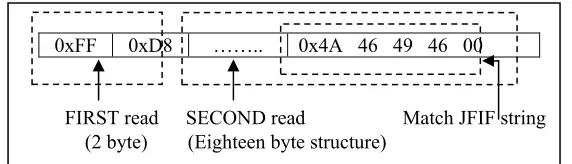
The name dual-byte-marker is used because two byte is read from the input. For a successful JFIF header search, the first two byte read must match 0xFFD8. After the first match, the second read obtained an eighteen-byte structure. The successful match is shown in Figure 1.
0xFF 0xD8 …….. 0x4A 46 49 46 00
[image:3.595.153.439.387.469.2]FIRST read SECOND read Match JFIF string (2 byte) (Eighteen byte structure)
Fig. 1. A match for JFIF header using “dual-byte-marker” algorithm
0xFF … …… ……
First Read (Partial-match) Next Read
… 0xD8 …… ……
First Read (Partial-match) Next Read
… … …… ……
[image:4.595.170.419.164.358.2]First Read (Non-match) Next Read
Fig. 2. First dual-byte-marker non-match case
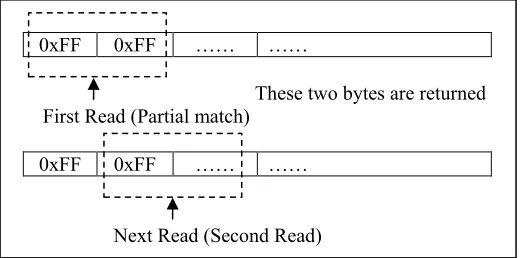
The second non-match happens when the first two byte read is a contiguous 0xFFFF instead of 0xFFD8. When this happens, the two bytes read need to be returned to the input stream. So, the next read (second read) would start at the second byte of the two byte returned. This is illustrated Figure 3.
0xFF 0xFF …… ……
These two bytes are returned First Read (Partial match)
0xFF 0xFF …… ……
[image:4.595.169.431.450.579.2]
Next Read (Second Read)
Fig. 3. Second dual-byte-marker non-match case
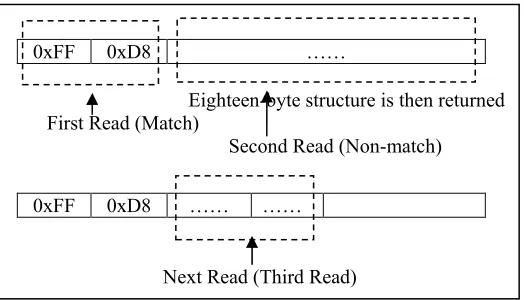
0xFF 0xD8 ……
Eighteen-byte structure is then returned First Read (Match)
Second Read (Non-match)
0xFF 0xD8 …… ……
[image:5.595.172.434.163.313.2]Next Read (Third Read)
Fig. 4. Third dual-byte-marker non-match case
The algorithm can be generalized as
Let P
( )
x be 0xFFD8 (SOI). Let Q( )
x be “JFIF\0” string.( )
( )
JFIFHeader isfound, ∧ ⇔
∈
∃ +
x Q x P Z x
[image:5.595.131.464.481.655.2]After considering all the cases, the algorithm for dual-byte-marker is illustrated in Figure 5.
Do
Read two-byte structure // FIRST read If two-byte = ‘0xFFD8’ marker then
Read whole structure // SECOND read 18-byte // structure If (the seventh-byte of the structure Match JFIF string) Valid JFIF Header is FOUND
Else
Return the structure (18 bytes) to input stream
Position the pointer to the STARTING byte of the returned structure
End-if
Else if second byte of the two-byte structure = 0xFF // if contiguous 0xFFFF is found
Return the structure (2 bytes) to the input stream
Position the pointer to the 2nd BYTE of the returned structure
End-if
While not end-of-image
Best case scenario:
This happens when the first read (two bytes) is P
( )
x , second read (18 bytes) is Q( )
x . Thus, every two reads, there is one successful detection of JPEG header. Thus, the big O value for best case scenario is( )
nn
Ο =
×2
20 .
Worst case scenario:
This happens when no JFIF header is found but all are ‘0xFF’s. Therefore, only two bytes are read every time, but every time the second byte is found to be ‘0xFF’, the second byte will be returned. The byte will be read in the next round as the first byte of the two byte read. Thus, the big O value for worst case scenario is
( )
nn 1 2
2 − =Ο .
3
Experiment test
This section discusses on the experiment done using FORHEADER model. The proposed dual-byte-marker algorithm will be tested using this model. Then we compare the results with that single-byte-marker algorithm [13]. The algorithms are separately implemented in C language using Windows XP operating system with processor Intel® dual core 1.8 MHz and 2GB memory.
3.1 FORHEADER model for JFIF header detection
To implement the model, these two algorithms are run separately to process the data from various data sources. For the first test, the program using single-byte-marker algorithm is run to process data from the memory image. The program searches for appropriate markers (e.g. SOI markers) and valid JFIF header structures from the data. The information of all the headers found and the total processing time taken will be displayed. All the tests are done using FORHEADER model.
3.2 Preparing Input for FORHEADER model
Two input data are prepared for these tests. The first input is memory image taken from 1GB physical memory using Helix Live CD [15,16,17]. To ensure the presence of JFIF files in the image, few JFIF files are simultaneously opened prior to taking the image. Second input data is the hard disk image taken from 8MB hard disk partition using Helix Live CD. There are totally no other files in the partition except few JFIF files. 8MB is the minimum partition size that can be allocated by the partition manager. The final input data is taken from DRFWS 2006 Challenge which is downloaded from the internet.
resources used in the experiment is shown below. a. Input files
1) hdd.dd - The total number of headers and footers found are shown in Table 1
and Figures 6 and 7.
2) mem.dd - The total number of headers and footers found are shown in Table 2
and Figures 8 and 9.
b. Algorithms developed using C language
3) single.c – implement single-byte-marker algorithm
4) dual.c – implement dual-byte-marker algorithm
c. The experiment of running and recording the processing time of each algorithm
against each input is done on an Intel® Core 2 Duo processor with 2GB of memory.
Table 1. Number of headers and footers in hdd.dd of size 8mb
JPEG Total number
header 6
footer 6
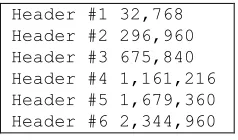
There are 6 headers found in hdd.dd at these addresses.
[image:7.595.239.358.394.464.2]Header #1 32,768 Header #2 296,960 Header #3 675,840 Header #4 1,161,216 Header #5 1,679,360 Header #6 2,344,960
Fig. 6. The header found
There are also 6 footers found in hdd.dd at these addresses.
[image:7.595.237.358.513.598.2]Footer #1 295,134 Footer #2 675,687 Footer #3 1,160,956 Footer #4 1,677,638 Footer #5 2,343,847 Footer #6 3,115,000
Fig. 7. The footer found
Table 2. Number of headers and footers in mem.dd
Data read from the file JPEG
30MB 60MB 90MB 120MB 150MB 180MB 600MB
header 2 2 2 2 7 8 33
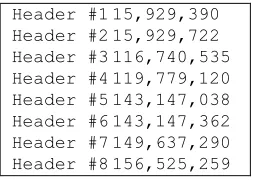
There are 8 headers found in mem.dd between address 0−180,000,000 at these addresses:
[image:8.595.235.362.183.273.2]Header #1 15,929,390 Header #2 15,929,722 Header #3 116,740,535 Header #4 119,779,120 Header #5 143,147,038 Header #6 143,147,362 Header #7 149,637,290 Header #8 156,525,259
Figure 8. The header found
There are also footers found in mem.dd between address 0−180,000,000 at these addresses.
Footer between 0-30,000,000 793 Footer between 0-60,000,000 1,448 Footer between 0-90,000,000 1,793 Footer between 0-120,000,000 2,000 Footer between 0-150,000,000 2,351 Footer between 0-180,000,000 2,836
Figure 9. The footer found
The number of headers and footers do not totally. This can cause many false positives when doing file carving. Nevertheless, this issue will not be discussed in this paper. Next, two experiments are done using FORDETECT model on various input data for detecting JFIF headers. Even though, experiments only done to locate headers, these algorithms can also be fine-tuned to extend the detection for footers and other markers as well.
3.3 First experiment
Table 3. Results of tests done on memory image (mem.dd) of size 1GB
Data read from mem.dd of size Algorithm
30MB 60MB 90MB 120MB 180MB 600MB
single 94.075 267.918 408.020 490.697 671.181 1959.070
dual 64.741 219.532 329.818 378.654 494.321 1365.277
3.4 Second experiment
The dual-byte-marker and single-byte-marker algorithms are run using data from hard disk image hdd.dd according to FORDETECT model. The result (processing time taken in seconds) is summarized in Table 4. Dual-byte-marker algorithm shows a better performance in this experiment.
Table 4. Results of tests done on hard disk image (hdd.dd) of size 8mb
Algorithm Data read from the file
single 21.860
dual 11.530
4
Conclusion
In this paper, we have proposed a novel algorithm, i.e. dual-byte-maker for JFIF header detections using a novel FORDETECT model. There are three contributions being demonstrated. Firstly, we proposed FORHEADER, a novel JPEG header detection model for analyzing data from few sources. Secondly, a novel algorithm dual-byte-marker for detecting JPEG header is proposed. Finally, we develop a proof-of-concept C program for JPEG header detection implementing these three algorithms. The results clearly show that dual-byte-marker algorithm gives the best performance based on its processing time as compare to single-byte-marker when applied using FORDETECT model to find JFIF headers.
Acknowledgement
This work was supported by Universiti Tun Hussein Onn Malaysia.
References
1. Garfinkel, S.L.: Carving continuous and fragmented files with fast object validation, Journal of Digital Investigation 4, 2−12 (2007)
2. Anadabrata, P., Husrev, T. and Sencar, N.M.: Detecting file fragmentation point
3. Golden, R., Roussev, G. and Scalpel, V.: A Frugal, High Performance File Carver, In the Proceedings of the 2005 digital forensics research workshop, (2005)
4. Karresand, M. and Shahmeri, N.: Reassembly of Fragmented JPEG Images
Containing Restart Markers, IEEE press (2008)
5. Pal, A., Shanmugasundaram, K. and Memon, N.: Automated Reassembly Of
Fragmented Images, AFOSR Grant F49620-01-1-0243, (2003)
6. Memon, N. and Pal, A.: Automated reassembly of file fragmented images using
greedy algorithms, IEEE press (2006)
7. Hamilton, E., JPEG File Interchange File Format – Version 1.02,
http://www.w3.org/Graphics/JPEG/jfif3.pdf
8. JPEG File Interchange Format, http://en.wikipedia.org/wiki/JFIF
9. Wallace, G.K.: The JPEG Still Picture Compression Standard, IEEE
Transactions on Consumer Electronics (1991)
10. Alvarez, P.: Using Extended File Information (EXIF) File Headers in Digital Evidence Analysis, International Journal of Digital Evidence, 2 (3) (2004)
11. Swee, L.H., JPEG for Digital Panel, Texas Instrument,
http://focus.tij.co.jp/jp/lit/an/spra664/spra664.pdf
12. Haggerty, J., Liewellyn-Jones, D. and Taylor, M.: FORWEB: File
Fingerprinting for Automated Network Forensics Investigations, 2007.
13. Mohamad, K.M. and Mustafa M.D.: Single-byte-marker for detecting JPEG
JFIF header using FORIMAGE-JPEG, in proceeding of NCM 2009, 1693−1698
(2009)
14. http://www.dfrws.org/2006/challenge/dfrws-2006-challenge.zip.
15. Austin, R. D.: Digital Forensics on the Cheap: Teaching Forensics Using Open
Source Tools, ACM press (2007)
16. http://www.e-fense.com/helix