R E S E A R C H
Open Access
On the security of compressed encryption
with partial unitary sensing matrices
embedding a secret keystream
Nam Yul Yu
Abstract
The principle of compressed sensing (CS) can be applied in a cryptosystem by providing the notion of security. In this paper, we study the computational security of a CS-based cryptosystem that encrypts a plaintext with a partial unitary sensing matrix embedding a secret keystream. The keystream is obtained by a keystream generator of stream ciphers, where the initial seed becomes the secret key of the CS-based cryptosystem. For security analysis, the total variation distance, bounded by the relative entropy and the Hellinger distance, is examined as a security measure for the indistinguishability. By developing upper bounds on the distance measures, we show that the CS-based cryptosystem can be computationally secure in terms of the indistinguishability, as long as the keystream length for each
encryption is sufficiently large with low compression and sparsity ratios. In addition, we consider a potential chosen plaintext attack (CPA) from an adversary, which attempts to recover the key of the CS-based cryptosystem. Associated with the key recovery attack, we show that the computational security of our CS-based cryptosystem is brought by the mathematical intractability of a constrained integer least-squares (ILS) problem. For a sub-optimal, but feasible key recovery attack, we consider a successive approximate maximum-likelihood detection (SAMD) and investigate the performance by developing an upper bound on the success probability. Through theoretical and numerical analyses, we demonstrate that our CS-based cryptosystem can be secure against the key recovery attack through the SAMD.
Keywords: Compressed encryption, Hellinger distance, Indistinguishability, Integer least-squares (ILS) problem, Relative entropy, Total variation distance, Stream ciphers
1 Introduction
Compressed sensing (CS) [1–4] is a novel data acquisition scheme that samples a signal at a sub-Nyquist rate, which allows simultaneous data acquisition and compression. The original signal can be faithfully recovered from the measurement samples, if it is sparse with respect to a par-ticular basis and sampled via a random projection. With efficient measurement and stable reconstruction, the CS technique has been of interest in a variety of research fields, e.g., communications [5–7], sensor networks [8–10], image processing [11–13], and radar [14].
Recently, a great deal of attention has been paid to the CS technique for data confidentiality in informa-tion security field. A CS-based cryptosystem encrypts a
Correspondence: [email protected]
School of Electrical Engineering and Computer Science, Gwangju Institute of Science and Technology (GIST), Gwangju, Korea
plaintext through a CS measurement process by keeping the sensing matrix secret. Then, the ciphertext can be decrypted by a CS reconstruction process. Thus, the CS-based cryptosystem performs simultaneous data acquisi-tion and encrypacquisi-tion at physical layer. Such a lightweight cryptosystem is particularly attractive for secure commu-nications in wireless sensor networks, where the resources are not sufficient for providing data confidentiality by conventional encryption.
The security potential of compressed sensing was hinted by Candes and Tao [3], where the measurement sam-ples were referred to as a weakly encrypted ciphertext. In [15], Rachlin and Baron proved that the CS-based cryptosystem cannot be perfectly secure but might be computationally secure. Orsdemir et al. [16] showed that it is computationally secure against a key search technique via an algebraic approach. Subsequently, many researchers have studied the security of CS-based cryptosystems
for practical applications, which will be discussed with more details in Section 2.3. For a comprehensive review of CS techniques in information security, readers are referred to [17].
In this paper, we study the computational security of a CS-based cryptosystem that encrypts a plaintext with a partial unitary sensing matrix embedding a secret keystream. The keystream to be embedded is obtained by a keystream generator of stream ciphers, which ensures fast and efficient generation of the keystream. Assum-ing that the keystream is part of the original one with an extremely long period, we renew it at each encryption, which leads to a one-time sensing (OTS) cryptosystem. Then, the initial seed (or state) of the original keystream generator is essentially the secret key of the CS-based cryptosystem. With the sensing matrix, we demonstrate that the CS-based cryptosystem theoretically guarantees a stable and robust CS decryption for a legitimate recipient. For security analysis, we first use probability metrics to investigate the security in a statistical manner. Thetotal variation (TV) distance [18] between probability distri-butions of ciphertexts conditioned on a pair of plaintexts is examined as a security measure for the indistinguisha-bility [19] of our CS-based cryptosystem. We investigate the TV distance by developing upper bounds on the rel-ative entropy[20] and theHellingerdistance [21], which demonstrates that our CS-based cryptosystem can be computationally secure in terms of the indistinguisha-bility, as long as the keystream length for each encryp-tion is sufficiently large with low compression MNand
sparsityKNratios.
Next, we analyze the security of our CS-based cryp-tosystem by examining the resistance against a cryptan-alytic attack. We consider a potential chosen plaintext attack(CPA) from an adversary to recover the key of our CS-based cryptosystem. In the CPA, the adversary needs to restore a keystream embedded in CS encryption, which is nontrivial unlike in stream ciphers, since the keystream is not outstanding from a known plaintext-ciphertext pair. Associated with the key recovery attack, we show that the security of our CS-based cryptosystem is based on the mathematical intractability of a constrainedinteger least-squares (ILS) problem. For a sub-optimal, but feasible key recovery attack, we consider a successive approxi-mate maximum-likelihood (ML) detection (SAMD) for the adversary’s CPA and investigate the performance by developing an upper bound on the success probability. Finally, theoretical analysis and numerical results reveal that our CS-based cryptosystem can be secure against the key recovery attack through the SAMD.
This paper is organized as follows. Section 2 reviews the CS principle, discusses some known CS-based cryp-tosystems, and summarizes the contributions of this
paper. In Section 3, we describe a mathematical model of the CS-based cryptosystem proposed by this paper. We discuss a theoretical guarantee of CS decryp-tion for a legitimate recipient by the cryptosystem. In Section 4, we analyze the indistinguishability of our CS-based cryptosystem, to demonstrate the computa-tional security. Section 5 introduces an adversary’s poten-tial CPA strategy for key recovery, where we describe the details and examine the performance of SAMD. Section 6 presents numerical results to demonstrate the reliability and the security of our CS-based cryp-tosystem. Finally, concluding remarks will be given in Section 7.
2 Background
2.1 Notations
A matrix (or a vector) is represented by a boldface upper (or lower) case letter.UTand|U|denote the transpose and the determinant of a matrixU, respectively. tr(U)denotes the trace of a matrixUor the sum of all diagonal entries of U. U(k,t) is an entry of anM× N matrix U in the
kth row and thetth column, where 0 ≤ k ≤ M−1 and 0 ≤ t ≤ N − 1. μ(U) denotes the maximum magni-tude of the entries ofU, i.e.,μ(U)=max
k,t |U(k,t)|. diag(s) is a diagonal matrix whose diagonal entries are from a vector s. An identity matrix is denoted by I, where the dimension is determined in the context.W is a conven-tionalN×N Walsh-Hadamard matrix, whereWWT = WTW=NI. Also,Ddenotes a discrete-cosine transform (DCT) matrix, whereDDT = DTD = NI. For a vector
x = (x0,· · ·,xN−1)T ∈ RN, thelp-norm ofxis denoted
by ||x||p =
N−1 k=0 |xk|p
1
p
, where 1 ≤ p < ∞. If the context is clear,||x|| denotes thel2-norm ofx. A vector
n ∼ N0,σ2Iis a Gaussian random vector with mean
0 = (0,· · ·, 0)T and covarianceσ2I. Finally,E[·] denotes the average of a random vector or a random matrix.
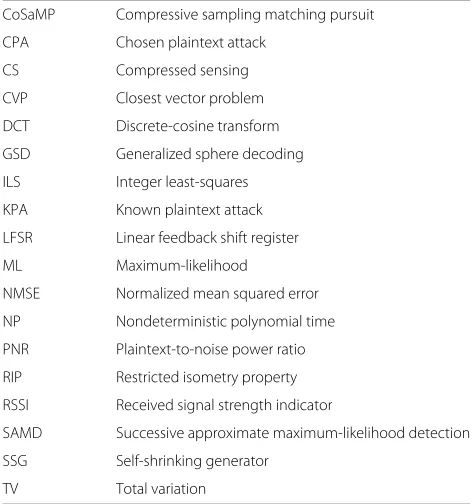
Table 1 summarizes the abbreviations of this paper.
2.2 Compressed sensing
Compressed sensing (CS) [1–3] is to recover a sparse signal from the measurements that are believed to be incomplete. A signal x ∈ RN is called K-sparse
with respect to a sparsifying (orthonormal) basis if θ = x has at most K nonzero entries, where
K N. The sparse signal x is linearly measured by
r = x+ n = Tθ + n ∈ RM, where is an
M×Nmeasurement matrix withM Nandn ∈ RM
Table 1Abbreviations
CoSaMP Compressive sampling matching pursuit
CPA Chosen plaintext attack
CS Compressed sensing
CVP Closest vector problem
DCT Discrete-cosine transform
GSD Generalized sphere decoding
ILS Integer least-squares
KPA Known plaintext attack
LFSR Linear feedback shift register
ML Maximum-likelihood
NMSE Normalized mean squared error
NP Nondeterministic polynomial time
PNR Plaintext-to-noise power ratio
RIP Restricted isometry property
RSSI Received signal strength indicator
SAMD Successive approximate maximum-likelihood detection
SSG Self-shrinking generator
TV Total variation
θ =argmin
θ ||θ||1subject to||Aθ −r||2≤
with convex optimization or greedy algorithms [4]. For simplicity, this paper assumes=I, or thatxis sparse in canonical basis, which yields the sensing matrix ofA=.
2.3 Prior works on CS-based cryptosystems
Since the foundational works of [15] and [16], there have been many research efforts on CS-based cryptosystems. Bianchi, Bioglio, and Magli [22, 23] analyzed the secu-rity of a noiseless CS-based cryptosystem utilizing ran-dom Gaussian sensing matrices in an OTS manner. In [24], a similar analysis has been made for a noiseless CS-based cryptosystem having a circulant sensing matrix for efficient CS processes. Cambareri et al. [25] pro-posed a CS-based cryptosystem that supports multiclass encryption using a random Bernoulli matrix and its class-dependent variations. In spite of exploiting different secu-rity measures, i.e., indistinguishability [23] and asymptotic spherical security [25], the security analyses of [23] and [25] showed that the statistical properties of ciphertexts reveal only the information about the energy of the plain-texts. The security of the multiclass encryption scheme has been further investigated in [26] against a known plaintext attack (KPA), by examining the average num-ber of candidate solutions matching a plaintext-ciphertext pair.
In addition to the secret sensing matrix, a CS-based cryptosystem may employ an extra cryptographic prim-itive, which can be considered as a product cipher. For
instance, scrambling or random permutation has been additionally accomplished, before [27] or after [28] CS encryption. In [29], nonlinear diffusion has been added to quantized ciphertexts. Zhang et al. [30] proposed a bi-level protected CS (BLP-CS), where the sparsifying basis and the sensing matrix are generated with different secret keys. In the BLP-CS, the knowledge of both the sparsifying basis and the sensing matrix is required for CS decryption. To gain a resistance against KPA and CPA, a CS-based cryptosystem normally operates in an OTS manner, by renewing the sensing matrix at each encryption. As the renewal requires the additional complexity and can quickly waste up the cryptographic resource for generat-ing each sensgenerat-ing matrix, a CS-based cryptosystem reusgenerat-ing the sensing matrix during multiple encryptions has also been of interest. However, it is insecure against KPA and CPA, since an adversary can easily recover the sensing matrix with N linearly independent plaintexts by solv-ing the system of linear equations [15]. While reussolv-ing the same sensing matrix, the BLP-CS [30] attempted to over-come the weakness and to achieve a CPA-resistance by ensuring a RIPless reconstruction for an adversary.
CS-based cryptosystems can work in a framework of physical layer security [31]. The emerging technol-ogy of physical layer security is a promising paradigm for enhancing wireless security [32], by exploiting the randomness of wireless channel characteristics. In [33], Agrawal and Vishwanath derived sufficient conditions for secret communications via CS in a wiretap channel. Reeves at al. [34] investigated the secrecy capacity of a wiretap channel employing CS. Dautov and Tsouri [35] used the received signal strength indicator (RSSI) from wireless channels for secure key establishment in a CS-based cryptosystem, where the shared key can be used to form a common sensing matrix in a sender and a recipient. In practice, a variety of CS-based cryptosystems concerning the security and privacy of multimedia, imag-ing, and smart grid data have been suggested and studied in [36–39].
2.4 Summary of contributions
generated by a keystream generator of stream ciphers. Based on the RIP analysis, the knowledge of the sens-ing matrix, or equivalently the keystream, theoretically guarantees a reliable CS decryption.
In security analysis, we obtain the result by two different approaches. On the one hand, we demonstrate the indis-tinguishability of our CS-based cryptosystem, by investi-gating the TV distance between probability distributions of a pair of ciphertexts. This statistical approach seems like the analysis of [23], but we use a new probability met-ric of the Hellinger distance [21] to characterize the TV distance. On the other hand, we consider a potential CPA from an adversary for key recovery of our CS-based cryp-tosystem. By formulating the CPA as an NP-hard problem, we show that the success of the CPA is computationally infeasible for a sufficiently large keystream length. In addi-tion, we introduce a sub-optimal but feasible CPA strategy and investigate the performance with the highest possible success probability. Finally, the CPA performance turns out to be quite poor even under an optimistic scenario, which guarantees the security against the CPA for our CS-based cryptosystem. The second type of security analysis is new in this paper.
3 Mathematical model
3.1 CS encryption with a partial unitary sensing matrix
A CS-based cryptosystem encrypts a sparse plaintext
x ∈ RN through the CS measurement process with a sensing matrix ∈ RM×N, which produces the cipher-text r = x + n ∈ RM, where n ∼ N0,σ2I
is a measurement noise. This paper proposes a CS-based cryptosystem that employs a partial unitary sensing matrix embedding a secret keystream, as defined in Definition 1.
Definition 1The sensing matrix1of our CS-based
cryp-tosystem is defined by
= √1
MRU=
1
√
MNRU1diag(s)U2. (1) In (1), R is a public random subsampling operator that selects M rows out of N ones uniformly at ran-dom, where the selected indices are specified by = {ω0,· · ·,ωM−1}. Also, Ui ∈ RN×N is a unitary matrix, i.e.,UTi Ui = UiUTi = NIfor i = 1and 2, respectively. In particular, each entry ofU1 has unit magnitude, i.e.,
|U1(k,t)| = 1 for all 0 ≤ k,t ≤ N −1. Finally, U = 1
√
NU1diag(s)U2is also unitary fors∈ {−1,+1}
N, where
sis a secret keystream to be embedded infor each CS encryption.
In this paper, we useU1 = H, or anN×NHadamard matrix that employs a binarym-sequence [40] of period
N − 1 = 2n − 1 for a positive integer n, i.e., d =
(d0,· · ·,d2n−2), wheredk ∈ {0, 1}. For 0 ≤k,t ≤N−1,
each entry ofHis given by
H(k,t)=
1, ifk=0 ort=0,
(−1)dk+t−2, otherwise,
where the indexk+t−2 is computed modulo 2n−1. From the structure,His symmetric, orHT = H. Asdhas the
ideal two-level autocorrelation[40], i.e.,
2n−2
k=0
(−1)dk+dk+τ =
2n−1, ifτ =0,
−1, if 1≤τ ≤2n−2,
wherek+τ is computed modulo 2n−1, it is obvious that
HHT =HTH=NI. SinceHis public, the structure and the initial state of ann-stage linear feedback shift register (LFSR) generating the binarym-sequenced are publicly known.
3.2 Keystream generation for CS encryption
In the sensing matrix of (1), we assume that s is a segment of length N from the original keystream of an extremely long period, which enables to renew the keystream s at each CS encryption. For fast and effi-cient keystream generation, one may employ an LFSR-based nonlinear keystream generator of stream ciphers. For example, we may consider the combinatorial sequence generator [41], the filtering sequence generator [42], the clock-controlled generator [43, 44], the shrinking gen-erator [45], and the self-shrinking gengen-erator (SSG) [46], each of which presents a simple structure but a remark-able resistance against various attacks. For more details on keystream generators and stream ciphers, see [47] and [48]. Regarding the keystream of our CS-based cryptosys-tem, we make the following assumption.
Assumption 1An original keystream from a stream
cipher is designed to have nice pseudorandomness prop-erties [40] such as balance, large period, low autocorrela-tion, and large linear complexity. With the properties, we assume that each element of the keystreamstakes+1or −1independently and uniformly at random, which facili-tates the security analysis of our CS-based cryptosystem.
3.3 CS decryption
For CS decryption, a noisy ciphertextr=x+n∈RMis available for an adversary as well as a legitimate recipient, wheren ∼ N0,σ2Iis a measurement noise. A legiti-mate recipient of the ciphertextr, who knows, attempts to recover the plaintextxby conducting a CS reconstruc-tion. Meanwhile, an adversary will make various attempts to recover the plaintext x or the keystream s, with no knowledge of.
Proposition 1 presents the reliability and the stability of our CS-based cryptosystem for a legitimate recipient, which is from the RIP result [49, 50] of a partial unitary sensing matrix.
Proposition 1[49, 50] For a legitimate recipient, our
CS-based cryptosystem theoretically guarantees a stable decryption of a K-sparse plaintext with bounded errors, as long as M=Oμ2(U)·Klog4N.
WhenU1 = H, numerical experiments revealed that μ(U) = O logN
for i)U2 = W or ii)U2 = D, if each entry of the keystreamstakes+1 or−1 uniformly at random. In this case, ifM= OKlog5N, Proposition 1 guarantees a stable decryption.
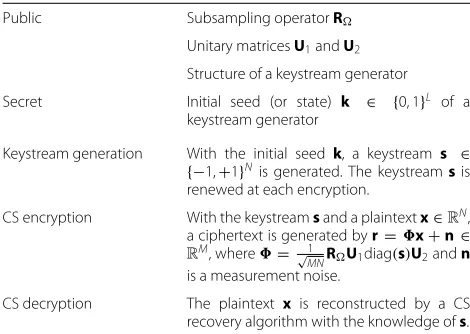
Table 2 summarizes a symmetric-key CS-based cryp-tosystem proposed in this paper.
4 Security analysis
A CS-based cryptosystem cannot be perfectly secure [15] but is believed to becomputationally secure [15, 16]. In this section, we analyze the computational security of our CS-based cryptosystem by studying the notion of indistinguishability [19].
Assume that a cryptosystem produces a ciphertext by encrypting one of two possible plaintexts. The
cryptosys-Table 2Symmetric-key CS-based cryptosystem
Public Subsampling operatorR
Unitary matricesU1andU2
Structure of a keystream generator
Secret Initial seed (or state) k ∈ {0, 1}L of a keystream generator
Keystream generation With the initial seed k, a keystream s ∈
{−1,+1}Nis generated. The keystreamsis renewed at each encryption.
CS encryption With the keystreamsand a plaintextx∈RN, a ciphertext is generated byr=x+n∈
RM, where= √1
MNRU1diag(s)U2andn is a measurement noise.
CS decryption The plaintext x is reconstructed by a CS recovery algorithm with the knowledge ofs.
tem is said to have theindistinguishability, if no adversary can determine in polynomial time which of the two plain-texts corresponds to the ciphertext, with probability sig-nificantly better than that of a random guess [51]. In short, if a cryptosystem has the indistinguishability, an adversary is unable to learn any partial information of the plaintext in polynomial time from a given ciphertext.
In specific, let us consider anindistinguishability exper-iment[51] with a constraint ofK-sparse plaintexts. First of all, an adversary creates a pair of plaintextsx1andx2 with at mostK nonzero entries per each. Then, our CS-based cryptosystem produces a ciphertextr=xh+nby randomly selectingh, whereh=1 or 2. Givenr, the adver-sary attempts to figure out which plaintext,x1orx2, was encrypted for the ciphertext, by carrying out a polynomial time testD:r→h∈ {1, 2}.
In this paper, we make use of the total variation (TV) distance [18] to evaluate the performance of the indistin-guishability experiment. Let dTV(p1,p2) be the TV dis-tance between the probability distributionsp1=Pr(r|x1) and p2 = Pr(r|x2). Then, it is readily checked from [52] that the probability that an adversary can success-fully distinguish the plaintexts by some kind of the binary hypothesis testDis bounded by
pd≤ 1 2 +
dTV(p1,p2)
2 . (2)
Therefore, ifdTV(p1,p2)approaches to zero, the prob-ability of success will be at most that of a random guess, which leads to the indistinguishability of a cryptosystem. Consequently, one can argue that a cryptosystem with
dTV(p1,p2)closer to zero would be more secure in terms of the indistinguishability. Since computing dTV(p1,p2) directly is difficult [53], we compute two probability metrics instead to bound the TV distance, which ulti-mately examines the indistinguishability of our CS-based cryptosystem.
4.1 Relative entropy
In [23] and [24], the relative entropy (or the Kullback-Leibler divergence [20]) has been used to quantify the indistinguishability. Precisely, the relative entropy of two probability distributions gives an upper bound on the TV distance by Pinsker’s inequality [54] or the refinements [55], which ultimately bounds the success probability of the indistinguishability experiment by (2).
1
√
MNRU1·E[diag(s)]·U2 = 0for a givenR, as each entry ofstakes±1 with probability 1/2 under Assump-tion 1. Thus, E[r|xh] = E[]·xh+E[n]= 0. With the Gaussian random vectorr, the relative entropy between
p1 = Pr(r|x1) and p2 = Pr(r|x2) has the following
where C1 andC2 are the covariance matrices of r con-ditioned on x1 and x2, respectively. By measuring the relative entropy by (3), we obtain an upper bound on the TV distance, i.e.,
by Pinsker’s inequality. In (4), the upper bound is set to be at most 1, sincedTV(p1,p2)∈[0, 1].
In what follows, we present an upper bound on the rel-ative entropy with some constraints on plaintexts, which subsequently yields an analytic upper bound on the maxi-mum TV distance by (4).
Theorem 1 In our CS-based cryptosystem, assume that
each plaintext xhas at most K nonzero entries with the constant energyEx = ||x||2. Then, the relative entropy of (3) is bounded by
D(p1||p2)≤
where PNR = MExσ2 is the plaintext-to-noise power ratio
(PNR).
ProofSee the Appendix.
In Theorem 1,μ(U2) = 1 ifU2 = W, whileμ(U2) = indistinguishability of our CS-based cryptosystem.
To ensure a reliable CS decryption for a legitimate recipient, our CS-based cryptosystem can set K = O M
μ2(U)logN
for nonuniform CS recovery [57], which yields the following corollary.
Corollary 1In our CS-based
cryptosys-tem with U1 = H and N = 2n, assume
Thus, if the keystream length N is sufficiently large with given M and PNR, our CS-based cryptosystem will have low relative entropy, which contributes to the indistin-guishability against an adversary, while guaranteeing the reliability for a legitimate recipient.
4.2 Hellinger distance
To bound the TV distance, we may use another probability metric, theHellingerdistance [21]. In our CS-based cryp-tosystem, recall that the ciphertextr, conditioned onxh, is assumed to be a jointly Gaussian random vector with zero mean and the covariance matrixCh, whereh = 1 or 2. Then, the Hellinger distance for the multivariate Gaussian distributionsp1andp2is given by [58, 59]
dH(p1,p2)= useful by giving both upper and lower bounds on the TV distance [60], i.e.,
d2H(p1,p2)≤dTV(p1,p2)≤dH(p1,p2)
2−d2H(p1,p2).
(7)
In what follows, we present an upper bound on the Hellinger distance of (6), which leads to an analytic upper bound on the maximum TV distance by (7).
Theorem 2Recall the assumptions and definitions of
Theorem 1. In our CS-based cryptosystem, the Hellinger distance of (6) is bounded by
dH(p1,p2)≤
Proof See the Appendix.
Corollary 2 In our CS-based cryptosystem withU1 =
Thus, if the keystream length N is sufficiently large with given M and PNR, our CS-based cryptosystem will have low Hellinger distance, which contributes to the indistin-guishability against an adversary, while guaranteeing the reliability for a legitimate recipient.
Remark 1Theorems 1 and2 suggest that the relative
entropy and the Hellinger distance will approach to zero as PNR decreases. Accordingly, our CS-based cryptosys-tem will have low TV distance by(4)and(7)at low PNR. Similarly, the TV distance will be low when M and K are small, respectively. Consequently, our CS-based cryp-tosystem can be indistinguishable at low PNR for small M and K.
Remark 2When N = 2n increases, Corollaries1and
2 suggest that if M is fixed, the relative entropy and the Hellinger distance will decrease at a givenPNRby reduc-ing K = OMn2
, which will be confirmed by numerical results of Section 5. On the other hand, if M increases with M= OKn2for a given K, numerical results reveal that
they also decrease over N at a givenPNR, which contradicts Theorems1 and2. This observation implies that there is a room to improve the bounds of the theorems. Combined with Remark1, the TV distance will be low if the keystream length N is sufficiently large with low compression MN
and sparsity
K N
ratios, which leads to the asymptotic indistinguishability of our CS-based cryptosystem.
5 Potential key recovery attack
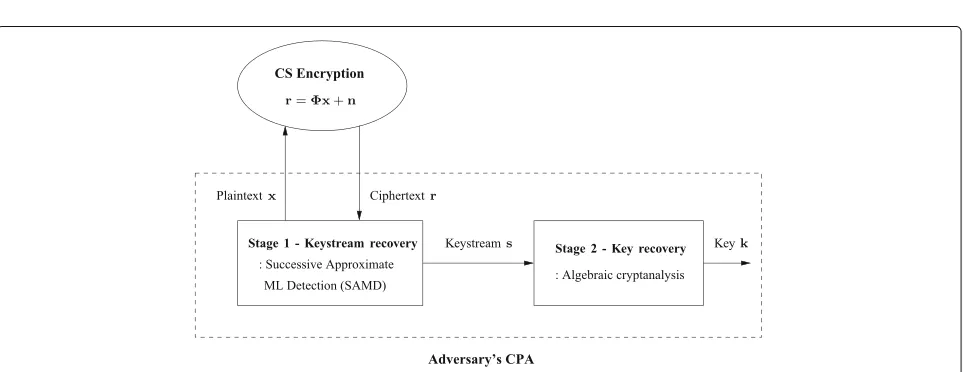
In this section, we consider a potential key recovery attack in which an adversary attempts to recover the key of our CS-based cryptosystem. In the CPA, the adversary tries to restore a keystream from a ciphertext (stage 1) and then to recover the original key from the restored keystream via algebraic cryptanalysis (stage 2). With a sufficiently
long key, we assume that the number of keystream bits required for the algebraic cryptanalysis, denoted byD, is much larger than the ciphertext lengthM. For a conve-nience of analysis, we assumeD = N, which means that the adversary needs to restore a keystream of full length
N from stage 1. Figure 1 illustrates the potential CPA from an adversary for key recovery. This section discusses the adversary’s strategy for keystream recovery in stage 1. Once a keystream is successfully restored through stage 1, a known cryptanalysis [47, 48] can be carried out in stage 2 for key recovery, which will not be discussed in this paper.
5.1 Mathematical intractability of keystream recovery
In stage 1 of the CPA, an adversary needs to observe a correctN-bit keystream from a ciphertext that has been encrypted by a chosen plaintext. We assume that the adversary will choose a plaintext xsuch that each entry ofx=U2xis nonzero for a unitary matrixU2. Then, the corresponding ciphertext is given by
r=x+n= √1
MNRU1diag(s)U2x+n
= √1
MNRU1diag(x)s+n =As+n,
(9)
whereA = √1
MNRU1diag(x). Unlike in stream ciphers, restoring the keystream s from the known plaintext-ciphertext pair is not a trivial task, sincesis hidden under compression inr.
From the ciphertextrof (9), an adversary needs to find a most likely keystream, which is equivalent to a maximum-likelihood(ML) estimate of
s= argmin
s∈{−1,+1}N||
r−As||2. (10)
Finding the ML solution of (10) is known as a con-strainedinteger least-squares (ILS)problem, which is also called aclosest vector problem(CVP) [61] in lattices. For a generalA, the constrained ILS problem is proven to be NP hard [62].
To find a most likely keystream of (10), an exhaus-tive ML search requires the complexity ofO2N, which would be computationally infeasible if the keystream lengthNis sufficiently large. Alternatively, the generalized sphere decoding (GSD) algorithms [63–65] can find an ML solution to the ILS problem of theunderdetermined
system with M < N. However, as it has the complexity exponential inN−M[63–65], the GSD cannot be appli-cable to the ILS problem withM N. To the best of our knowledge, there is no polynomial-time algorithm to find an ML solution of (10) withMNfor a sufficiently largeN.
In summary, the computational security of our CS-based cryptosystem against the key recovery attack is brought by the mathematical hardness that no polynomial-time algorithm is known to find an ML solu-tion to the underdetermined ILS problem. In fact, the mathematical intractability of the ILS problem has been exploited by public-key cryptosystems [66–68]. In our symmetric-key CS-based cryptosystem, it also ensures that if the keystream length N is sufficiently large with
M N, no adversary will be able to find a most likely keystream of length N in polynomial time, which demonstrates the computational security of our CS-based cryptosystem against the key recovery attack.
5.2 Successive approximate maximum-likelihood detection (SAMD)
In Section 5.1, we demonstrated that the ML detection would be infeasible for keystream recovery, as long as the keystream length is sufficiently large. As an alternative, we consider a sub-optimal, but feasible keystream recov-ery process for the CPA. Instead of restoring an N-bit keystream at once, we assume that an adversary attempts to restore a disjoint J-bit segment2 of the keystream from each detection, where J N, and repeats the detection NJtimes successively to restore the keystream of full length N. In this subsection, we describe the details of the successive detection process for keystream recovery.
For a convenience of analysis, we assume a chosen plain-text such thatx = √MN,· · ·,√MNT in (9), which yields A = RU1 for our analysis3. In the keystream recovery, an adversary has a freedom to choose the value ofJand theJ-bit positions of a keystream to be restored at theith detection. Leti ⊂ {0,· · ·,N−1}be a set of
entries are taken from the indices ofiin the keystream
s. At theith detection, an adversary attempts to findsi
from the ciphertextrof (9). Withs1,· · ·,si−1that have
been detected from the previous detections, theith detec-tion should use a new ciphertextri by subtracting their contribution fromr, i.e.,
ri=r−
h is anN ×J column selection operator that selectsJ
columns ofU1whose indices are specified byh. Let i=
{0,· · ·,N−1} \(1+ · · · +i), where ns =φ, andRTi
be anN×(N−iJ)column selection operator whose indices are specified by i. By assumingsh = shfor 1 ≤ h≤
component to be detected at the ith detection, wi =
RU1RTis i is an interfering component from the
keystream segments that have not been detected yet, and
n∼N(0,σ2I)is a Gaussian random noise.
In (12),wns = 0since ns = φ. On the other hand, if
1≤i≤ns−1, each entry ofwiis taken from the sum of N−iJcolumn vectors ofRU1, each of which is weighted by the entry ofs i. Since each entry ofs itakes+1 or−1
randomly and independently under Assumption 1,wiwill follow the jointly Gaussian distribution by the central limit theorem [69]. By noting thatwi+ncan be modeled as a
dent ofwiandn, respectively. Also, the covariance ofriis given by
wherewiandnare independent. In (14),
where Es isTi
= I. Since Ki does not depend on
si, the covariance ofri in (14) is equal for all possible si ∈ {−1,+1}|i|at eachith detection. Under the
Gaus-sian model ofriwith equal covariance, we can apply the ML decision rule [70] at theith detection, which yields
si= argmin
si∈{−1,+1}|i|
(ri−mi)T
Ki+σ2I −1
(ri−mi).
(16)
In (11) and (12), we assumed that all the estimatessh,
1 ≤ h ≤ i− 1, from the previous detections are cor-rect, and then ignored the estimation errors sh −sh
while subtracting the contribution fromr. Therefore, (16) cannot be a true ML detection, but an optimistic approxi-mation to the adversary.
Finally, the adversary carries out the approximate ML detection of (16) ns times successively for 1 ≤ i ≤ ns and restores the full N-bit keystream by combin-ing the disjoint |i|-bit estimates ofsi. Throughout
this paper, the detection process is called a successive approximate ML detection(SAMD). In what follows, we present an upper bound on the success probability of the SAMD.
Theorem 3In the SAMD, recall the approximate ML
decision rule of (16)applied at each ith detection for1 ≤
i ≤ ns, where ns = NJ . Let λmin(Ki) be the minimum eigenvalue of the covariance matrixKiin(15). Let Psuccbe the probability that an N-bit keystream can be successfully restored by the SAMD. Then,
Psucc≤ ns
i=1 ⎛ ⎝1−Q
⎛ ⎝
Mμ2(U1) λmin(Ki)+σ2
⎞ ⎠ ⎞
⎠Psucc,UB,
(17)
where Q(x)= √1
2π
∞ x e−
t2
2dt.
ProofSee the Appendix.
Theorem 3 shows the result for a general unitary matrixU1, which suggests that our CS-based cryptosys-tem should choose anN×Nunitary matrixU1such that μ(U1) is as small as possible, regardless of N, in order to degrade the performance of the SAMD. In this paper, μ(U1)=1 fromU1=H.
The upper bound on the success probability of Theorem 3 represents the highest possible performance that the SAMD can achieve with no estimation errors at each detection, which is an optimistic scenario for an adversary. In reality, the actual probability of success will be much lower than the upper bound, due to estimation
errors and error propagation through detections. If an adversary finds a solution of (16) via an exhaustive search, the complexity of each detection of the SAMD will be
O2JwithJN.
5.3 Minimum eigenvalues ofKi
Theorem 3 implies that minimizingλmin(Ki)can improve the performance of the SAMD. At theith detection of the SAMD, it is an adversary that determines the selection operator Ri. Therefore, if the adversary appropriately
choosesi(or equivalently i) to minimizeλmin(Ki), the success probability of the SAMD can be improved. In this paper, we consider three possible selections forithat the adversary may choose reasonably.
1) Uniform selection:! i=
i−1,NJ +i−1, · · ·, (J−1)NJ +i−1". 2) Consecutive selection:
i= {(i−1)J, (i−1)J+1,· · ·, iJ−1}.
3) Random selection:iselects theJ indices from
{0,· · ·,N−1} \(1+ · · · +i−1)uniformly at random.
Each selection is valid for 1 ≤ i ≤ ns − 1, and ns = {0,· · ·,N − 1} \ (1 + · · · + ns−1), where
ns = NJ. To further minimizeλmin(Ki), the adversary might be able to develop a more sophisticated selec-tion of i by exploiting the structure of R and U1. However, we leave this issue open for future research. Regarding the selection operator, we have the following assumption.
Assumption 2Once an adversary chooses a
value of J and a type of selection, we assume that they will be fixed through the entire detections of the SAMD.
Intuitively, the largerJwill ensure better detection per-formance for the SAMD, since a longer keystream seg-ment that can be subtracted from each detection may contribute less interference. The intuition will be justi-fied by the numerical results of Section 6. In this regard, Assumption 2 is valid, since the adversary’s reasonable option is to fix the value ofJ to the largest possible one allowed by the computing power. In addition, the numer-ical results of Section 6 show that λmin(Ki) is not so affected by the type of selections, which also supports Assumption 2.
In what follows, we present a theoretical lower bound on λmin(Ki) for 1 ≤ i ≤ ns, if i is a random selection.
Theorem 4In our CS-based cryptosystem withU1=H,
iin the ith detection of the SAMD, where1 ≤i ≤ns = N
J. Let IT =
N−c2MlogM
J for a constant c2 > 0. Then,
λmin(Ki)≥ # √
N−iJ− c1MlogM 2
, if i<IT,
0, if i≥IT
(18)
with high probability, where c1 is a constant with 0<c1<c2.
ProofSee the Appendix.
The numerical results of Section 6 show that the lower bound also holds for uniform and consecutive selections. Using the bound, Corollary 3 presents a further upper bound on the success probability of the SAMD, which is straightforward from Theorems 3 and 4 withμ(H)=1.
Corollary 3 In our CS-based cryptosystem withU1 =
H, if an adversary chooses a random selection for i, 1 ≤ i ≤ ns during the SAMD, Psucc, UB in Theorem 3 is bounded by
Psucc,UB≤
1−Q
M
σ2
ns−IT+1
·
IT−1
i=1
1−Q
M
(√N−iJ− c1MlogM)2+σ2
Psucc,U2B,
where IT = N−c2MJ logMfor constants c1and c2with0<
c1<c2.
6 Numerical results
This section presents numerical results to demonstrate the reliability and the security of our CS-based cryp-tosystem. In numerical experiments, each plaintext x
has at most K nonzero entries, where the positions are chosen uniformly at random and the coefficients are taken from the Gaussian distribution. In CS
encryp-tion, = √1
MNRU1diag(s)U2, where U1 = H, and U2 = W or D. Also, the secret keystream s is generated by the self-shrinking generator [46] of a 128-stage LFSR. For CS decryption, the CoSaMP recov-ery algorithm [71] has been employed for a legiti-mate recipient to decrypt each ciphertext with the knowledge of.
6.1 CS decryption of a legitimate recipient
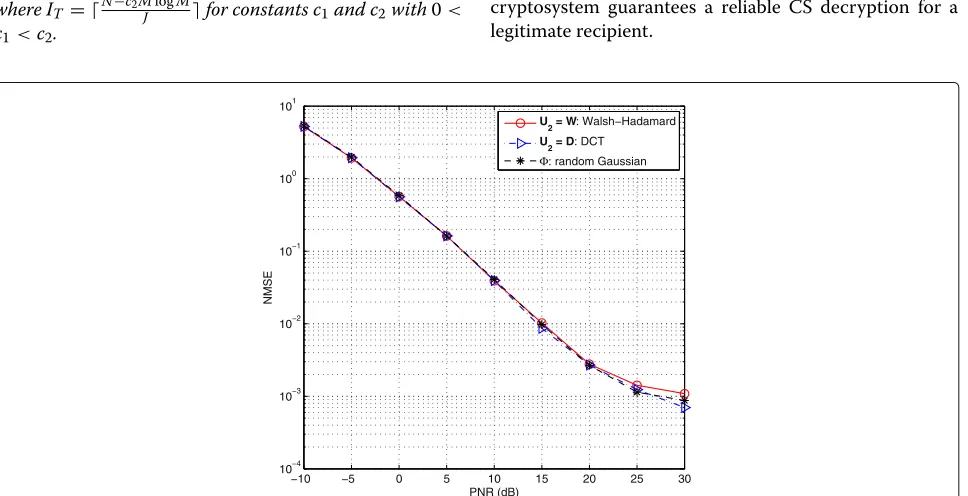
Figure 2 demonstrates the performance of CS decryp-tion of a legitimate recipient, where the plaintext length is N = 1024 and the ciphertext length is M = 48. The figure sketches the normalized mean squared error (NMSE), defined by NMSE = E
||x−x||2
||x||2
, wherexand xare original and decrypted plaintexts, respectively. We examine the performance with total 10000 plaintexts at a given PNR , where each one has at most K = 4 nonzero entries. For comparison, we sketch the perfor-mance of CS reconstruction with a random Gaussian sensing matrix for . The figure shows that the per-formance of our CS decryption is as good as that of CS recovery with a random Gaussian sensing matrix. As a consequence, it demonstrates that our CS-based cryptosystem guarantees a reliable CS decryption for a legitimate recipient.
−10 −5 0 5 10 15 20 25 30
10−4 10−3 10−2 10−1 100 101
PNR (dB)
NMSE
U
2 = W: Walsh−Hadamard U
2 = D: DCT
Φ: random Gaussian
6.2 Indistinguishability
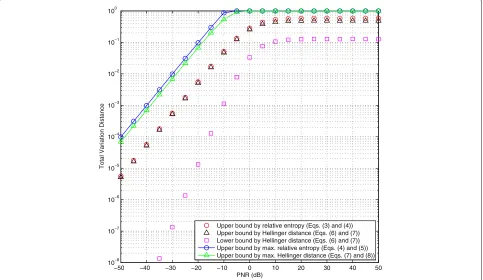
Figure 3 displays the upper and lower bounds of TV dis-tance over PNR withU2 = W, where N = 1024,M = 48, andK = 4. In the figure, the relative entropy of (3) and the Hellinger distance of (6) were computed using the covariance matrix of (19). Averaged over 10,000 pairs of randomly generated plaintexts (x1,x2) with at most
K nonzero entries per each, the relative entropy and the Hellinger distance yield the bounds of (4) and (7) on the TV distance, respectively. For comparison, we also sketch the theoretical upper bounds on the TV distance, which are obtained by the maximum relative entropy of (5) and the maximum Hellinger distance of (8), respectively. The figure shows that the TV distance approaches to zero as noise level grows, which implies that our CS-based cryp-tosystem can be indistinguishable at low PNR. As PNR increases, however, we observe that the upper and lower bounds increase and finally converge to certain levels, respectively. More extensive simulations agreed with the implication of Remark 1 that the CS-based cryptosystem will have lower TV distances with less PNR, M, and K. We made similar observations of the TV distance when
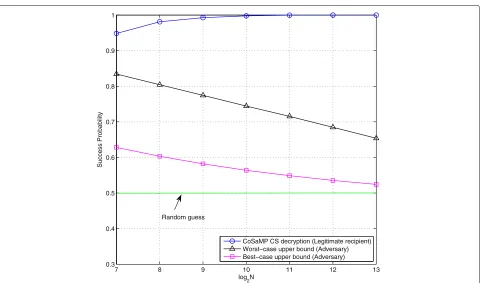
U2=Dand/or each plaintext has bipolar nonzero entries. Figure 4 depicts the upper bounds on the success prob-ability of an adversary in the indistinguishprob-ability experi-ment, where the best- and worst-case upper bounds of (2) are from the minimum and maximum achievable TV
distances of (7), respectively, obtained by the Hellinger distance (6). In the figure,U2 = W and PNR = 25 dB. With a given ciphertext lengthM = 48, the maximum sparsity is set asK = $cM/log22N%for eachN = 2n, to ensure a reliable nonuniform CS decryption for a legiti-mate recipient, wherec=8.5. For comparison, we sketch the empirical success probability of CS decryption by a legitimate recipient, where a decrypted plaintext has been declared as a success if||x||−x||x2||2 <10−2. The figure reveals
that the adversary’s success probability approaches to that of a random guess as the keystream lengthN increases, while a legitimate recipient maintains its reliability.
Figure 5 also displays the upper bounds on the suc-cess probability of an adversary in the indistinguishability experiment. At this time, the ciphertext length is kept as
M = &cKlog22N'for eachN = 2nwith a givenK = 4, where c = 0.12. As in Fig. 4, it also reveals that the adversary’s success probability approaches to 0.5 as the keystream lengthN increases, while a legitimate recipi-ent maintains its reliability. In conclusion, the empirical results of Figs. 4 and 5 show that if the keystream lengthN
is sufficiently large with low compressionMNand sparsity
K N
ratios, our CS-based cryptosystem can be computa-tionally secure in terms of the indistinguishability, while guaranteeing a reliable CS decryption for a legitimate recipient.
−50 −40 −30 −20 −10 0 10 20 30 40 50
10−8 10−7 10−6 10−5 10−4 10−3 10−2 10−1 100
PNR (dB)
Total Variation Distance
Upper bound by relative entropy (Eqs. (3) and (4)) Upper bound by Hellinger distance (Eqs. (6) and (7)) Lower bound by Hellinger distance (Eqs. (6) and (7)) Upper bound by max. relative entropy (Eqs. (4) and (5)) Upper bound by max. Hellinger distance (Eqs. (7) and (8))
7 8 9 10 11 12 13 0.3
0.4 0.5 0.6 0.7 0.8 0.9 1
log
2N
Success Probability
CoSaMP CS decryption (Legitimate recipient) Worst−case upper bound (Adversary) Best−case upper bound (Adversary) Random guess
Fig. 4The success probability of legitimate recipient and adversary for a givenM
7 8 9 10 11 12 13
0.3 0.4 0.5 0.6 0.7 0.8 0.9 1
log2N
Success Probability
CoSaMP CS decryption (Legitimate recipient) Worst−case upper bound (Adversary) Best−case upper bound (Adversary) Random guess
6.3 Performance of SAMD
Figure 6 sketches the minimum eigenvalues of the covari-ance matrixKiof (15) at theith detection for variousJ∈
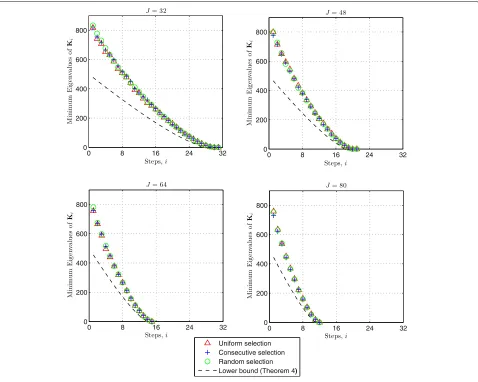
{32, 48, 64, 80}, whereN = 1024 andM = 48. For com-parison, it also sketches the lower bound of Theorem 4, where c1 = 0.5 and c2 = 1. For each i, we tested with 100,000 pairs of(,i)for random subsampling and selection operatorsRandRi, whereihad been fixed
through the tested pairs in case of uniform and consec-utive selections. In each subfigure,λmin(Ki) is sketched over 1≤i≤ns−1, wherens= NJ . Figure 6 shows that ifJincreases,λmin(Ki)decreases faster overi, which sug-gests that the detection performance will be improved asJ
increases. It is plausible because if more keystream bits are detected from theith detection with no estimation errors, more interfering components can be subtracted from the (i+1)th detection. In addition, it appears that the mini-mum eigenvalues are irrelevant to the types ofi, which
means that an adversary may expect no benefits from a particular selection of i. Finally, Fig. 6 demonstrates that the lower bound of Theorem 4 is valid, not only for random selection but also for uniform and consecutive selections.
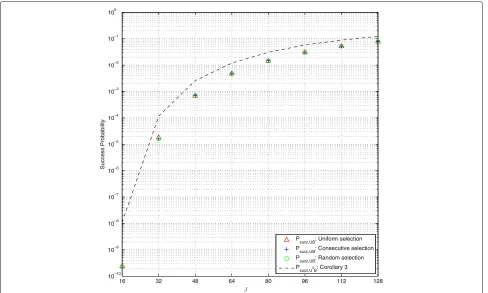
Figure 7 displays the upper bounds on the success prob-ability of the SAMD for keystream recovery. For com-parison, it also sketches the theoretical upper bound of Corollary 3 for random selectioni. In view of the adver-sary’s bounded computing power, we setJ ≤ 128, where the complexity of each detection in the SAMD will be
O2Jby an exhaustive search. Sinceλmin(Ki)has similar values for different types ofi’s in Fig. 6, the upper bounds of Fig. 7 are also similar for every selection types. More-over, the upper bounds increase overJ, which is obvious from the sharp decline ofλmin(Ki)overJ, observed from Fig. 6. However, even if an adversary chooses a large value ofJ, the upper bounds on the success probability are still
0 8 16 24 32
0 200 400 600 800
0 8 16 24 32
0 200 400 600 800
0 8 16 24 32
0 200 400 600 800
0 8 16 24 32
0 200 400 600 800
Uniform selection Consecutive selection Random selection Lower bound (Theorem 4)
16 32 48 64 80 96 112 128 10−10
10−9 10−8 10−7 10−6 10−5 10−4 10−3 10−2 10−1 100
Success Probability
P
succ,UB: Uniform selection
P
succ,UB: Consecutive selection
P
succ,UB: Random selection
P
succ,U2B: Corollary 3
Fig. 7The upper bounds on the success probability of the SAMD
significantly low, which implies that the potential of the SAMD to restore a correctN-bit keystream is pessimistic. Note that this is the result of an optimistic scenario, and in reality, the actual probability of success of the SAMD will be much lower than the upper bounds, due to estimation errors and their propagation through the SAMD.
7 Conclusions
This paper has proposed a CS-based cryptosystem that encrypts a plaintext with a partial unitary sensing matrix embedding a secret keystream. We demonstrated that our CS-based cryptosystem can offer a theoretically and empirically reliable decryption performance for a legit-imate recipient, which is the first contribution of this paper. Then, we examined the indistinguishability of our CS-based cryptosystem by studying the TV distance as a security measure. To investigate the TV distance, we developed upper bounds on the relative entropy and the Hellinger distance, respectively. From the second contri-bution, we showed that our CS-based cryptosystem can be computationally secure in terms of the indistinguishabil-ity, as long as the keystream length for each encryption is sufficiently large with low compression and sparsity ratios. In addition, we considered a potential CPA from an adversary to recover the key of our CS-based cryp-tosystem. The computational security of our CS-based
cryptosystem against the CPA is based on the mathemati-cal hardness that no polynomial-time algorithm is known to find an ML solution to the underdetermined ILS prob-lem for keystream recovery. As a sub-optimal approach, we introduced the SAMD for an adversary to restore a secret keystream in polynomial time. In the third con-tribution, we developed an upper bound on the success probability of the SAMD and demonstrated that the per-formance of the keystream recovery through the SAMD is very pessimistic. In conclusion, our CS-based cryptosys-tem with a partial unitary sensing matrix embedding a secret keystream can be secure against the CPA, while guaranteeing a stable and robust decryption for a legiti-mate recipient.
Endnotes
1This paper assumes that a plaintext x is sparse in
canonical basis, or = I. In general, if a plaintextxis sparse with respect to an arbitrary orthonormal basis, i.e.,x = Tθ, the sensing matrixA = T maintains the form of (1) by considering U2T as a new unitary matrixU2.
2In the last detection, (N −( N
3Under this assumption, numerical results showed that
the upper bound on the success probability of the succes-sive detection is more favorable for an adversary than that ofxwith arbitrary nonzero entries.
Appendices
Proof of Theorem 1
We give a brief sketch for the proof of Theorem 1, as the underlying technique is similar to that of Theorem 1 in [72]. Similar to Lemma 1 of [72], the covariance matrix ofris given by
be the eigenvalues of (
matrix of (Ch, where successive application of the inter-lacing inequality [73] leads toλt+N−M(Ch
M. By the Cauchy-Schwarz inequality, we
obtain vh,0
Meanwhile, the upper bound on tr
Proof of Theorem 2
We use definitions and notations in the proof of Theorem 1. Letλ1(C3) ≥ · · · ≥λM(C3)be the eigenval-ues ofC3= C1+2C2. Clearly, the eigenvalues ofC1,C2, and
C3are positive by (20) and the Weyl inequality [73]. In (6),
let= |C1|
where the inequality is from the arithmetic mean-geometric mean inequality. For h = 1 or 2, the tth diagonal entry of(Ch = N1UT1diag
Inn, the geometric mean-harmonic mean inequality yields
whereh=1 or 2. By the Kantorovich inequality [74],
whereλ1(Ch)andλM(Ch)have been replaced byλmaxand
Proof of Theorem 3
In (15), Ki is the Gram matrix, or Ki = ATi Ai with Ai = R iUT1RT for 1 ≤ i ≤ ns − 1, where λmin(Ki) ≥ 0, since Ki is positive semi-definite [73]. Let si and si be a pair of correct and
wrong J-bit segments from a keystream s at the index set i, respectively. From (13), E
ri is a Gaussian random vector, the binary hypothesis detection of Section 3.2 in [70] reveals that the pairwise error probability thats
iis incorrectly detected by theith
detection is
We assume that the pairwise error event occurs only for a specific s
i, which is closest tosi, and ignore all the
others
i. In other words, we take into account only a
sin-gles
i, wheresi−s
ihas the nonzero entry (+2 or−2)
at one position, or equivalently ||si −si|| = 2 for a
givensi. This assumption, similar to the one in [75], is
favorable for an adversary. From (27), the error probability under the assumption is given by
P(ei)= assumption that all the estimates from previousi−1 detec-tions have been subtracted with no errors to yieldri of (12). Then, the success probability of theith detection is
Ps(i)=Prsi=si|s1 =s1,· · ·,si−1 =si−1 be restored, all the component detections should be suc-cessful. Thus, the success probability of the SAMD is
Psucc=Pr
Finally, we obtain the upper bound of (17) by combining (29) and (30), which completes the proof.
Proof of Theorem 4
In (15), let Ai = R iHTRT with U1 = H. Then, the
To examineσmin(Ai)for 1≤i≤ns−1, we first define
Bi = HTRT. Then, Bi is an N × M matrix satisfying
BTiBi = RH·HTRT = NI, which means that each col-umn ofBiis mutually orthogonal. Also, it is clear that the l2-norm of each row ofBiis are specified by i. For such a matrixAi, Corollary 5.55 of [4] shows that for everyt≥0,
c2MlogMfor the bound to be nontrivial and nonnegative, where 0< c1 < c2. Thus, the bound of (31) is valid only
This work was supported by the National Research Foundation of Korea (NRF) grant funded by the Korea government (MSIP) (no. NRF-2017R1A2B4004405).
Competing interests
The author declares that he has no competing interests.
Publisher’s Note
Springer Nature remains neutral with regard to jurisdictional claims in published maps and institutional affiliations.
Received: 17 May 2017 Accepted: 12 October 2017
References
1. DL Donoho, Compressed sensing. IEEE Trans. Inf. Theory.52(4), 1289–1306 (2006)
2. EJ Candes, J Romberg, T Tao, Robust uncertainty principles: exact signal reconstruction from highly incomplete frequency information. IEEE Trans. Inf. Theory.52(2), 489–509 (2006)
3. EJ Candes, T Tao, Near-optimal signal recovery from random projections: universal encoding strategies. IEEE Trans. Inf. Theory.52(12), 5406–5425 (2006)
4. YC Eldar, G Kutyniok,Compressed sensing—theory and applications. (Cambridge University Press, Cambridge, 2012)
5. J Tropp, JN Laska, M Duarte, J Romberg, RG Baraniuk, Beyond Nyquist: efficient sampling of sparse bandlimited signals. IEEE Trans. Inf. Theory. 56(1), 520–544 (2010)
6. M Mishali, YC Eldar, From theory to practice: sub-Nyquist sampling of sparse wideband analog signals. IEEE J. Select Top. Sig. Process.4(2), 375–391 (2010)
7. J Haupt, W Bajwa, G Raz, R Nowak, Toeplitz compressed sensing matrices with applications to sparse channel estimation. IEEE Trans. Inf. Theory. 56(11), 5862–5875 (2010)
8. MF Duarte, S Sarvotham, D Baron, MB Wakin, RG Baraniuk, inAsilomar Conf. on Signals, Systems and computers. Distributed compressed sensing of jointly sparse signals, (Pacific Grove, 2005), pp. 1537-1541
9. J Haupt, W Bajwa, M Rabbat, R Nowak, Compressed sensing for networked data. IEEE Sig. Process. Mag.25(2), 92–101 (2008)
10. C Caione, D Brunelli, L Benini, Compressive sensing optimization for signal ensembles in WSNs. IEEE Trans. Ind. Inform.10(1), 382–392 (2014) 11. M Duarte, M Davenport, D Takhar, JN Laska, T Sun, KF Kelly, RG Baraniuk,
Single-pixel imaging via compressive sampling. IEEE Sig. Process. Mag. 25(2), 83–91 (2008)
12. R Marcia, Z Harmany, R Willet, inProc. IS&T/SPIE Symp. Elec. Imag.: Comp. Imag. Compressive coded aperture imaging, (San Jose, 2009) 13. M Lustig, D Donoho, J Pauly, inProc. Ann. Meeting of ISMRM. Rapid MR
imaging with compressed sensing and randomly under-sampled 3DFT trajectories, (Seattle, 2006)
14. S Goginneni, A Nehorai, Target estimation using sparse modeling for distributed MIMO radar. IEEE Trans. Signal Process.59(11), 5315–5325 (2011)
15. Y Rachlin, D Baron, inProc. 46th Annu. Allerton Conf. Commun.Control, Comput. The secrecy of compressed sensing measurements, (2008), pp. 813-817
16. A Orsdemir, HO Altun, G Sharma, MF Bocko, inProc. IEEE Military Commun. Conf. (MILCOM). On the security and robustness of encryption via compressed sensing, (2008), pp. 1-7
17. Y Zhang, LY Zhang, J Zhou, L Liu, F Chen, X He, A review of compressive sensing in information security field. IEEE Access Spec. Sect. Green Commun. Netw. 5G Wirel.4, 2507–2519 (2016)
18. AL Gibbson, FE Su, On choosing and bounding probability metrics. Int Stat Rev.70(3), 419–435 (2002)
19. S Goldwasser, S Micali, Probabilistic encryption. J. Comput. Syst. Sci.28, 270–299 (1984)
20. TM Cover, JA Thomas,Elements of information theory. (Wiley & Sons, Inc., Hoboken, 2006)
21. L Le Cam,Asymptotic methods in statistical decision theory. (Springer-Verlag, New York, 1986)
22. T Bianchi, V Bioglio, E Magli, inProc. IEEE Int. Conf. Acoust. Speech Signal Process (ICASSP). On the security of random linear measurements, (2014), pp. 3992–3996
23. T Bianchi, V Bioglio, E Magli, Analysis of one-time random projections for privacy preserving compressed sensing. IEEE Trans. Inf. Forens. Sec.11(2), 313–327 (2016)
24. T Bianchi, E Magli, inIEEE Workshop on Information Forensics and Security (WIFS). Analysis of the security of compressed sensing with circulant matrices, (2014), pp. 1–6
25. V Cambareri, M Mangia, F Pareschi, R Rovatti, G Setti, Low complexity multiclass encryption by compressed sensing. IEEE Trans. Signal Process. 63(9), 2183–2195 (2015)
26. V Cambareri, M Mangia, F Pareschi, R Rovatti, G Setti, On known-plaintext attacks to a compressed sensing-based encryption: a quantitative analysis. IEEE Trans. Inf. Forensics Secur.10(10), 2182–2195 (2015) 27. Y Zhang, J Zhou, F Chen, LY Zhang, K-W Wong, X He, Embedding
cryptographic features in compressive sensing. Neurocomputing.205, 472–480 (2016)
28. L Zeng, X Zhang, L Chen, Z Fan, Y Wang, Scrambling-based speech encryption via compressed sensing. EURASIP J. Adv. Signal Process.2012, 257 (2012)
29. LY Zhang, K-W Wong, Y Zhang, Q Lin,Joint quantization and diffusion for compressed sensing measurements of natural images, (2015), pp. 2744–2747 30. LY Zhang, K-W Wong, Y Zhang, J Zhou, Bi-level protected compressive
sampling. IEEE Trans. Multimed.18(9), 1720–1732 (2016) 31. M Bloch, J Barros,Physical-layer security—from information theory to
security engineering. (Cambridge University Press, 2011)
32. Y Zou, J Zhu, X Wang, L Hanzo, A survey on wireless security: technical challenges, recent advances, and future trends. Proc. IEEE.104(9), 1727–1765 (2016)
33. S Agrawal, S Vishwanath, inProc. IEEE Inf. Theory Workshop (ITW). Secrecy using compressive sensing, (2011), pp. 563–567
34. G Reeves, N Goela, N Milosavljevic, M Gastpar, inProc. IEEE Inf. Theory Workshop (ITW). A compressed sensing wire-tap channel, (2011), pp. 548–552
35. R Dautov, GR Tsouri, inProc. Int. Conf. Comput. Netw. Commun. Establishing secure measurement matrix for compressed sensing using wireless physical layer security, (2013), pp. 354–358
36. SN George, DP Pattathil, A secure LFSR based random measurement matrix for compressive sensing. Sens. Imag.15(1), 1–29 (2014) 37. YD Li, Z Zhang, M Winslett, Y Yang, inProc.10th Annu. ACM Workshop
Privacy Electron. Soc. (WPES). Compressive mechanism: utilizing sparse representation in differentical privacy, (2011), pp. 177–182
39. J Gao, X Zhang, H Liang, X Shen, inProc.IEEE GLOBECOM, Commun. Inf. Syst. Security Symp. Joint encryption and compressed sensing in smart grid data transmission, (2014), pp. 662–667
40. SW Golomb, G Gong,Signal design for good correlation—for wireless communication, cryptography and radar. (Cambridge University Press, New York, 2005)
41. R Rueppel, O Staffelbach, Products of linear recurring sequences with maximum complexity. IEEE Trans. Inf. Theory.33(1), 124–131 (1987) 42. T Herlestam, inAdvances in Cryptology-Eurocrypt’85. On functions of linear
shift register sequences. Lecture Notes in Computer Science (LNCS), vol. 219 (Springer-Verlag, 1986), pp. 119–129
43. T Beth, F Piper, inAdvances in Cryptology-Eurocrypt’84. The stop-and-go generator. Lecture Notes in Computer Science (LNCS), vol. 209 (Springer-Verlag, 1985), pp. 88–92
44. D Gollmann, WG Chambers, Clock-controlled shift registers: a review. IEEE J. Sel. Areas Commun.7(4), 525–533 (1989)
45. D Coppersmith, H Krawczys, Y Mansour, inAdvances in Cryptology -Eurocrypt’93. The shrinking generator. Lecture Notes in Computer Science (LNCS), vol. 773 (Springer-Verlag, 1993), pp. 22–39
46. W Meier, O Staffelbach, inAdvances in Cryptology-Eurocrypt’94. The self-shrinking generator. Lecture Notes in Computer Science (LNCS), vol. 950 (Springer-Verlag, 1995), pp. 205–214
47. L Chen, G Gong,Communication system security. (Chapman & Hall/CRC, Boca Raton, 2012)
48. A Klein,Stream ciphers. (Springer-Verlag, London, 2013)
49. M Rudelson, R Vershynin, On sparse reconstruction from Fourier and Gaussian measurements. Comm. Pure Appl. Math.61(8), 1025–1045 (2008)
50. MF Duarte, YC Eldar, Structured compressed sensing: from theory to applications. IEEE Trans. Signal Process.59(9), 4053–4085 (2011) 51. J Katz, Y Lindell,Introduction to modern cryptography, 2nd Ed., (Boca Raton,
2015)
52. L Le Cam, Convergence of estimates under dimensionality restrictions. Ann. Stat.1(1), 38–53 (1973)
53. A DasGupta,Asymptotic theory of statistics and probability. (Springer Science+Business Media, LLC, New York, 2008)
54. MS Pinsker,Information and information stability of random variables and processes (in Russian). (U.S.S.R., Izv.Akad. Nauk, Moscow, 1960)
55. AA Fedotov, P Harremoës, F Topsoe, Refinements of Pinsker’s inequality. IEEE Trans. Inf. Theory.49(6), 1491–1498 (2003)
56. Y Singer, MK Warmuth, inProc. Advances in Neural Information Processing Systems 11 (NIPS’98). Batch and on-line parameter estimation of Gaussian mixtures based on the joint entropy, (1998), pp. 578–584
57. S Foucart, H Rauhut,A mathematical introduction to compressive sensing. (Springer Science+Business Media, New York, 2013)
58. T Kailath, The divergence and Bhattacharyya distance measures in signal selection. IEEE Trans. Commun. Technol. COM-15(1), 52–60 (1967) 59. KT Abou-Moustafa, FP Ferrie, inJMLR: Asian Conference on Machine
Learning. A note on metric properties for some divergence measures: The Gaussian case, vol. 25, (2012), pp. 1–15
60. A Guntuboyina, S Saha, G Schiebinger, Sharp inequalities for f-divergences. IEEE Trans. Inf. Theory.60(1), 104–121 (2014)
61. S Arora, L Babai, J Stern, Z Sweedyk, The hardness of approximate optima in lattices, codes, and systems of linear equations. J. Comput. Syst. Sci. 54(2), 317–331 (1997)
62. M Ajtai, inProc. of 30th Ann. ACM Symp. Theory Comput. The shortest vector problem inL2is NP-hard for randomized reductions, (1998), pp. 10–19
63. M Damen, K Abed-Meraim, J-C Belfiore, Generalized sphere decoder for asymmetrical space-time communication architecture. IET Electron. Lett. 36(2), 166–167 (2000)
64. P Dayal, MK Varanasi, inProc.of 41st Annula Allerton Conf. on Comm. Control, and Comput. A fast generalized sphere decoder for optimum decoding for under-determined MIMO systems, (2003)
65. T Cui, C Tellambura, An efficient generalized sphere decoder for rank-deficient MIMO systems. IEEE Commun. Lett.9(5), 423–425 (2005) 66. M Ajtai, inProc. 28th Annu. ACM Symp. Theory Comput. Generating hard
instances of lattice problems, (1996), pp. 99–108
67. O Goldreich, S Goldwasser, S Halevi, inProc.17th Annu. Int. Cryptography Conf. Publick-key cryptosystems from lattice reduction problems, (1997), pp. 112–131
68. R Fischlin, J Seifert, inProc. 7th IMA Int. Conf. Tensor-based trapdoors for CVP and their application to public key cryptography, (1999), pp. 244–257 69. RG Gallager,Stochastic processes: theory for applications. (Cambridge
University Press, 2013)
70. HL van Trees, KL Bell, Z Tian,Detection, estimation, and modulation theory: part I—detection, estimation, and filtering theory, Second Ed.(Wiley & Sons, Inc., Hoboken, 2013)
71. D Needell, JA Tropp, CoSaMP: iterative signal recovery from incomplete and inaccurate samples. Appl. Comput. Harmon. Anal.26, 301–321 (2009) 72. NY Yu, Indistinguishability of compressed encryption with circulant
matrices for wireless security. IEEE Signal Process. Lett.24(2), 181–185 (2017)
73. RA Horn, CR Johnson,Matrix Analysis, 2nd Ed. (Cambridge University Press, Cambridge, 2013)
74. G Strang, On the Kantorovich inequality. Proc. Amer. Math. Soc.11, 468 (1960)