Proceedings of MUCET2008
Malaysian Technical Universities Conference on Engineering and Technology March 8-10,2008, Putra Palace, Perlis, MalaysiaProblem-Based
Learning
Experience
and Self-Directed
Learning
Readiness
among
University
Students
Mazarn Alias
and
Siti Nurzakiah ZainalAlam
Abstract-The
ability to self-direct one's learning
I. INTRODUCTIONis the key in inculcating life-long learning
Developing the ability to self-direct learning has receivedculture. which is essential to the develo~ment
increasing emphasis in tertiary education due to importanceof
knowledge workers that
are
much
ieeded
in promoting life long learning culture, which is essential toby our fast developing country. The need to
the development of knowledge workers that is much demanded by our developing country. Self-directedlearning
has
learning (SDL) has been described as a process [I] and as amotivated
educators in higher educational
psychological predisposition of the learner [2]. As a process,in~titution~
to experiment with alternative
SDL is described as a situation where " individuals taketeaching methods that are believed to be more
conducive to the development of self-directed
learning. One such method is the problem
based learning (PBL) method which has been
extolled as having a high potential to promote
self-directed learning readiness
(SDLR)
among learners. The main objective of this
study was to determine if PBL experience is
related to SDLR level.
A cross-sectional
study was carried out involving a sample of
260 first year students from the University of
Tun Hussein Onn Malaysia. The students were
administered a specifically designed SDLR
questionnaire to assess their SDLR level after
varying exposure to PBL experience. It was
found that exposure to PBL experience up to a
certain extent is related to higher overall
SDLR level beyond which SDLR appears to
diminish.
However, some dimensions of
SDLR were
found to
be
increasing
consistently with repeated exposure to PBL. In
conclusion, although its efficacy on SDLR as
a whole is not supported the data did provide
some evidence on the efficacy of PBL as a
tool for the development of some dimensions
of SDLR.
Keywords: Problem-based learning, self-directed learning.
the initiative, with or without the help of others, in diagnosing their learning needs, formulating learning goals, identifling human and material resources for learning, choosing and implementing appropriate learning strategies, and evaluating learning outcomes." [3]. As a personality predisposition of individuals SDL is described as a learning behavior that is " characterized by initiative and persistence in learning overtime through a variety of mode" [41.
A two dimensional definition of SDL was proposed that encompasses the process and personal attributes of the learner, namely process orientation and personal orientation [4]. The process orientation, or the external factors, is where the learner assumes primary responsibility for planning, implementing, and evaluating the learning process. It refers to an instructional method in which an education agent or resource often plays a facilitating role. The personal orientation (or internal factors), relates to the learner's characteristics that predispose him or her towards taking primary responsibility for personal learning endeavors. Both the process and personal orientation are encapsulated in the "Personal Responsibility Orientation" Model proposed by 141.
11. PROBLEM BASED LEARNING
Problem based learning (PBL) is an instructional method heralded by some as one of the most powerful teaching methodologies to encourage students to take responsibility for their own learning [5] and [6]. In [6] the PBL approach was found to be facilitative towards the development of self-directed learners who have an understanding for their learning, are able to handle and assess their ongoing learning process, and also their needs for learning. However, in other studies [7] and [8] only some dimensions Maizam Alias is an Associate Professor at the Faculty of Technical
S D L ~ are improved through the PBL approach. For
Education and the Deputy Dean of the Centre for Graduate Studies in
learner', and 'Self-understanding of one's own learning' experienced PBL trainer in UTHM. The SDRL was found improving after undergoing PBL intervention questionnaire subscales and their estimate of reliability are [7]. More studies are needed to fully understand the scope given in Table 2.
of contribution of the PBL approach towards SDLR
development. TABLE 2 SDLR SUBSCALES AND RELIABILITY
SDLR subscales A
Love of learning 0.7
111. PROBLEM STATEMENT
Creativity
Some universities in Malaysia have started incorporating 0.6
PBL into their teaching and learning [8] and [9]. However, Of risky ambiguityy in
learning 0.6
to date no published studies are found investigating the Self-concept as an eflective learner
0.6
relationship between PBL and SDLR development. UTHM
of responsibility for own
itself have been experimenting with PBL for the past few learning 0.3
years in various subjects using the variations of the PBL Self-understanding ofone's own learning 0.6
model of the Republic Polytechnic of Singapore. Therefore, Initiative in learning 0.6 it is appropriate that a study is carried out that can provide
View of learning as lifelong beneficial process
empirical data on the relationship between the PBL 0.8
Acceptance of work hard
approach and development of SDLR. The purpose of this 0.4
study is to investigate self-directed learning readiness
among UTHM students exposed to varying levels of PBL V. RESULTS AND DISCUSSION
experience. The specific objectives of this study are to Two hundred and sixty completed questionnaires were
determine returned. Out of these 66 were from civil engineering, 97
1 the relationship between level of exposure to from electrical engineering and 97 from technical education.
PBL experience and SDLR level in general Among civil engineering group, minimum PBL exposure is ii the relationship between level of exposure to once and maximum exposure is twice. For the electrical
iii
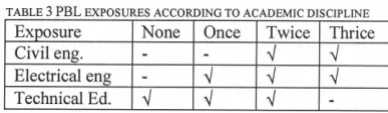
PBL experience and SDLR level for students from engineering group, minimum exposure was once and different educational background maximum was thrice while for the education group, some the relationship between level of exposure to students have not had any exposure to PBL and some had a PBL experience and SDLR level for students from maximum exposure of twice to PBL experience. Table 3 different academic disciplines summarizes the number of PBL exposure according to
academic discipline. IV. METHODOLOGY
Six hundred of SDLR questionnaires were distributed to students who have had varying levels of exposure to PBL experience to measure their associated SDLR level. The instrument is an adaptation of the Self-Directed Learning Readiness Scale (SDLRS) by [Guglielmino (1977) Brockett
TABLE 3 PBL EXPOSURES ACCORDING TO ACADEMIC DISCIPLINE Exposure
1
NoneI Once
I
TwiceI
ThriceI I I I
1
Civil eng. 141 4
& Heimstra, 1999b) . The S D L R ~ S in Bahsa ~ e l a ~ u . The
level of PBL exposure was categorized into "0 for "have Observations on educational background of respondents never being exposed to PBL experience", " 1 for "have been indicate that 14% had Malaysian High Education certificate, exposed to PBL experience once" and so on. The 70% had matriculation certificates and 16% had diplomas. Table 4 shows the PBL exposure intensity according to questionnaire used the 5-point Lickert scale response format
and the mean score ranging from 1-5 is used for mean background. Electrical eng Technical Ed.
difference analysis and interpretations. The interpretation of the mean scores is given in Table 1
-
4
TABLE 1 SDLR SCORE AND INTERPRETATIONS
Mean score Interpretation -
1.05~53.0 Low
3 .O<x13.5 Below average
3 . 5 ~ ~ 5 3 . 9 Average
3.9Cx14.3 Above average
4.3cx55.0 High
4
4
The SDRL Questionnaire has an overall reliability
estimate of 0.9 on the Cronbach Alpha scale. The
4
TABLE 4 PBL EXPOSURES ACCORDING TO EDUCATIONAL BACKGROUND
1
ExposureI
NoneI
OnceI
TwiceI
ThriceI
4
4
Matriculation
A. Level of exposure to PBL experience and SDLR level
Mean SDLRS scores according to PBL exposure irrespective of academic disciplines are shown in Table 5.
- - -Diploma Others
Results of ANOVA test indicating statistical significance between at least two means are shown in Table 6.
4
4
4
4
4
4
STPM4
questionnaire has nine subscales based on the eight TABLE 5 MEAN SCORES ON SDLR ACCORDING TO EXPOSURE
4
dimensions suggested by Guglielmo in [4] and an additional
Erporurr
d
.\Id
dimension "Acceptance of hardwork" proposed by an
-
[image:2.597.304.513.147.303.2] [image:2.597.315.509.436.492.2] [image:2.597.301.507.574.641.2]TABLE 6 ANOVA RESULTS ON MEAN DIFFERENCE OF SDLR FOR DIFFERENT EXPOSURE
Between groups 4823.58 1607.86 3.34 0.02 Within groups 123384.5 256 481.97
Total 128208.1 259
0 1 2 .
3
The result of the post-hoc test indicate that statistical significance is found only between means for PBL exposure once and exposure twice with students exposed twice having higher SDLR compared to students exposed once to PBL.
Lack of SDLR improvement form zero PBL exposure to exposure once is expected because some students may have been overwhelmed by the new PBL experience. The high efforts demanded of students may make some students feel inadequate in some respects and may results in a low self concept etc as indicated by some studies. Improvement in SDLR level from exposure once to exposure twice is also expected because as students become more familiar with PBL they are more able to participate and contribute in a more beneficial way which results in an improvement in their self-perception.
However, lack of improvement in SDLR fiom exposure twice to thrice is quite unexpected and therefore additional data collection through interviews were gathered to understand the phenomena. The interviews indicated that when more that two subjects were taught using PBL approach simultaneously, the work-load became too much for some students to deal with and having to take the responsibility for their own learning in more than two subjects create resentments in some students. The finding is consistent with a study by [lo] who found that that students experience a significant decline in their perceptions of their ability and also their perceived importance of SDL as a result of a PBL curriculum.
[image:3.596.302.516.95.316.2]15 74 115 56
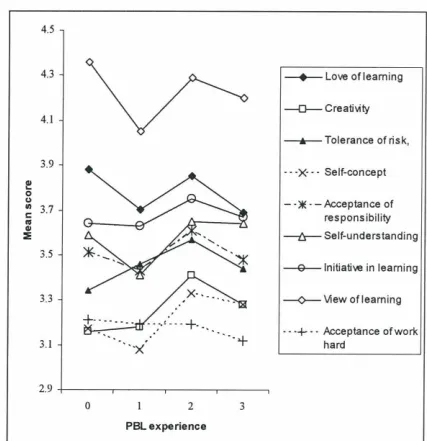
FIGURE 1 DISTRIBUTIONS OF SDLR DIMENSION MEAN SCORES ACCORDING TO PBL EXPOSURE
3.54 3.46 3.63 3.54
4.5 -
"
4.1
3.9 - ?! 0
=
3.7 - (I g3.5 -
3.3 -
3.1 -
2.9
In general, means scores on the individual SDLR dimensions are at the average level across exposure. One aspect that is worth noticing is that dimensions 'Acceptance
of hard work' scored the lowest, while ' View of learning as
a lifelong benejicial process' scored the highest across exposures. The low scores for 'Acceptance of hard work' is consistent with the findings in [S]. In [S], students who disliked PBL stated that it involved too much work; thus depleting their time for other subjects. This is also consistent with the follow-up study in UTHM done after a few weeks of distributing the instrument.
Even if lecturers may perceive the importance of hard work in a PBL curriculum, the students may resent the work load given to them, especially if there were more than two subjects that implement PBL at the same time. However, it should be noted that 'Acceptance of hard work' had a low Cronbach alpha coefficient. Therefore, the possibility of
biased items in the instrument is unavoidable. The high
score on the dimension of 'View of learning as a lifelong benejicialprocess', through out warrant further study.
a) PBL exposure and individual SDLR dimensions
Significance testing indicates that creativity, self concept
Results of analysis on the individual dimensions are shown self-understanding are statistically
in Figure 1. improved fiom exposure once to twice. The specific result 0.35
0.37 0.34 0.44
PBL experience
$P-
-..
'.
.x'.
corresponds with one of the goals of PBL, which according
to [6] which is to develop self-directed learners who have an understanding for their learning, are able to handle and
assess their ongoing learning process, and also their needs
for learning. The result is also consistent with [7] in which
students' 'Creativity', 'Self-concept as an effective learner',
and 'Self-understanding of one's own learning' increased
significantly for PBL group from pre- and post- tests.
Average Below Average Average Average
+,Low of learning
U Creatidty
-+Tolerance of risk,
- - -X
-
- Self-concept- - X - - Acceptance of responsibility
-A- Self-understanding
+Initiative in learning
,-$-Mew of learning
- -
-+
- - Acceptance of workhard
B. Level of exposure to PBL experience and SDLR level for students porn dzflerent educational background
I
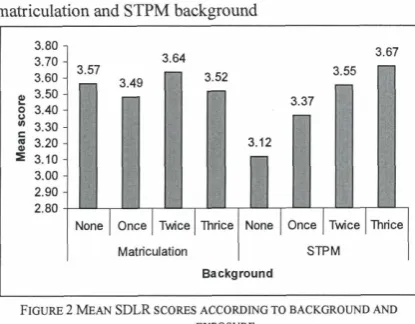
[image:3.596.71.283.96.238.2]Figure 2 shows the distribution of SDLR levels for Table 8 shows the SDLR scores according to PBL matriculation and STPM background exposure intensity and academic discipline.
Matriculation
1
BackgroundSTPM
I 1
FIGURE 2 MEAN SDLR SCORES ACCORDING TO BACKGROUND AND EXPOSURE
SDLR scores for students with Matriculation education background did not differ much across exposures. However, there is a noticeable trend in SDLR scores for students with STPM background, in which the SDLRS scores increase steadily as exposure intensity increases.
A further investigation on the SDLR dimensions revealed that for students with Matriculation background a statistically significant difference was found on three dimensions from exposure once to twice, namely, on 'Self- concept as an eflective learner', 'Responsibility for one's own learning', and 'Self-understanding of one's own learning'.
For students from STPM background, only the dimension
'Self-understanding of one's own learning' shows a statistically significant increase, i.e., from exposure once to exposure thrice. Again, 'Acceptance of hard work' scored the lowest across exposure intensities while 'View of learning as a lifelong beneficial process' scored the highest for both education background. Table 7 presents the SDLR dimensions that improved with increase in PBL experience from once to twice for students from Matriculation and STPM background.
TABLE 8 OVERALL SDLR SCORES ACCORDING TO PBL EXPOSURE INTENSITY ACCORDING TO FACULTY
No statistically significant difference was found between different levels of exposure for any of the academic disciplines.
Changes in SDLR dimensions were analyzed between exposure once and twice which involve education and electrical engineering groups only. A statistically significant SDLR increase was found for the education group only. A closer look at the SDLR dimensions within each academic discipline reveals a statistically significant increase from exposure once to twice on the 'Self-concept as an efective learner' dimension (mean gain=0.25, p<.05) (Table 9) and 'Self-understanding of one's own learning'
dimension (mean gain=0.24, p<.05) for the education group. However, no statistically significant increase was found in the electrical engineering group.
TABLE 9 ANNOVA FOR THE EDUCATION GROUP
Sum of df Mean F P
squares square
Between 1.335 2 .688 3.733 .028
group
Within 16.808 94
group
Total 18.143 96
The fact PBL exposure is associated with improved self- concept as an eflective learner and responsibility for one's own learning for those with matriculation background but not those with STPM background is interesting because it suggests a possibility of background influence on the eficacy of PBL in promoting SDLR.
C. Level of exposure to PBL experience and SDLR level for studentsfrom dzferent academic disciplines
TABLE 7 IMPROVEMENT IN SDLR DIMENSIONS FOR STUDENTS WITH A possible explanation for the higher increase in scores
MATRICULATION AND STPM BACKGROUND for these two dimensions among the education students may
learn and also how they can improve their learning capabilities. It is possible that Technical Education students have more awareness of the psychological aspects of learning; thus the high scores. This is consistent with the follow-up study from the interviews with some lecturers.
Another suggestion to the possible cause for the low SDLR for Electrical Engineering students is perhaps the subjects using PBL may not have focused on building SDL skills but more on problem-solving skills and generic skills, as the literature review indicates. Possibly the use SDL in lie in the discipline itself. As a teacher training programme, understanding of and reflecting one's own learning is highly emphasized, as compared to the trainings of the other two disciplines. Therefore, the improvements in these two dimensions cannot be confidently attributed to PBL alone.
According to [ll], awareness of the internal changes of consciousness by the learner leads to the increase in self-
Dimensions Self-concept as an effective learner Responsibility for one's own learning Self-understanding of one's own learning
*
Significant at the .I level and**
significant at .05 level.direction. Learners must be self-aware in regard to how they
Matriculation
*
$*
*
STPM
[image:4.600.81.289.110.272.2] [image:4.600.308.517.134.262.2] [image:4.600.300.524.455.524.2] [image:4.600.84.297.551.637.2]PBL has been more or less taken for granted, as stated by [61.
Another thing worth noticing is that dimensions 'Acceptance of hard work' scored the lowest points in most
exposure intensity, while 'View of learning as a lifelong
benepcial process' scored the highest in all exposure intensity in all academic programme. The low scores for 'Acceptance of hard work' tally with the findings in [8]. Students who disliked PBL stated that it involved too much work; thus depleting their time for other subjects [8]. This is also consistent with the follow-up study done after a few weeks of distributing the instrument.
VI. CONCLUSION
This study was designed to measure the self-directed learning readiness of students after undergoing PBL training to determine if there were significant difference in SDLR levels between vaying PBL exposure intensity within the same academic programme and education background, and to determine if there were significant difference in SDLR levels between different academic programme within the same exposure intensity.
This study anticipated that the more students are exposed to PBL, the higher their SDLRS level would be. This anticipation was grounded in the literature which supported the theory that subjects which allow students the opportunity to practice SDL contribute to the student's ability, effectiveness, and desire for SDL.
The data support the conclusion that some dimensions of the SDLR are improved with increased PBL exposure
intensity namely the dimensions of 'Self-concept as an
eflective learner' and 'Self-understanding of one's own learning'
.
The data also suggest that students from certain educational background may benefit more compared to others while certain academic discipline may be more conducive to SDLR development compared to others. In future, studies could be done to determine the contributions of these factors to SDLR development as well as its interaction with PBL approaches in the process of developing SDLR.ACKNOWLEDGMENT
The authors would like to extend their appreciations to Dr Berhanuddin Mohd Salleh who is an experienced PBL trainer for his valuable feedback on the instrument design.
[ l ] Conlan, J.; Grabowski, S., & Smith, K. (2003). Current trends in adult education. In M. Orey (Ed.), Emerging perspective on learning, teaching, and technology. Available on website
[2] Reio, T. & Davis, W. (2005). Age and gender differences in self-directed learning readiness: a developmental perspective. International Journal of Self-Directed Learning, Volume 2, Number 1, Spring 2005.
[3] Knowles, M. (1984). Androgogy in action. Jossey-Bass Publishers : California.
[4] Brockett, Ralph G. & Hiemstra, Roger (1991b).
Measuring the Iceberg: Quantitative Approaches to Studying Self-Direction. In Self-Direction in Adult Learning: Perspectives on Theory, Research, and Practice (Chapter 4). London and New York: Routledge.
[5] Walker, J. T. & Lofton, S. P. (2003). Effect of a
Problem-Based Learning Curriculum on Students' Perception of Self-Directed Learning. Issues in Educational Research, vol. 13,2003.
[6] Silen, Charlotte & Uhlin, Lars (2004). Self-directed
learning- a learning issue for the student! PBL2004
International Conference, 14- 1 8 June, Cancun,
Mexico.Oddi
[7] Siaw, Irene (2001). Fostering Self-Directed Learning Readiness by way of PBL Intervention in Business Education. Working Paper Series, The Open University of Hong Kong, paper no. 021200 l/ODE/BA/OUHK.
[8] Mohd Yusof, K., Tasir, Z., Harun, J & Syed Ahmad
Helmi (2005). Promoting Problem-Based Learning (PBL) in Engineering Courses at the University Teknologi Malaysia. Global Journal of Engineering Education, volume 9, no. 2, Australia.
[9] Alias, M. and Md Salleh, H. H. (2007). The effect of blended problem-based learning method on acquisition of content specific knowledge in mechanical engineering. World Transactions on Engineering and Technology Education, 6(2),249-252. UICEE, Monash University.
http:llwww.coe.uga.edu~epltt/AdultEducation.htm (8 January 2007).
[lo] Walker, J. T. & Lofton, S. P. (2003). Effect of a
Problem-Based Learning Curriculum on Students' Perception of Self-Directed Learning. Issues in Educational Research, vol. 13,2003.