APRIL - MAY, 2017, VOL. 4/21 www.srjis.com Page 4919 INFORMATION AND COMMUNICATION TECHNOLOGY ENABLED TEACHING IN HIGHER EDUCATION WITH REFERENCE TO CONVENTIONAL
COLLEGES UNDER SHIVAJI UNIVERSITY, KOLHAPUR V. S. Dhekale, Ph. D.
Associate Professor, Vivekanand College, Kolhapur
The information and technology has influenced all the aspects of human life. Education is not an exception to the technology and information. Communication is an important aspect in the teaching and learning process. Information systems are important and they redefine the way of different organizations. . The ICT provide innovative learning opportunities and provides for valuable advancement in research. There is need to spread the education to every corner of the nation quickly and effectively. Therefore, it essential to have ICT enabled teaching higher education. ICT in education requires infracture, skilled teachers, full use of ICT devices, and maintenance of such devices. The present study covered the aspects ICT and based on data collected from the sampled institutions and population with the help of statistical tools conclusions were drawn. ICT enabled teaching require ICT infracture, IC T Coordinator, and teachers with ICT skills and knowledge. Keywords: Information and Communication technology, higher education, teachers
INTRODUCTION
Today’s age is influenced by and information and technology. The information and
technology has influenced all the aspects of human life. Education is not an exception to the
technology and information. Communication is the heart of teaching and learning process.
Information systems are important and they redefine the way of different organizations. The
fast growing ICT has brought down the limitations on communication around the globe and
has added towards efficiency and productivity of the various organizations. It has been
universally recognized the need of ICT in education in the era of privatisation globalisation
and liberalisation there is free flow of information through satellite and internet captures the
way in the international information dissemination of knowledge. Educational institutions are
using ICT for online learning; however use of ICT is not widely adopted by the teachers. The
ICT provide innovative learning opportunities and provides for valuable advancement in
research too. The country, like India, where there are needs to spread the education to every R4Z Scholarly Research Journal's is licensed Based on a work at www.srjis.com
APRIL - MAY, 2017, VOL. 4/21 www.srjis.com Page 4920 corner of the nation to a large population, ICT shall play an important role in the process of
education.
OBJECTIVES OF THE STUDY
1. To investigate the present status of ICT infrastructure in the colleges.
2. To study the attitude of the teachers in the use of ICT.
HYPOTHESIS OF THE STUDY
1. H0: Faculty going for Professional Development in ICT is independent to Percentage of
Operational ICT
2. H0: Lack of Adequate Skills to Teachers in ICT is independent to Percentage of
Operational ICT
3. H0: Percentage of ICT Operational is independent to Availability of ICT Coordinator
4. H0: Lack of Adequate Skills to Teachers in ICT is independent to Availability of ICT
Coordinator
SIGNIFICANCE OF THE STUDY
The study is a path finding towards to the policy makers in adopting ICT enabled teaching in
higher education. It will bring the facts regarding use of ICT at conventional colleges under
Shivaji University, Kolhapur. The study considered the aided multi-faculty colleges in the
jurisdiction. It will also find out the attitude of the teachers towards use of ICT in teaching.
The study shall guide for the planning of ICT enabled teaching .Use of ICT enabled teaching
will focus on smartness of the students on employability variable. Besides, this will enable
the academicians, institutions and persons interested to understand the significance of ICT
enabled teaching in the context of globalization.
Few studies were conducted on this topic at the national and the state level. Very few
researchers have studied pertaining to aided conventional colleges in Western Maharashtra.
Therefore, the study is an important contribution on this background. The scope of the
present study is relating to the area covered under Shivaji University, Kolhapur only.
LIMITATIONS OF THE STUDY
1. The study is limited only for the use of ICT in the colleges (conventional, aided and multi
faculty) affiliated to Shivaji University, Kolhapur
RESEARCH METHODOLOGY
A research methodology is the arrangement of conditions for data collection and analysis of
the data in a manner that aims to combine relevance to the research purpose with economy in
procedure. The present study is regarding Information and Communication Technology
APRIL - MAY, 2017, VOL. 4/21 www.srjis.com Page 4921 Shivaji University, Kolhapur. For the research purpose, both primary and secondary data
used to get the information and to meet the objectives of the study. Primary data is fresh and
original collected to satisfy the research objectives. The data was collected through the
questionnaire. The collected is classified, tabulated and as per frequencies percentages were
drawn. Chi-square test is applied to test the hypothesis.
Table No. 1 Availability of Total number of Desktop Computers.
Range for the number of Desktop computers available
for the use in teaching Frequency Percent
0 8 28.6
1-20 9 32.1
21 - 40 5 17.9
61 - 80 2 7.1
81 - 100 1 3.6
Above 100 3 10.7
Total 28 100
The figures in the above table show the response of the Principals about the availability of
total number of Desktop Computers. 28.6 percent principals have opined that there are not
such desktop computers in the colleges. 32.1 percent colleges have 1 o 20 c0mputers. 17.9
percent colleges have 21 to 40 desktop computers. It reveals that about 1/3 colleges do not
have desktop computers for the use of the students and teachers and about 1/3 colleges have
only up to 20 desktop computers. Therefore, it is concluded that there are not enough
Desktop Computers for the use of the students and teachers.
Table No. 2 Total Number of LCD Projectors Available for teaching and learning process.
Range for the number of LCD Projectors
available for the use in teaching Frequency Percent
1 – 10 23 82.1
11 - 20 4 14.3
Above 21 1 3.6
Total 28 100
The figures in the above table show the response of the Principals about the availability of
total number of LCD projectors for the use in teaching learning process. 82.1 percent
principals have opined that there are minimum 1 to 10 LCD projectors for the teaching and
learning purpose. 14.3 percent colleges have the laptops in the range of 11 to 20 for the
teaching purpose. It reveals that majority of the colleges have LCD projectors, but they are
APRIL - MAY, 2017, VOL. 4/21 www.srjis.com Page 4922 Table No. 3 Total Number of Desktop Computers with Internet Access.
Range for the number of Desktop computers available
for the use in teaching Frequency Percent
0 2 7.1
1 - 50 13 46.4
51 - 100 6 21.4
101 - 150 3 10.7
151 - 200 2 7.1
251 - 300 1 3.6
301 - 350 1 3.6
Total 28 100
The figures in the above table show the response of the Principals about the availability of
total number of Desktop Computers with internet access. 7.1 percent principals have opined
that there are not such desktop computers in the colleges. 46.4 percent colleges have 1 o 50
desktop computers with internet facility. 21.4 percent colleges have 101 to 150 desktop
computers with internet facility. It reveals that about majority colleges do not have desktop
computers with internet facility in proportion with the enrolment of the students for the use of
the students and teachers. Therefore, it is concluded that there are not enough Desktop
Computers with internet facility for the use of the students in proportion of the enrolment of
the students.
Table No. 4 Attitude the Teachers Regarding Use of ICT for Learning Process.
Sr. No.
Use of ICT for learning has a positive impact
Frequency Percentage
1 Yes 230 97.87
2 No 05 02.13
Total 235 100
The figures in the above table show the attitude of the teachers regarding impact of use of
ICT for learning process. 97.87 percent teachers have opined that there is great impact of use
of ICT in learning process. It reveals that almost all the respondents opined that there is great
impact of use of ICT in learning process. Therefore, it is concluded that there is great impact
of use of ICT in teaching learning process.
TESTING OF HYPOTHESIS
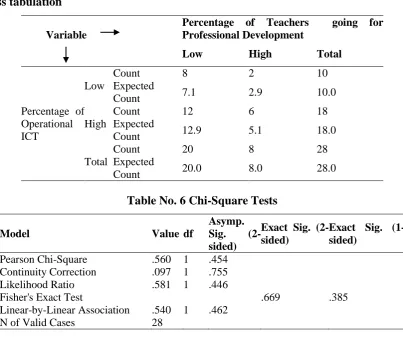
1) H0: Teachers going for Professional Development in the matters of ICT is independent to Percentage of Operational ICT equipments in the colleges
H1: Teachers going for Professional Development in the matters of ICT dependents to
APRIL - MAY, 2017, VOL. 4/21 www.srjis.com Page 4923 Table No.5
Percentage of Operational ICT * Percentage of Teachers going for Professional Development
Cross tabulation
Variable
Percentage of Teachers going for Professional Development
Low High Total
Percentage of Operational ICT
Low
Count 8 2 10
Expected
Count 7.1 2.9 10.0
High
Count 12 6 18
Expected
Count 12.9 5.1 18.0
Total
Count 20 8 28
Expected
[image:5.595.95.499.119.456.2]Count 20.0 8.0 28.0
Table No. 6 Chi-Square Tests
Model Value df
Asymp.
Sig.
(2-sided)
Exact Sig. (2-sided)
Exact Sig. (1-sided)
Pearson Chi-Square .560 1 .454
Continuity Correction .097 1 .755
Likelihood Ratio .581 1 .446
Fisher's Exact Test .669 .385
Linear-by-Linear Association .540 1 .462
N of Valid Cases 28
The calculated value of Pearson Chi-Square is .560 and ‘P’ value is .454. Here at 5% level of
significant we fail to reject the null hypothesis (P>0.05). The test is not significant. Hence;
the null Percentage of Teachers going for Professional Development in ICT is independent to
Percentage of Operational ICT equipments in the colleges, is accepted. There is no
association between Teachers going for Professional Development in the matters of ICT and
Percentage of Operational ICT equipments in the colleges.
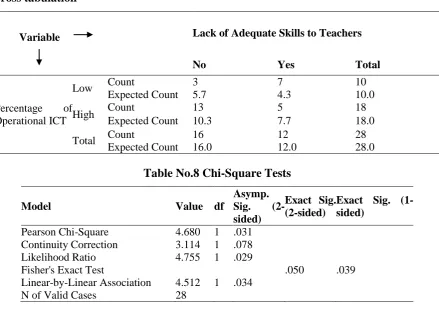
2) H0: Lack of Adequate Skills of Teachers in the use of ICT is independent to Percentage of Operational ICT equipments in the colleges.
H1: Lack of Adequate Skills to Teachers in the use of ICT is dependents to Percentage of
APRIL - MAY, 2017, VOL. 4/21 www.srjis.com Page 4924 Table No. 7
Percentage of Operational ICT equipments* Lack of Adequate Skills to Teachers
Cross tabulation
Variable Lack of Adequate Skills to Teachers
No Yes Total
Percentage of Operational ICT
Low Count 3 7 10
Expected Count 5.7 4.3 10.0
High Count 13 5 18
Expected Count 10.3 7.7 18.0
Total Count 16 12 28
[image:6.595.80.520.123.432.2]Expected Count 16.0 12.0 28.0
Table No.8 Chi-Square Tests
Model Value df
Asymp.
Sig.
(2-sided)
Exact Sig. (2-sided)
Exact Sig. (1-sided)
Pearson Chi-Square 4.680 1 .031
Continuity Correction 3.114 1 .078
Likelihood Ratio 4.755 1 .029
Fisher's Exact Test .050 .039
Linear-by-Linear Association 4.512 1 .034
N of Valid Cases 28
The calculated value of Pearson Chi-Square is 4.680 and ‘P’ value is .031. Here at 5% level
of significant we reject the null hypothesis (P<0.05). The test is significant. Hence; the null
Percentage of Lack of Adequate Skills to Teachers in the use of ICT is dependents to
Percentage of Operational ICT equipments in the colleges, is rejected. There is association
between Lack of Adequate Skills of Teachers and Percentage of Operational ICT equipments
in the colleges.
3) H0: Percentage of Operational ICT equipments in the colleges is independent to Availability of ICT Coordinator in the college.
H1: Percentage of Operational ICT equipments in the colleges is dependents to Availability of
APRIL - MAY, 2017, VOL. 4/21 www.srjis.com Page 4925 Table No.9
Availability of ICT Coordinator * Percentage of Operational ICT Equipments
Cross tabulation
Variable Percentage of Operational ICT
Low High Total
Availability of ICT
Coordinator
Yes Count 5 8 13
Expected Count 2.8 10.2 13.0
No Count 1 14 15
Expected Count 3.2 11.8 15.0
Total Count 6 22 28
Expected Count 6.0 22.0 28.0
Table No.10 Chi-Square Tests
Model Valu
e df
Asymp. Sig. (2-sided)
Exact Sig.
(2-sided)
Exact Sig.
(1-sided) Pearson Chi-Square 4.182 1 .041
Continuity Correction 2.506 1 .113 Likelihood Ratio 4.425 1 .035
Fisher's Exact Test .069 .056
Linear-by-Linear
Association 4.032 1 .045
N of Valid Cases 28
a Computed only for a 2x2 table
b 2 cells (50.0%) have expected count less than 5. The minimum expected count is 2.79.
The calculated value of Pearson Chi-Square is 4.182 and ‘P’ value is .041. Here at 5% level
of significant we reject the null hypothesis (P<0.05). The test is significant. Hence;
Percentage of Operational ICT equipments in the colleges is independent to Availability of
ICT Coordinator in the college, is rejected. There is association between Percentage of
Operational ICT equipments in the colleges to Availability of ICT Coordinator in the college
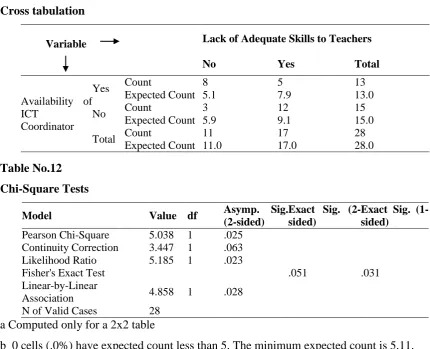
4) H0: Lack of Adequate Skills to Teachers in the use of ICT is independent to Availability of ICT Coordinator in the college.
H1: Lack of Adequate Skills to Teachers in the use of ICT is dependents to Availability of
APRIL - MAY, 2017, VOL. 4/21 www.srjis.com Page 4926 Table No.11
Availability of ICT Coordinator * Lack of Adequate Skills to Teachers
Cross tabulation
Variable Lack of Adequate Skills to Teachers
No Yes Total
Availability of ICT
Coordinator
Yes Count 8 5 13
Expected Count 5.1 7.9 13.0
No Count 3 12 15
Expected Count 5.9 9.1 15.0
Total Count 11 17 28
[image:8.595.72.503.110.459.2]Expected Count 11.0 17.0 28.0
Table No.12 Chi-Square Tests
Model Value df Asymp. Sig.
(2-sided)
Exact Sig. (2-sided)
Exact Sig. (1-sided)
Pearson Chi-Square 5.038 1 .025
Continuity Correction 3.447 1 .063
Likelihood Ratio 5.185 1 .023
Fisher's Exact Test .051 .031
Linear-by-Linear
Association 4.858 1 .028
N of Valid Cases 28
a Computed only for a 2x2 table
b 0 cells (.0%) have expected count less than 5. The minimum expected count is 5.11.
The calculated value of Pearson Chi-Square is 5.038 and ‘P’ value is .025. Here at 5% level
of significant we reject the null hypothesis (P<0.05). The test is significant. Hence Lack of
Adequate Skills to Teachers in the use of ICT is independent to Availability of ICT
Coordinator in the college is rejected. There is an association between Lack of Adequate
Skills to the Teachers in the use of ICT and Availability of ICT Coordinator in the colleges.
CONCLUSIONS
It is concluded that there are not enough Desktop Computers for the use of the students and
teachers. There not enough LCD projectors, there are not enough Desktop Computers with
internet facility for the use of the students in proportion of the enrolment of the students. The
attitude of the teachers concludes that there is great impact of use of ICT in teaching learning
process.
There is no association between Teachers going for Professional Development in the matters
APRIL - MAY, 2017, VOL. 4/21 www.srjis.com Page 4927 There is association between Lack of Adequate Skills of Teachers and Percentage of
Operational ICT equipments in the colleges. There is association between Percentage of
Operational ICT equipments and Percentage of Operational ICT equipments in the college.
There is an association between Lack of Adequate Skills to the Teachers in the use of ICT
and Availability of ICT Coordinator in the colleges.
SUGGESTIONS
It is high time to give an attention towards ICT enabled teaching in higher education, it has
number benefits such as covers the large number of population, learning across nations,
reduction in the cost of education, can be used for all streams, time saving, useful for
independent learning, therefore, State should increase the infrastructure of ICT enabled
teaching in the colleges. Teachers must acquire the knowledge and skill required to use ICT
in educational process. There should be ICT coordinator to look after ICT infrastructure,
provide technical support to teachers and the students. The ICT equipments must be fully
sued in the teaching and learning process.
REFERENCES
Carl Simmons & Claire Hawkins (2009) Teaching ICT, Sage Publications India Pvt. Ltd., New Delhi. Sreedevi Dr. P. S.(2016) ICT Enabled Education, A. P. H. Publishing Corporation, New Delhi. Sreedevi Dr. P. S.(2016) Encyclopaedia of ICT in Education, Vol.1 &2, A. P. H. Publishing
Corporation, New Delhi.
K. S. (2015) Information and Communication Technology, Navyug Books International, New Delhi. Rajub Saha and Jayant Mete (2017) ICT in Education: A 21St Century Phenomenon, A. P. H.
Publishing Corporation, New Delhi.
Angadi Dr. G. R. (2016) professional Development and ICT in Education, A. P. H. Publishing Corporation, New Delhi.
Chatterjee Deepak (2015) An Introduction to Teaching, Atlantic Publishers and Distributers (P) Ltd., New Delhi.
Swami Anita & Borkar Usha (2016) Higher Education, A. P. H. Publishing Corporation, New Delhi. Chauhan Dr. R. S. (2014) ICT in Education, A. P. H. Publishing Corporation, New Delhi.
Department of School Education and Literacy Ministry of Human Resource Development Government of India (2012): National Policy on Information and Communication Technology (ICT) In School Education.
Schwalbe Kathy (2011) managing Information Technology Projects, Cenage3 Learning India Pvt. Ltd., Delhi.
Neelam Kumari (2014) Communication and Education Technology, S. Vikas &Company, India, Jalandhar
S. K. , Uma Mangal (2014) Essentials of Educational technology, Prentice Hall Learning Pvt. Ltd. , Delhi.
Reeta (2015) Essentials of Quality in Higher Education, Shree Niwas Publications, Jaipur.
APRIL - MAY, 2017, VOL. 4/21 www.srjis.com Page 4928 Thamarasseri Ismail, Parey Manzoor Ahamed (2014) Instructional Technology, A. P. H. Publishing
Corporation, New Delhi.
Mistry Milan T. (2015) Advanced Educational Research and Statistics, Paradise Publishers, Jaipur. Ghosh Chandra Mohan (2015) Teachling Skills for 21st Century, Yking Books, Jaipur.
Sabu Dr. S. (2015) Education in the New Millennium, A. P. H. Publishing Corporation, New Delhi. Mishra L. K. (2015) Communication & Communication Technology, Y. K. Publishers, Agra. Journals and Reports:
Kavitha T C Dr. D Ashok SOM (2015): “ICT: An Enabler and a Catalyst to Nurture Service Quality in Higher Education- A Review”, India International Journal of Emerging Research in Management &Technology, ISSN: 2278-9359 (Volume-4, Issue-2) Research Article, February 2015.
Meoli Kashorda and Timothy Mwololo WAEMA(2011): “ICT Indicators in Higher Education: Towards an E-readiness Assessment Model”, Reports Proceedings and of the 4th Ubuntu Net Alliance Annual Conference, 2011, pp 57-76, ISSN 2223-7062,
Augustus Richard J. (2015): “The Role of ICT in Higher Education In The 21st Century”, International Journal of Multidisciplinary Research and Modern Education (IJMRME) ISSN (Online): 2454 - 6119 (www.rdmodernresearch.org) Volume I, Issue I, 2015.
Sukanta Sarkar (2012): “The Role of Information and Communication Technology (ICT) in Higher Education for the 21st Century”,The Science Probe, Vol. 1 No. 1 (May 2012) Page No- 30-41.
Dr. Md. Mahmood Alam (2016): “Use of ICT in Higher Education”, The International Journal of Indian Psychology ISSN 2348-5396 (e) | ISSN: 2349-3429 (p) Volume 3, Issue 4, No. 68, DIP: 18.01.208/20160304 ISBN: 978-1-365-39398-3, July-September, 2016, pp-162-171. Munienge Mbodila1, Telisa Jones2, Kikunga Muhandji (2013): Integration of ICT in Education: Key
Challenges, International Journal of Emerging Technology and Advanced Engineering, Website: www.ijetae.com (ISSN 2250-2459, ISO 9001:2008 Certified Journal, Volume 3, Issue 11, November 2013)
Deepa Mehta, Suman Kasnia (2011): “A Scenario on the role of ICT in Governance and Education System”, IJCEM International Journal of Computational Engineering & Management, Vol. 13, July 2011 ISSN (Online): 2230-7893, pp.100-109.
Uttam Kr Pegu (2014):“Information and Communication Technology in Higher Education in India: Challenges and Opportunities” , International Journal of Information and Computation Technology. ISSN 0974-2239 Volume 4, Number 5 (2014), pp. 513-518 © International Research Publications House, pp – 513-518.
Krishna V.V. (2007): “Universities and Emerging National Innovation Systems,” South Asian (Indian) Experience. 2007.
Communication Technology, The International Arab Journal of Information Technology, 2010, Vol 1, No. 4.
Kourosh Fathi Vajargah, Sheida Jahani, and Nahid Azadmanesh (2010) “Application of ICT in teaching and learning at university level: The case of Shahid Beheshti University,” TOJET: The Turkish Online Journal of Educational Technology, 2010, vol. 9, Issue 2.
Websites:
https://en.wikipedia.org/wiki/E-reader
https://www.google.co.in/webhp?sourceid=chrome-instant&ion=1&espv=2&ie=UTF-8#q=meaning+of+digital+camera&*
http://www.webopedia.com/TERM/K/kindle.html