S T U D Y P R O T O C O L
Open Access
One or two trainees per workplace in a structured
multimodality training curriculum for laparoscopic
surgery? Study protocol for a randomized
controlled trial
–
DRKS00004675
Felix Nickel
1, Felix Jede
1, Andreas Minassian
1, Matthias Gondan
2, Jonathan D Hendrie
1, Tobias Gehrig
1, Georg R Linke
1,
Martina Kadmon
1, Lars Fischer
1and Beat P Müller-Stich
1*Abstract
Background:Laparoscopy training courses have been established in many centers worldwide to ensure adequate
skill learning before performing operations on patients. Different training modalities and their combinations have been compared regarding training effects. Multimodality training combines different approaches for optimal training outcome. However, no standards currently exist for the number of trainees assigned per workplace.
Methods:This is a monocentric, open, three-arm randomized controlled trial. The participants are laparoscopically-naive medical students from Heidelberg University. After a standardized introduction to laparoscopic cholecystectomy (LC) with online learning modules, the participants perform a baseline test for basic skills and LC performance on a virtual reality (VR) trainer. A total of 100 students will be randomized into three study arms, in a 2:2:1 ratio. The intervention groups participate individually (Group 1) or in pairs (Group 2) in a standardized and structured multimodality training curriculum. Basic skills are trained on the box and VR trainers. Procedural skills and LC modules are trained on the VR trainer. The control group (Group C) does not receive training between tests. A post-test is performed to reassess basic skills and LC performance on the VR trainer. The performance of a cadaveric porcine LC is then measured as the primary outcome using standardized and validated ratings by blinded experts with the Objective Structured Assessment of Technical Skills. The Global Operative Assessment of Laparoscopic Surgical skills score and the time taken for completion are used as secondary outcome measures as well as the improvement of skills and VR LC performance between baseline and post-test. Cognitive tests and questionnaires are used to identify individual factors that might exert influence on training outcome.
Discussion:This study aims to assess whether workplaces in laparoscopy training courses for beginners should be used by one trainee or two trainees simultaneously, by measuring the impact on operative performance and learning curves. Possible factors of influence, such as the role of observing the training partner, exchange of thoughts, active reflection, model learning, motivation, pauses, and sympathy will be explored in the data analysis. This study will help optimize the efficiency of laparoscopy training courses.
Trial registration number:DRKS00004675
Keywords:Cholecystectomy, Education, Laparoscopy, Minimally invasive surgery, Training
* Correspondence:[email protected]
1Department of General, Visceral, and Transplantation Surgery, University
Hospital of Heidelberg, Im Neuenheimer Feld 110, 69120 Heidelberg, Germany
Full list of author information is available at the end of the article
Background
Minimally invasive surgery (MIS) has been established as a standard for many operations in abdominal surgery. However, in comparison to open surgery, laparoscopic surgeons face technical challenges and increased psycho-motor demands resulting in an additional learning curve and prolonged operative times [1-4]. Different training modalities enable prospective surgeons to acquire the psychomotor abilities and surgical skills necessary before applying them to patients [5-9]. Current training modalities include box and pelvi trainers with real surgical instru-ments, organ models, cadavers, cadaveric organs, live animal models, and computer simulators. Cadavers and animal models provide the most realistic training for oper-ations but are of limited availability [10,11]. Box and pelvi trainers enable the acquisition of basic skills with real in-struments and are essential for the training of knot tying and suturing. Virtual reality (VR) trainers enable repetitive training of both basic skills and operations in a virtual environment. In addition, trainees receive automated instructions and feedback, and their performance can be recorded in order to monitor training progress [12,13]. However, at their current level of performance, VR trainers still lack realism in terms of tissue interaction and haptic feedback, and performance feedback is often limited to metric parameters such as the instrument path length [11].
Positive learning effects of both box and VR trainers have been shown for practical laparoscopic skills without clear superiority of one over the other. Other studies have proven positive effects on the duration of operations and on the clinical outcome of both training modalities [5-7,14,15]. When box trainers are augmented with cadaveric organs, surgical interventions can be realistically simulated, e.g., laparoscopic cholecystectomy (LC) [16-18]. Online learning platforms provide videos of operations, ex-planations, and teaching of surgical techniques, the relevant anatomy, and perioperative management [19,20]. The efficacy of online learning modules has been studied with positive results for online learning both alone and in combination with other training modalities [21]. Multi-modality training combines the available training modalities for optimal outcome [11,22,23].
The present study is primarily directed at identifying how many trainees should be assigned per workplace in laparoscopy training courses. One may surmise that the option of having one trainee per workplace would be the optimal training environment and lead to the best training outcome. However, there is currently no evidence avail-able for surgical training [24]. Different factors might exert influence on the outcome of training in pairs or alone. Pairs have many potential advantages, such as the exchange of knowledge, technical discussions between training part-ners, more pauses with active reflection, analysis of errors,
and model learning when the partner trains [25-27]. Evi-dence from training psychology suggests higher efficiency with pauses and feedback between repetitions of exercises, thus supporting the concept “train less and learn more” [28]. For example, positive effects of intraoperative breaks during long operations have been shown to result in lower stress levels while preserving operation time [29]. Ob-serving peers during learning of practical skills in medical education has been shown to accelerate the learning process, e.g., for physical examination skills [30]. On the other hand, the available literature suggests a learning curve with a certain number of repetitions required for reaching proficiency levels of given tasks and procedures in laparoscopic surgery, thereby suggesting that trainees with a workplace to themselves would benefit [24,31-34]. The secondary objective of this study is to analyze individ-ual and general factors that influence laparoscopic learning curves and test results. The factors assessed include sex, cognitive measures, gaming experience, and personal characteristics [35,36].
Methods Objectives
The primary goal of this study is to examine whether study participants who undergo laparoscopic training individually (group 1) perform better after the training than study participants who undergo the same training in paired teams (group 2). The control group (group C), which does not receive training, exists to assess the im-portance of training for a successful operative outcome. Baseline and post-tests are performed on the VR trainer (Figure 1). The operative performance in all three groups will be tested on a cadaveric porcine model with the pulsating organ perfusion (POP) trainer at the end of the study and will be evaluated according to standardized and validated assessment criteria by blinded raters [37-40]. Secondary goals include assessing the influence of individual trainee characteristics on surgical training and performance [35,41,42].
Study design
This is a registered prospective, single-center, rater-blinded, three-arm, parallel-group randomized controlled trial (DRKS00004675).
Setting and participants
Inclusion and exclusion criteria
Inclusion criteria are students enrolled at Heidelberg University Medical School during their clinical years. Ex-clusion criteria are students who have already participated in laparoscopy training courses or who have experience assisting in laparoscopic surgeries.
Introduction to laparoscopic cholecystectomy by online learning
All participants work with online learning modules for two hours as an introduction to LC at the beginning of the study [43]. This is done in a standardized fashion by using the same room at the Department of Surgery at Heidelberg University with identical surrounding conditions in order to rule out any difference between participants. The trainees get assistance with the necessary
online registration and are given an explanatory intro-duction by trained staff in a standardized way to begin the LC module on www.webop.de. During this, the trainees are asked to study the anatomy, illustrations, and videos of the procedural techniques. Following this general overview, the participants learn more specific LC information including the operating room set-up and trocar placement. Next, the trainees watch the
[image:3.595.59.538.87.510.2]“Laparoscopic cholecystectomy: a gold standard case for dissection of Calot’s triangle” module on www.websurg. com to complement what they had previously learned. At the end of the online learning session a standardized multiple choice test is used to check the learning success. The trainees are informed about the multiple choice test at the beginning of the online learning module to ensure that learning motivation is high.
Introduction to the training modalities in the training center The participants receive a standardized introduction and instructions on using the box and VR trainer by trained staff. Thus, students can familiarize themselves with the training facilities and training devices prior to the start of the tests and exercises.
Baseline test
After online learning and a VR introduction, all partici-pants take a baseline test at the VR trainer for an initial assessment of basic skills and LC performance. After this test, participants are randomly assigned to one of the three groups.
Randomization
Study participants are stratified according to sex and randomly assigned to the training groups or control group in a 2:2:1 ratio by block randomization with a variable block length. Group 1 trains alone, group 2 trains in paired teams, and the control group C receives no training between tests (Figure 1). There are indices for differences between males and females in the acquisition of laparo-scopic surgical skills [44,45]. After the participants have finished the baseline test on the VR trainer, an employee of the Department of Surgery at Heidelberg University will perform the randomized distribution of subjects using sealed envelopes. The employee responsible for the randomization and group assignment is otherwise not involved with the training, tests, and data from the present study.
Training curriculum
The curriculum uses multiple training modalities to ascertain several advantages of each, and to give variety to the trainees for ensuring high motivation. In the present study, the multimodality training embraces online learning, box trainers, and VR training. The training groups participate in a standardized and structured multi-modality training curriculum involving box and VR trainers either individually (group 1) or in pairs (group 2). Basic skills are trained with the box (Table 1) and VR trainers (Table 2). Procedural skills and complete LCs are practiced on the VR trainer (Table 3). Training in pairs involves less repetitions of each training task per individual participant since pairs are given the same total training time per workplace and must take turns every 30 minutes. The basic and procedural skills exer-cises of the curriculum are repeated by the training groups during two training sessions of 4 hours until training time is over. The remaining 4-hour training session is used to repeat the LC modules on the VR trainer. The VR trainer permanently records data from exercises including time, precision, economy of motion, instrumental distance, and the number of misaligned clips.
Post-test
The post-test includes the basic skills and LC modules on the VR trainer and a porcine cadaveric LC. The groups 1 and 2 take the VR trainer post-test at the end of the train-ing curriculum and the porcine cadaveric LC test on the POP trainer is taken on a separate day.
Control group
Group C does not participate in the repetitive training exercises, but is provided the same E-learning, LC intro-duction, and tests as the training groups. Group C takes the VR baseline test on the first day of the study. The post-test on the VR and POP trainer LC are taken on a separate day.
Blinded test evaluation
[image:4.595.304.540.102.237.2]The post-test LC with the POP trainer and cadaveric ani-mal organ is used to evaluate and compare the operative performance of all participants. The POP trainer simulates MIS with perfused cadaveric organs. The artery of a hepato-biliary organ can be catheterized and linked to the frequency and pressure controlled POP trainer pump and Table 1 Box-trainer basic skills exercises
Nr. Exercise
1 Moving matches from a box passing them to the other instrument
2 Crossing of 6 rubber bands in a device of 6 screws
3 Cutting out a predefined circle on paper
4 Drawing a rubber band in a device consisting of eyelets and hooks
5 Cutting out a predefined triangle located on a rubber glove
6 Leading needle and thread in the correct order through eyelets screwed on a board
7 Closing a 5 cm cut on foam with a running suture
8 Attaching a simple interrupted stitch on foam
Table 2 VR trainer basic skills exercises
Basic skill Exercise
Camera manipulation The 0° and a 30° angled camera is used to locate 10 balls and snap photos of them
Eye-hand coordination Objects of blue or red colour have to be touched with the respectively colored instrument tips
Clip-application Ducts have to be clipped to stop the leakage
Clipping/grasping Leaking ducts need to be safely grasped and then clipped
Two-handed maneuvers Balls have to be grasped from a jelly mass and placed into a bag with both instruments
Circular cutting A circular form has to be freed from tissue attachments by cutting with scissors while retracting the form
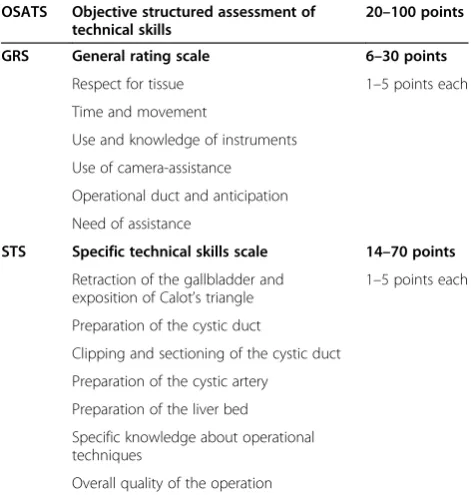
[image:4.595.305.539.547.733.2]perfused by colored water. The perfused liquid flows back into the POP trainer via side arms of the arteries, veins, and parenchymal lesions. The Objective Structured As-sessment of Technical Skills (OSATS, range 20 to 100) is used as the primary endpoint of the study (Table 4). The expert raters are blinded to the training status of the par-ticipants. The OSATS consists of two evaluative spectra and allows for the evaluation of general laparoscopic surgical skills as well as specific procedural and technical skills for the operation. The unweighted sum of the two scales will be evaluated as the primary endpoint.
With the general rating scale (GRS), the rater evaluates the trainee in the following categories (1 to 5 points each): respect for tissue, time and movement, use of in-struments, knowledge of inin-struments, use of camera-assistance, operational duct and anticipation, and need of assistance in general. The GRS covers a range from 6 (minimum) to 30 points (maximum). The specific technical skills scale (STS) measures the retraction of the gallbladder and exposition of Calot’s triangle, preparation of the cystic duct, clipping and sectioning of the cystic duct, preparation of the cystic artery, preparation of the liver bed, specific knowledge about operational techniques, and the overall quality of the operation [38,46]. In this study, the STS scale is applied in a modified way due to specific circumstances: as the criteria “incision and insertion of the port” and
“extraction of the gallbladder”refer to surgeries performed on humans or on living animals and cannot be rated prop-erly on the POP trainer, both are replaced by the criteria
“knowledge of surgery specific aspects”and“quality of the
operative outcome”. The STS covers a range from 14
(minimum) to 70 points (maximum).
In addition to the OSATS criteria, the rater will use the Global Operative Assessment of Laparoscopic Surgical Skills (GOALS, range 6 to 30) score and the time required to perform the operation as secondary endpoints (Table 5) [40]. The given time to finish the LC is 80 minutes so as to ensure the feasibility of this study. Previous studies have shown that 80 minutes is sufficient to assess the competence of each participant for all major parts of the operation.
Primary outcome measure
The primary outcome measure is the operative perform-ance of the study participants during the porcine cadaveric LC on the POP trainer based on the standardized and validated OSATS score.
Secondary endpoints
[image:5.595.56.292.109.290.2]The GRS and STS scales of the OSATS score will be evaluated separately as secondary endpoints, as well as the GOALS scores, operative times, and improvement Table 4 Objective structured assessment of technical
skills (OSATS) scores
OSATS Objective structured assessment of technical skills
20–100 points
GRS General rating scale 6–30 points
Respect for tissue 1–5 points each
Time and movement
Use and knowledge of instruments
Use of camera-assistance
Operational duct and anticipation
Need of assistance
STS Specific technical skills scale 14–70 points
Retraction of the gallbladder and exposition of Calot’s triangle
1–5 points each
Preparation of the cystic duct
Clipping and sectioning of the cystic duct
Preparation of the cystic artery
Preparation of the liver bed
Specific knowledge about operational techniques
Overall quality of the operation
Table 5 Global operative assessment of laparoscopic skills–GOALS score
GOALS–Global operative assessment of laparoscopic skills
6–30 points
Depth perception 1–5 points each
Bimanual dexterity
Efficiency
Tissue handling
Autonomy
[image:5.595.56.292.483.731.2]Level of difficulty Table 3 VR trainer procedural skills exercises for
laparoscopic cholecystectomy
Procedural skill Exercise
Clipping and cutting The gallbladder is already exposed with Hartmann’s pouch retracted laterally by a static tool. The cystic duct and artery have to be clipped and cut. Instructions are given.
Exposure of Calot’s triangle The gallbladder has to be grasped to expose Calot’s triangle. With correct exposure the students are instructed to clip the cystic duct and artery with the second instrument.
Dissection of cystic duct and artery
The gallbladder’s infundibulum has to be retracted for safe dissection of the highlighted cystic duct and artery to achieve the critical view of safety.
[image:5.595.305.540.626.731.2]from baseline to post-test on the VR trainer. In all groups, data from the practical exercises will be collected con-tinuously for each participant based on the multimodal standardized training curriculum designed by the Depart-ment of Surgery at Heidelberg University. Each individual exercise on the box trainer will be recorded with respect to time and error. The VR trainer software allows for the continuous recording of various parameters for every participant. Based on this recorded data, learning curves can be displayed for all participants and their differences can be analyzed between groups.
Psychometric and personal parameters will be collected for each participant using anonymous questionnaires. The questions will relate to prior laparoscopic experience and leisure behavior with regards to physical activity, computer games, music, and personal interests. Other parameters, e.g., personality traits and spatial awareness, will also be recorded. Group 2 will receive an additional question concerning team training. In addition, partici-pants will evaluate the training methods through a questionnaire. Explorative analyses will be performed using the collected data and possible relations to the training results [42,47].
Statistical analysis
The normal distribution provides a fairly exact approxi-mation of the distribution of the scale-specific scores (Figures 1 and two in [46]), which allows standard para-metric tests to be used to compare the mean OSATS scores of the three groups [46]. In the first step, overall training effects will be analyzed by a linear mixed model with the main effects Group (1, 2, C), gender (stratifica-tion factor), and training pair as a random factor nested in Group 2. If the group effect is not significant atα= 5% in this gatekeeper analysis, statistical inference will stop concluding that there is no substantial training effect at all. If the test is significant, all possible pairs of interven-tions will be compared (1 vs. C, 2 vs. C, 2 vs. 1) in a simi-lar linear mixed model with group, gender, and training pair (if applicable). These latter analyses will be performed at α= 5% two-tailed, without correction for multiplicity (closed test procedure).
Statistical analysis will be based on the intention-to-treat population that includes all participants that have been randomized and have attended at least one training session. Multiple imputation will be used for missing endpoint information, with linear regression of OSATS scores by the baseline performance on the VR trainer.
Sensitivity analyses will be made using mixed best (Group C) and worst-case (Groups 1 and 2) imputation for the three treatment groups, and vice versa, as well as for the per protocol set of participants that attended all trainings and have complete primary endpoint information.
Sample size determination
We plan to examine 40 study participants in the two active arms. This sample size, together with a two-sided α= 0.05, gives 80% power to detect a standardized effect of d = 0.64 with a power of 80%. This effect represents approximately 2.5 points for the general skills scale and approximately 3.5 points for the specific skills scale. As the parameters of the general skills scale range from 1 to 5 and those for the specific skills from 2 to 10, the afore-mentioned effect would reflect an improvement of exactly one scale unit, which is fairly small. The determin-ation of the sample size for the total scores of general and specific scales can only be estimated, as the correlation between the two scales is unknown. Assuming a positive correlation ofρ= 0.5, the standard deviation for the total scores of the scales would be 7.86 for both groups. With the sample size of 40 participants per group and α= 0.05 two-tailed, a difference of 5 points would be detected (for example 3 points for general skills area and 2 points for specific skills area) with a power of 80%. Even smaller differences can be neglected.
In the other analyses, the active study arms are com-pared with the control group, which consists of students who do not take part in any laparoscopic training. The effect of this control group would be larger than the one of the previous case, thereby allowing for a significantly smaller sample size. In each comparison, a standardized effect of d = 0.79 with 80% power can be measured, which would represent a mean difference of about 6 points on the OSATS scale (for example 3 points for general skills area and 3 points for specific skills area).
Ethical and legal aspects
All data for the study are recorded anonymously, treated confidentially, and are evaluated by authorized staff for
scientific purposes only. Participants’ names are kept
from the study. Ethical approval was obtained by the local ethics committee at Heidelberg University prior to the be-ginning of the study (Code S-334/2011). Written informed consent is obtained from each trainee.
Discussion
This study aims to assess the differences in laparoscopy training courses for laparoscopic beginners by using a single workplace to train one or two trainees simultan-eously. Since the study participants of Group 2 work in pairs, they repeat each individual exercise less and essen-tially work for only half of the total training time. Intui-tively, this seems disadvantageous, but there is no evidence to support this conjecture. Educating prospective surgeons on common laparoscopic training programs as groups of two might even lead to more successful performances in comparison to solo training. Additionally, this would lead to an effective optimization of resources, as twice the number of trainees could participate in courses.
Despite the careful avoidance of bias, some possible factors of influence still remain, e.g., the contradiction of the high vigilance and motivation of each study participant and the implicated individual difference. Furthermore, it is not ensured that active pauses during exercises always have the same quality for each participant, even though the staff is encouraged to keep making pauses periodically in standardized intervals. We measure if cooperative learning and other exchange effects between the trainees occurs, but not how or why they occur. The expected clin-ical performance of the study participants will be assessed by the best available simulation, a cadaveric perfused ani-mal organ. Comparison of the two intervention groups will show whether there is a difference in surgical per-formance based on training alone or in pairs. Comparison of the intervention groups with the control group will show if there exists any training effect at all. The results of the baseline and post-test of the VR trainer should dem-onstrate the differences in learning success between the trained groups 1 and 2 versus group C without training. The continuous data recording of the VR trainer and the tests will help understand if there is a difference in learning curves between both training groups and be-tween the partners in group 2, as the same training partner always starts the exercises. The assessment of general and individual parameters of the study partici-pants will help understand the possible factors of influ-ence for successful surgical education. As the study is limited to laparoscopically-naive medical students and the performance of basic skills and LC, the results cannot be directly transferred to more experienced surgeons and other interventions. However, the results of this study will increase knowledge about the optimal training conditions for laparoscopic surgery, i.e., if workplaces in surgical training centers should be used by one or two trainees
simultaneously in order to achieve the optimal training outcome.
Trial status
Recruitment started in October 2012 and is planned to be finished in June 2014.
Abbreviations
GOALS:Global Operative Assessment of Laparoscopic Skills; GRS: General rating scale; LC: Laparoscopic cholecystectomy; MIS: Minimally invasive surgery; OSATS: Objective Structured Assessment of Technical Skills; POP: Pulsating organ perfusion; STS: Specific technical skills scale; VR: Virtual reality.
Competing interests
The authors hereby declare that they have no competing interests.
Authors’contributions
FN: Conception and design, manuscript writing, critical revision, and final approval of the manuscript. FJ: Conception and design, manuscript writing, and final approval of the manuscript. AM: Conception and design,
manuscript writing, and final approval of the manuscript. JH: Conception and design, manuscript writing, and final approval of the manuscript. MG: Planning of the statistical analysis and the sample size calculation, manuscript writing, and final approval of the manuscript. TG: Conception and design, critical revision, and final approval of the manuscript. GL: Conception and design, critical revision, and final approval of the manuscript. MK: Conception and design, critical revision, and final approval of the manuscript. LF: Conception and design, critical revision, and final approval of the manuscript. BM: Conception and design, critical revision, and final approval of the manuscript. All authors read and approved the final manuscript.
Acknowledgments
We would like to thank Marion Link and Nicolas Drössler for helping to prepare this study.
Funding
The Heidelberg Foundation for Surgery supported this study with€15,000.
Disclosure information
The authors hereby declare that they have no financial ties to disclose.
Author details
1
Department of General, Visceral, and Transplantation Surgery, University Hospital of Heidelberg, Im Neuenheimer Feld 110, 69120 Heidelberg, Germany.2Department of Psychology, University of Copenhagen, Oster Farimagsgade 2A, 1353 Copenhagen, Denmark.
Received: 10 November 2013 Accepted: 10 April 2014 Published: 23 April 2014
References
1. EU Hernia Trialists Collaboration:Laparoscopic compared with open methods of groin hernia repair: systematic review of randomized controlled trials.Br J Surg2000,87(7):860–867.
2. Clinical Outcomes of Surgical Therapy Study Group:A comparison of laparoscopically assisted and open colectomy for colon cancer.N Engl J Med2004,350(20):2050–2059.
3. Hamad GG, Curet M:Minimally invasive surgery.Am J Surg2010,
199(2):263–265.
4. Harrell AG, Heniford BT:Minimally invasive abdominal surgery: lux et veritas past, present, and future.Am J Surg2005,190(2):239–243. 5. Aggarwal R, Balasundaram I, Darzi A:Training opportunities and the role
of virtual reality simulation in acquisition of basic laparoscopic skills.
J Surg Res2008,145(1):80–86.
6. Aggarwal R, Darzi A:Training in laparoscopy–which model to use?
Indian J Gastroenterol2005,24(3):95–96.
8. Korndorffer JR Jr, Stefanidis D, Scott DJ:Laparoscopic skills laboratories: current assessment and a call for resident training standards.Am J Surg 2006,191(1):17–22.
9. Undre S, Darzi A:Laparoscopy simulators.J Endourol2007,21(3):274–279. 10. Gutt CN, Kim ZG, Krahenbuhl L:Training for advanced laparoscopic
surgery.Eur J Surg2002,168(3):172–177.
11. Nickel F, Bintintan VV, Gehrig T, Kenngott HG, Fischer L, Gutt CN, Muller-Stich BP:
Virtual reality does not meet expectations in a pilot study on multimodal laparoscopic surgery training.World J Surg2013,37(5):965–973. 12. Ayodeji ID, Schijven M, Jakimowicz J, Greve JW:Face validation of the
Simbionix LAP Mentor virtual reality training module and its applicability in the surgical curriculum.Surg Endosc2007,21(9):1641–1649.
13. Schijven MP, Jakimowicz JJ, Broeders IA, Tseng LN:The Eindhoven laparoscopic cholecystectomy training course–improving operating room performance using virtual reality training: results from the first E.A.E.S. accredited virtual reality trainings curriculum.Surg Endosc2005,19(9):1220–1226.
14. Debes AJ, Aggarwal R, Balasundaram I, Jacobsen MB:A tale of two trainers: virtual reality versus a video trainer for acquisition of basic laparoscopic skills.Am J Surg2010,199(6):840–845.
15. Gurusamy KS, Aggarwal R, Palanivelu L, Davidson BR:Virtual reality training for surgical trainees in laparoscopic surgery.Cochrane Database Syst Rev 2009,1, CD006575.
16. Clerici T, Lange J, Zerz A, Beller S, Szinicz G, Losert UO, Siegl H, Fugger R:
Educational opportunities in minimally invasive surgery.Wien Klin Wochenschr1995,107(2):43–48.
17. Szinicz G, Beller S, Bodner W, Zerz A, Glaser K:Simulated operations by pulsatile organ-perfusion in minimally invasive surgery.Surg Laparosc Endosc1993,3(4):315–317.
18. Szinicz G, Beller S, Zerz A:Role of the pulsatile organ perfusion surgical simulator in surgery education.Langenbecks Arch Chir Suppl Kongressbd 1997,114:687–693.
19. Pape-Koehler C, Chmelik C, Aslund AM, Heiss MM:An interactive and multimedia-based manual of surgical procedures: Webop–an approach to improve surgical education.Zentralbl Chir2010,135(5):467–471. 20. Mutter D, Vix M, Dallemagne B, Perretta S, Leroy J, Marescaux J:WeBSurg:
An innovative educational Web site in minimally invasive surgery–principles and results.Surg Innov2011,18(1):8–14.
21. Pape-Koehler C, Immenroth M, Sauerland S, Lefering R, Lindlohr C, Toaspern J, Heiss M:Multimedia-based training on Internet platforms improves surgical performance: a randomized controlled trial.Surg Endosc2013,27(5):1737–1747. 22. Brinkman WM, Havermans SY, Buzink SN, Botden SM, Jakimowicz JJ, Schoot
BC:Single versus multimodality training basic laparoscopic skills.Surg Endosc2012,26(8):2172–2178.
23. Zimmerman H, Latifi R, Dehdashti B, Ong E, Jie T, Galvani C, Waer A, Wynne J, Biffar D, Gruessner R:Intensive laparoscopic training course for surgical residents: program description, initial results, and requirements.Surg Endosc2011,25(11):3636–3641.
24. Stefanidis D, Korndorffer JR Jr, Markley S, Sierra R, Heniford BT, Scott DJ:
Closing the gap in operative performance between novices and experts: does harder mean better for laparoscopic simulator training?J Am Coll Surg2007,205(2):307–313.
25. Henning JM, Weidner TG, Jones J:Peer-assisted learning in the athletic training clinical setting.J Athl Train2006,41(1):102–108.
26. Weidner TG, Popp JK:Peer-assisted learning and orthopaedic evaluation psychomotor skills.J Athl Train2007,42(1):113–119.
27. Henning JM, Weidner TG, Snyder M, Dudley WN:Perceived frequency of peer-assisted learning in the laboratory and collegiate clinical settings.
J Athl Train2012,47(2):212–220.
28. Crochet P, Aggarwal R, Dubb SS, Ziprin P, Rajaretnam N, Grantcharov T, Ericsson KA, Darzi A:Deliberate practice on a virtual reality laparoscopic simulator enhances the quality of surgical technical skills.Ann Surg2011,
253(6):1216–1222.
29. Engelmann C, Schneider M, Kirschbaum C, Grote G, Dingemann J, Schoof S, Ure BM:Effects of intraoperative breaks on mental and somatic operator fatigue: a randomized clinical trial.Surg Endosc2011,25(4):1245–1250. 30. Martineau B, Mamede S, St-Onge C, Rikers RM, Schmidt HG:To observe or
not to observe peers when learning physical examination skills; that is the question.BMC Med Educ2013,13:55.
31. Brunner WC, Korndorffer JR Jr, Sierra R, Dunne JB, Yau CL, Corsetti RL, Slakey DP, Townsend MC, Scott DJ:Determining standards for laparoscopic proficiency using virtual reality.Am Surg2005,71(1):29–35.
32. Grantcharov TP, Funch-Jensen P:Can everyone achieve proficiency with the laparoscopic technique? Learning curve patterns in technical skills acquisition.Am J Surg2009,197(4):447–449.
33. Korndorffer JR Jr, Dunne JB, Sierra R, Stefanidis D, Touchard CL, Scott DJ:
Simulator training for laparoscopic suturing using performance goals translates to the operating room.J Am Coll Surg2005,201(1):23–29. 34. Stefanidis D, Acker C, Heniford BT:Proficiency-based laparoscopic
simulator training leads to improved operating room skill that is resistant to decay.Surg Innov2008,15(1):69–73.
35. Stefanidis D, Korndorffer JR Jr, Black FW, Dunne JB, Sierra R, Touchard CL, Rice DA, Markert RJ, Kastl PR, Scott DJ:Psychomotor testing predicts rate of skill acquisition for proficiency-based laparoscopic skills training.
Surgery2006,140(2):252–262.
36. Thijssen AS, Schijven MP:Contemporary virtual reality laparoscopy simulators: quicksand or solid grounds for assessing surgical trainees?
Am J Surg2010,199(4):529–541.
37. Hiemstra E, Kolkman W, Wolterbeek R, Trimbos B, Jansen FW:Value of an objective assessment tool in the operating room.Can J Surg2011,
54(2):116–122.
38. Kundhal PS, Grantcharov TP:Psychomotor performance measured in a virtual environment correlates with technical skills in the operating room.Surg Endosc2009,23(3):645–649.
39. Lund L, Hoj L, Poulsen J, Funch-Jensen P, Nilsson T:Organisation of basic training in laparoscopic surgery.Ugeskr Laeger2010,172(6):436–440. 40. Hogle NJ, Chang L, Strong VE, Welcome AO, Sinaan M, Bailey R, Fowler DL:
Validation of laparoscopic surgical skills training outside the operating room: a long road.Surg Endosc2009,23(7):1476–1482.
41. Hassan I, Zielke A:Is the aptitude of manual skills enough for assessing the training effect of students using a laparoscopy simulator?Ger Med Sci2005,3:Doc11.
42. Maan ZN, Maan IN, Darzi AW, Aggarwal R:Systematic review of predictors of surgical performance.Br J Surg2012,99(12):1610–1621.
43. Wong G, Greenhalgh T, Pawson R:Internet-based medical education: a realist review of what works, for whom and in what circumstances.
BMC Med Educ2010,10:12.
44. Grantcharov TP, Bardram L, Funch-Jensen P, Rosenberg J:Impact of hand dominance, gender, and experience with computer games on performance in virtual reality laparoscopy.Surg Endosc2003,17(7):1082–1085.
45. Madan AK, Harper JL, Frantzides CT, Tichansky DS:Nonsurgical skills do not predict baseline scores in inanimate box or virtual-reality trainers.
Surg Endosc2008,22(7):1686–1689.
46. Sarker SK, Chang A, Vincent C, Darzi SA:Development of assessing generic and specific technical skills in laparoscopic surgery.Am J Surg2006,
191(2):238–244.
47. Buckley CE, Kavanagh DO, Gallagher TK, Conroy RM, Traynor OJ, Neary PC:
Does aptitude influence the rate at which proficiency is achieved for laparoscopic appendectomy?J Am Coll Surg2013,217(6):1020–1027.
doi:10.1186/1745-6215-15-137
Cite this article as:Nickelet al.:One or two trainees per workplace in a structured multimodality training curriculum for laparoscopic surgery? Study protocol for a randomized controlled trial–DRKS00004675.Trials
201415:137.
Submit your next manuscript to BioMed Central and take full advantage of:
• Convenient online submission
• Thorough peer review
• No space constraints or color figure charges
• Immediate publication on acceptance
• Inclusion in PubMed, CAS, Scopus and Google Scholar
• Research which is freely available for redistribution