Challenges of Technology and E-Learning Encounter
by Teacher Educators -A Study
Rupali Uttam Sankpal Balaji Sitaram Raut Department Of Education
Shivaji University, Kolhapur (Maharashtra) [email protected]
Abstract:
It is clear that teacher educators are encounter with number of technological and e-learning challenges. It seems that most of the teacher educators does not have conceptual clarification about e-learning as well as they don’t have proficiency over ICT skills. However if all the teacher educators wants the qualitative development of the field then certain changes should be adopted. After all nations development is depend upon teachers’ quality. Hence following suggestions are given to the teacher education institutes ICT teacher training institutes and to the teacher educators:
Key Words: Technology, E-learning, Teacher Educators
Today’s era is called as Information Technology. Numbers of people from the society are involved in the profession of information creation and dissemination of it. Therefore this society is called as Information Technology Society. However this evolution of society’s profession is not took all of a sudden. In primitive age numbers of people from society are wandering from one place to another for pasture. This society is called as Nomadic Society. After it agricultural society came into the existence. From this society numbers of people are involved in farming. Then industrial society came into the existence. This society is involved in serving the needs of industries. After it the Information Technology came into the existence. Now this voage of transformation is towards Knowledge Society. However from above discussion it is clear that the different society’s are come into existence by depending upon the previous society. All the societies are yet into the existence they are not banished. It’s figuratively representation is as follows:
NOMADIC
SOCIETY
AGRICULTURAL
SOCIETY
INDUSTRIAL SOCIETY
INFORMATION TECHNOLOGY
SOCIETY
Figure 1 Evolution of the Different Societies
From Figure 1 it is clear that today’s Information Technology is transforming into the Knowledge Society. There is need to think over that really are today’s Society is transforming into the Knowledge Society?
The answer of this question is ‘no’. Though sociologist are right on their conclusions, these are not seems applicable to the teacher education field. Because Teacher Education field is encountering the number of challenges of Technology and e-learning. It is a fact. This fact is not only existed in India but this scenario is seems same in the developing countries. It is clear from following discussions:
Several studies investigating strategies that use of ICTs in the public sector in developed countries have been carried out on several problems. A low level of economic development, poor infrastructure and political unrest are the main factors obstructing the ICTs progress. Access by individual or organizations to ICT tools and IT in the education field is necessary for building the meta-data based in national level. (Thajchayapong, Reinermann et al. 1997; Imran and Gregor 2005) There is a perception that technology leadership plays an important role to successful ICT development. (Hanna 2003) To develop new ICT strategies, the government must set up policy by consultation or advisory committee. This policy should have an appropriate way to follow the national lead to go or development goal. Generally, to set up the national ICTs policy, a basic infrastructure of services such as electric power, telephone, broadcasting, and internet are needed. (Adeyeye and Iweha 2005)
contributed to increased understanding of the various components of alignment between ICT and business strategies, they have had a macro focus; alignment in regards to structure of the ICT organization, information systems, ICT architecture or overall ICT strategy. (Fardal 2007) The previous research has been investigated in the social dimension of strategic alignment, and their results indicated that the individual level should be included when studying ICT strategic phenomena. Including the ICT user perspective in this research domain will strengthen our knowledge on the mechanisms that gives better use of ICTs as well as identifying factors leading to alignment between ICT users and ICT managers. (Reich and Benbasat 2000) The linkage between ICT strategy, ICT projects and ICT use requires that the technologies and information system organizations should be implemented or used in a proper way.
From above discussion one can conclude that the development of the nation is depend upon the education. Education can be effectively disseminated with the help of technology and e-learning. As all of know that India is developing country, India required effective education and it is possible with the help of ICT. Hence today’s teacher’s role is very important about it. Therefore the responsibility of the teacher education institutes are increased hence teacher educator is involved directly for caring out these responsibilities. During this process they are encounter with number of challenges of Technology and e-learning. Hence investigator undertake a study about it with the following objectives.
OBJECTIVES OF THE STUDY:
1. To Study the Challenges of Technology and e-learning encounter by teacher educators about the curriculum.
2. To study the challenges of Technology and e-learning encounter by teacher educators about the accessibility of it.
4. To study the challenges of Technology and e-learning encounter by teacher educators about the dissemination of the skills related to technology and e-learning.
5. To make appropriate suggestions to the teacher educators to face these Challenges.
In the light of above objectives the investigators followed following research procedure:
RESEARCH PROCEDURE:
To find the Challenges of Technology and e-learning encounter by Teacher
[image:5.612.106.552.482.719.2]Educators a survey was conducted in Pune City and from 20 IT – Teacher Educators data was collected with the help of the questionnaire. It comprises 10 structured type of questions and 10 open ended type of questions. It’s analysis is as follows:
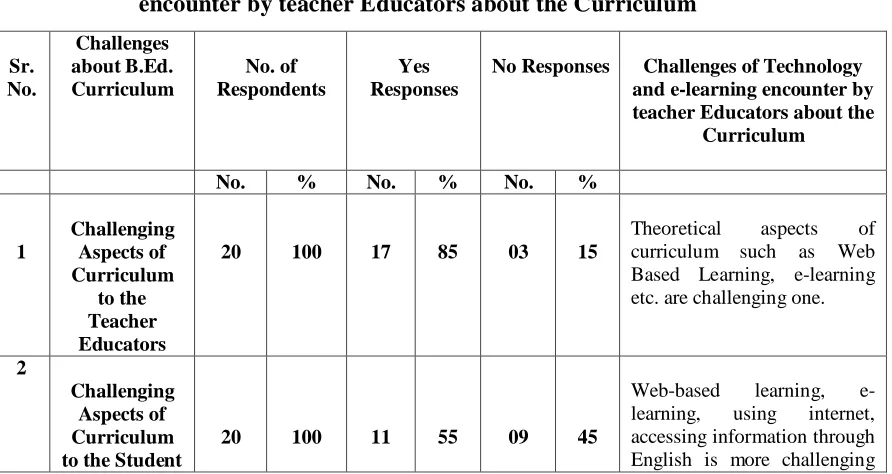
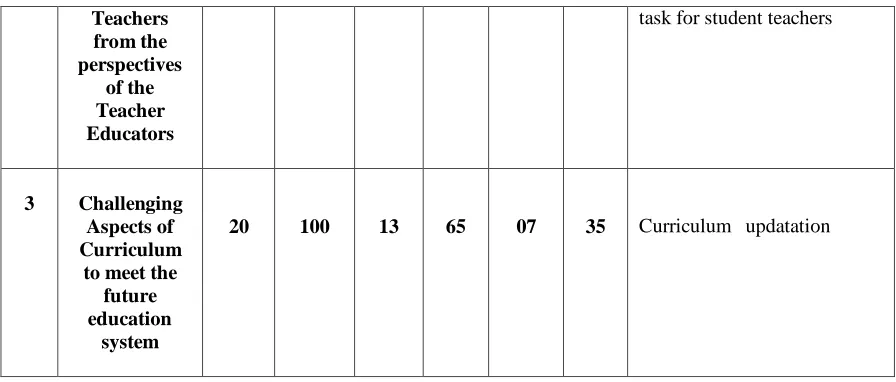
Table 1
Analysis of the responses on the Challenges of Technology and e-learning
encounter by teacher Educators about the Curriculum
Sr. No. Challenges about B.Ed. Curriculum No. of Respondents Yes Responses
No Responses Challenges of Technology and e-learning encounter by teacher Educators about the
Curriculum
No. % No. % No. %
1 Challenging Aspects of Curriculum to the Teacher Educators
20 100 17 85 03 15
Theoretical aspects of curriculum such as Web Based Learning, e-learning etc. are challenging one.
2
Challenging Aspects of Curriculum to the Student
20 100 11 55 09 45
Teachers from the perspectives of the Teacher Educators
task for student teachers
3 Challenging
Aspects of Curriculum to meet the
future education
system
20 100 13 65 07 35 Curriculum updatation
[image:6.612.102.550.69.260.2]From Table 1 it seems that majority of the teacher educators are agree that teacher education field encounter by number of challenges on curriculum aspects. It comprises theoretical aspects of curriculum such as Web based Learning, e-learning etc. According to teacher educators, student teachers are encounter with the challenges of web based learning, using internet, accessing information in English Language. The present curriculum is outdated to meet the future challenges and it is required to be updated.
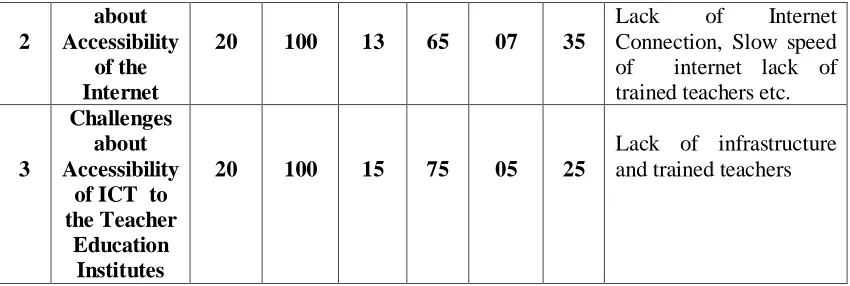
Table 2
Analysis of the responses on the Challenges of Technology and e-learning
encounter by teacher Educators about the Accessibility
Sr. No. Challenges about Accessibility No. of Respondents Yes Responses No Responses Challenges of Technology and e-learning encounter by
teacher Educators about the Accessibility
No. % No. % No. %
1 Challenges about Accessibility of the Computers
20 100 11 55 09 45
2
about Accessibility
of the Internet
20 100 13 65 07 35
Lack of Internet
Connection, Slow speed of internet lack of trained teachers etc.
3
Challenges about Accessibility
of ICT to the Teacher
Education Institutes
20 100 15 75 05 25
Lack of infrastructure and trained teachers
[image:7.612.104.529.71.214.2]From Table 2 it seems that majority teacher educators are encountering the challenges about the accessibility of the ICT. The major challenges are slow speed of PC, lack of antivirus installation/updatation, problem of electric supply, lack of trained teachers. The challenges about accessibility of the Internet are lack of Internet connection and if some institutes have then the speed is slow, th lack of trained teacher educators etc. However it seems that teacher education institutes have challenging task to provide Qualitative infrastructure facilities.
Table 3
Analysis of the responses on the Challenges of Technology and e-learning
encounter by Teacher Educators about the Training
Sr. No. Challenges about Training No. of Respondents Yes Responses No Responses Challenges of Technology and e-learning encounter
by teacher Educators about the
Training
No. % No. % No. %
1
Training about ICT
received by the
20 100 14 70 06 30
Teacher Educators 2
Challenges about Training
20 100 13 65 07 35 Skill based training of ICT etc
[image:8.612.97.528.72.158.2]From Table 3 it seems that majority teacher educators encounter with the challenges of ICT training. According to teacher educators during training they required enough hands on practice and skill based training of ICT during the training programme. And it is a challenging task to the ICT training institutes.
Table 4
Analysis of the responses on the Challenges of Technology and e-learning
encounter by Teacher Educators about the dissemination of the skills
to the student Teachers related to technology and e-learning
Sr. No.
Challenges about dissemination
of the skills related to technology and
e-learning
No. of Responde
nts
Yes Responses
No Responses
Challenges of Technology and e-learning encounter by teacher Educators
about the dissemination of the skills related to
technology and e-learning
No .
% No. % No. %
to technology and Fluency in English Language
2
The dissemination of the skills related
to e-learning
20 100 15 75 05 25
Lack of Internet connection,
Computer
Laboratory, lack of Trained Teacher Educators etc.
From table 4 it seems that majority teacher educators are encounter with the challenges of the dissemination of the skills related to technology. Those are lack of basic knowledge of ICT and fluency in English language. Teacher educators also face the challenges regarding the dissemination of the skills related to e-learning to the student teachers. That comprises lack of Computer laboratory, lack of internet and lack of trained teachers.
1. Suggestions to the Teacher Education Institutes:
Proper infrastructure and physical resources for ICT subject.
Internet connection and computer lab and trained teacher educators is essential for ICT and e-learning.
English communication classes and English competency based
programme must be implemented among Marathi and English medium teacher educators and student teachers.
2. Suggestions to the ICT Teacher Training Institutes:
Knowledge about different web sites is needed for teacher educator
The ICT curriculum must be updated in terms of more practical exposure than theoretical knowledge about ICT.
3. Suggestions to the Teacher Educators:
Training of how to handle smart classes from e-learning and web based learning must be given to student teachers.
More use of multimedia is essential for effective teaching and learning.
References:
Bhattacharya S. K. (2006). Educational Technology. Chandigrah: Abhishek Publications.
Dey, D. K. (1993). Perspectives in Mass Communication. Ludhiana : Kalyani Publishers.
Dahiya, S. S. ( 2004). Educational Technology: Towards Better Teacher Performance. Delhi: Shipra Publications.
Kumar, K. L. (1997). Educational Technology. Pune: New Age International (P) Ltd. Publishers.
Kumar, V. (1998). Media Options for Teachers. New Delhi: Atlantic Publishers and Distributors.
Rayndu C.S. (2000). Communication. Delhi: Himalaya Publications Yeole, C.M. (1991). Educational Technology. Kolhapur: Cima Yeole (Self Publication)
Google search results:
Educational Technology\ICT\role of university teachers.htm
ICT\IT Education Integrating the role of teachers Mapping the Neighbourhood.htm
Educational Technology\ICT\Internet Society (ISOC) INET '98 Track Abstracts New Applications - Track 1.htm
Educational Technology\ICT\Classroom management issues in information and communication technology (ICT)-mediated learning environments back to the basics_ - Free Online Library.htm