Financial challenges in immunization and role of Health
Technology Assessment as a Tool for Assessing New
Vaccines in Developing Countries
Mahafroz Khatib*, Rituraj Mohanty**, Arun Gowda***, Gayathri Balasubramanian*
*
Senior Scientific Associate, FSRC part of phamax **
Senior Program Manager, FSRC part of phamax ***
Director, FSRC part of phamax
Abstract- Despite the advances in vaccine development, vaccine
preventable diseases still add to the burden of childhood morbidity and mortality across the globe, particularly in developing countries. One of the major barriers preventing the access to sophisticated vaccines is the high vaccine price, the same factor that is preventing their implementation in developing countries with limited resources and funds. So, it is imperative that financial breaches and funding resources for the future are stringently appraised to strengthen immunization programs and expedite financial sustainability. Health Technology Assessment (HTA) presents an inventive and efficient approach by facilitating decision makers with a valid tool to improvise the allocation of limited resources in immunization programs. Hence, in this article we have attempted to address and suggest measures that can be implemented on a collaborative basis to mitigate the financial challenges faced in immunization programs in developing nations. The article also explores the potential and advantages of HTA as a tool for introducing new vaccines as part of immunization programs in developing countries.
Index Terms- Vaccines, Cost, Health Technology Assessment
I. INTRODUCTION
ast evidence validates the benefits of immunization in terms of cost-effectiveness and ease of implementation when evaluated against other forms of health interventions. Vaccinations prevent an estimated 2.5 million deaths each year [1]. Mortality caused by traditional vaccine preventable diseases (diphtheria, measles, neonatal tetanus, pertussis and poliomyelitis) have declined from an estimated 0.9 million in 2000 to 0.4 million in 2010 [1]. However, despite advances in vaccine development, vaccine preventable diseases still add to the burden of childhood morbidity and mortality. Out of the 8.8 million, estimated number of all deaths in children (0-59 months) under five in 2008, about 17% were vaccine preventable [1]. Based on WHO reports, 21.8 million children under one year of age did not receive DTP3 vaccine worldwide in 2013. Of these, about 70% children belonged to developing and resource stricken countries.
Even though the relevant vaccines are readily available, several reasons contribute to the poor vaccination coverage of children. In addition to issues involving immunization coverage and vaccine supply chains, a major obstruction to the access to
sophisticated vaccines in developing countries is the high cost of vaccines, which is a key factor inhibiting their implementation in nations with shortfalls in resources and funding. Also, this throws into the limelight the potential negative public insights that can be inferred about large pharmaceutical organizations. The costs of new pharmaceutical products, including vaccines, generally include high mark-ups to recover research and development investments. But, it is not justifiable to have an antagonistic approach towards manufacturers making profits since each product goes through rigorous research and development investments before entering a market. Still, there needs to be a balance between access and return on investments that companies reap. On the other hand, goals of immunization programs are generally supported through fund mobilization in such a manner that along with minimal administrative costs there are no additional burdens on the poor and timely and reliable resources are made available with the highest level of self-sufficiency. In decisions related to financial matters, it is essential that decision makers evaluate how to utilize available options based on equity, efficiency, timely provision of adequate and reliable resources, accountability and self-sufficiency. Therefore, as mentioned earlier the financial gaps and future funding resources need to be stringently evaluated and novel paths need to be found to strengthen immunization programs and ensure financial sustainability.
Hence, in this article we have tried to address and suggest measures which can be implemented on a collaborative basis to mitigate the financial challenges encountered in implementing immunization programs in developing nations. Also we intended to discuss and explore the potential and prospects of health technology assessment (HTA) as a tool for introduction of new vaccines in immunization program in developing countries.
II. CURRENT COSTS OF THE IMMUNIZATION
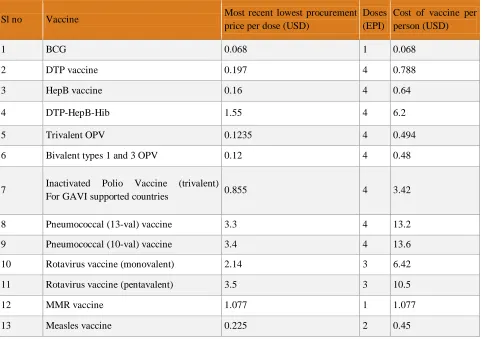
(mono or penta valent) vaccines per person costs about 40 – 44 USD, excluding associated expenses such as infrastructure development, supply chain management, surveillance, training and educational related expenses. Moreover, the costs mentioned in the table 2 are applicable only when the vaccines are procured through UNICEF/GAVI for GAVI eligible countries (that includes India). In 2011, due to inflation and other concerns, GAVI restricted the eligibility for cheap vaccines to nations whose GNI per capita income was USD 1,500 or less, which decreased the number of eligible countries to 58 from 72 [3]. GAVI eligible economies would have to procure vaccines on their own and so would be exposed to market prices and pressures.
The resultant surge in spending and budgetary constraints produces an urgent need for sustained financial vaccination support. Eventually choice of funding and payers will have a major impact on economic evaluations related to vaccines that include cost (GAVI-negotiated prices, country co-payment levels or market prices) and also related benefits. Hence, in these regards several measures/models currently being practiced to mitigate financing issues related to immunization across the globe have been discussed.
Measures to Mitigate Financing Issues
1.
Vaccine purchase through UNICEF or vaccine procurement cartelIntroduced in 1991 by UNICEF and WHO to assist the developing countries in vaccine procurement, advantages associated with the Vaccine Independence Initiative (VII) includes delivery of pooled procurement of vaccines which drives down the costs; use of local currency as mode for payment for vaccines, and payment post vaccine delivery which effectively increases the limited time credit. So, the concept generally proposed incentives for the nations who utilized it. UNICEF supported the cause by absorbing the risks concerned with issues related to nonpayment for vaccines by reassuring the manufacturers in such scenarios. However, subsequent to recovery with GAVI support, nations encountered escalating prices for the same vaccines. Forming vaccine procurement cartel with regional countries was an option for minimizing these associated risks. Such cartels that provided pooled procurement put nations in a better position for low price negotiations. Furthermore, bulk/long-term orders as an effect of this initiative was an added advantage for the manufacturing industry. In future, these procurements may be stretched in terms of technical assistance, sharing of technology, and exchange in currency etc., guaranteeing a sustained vaccine supply to these nations. Example includes Pan American Health Organization (PAHO) in Latin American and Caribbean countries and the Gulf Cooperation Council in Middle East countries [4].
2.
Vaccine purchase through advanced marketing commitment (AMC)AMC, generally a binding contract offered by a government or any financial organization on successful development of a new vaccine or any other drug is a new type of financing model which subsidizes a fixed volume of vaccines for a fixed period in exchange of commitments to buy the same.
Subsequent to the lapse of the AMC period, low cost is charged for a long duration depending on previous negotiations which decrease manufacturer risk at various stages of immunization from development, production and marketing of the vaccine in developing geographies. Also, this commitment saves the transfer of production to third parties or local manufacturers in developing nations hindering low cost production [3]. Introduced by the GAVI countries to finance a pneumococcal conjugate vaccine AMC has made it possible for the pharma companies to provide 10 million doses of Prevnar-13 and Synflorix (pneumococcal conjugate vaccines) respectively per year for 10 years.
3.
Vaccine purchase through tiered pricing model (differential pricing)In this, varied classes of buyers are subjected to different cost for the same technology. With reference to vaccines, prices levied at LMICs (Lower middle income countries) are lower in comparison to the open market rate by bulk procurement systems recognized by UNICEF and PAHO. This decreases financial hurdles to access related to vaccine for the developing economies and facilitating manufacturers with profit in richer economies so as to invest in adequate production capacity and research and development of new vaccine. In this model, the vaccines are priced according to the GDP per capita income with the mutual agreement of the manufacturer as well as the buyer. Though this mitigates risk for manufacturers associated with handling vaccine orders on long term, there exists conflicts of interest arising from multiple procurement channels. Eg: UNICEF’s AMC is lower priced as compared to PAHO for pneumococcal conjugate vaccines [3]. Considering the fact that it would be challenging for substantiating decision with the stakeholders and promoters, such a model is hard to implement for the pharmaceutical companies. Although the unambiguous modification of ex-factory costs with respect to 3 – 4 tiers of GDP (GAVI) is a reasonably rational approach, but it goes against the general European Union framework of the Transparency Directive (national regulation of pricing and reimbursement decisions). Other solutions for differential pricing include Ramsey (differential) pricing which consists of adjustment of ex-factory prices according to the local purchasing power (ancient method), restrictions on international price referencing (e.g. according to the GDP) and parallel trade; confidential rebate mechanism (i.e. discount, rebate, claw-back); risk-sharing (i.e. patient access schemes) in developing countries.
4.
Vaccination through insurance modelefficiency in health protection is well documented. Hence, it would be more suitable for inclusion in insurance [4]. Different countries have already incorporated this model to immunization processes. In Bulgaria, general practitioners receive vaccines, purchased by the Ministry of Health and are compensated by the National Health Insurance Fund for their services. Also, the Social Security Administration is supposed to fund resources for immunization from the fund gathered by contributions of payroll and tax revenues, in Costa Rica [4].
However, a major drawback with this model is that the vaccines may not cover those children who are not under the coverage of insurance. As the general public is not fully aware of the benefits of vaccination, acceptability of vaccines is subjected to decline. In the fifth Board meeting GAVI decided to recommend countries to do away with charging user fees for national immunization campaigns, as this would hinder the acceptance of immunization services. Following this many other organizations like, the Commission for Africa, Department for International Development (DFID), UNICEF, Save the Children-UK, and the World Bank also have also supported and recommended the same. However in contrast, the World Bank recommends the use of insurance or other pre-payment mechanisms to finance immunization programs [4].
5.
Domestic production or contract manufacture of vaccinesThe cost of a new vaccine generally depends on investment in research and development and production costs including setting up and maintaining a manufacturing plant. Vaccine prices are not linked to the costs of production, but on costs saved by a vaccine in protecting against a disease from a health economic standpoint. This raises the cost of vaccines dramatically and the resulting price value is often excessively expensive for a developing economy. Hence forth, a number of independent vaccine manufacturers emerged in Asia and Latin America buoyed by low cost raw materials and labor and were able to produce vaccines at a much lesser cost as compared to traditional manufacturers. Subsequently, in terms of volume, about 14% of vaccines that are catered globally are from suppliers in industrialized countries; while bulk of remaining 86% are dispensed by manufacturers from the developing countries. Presently, domestic manufacturers contribute the bulk of vaccines produced and distributed globally. In 2007, about 60 % of vaccine doses were procured by UNICEF and WHO from new manufacturers [5]. Some of these include public sector firms in Brazil, China, Indonesia and some private sector firms from India which have been responsible for supplying basic vaccine that are technologically easier to produce and have trusted on the cost for their growth. These firms firmly believed in their cost strategies impacting their future growth. Gradually, with increasing investments, some of these firms also produce additional vaccines (for hepatitis B, pentavalent vaccine of DTP-HepB-Hib etc.) and are currently in phase of promoting more advanced vaccines like rotavirus vaccine, HPV vaccine and pneumococcal vaccines, which would eventually raise the supplier base and bring down costs.
6.
Vaccine purchase through other forms of fundingIn few nations (like Bhutan) the immunization programs are funded by National Trust Funds, which are specialized funds created for particular purposes usually generated through different resources (taxes, donor funds, and private sources through incentives and regulations). This type of funding is supposed to be more secure as it assures financing stability for immunization programs without excessive burden on the national budget. In Bhutan, the Health Trust Fund was established by the government and taxation was removed as the funds were held by UN agencies in which government contribution was nearly 50 %, while the rest of the funding was generated from other public and private agencies. Different countries raise revenues from different sources for funding national immunization program. For example, Mexico uses fixed portions from oil revenues; Costa Rica from lottery sales; Tajikistan, Vietnam, and Haiti from luxury goods. These nations utilize these revenues for health programs. Revenues generated from sin taxation that includes taxes levied on goods proven to be health hazards, like tobacco, alcohol, and habit forming drugs are earmarked for the health of masses.
The funding level for the health programs would survive on the sales and revenues of such products, which at times could be devastating, especially in times of an economic downslide. Also, at other times funds are allocated on need basis for other projects of national importance, limiting the government’s contribution in immunization programs. Other forms of financial and non-financial resource allotments, termed project assistance can be in different forms such as financial assistance, technical assistance, merchandise assistance (essential vaccines, cold chain equipment), training, monitoring and evaluation which are usually provided by UN agencies or by other international donor agencies. However, such assistance can never drive a health project like immunization program; instead it has to be driven by the host country while absorbing available assistance. Another form of funding immunization funding is through development loans from leading international banks. Countries like India, Pakistan and Nigeria have taken huge loans to finance their polio eradication campaigns. However, there are a lot of limitations while opting for development loans, as all the loans need to be re-paid although there are also processes where the country’s debt is relieved or restructured based on mutual negotiations. However, such processes do not directly provide any financial support for immunization programs, instead they tend to have a soothing effect on the overall budget constraints and help to increase the investment [4].
Health Technology Assessment - a Tool for Assessing New Vaccines in Developing Countries
addition, these factors also make it difficult for the government in the developing countries to finance all vaccines. Therefore, it becomes obligatory to assess ways to make best of the available limited resources as per the needs and requirements of the countries. Also, for introduction of new vaccine in developing countries, a well-defined, transparent and extensively applicable process is an essential requisite that is robust enough to appraise the new vaccine and technology in every aspect. To explore the best possible strategy to launch them, a HTA approach could be beneficial, keeping in consideration the need to transform the presentation and mode of delivery of the present available vaccine [6]. In recent few years, interest for pursuing HTA has been rather promising in developing nations. Several practical evidences justify the necessity and scope of HTA in developing countries. For example study conducted in Asia on governmental decisions for introduction of new technologies (that evaluated diffusion pattern of the MRI machine) had observed visible problems with regards to efficiency, equity, and quality of technological services and henceforth advocated and recommended purchasing and regulatory bodies to be endowed with skill and knowledge of HTA [7].
The added prospective of HTA is that it serves as a multidimensional tool which evaluates social, legal, organizational and bioethical aspects along with the disease epidemiology; clinical (effectiveness, emergency, indications of use) and economic evaluation of different consequences of the new vaccine (technology). In contrast to present decision making process for vaccines which includes mostly evidence based medicine, cost-effectiveness evaluation and is subjected to political predilections, HTA incorporates Evidence Based Vaccinology (EBV) that deals with identification and utilizing best evidences for decisions throughout all development and introduction stages of vaccines. HTA potential on new vaccine introduction can support in decision making at national public health levels, company levels and even on a daily scale for economic resource allocation and improvisation of healthcare services and thereby facilitates the evaluation of new vaccines globally. Though HTA exists both formally and informally in some of the Asian and South American low and middle income countries, for example, Thailand, China, Laos, Pakistan ,Bangladesh, Sri Lanka, Malaysia, Taiwan, Bhutan, Mongolia, Cambodia, Indonesia, Brunei, Maldives, Philippines, India ,Nepal, Korea, Vietnam, Chile, Argentina, and Brazil [8], literature with respect to vaccine and HTA is lacking with reference to developing countries and also whatever data is available avails from developed countries which appears limited as well [6]. Due to this scarcity of information in developing countries, we evaluated the various prospects of HTA in immunization particularly in developing countries. Overall, the following research might be of potential interest to individuals and organizations pursuing for promoting HTA in any explicit perspective, and that too especially in developing countries.
HTA framework applied to vaccine
WHO, Global Alliance for Vaccine Initiative (GAVI) and UNICEF have been trying to implement vaccines for Streptococcus pneumonie infections, rotaviral diarrhea and human papilloma viral infections (PCV). PCV vaccines are in non-GAVI planning introduction phase and several developing
countries including India are yet to introduce the vaccine in their immunization schedule. IAP (Indian Academy of Pediatrics) had been recommending the inclusion of the pneumococcal conjugate vaccine in the government's immunization program since the last two years, but it has not yet materialized. When it comes to the introduction of PCV in developing countries, a potential framework for HTA which has been specifically modified for PCV vaccine for pneumococcal infections includes the following steps [6]:
i. Literature searching, secondary desk research including systematic reviews, meta-analysis, data banks, hospital records etc. for evaluating:
a. Epidemiology of pneumococcal infections in specific developing country including disease burden (use of healthcare services for pneumococcal infections including hospitalization, mortality, morbidity etc.) b. Current treatment practices in healthcare
for the pneumococcal infections
c. Preventive measures to avoid
pneumococcal infections (PCV immunization currently and past evidences)
ii. Mathematical modeling of the pneumococcal disease’s course. Mathematical modeling of reduction in the incidence of pneumococcal infections within 10 - 15 years, taking into account the estimated ageing of the country.
iii. Evaluating for remuneration: an in-depth detailed survey involving patient suffering from pneumococcal infections to evaluate the readiness to pay for the treatment and modalities to prevent disease development.
iv. Evaluating the impact of the PCV vaccination on the epidemiology of pneumococcal infections that includes the pre-vaccination and post-vaccination data through SDR.
v. Evaluating the effectiveness, efficacy and safety of the PCV vaccine: by utilizing highest quality data evidences that includes systematic reviews, meta-analysis, RCT (based on quality assessment tool - low risk of bias) on its effectiveness, efficacy and safety.
vi. Elaboration of a mathematical model predicting economic impact of vaccination.
vii. Economic evaluation of immunization by means of cost-benefit and a cost-effectiveness analyses; using a cost-effectiveness analysis expressing the final results in terms of quality adjusted life years gained (QALYs); viii. Evaluation of the impact of PCV vaccination on the
health system (the relationship between industry and the government; surveillance system of those vaccinated); ix. Organizational aspects of PCV: - Study of the
x. Investigation of biotechnological aspects and manufacturers’ view on PCV introduction.
xi. Evaluation of ethical, legal and social issues of the PCV immunization.
Another approach: transferability of the successful implementation of immunization strategies
Poor health status, restricted healthcare budgets, analytical resources, limited data availability along with the fact that the prices for globally traded goods (e.g. pharmaceuticals) are adjusted to large (high income) markets limiting the availability, force developing countries to pay even greater consequences for inappropriate reimbursement decisions in comparison to developed countries. For decisions concerned with provision and reimbursement of new healthcare technologies that includes vaccines as well, information regarding the cost effectiveness is an indispensable requisite for the decision makers. However, in developing countries there appear inadequate analytical resources that can facilitate the provision of the data for such decisions. Hence, in such situations, transferability of existing economic evaluation data to these countries could serve as a sound valid alternative. The decisions makers can conserve potentially a large amount of scarce evaluation resources and take more timely decisions, if the clinical as well as cost effectiveness related analysis can be efficaciously utilized, recalculated or reapplied to satisfy requirements that are specific geographically [9].
There exists a large amount of variation in data related cost effectiveness internationally and also lack of understanding on the various factors related to this variability. Hence, it becomes obligatory to evaluate which causes and factors concerned with this variability in international cost-effectiveness can be associated with the degree of economic attainment of the specific nation of interest in relation to transferring of data to the developing countries [10]. For assessing the transferability of the successful implementation of immunization strategies prevalent in developed countries to developing countries, specific criteria mainly depends on perspective, discount rate, medical cost approach, productivity cost approach, absolute and relative prices in healthcare, practice variation, technology availability, disease incidence/prevalence, case-mix, life expectancy, health-status preference, acceptance, compliance, incentives to patients, productivity and work-loss time and disease spread of the country [11]. For nations that qualify these criteria, one has to gaze at the availability of local data to evaluate and analyze the requisite for modeling based adjustment (e.g. sensitivity analysis) for improvising the transferability quotient. Alternatively, application of local cost as well as utility data can also be considered to populate the model by applying results from published clinical effectiveness review. However, availability of data that is country-specific, fundamental variations and disparities across the healthcare systems, access to decision model that has an effect on assumptions related to decision models, can restrict the practicality of these strategies during transferring of data to developing countries.
Each nation is different with regards to social, cultural and historical elements that mould the population’s and system’s readiness to pay for technologies. These in turn also affect the infrastructure, readiness and ability to apply HTA methodology as well. Together with equity, these may also govern whether
HTA applies cost effectiveness analysis, includes indirect comparison, considers subgroups, availability of risk sharing schemes etc. These factors that vary across countries apprise and influence HTA decisions and recommendations. Hence, a technology reimbursed in full in a certain nation can be rejected, or only accepted with conditions, in another. Henceforth the developing countries have a positive prospective for using HTA to judiciously improve use of restricted resources may at times be least able to conduct HTA.
If HTA is to propose a convincing proposition for policy making related to healthcare including immunization, it may demonstrate a positive impact and value. But the fact that persists is how one measures impact; change in practice; cost saving including direct and indirect costs from immunization (any technology); whether impact is likely to be more in structured systems with reimbursements list as compared to open system without guidance; whether impact is affected when the processes of HTA is too far from the decision makers and budget holders (national, regional, local). The HTA impact is improvised if there is a policy process with regulation while in systems where the incentive does not facilitate or support HTA (fee for service), the HTA impact is reduced. Henceforth, any immunization decision based on HTA recommended in two different countries may have a dissimilar impact on practice in each depending on variations in the fit between HTA and decision making processes.
Assessing the impact of health technology assessment and its barriers
There have been studies in the past evaluating HTA impact on setting healthcare priorities [8–11]. Past evidences including 21 reports, covering 16 topics, reported that all but three HTA reports had an influence on policy decisions and about an annual saving of $16 million and $27 million were reported by the cost-minimization studies through HTA [12]. Also a commentary has stated that while the earlier ten years has been well spend on constructing HTA infrastructure and evidence base , the coming ten years should focus on the outcomes [13]. Though HTA has been influential in healthcare priority setting in few healthcare systems, observers do approve that the impact on priority setting has been modest at best [14].
The HTA’s traditional emphasis on health service level than the public health level along with its struggle in integrating political as well as public health levels has been a major barrier for HTA. Though it has helped inform healthcare priority setting in practice, it has been not so successful to deliver in this arena due to restrictions implemented by their policy implementation level as noted previously.
III. RECOMMENDATIONS AND CONCLUSIONS
application of HTA in immunization procedures in such countries. While in smaller counties with population lesser than three million, international collaboration is needed with countries with similar healthcare system preferably (eg EUnetHTA Core Model). Also for the success of HTA in immunization processes, the acceptance of multiple key stakeholders is an indispensable requisite, which will need the involvement of healthcare professionals, patient advocacy groups, and medical technology firms coupled with open, consistent and transparent HTA processes with respect to selection of technology to be assessed, its conduct and application of the results of assessment to access and reimbursement [15].
Thus, availability of human and financial resources, capacity building and training programs to perform/run HTA, previously existing good practices and examples from other countries, international networking, support and collaboration, compatibility to adopt and/or adapt foreign evidence in the local context along with the rising interest and demand for EBM and/or HTA, have been potential motivation to promote HTA to produce a positive health impact in immunization, particularly in developing countries. However, conflict of interest, questionable data quality, rigidity of the health system , existing practice routines and culture to change, absence of real world application, HTA viewed as an obstacle to acquisition of new technologies
have served to be major barriers to HTA in immunization processes [16].
Thus, over the past two decades, scientific research has led to the development of new technologies related to healthcare including the introduction of new vaccines in the immunization schedule. The decision process with regards to these developments would be an area of concern in the coming years as well and a useful valid tool for orientation of the decision making toward the best allocation of limited resources is the need of the day, particularly in the developing countries. HTA’s multidisciplinary aspects in immunization could definitely serve as an innovative and effective decision supporting approach [17]. The mainstream approach of developed countries may not deliver the desired results in developing countries, but one can still learn from their experiences. Creative and consistent local HTA implementation can deliver success over years. While the benefits of vaccines are difficult to measure as they are preventive in nature unlike curative interventions, making decisions on the suitable financing models on immunizations is a difficult task. As the low and middle income countries progress, their economies also would progress, giving them extra financial muscle to fund immunizations and other health related programs. As HTA systems are refined and exported to countries developing HTA system infrastructure, more research on the structure, process and outcome of HTA systems is warranted.
[image:6.612.67.549.374.715.2]Tables:-
Table 1: Vaccine procurement cost for immunization of a single person
Sl no Vaccine Most recent lowest procurement
price per dose (USD)
Doses (EPI)
Cost of vaccine per person (USD)
1 BCG 0.068 1 0.068
2 DTP vaccine 0.197 4 0.788
3 HepB vaccine 0.16 4 0.64
4 DTP-HepB-Hib 1.55 4 6.2
5 Trivalent OPV 0.1235 4 0.494
6 Bivalent types 1 and 3 OPV 0.12 4 0.48
7 Inactivated Polio Vaccine (trivalent)
For GAVI supported countries 0.855 4 3.42
8 Pneumococcal (13-val) vaccine 3.3 4 13.2
9 Pneumococcal (10-val) vaccine 3.4 4 13.6
10 Rotavirus vaccine (monovalent) 2.14 3 6.42
11 Rotavirus vaccine (pentavalent) 3.5 3 10.5
12 MMR vaccine 1.077 1 1.077
14 Meningococcal A conjugate vaccine 0.621 2 1.242
15 Bivalent Human Papilloma Virus (Types
16 and 18) vaccine 4.6 3 13.8
16 Quadra valent Human Papilloma Virus
(Types 6, 11, 16 and 18) vaccine 4.5 3 13.5
17 Td vaccine 0.105 2 0.21
18 TT vaccine 0.05 2 0.1
19 Yellow Fever vaccine 0.769 1 0.769
* Data based on UNICEF purchase prices (Conversion factor 1USD=1.14 Euro) [2]
Figures:
Figure 1: Global cause of child death
reventable diseases
: Deaths in under five children from vaccine preventable diseases
Title Title
Tetanus (non-neonatal) 2000
Neonatal tetanus 59000
Measles 118000
Pertussis 195000
Hib 199000
Pneumococcal disease 476000
Source:
Figure 2: Global vaccine preventable deaths (2008) in children below 59 months
REFERENCES
[1] Global Vaccine Action Plan 2011-2020.WHO.Available at: file:///C:/Users/mahafroz.k/Downloads/9789241504980_eng%20(1).pdf [2] Vaccine Price Data. UNICEF. Available at :
http://www.unicef.org/supply/index_57476.html
[3] Paul Wilson .Giving developing countries the best shot: An overview of vaccine access and R&D. Available at:http://www.msf.org.uk/sites/uk/files/Vaccine_Report_201005111518.pdf
[4] IMMUNIZATION FINANCING TOOLKIT: A Resource for Policy Makers and Program Managers. The World Bank and the GAVI Alliance December 2010.Available at
[5] http://www.who.int/immunization/programmes_systems/financing/tools/fin al_toolkit_2011.pdf
[6] WHO, UNICEF, World Bank. State of the world’s vaccines and immunization, 3rd ed. Geneva, World Health Organization, 2009.Avialable at
:http://www.unicef.org/media/files/SOWVI_full_report_english_LR1.pdf. [7] Giuseppe La Torre et.al.Health Technology Assessment and vaccine: new
needs and opportunities?IJPH 2007;4(1)
[8] Hutubessy RC, Hanvoravongchai P, Edejer TT. Diffusion and utilization of magnetic resonance imaging in Asia. Int J Technol Assess Health Care. 2002;18:690-704.
[9] Sivalal S. Health technology assessment in the Asia Pacific region. Int J Technol Assess Health Care. 2009;251:196-201.
[10] Goeree et al (2007) Transferability of economic evaluations: Factors to consider when using results from one geographic area for another; Current Medical Research and Opinion, 23:4, pp671-682
[11] Sculpher et al. Generalisability in economic evaluation studies in healthcare: a review and case studies 2004;.8(49)
[12] Welte R, Feenstra T, Jager H, Leidl R. A decision chart for assessing and improving the transferability of economic evaluation results between countries. Pharmacoeconomics. 2004;22(13):857-76.
[13] Robert Jacob,Maurice McGregor. Assessing the impact of health technology assessment. International Journal of Technology Assessment in Health Care 1997; 13(1): 68-80
[14] Straus SE. What has evidence based medicine done for us? BMJ 2004;329:987–8.
[15] Klein R, Day P, Redmayne S. Managing Scarcity. Priority Setting and Rationing in the NHS. Nuckingham: Open University Press,1996.
[16] John Donnell , Sissi V. , Chris L. Pashos David W. Miller and Marilyn Dix Smith. Health Technology Assessment: Lessons Learned from Around the World—An Overview.Value in Health 2009;12(s2):s1-s5.
[17] Abinaya Rajan, naki Gutierrez-Ibarluzea,Vitoria-Gasteiz,Montse Moharra.International Journal of Technology Assessment in Health Care 2011; 27(1): 55–63.
[18] Giuseppe La Torre, Chiara de Waure, Giacomina Chiaradia, Alice Mannocci, Maria Lucia Specchia, Nicola Nicolotti, Walter Ricciardi.The future of best investing in vaccines: The Health Technology Assessment approach .Vaccine 2008;26(13):1609–1610.
AUTHORS
Email: [email protected]
Second Author – Dr.Rituraj Mohanty, Qualifications: M.B.B.S, Designation: Senior Program Manager, FSRC part of phamax Address: FSRC part of phamax, phamax Analytic Resources Pvt. Ltd., #19, "KMJ Ascend", 1st Cross, 17th C Main, 5th Block, Koramangala , Bangalore, Karnataka, India 560 095
Third Author – Dr.Arun Gowda, Qualifications: M.B.B.S, Designation: Director, FSRC part of phamax, Address: FSRC part of phamax, phamax Analytic Resources Pvt.Ltd., #19, "KMJ Ascend", 1st Cross, 17th C Main, 5th Block, Koramangala ,Bangalore, Karnataka, India 560 095
Fourth Author – Dr. Gayathri Balasubramanian,
Qualifications: MSc in Clinical Research, Designation: Senior Scientific Associate, FSRC part of phamax, Address: FSRC part of phamax, phamax Analytic Resources Pvt.Ltd., #19, "KMJ Ascend", 1st Cross, 17th C Main, 5th Block, Koramangala , Bangalore, Karnataka, India 560 095, Email: