Efficient Flash Translation layer for Flash Memory
Shinde Pratibha
*, Mrs.Suvarna
***
PG student, Department of IT-PDVVP COE, Pune University, Ahmednagar
**
Asst.Professor, Department of IT-RM COE,JNT University, Hyderabad
Abstract- Flash is a type of electronically erasable programmable read- only memory (EEPROM). Flash memory is important as nonvolatile storage for mobile consumer electronics due to its low power consumption and shock resistance.
NAND flash memory has many advantageous features as a storage medium, such as superior performance, shock resistance, and low power consumption. However, the erase-before-write nature and the limited number of write/erase cycles are obstacles to the promising future of NAND flash memory. An intermediate software layer called Flash Translation Layer (FTL) is used to overcome these obstacles.
Many efforts for optimizing the working of address mapping schemes have been done by different research workers. Though various schemes are designed and proposed but there is no literature available providing mathematical computations comparing the performance of the various mapping schemes in the form of time complexity. In this paper we have tried to find out the comparative cost of block merge operation required during garbage collection for some representative mapping schemes like BAST and FAST .
I. INTRODUCTION
1.1 Characteristics of NAND flash memory NAND flash memory has several limitations:
1) The previous data should be erased before a new data can be written in the same place. This is usually called erase-before-write characteristic.
2) Normal read/write operations are performed on a
per-page basis, while erase operations on a per-block basis. The erase block size is larger than the page size by 64~128 times. In MLC (Multi-Level Cell) NAND flash memory, the typical page size is 4KB and each block consists of 128 pages.
3) Flash memory has limited lifetime; MLC NAND flash memory wears out after 5K to 10K write/erase cycles.
There are three basic operations in NAND flash memory: read, write (or program), and erase. The read operation fetches data from a target page, while the write operation writes data to a page. The erase operation resets all values of a target block to 1. NAND flash memory does not support in-place update.
A NAND flash memory chip is composed of a fixed number of blocks, where each block typically has 32 pages. Each page in turn consists of 512 bytes of the main data area and 16 bytes of the spare area. The page is the basic unit of read and write operations in NAND flash memory.
NAND flash memory is usually used as a storage medium in place of Hard Disk Drive (HDD) because of its non- volatility and large I/O unit. It is not straightforward to replace HDDs with NAND flash memory due to its erase before- write nature.
The erase unit (called block) is larger than the read and write unit (called page) by 32 – 128 times.
Other semiconductor devices such as SRAMs and DRAMs, the write operation compared to the read operation. As the write operation usually accompanies the erase operation.
Another limitation of NAND flash memory is that the number of program/erase cycles for a block is limited to about 100,000 – 1,000,000 times. Thus, the number of erase operations should be minimized to improve the overall performance and the lifetime of NAND flash memory.
1.2 Flash Translation Layer (FTL) The FTL is one of the core engines in flash-based SSDs that maintain a mapping table of virtual addresses from upper layers to physical addresses on the flash.
The main goal of FTL is to emulate the functionality of a normal block device with flash memory, hiding the presence of erase operation and erase-before-write characteristics. Two important functions of FTL are address translation and garbage collection.
Figure 1 Architecture of Flash File System
Fig. 1 shows the software architecture of the flash file system. This section focuses on the FTL layer shown in Fig. 1. The file system layer issues a series of read or write commands each with a logical sector number, to read data from, or write data to, specific addresses in flash memory. The logical sector number is converted to a real physical sector number of flash memory by some mapping algorithm in the FTL layer.
FTLs can be categorized into two classes according to their mapping granularities: Sector-mapped FTLs and block-mapped FTLs. A Sector-mapped FTL literally maps a logical address into a physical address in a page unit. It is highly flexible as a logical page can be written to any physical page in NAND flash memory. On the other hand, the mapping unit of a block-mapped FTL is a block. And later on a hybrid mapping scheme proposed by D. Park came into existence.
II. TYPES OF MAPPING SCHEMES
2.1 Sector – Mapping FTL
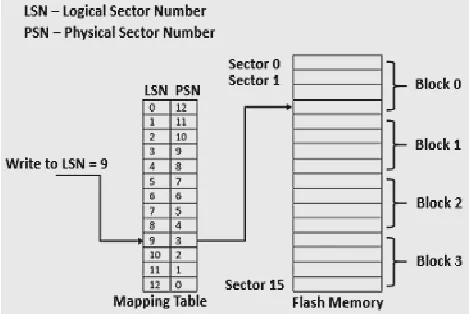
For example, Figure 2 shows an example of sector mapping. In the example, we assume that a block is composed of four pages and so there are totally 16 physical pages, where each page is organized into the sector and spare areas. If we also assume that there are 16 logical sectors, the row size of the mapping table is 16. When the file system issues a command - “write some data to LSN (Logical Sector Number) 9”, the FTL algorithm writes the data to PSN (Physical Sector Number) 3 according to the mapping table in case the PSN 3 has not been written before.
Figure 2 Sector Mapping
But, in other case, the FTL algorithm looks for an empty physical sector, writes data to it, and adjusts the mapping table. If there is no empty sector, the FTL algorithm will select a victim block from flash memory, copy back the valid data to the spare free block, and update the mapping table. Finally, it will erase the victim block, which will become the spare block.
[image:2.612.50.286.328.485.2]In order to rebuild the mapping table after power outage, the FTL algorithm either stores the mapping table to flash memory or records the logical sector number in the spare area on each writes to the sector area.
Table 1. Measures of Sector mapping scheme
Garbage collection cost Block Erase is done when a block is completely utilized. RAM requirement Proportional to flash size
Search time Not required
Usefulness Useful in case strict time requirement
2.2 Block-mapping FTL
The pure block-mapping FTL is another classic FTL scheme Block-mapping table is used to store and manage the mapping information between LBN and Physical Block Number (PBN). If there are m pages in a block, the size of the block-mapping table is m times smaller than its page-block-mapping counterpart. In a block-mapping FTL, one LPN must be mapped to a fixed page offset in any physical block (i.e., direct mapping). If this page offset has been written before, the LPN cannot be written to any other page in this block even if there are free pages in the same physical block. In this case, all existing valid data in the block as well as the data to be written must be copied to a new clean block, and the old block is marked for erase, incurring one erase and a number of read/write operations. Compared with the page-mapping FTL the block-mapping FTL requires extra operations to serve a request, adversely affecting the performance. Since both the block-mapping and page-mapping FTLs have their aforementioned disadvantages, they are rarely used in SSD commercial products in their pure forms.
Figure 3. Block mapping
Table 2. Measures of block mapping scheme
Garbage collection cost Block Erase is done hen a block is completely utilized.
RAM requirement Proportional to flash size
Search time Not required
Usefulness Useful in case of strict time requirement
2.3 Hybrid FTL
A family of the hybrid mapping schemes is introduced to address the shortcomings of the Sector-mapping and block-mapping FTLs. In a typical hybrid FTL, physical blocks are logically partitioned into two groups: data blocks and log blocks. When a write request arrives, the hybrid FTL first writes the new data in a log block and invalidates the data in the corresponding target data block.
Block-mapping information for data blocks and page-mapping information for log blocks are kept in a small RAM for performance purposes. When all the log blocks are full, their data are flushed into the data blocks immediately and they are then erased to generate new free log blocks. More specifically, the valid data in data blocks and the valid data in the corresponding log block must be merged and written to a new clean data block. This process is called a merge operation. Further, merge operations can be classified into three types depending on their overhead. Full merge occurs, when the log block is selected as a victim block and not written sequentially from the first page to the last page, and all the valid data in it and in its corresponding data block are copied to a new clean block.
This process requires m read operations, m write operations and two erase operations, where m is the number of pages in a block. When the log block is written sequentially from the first page to the last page of a logical block, this log block can replace the corresponding data block, a merge operation called switch merge. This type of merge requires only one erase operation. Partial merge takes place when the log block is written sequentially from the first page to a middle page in a block, and the last part of data will be copied from the corresponding data block. Partial merge requires several read and write operations and one erase operation. A number of variations of the hybrid FTL schemes have been proposed recently, including BAST, FAST, LAST, Superblock Reconfigurable FTL. More recently, Demand-based FTL (DFTL) was proposed to address the RAM-capacity problem of the page-mapping FTL by storing only the “hot” mapping information in RAM based on temporal locality of workloads.
DFTL is shown to significantly outperform hybrid FTLs. A hybrid technique, as its name suggests, first uses a block mapping technique to get the corresponding physical block , and then, uses a sector mapping technique to find an available empty sector within the physical block.
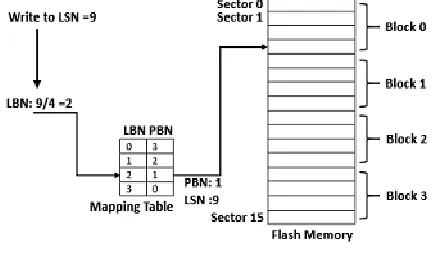
Figure 4 shows an example of the hybrid technique. When the file system issues the command “write some data to LSN 9”, the FTL algorithm calculates the logical block number 2(=9/4) for the LSN, and then, finds the physical block number 1 from the mapping table. After getting the physical block
number, the FTL algorithm allocates an empty sector for the update. In the example, since the first sector of the physical block 1 is empty, the data is written to the first sector location. In this case, since the two logical and physical sector offsets (i.e., 2 and 1, respectively) differ from each other, the logical sector number 9 should be written to the spare area in page 1 of the physical block 1. For rebuilding the mapping table, not only this information but also the logical block numbers have to be recorded in the spare areas of the physical blocks.
When reading data from flash memory, the FTL algorithm first finds the physical block number from the mapping table using the given LSN, and then, by reading the logical sector numbers from the spare areas of the physical block, it can get the most recent value for requested data.
Figure 4. Hybrid Mapping
III. COMPARATIVE SCHEME
3.1) Block Associative Sector Translation (BAST)
exclusively associates a log block with a data block. In presence of small random writes, this scheme suffers from log block thrashing that results in increased full merge cost due to inefficiently utilized log blocks.
Table 3. Measures of BAST scheme
Garbage collection cost (Worst case:
considering number of random requests = number of log blocks
((3T/100)*N )Read + ((3T/100)*N) Write + (2*3T/100) Erase T: total blocks in flash
N: number of
pages/block Log block: 3% of T
RAM requirement Less, Proportional to number of log block Search time (worst case Time to search the page
map table of a single log block
Usefulness In case of sequential read write and update pattern
[image:3.612.330.546.236.369.2]single sequential log block dedicated for sequential updates while other log blocks are used for performing random writes. Thus, it cannot accommodate multiple sequential streams and does not provide any special mechanism to handle temporal locality in random streams.
Table 4. Measures of FAST mapping scheme
Garbage collection cost (worst and best case : considering number of random requests = K* number of log Blocks)
((3T/100)*K*N) Read + ((3T/100) * K*N) Write +(2*3T/100) Erase T: total blocks in flash N: number of ages/block Log block: 3% of T
RAM requirement Less, Proportional to
num, of random log blocks
Search time (worst
case)
Time to search the page map table of all log blocks.
Usefulness
3.3)Super Block FTL scheme utilizes existence of block level spatial locality in workloads by combining consecutive logical blocks into a super block. It maintains page- level mappings within the superblock to exploit temporal locality in the request streams by separating hot and cold data within the superblock. However, the three-level address translation mechanism employed by this scheme causes multiple OOB area reads and writes for servicing the requests. More importantly, it utilizes a fixed superblock size which needs to be explicitly tuned to adapt to changing workload requirements.
3.4)Locality-Aware Sector Translation (LAST)
Scheme tries to alleviate the shortcomings of FAST by providing multiple sequential log blocks to exploit spatial locality in workloads. It further separates random log blocks into hot and cold regions to reduce full merge cost. In order to provide this dynamic separation, LAST depends on an external locality detection mechanism. However, Lee et al. themselves realize that the proposed locality detector cannot efficiently identify sequential writes when the small-sized write has sequential locality. Moreover, maintaining sequential log blocks using a block-based mapping table requires the sequential streams to be aligned with the starting page offset of the log block in order to perform switch-merge. Dynamically changing request streams may impose severe restrictions on the utility of this scheme to efficiently adapt to the workload patterns.
Table 5. Measures of LAST mapping scheme
Garbage collection cost Better than FAST RAM requirement Same as that of FAST Search time Time to search a page
map tables of all log block
Usefulness Useful in case of random Read write & update pattern.
IV. DFTL ARCHITECTURE
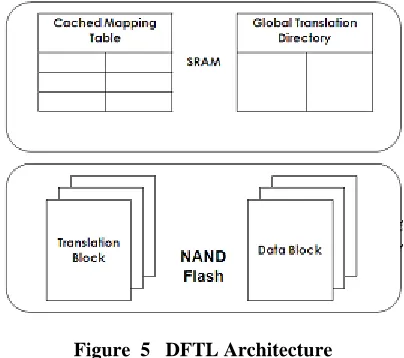
DFTL makes use of the presence of temporal locality in workloads to judiciously utilize the small on-flash SRAM. Instead of the traditional approach of storing all the address translation entries in the SRAM, it dynamically loads and unloads the page-level mappings depending on the work- load access patterns. Furthermore, it maintains the complete image of the page-based mapping table on the flash device itself. There are two options for storing the image: (i) The OOB area or (ii) the data area of the physical pages. We choose to store the mappings in the data area instead of OOB area because it enables us to group a larger number of mappings into a single page as compared to storing in the OOB area. For example, if 4 Bytes are needed to represent the physical page address in flash, then we can group 512 logically consecutive mappings in the data area of a single page whereas only 16 such mappings would fit an OOB area. Moreover, the additional space overhead incurred is negligible as compared to the total flash size. A 1GB flash device re- quires only about 2MB (approximately 0.2% of 1GB) space for storing all the mappings.
Figure 5 DFTL Architecture
5) Comparison of Existing State-of-the-art FTLs with DFTL Table 2 shows some of the salient features of different FTL schemes. The DFTL architecture provides some intrinsic advantages over existing state-of-the-art FTLs as follows: 5.1) Full Merge - Existing hybrid FTL schemes try to reduce the number of full merge operations to improve their performance. DFTL, on the other hand, completely does away with full merges. This is made possible by page- level mappings which enable relocation of any logical page to any physical page on flash while other hybrid FTLs have to merge page-mapped log blocks with block- mapped data blocks.
[image:4.612.54.281.646.742.2]5.3) Random Write Performance - As is clearly evident, it is not necessarily the random writes which cause poor flash device performance but the intrinsic shortcomings in the design of hybrid FTLs which cause costly merges (full) on log blocks during garbage collection. Since DFTL does not require these expensive full-merges, it is able to improve random write performance.
5.4) Block Utilization - In hybrid FTLs, only log blocks are available for servicing update requests. This can lead to low block utilization for workloads whose working-set size is smaller than the flash size. Many data blocks will remain un-utilized (hybrid FTLs have block-based map- pings for data blocks) and unnecessary garbage collection will be performed. DFTL solves this problem since up- dates can be performed on any of the data blocks.
V. CONCLUSION
We argued that existing hybrid FTL schemes exhibit poor performance for enterprise-scale workloads with significant random write patterns. We proposed a complete paradigm shift in the design of the FTL with our Demand-based Flash Translation Layer (DFTL) that selectively caches page- level address mappings. Our experimental evaluation using Disk Sim with realistic enterprise-scale workloads endorsed DFTL’s efficacy for enterprise systems by demonstrating that DFTL offered (i) Improved performance, (ii) reduced garbage collection overhead, (iii) Improved overload behavior and (iv) Most importantly unlike existing hybrid FTLs is free from any tunable parameters. As a representative example, a predominantly random write-dominant I/O trace from an OLTP application running at a large financial institution showed a 78% improvement in average response time due to a 3-fold reduction in garbage collection induced operations as compared to a state-of-the-art FTL scheme.
[image:5.612.320.569.79.400.2]
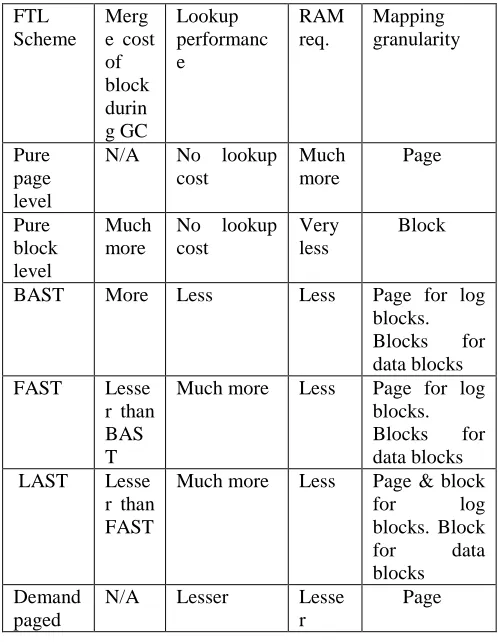
Table 6. Comparative analysis of various FTL schemes
FTL Scheme
Merg e cost of block durin g GC Lookup performanc e RAM req. Mapping granularity Pure page level
N/A No lookup cost Much more Page Pure block level Much more
No lookup cost
Very less
Block
BAST More Less Less Page for log blocks. Blocks for data blocks
FAST Lesse
r than BAS T
Much more Less Page for log blocks. Blocks for data blocks LAST Lesse
r than FAST
Much more Less Page & block
for log
blocks. Block for data blocks Demand
paged
N/A Lesser Lesse
r
Page
REFERENCES
[1] Tae-Sun Chung, Dong-Joo Park, Sangwon Park, Dong-Ho Lee, Sang-Won Lee, Ha-Joo Song “A survey of Flash Translation Layer” College of Information Technology, Ajou University, Suwon 443-749, Korea School of Computing, Soongsil University, Seoul 156-743, Korea Information Comm- unication Engineering, Hankook University of Foreign Studies, Yongin 449-791, Korea. [2] Jeong-UK Kang ,Heeseung Jo , Jin-Soo Kim, Joonwon Lee “A Superblock
based Flash Translation layer for NAND Flash Memory” Computer Science Division Korea Advanced Instituteof Science & Technology(KAIST) Daejeon ,Korea.
[3] C.Association. http://www.compactflash.org/.
[4] A. Ban. Flash file system. United States Patent, no. 5, 404,485, April 1995.
[5] I. Corporation. Understanding the flash translation layer (ftl) specification. http://developer.intel.com/.
[6] Aayush Gupta Youngjae Kim Bhuvan Urngaonkar “DFTL: A Flash Translation Layer Employing Demand-based Selective Caching of Page-level Address Mappings” Computer Systems Laboratory, department of Computer Science & Engineering. The Pennsylvania State University, Univesity Park,PA 16802, Technical Report CSE-08-012 August 2008. [7] Dongchul Park, Biplob Debnath, and David Du “CFTL: A Convertible
Flash Translation Layer with Consideration of Data Access Patterns”, Technical Report Department of Computer Science and Engineering University of Minnesota September 14, 2009.
[8] S. Lee, D. Shin, Y. Kim, and J. Kim. LAST: Locality- Aware Sector Translation for NAND Flash Memory- Based Storage Systems, in Proceedings of the International Workshop on Storage and I/O Virtualization, Performance, Energy, Evaluation and Dependability (SPEED2008), February 2008.
IEEE Transactions on Embedded Computing Systems, 6(3):18, 2007. ISSN 1539–9087.
[10] J. Kang, H. Jo, J. Kim, and J. Lee. A Superblock-based Flash Translation Layer for NAND Flash Memory. In Proceedings of the International Conference on Embedded Software (EM-SOFT), pages 161–170, October 2006. ISBN 1-59593-542-8.
[11] Chung, D. Park, S . Park, D. Lee, S. Lee, and H. Song. System Software for Flash Memory: A Survey. In Proceedings of the International Conference on Embedded and Ubiquitous Computing, pages 394–404, August 2006.
AUTHORS
First Author – Shinde Pratibha, PG student, Department of IT-PDVVP COE, Pune University, Ahmednagar, Email:
Second Author – Mrs.Suvarna, Asst.Professor, Department of IT-RM COE, JNT University, Hyderabad, Email: