Near Miss Incident Management, the Root for an
Effective Workplace Safety is determined by the
Management Commitment
Isaac M. Mbuvi, Professor Robert Kinyua, Dr. Fred Mugambi
Jomo Kenyatta University of Agriculture and Technology Mombasa Campus, P.O Box 81310-80100 Mombasa
Abstract- Near miss incidences are often ignored by most
stakeholders in the workplace and yet every major or fatal accident or incident originates from a near miss that was not prevented or controlled. Management of near miss incidences is directly proportional to the prevention of major incidences and accidents and therefore goes a long way to eliminate or minimize work place hazards and guarantee the safety of the workers with a direct bearing on the overall performance of the organization. Although the near-miss concept has long been understood in the oil industry, what has been largely missing is the integration of near-miss management into the safety culture and day to day operations in a manner that underlines the critical connections between near-misses and behavior. In the oil industry, incident assessment is key to its very survival and profitability. But among other incidences, there were challenges in the management of the near miss incidences in the organization, hence the necessity of the study to determine the role of near miss incidents management on the safety performance of the organization. Near Miss incident Management System theorems were also part of this study. In this study the target population was the workers in an Oil and Gas organization . This involved those engaged in storage of white (refined) oil products, pipeline transportation and dispensing of petroleum products within the study area. For this descriptive study, a random sampling was used to select a representative sample of the target population. Data collection in the research was through the use of structured questionnaires designed by the researcher. Questionnaires were distributed in cluster and randomly among the workers. After data collection, analysis of the same was done using appropriate statistics software such as SPSS. The study found that Management commitment in the organization may be improved by the availing of resources for the establishment, implementation and maintenance of a Near Miss Incident Management System (NMIMS) for an effective work place safety performance
Index Terms- Near miss, Incident, Hazard
I. INTRODUCTION
t the root of every accident or incident fatal or otherwise is a near miss that was ignored and not prevented. Near miss incidents often precede loss producing events but are largely ignored because nothing (no injury, damage or loss) happened. Employees may not be enlightened to report these close calls as there has been no disruption or loss in the form of injuries or
property damage (Vassiliou et.al, 2009). Thus, many opportunities to prevent the accidents that the organizations have not yet had are lost. Near misses are often less obvious than accidents and are defined as having little if any immediate impact on individuals or processes. Despite their limited impact, near misses provide insight into potential accidents that could happen. Safety activities in most organizations are reactive and not proactive. Many organizations wait for losses to occur before taking steps to prevent an occurrence.
Overview of Near Miss
A near miss is an unplanned event that did not result in injury, illness, or damage but had the potential to do so. Only a fortunate break in the chain of events prevented an injury, fatality or damage; in other words, a miss that was nonetheless very near. A near miss is also any unplanned event or chain of events in which personal injury or damage to property, plant or equipment has only been avoided by choice or chance.
A broader definition which focuses not only on the negative side of near misses but also on their positive contribution to a system’s operation describes a near miss as an event, a sequence of events, or an observation of unusual occurrence that possess the potential of improving a system’s operability by reducing the risk of upsets some of which could eventually cause serious damage. A near miss is an opportunity to improve environmental, health and safety practice based on a condition, or an incident with potential for more serious consequence. Near miss is viewed as “improvement opportunities” which positive experiences are encouraging employees to report rather than to hide. It also includes all operational disturbances, some of which have the potential to cause serious damage while others are inconveniences that mainly cause inefficiencies. It not only captures events but also includes observation.
Although the label of 'human error' is commonly applied to an initiating event, a faulty process or system invariably permits or compounds the harm, and should be the focus of improvement. Other familiar terms for these events are a "close call", or in the case of moving objects, "near collision" or a near hit. According to (Lauver et al 2009) a near miss is defined as “anytime an employee felt that they were in an unsafe situation due to circumstances, equipment, or their own actions which had a high probability of resulting in an injury, and only by good fortune did the employee remain uninjured”. Near miss definitions vary and may even include incidents that result in damage or injuries but not death.
Statement of the problem
As numerous catastrophes illustrate, management failure to capture and remedy near-misses may foreshadow disaster. Notable examples where near-miss precursors have been observed but not effectively managed with dire consequences include:-
The 1997 Hindustan refinery explosion in India. Sixty people died and over 10,000 metric tons of petroleum-based products were released to the atmosphere or burned. Written complaints of corroded and leaking transfer lines where the explosion originated went unheeded (Khan and Abbasi, 1999).the 1998 morton explosion and fire resulting from a reactor temperature excursion (khan et al, 1999).nine people were injured, two seriously In an accident investigation, the Chemical Safety Board concluded, “Management did not investigate evidence in numerous completed batch sheets and temperature charts of high temperature. As these examples illustrate, failure to utilize precursor data to identify and remedy systemic flaws can have catastrophic results. To reduce the likelihood of future catastrophe and further improve employee safety and process reliability, management systems that recognize operational weaknesses need to be developed to seek and utilize accident precursors (March et al., 1991). These programs operate under the umbrella of Near Miss Management Systems. Near miss management systems have been developed and are implemented across a range of industries including the chemical/process, airline and rail, nuclear and medical disciplines.
II. RELATEDLITERATURE
The Safety Pyramid
“Unsafe act or mechanical or physical hazard” lines up with Heinrich’s third, and arguably most controversial, axiom: “The unsafe acts of persons are responsible for the majority of accidents.” According to Heinrich, 88 percent of accidents are caused by unsafe acts of persons and 10 percent by unsafe machines (with 2 percent being unavoidable or acts of God).From the “safety pyramid”, and was further developed by Frank E. Bird based on his 1969 study of industrial accidents (Bird and Germain, 1996). He concluded that out of 300 near misses, there shall be 29 minor incidences causing minor injuries which require first aid for intervention and 1 major incident which may be fatal or cause major injury such as impairment. Therefore, if the near misses can be reduced, chances of the major incident shall also be remote or drastically reduced.( Phimister et.al,2000)
Fig.1 The Safety Pyramid
Essentially, injury data capture the unfortunate individuals. To illustrate this, Lauver et al. cited Heinrich’s (1931) finding that for every 300 unsafe acts, 29 minor injuries occur and one major injury occurs (Lauver et al., 2009).
The Ice Berg Theory
According to this theory, workplace incidents and accidents cost an organization in terms of compensation payments but more costs are the indirect costs of the same. It is a calculation method developed to estimate the indirect costs of an incident or accident in the workplace. Assuming the cost of an accident is shillings 10,000.Associated costs which include but not limited to investigations, loss in productivity, equipment downtime is five times the accident cost which will be shillings 50,000 . The replacement costs such as overtime, new employee, re-training will be shillings 10,000. The real cost of this accident shall be shillings 70,000 which is seven times the cost of the accident. Therefore in the Iceberg Theory, the initial cost of an accident is only the tip of what it really costs an organization.
Near Miss Management System
and training programs for all workers (Phimister etal 2000).According to the Wharton Risk Center’s near miss study, conducted in 2000, an effective NMMS must cover the entire range of operations and must contain the essential components of eight steps, as in the near miss management process.
Near miss management Process
This is a seven step process aimed at implementing the NMMS. These steps include Identification, Disclosure (Reporting), Prioritization, Distribution Identification of Causes (Causal analysis), Solution Identification, Dissemination and Resolution (Tracking) (Phimister et al.,2000).
a. Identification
Identification is the first step of the process where an individual recognizes an incident or a condition as a “near miss”. To execute this step successfully there must be a clear definition of a near miss, and the means to ensure that every employee in the organization knows this definition at all times. This calls for sensitization of all employees in the organization which should be facilitated and driven by the Management or their representative and the workers’ representatives. These sensitization campaigns should be done by the HSE committees using such tools as group discussions, tool box talks, brochures and films. As the employees become aware on how to identify near miss incidents, they shall be equipped to own and be part and parcel of this worthy course. Establishing a culture sensitive to the Near Miss concept is critical for successful implementation of a Near miss management system and takes time and effort to develop. Identification of current and potential problems can be encouraged by recognizing and rewarding observant workers and by publicizing identified problems as well as the actions taken to address them. (Phimister et al.,2000)
b. Reporting or Disclosure
A recognized near miss has only limited value even to the one who identified it, unless it is reported for appropriate measures to be taken to prevent its recurrence. Once a near-miss is identified it must be disclosed, preferably in a written form. This can be done either by the worker who identified the near miss or by a supervisor to whom a near-miss is reported verbally who may resolve this worker’s problem or bring it to the attention of others.
Having a clear and simple procedure for reporting would encourage this process and would increase the probability of reporting most near miss observations. Reporting should be made very simple to encourage every employee who observes or experiences a near miss to fill-out a report without spending much time and effort. It is important to capture as many Near Misses as possible even though not all of them may have the same importance. The objective of near miss disclosure is to ensure that all identified near misses are reported.(Bridges,2000) The reporting system must be accessible or “user friendly”, as well. Reporting systems should be empowering for all. There are instances where workers suspected a hazard or problem but stayed silent because they did not have access to data that could provide objective support or justify their feelings (Maher & Casamayou, 2009). And, in some cases, low-level workers who know of problems may not have enough clearance to submit a report; thus, serious information may not be recorded or communicated to decision makers.
An organization’s intent, or motivation, for requiring injury and near-miss reporting influences worker participation. Workers that fear punishment, retribution, or criticism are likely to remain silent (Maher & Casamayou, 2009; Rose, 2004). Fortunately, research suggests that there are ways to encourage employee participation. A shift towards an organizational culture that allows workers to feel like reporting is an opportunity rather than a self sacrificing event can increase reporting organizational safety (Hofmann & Stetzer, 1998; Morris & Moore, 2000). Other ways to effect positive change toward injury and near miss reporting is to ensure anonymity or re-direct accountability to an outside agency.
c. Prioritization and Distribution
This is the ranking of near misses according to the severity of the consequence they may cause in case they occurred to allocate appropriate time, expertise and resources to follow up on the incident. Prioritization is a very critical step in establishing an effective Near Miss Management system since this step determines, out of the large number of Near-Miss reports, which ones will require and to what extent the attention of the limited resources of the organization. Prioritization is important for a near miss program with a high number of reports in which case most near misses shall be investigated by the reporter and/or the supervisor. High priority near misses should have a separate distribution channel from the low priority ones to ensure appropriate trafficking of the report for prompt attention. The characteristics for high priority near misses include but not limited to:-Expertise beyond the worker’s capabilities is required to investigate the incident, Similarity of the incident to previous incidences or trends hence requiring the same attention, Incident with significant potential for major loss, cost to mitigate and environmental damage (Phimister et al., 2000).
d. Evaluation (Causal Analysis)
Once a near miss is reported based on the given priority the reporter, a supervisor or a group of experts related to the subject matter should identify the root cause(s) or the underlying factors that enable the incident or unsafe condition and come-up with actions(s) to eliminate the recurrence of this or similar incidents (Peace,1992).
Clearly priority given to a particular near miss plays an important role in these follow up activities (Eckes,2000). If the reported incident is labeled as “high priority”, it may require a rather thorough causal analysis such as identification of root-causes to help tackle the problem at the basic level. This is accomplished through a HSE committee in an organization. Recurrence of similar incidents indicates that implemented solutions have not been satisfactory. Over time, due to repeating events of similar nature, the priority of new near misses will become higher with each report.
e. Elimination and Control
operating procedures in the organization should be changed to account for the hazard.
The employees should be sensitized on the control measures for the specific near miss corrective action. This acts as a learning point. The identified corrective action should not be a source of new incidents. The hierarchy of control should be adopted with the last option for appropriate and adequate personal protective equipment for all the workers (Dowell,1997).
f. Dissemination
This is the channeling of the identified corrective actions to the respective implementers. It also involves informing the targeted audience on the decision made. This involves the use of all the necessary resources (human and financial) to implement the corrective actions.
g. Resolution and Review
This is the step where all actions are completed including follow up with the proper departments and personnel. It is at this step that one needs to identify and track all open actions and pursue with the right people for their closure. These activities may involve:-Reviewing or auditing the corrective actions upon completion to ensure that they were objective, Updating the near miss report if deviations from the indeed action were implemented and Feedback to the reporter and others on the completion and closure of the incident (Phimister et al., 2000).
Near miss management policy and reinforcement
To ensure that safety is consistently given priority in decision making, the responsibilities of each member of the organization from top management to individual must be spelled out in the safety and health program. But merely assigning responsibility does not suffice: each person must be held accountable for his/her safety performance, and each individual assigned such responsibilities must be given adequate authority and resources to meet them.
Control systems to ensure that responsibilities are being met must therefore be in place. There are different ways of achieving this objective: some companies require that the recordable injury rate for each supervisor be factored into annual review and promotion decisions, while others use a formal tracking system that allows supervisors with good safety records to earn bonuses (DeJoy, 1985).
Employees must also be held accountable for complying with safety policies and procedures. The company's overall program should contain a disciplinary component that is clearly expressed, and employees who violate safety procedures should be subject to disciplinary action. The program should establish a hierarchy of disciplinary measures, beginning with verbal and written warnings, proceeding to formal meetings.
Management Commitment to Safety
The success of any workplace safety is determined by the organizational management. The top management formulates the Near Miss management system policy and objectives which are pivotal to implement and maintain the system with periodic reviews and updates. The top management provides resources (financial, human, technical and infrastructural) which are key to facilitate the implementation and maintenance of the system. A top management representative is appointed and authorised amongst other duties to ensure that the system is established,
implemented, maintained and to report on the performance of the system. An effective and efficient implementation of a near miss management system requires the full support of all levels of management. This goes beyond just management approval. There must be active involvement. It is important to continuously follow-up on system progress, encourage reporting, reward participation, and most importantly lead by example.
Management engages all employees who are intimately familiar with daily operations; therefore, it can easily detect potential problems on a timely basis. But, there are several important issues that have to be recognized and addressed to effectively integrate near-miss management into corporate governance. These are: Management support and encouragement, ensuring a uniform and seamless operation across all businesses and having a seamless and efficient system for handling near misses as well as accidents.
This means that management must consider worker protection the company's top priority and be willing to spend time and money on programme development, safety equipment, and employee training. One of the best ways management can demonstrate its commitment to safety is the development of a comprehensive, written safety and health programme that is performance oriented and general enough to cover the complete range of projects conducted by the organization.
The written program should also outline procedures for formally evaluating or auditing the occupational safety and health program's success at least once a year. A written, site-specific safety plan should also be kept at each work site. At a minimum, this plan should include information on safety responsibilities, emergency procedures, and provisions for hazard communication, accident prevention, inspections, grounded electrical systems, record keeping, personal protective equipment, and housekeeping (Boden, 1984).
Workers' adequate knowledge, skill and ability to their works, especially toward risks and dangers in their work and near miss management, may minimize accidents. These competences can be enhanced through training and appropriate workers selection which is a management responsibility. Workers competence was enhanced through training in Malaysia and it was noted to have reduced the rate of accidents from twenty five persons per week to about five persons per week (Dedobbeler et.al, 1991).
How Near Miss Management affects the Organizational Safety Performance
Near misses are often pre-cursors and valuable warning signs of existing safety problems (Maher & Casamayou, 2009). “A near miss by luck is no different to a midair collision from an organizational failure view point and hence the reaction to the two should be identical” (Rose, 2004,).
At the 2010 Engineering and Operations Conference Line Workers Roundtable, those present recommended capturing near-miss data as a way to improve their existing safety programs (Morris & Moore, 2000). Consequently, the American Public Power Association (APPA) collected a selection of near-miss forms and policies to help members start programs of their own. The APPA recognized that near-miss reporting can help focus safety training and provide a foundation for worker “tailgate talks” (American Public Power Association, 2010.). Furthermore, the collection authors noted that using a near-miss form is an excellent way to reinforce the group’s safety culture and promote organizational learning.
A safety program that includes clear accident and incident reporting requirements, incorporates trend analysis, and encourages open discussion enhances the overall safety of an organization (Rogers Commission, 1986). A strong organizational safety culture is correlated with safer working environments (Columbia Accident Investigation Board, 2003). Reason (1997) noted that a healthy safety culture should focus on reporting and learning, rather than assigning blame. And, the goal of any organization’s incident reporting and investigation system should be to support corporate safety measures that come from lessons learned (Rose, 2004). Accurate accident and incident reporting can help organizations decide where to focus resources to make cultural changes for safety (Krause & Russell, 1994). When employees believe their supervisors value safety they are more likely to report occupational injuries and illnesses and participate in investigations (Lauver et al., 2009). Supervisor support for safety behavior and a safety culture often results in a positive change in employee attitude towards safety (Littlejohn, Margaryan, & Lukic, 2010).Injury and near-miss analyses allow organizations to assemble key information related to employee safety. This is a prerequisite for the process that allows organizational and individual learning to occur; workers must have access to data and acknowledge that results or outcomes are unsatisfactory (Maher & Casamayou, 2009). Once employees or managers acknowledge this, change can begin through informal processes like casual communication and adjustments in expectations and norms.
Incident and near miss data is used in the decision making process by organizations when they make formal policy, equipment, and training changes. Often, data analyses indicate problem areas and identify systems that need improvement (Columbia Accident Investigation Board, 2003; Krause & Russell, 1994). Monitoring minor accidents and near-misses allows organizations to adjust safety policies and procedures and possibly prevent future incidents (Lauver et al., 2009). Actually, making policy, rule and standard operating procedure changes based on injury and accident data is recognized as one of the first steps towards organizational learning (Maher & Casamayou, 2009).
Injury and near-miss reporting can help organizations evaluate the current state of operations and changes in policy, training and equipment, as well as individual and team performance. Measuring performance can help organizations determine whether safety efforts are having the desired outcome (Petersen, 1998). Certain programs can be used to assess an organization’s present safety environment and even provide insight to trends through past or historical event analysis.
(Earnest, 2000) emphasized the value of measuring before the face and after the fact performances; a system like this provides a means to hold managers or workers accountable for injury and loss experienced after a policy or procedure change. It also gives organizations a way to measure the effectiveness of the change. Injury and near miss reporting is an essential part of an organization’s risk management plan. Past accident and injury statistics help identify high risk processes or behaviors and the frequency and severity of these events helps managers set priorities for action. After new safety measures and policies are developed and put in place, the final step is monitoring the results. Importantly, the changes that stem from injury and near miss data analysis should result in better safety and financial security for employees, as well as improved productivity and cost savings for employers (FIRST, Drexel School of Public Health). Often, when organizations recognize unsatisfactory results, they strive to produce more favorable outcomes. Frequently, these types of changes carry a financial impact; organizations can use injury and near-miss data to aid in budgeting and resource allocation. Organizations can use injury and near-miss data to bolster support for changes in staffing and equipment, and to promote investments in training, incident prevention, technology, physical fitness, and recruiting (Loflin & Kipp, 1997: TriData Corporation, 2004).Injury and near-miss data can also be used to educate researchers, industry, and the public. Feedback from analyses contributes to equipment modifications by manufacturers and changes in professional standards. For instance, changes in fire fighter protective ensembles, self-contained breathing apparatus design and standards of use, closed cab apparatus, and advanced restraint systems have all been improved as a result of injury information sharing (TriData Corporation, 2004).
Occupational health researchers can benefit from organizational injury and near-miss data collection. NIOSH recognizes that all federal agencies can benefit from increasing coordination and information exchange (Surveillance Strategic Plan, 2011). Madsen (2009) found that fatal accident experiences in mines had a significant and measureable impact on worker safety because they prompted changes in government mine safety laws and regulations. Public officials and stakeholders can be persuaded to modify their expectations, change municipal requirements, and support budget items when they are educated about the nature of an organization’s safety or health problem, possible solutions, and resources needed (Levy, 1996). Alternatively, if statistics are not available to describe a safety problem and its consequences, stakeholders and officials are likely to invest in solving other, more immediate problems (Maher & Casamayou, 2009).
III. METHODOLOGY Research Design
The research design that was used in this study was descriptive and empirical research with largely qualitative findings. The research design generally entailed describing a unit in details. It is intensive, descriptive and holistic analysis of an entity (Oso & Onen, 2005).
fatal accident if it is not properly and promptly managed and may affect the overall performance of the organization.
Target Population of the study
In this study the target population consisted of most of workers at all levels the organization with 883 workers.
Sample size of the study
Since the target population was 883 workers in the organization through random sampling method, These were workers, supervisors and management levels. According to (Kothari , 2011), the size of the target population was determined by the following formula
n=Z2pqN Z2p.q+(N-1) e2
Where: n = the desired sample size (in case of finite population)
Z = Confidence level at 95% at 1.96 p=acceptance error of 0.5 q=1-p
e=Statistical significance set=0.05
N=the target population size of workers in KPC Depots as at September 2013.
Therefore; the sample size (n) n= (1.96)2 (.5) (.5)(883) (1.96)2 (.5) (.5)+ (883-1)(0.05)2 = 848
3.1654 = 267.9 = 268
Allowing 5% for any loss =13 = 281
Data Collection
The researcher used questionnaires and interviews as the main tools for collecting data. The selection of these tools was guided by the nature of data to be collected, the time available as well as by the objective of the study. The overall aim of this study is to assess how the near miss management system affects the workplace safety performance in the organization in the oil and gas industry. The researcher was mainly concerned with opinions, skills, knowledge and attitude of workers of oil industry on near miss management system, such information could only be best collected through the use of questionnaires and interviews (Touliatos & Compton, 1988; Bell, 1993).
IV. DATAANALYSIS,FINDINGSANDDISCUSSION
Response Rate
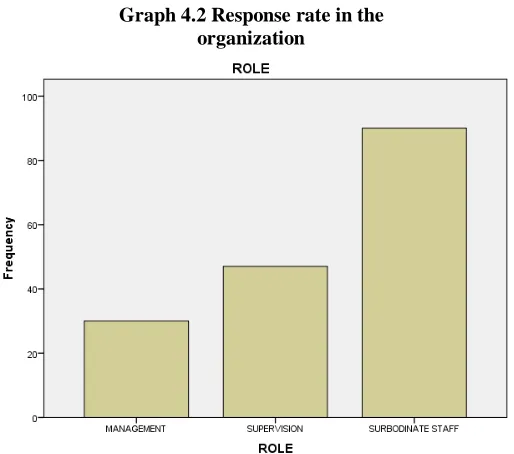
A total of 281 questionnaires were administered but only 167 were fully filled and returned while 114were not returned. This represented a response rate of 60% the respondents included the management, supervisors and workers in the organization.
Graph 4.2 Response rate in the organization
Source: Research Data (2015)
From the above data the analysis focused on the workers with a response rate of 82% followed by the supervisors at 45% and lastly the management at 30% rate.
Near Miss incidents Management system
[image:6.612.319.576.56.283.2]Near miss incidents management systems are systems that report incidents that could lead to injury or property damage, to prevent consequences that could be severe therefore it is important for near miss to be identified, reported and mitigated against in the system, the item covers the entire range of operations in the organization.
Figure 4.3: Near miss management system
Training of Near Miss
[image:7.612.321.571.84.263.2]The researcher sought to find out whether the organization carries out training on near miss to all its employees across the board, a scale of No and Yes was used with yes indicating that the training takes place and no indication that the training does not take place. The findings are as shown below.
Figure 4.4.1:Training of Near Miss
[image:7.612.44.245.140.334.2]From the above data it is clearly evident that no near miss training takes place with a high respond rate saying that the training does not take place followed by a few of the employees agreeing that it takes place.
Figure 4.4.2: Training of NMIMS at all levels in the organisation
From the above data most workers are in unison that no training takes place at all levels in the organisation at a frequency of 140 (83.8%) no and the rest at 27 (16.2%) frequency.
Safety Briefs
The researcher sought to find out whether the organisation employees understand safety briefs which should be offered by supervisors in terms of near miss in the organisation, this as illustrated in the table below
Table 4.5: Safety briefs
Frequency Percent Cumulative Percent Yes 47 28.1 28.1 No 120 71.9 100 Total 167 100
_____________________________________________________________________
From the above it is clearly evident that majority of the employees do not understand safety briefs in the organisation with a high percent saying no with a frequency of 120 which also forms the highest percent at 71.9% and yes at a frequency of 47 and 28.1%.
Near miss incident monitoring system
[image:7.612.36.396.428.488.2]Figure 4. 6 Near miss incident monitoring system
[image:8.612.56.426.386.441.2]From the above data most employees were in unison that there is no monitoring system of near miss management n the firm with a frequency of 97 yes and 60 frequency yes.
Table 4.6 Near Miss Monitoring system
Frequency Percent Cumulative percent Yes 20 41. 9 41.9
No 97 58.1 100 Total 167 100
_____________________________________________________________________
Near miss management process
For near miss management process in the firm the data is as outlined in the process below.
Figure 4. 7: Near miss management process
[image:8.612.320.593.484.691.2]process with majority no at 118 (70.65%) frequency and no at a frequency of 45.
Near miss management policy
[image:9.612.45.299.140.345.2]For the near miss policy in the organisations. The findings were as shown in the figure below
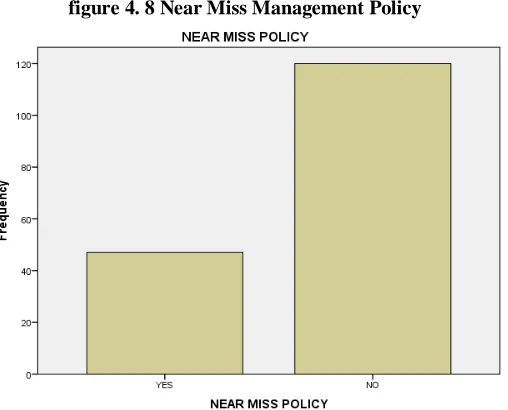
figure 4. 8 Near Miss Management Policy
From the findings above most employees do not understand a near miss policy in the organization with a majority frequency of 118(70.65%) saying no and frequency 45 (29.35%) saying yes. Therefore they could not be effective in implementing the system they do not understand
Audit of the near miss management process
For audit of the near miss management process in the firm and whether the employees in the organisation understand the audit process, the findings were as shown in the figure below
Figure 4. 9: Audit of the Near Miss Management process
From the above data it is clear that most employees do not understand that there is an audit of near miss in the firm with a frequency of 110 (68.75%) no and yes at a frequency of 50. (31.25%)
Reward System for near miss reporting
[image:9.612.319.576.141.300.2]The management should establish, implement and maintain reward procedure and ensure that the employees understand it. The findings were as shown in the figure below.
Figure 4.10: Reward system for Near Miss reporting
From the above data it is clearly evident that most employees registered the absence of reward system with a majority at 150 (93.8%) frequency saying no and the rest yes at a frequency of 10 (6.2%).
Understanding of role in implementation of near miss management process
Whether the workers understand the role they play in the implementation of NMIMS process in the system, the findings were as outlined in the diagram below.
Figure 4.11: Understanding of role in implementation of NMIMS process.
[image:9.612.321.573.488.663.2] [image:9.612.48.293.505.686.2]Regression Analysis
Table 4.12.1 Regression Model
Model Summary
Model R R Square Adjusted R
Square
Std. Error of the Estimate
1 .226a .051 .028 .439
a. Predictors: (Constant), NEAR MISS POLICY FORMULATED BY MGT, HEALTHY BRIEFS BEFORE COMMENCING WORK, HEALTH, SAFETY AND ENVIRONMENT (HSE) POLICY IN KPC, NEAR MISS MANAGEMENT
From the table above the study used correlation coefficient r to check on the magnitude and the direction of the relationship between the variables, coefficient of determination (the percentage variation in the dependent variable being explained by the changes in the independent variables) and p- value were used to check on the overall significance of the model. Correlation coefficient of 0.226 indicates a strong positive
correlation between the dependent and independent variables. On the other hand coefficient determination (R2) of 0.051 shows that 0.5% of the variation in the near miss policy is explained by the changes in the healthy briefs before commencing work, health safety and environment policy and near miss management . The adjusted R square of 2.8% also shows that the model is a good estimate of the relationship between the variables.
Table 4.12.2 Role of Intergration of near miss management system on safety performance
ANOVAa
Model Sum of Squares df Mean Square F Sig.
1
Regression 1.685 4 .421 2.188 .073b
Residual 31.189 162 .193
Total 32.874 166
a. Dependent Variable: INTERGRATION OF NEAR MIS
b. Predictors: (Constant), NEAR MISS POLICY FORMULATED BY MGT, HEALTHY BRIEFS BEFORE COMMENCING WORK, HEALTH, SAFETY AND ENVIRONMENT (HSE) POLICY IN KPC, NEAR MISS MANAGEMENT
[image:10.612.73.540.529.710.2]The significance value is .073b which is less than 0.05 thus the model is statistically significance in predicting the role of intergration of near miss management systems, healthy safety and environmental policy, healthy briefs on the organization safety performance. The F critical at 5% level of significance was 2.188 Since F calculated is greater than the F critical value (value=0) this shows that the overall model was significant.
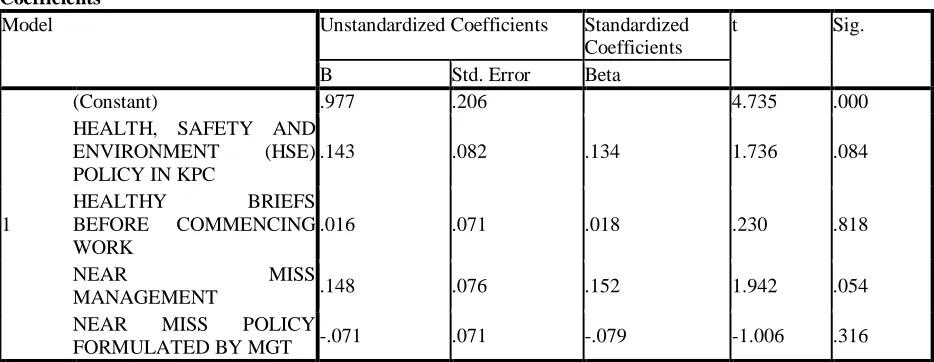
Table 4.12.3 Coefficient of determination
Coefficientsa
Model Unstandardized Coefficients Standardized Coefficients
t Sig.
B Std. Error Beta
1
(Constant) .977 .206 4.735 .000
HEALTH, SAFETY AND ENVIRONMENT (HSE) POLICY IN KPC
.143 .082 .134 1.736 .084
HEALTHY BRIEFS BEFORE COMMENCING WORK
.016 .071 .018 .230 .818
NEAR MISS
MANAGEMENT .148 .076 .152 1.942 .054
NEAR MISS POLICY
The regression above has established that taking all factors into account (Healthy, safety and environment policy, healthy briefs before commencing work, near miss management ad near miss policy formulated by management) constant at zero, organization safety performance will be 0.977 The findings presented also shows that taking all other independent variables at 0.001, a unit increase in health, safety and environment policy will lead to an increase in 0.143 on organization safety
performance, a unit increase in health briefs before commencing work at 0.016, a unit increase in near miss management at 0.148 and a unit decrease in near miss policy formulated by management at -0.071.This infers that near miss management policy, followed by health, safety and environment policy, health briefs before commencing work and lastly by near miss policy formulated by management influencing organizational safety performance reduction least.
The cross tabulation table of near miss management and near miss implementation roles
NEAR MISS MANAGEMENT * NEAR MISS IMPLEMENTATION ROLES Cross tabulation
Count
NEAR MISS IMPLEMENTATION ROLES
Total
YES NO
NEAR MISS MANAGEMENT
YES 92 26 118
NO 30 19 49
Total 122 45 167
From the above analysis most respondents in terms of near miss management there is a near miss implementation roles at 92 to organizational safety performance.
Chi Square tests
Chi-Square Tests
Value df Asymp. Sig. (2-sided)
Exact Sig. (2-sided)
Exact Sig. (1-sided)
Pearson Chi-Square 4.930a 1 .026 Continuity Correctionb 4.116 1 .042 Likelihood Ratio 4.740 1 .029
Fisher's Exact Test .035 .023
Linear-by-Linear Association 4.900 1 .027 N of Valid Cases 167
a. 0 cells (0.0%) have expected count less than 5. The minimum expected count is 13.20. b. Computed only for a 2x2 table
From the above analysis Pearson chi square analysis at X(1) = 4.93 and p = 0.026 this shows that there is no statistically significant association between the near miss management and near miss implementation roles formulated by management.
V. SUMMARY,CONCLUSIONSAND RECOMMENDATIONS
Summary
Despite their limited impact near misses provide insight into potential major adverse conditions and business disruptions therefore addressing near misses timely and properly discourages major problems from flourishing (Jones et al 1999). It is important to note that even though investigations have shown that almost all major incidents had precursors with minor or no consequences not all minor incidents have the potential to cause a major incident.
Every major or fatal accident or incident originates from a near miss that was not prevented or controlled. Management of near miss incidences is directly proportional to the prevention of
major incidences and accidents and therefore goes a long way to eliminate or minimize work place hazards and guarantee the safety of the workers with a direct bearing on the overall performance of the organization. Establishing a culture sensitive to the near miss concept is critical for successful implementation of a near miss system and takes time and effort to develop. Identification of current and potential problems can be encouraged by recognizing and rewarding observant people and by publishing identified problems as well as the actions taken to address them. It is important to capture as many near misses as possible even though not all of them will have the same impact.
Conclusions
There was no well-established and implemented near miss incident management system which should have a near miss incident policy, procedures and relevant records. This is evident with 70.65% of the responders on the affirmative. Although majority of workers are in a position to identify a near miss, reporting and mitigation of the same is lacking (with 71.9%) due to the fear of victimization.
research.(with 93.8% of responders confirming). This causes the workers have low morale in reporting of the near miss incidences and this has a direct outcome of major incidences. Training and awareness creation on near miss incidences among workers was also lacking (with 83.8%on the affirmative) and this has led to many of them being unable to identify, report, control and review of the incidences as per the research.
Recommendations
Top Management commitment may be improved by the availing of resources for the establishment, implementation and maintenance of a Near Miss Incident Management System (NMIMS)
Resources also should be availed by the top management to ensure training and awareness creation of all workers at all levels on Near Miss Incident Management System (NMIMS).This will give all the workers a leverage to identify, report and mitigate the incidences and this shall reduce the major incidences which could impact negatively on the organization by denting its image globally, reducing customer confidence and exposure to litigations leading to colossal financial losses due to compensation of injured and also high premiums for insurance. Report of near miss incident should be encouraged by acknowledgement and recognition. There should be a formal reward system for the worker(s) who identifies and reports most near miss incidences through an incentive. It is important to note that the worker who identifies a near miss and the one who reports it does not have to be the same for example if someone complains to his or her supervisor about a problematic situation the supervisor who may resolve this persons problem or bring it to the attention of others can also report it as a near miss.
Establishing a system that captures all near misses regardless of their impact is important. Equally important is establishing effective prioritizing systems. Employees need clear guidelines on near miss management process to be able to recognize all the near misses that are likely to cause major problems.
With a well established near miss management system, with all observing and identifying every incident and reporting all potential issues as well as incidents, most near miss reports will not be indicators of major problems, however, paying attention not only to the high priority items but also to the other reported issues would help improving the systems productivity and operability.
Each near miss observation or incident may serve as a risk indicator or an event data point. These points individually and collectively should be investigated, analyzed for root causes and corrective and preventive actions taken to prevent recurrence. The system changes must be implemented and review practices observed to not only reduce the potential for catastrophic events but also to improve the system operations
REFERENCES
[1] Bird, F.E. Jr. and Germain, G.L(1996). Practical Loss Control Leadership. Loganville, Georgia. Det Norske Veritas Inc.
[2] Deniz S. Ones, Susan E. Jackson.(1999).Managing Human Resources for Environmental Sustainability, Jossey. SanFrancisco.
[3] Drucker, P.F. (1986). The practice of management. New York, New York: Harper Collins.
[4] Earnest, R.E. (2000). Making safety a basic value. Professional Safety. [5] Frank, Alison Fleig (2005). Oil Empire: Visions of Prosperity in Austrian
Galicia (Harvard Historical Studies). Harvard University Press.
[6] HOBBSA, . 1997, Human Factors in Airline Maintenance: A Study of Incident Reports (Canberra: Bureauof Air Safety Investigation).
[7] HOFSTEDGE., (1994). Cultures and Organisational: Intercultural Co-operation and its Importance for Survival London : Harper Collins. [8] Hofmann, D.A., & Stetzer, A. (1998, December). The role of safety climate
and communication in accident interpretation: Implications for learning from negative events. Academy of Management Journal, 41, 644-657. [9] HSE Guidance on Regulations, L73, ‘A guide to the Reporting of Injuries,
Diseases and Dangerous Occurrences Regulations 1995’, 4th Edition 2012, ISBN 978 0 7176 6459 7
[10] HSE Guidance Booklet HSG48, ‘Reducing error and influencing behaviour’, 2nd Edition, Reprinted 2007, ISBN 978 0 7176 2452 2,
[11] Jeremy Stranks (2006) The A-Z of Health and Safety. Thorogood Publishing Ltd
[12] Kothari C.R. (2011) Research Methodology, Methods and Techniques. 2nd Edition, New Age International Publishers Limited.
[13] Krause, T., & Russell, L. (1994). The behavior-based approach to proactive accident investigation. Professional safety.
[14] KrauseT., Groover, D. & Martin, D. (2010). Preventing incidents and fatalities. Professional Safety.
[15] Lauver, K. Lester, S. & Le, H. (2009). Supervisor support and risk perception. Their relationship with unreported injuries and near misses. Journal of Managerial Issues.
[16] Loflin, M.E. & Kipp. J.D. (1997). Incorporating risk management into emergency incident operations. Professional Safety.
[17] National Institute for Occupational Safety and Health (NIOSH). (2011, October 18). About NORA. Partnerships research and practice (Fact Sheet). Retrieved from Centers for Disease Control and Prevention Website: http://www.cdc.gov/niosh/nora/about.html.
[18] Phimister, J.R., U. Oktem, P. Kleindorfer, and H. Kunreuther. “Near-Miss ManagementSystems in the Chemical Process Industry.” Working paper, Wharton Risk Managementand Decision Processes Center, University of Pennsylvania.
[19] REASONJ., (1990). Human Error, New York: Cambridge University Press. [20] Scott, C.W. & Tretheway, A. (2008, August). Occupational discourse and
the appraisal of occupational hazards: Interpretive repertoires, heedful interrelating, and identity at work. Journal of Applied Communication Research.
[21] Taylor, J. (2011, June 27). A call to collect industry and occupation codes in healthcare data (Policy Brief). Retrieved from Drexel University. Firefighter Injury Research & Safety Trends:
[22] Tolf, Robert W. (1976). "4: The World's First Oil Tankers". The Russian Rockefellers: The Saga of the Nobel Family and the Russian Oil Industry. Hoover Press.
[23] United States Fire Administration (2011, June). Executive Development .Student Manual 4th Edition, 1st Printing. Emmitsburg, MD: Authro. [24] Van der Schaaf T.W,Deborah Luicer. (1991) Near-Miss Reporting as a
Safety Tool’Butterworth
[25] Van der Schaaf T.W,Deborah Luicer. (1992) Near-Miss Reporting in chemical process IndustryButterworth.
[26] Vassiliou, Marius (2009). Historical Dictionary of the Petroleum Industry. Lanham, MD: Scarecrow Press ,Rowman and Littlefield.
AUTHORS
First Author – Isaac .M. Mbuvi, Jomo Kenyatta University of
Agriculture and Technology Mombasa Campus, P.O Box 81310-80100 Mombasa
Second Author – Professor Robert Kinyua, Jomo Kenyatta
Third Author – Dr. Fred Mugambi, Jomo Kenyatta University of Agriculture and Technology Mombasa Campus, P.O Box