trial: study protocol for a randomized controlled
trial
Schuh
et al.
Schuhet al. Trials (2016) 17:261
S T U D Y P R O T O C O L
Open Access
Magnesium nebulization utilization in
management of pediatric asthma
(MagNUM PA) trial: study protocol for a
randomized controlled trial
Suzanne Schuh
1*, Judy Sweeney
17, Stephen B. Freedman
2, Allan L. Coates
15, David W. Johnson
3,
Graham Thompson
4, Jocelyn Gravel
5, Francine M. Ducharme
6, Roger Zemek
7, Amy C. Plint
8, Darcy Beer
9,
Terry Klassen
10,11,12, Sarah Curtis
13, Karen Black
14, Darcy Nicksy
17, Andrew R. Willan
16and on behalf of Pediatric
Emergency Research Canada Group
Abstract
Background:
Up to 30 % of children with acute asthma are refractory to initial therapy, and 84 % of this
subpopulation needs hospitalization. Finding safe, noninvasive, and effective strategies to treat this high-risk
group would substantially decrease hospitalizations, healthcare costs, and the psycho-social burden of the
disease.
Whereas intravenous magnesium (Mg) is effective in severe refractory asthma, its use is sporadic due to safety
concerns, with the main treatment goal being to prevent intensive care unit admission. In contrast, nebulized
Mg is noninvasive, allows higher pulmonary drug concentrations, and has a much higher safety potential due
to the lower rate of systemic delivery. Previous studies of inhaled Mg show disparate results due to the use
of unknown/inefficient delivery methods and other methodological flaws.
Methods/Design:
The study is a randomized double-blind controlled trial in seven Canadian pediatric Emergency
Departments (two-center pilot 2011 to 2014, Canada-wide November 2014 to December 2017). The trial will include
816 otherwise healthy children who are 2 to 17 years old, having had at least one previous wheezing episode, have
received systemic corticosteroids, and have a Pediatric Respiratory Assessment Measure (PRAM)
≥
5 points after three
salbutamol and ipratropium treatments for a current acute asthma exacerbation. Eligible consenting children will
receive three experimental treatments of nebulized salbutamol with either 600 mg of Mg sulfate or placebo 20 min
apart, using an Aeroneb Go nebulizer, which has been shown to maximize pulmonary delivery while maintaining
safety. The primary outcome is hospitalization within 24 h of the start of the experimental therapy for persistent
respiratory distress or supplemental oxygen. Secondary outcomes include all-cause hospitalization within 24 h,
PRAM, vital signs, number of bronchodilator treatments by 240 min, and the association between the
difference in the primary outcome between the groups, age, gender, baseline PRAM, atopy, and
“
viral induced
wheeze
”
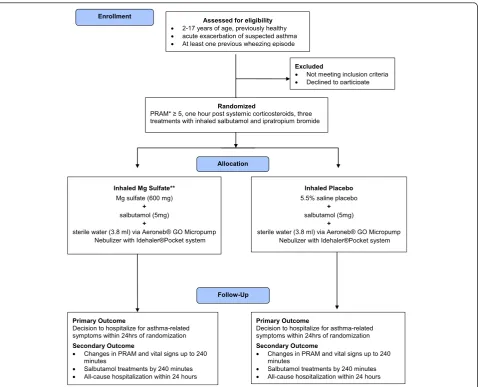
phenotype (Fig. 1).
(Continued on next page)
* Correspondence:[email protected]
1Division of Paediatric Emergency Medicine, The Hospital for Sick Children,
Child Health Evaluative Sciences, SickKids Research Institute, University of Toronto, 555 University Avenue, Toronto, ON M5G 1X8, Canada Full list of author information is available at the end of the article
© 2016 Schuh et al.Open AccessThis article is distributed under the terms of the Creative Commons Attribution 4.0 International License (http://creativecommons.org/licenses/by/4.0/), which permits unrestricted use, distribution, and reproduction in any medium, provided you give appropriate credit to the original author(s) and the source, provide a link to the Creative Commons license, and indicate if changes were made. The Creative Commons Public Domain Dedication waiver (http://creativecommons.org/publicdomain/zero/1.0/) applies to the data made available in this article, unless otherwise stated.
Schuhet al. Trials (2016) 17:261
(Continued from previous page)
Discussion:
If effective, inhaled Mg may represent an effective strategy to minimize morbidity in pediatric
refractory acute asthma. Unlike previous works, this trial targets nonresponders to optimized initial therapy
who are the most likely to benefit from inhaled Mg. Future dissemination of results will include knowledge
translation, incorporation into a Cochrane Review, presentation at scientific meetings, and a peer-reviewed
publication.
Trial registration:
NCTO1429415, registered 2 September 2011.
Keywords:
Randomized controlled trial, children, acute asthma, magnesium
Background
Acute asthma is a leading cause of pediatric emergency
department (ED) visits and of pediatric hospitalizations
[1], with the annual asthma expenditures in the United
States exceeding $37 billion [2]. In 2005, 754,000 pediatric
ED asthma visits were reported in the US [3, 4], and 27 %
of these resulted in hospitalization [4]. Practice guidelines
recommend high dose ß2 agonists, inhaled
anticholiner-gics, and oral corticosteroids to manage major acute
exacerbations [5
–
9]. However, this initial optimal therapy
[9
–
11] is not always effective [12] because up to 30 % of
patients with asthma are resistant to initial
bronchodila-tion [13] in part due to ß2 adrenoreceptor gene
polymorphism [14
–
32], and gene polymorphisms also
im-pact the frequently delayed response to corticosteroids
[33
–
35]. Finding further effective strategies to decrease
pediatric asthma hospitalizations in this high-risk
popula-tion is necessary.
Magnesium sulfate (Mg) produces rapid
bronchodila-tion by multiple mechanisms [36
–
39] and can be given
either intravenously (IV) or by nebulization. Two key
meta-analyses of adult and pediatric trials have
con-firmed that the addition of IV Mg to routine therapy
sig-nificantly decreases hospitalizations and improves lung
function [40, 41]. These authors, as well as various
asthma guidelines, recommend that IV Mg be
consid-ered in children not responding to initial management
[40, 42
–
44]. However, IV Mg is used infrequently and
often as a last resort [45, 46]. In contrast, the
nebuliza-tion route is noninvasive and offers a major advantage of
targeted delivery to the lower airway and less potential
for side effects [47]. However, the benefit of nebulized
Mg has not been well established.
The investigation of the efficacy of nebulized Mg has
been limited, with disparate results. The dose of Mg varied
seven-fold among studies [48
–
60], and only one study
[48] limited participants to nonresponders to
bronchodila-tors. Two meta-analyses of mainly adult studies have
found a trend toward reduction in hospitalizations in
pa-tients given nebulized Mg [40, 61], with the recent
Cochrane review reaching similar conclusions [59]. The
main limitations of past pediatric studies are failure to
limit participants to nonresponders to bronchodilators,
inadequate use of anticholinergics, use of inefficient
deliv-ery methods, and small sample size [49, 58, 60, 62]. In
contrast, this study focuses on the poor responders to
op-timized baseline acute asthma therapy. This group is at
the highest risk of hospitalization and the most likely to
benefit from nebulized Mg intervention. Furthermore,
previous studies have used nebulizers of
suboptimal/un-known efficacy. In contrast, the device used in this study
has been pre-tested and shown to deliver a considerably
greater proportion of the drug into the lungs compared to
the conventional nebulizers.
Research questions and study hypothesis
Primary question
The primary question is whether, in children 2–17
years of age with acute asthma who have persistent
moderate to severe airway obstruction despite
maxi-mized initial bronchodilator and steroid therapy, a
re-duction
can
be
achieved
in
the
probability
of
hospitalization within 24 h of starting experimental
therapy. Specifically, this trial compares those patients
who receive three nebulized Mg and salbutamol
treat-ments to those receiving only nebulized salbutamol.
Secondary questions
The trial seeks to determine the following for these
treatment modalities:
a) Is there a difference in the probability of all-cause
hospitalization within 24 h of starting therapy?
b) Is there a difference in the changes in the validated
Pediatric Respiratory Assessment Measure (PRAM),
respiratory rate, oxygen saturation, and blood
pressure to 240 min?
c) Does the treatment effect with respect to primary
outcome vary among the subgroups defined by the
following variables: age, sex, pre-randomization
PRAM score, personal history of atopy and
“
viral-in-duced wheeze
”
phenotype?
Hypothesis
steroid therapy who are given nebulized Mg in addition to
nebulized salbutamol will have a significantly lower
prob-ability of hospitalization compared to those given
salbuta-mol only.
Methods/Design
Study design and population
This is a seven-center, randomized, double-blind
con-trolled trial. Two study groups are compared: nebulized
salbutamol with Mg sulfate and nebulized salbutamol
with placebo. This study has received approval by the
Research Ethics Board of the Hospital for Sick Children.
Furthermore, local Research Ethics Boards have
ap-proved the study at all participating sites (see Additional
file 1). A written informed consent and assent where
appropriate is being obtained from all study participants.
All otherwise healthy children 2–17 years of age with
a past history of asthma/recurrent wheeze arriving in the
ED when the study nurses are on duty with a presenting
PRAM
≥
5 are considered potentially eligible. Following
assessment by the ED physician, the patients receive
oral/IV corticosteroid plus three salbutamol and
ipratro-pium inhalations according to the local management
guidelines [63–68]. If the PRAM is still
≥
5 after the
ini-tial therapy, the study nurse confirms eligibility,
mea-sures the pre-randomization PRAM score, and obtains
informed consent.
PRAM score
PRAM is a validated 12-point clinical asthma severity
score [69], exhibits the most comprehensive
measure-ment properties of all asthma scores [70], and has been
successfully used as an outcome in major trials [71]. It is
the only score with demonstrated criterion validity,
using respiratory resistance as the gold standard [72].
PRAM has been validated in both preschool and
school-aged children who have been assessed in the ED for
asthma and has a strong association with admission
[73]. The score has inter-rater reliability consistently
above 70 % [73] and is currently implemented in
virtu-ally all pediatric EDs across Canada. Children with
PRAM
≥
5 following initial bronchodilator therapy have
at least a 30 % probability of hospitalization and
repre-sent 84 % of all acute asthma admissions in children. All
participating EDs now measure the PRAM score as part
of routine clinical assessment in their EDs in children
with acute asthma. Because Calgary is situated 1000 m
above sea level, oxygen saturations there can be
ex-pected to be approximately 2 % lower than in Toronto
(International Civil Aviation Organization, Manual of
the ICAO Standard Atmosphere, Doc 7488-CD, Third
Edition, 1993, ISBN 92-9194-004-6). Therefore, the
oxy-gen saturation component of the PRAM is adjusted in
Calgary.
Inclusion criteria
Inclusion criteria are (1) 2 to 17 years of age, (2)
diagno-sis of asthma/reactive airways/viral-induced wheeze plus
at least one prior acute episode of wheezing treated with
inhaled ß2 agonists or oral corticosteroids, (3) persistent
moderate to severe airway obstruction after oral steroid
and three doses of salbutamol and ipratropium, defined
as a PRAM
≥
5 [73].
Exclusion criteria
Exclusion criteria are (1) no past history of wheezing or
bronchodilator therapy; (2) prior IV Mg therapy during
the index visit; (3) critically ill children requiring
imme-diate intubation; (4) coexistent renal, chronic pulmonary,
neurologic, cardiac, or systemic disease; (5) children who
in the opinion of the treating physician require a chest
radiograph due to atypical clinical presentation and are
diagnosed to have lobar consolidation with pneumonia,
felt to be the primary cause of respiratory distress; (6)
known hypersensitivity to Mg sulfate; (7) patients
previ-ously enrolled; (8) insufficient command of the English
or French language; and (9) lack of a phone.
Delivery device
To ensure adequate delivery of the experimental
treat-ment into the lungs, we have pre-tested the Aeroneb
™
Go Micropump Nebulizer along with the Idehaler
™
Pocket system without valves that connects with a
face-mask in vitro and in vivo. We found that this device
de-posited 20 % of the charge dose compared to 4 % by
conventional nebulizers, while also maintaining
accept-able osmolarity and safety [74]. This device has been
dis-tributed to all participating sites, related training
provided, and Health Canada approval obtained. All
ex-perimental treatments are delivered with this device.
This device is fully licensed both in the United States
and in Europe and is currently awaiting license approval
in Canada. We do not anticipate any difficulties with its
official adoption by the time this trial is concluded.
Sample selection
Children presenting to the collaborating EDs at The
Hospital for Sick Children, Children’s Hospital of
Eastern Ontario, Ste Justine’s Hospital, Alberta
Chil-dren’s Hospital, Stollery Hospital, ChilChil-dren’s Hospital of
Winnipeg and the B.C. Children’s Hospital who meet
eli-gibility criteria are approached for enrollment when the
research nurses are on duty. The research nurses keep a
log of all children presenting to the ED with acute
asthma during the study period whether randomized or
not in order to assess the generalizability of the study.
All aforementioned hospitals are tertiary care centers,
which see the entire clinical and demographic spectrum
of the asthma population.
Pre-study screening and baseline evaluation
All previously healthy children 2 and 17 years of age
with acute asthma have a PRAM score measured in
tri-age. Those meeting local ED criteria for enhanced
therapy receive either oral dexamethasone, oral
prednis-olone/prednisone, or IV hydrocortisone plus three
salbu-tamol and ipratropium inhalations via a Metered Dose
Inhaler/Valved Holding Chamber (MDI/VHC)/nebulizer
according to the local asthma pathway and 20 min apart.
Study procedures
At the conclusion of the three baseline inhalations, the
research nurse assesses eligibility and measures the
pre-randomization PRAM score. Eligible children with
PRAM
≥
5 are approached, and informed consent is
ob-tained. Subjects are randomly allocated to receive three
consecutive nebulizations of salbutamol with either
diluted Mg sulfate or diluted 5.5 % saline placebo
20 min apart [48] using the Aeroneb
™
Go Micropump
Nebulizer along with the Idehaler
™
Pocket system.
Spe-cifically, each treatment utilizes 600 mg (1.2 mL) of Mg
sulfate or 1.2 mL 5.5 % saline, 5 mg (1 mL) of
salbuta-mol, and 3.8 mL of sterile water (Fig. 1).
Randomization and masking
The Research Coordinating Pharmacist at SickKids
pro-duced Master Randomization tables, stratified by site
and age (
≥
6 years versus less), using a permuted block
randomization of six and eight in a 1:1 ratio of active
Mg sulfate to placebo, using random number generating
software. The Master Randomization tables are held at
the site Research Pharmacies. Consecutively numbered
kits are prepared by each pharmacy according to the
step-by-step procedure manual provided by Research
Fig. 1Flow diagram of participant study flow. The intervention consists of two treatment arms with solutions of identical osmolarity consisting of
[image:5.595.60.539.308.695.2]Coordinating Pharmacist at SickKids. Upon receiving
the informed consent, the study nurse obtains the next
appropriate numbered study kit from the locked
re-search fridge in the ED (Mg has to be refrigerated) and
enters the number in the confidential logbook. Since Mg
sulfate solution is hypertonic, 5.5 % saline was chosen as
a placebo. Using sterile water as a top-up diluent in both
arms
produces
solutions
of
identical
isotonicity
380 mOsm/L in both study groups. Because the
depos-ition of inhaled drugs is weight-independent [64], a
uni-form Mg dose is used in all children.
The patients, research nurses and ED physicians are
blinded to the treatment assignment. Only the
pharma-cies are unblinded. Each site is given detailed
require-ments for drug accountability and handling to ensure
compliance with Health Canada regulations. The active
Mg and placebo hypertonic saline mixture with
salbuta-mol and sterile water are very similar in volume, color,
taste, and smell when nebulized (tested in the research
pharmacy at SickKids). To assess blinding, the research
nurse and parents are asked at the conclusion of the
ex-perimental therapy which intervention they think the
child had received.
In case of increasing respiratory distress, IV Mg may
be given after the experimental therapy, provided the
pa-tient is not hypotensive. In the unlikely event that the
patient develops hypotension requiring therapy or apnea
and the ED physician feels that the experimental therapy
cannot be safely continued, further doses of the
experi-mental treatment are stopped. If these Mg side effects
are also accompanied by severe distress and additional
IV Mg is warranted, the code may be broken for that
pa-tient. Unblinding will only occur if the clinical treatment
of the patient will change because the physician knows
which arm of the study the patient was previously
en-rolled. The study PI/local PI and the study nurses will
remain blinded. No patients participating in our inhaled
Mg study received experimental therapy unblinded.
The study nurses also keep continuous study logs with
the characteristics and outcome of the participating and
nonparticipating eligible acute asthmatics
≥
2 years of
age; these logs will also be used to track missed patients,
those excluded for criteria, and patients who refused
participation, which will help document any selection
bias.
After the intervention
Following the study medication, the patients continue to
receive further salbutamol as frequently as clinically
warranted as per the treating ED physician. Disposition
is also determined by blinded ED physicians. Discharged
patients receive a prescription for inhaled salbutamol
every 4 h as necessary for the next week and daily oral
corticosteroid according to local practice. All participating
families receive instructions to visit their primary care
provider/ED if salbutamol has to be given more often than
every 4 h for increased work of breathing/severe cough
and if the respiratory status interferes with usual
play/nor-mal speech or activity.
Outcome measures
Primary outcome measure
The primary outcome measure is hospitalization (based
on the ED physician’s decision to admit) to an inpatient
unit within 24 h of the start of the experimental therapy
for persistent respiratory distress or for supplemental
oxygen. Children deemed to be admitted but who due to
lack of bed availability are never transferred to the ward
will be analyzed as hospitalized. Extended ED stays
with-out a decision to admit are not considered admitted.
Secondary outcome measures
The two groups will also be compared with respect to
the following:
a. All cause hospitalization rate by 24 h to examine Mg
impact on side effects, such as hypotension
necessitating admission.
b. Changes in the PRAM, respiratory rate, and oxygen
saturation from the start of the first experimental
nebulization to 60, 120, 180, and 240 min and the
changes in the blood pressure from the first
experimental nebulization to 20, 40, 60, 120, 180,
and 240 min.
c. Number of salbutamol treatments within 240 min of
starting study medication.
d. An association between hospitalization and age, sex,
symptom duration <24 h [
60
], pre-randomization
PRAM score, personal history of atopy, and
“
acute
viral induced wheeze
”
phenotype [
75–81
].
Other outcomes
Major side effects such as hypotension (systolic blood
pressure below the 5th percentile for age) or apnea is
tracked as is admission to ICU for airway stabilization.
The clinical outcomes are measured by trained study
nurses in the ED. The research nurses also ascertain
subsequent return visits/hospitalizations from the
tele-phone follow-ups according to standardized interviewing
techniques, as well as from a review of the patient health
records at 72 h.
Sample size
The sample size calculation is based on the targeted
minimal significant between-group difference in
propor-tions of hospitalizapropor-tions of 10 %, which has previously
been shown to impact treatment decisions. The
esti-mated probability of hospitalization is based on our fully
blinded pilot data (pilot patients form an integral part of
this trial), where the overall hospitalization rate is close
to 50 %. This is a superiority study in which the
adop-tion of the Mg therapy can only be recommended for
fu-ture practice if the probability of the primary outcome
in the Mg group is significantly lower than in the
pla-cebo group. With 408 patients per arm (816 in total), a
two-sided test with a type I error of 0.05 will have 80 %
power to achieve statistical significance if Mg therapy
re-duces the probability of hospitalization from 50 to 40 %
(that is, absolute reduction of 10 %) [82].
Analyses
Primary analysis
The proportion of patients hospitalized will be compared
between treatment groups using a two-sided Fisher’s
exact test at the 5 % level. An intention-to-treat analysis
will be used with all randomized participants included in
the analysis as part of the groups to which they were
randomized regardless of whether they completed the
study medication or not.
Secondary analysis
Secondary analysis will include the following:
a) A Fisher
’
s exact test to compare the rates of all
cause admissions in the two arms.
b) A repeated measures ANOVA to compare treatment
arms with respect to the PRAM score, respiratory
rate, heart rate, oxygen saturation, and blood
pressure over time. Baseline values will be added to
the model as a covariate.
c) A Poisson model will be used to compare the
number of salbutamol treatments used in the ED in
the regression analysis of the two study arms,
including interaction terms with the treatment
group, which will be used to examine the subgroup
effects with respect to the primary outcome. The
following variables will be used to define subgroups:
age, sex, pre-randomization PRAM score, and
per-sonal history of atopy. The statistical tests of
hy-potheses for the secondary outcomes a) through d)
will be two-sided at the 0.00625 level to account for
the issue of multiple testing and to maintain an
over-all type 1 error of 0.05.
Interim analysis
To assure safety, one planned interim analysis will be
conducted on the first 200 patients randomized (a
quar-ter through the study) conducted by a statistician not
in-volved in the trial and evaluated by the independent data
safety monitoring board. The interim analysis will be a
one-sided test of the null hypothesis of no difference
versus the alternative hypothesis that the probability of
hospitalization is higher on Mg therapy at the 0.01 level.
That is, we are looking for evidence that Mg therapy is
less effective, and the trial will be stopped at an interim
analysis only if the null hypothesis is rejected in favor of
the control arm. Therefore, the interim analysis is only
for safety and not for efficacy, and it will not increase
the probability of erroneously rejecting the null
hypoth-esis in favor of Mg therapy at the final analysis. The
rea-son we are doing one-sided (for harm) interim analysis
is because if there is early strong evidence that Mg
in-creases the probability of hospital admission, we want to
stop the trial. On the other hand, we do not want to stop
the trial early for benefit because a smaller sample size
will not be convincing.
Safety
Magnesium blocks the neuromuscular transmission and
acts as a CNS depressant. Therefore, the theoretical
ad-verse effects with IV Mg may include a transient drop in
blood pressure or apnea [83]. The potential for these
problems after nebulized Mg is lower than with IV Mg
because this treatment route will result in a lower
sys-temic delivery of Mg (1/4 of the IV dose) and a lower
systemic effect. Since hypotension is the only major side
effect of IV Mg occurring with appreciable frequency, all
patients are monitored using continuous automated
blood pressure devices, and if the systolic blood pressure
drops below 5
thpercentile for age, the study will be
stopped, treatment given as necessary, and the DSMC
will be notified. Of note, a recent Cochrane review of
896 patients given inhaled Mg confirmed the safety of
this agent [59]. No child in this study had experienced
hypotension or apnea.
All adverse events are being reported to the Hospital
for Sick Children Research Ethics Board according to
the Hospital for Sick Children’s adverse event reporting
requirements. Adverse events will be classified as mild,
moderate or severe and as expected or unexpected.
Ex-pected adverse events will include cough, respiratory
dis-tress, asthma-related hospitalization, IV insertion, sinus
tachycardia and bitter/salty taste of the experimental
so-lution. Adverse reactions are managed according to the
standard clinical management practices. Furthermore,
we plan to document episodes of severe cough
necessi-tating interruption of the experimental therapy for more
than approximately 3 min to examine the safety profile
of magnesium.
Due to the osmolarity of the study solutions being well
under 500 mOsm/L throughout nebulization and
co-administration of salbutamol, we do not anticipate side
effects due to the aforementioned composition of the
study solutions. However, should the highly unlikely
event of respiratory deterioration occur, the
experimen-tal therapy will be discontinued, appropriate additional
treatment started, and the event will be reported to the
DSMC within 48 h. Salbutamol may cause tachycardia,
and this has been the case in many children enrolled to
date. However, this has been uniformly well tolerated,
and no patient has had to stop/interrupt experimental
therapy due to this issue.
The Data Safety and Monitoring Committee (DSMC)
consists of a non-study biostatistician, a researcher, and
a child health scientist, specifically Dr. Annie Dupuis,
Dr. Neil Sweezey, Dr. Patricia Parkin. The members of
this committee are not collaborators of this trial. They
are notified of all serious adverse events by the study
co-ordinator within 48 h. The DSMC meets once per
asthma season or ad hoc if necessary.
Trial management
The Hospital for Sick Children Research Institute will
act as a central repository for all study data and will be
responsible for study data management technology and
clinical data management services. Dr. Willan will
supervise all data analyses. Dr. Schuh takes overall
re-sponsibility for the study. The study has a Steering
Com-mittee which includes senior research team members:
Dr. Nathan Kuppermann (past chair of Pediatric
Emer-gency Children’s Research Network), Dr. Joseph Zorc
(senior ED clinician investigator), Dr. Amy C. Plint (past
chair of PERC) and Dr. Allan L. Coates (expert in
in-haled drug delivery).
Discussion
If effective, inhaled Mg will represent an effective
strat-egy to minimize morbidity in pediatric refractory acute
asthma. Furthermore, the potential for side effects in this
study can reasonably be expected to be low, since the
in-haled delivery route will result in a lower systemic
deliv-ery of magnesium, a lower systemic effect, and a
substantially enhanced margin of safety compared to the
intravenous administration. To ensure study safety, all
severe adverse events will be reported to the Research
Ethics Board and the Data Safety and Monitoring
Com-mittee as well as to the Steering ComCom-mittee. A safety
in-terim analysis is planned after the first 200 patients have
been randomized and appropriate unblinding procedures
have been defined.
Future dissemination of results will include knowledge
translation, incorporation into a Cochrane Review,
presentation at scientific meetings, and a peer-reviewed
publication.
We plan to disseminate the results of this study widely
and rapidly to all relevant stakeholders. This will be
ac-complished via the Pediatric Emergency Research
Canada (PERC) network, which has a unique
partner-ship with the Translating Research Emergency
Know-ledge for Kids (TREKK) group, encompassing 36 general
EDs across Canada and 12 PERC sites. In addition, the
PERC network is part of the worldwide Pediatric
Emer-gency Research Network (PERN), consisting of 122
hos-pitals on five continents.
Trial status
As of 15 September 2015, 207 children had been
enrolled.
Additional file
Additional file 1:REB names.List of REB approving study. (PDF 78 kb)
Abbreviations
ANOVA:analysis of Variance; ED: Emergency Department; IV: intravenous; Mg: magnesium; PRAM: Pediatric Respiratory Assessment Measure.
Competing interests
The authors declare that they have no competing interests.
Authors’contributions
SS conceived the study idea, designed the study, wrote the protocol, supervised study execution and drafted the manuscript. JS was involved in the multi-site phase of the study development process and has made a critical contribution to the overall study management and to the preparation of this manuscript. SBF helped design the study and assisted with supervision of the overall study execution, manuscript preparation and preparation of the manuscript. ALC participated in study design and protocol preparation, chaired site education in the use and management of the study device and of the technical aspects of the inhaled study drugs and helped with preparation of the manuscript. DWJ conceived the study idea and helped with the preparation of the protocol and manuscript. GT assisted with study protocol, manuscript preparation and preparation of the manuscript. JG participated in study design and protocol preparation and preparation of the manuscript. FMD participated in study design and protocol preparation and preparation of the manuscript. RZ participated in study design and protocol preparation, overall study execution, and preparation of the manuscript. ACP participated in study design and protocol preparation, overall study execution, and preparation of the manuscript. DB assisted with study protocol, manuscript preparation and preparation of the manuscript. TK helped design the study protocol and prepare the manuscript. SC critically reviewed the study protocol and assisted with manuscript preparation and preparation of the manuscript. KB participated in study design and protocol preparation and preparation of the manuscript. DN critically reviewed the protocol, provided input on technical aspects of the inhaled study drugs and critically reviewed the manuscript. ARW participated in study design and protocol preparation, supervised the interpretation of the data and study analysis and critically reviewed the manuscript. All participating authors also coordinated study execution at their respective sites. All authors read and approved the final manuscript. PERC is a Canada-wide research network of 15 pediatric emergency departments. All authors read and approved the final manuscript.
Authors’information
Primary and corresponding author
Dr. Suzanne Schuh (SS): Division of Paediatric Emergency Medicine, The Hospital for Sick Children, University of Toronto, 555 University Avenue, Toronto ON, M5G 1X8, Canada. Email: [email protected] Co-Investigators
Dr. Stephen B. Freedman (SBF): Sections of Pediatric Emergency Medicine and Gastroenterology, Alberta Children’s Hospital, Alberta Children’s Hospital Research Institute, University of Calgary, 2888 Shaganappi Trail NW, Calgary AB, T3B 6AB, Canada.
Email: [email protected]
Dr. David. W. Johnson (DWJ): Departments of Paediatrics, Pharmacology and Physiology, Alberta Children’s Hospital Research Institute, Faculty of Medicine, University of Calgary, C4,643, 2888 Shaganappi Trail NW, Calgary AB, T3B 6AB, Canada.
Email: [email protected]
Dr. Graham Thompson (GT): Department of Paediatrics, Alberta Children’s Hospital, 2888 Shaganappi Trail NW, Calgary AB, T3B 6AB, Canada. Email: [email protected]
Dr. Jocelyn Gravel (JG): CHU Sainte-Justine, 3175 Cote Sainte-Catherine, Montreal QC, H3T 1C5, Canada.
Email: [email protected]
Dr. Francine M. Ducharme (FD): General Pediatrics, Department of Pediatrics, Faculty of Medicine, CHU Sainte-Justine, 3175 Cote Sainte-Catherine, Montreal QC, H3T 1C5, Canada.
Email: [email protected]
Dr. Roger Zemek (RZ): Division of Pediatric Emergency Medicine, Children’s Hospital of Eastern Ontario (CHEO), 401 Smyth Road, Ottawa ON, K1H 8L1, Canada.
Email: [email protected]
Dr. Amy C. Plint (ACP): Division of Emergency Medicine, Children’s Hospital of Eastern Ontario (CHEO), 401 Smyth Road, Ottawa, ON K1H 8L1, Canada. Email: [email protected]
Dr. Darcy Beer (DB): The Children’s Hospital of Winnipeg, 820 Sherbrook Street, Winnipeg MB, R3J 1R9, Canada.
Email: [email protected]
Terry Klassen (TK): CEO and Scientific Director, Children’s Hospital Research Institute of Manitoba (formerly Manitoba Institute of Child Health), Associate Dean, Academic Faculty of Medicine; Director of Research, Department of Pediatrics and Child Health, University of Manitoba; and Pediatric Emergency Physician, Child Health Program, Winnipeg Health Region. MICH, 715 McDermot Ave, Winnipeg MB, R3E 3P4.
Email: [email protected]
Dr. Sarah Curtis (SC): Stollery Children’s Hospital, 8440 112 Street Northwest, Edmonton AB T6G 2B7, Canada
Email: [email protected]
Dr. Karen Black (KB): Division of Pediatric Emergency Medicine, University of British Columbia, BC Children’s Hospital, 4480 Oak St, Vancouver BC, V6H 3N1, Canada. Email: [email protected]
Dr. Allan L. Coates (ALC): The Hospital for Sick Children, University of Toronto, 555 University Avenue, Toronto ON, M5G 1X8, Canada.
Email: [email protected]
Dr. Andrew Willan (AW): Child Health Evaluative Sciences, SickKids Research Institute, Dalla Lana School of Public Health, University of Toronto, 555 University Avenue, Toronto ON, M5G 1X8, Canada.
Email: [email protected] Collaborator
Judy Sweeney (JS): SickKids Research Institute, The Hospital for Sick Children, University of Toronto, 555 University Avenue, Toronto ON, M5G 1X8, Canada. Email: [email protected]
Darcy Nicksy (DN): The Hospital for Sick Children, University of Toronto, 555 University Avenue, Toronto ON, M5G 1X8, Canada.
Email: [email protected].
Paediatric Emergency Research Canada (PERC): Children’s Hospital of Eastern Ontario, 401 Smyth Road, Ottawa ON, K1H 8L1, Canada
Email: [email protected]
Acknowledgments
This study was approved for funding by the Thrasher Research Fund, the Canadian Institutes for Health Research and Physician Services Incorporated Foundation. These funding bodies played no role in the study design, data
collection, data interpretation, or analysis or in the preparation of relevant manuscript.
Author details
1Division of Paediatric Emergency Medicine, The Hospital for Sick Children,
Child Health Evaluative Sciences, SickKids Research Institute, University of Toronto, 555 University Avenue, Toronto, ON M5G 1X8, Canada.2Sections of Pediatric Emergency Medicine and Gastroenterology, Alberta Children’s Hospital, Alberta Children’s Hospital Research Institute, University of Calgary, 2888 Shaganappi Trail NW, Calgary, AB T3B 6AB, Canada.3Departments of
Paediatrics, Pharmacology and Physiology, Alberta Children’s Hospital Research Institute, Faculty of Medicine, University of Calgary, C4,643, 2888 Shaganappi Trail NW, Calgary, AB T3B 6AB, Canada.4Division of Pediatric
Emergency Medicine, Alberta Children’s Hospital, University of Calgary, 2888 Shaganappi Trail NW, Calgary, AB T3B 6AB, Canada.5Division of Paediatric Emergency Medicine, Department of Pediatrics, Centre Hospitalier Universitaire Ste-Justine, Université de Montréal, 3175 Cote Sainte-Catherine, Montreal, QC H3T 1C5, Canada.6Department of Pediatrics, Centre Hospitalier
Universitaire Ste-Justine, Université de Montréal, 175 Cote Sainte-Catherine, Montreal, QC H3T 1C5, Canada.7Division of Pediatric Emergency Medicine,
Children’s Hospital of Eastern Ontario (CHEO), 401 Smyth Road, Ottawa, ON K1H 8L1, Canada.8Division of Emergency Medicine, Children’s Hospital of
Eastern Ontario (CHEO), 401 Smyth Road, Ottawa, ON K1H 8L1, Canada.
9Divsion of Pediatric Emergency Medicine, The Children’s Hospital of
Winnipeg, University of Manitoba, 820 Sherbrook Street, Winnipeg, MB R3J 1R9, Canada.10Children’s Hospital Research Institute of Manitoba (formerly
Manitoba Institute of Child Health), Academic Faculty of Medicine, 715 McDermot Ave, Winnipeg, MB R3E 3P4, Canada.11Department of Pediatrics
and Child Health, University of Manitoba, 715 McDermot Ave, Winnipeg, MB R3E 3P4, Canada.12Child Health Program, Winnipeg Health Region MICH,
715 McDermot Ave, Winnipeg, MB R3E 3P4, Canada.13Division of Paediatric Emergency Medicine, Stollery Children’s Hospital, University of Alberta, 8440 112 Street Northwest, Edmonton, AB T6G 2B7, Canada.14Division of Pediatric
Emergency Medicine, University of British Columbia, BC Children’s Hospital, 4480 Oak St, Vancouver, BC V6H 3N1, Canada.15SickKids Research Institute, The Hospital for Sick Children, University of Toronto, 555 University Avenue, Toronto, ON M5G 1X8, Canada.16Child Health Evaluative Sciences, SickKids
Research Institute, Dalla Lana School of Public Health, University of Toronto, 555 University Avenue, Toronto, ON M5G 1X8, Canada.17SickKids Research Institute, The Hospital for Sick Children, 555 University Ave, Toronto, ON M5G 1X8, Canada.
Received: 5 June 2015 Accepted: 30 December 2015
References
1. Mannino DM, Homa DM, Pertowski CA, Ashizawa A, Nixon LL, Johnson CA, et al. Surveillance for asthma–United States, 1960–1995. MMWR CDC Surveill Summ. 1998;47:1–27.
2. Kamble S, Bharmal M. Incremental direct expenditure of treating asthma in the United States. J Asthma. 2009;46:73–80.
3. Akinbami L. Asthma prevalence, health care use and mortality: United States, 2003–2005. November: Centers for Disease Control and Prevention; 2006. http://www.cdc.gov/nchs/data/hestat/asthma03-05/asthma03-05.htm. Accessed 19 Jan 2016.
4. Moorman JE, Rudd RA, Johnson CA, King M, Minor P, Bailey C, et al. National surveillance for asthma–United States, 1980–2004. MMWR Surveill Summ. 2007;56:1–54.
5. National Heart, Lung and Blood Institute. Global Initiative for asthma. Global strategy for asthma management and prevention. NHLBI/WHO workshop report. Bethesda, Md: NIH; 2002. Report No.: 02-3659.
6. National Institutes of Health and National Heart, Lung, and Blood Institute. Guidelines for the diagnosis and management of asthma–update on selected topics 2002. Washington, DC: US Dept of Health and Human Services; 2002. Report No.: 97-4051.
7. National Asthma Council. Asthma management handbook 2002. Melbourne: National Asthma Council Australia, Ltd; 2002.
9. Becker A, Lemiere C, Berube D, Boulet LP, Ducharme FM, Fitzgerald M, et al. Summary of recommendations from the Canadian Asthma Consensus guidelines, 2003. Can Med Assoc J. 2005;173(6 Suppl):S3–11. 10. Scarfone RJ, Fuchs SM, Nager AL, Shane SA. Controlled trial of oral
prednisone in the emergency department treatment of children with acute asthma. Pediatrics. 1993;92:513–8.
11. National Asthma Education and Prevention Program. Expert panel report 3: guidelines for the diagnosis and management of asthma. Bethesda, MD: National Institutes of Health, National Heart, Lung, and Blood Institute; 2007. 12. Kercsmar CM, McDowell KM. Love it or lev it: levalbuterol for severe acute
asthma–for now, leave it.[comment]. J Pediatr. 2009;155:162–4. 13. Fischl MA, Pitchenik A, Gardner LB. An index predicting relapse and need
for hospitalization in patients with acute bronchial asthma. New Engl J Med. 1981;305:783–9.
14. Hall IP. Pharmacogenetics of asthma. Eur Respir J. 2000;15:449–51. 15. Drazen JM, Silverman EK, Lee TH. Heterogeneity of therapeutic responses in
asthma. Br Med Bull. 2000;56:1054–70.
16. Palmer LJ, Silverman ES, Weiss ST, Drazen JM. Pharmacogenetics of asthma. Am J Respir Crit Care Med. 2002;165:861–6.
17. Koga T, Kamimura T, Oshita Y, Narita Y, Mukaino T, Nishimura M, et al. Determinants of bronchodilator responsiveness in patients with controlled asthma. J Asthma. 2006;43:71–4.
18. Tsai HJ, Shaikh N, Kho JY, Battle N, Naqvi M, Navarro D, et al. Beta 2-adrenergic receptor polymorphisms: pharmacogenetic response to bronchodilator among African American asthmatics. Hum Genet. 2006;119:547–57.
19. Johnson M. The beta-adrenoceptor. Am J Respir Crit Care Med. 1998;158:S146–53. 20. Taylor DR, Epton MJ, Kennedy MA, Smith AD, Iles S, Miller AL, et al.
Bronchodilator response in relation to beta2-adrenoceptor haplotype in patients with asthma. Am J Respir Crit Care Med. 2005;172:700–3. 21. Lipworth BJ, Hall IP, Tan S, Aziz I, Coutie W. Effects of genetic polymorphism
on ex vivo and in vivo function of beta2-adrenoceptors in asthmatic patients. Chest. 1999;115:324–8.
22. Israel E, Drazen JM, Liggett SB, Boushey HA, Cherniack RM, Chinchilli VM, et al. The effect of polymorphisms of the beta(2)-adrenergic receptor on the response to regular use of albuterol in asthma. Am J Respir Crit Care Med. 2000;162:75–80.
23. Taylor DR, Drazen JM, Herbison GP, Yandava CN, Hancox RJ, Town GI. Asthma exacerbations during long term beta agonist use: influence of beta(2) adrenoceptor polymorphism. Thorax. 2000;55:762–7.
24. Israel E, Chinchilli VM, Ford JG, Boushey HA, Cherniack R, Craig TJ, et al. Use of regularly scheduled albuterol treatment in asthma: genotype-stratified, randomised, placebo-controlled cross-over trial.[see comment]. Lancet. 2004; 364:505–12.
25. Palmer CN, Lipworth BJ, Lee S, Ismail T, Macgregor DF, Mukhopadhyay S. Arginine-16 beta2 adrenoceptor genotype predisposes to exacerbations in young asthmatics taking regular salmeterol.[see comment]. Thorax. 2006;61:940–4.
26. Contopoulos-Ioannidis DG, Manoli EN, Ioannidis JP. Meta-analysis of the association of beta2-adrenergic receptor polymorphisms with asthma phenotypes. J Allergy Clin Immun. 2005;115:963–72.
27. Martinez FD, Graves PE, Baldini M, Solomon S, Erickson R. Association between genetic polymorphisms of the beta2-adrenoceptor and response to albuterol in children with and without a history of wheezing. J Clin Invest. 1997;100:3184–8.
28. Carroll CL, Schramm CM, Zucker AR. Slow-responders to IV beta2-adrenergic agonist therapy: defining a novel phenotype in pediatric asthma. Pediatr Pulm. 2008;43:627–33.
29. Liggett SB. Polymorphisms of the beta2-adrenergic receptor and asthma. Am J Respir Crit Care Med. 1997;156:S156–62.
30. Thakkinstian A, McEvoy M, Minelli C, Gibson P, Hancox B, Duffy D, et al. Systematic review and meta-analysis of the association between {beta}2-adrenoceptor polymorphisms and asthma: a HuGE review. Am J Epidemiol. 2005;162:201–11.
31. Choudhry S, Ung N, Avila PC, Ziv E, Nazario S, Casal J, et al. Pharmacogenetic differences in response to albuterol between Puerto Ricans and Mexicans with asthma.[see comment]. Am J Respir Crit Care Med. 2005;171:563–70. 32. Martin AC, Zhang G, Rueter K, Khoo SK, Bizzintino J, Hayden CM, et al.
Beta2-adrenoceptor polymorphisms predict response to beta2-agonists in children with acute asthma. J Asthma. 2008;45:383–8.
33. Tantisira KG, Hwang ES, Raby BA, Silverman ES, Lake SL, Richter BG, et al. TBX21: a functional variant predicts improvement in asthma with the use of inhaled corticosteroids. Proc Natl Acad Sci U S A. 2004;101:18099–104.
34. Tantisira KG, Lake S, Silverman ES, Palmer LJ, Lazarus R, Silverman EK, et al. Corticosteroid pharmacogenetics: association of sequence variants in CRHR1 with improved lung function in asthmatics treated with inhaled
corticosteroids. Hum Mol Genet. 2004;13:1353–9.
35. Tantisira KG, Silverman ES, Mariani TJ, Xu J, Richter BG, Klanderman BJ, et al. FCER2: a pharmacogenetic basis for severe exacerbations in children with asthma. J Allergy Clin Immun. 2007;120:1285–91.
36. Middleton Jr E. Antiasthmatic drug therapy and calcium ions: review of pathogenesis and role of calcium. J Pharmaceut Sci. 1980;69:243–51. 37. Hill J, Britton J. Dose-response relationship and time-course of the effect of
inhaled magnesium sulphate on airflow in normal and asthmatic subjects. Br J Clin Pharmacol. 1995;40:539–44.
38. Iseri LT, French JH. Magnesium: nature’s physiologic calcium blocker. Am Heart J. 1984;108:188–93.
39. Classen HG, Jacob R, Schimatschek H. Interactions of magnesium with direct and indirect-acting sympathomimetic amines. 1987. p. 80–7.
40. Mohammed S, Goodacre S. Intravenous and nebulised magnesium sulphate for acute asthma: systematic review and meta-analysis. Emerg Med J. 2007; 24:823–30.
41. Cheuk DK, Chau TC, Lee SL. A meta-analysis on intravenous magnesium sulphate for treating acute asthma. Arch Dis Child. 2005;90:74–7. 42. Bandura A. Social learning theory. New York: General Learning Press; 1977. 43. Canadian Asthma Consensus Group. Management of patients with asthma
in the emergency department and in hospital. Can Med Assoc J. 1999; 161(11 Suppl):S53–9.
44. British Thoracic Society and Scottish Intercollegiate Guidelines Network. British guideline on the management of asthma. 2009. https://www.brit- thoracic.org.uk/document-library/clinical-information/asthma/btssign-guideline-on-themanagement-of-asthma/. Accessed 19 January 2016. 45. Schuh S, Macias C, Freedman S, Plint A, Zorc J, Bajaj L, et al. North American
practice patterns of IV magnesium therapy in severe acute asthma in children. Acad Emerg Med. 2010;17:1189–96.
46. Schuh S, Zemek R, Plint A, Black KJ, Freedman S, Porter R, et al. Magnesium use in asthma pharmacotherapy: a Pediatric Emergency Research Canada study. Pediatrics. 2012;129:852–9. doi:10.1542/peds.2011-2202.
47. Okayama H, Aikawa T, Okayama M, Sasaki H, Mue S, Takishima T. Bronchodilating effect of intravenous magnesium sulfate in bronchial asthma. JAMA. 1987;257:1076–8.
48. Hughes R, Goldkorn A, Masoli M, Weatherall M, Burgess C, Beasley R. Use of isotonic nebulised magnesium sulphate as an adjuvant to salbutamol in treatment of severe asthma in adults: randomised placebo-controlled trial. [see comment]. Lancet. 2003;361:2114–7.
49. Mahajan P, Haritos D, Rosenberg N, Thomas R. Comparison of nebulized magnesium sulfate plus albuterol to nebulized albuterol plus saline in children with acute exacerbations of mild to moderate asthma. J Emerg Med. 2004;27:21–5.
50. Aggarwal P, Sharad S, Handa R, Dwiwedi SN, Irshad M. Comparison of nebulised magnesium sulphate and salbutamol combined with salbutamol alone in the treatment of acute bronchial asthma: a randomised study. Emerg Med J. 2006;23:358–62.
51. Drobina BJ, Kostic MA, Roos JA. Nebulized magnesium has no benefit in the treatment of acute asthma in the emergency department. Acad Emerg Med. 2006;13:S26.
52. Kokturk N, Turktas H, Kara P, Mullaoglu S, Yilmaz F, Karamercan A. A randomized clinical trial of magnesium sulphate as a vehicle for nebulized salbutamol in the treatment of moderate to severe asthma attacks.[see comment]. Pulm Pharmacol Therap. 2005;18:416–21.
53. Bessmertny O, Digregorio RV, Cohen H, Becker E, Looney D, Golden J, et al. A randomized clinical trial of nebulized magnesium sulfate in addition to albuterol in the treatment of acute mild-to-moderate asthma exacerbations in adults. Ann Emerg Med. 2002;39:585–91.
54. Nannini LJ, Pendino JC, Corna RA, Mannarino S, Quispe R. Magnesium sulfate as a vehicle for nebulized salbutamol in acute asthma. Am J Med. 2000;108:193–7. 55. Abreu-Gonzalez J, Rodriguez-Diaz C. Magnesium and bronchodilator effect
of beta-adrenergic. Am J Respir Crit Care Med. 2002;162:165–A85. 56. Gallegos-Solorzano MC, Perez-Padilla R, Hernandez-Zenteno RJ. Usefulness
of inhaled magnesium sulfate in the coadjuvant management of severe asthma crisis in an emergency department. Pulm Pharmacol Ther. 2010;23: 432–7. doi:10.1016/j.pupt.2010.04.006.
57. Gaur SN, Singh A, Kumar R. Evaluating role of inhaled magnesium sulphate as an adjunct to salbutamol and ipratropium in severe acute asthma. Chest
J. 2008;134:91003. doi: 10.1378/chest.134.4_MeetingAbstracts.p91003. Accessed 19 January 2016.
58. Khashabi J, Asadolahi S, Karamiyar M, Salari LS. Comparison of magnesium sulfate to normal saline as a vehicle for nebulized salbutamol in children with acute asthma: a clinical trial. European Respiratory Society Annual Congress; Berlin. 2008.
59. Powell C, Dwan K, Milan SJ, Beasley R, Hughes R, Knopp-Sihota JA, et al. Inhaled magnesium sulfate in the treatment of acute asthma. Cochrane Database Syst Rev. 2012;12, CD003898. doi:10.1002/14651858.CD003898.pub5.
60. Powell C. A randomised, double blind, placebo controlled study of nebulised magnesium sulphate in asute asthma in children–the MAGNETIC study. Arch Dis Child. 2012;97 Suppl 1:A2–3. doi:10.1136/archdischild-2012-301885.6. 61. Blitz M, Blitz S, Beasely R, Diner BM, Hughes R, Knopp JA, et al. Inhaled
magnesium sulfate in the treatment of acute asthma. [update in Cochrane Database Syst Rev. 2005; (4):CD003898; PMID: 16235345] [update of Cochrane Database Syst Rev. 2005; (2):CD003898; PMID: 15846687]. Cochrane Database Syst Rev. 2005;3:CD003898.
62. Ashtekar C, Powell C, Hood KID. Magnesium nebuliser trial (magnet): a randomised double-blind placebo controlled pilot study in severe acute asthma. Arch Dis Child. 2008;93:A100–6.
63. Chua HL, Collis GG, Newbury AM, Chan K, Bower GD, Sly PD, et al. The influence of age on aerosol deposition in children with cystic fibrosis. Eur Respir J. 1994;7:2185–91.
64. Tal A, Golan H, Grauer N, Aviram M, Albin D, Quastel MR. Deposition pattern of radiolabeled salbutamol inhaled from a metered-dose inhaler by means of a spacer with mask in young children with airway obstruction. J Pediatr. 1996;128:479–84.
65. Wildhaber JH, Dore ND, Wilson JM, Devadason SG, Lesouef PN. Inhalation therapy in asthma: nebulizer or pressurized metered-dose inhaler with holding chamber? In vivo comparison of lung deposition in children.[see comment]. J Pediatr. 1999;135:28–33.
66. Wildhaber JH, Devadason SG, Hayden MJ, Eber E, Summers QA, Lesouef PN. Aerosol delivery to wheezy infants: a comparison between a nebulizer and two small volume spacers. Pediatr Pulm. 1997;23:212–6.
67. Qureshi F, Pestian J, Davis P, Zaritsky A. Effect of nebulized ipratropium on the hospitalization rates of children with asthma. New Engl J Med. 1998;339: 1030–5.
68. Qureshi F, Zaritsky A, Poirier MP. Comparative efficacy of oral
dexamethasone versus oral prednisone in acute pediatric asthma. J Pediatr. 2001;139:20–6. doi:10.1067/mpd.2001.115021.
69. Chalut DS, Ducharme FM, Davis GM. The Preschool Respiratory Assessment Measure (PRAM): a responsive index of acute asthma severity.[see comment]. J Pediatr. 2000;137:762–8.
70. Birken CS, Parkin PC, Macarthur C. Asthma severity scores for preschoolers displayed weaknesses in reliability, validity, and responsiveness. J Clin Epidemiol. 2004;57:1177–81.
71. Panickar J, Lakhanpaul M, Lambert PC, Kenia P, Stephenson T, Smyth A, et al. Oral prednisolone for preschool children with acute virus-induced wheezing. New Engl J Med. 2009;360:329–38.
72. Ducharme FM, Davis GM. Respiratory resistance in the emergency department: a reproducible and responsive measure of asthma severity.[see comment]. Chest. 1998;113:1566–72.
73. Ducharme FM, Chalut D, Plotnick L, Savdie C, Kudirka D, Zhang X, et al. The Pediatric Respiratory Assessment Measure: a valid clinical score for assessing acute asthma severity from toddlers to teenagers. J Pediatr. 2008;152:476–80. 74. Coates AL, Leung K, Chan J, Ribeiro N, Charron M, Schuh S. Respiratory
system deposition with a novel aerosol delivery system in
spontaneously breathing healthy adults. Respir Care. 2013;58:2087–92. doi:10.4187/respcare.02455.
75. Brand PL, Baraldi E, Bisgaard H, Boner AL, Castro-Rodriguez JA, Custovic A, et al. Definition, assessment and treatment of wheezing disorders in preschool children: an evidence-based approach. Eur Respir J. 2008;32:1096– 110. doi:10.1183/09031936.00002108.
76. Ducharme FM, Lemire C, Noya FJ, Davis GM, Alos N, Leblond H, et al. Preemptive use of high-dose fluticasone for virus-induced wheezing in young children. New Engl J Med. 2009;360:339–53. doi:10.1056/ NEJMoa0808907.
77. Oommen A, Lambert PC, Grigg J. Efficacy of a short course of parent-initiated oral prednisolone for viral wheeze in children aged 1-5 years: randomised controlled trial. Lancet. 2003;362:1433–8. doi:10.1016/S0140-6736(03)14685-5.
78. Vuillermin PJ, Robertson CF, South M. Parent-initiated oral corticosteroid therapy for intermittent wheezing illnesses in children: systematic review. J Paediatr Child Health. 2007;43:438–42. doi:10.1111/j.1440-1754.2007.01107.x. 79. Johnston SL, Pattemore PK, Sanderson G, Smith S, Lampe F, Josephs L, et al.
Community study of role of viral infections in exacerbations of asthma in 9– 11 year old children. Br Med J. 1995;310:1225–9.
80. Martinez FD, Wright AL, Taussig LM, Holberg CJ, Halonen M, Morgan WJ. Asthma and wheezing in the first six years of life. The Group Health Medical Associates. New Engl J Med. 1995;332:133–8. doi:10. 1056/NEJM199501193320301.
81. Castro-Rodriguez JA, Holberg CJ, Wright AL, Martinez FD. A clinical index to define risk of asthma in young children with recurrent wheezing. Am J Respir Crit Care Med. 2000;162:1403–6. doi:10.1164/ajrccm.162.4.9912111. 82. Fleiss JL. Statistical methods for rates and proportions. 2nd ed. Wiley series
in probability and mathematical statistics. New York, NY: Wiley; 1981. 83. Reynolds JEF, Parfitt K, Parsons AV, Sweetman SC. Magnesium Sulphate:
Adverse Effects. Council of the Royal Pharmaceutical Society of Great Britain, Department of Pharmaceutical Sciences, editors. The extra pharmacopoeia. 29th ed. London: Pharmaceutical Press; 1989. p. 1033.
• We accept pre-submission inquiries
• Our selector tool helps you to find the most relevant journal
• We provide round the clock customer support
• Convenient online submission
• Thorough peer review
• Inclusion in PubMed and all major indexing services • Maximum visibility for your research
Submit your manuscript at www.biomedcentral.com/submit